Copyright © 2015 Vilnius Gediminas Technical University (VGTU) Press Technika http://www.bjrbe.vgtu.lt
doi:10.3846/bjrbe.2015.44
OF ROAD AND BRIDGE ENGINEERING
ISSN 1822-427X / eISSN 1822-4288 2015 Volume 10(4): 346–354
1. Introduction
The latest report from the Intergovernmental Panel on Climate Change (IPCC) Climate Change 2014: Impacts, Adaption, and Vulnerability and the U.S. Government National Climate Assessment Committee (Melillo et al. 2014) present the climate-change related challenges, dis-cuss the needs for different adaptation and mitigation activities, and express concern regarding the likely ef-fects of climate change on the infrastructure. The contri-bution of the transportation sector on the environment through emissions and resultant climate changes has also been highlighted (Fuglestvedt et al. 2007). Building road-way pavements that are resilient to the effects of climate change, and also reducing the impact of road building activities on the environment are two activities that logi-cally follow from such concerns. Since roadways consti-tute the bulk of the transportation system in most coun-tries around the world, without the proper consideration of these two important criteria, transportation in general,
and road construction and maintenance in particular, will be unsustainable in the future. The role of adaptive strate-gies in reducing the impacts and consequences of the cli-mate change has been highlighted, and it has been point-ed out that assessing vulnerability is an important step in the adaptation plan (Melillo et al. 2014). One of the direct impacts of climate change on the infrastructure is an in-creased risk of flooding, and resultant inundation of roads, as a result of both increased precipitation and frequency of extreme events (Melillo et al. 2014). A proper understand-ing of vulnerability of roads to the effects of inundation for different periods of time as well as different depths of ponding is critical for road agencies for proper adaptation of the infrastructure to climate change. This vulnerability is also dependent on the maximum high temperatures of the pavements, which are also most likely to increase in many areas, as a result of climate change.
To mitigate the effects of road building on the envi-ronment, several key steps are taken, such as recycling and
ADAPTATION TO FLOODING AND MITIGATING IMPACTS OF ROAD
CONSTRUCTION − A FRAMEWORK TO IDENTIFY PRACTICAL STEPS
TO COUNTER CLIMATE CHANGE
Rajib B. Mallick1, Martins Zaumanis2 , Robert Frank3
1Dept of Civil and Environmental Engineering, Worcester Polytechnic Institute (WPI), Institute road 100, Worcester, MA 01609, USA
2Research Management and Development Department at Road Competence Center, Latvian State Roads, Rencēnu iela 1, LV1073 Rīga, Latvia
3RAP Technologies, 217 Belhaven Avenue, Linwood, NJ 08221, USA E-mails: 1[email protected]; 2[email protected]; 3[email protected]
Abstract. Adaptation and mitigation are the two critical actions that are needed to counter the looming threats of climate change on transportation. For roadways, flooding constitutes one of the most important impacts of climate change, and adaptation to build more resilient roadways must be made. For a proper adaptation, the first step is a way to properly assess the vulnerability of roadways to flooding. Road construction impacts the environment negatively through emissions and energy consumption, and a proper way to determine the practical methods to reduce the impact is also necessary. This paper presents a framework to assess the vulnerability of roadways to flooding and evaluate the impact of different changes in construction on energy consumption and emission. Two system dynamics based models were developed and results of the simulations have been presented. Simulation tools for these two models have also been developed and made available on the public domain. The results of the simulation point out the beneficial effects of providing low permeability and dense and thick surface layers to reduce vulnerability to flooding and that of using drier aggregates, reducing heat losses, reduced mix temperatures and extension of pavement lives on the emission and energy consumption during roadway construction.
use of lower temperatures for production and construction of pavements. While the beneficial effect of recycling has been researched and reported extensively in the literature (Vidal et al. 2013; Zaumanis, Mallick 2015), there are also other simpler, yet equally, or more effective steps that could be taken that could lead to a significant reduction in the use of energy and creation of greenhouse gases (which to climate change); these include decreasing the Moisture Content (MC) of aggregates and using lesser amounts of new materials. While all of these steps may not be feasible for an industry or country, the simpler and less expensive, yet effective measures could be taken immediately.
While research is being conducted at all levels to improve the resilience of roads and reduce the impact of road construction on the environment, there is a need to utilize the existing information to build a framework and a tool that could be utilized by road agencies at present, and continuously improved with the use of newly available data and information from ongoing research.
2. Objective
The objectives of this paper are to present two frameworks that were developed, one related to the adaptation of the asphalt (which make up the majority of pavements in the world) pavement roadways to the effects of climate change (flooding) and the other related to the mitigation of the impacts of asphalt pavement construction on the environ-ment (energy and emission), which contribute to climate change, and to recommend some practical steps that are taken for effective adaptation to and mitigation of effects of climate changes.
3. Models
First, the topic of the adaptation of asphalt pavements to climate changes is discussed, followed by a discussion of the mitigation of the impacts of asphalt pavement con-struction.
3.1. Vulnerability to flooding
The recent report Climate Change 2014: Impacts, Adap-tion, and Vulnerability from the IPCC states that as a result of climate change the number of flooding events is most likely to increase in many parts of the world. Flood-ing results in standFlood-ing water of different depths and for different duration on roadways. This results in ingress of water into the pavement structure, and consequent dam-age. Whether or not such damage will occur, and to what extent the damage will occur, depend on a number of interrelated factors that also change over time. Hence, to adapt to flooding, a proper understanding of the roles of the various design and construction factors, and then a method to utilize that knowledge to build resilient road-ways, are needed. In this respect, the following considera-tions are made.
Consider a typical asphalt pavement with an asphalt mix (hot mix asphalt (HMA)) surface layer, and unbound aggregate base, subbase and subgrade course underneath. During flooding, water enters the structure through the surface layer (because they are relatively coarse graded
and with higher permeability compared to the subgrade soil), and the MC in the surface layer and the base course will increase. The danger is that an increase in the MC in both of these layers will result in a decrease in the stiffness and strength of the materials. If the flooding is long eno-ugh and/or the depth of ponding is high enoeno-ugh, the MC in these layers get up to such a level as to cause full or nearly full saturation of the materials; a review of litera-ture shows that such a high saturation level causes drastic deterioration in the load bearing capacity of the unbound aggregate layers (Carrera et al. 2009). To adapt to flooding, the pavement must be designed and constructed in such a way that the time for saturation is higher than the expected duration of flooding and/or the materials must be made resistant to damage at high saturation. Generally, unbound base layers made out of entirely aggregate is not made re-sistant to moisture damage at high saturation; however the HMA layer above it is made stronger to help it continue to support traffic even with a reduced base support. Hence, an accurate determination of the time for saturation of the base and an understanding of material properties that are related to HMA strength under saturated conditions, are needed.
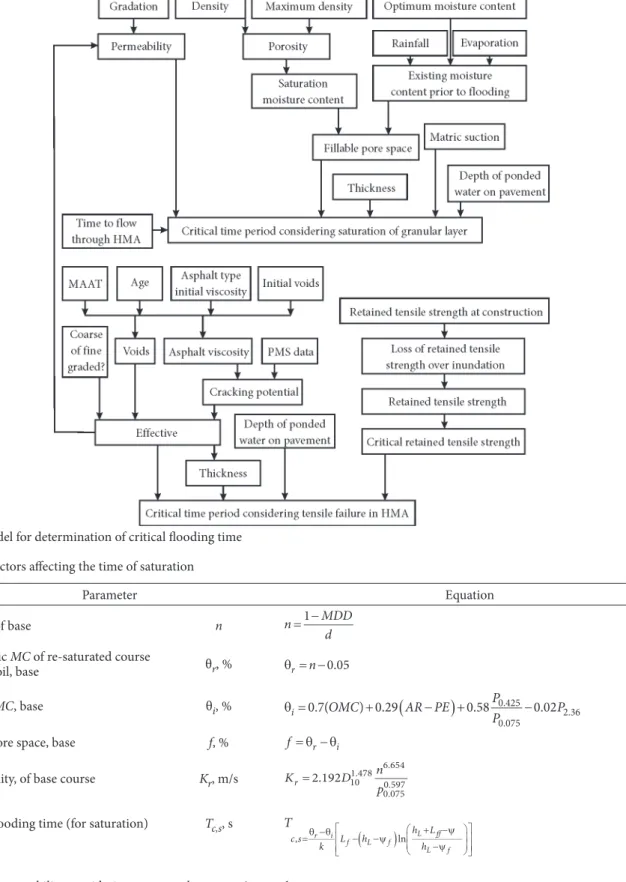
In general, materials of road construction are se-lected according to the agency specifications, which are developed on the basis of experience and with the con-sideration of locally available materials, and local clima-tic conditions. The key properties of the HMA layers are interdependent, and also change over time (are dynamic). Furthermore, the properties are also dependent on the distresses in the pavements; eg cracks in existing pave-ments significant increase the permeability and hence re-duce the flow time for saturation. The time for saturation and the potential of damage in HMA depend on materi-al and layer properties (Tables 1 and 2) as well as on the cracking potential of the mix, which is predicted from the aging potential of the mix, using the Global Aging System model (Brown et al. 2008; Green, Ampt 1911; Hubbard, Gollomb 1937; Ridgeway 1976). A system dynamics approach was adopted to develop an appropriate model and to run simulations that would allow to identify the effects of the different factors, and then to identify the more practical steps that could be taken to adapt these roadways to flooding. Fig. 1 shows the system dynamics model, and the simulation tool that was developed on the basis of this model (Mallick et al. 2015).
Fig. 1. Model for determination of critical flooding time
Table 1. Factors affecting the time of saturation
Parameter Equation
Porosity of base n (1)
Volumetric MC of re-saturated course
grained soil, base θr, % (2)
Existing MC, base θi, % (3)
Fillable pore space, base f, % (4)
Permeability, of base course Kr, m/s (5)
Critical flooding time (for saturation) Tc,s, s (6)
Effective permeability considering
HMA and base course layer keffective, m/s (7)
Retained tensile strength of HMA RTS(strengtht), % of dry (8)
Critical velocity of water for erosion (for coarse grained soil) which is
considered to be used in the base Vc, m/s (9)
2008) and with the consideration of existence (or absence) of cracks (Ridgeway 1976). The decrease in tensile strength in HMA (as a result of moisture damage has been modelled on the basis of published data by Choubane et al. (2000). Details of the model (models and simulations are available at: http://goo.gl/sBqJj0) are presented in Table 1.
3.2. Mitigation of impact of road building on the environment
A literature review (Frank et al. 2011) shows that energy consumption and emission of CO2, CO, SO2 and NOx (all of which can be quantified in terms of equivalent CO2) are the main concerns regarding the impact of the road build-ing industry on the environment. The problem of burn-ing of fuel and emission of gases has been recognized by the industry and agencies, and a number of potential solu-tions are becoming available for the reduction of emission. Many of these solutions are in the developmental stage, and may not be available at this time to users around the world. However, there are also some practical steps that are taken to reduce the amount of energy that is spent in the preparation of asphalt mix, and hence to cut down the amount of emissions. Based on a review of literature, this paper considers the following practical steps:
1. Reducing moisture in aggregate stockpile (Young 2007): an increase in the MC of the aggregates lead to the need for an increased amount of energy to drive off the excess moisture, since excess moisture in aggregates will lead to insufficient asphalt binder coating, and stripping damage in the field. Keeping the aggregate stockpiles un-der a cover, and/or in a dry place helps in reducing its MC. 2. Reducing heat loss during production: the amount of heat loss in the dryer drum, during the drying of the aggregates leads to wastage of fuel, and improvement in insulation of the drum results in significant savings in energy and reduction in emissions.
3. Reducing temperature of mix according NAPA Report Black and Green: Sustainable Asphalt, Now and Tomorrow of 2009, Young (2007) and Zaumanis (2014):
amount of emissions are directly proportional to the amount of energy that is utilized for the production of the mix. Hen-ce any reduction in temperature of production of the mix will lead to a significant drop in the emission. Such drop can be accomplished by either one of (a growing number of) Warm Mix Asphalt (WMA) technologies, which inclu-de the use of specialty products in relatively small amounts, and the use of foaming techniques with the addition of a small amount of water to the binder during mixing.
Using gas fuel versus liquid fuel (Myers et al. 2000): use of gas fuels generally results in reduction in emissions, especially with respect to SO2 and NOx.
Reducing the amount of mix per km of pavement (Carbon Trust 2010): a thicker layer requires a greater amount of mix and hence results in a greater amount of energy usage and a greater amount of emissions. Hence, a reduction in the amount of mix for both maintenance and rehabilitation work leads to a reduction in the amount of energy that is utilized and hence the amount of emissions.
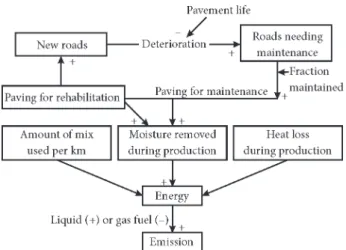
Using these five parameters as variables, a system dynamics model (models and simulations are available at: http://goo.gl/HbbPh0) was created and simulated for different values. The model is shown in Fig. 2.
Table 2. Determination of KHMA and KHMAcracked
Gradation of the
surface course Air voids,
Permeability of uncracked HMA by Brown et al. (2008),
Permeability of cracked HMA,
Permeability of cracks
by Ridgeway (1976),
V, % KHMA, 10–5 cm/s KHMAcracked, cm/s KCr, m/day/m Coarse, <40% passing
the 2.36 mm sieve V(t) (10)* (12)* 0.223 mRate of infiltration is 3/day/m; considering 12.5 mm wide crack is
2.06⋅10–4 Fine, >40% passing
the 2.36 mm sieve V(t) (11)*
Note: *equations derived by authors; MDD − modified maxm density, t/m3; d − density, t/m3s; OMC − Optimum Moisture Content, %; AR − Annual
Rain-fall, m; PE − Potential Evaporation, m; P0.425 − % finer than 0.425 mm; P2.36 − % finer than 2.36 mm; P0.075 − % finer than 0.075 mm; Tc − critical flooding time (for saturation); D10 and D50 − grain size at 10% and 50% passing, respectively, mm; Lf − thickness of (HMA + base course), m; Ψf − suction, m; hL − depth of ponded water, m; keffective − effective permeability in m/s; hHMA − thickness of HMA, m; hbase − thickness of base course, m; kHMA − permeability of HMA, m/s; kbase − permeability of base course, m/s; RTS(t) − Retained Tensile Strength at any time t, %; RTS(i) – Initial Tensile Strength (at construc-tion), %; RRTS − rate of change (deterioration) in Retained Tensile Strength, % per unit of time (year); t − time at which the retained tensile strength is determined, year; (t) − indicates time dependent.
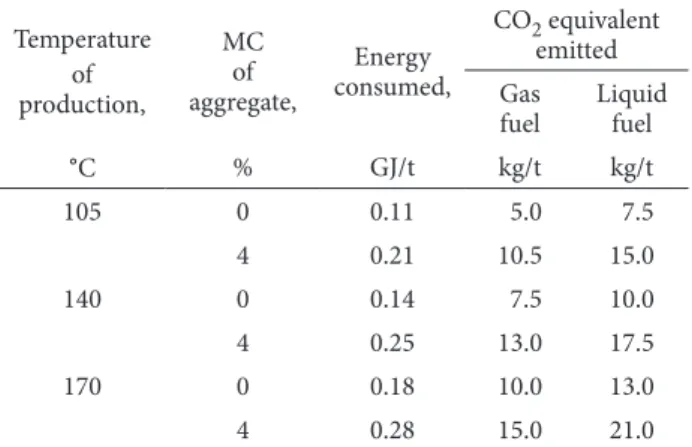
The energy consumed and CO2 equivalent generated because of new road construction/rehabilitation and main-tenance have been predicted using existing data (West et al. 2014) for two types of fuel (liquid and gas), mixes produced at different temperatures, different percentages of moisture
in aggregates, and different percentages of heat loss during the production of HMA. Variables include the fraction of the network that is maintained every year, authorized reha-bilitations per year and the average pavement life.
The relevant data are shown in Table 3 (West et al. 2014). The data were utilized to developed regression mo-dels that were used in the system dynamics model. 4. Why system dynamics?
A changing climate impacts the roadways in a very compli-cated way by affecting multiple interrelated factors. Con-sidering the case of flooding, eg a rise in maximum tem-perature will lead to an increased rate of aging of the asphalt binder, which will result in premature aging and cracks in the pavement. These cracks will increase the rate of flow of water through the surface layer to the unbound layer, and this, with the increased potential of flooding due to climate change, will lead to an increase in the vulnerability of the pavement. At the same time, it is also true that an increase in maximum temperature would lead to a drop in Vof the surface layer (due to increased compaction) and would re-duce the permeability of the surface layer (in the wheel path areas, for uncracked sections) over time. As is noted in the NCHRP Report Guide for Mechanistic-Empirical Design. Design Inputs of 2003 the change in voids will also have an effect on the aging of the binder, since mixes with a higher voids content would tent to experience a higher rate of oxi-dation and hence aging of the binder. Lastly, these changes are nonlinear in nature, and because of the interdepend-ence of various factors, the results could be counterintui-tive and a straightforward model (or an analytical solution) could not be formulated. Furthermore, for some issues such as emissions from road construction, the impacts of various steps need to be evaluated over a long period of time, to determine the best approach. Simulation is the best approach for evaluating such systems, and a complex time dependent system can be best simulated using the system dynamics approach (Forrester 1971), which does consider the dynamics of interactions between several factors, and helps the user to visualize changes over the long term. Sys-tem dynamics also allows the consideration of feedback loops, which affect a process to a significant extent, and also lead to counterintuitive results, and it has been utilized by many researchers to determine impacts of policy changes in critical areas such as energy, growth, resources and cli-mate changes (Mallick et al. 2014; Sterman 2012).
5. Results of simulation
For both system dynamics models described above, simula-tions were carried out with different scenarios. Specifically, the levels of the different variables were changed and the changes in the critical time of flooding (for the vulnerabil-ity study) and the energy consumption and CO2 generation (for the mitigation part of the study) were determined. 5.1. Vulnerability to flooding
As seen in Fig. 3, the critical period for a pavement, with respect to vulnerability to flooding, is the one that is im-mediately after construction, when the voids are relatively
Table 3. Data for model (from information presented in West et al. (2014))
Temperature of production,
MC of aggregate,
Energy consumed,
CO2 equivalent emitted Gas
fuel Liquid fuel °C % GJ/t kg/t kg/t
105 0 0.11 5.0 7.5
4 0.21 10.5 15.0
140 0 0.14 7.5 10.0
4 0.25 13.0 17.5
170 0 0.18 10.0 13.0
4 0.28 15.0 21.0
Note: 1. Regression equation relating temperature of production (T) and
MC to energy (E) consumed: = –0.005 + 0.001(T) + 0.026(MC). 2. Regression equation relating CO2 equivalent (CO2 eq, gas) to energy (E) for gas fuel: CO2 eq: gas = –0.630 + 55.37E. 3. Regression equation relating CO2 equivalent (CO2 eq, liquid) to energy (E) for liquid fuel: CO2 eq: liquid = –0.800 + 75.895E. 4. A 12% heat loss is assumed in these calcu-lations. For un-insulated dryers the heat loss (HL, %) will be higher and the energy consumption and the resultant heat CO2 eq will also be higher, as follows: = [–0.005 + 0.001(T) + 0.026(MC)][1 + 0.01(HL – 12)].
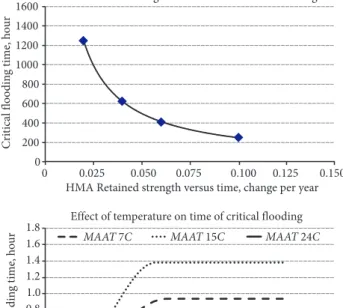
high, and have not been reduced by traffic compaction. During this period the base course gets saturated very quickly (very low critical time (Tc,s). This Tc,s will increase over time, with a decrease in voids and consequence de-crease in the permeability of the HMA; however, areas in between wheel paths and in shoulder areas will still re-main at high V and hence vulnerable. Hence, the best op-tion is to provide a very dense (low V) layer in pavements that are in flood prone areas. Such low V provided with the use of finer gradations, and/or specialized seals which consist or not consist of geosynthetic layers (Brown et al. 2008). TheTc,s also is decreased by increasing the thick-ness of the HMA as well as the base layer, and with the use of a HMA mix that has a low deterioration rate of tensile strength over time (Fig. 4). With an increase in age of the pavement, the potential of cracking increases. Cracked pavements have significantly higher permeability com-pared to untracked pavements, and hence a significantly lower Tc,s. Therefore, with time, the vulnerability of as-phalt pavements increases, and unless cracks are sealed or old pavements are resurfaced, the base layer gets saturated very quickly. The potential of cracking depends on a num-ber of factors including the Mean Annual Air Tempera-ture (MAAT, °C) of the location, and is reduced by using lower viscosity asphalt and lower initial V for any specific MAAT. Generally, as is noted in the NCHRP Report Guide for Mechanistic-Empirical Design. Design Inputs of 2003 higher the MAAT, greater is the degree of compaction, but also greater is the increase in viscosity by aging of the asphalt, and higher is the risk of cracking (as the binder reaches the critical viscosity sooner. Fig. 4 shows the Tc,s for three MAATs – 7 °C, 15 °C and 24 °C, for an initial V of 8%. The Tc,s is higher for 15 °C compared to that of the 7 °C as the higher temperature facilitates compaction and causes a greater drop in V and a consequent greater drop in permeability. However, at 24 °C, the higher tem-perature facilitates the aging of the asphalt binder o such an extent, that very quickly the binder viscosity reaches a critical level at which cracking is expected (Hubbard, Gollomb 1937), and hence there is drop in the Tc,s. Hence, pavements in flood prone areas, particularly in warm cli-matic conditions, must be maintained adequately through the use of proper crack filling/sealing and surfacing.
Examples of the results of simulations in terms of normalized Tc,s and parameter values are presented in Fig. 5. The time of saturation of the base course (and hence failure of the pavement due to flooding) is seen to be affec-ted by different factors, to different degrees, and an agency selects its most cost effective option. In terms of efficien-cy of reducing the potential of damage (by increasing the time of saturation), the factors are listed as follows (from increasing to decreasing effects):
HMA layer: −air voids (V);
−gradation (coarse or fine); −thickness;
−cracking;
−tensile strength loss. Base layer:
−thickness; −matric suction.
Embankments near flowing steams:
−provide riprap to protect from erosion (simula-tion shows very low Tc,s for soil embankments near streams);
−the highway agency determines the required Tc,s
and determine the most cost effective measure that it takes to prevent damage during flooding. 5.2. Mitigation of impact
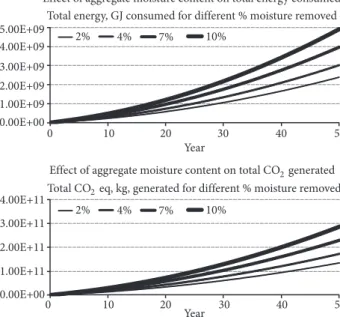
Examples of results of simulations are shown in Figs 6 and 7, in terms of percent moisture removed and pave-ment life, respectively. It is observed that total amount of energy consumed and emissions increase nonlinearly over time, the differences may not be discernible in the immediate future but are significant in the long run, and
Fig. 4. Effects of retained strength and MAAT on Tc,s
that the effects of the different factors (reducing tempera-ture, heat loss and MC) on the energy consumption/emis-sions are of different levels. The normalized amount of en-ergy consumed (and CO2 equivalent produced) versus the normalized changes in the different factors are shown in Fig. 8. It is seen that the effect of MC in aggregates and the amount of mix used for rehabilitation and maintenance and rehabilitation are greater than the effect of reduction in temperature and heat loss. These points out some im-portant practical steps that could be taken immediately even if sophisticated techniques for lowering the tempera-ture of mix are not available. Two such steps are:
−keep aggregates dry by keeping them under shed (and protecting them from rainfall, methods de-scribed in (West et al. 2012);
−utilize recycling as much as possible to reduce the use of new materials and mixes.
Of the various recycling techniques that are availa-ble (Zaumanis, Mallick 2015), those requiring no or re-duced heating of aggregates (cold recycling) should be given preference. Wherever the use of new mixes is una-voidable, newly available techniques must be adopted to reduce their temperatures. Finally, the amount of heat loss (through dryer drums and ductwork) should be minimi-zed with the use of proper insulations, wherever possible.
Note that the results are dependent on how many km of roads are rehabilitated and maintained per year, and the pavement life. Depending on the specific values of these variables, highway agencies experiment with dif-ferent techniques and determine the most cost effective option. One direct way of decreasing the amount of en-ergy consumed/emissions is by enhancing the longevity of the pavements, so that the pavement life is increased, and the amount of maintenance/rehabilitation work is re-duced. One important topic to note is that the model is improved significantly by incorporating the changes in the average pavement life that is anticipated for the changes in the temperature of the mix that is used for paving the layers; at this time, due to lack of sufficient published data, the lives have been considered to be the same. So eg if the use of a lower temperature actually results in a mix with a longer life (because of less oxidation of the asphalt binder during production) then the positive effect of the lowering of temperature will be more significant than what is illus-trated here. Note that the mixes considered here are hot and WMA, and not cold mix asphalt.
The models presented here should be considered as part of a framework, which is improved significantly and calibrated for local conditions/materials/structures with pertinent data.
6. Limitations
This paper considers the energy consumption and CO2 emissions from only part of the processes that are involved in road construction. In the next version of the model, the effects of such steps as transportation and end of life con-struction will be included. Furthermore, the model will also be upgraded to include the effects of land use change on the total impact of emissions – it is expected that as
Fig. 6. Effect of moisture removed (from mix)
Fig. 7. Effect of pavement life
more trees are cut down for making roads, the CO2 ab-sorption ability of the land will be reduced.
7. Summary
The objectives of this paper were to present frameworks for the adaptation to and mitigation of effects of climate changes for roadway pavements and suggest some practi-cal beneficial steps that could be taken at this time. The objectives were achieved through the development of two comprehensive models that allow the simulation of the ef-fect of different relevant factors over a long period of time (50 years). The two models are related to the adaptation of pavements to make them resilient to the effects of flood-ing (which may increase as a result of climate change), and to the reduction in the amount of energy and emis-sions that contribute to climate change. Since many of the factors are interrelated and also dependent on time, sys-tem dynamics was selected as an appropriate method, and utilized, for the construction of the models. The simula-tions demonstrated the overall effects of the different fac-tors, and also helped in the ranking of the different factors in terms of their effectiveness.
8. Conclusions
For roadways that are likely to get flooded, the following steps could be taken to make them flood resistant, help the agencies/public to be able to utilize the roads during and immediately after flooding for emergency and non-emer-gency needs, and avoids costly repairs.
1. Reduce the permeability of the surface layer through a reduction of the air voids: this could be accom-plished by using a suitable number of rollers, appropriate (fine) mix, closer quality control, and/or through the ap-plication of a binder rich surface seal; reduction of initial voids from 10% to 6% can increase the critical flooding time by seven times.
2. Provide a thicker surface layer to protect the un-derlying granular base course; an increase in surface layer thickness from 30 mm to 200 mm increases the critical flooding time by six times.
3. Use appropriate materials to prevent cracking of the surface layer, and seal cracks on a regular basis, espe-cially prior to flooding seasons.
4. Protect embankments from erosion by providing riprap near flowing streams.
5. To reduce the negative impact of road construction, with respect to energy consumption and emission, the fol-lowing steps are suggested:
−store aggregates under covers or sheds to avoid the increase in moisture content due to rainfall; a de-crease in moisture content from 10% to 4% reduces the energy consumption by 40%;
−reduce heat losses from dryer drums and ductwork through proper insulation; a reduction of heat loss from 5% to 3% result in an energy savings of 28%; −reduce temperature of new mixes, with the
adop-tion of new Warm Mix Asphalt technology; a re-duction in temperature from 160 °C to 120 °C will
result in a savings of a significant amount of energy (0.5·109 GJ, over the course of 60 years);
−utilize materials and methods to enhance the life of the pavements such that fewer maintenance cycles would be required.
References
Briaud, J. L. 2008. Case Histories in Soil and Rock Erosion: Woodrow Wilson Bridge, Brazos River Meander, Normandy Cliffs, and New Orleans Levees, Journal of Geotechnical and Geoenvironmental Engineering 134(10): 1425−1447.
http://dx.doi.org/10.1061/(ASCE)1090-0241(2008)134:10(1425)
Brown, E. R.; Hainin, M. R.; Cooley, A.; Hurley, G. 2008. Rela-tionship of HMA in-Place Air Voids, Lift Thickness, and Per-meability. Vol. 3. NCHRP Web Document 68 (Project 9−27). Transportation Research Board, Washington, D.C. 47 p. Carrera, A.; Dawson, A.; Stege, J. 2009. Report Nr 2 – State of
the Art of Materials’ Sensitivity to Moisture Change. Project: P2R2C2 − Material Sensitivity to Moisture Change. Univer-sity of Nottingham, UK. 38 p.
Choubane, B.; Page, G. C.; Musselman, J. A. 2000. Effects of Different Water Saturation Levels on the Resistance of Compacted HMA Samples to Moisture Induced Damage, Transportation Research Record 723: 97−106.
http://dx.doi.org/10.3141/1723-13
Forrester, J. W. 1971. World Dynamics. Cambridge: Wright-Al-len Press. 142 p.
Frank, B.; Brian, P. D.; Hurley, G. C.; West, R. C. 2011. Warm Mix Asphalt (WMA) Emission Reductions and Energy Savings, in Proc. of the2nd International Conference on Warm Mix As-phalt: Papers and Speakers Presentation, 11−13 October 2011, St. Louis, Missouri, USA.
Fuglestvedt, J.; Berntsen T.; Myhre G.; Rypdal, K.; Skeie, R. B. 2008. Climate Forcing from the Transport Sectors, PNAS
105(2): 454−458. http://dx.doi.org/10.1073/pnas.0702958104
Green, W. H.; Ampt, G. A. 1911. Studies of Soil Physics, Part I – the Flow of Air and Water through Soils, The Journal of Agri-cultural Science 4(1): 1−24.
http://dx.doi.org/10.1017/S0021859600001441
Hubbard, P.; Gollomb, H. 1937. The Hardening of Asphalt with Relation to Development of Cracks in Asphalt Pavements,
Journal of the Association of the Asphalt Paving Technologists
9: 165−194.
Mallick, R. B.; Tao, M.; Daniel, J. S.; Jacobs, J.; Veeraragavan, A. 2015. Development of a Methodology and a Tool for the As-sessment of Vulnerability of Roadways to Flood-Induced Damage, Journal of Flood Risk Management. 13 p.
http://dx.doi.org/10.1111/jfr3.12135
Mallick, R. B.; Radzicki, M.; Zaumanis, M.; Frank, R. 2014. Use of System Dynamics for Proper Conservation and Recycling of Aggregates for Sustainable Road Constructions, Resources, Conservation and Recycling 86: 61−73.
http://dx.doi.org/10.1016/j.resconrec.2014.02.006
Melillo, J. M.; Richmond, T. C.; Yohe, G. W. 2014. Climate Change Impacts in the United States: the Third National Climate Assess-ment. U.S. Global Change Research Program. 841 p.
Myers, R.; Shrager, B.; Brooks, G. 2000. Hot Mix Asphalt Plants Emission Assessment Report. Report No. EPA-454/R-00-019. National Asphalt Pavement Association, North Carolina, USA. 46 p.
West, R.; Rodenzo, C.; Grand, J.; Prowell, B.; Frank, B.; Osborne, L. V.; Kriech, T. 2014. Field Performance of Warm Mix Asphalt Technologies. NCHRP Report 779. Transportation Research Board, Washington, D.C. 255 p.
Ridgeway, H. H. 1976. Infiltration of Water through the Pave-ment Surface (AbridgePave-ment), Transportation Research Record
616: 98–100.
Sterman, J. D. 2012. Sustaining Sustainability: Creating a Systems Science in a Fragmented Academy and Polarized World, in M. P. Weinstein, E. R. Turner (Eds.). Sustainability Science: the Emerging Paradigm and the Urban Environment. Springer, 21−58. http://dx.doi.org/10.1007/978-1-4614-3188-6_2
Vidal, R.; Moliner, E.; Martinez, G.; Rubio, M. C. 2013. Life Cycle Assessment of Hot Mix Asphalt and Zeolite-Based Warm Mix
Asphalt with Reclaimed Asphalt Pavement, Resources, Con-servation and Recycling 74: 101−114.
http://dx.doi.org/10.1016/j.resconrec.2013.02.018
Young, T. J. 2007. Energy Conservation in Hot-Mix Asphalt Pro-duction. Quality Improvement Series 126. National Asphalt Pavement Association, Lunham, Maryland, USA. 32 p. Zaumanis, M.; Mallick, R. 2015. Review of Very High Content
Reclaimed Asphalt Use in Plant Produced Pavements: State-of-the-Art, International Journal of Pavement Engineering
16(1): 39−55.http://dx.doi.org/10.1080/10298436.2014.893331
Zaumanis, M. 2014. Warm Mix Aspahlt, in K. Gopalakrishnan, W. Steyn, J. Harvey. Climate Change, Energy, Sustainability and Pavements. Berlin: Springer-Verlag. 309−334.
http://dx.doi.org/10.1007/978-3-662-44719-2_10