c
⃝T ¨UB˙ITAK
doi:10.3906/elk-1207-102 h t t p : / / j o u r n a l s . t u b i t a k . g o v . t r / e l e k t r i k /
Research Article
Efficient ID-based authentication and key agreement protocols for the session
initiation protocol
Hacı Hakan KILINC¸1,∗, Yolguly ALLABERD˙IYEV2, Tu˘grul YANIK3, Serdar S¨uer ERDEM1
1Department of Electronics Engineering, Gebze Institute of Technology, Gebze, Kocaeli, Turkey 2
Department of Computer Engineering, Fatih University, B¨uy¨uk¸cekme¸ce, ˙Istanbul, Turkey 3Department of Computer Engineering, Celal Bayar University, Muradiye, Manisa, Turkey
Received: 25.07.2012 • Accepted: 18.04.2013 • Published Online: 23.02.2015 • Printed: 20.03.2015 Abstract:In a widely deployed VoIP system tens of thousands of clients compete for the SIP proxy server’s authentication service. SIP protocol implementations have to meet certain QoS and security requirements. In this study new ID-based protocols are proposed for the SIP authentication and key agreement protocols. These protocols minimize the use of expensive pairing functions but still resist notable attacks. The security of the proposed protocols are analyzed and demonstrated with security proofs based on the BJM security model. Finally, the performance overhead of the proposed protocols are compared to ID-based SIP authentication and key agreement protocols given in the literature.
Key words: SIP, ID-based cryptography, authentication, key agreement
1. Introduction
Session Initiation Protocol (SIP) is designed to manage communication sessions such as audio and video transmissions through the Internet. The protocol can be used to create, modify, and terminate sessions among multiple parties. SIP is accepted as a 3GPP signaling protocol and a part of the IP Multimedia Subsystem (IMS) architecture [1].
Despite its benefits, SIP is subject to various security threats [2, 3]. Dantu et al. [4] studied the security problems of the VoIP infrastructure and presented features necessary for high level security at different levels. This study demonstrated that an effective authentication protocol is indispensable for almost all network components. Therefore, fortifying the SIP proxy with a secure and efficient SIP authentication and key agreement mechanism is of key importance.
SIP uses an authentication scheme that relies on HTTP Digest Authentication[5]. The HTTP Digest Authentication is vulnerable to server spoofing and offline password guessing attacks. To avoid these attacks, various authentication and key agreement schemes were proposed. These schemes can be categorized as Password Authenticated Key Exchange (PAKE)-based schemes [6,7,8,9], hash and encryption-based shemes [10,11,12], public key cryptosystem (PKC)-based schemes that include RSA and elliptic curve cryptography (ECC) [13,14], and ID-based schemes[15, 16, 17,18, 19]. Each category presents different tradeoffs between performance and security.
Hash and encryption-based schemes offer high performance but can be vulnerable to a number of security attacks such as spoofing and offline password guessing attacks. Usually PAKE-based schemes have slightly
higher computational costs than hash and encryption-based schemes. When designed properly they can resists spoofing and offline password guessing attacks. PKC-based schemes have much higher computational costs but eliminate the need of a preshared password. When fortified with a robust public key infrastructure (PKI), secure authentication schemes can be designed. Compared to the previous categories ID-based schemes have the highest computational cost, but they eliminate the costly PKI infrastructure and offer comparable security, which can be preferable to PKC-based schemes.
This study focuses on authentication protocols that employ ID-based cryptography. In an ID-based cryptosystem, the public keys can be chosen as arbitrary strings, which can be unique identifiers such as email addresses. There is no need to associate a user’s identity to a public key using a certificate. The private key generator (PKG), a trusted third party, authorizes the public key and calculates the associated private key for each user. The PKG publishes a set of authenticated public system parameters as well. To verify a signature or send an encrypted message, only the signer’s identity or receiver’s identity and the system parameters are required. For a user, obtaining and authenticating the system parameters is a one-time process. In traditional PKCs each user needs to validate a certificate, which can involve the verification of a certificate path if multiple certificate authorities are present. Furthermore, in a traditional PKC, each user needs to maintain a public key directory for other users, which is not necessary in ID-based cryptosystems.
The heavy computational cost of the bilinear pairing function, the fact that the PKG knows the private keys of the users, and the need for a secure channel to transfer private keys to the users are drawbacks of ID-based SIP authentication schemes. The proposed ID-based SIP authentication and key agreement schemes in the literature greatly suffer from high computational costs caused by the multiple use of bilinear pairing functions. These schemes can resist most attacks, but not collusion attacks. Since the private keys are known by the PKG, it can share sensitive information with other parties causing collusion attacks.
In this study, we propose specific ID-based authentication and key agreement schemes for client-to-server and client-to-client communication that have significantly better performances compared to previously proposed ID-based authentication and key agreement schemes. In addition, we show that the schemes we propose are provably secure according to the BJM security model.
The next section explains the related work. Section 3gives background information about the proposed protocols. Section4explains proposed protocols and security proofs. Section5 evaluates the performance and security of the proposed protocols and compares them to the ID-based SIP authentication protocols proposed in the literature respectively. Section6concludes the paper. The Appendix includes the message flow diagrams of the schemes compared in this work.
2. Related work
In the literature, several schemes have been proposed for SIP authentication and key agreement. Authentication and key agreement schemes based on ID-based cryptosystems are more recent and provide some advantages compared to the PKC-based and ECC-based schemes that were mentioned in Section 1. In this section, we will examine the proposed SIP authentication schemes based on ID-based cryptography.
Ring et al. [15] proposed an authentication scheme that relies on ID-based signatures and time-dependent nonce values. This scheme consists of 2 parts: the authentication part and the key agreement part. For the key agreement part the modified ID-based protocol of Chen and Kudla[20] was proposed. To realize this scheme an additional signature field in the standard existing authentication protocol is needed. The ID-based signature scheme requires the computation of multiple pairing functions and point multiplication, which cause significant computational overhead and delay.
Ring et al. did not specify the signature scheme for the authentication, whereas Han et al. [16] proposed to use a combination of Hess’s ID-based signature scheme[21]. To decrease the delay for session key generation in the key establishment part, the one-way authenticated ID-based key agreement protocol of Okamoto et al. [22] was proposed. This protocol reduces the computational overhead compared to Ring et al.’s 2-way key agreement scheme. Each party can compute the session key simultaneously using bilinear pairing rules. Due to multiple pairing computations, the computational cost is significant. A collusion attack is also applicable.
Patil and Willis [23] proposed authentication protocols using the ID-based signature and signcryption schemes. The authors use the “Identity” and “Identity-Info” fields that are defined in RFC 4474 for authenti-cation purposes. Although an RSA-based signature scheme is recommended in RFC 4474, the authors propose ID-based signature and signcryption schemes and compare the proposed schemes to an RSA-based scheme. The purpose of the signcryption schemes is to achieve authenticity and confidentiality together. The authors propose different ID-based signature and signcryption schemes for single and hierarchical domain environments.
Wang and Zhang [17] proposed a secure mutual authentication and key agreement (SAKA) protocol that relies on certificateless public key cryptography (CL-PKC), which was established by Al-Riyami and Paterson[24]. This scheme consists of the system initiation and the authentication and key agreement stages. The authors acknowledged their contribution as the removal of the key escrow feature and support for interdo-main peer-to-peer connections where clients in different dointerdo-mains can communicate directly. In this scheme, the key generation center (KGC), which is a variation of the PKG, does not know the private keys of the clients. A security proof based on the CK-Model was provided.
Kilinc et al. [18] replaced the standard HTTP Digest Authentication with the ID-based signature schemes of Choon and Cheon[25]. In this comparative study, real performance data of the proposed schemes were obtained by using the Pairing Based Cryptography (PBC) Library[26] to implement the proposed schemes into an SIP proxy server (OpenSIPs[27]), which is open source.
Ni et al. [19] proposed an ID-based authenticated key agreement mechanism relying on a signature scheme. The scheme is based on ECC and does not require the computation of a pairing function. The proposed mechanism employs the CL-PKC method to construct a secret key, which is only known by the client side, avoiding the key escrow problem. To sign and verify, a set of parameters are needed, where the identity is one of them. To calculate the client’s and server’s public key an identity-based public key building parameter is sent by the related party. This scheme and its performance falls between the traditional PKC and the ID-based cryptography.
3. Background information 3.1. SIP summary
SIP is a signaling and application-layer control protocol commonly used for VoIP communication. The tradi-tional SIP architecture is a client-server architecture. The general idea of SIP is to establish sessions among different user agents on any Internet platform. SIP networks includes 5 kinds of logical entities such as user agents, registrar servers, proxy servers, location servers, and redirect servers. The user agents are the end users, which generate or receive SIP messages. The SIP proxy server is an intermediate entity that can hold session information and redirect SIP messages to other proxy servers or user agents.
SIP security mechanisms can be categorized as hop-by-hop and end-to-end mechanisms. TLS, which is a transport layer security mechanism, and IPsec, which is a network layer security mechanism, are hop-by-hop security mechanisms. S/MIME and the HTTP Digest Authentication are end-to-end security mechanisms. For
media security, the Secure Real-Time Transport Protocol (SRTP) and the Datagram Transport Layer Security (DTLS) protocol are used.
3.2. Identity-based cryptosystem
The ID-based cryptography concept was first suggested by Shamir in 1984[28]. The ID-based cryptosystem includes ID-based encryption (IBE) and ID-based signature (IBS). The essential idea is to set the public key to an arbitrary string. An IP address, an e-mail address, or different types of identities can be assigned as a public key for a user or a node. Public keys are derived from a user identifier. The main purpose is the elimination of the public key distribution infrastructure and certificate management. The private key based on the public key is calculated by the PKG, which is recognized as a trusted third party. After that, the PKG uses a secure channel to submit the private key to the client.
The first usable IBE schemes were realized by Boneh and Franklin in 2001. They used elliptic curve cryptography and Weil pairings on elliptic curves[29]. Following this work many IBE and IBS schemes such as Hess and Cha-Cheon algorithms were proposed.
Weil pairing is realized by mapping 2 points of group G1 on elliptic curve E(Fq) to the finite field Fq.
Some of the very practical features of Weil pairing can be summarized as follows: 1. Bilinearity: ∀P, Q, R∈G1,
e:G1×G1→G2
e(aP, bQ) =e(bP, aQ) =e(P, Q)ab , e(P+Q, R) =e(P, R)e(Q, R) , and e(P, Q+R) =e(P, Q)e(P, R) ; 2. Nondegeneracy:
e(P, Q) = 1 , for all Q∈G1, iff P =O, where O is point at infinity
3. Computability:∀P, Q∈G1, the computation of the function e(P, Q) is efficient.
3.3. The BJM security model
The work of Chen and Kudla adapted the security model proposed by Blake-Wilson et al.[30] (BJM security model) to the identity-based setting. The security model proposed by Blake-Wilson et al. was adapted to the public key setting from the security model initially proposed by Bellare and Rogaway [31]. In this work the security proofs of the identity-based authentication protocols will rely on Chen and Kudla’s BJM security model adaptation.
The BJM security model consists of a set of participants denoted by U and an adversary denoted by E. The participants are modeled by oracles denoted by Πn
I,J, where participant I believes that it is conducting
a protocol session with participant J for thenth time. The oracles answer queries by receiving and sending messages, which are recorded to transcripts. The adversary is modeled by a probabilistic polynomial time Turing machine and can conduct certain queries on all oracles, which consist of the participant’s oracles and random oracles. The adversary has control over the communications and can rely, modify, delay, interleave, or delete messages. The participant oracles can communicate only through the adversaries’ queries.
To define the groups G1,G2 and the bilinear map e, and to assign a long-term master key to the PKG, a setup algorithm is deployed. For each participant the PKG will calculate the private key based on the public key, which is related to the participant’s identifier.
The adversary can conduct the following queries:
• Create: Using this query adversary E can create and setup a new participant. The public key of the participant will be obtained from the identity. The PKG will generate a private key using this public key. An oracle that will model the participant will be created as well. The adversary will obtain the public key of the participant.
• Send: The adversary E can use this query to send a message to an oracle. If the receiving oracle is ΠnI,J, it will assume that the message was sent by participant J. The adversary can send a special message λ, which will instruct the oracle to initiate a session with participantJ. An oracle becomes an initiator or a responder oracle according to the first message it receives.
• Reveal: The adversary uses this query to ask an oracle to reveal the session key it holds.
• Corrupt: Using this query, the adversary asks an oracle to reveal the long-term private key it is holding. Before explaining the test query, which is the last query, the states of an oracle should be explained. According to the BJM security model an oracle can be in the accepted state, rejected state, * state, opened
state, or corrupted state. To reach the accepted state an oracle has received proper messages, is holding a session key, and decides to accept. Therejected state is reached when an oracle has decided to abort the session without establishing a session key. The * state means that no decision is reached yet. The opened state is reached when the oracle has answered a reveal query. Finally, the corrupted state is reached when the oracle has answered a corrupt query.
When 2 oracles reach the accepted state receiving proper messages generated by the communicating oracle, where one of the oracles is an initiator oracle, they have had a matching conversation[31].
• Test: A test query is actually used to model an attack. After creating participants and initiating and conducting sessions among participants, the adversary can ask a single test query to an oracle ΠnI,J that has accepted and is unopened where none of the participants I or J have been corrupted. In addition, there should be no oracle Πt
J,I that had a matching conversation and is opened. The oracle receiving the
test query should flip a fair coin denoted by b∈0,1 . If b= 0 the oracle should return the session key it is holding; otherwise, it should return a k-bit random key. The adversaryE should output b′ as its guess to b. The function AdvantageE(k) is the probability the adversary has in distinguishing the session key from a random string. It is defined as:
AdvantageE(k) =|P r[b′ =b]1/2|.
As stated in [30] an authenticated key agreement protocol (AK protocol) is a key agreement protocol where both parties are assured that no other party can possibly compute the key agreed upon. However, if both parties want to make sure that each party actually computed the key agreed upon, a key confirmation part should be included. Such a protocol is called an authenticated key agreement with key confirmation (AKC protocol).
• Definition 1: A protocol is an AK protocol if:
1. In the presence of the benign adversary on ∏ni,j and ∏tj,i both oracles always accept holding the same session key, and this key is distributed uniformly at random on {0,1}k; and if for every adversary E.
2. If uncorrupted oracles ∏ni,j and ∏tj,i have matching conversations then both oracles accept and hold the same session key.
3. AdvantageE(k) is negligible.
According to the BJM security model an AKC protocol is secure ifDefinition 2 given below is met.
• Definition 2: A protocol is an AKC protocol if the first 3 conditions of Definition 1 and the below condition are satisfied.
1. The probability of N o−M atchingE(k) is negligible.
N o−M atchingE(k) as the additional condition inDefinition 2 denotes the event where an uncorrupted oracle ΠnI,J has accepted under the attack of adversary E but there is no other uncorrupted oracle ΠtJ,I that had a matching conversation with it.
3.4. Security features
AK and AKC protocols should have the following security features:
• Known-key security: A protocol is secure against known-key attack when the adversary cannot compromise a shared key knowing several shared keys of past sessions.
• Forward secrecy: A protocol has the forward secrecy feature if the adversary cannot obtain the previous shared keys by compromising the long-term private keys of multiple parties. This definition can be expressed as partial forward security if the compromise of some parties’ long-term private keys cannot reveal any previously shared key or extended to perfect forward secrecy if the compromise of all parties’ long-term private keys cannot reveal any previously shared key.
• Ephemeral key reveal resilience: The ephemeral key reveal can be realized when a revealed short-term key (random key) can be used to obtain the shared key of that session.
• Key compromise impersonation resilience: The key compromise impersonation attack is applicable if the long-term key of a valid entity is compromised and with that entity the adversary can establish a session key by masquerading as another party [32].
• Unknown key share resilience: A party should not be persuaded into calculating a shared key with another party that masquerades as another party. A man-in-the-middle attack is conducted to achieve such a goal with both parties that want to communicate with each other.
4. Proposed protocols and their security analysis 4.1. Assumptions
There are some assumptions and common parameters for the proposed protocols.
• All parties use the same elliptic curve parameters, and all private keys are stored in secure environments.
• SIP servers have the functionality of a PKG, which produces public/private key pairs and is trusted by all entities in the system.
• The bilinear function e, H1, H2, Ppub, P, and some group parameters are published by the PKG. • Both the client and server should agree on the following system parameters:
– Cyclic groups (G1,+) and (G2, .) , which have the same prime order l. – P ∈E(F q) is the generator point of the group G1.
– IDS is identity of the server.
– s is the private key of the PKG.
– Ppub is the public key of the PKG.
– e:G1×G1→G2 is a pairing function with bilinearity and nondegeneracy properties. – IDA is the identity of Alice.
– QA ( = H1(IDA) ) is the public key of Alice.
– SA ( = sQA) is the private key of Alice.
– IDB is the identity of Bob.
– QB ( = H1(IDB) ) is the public key of Bob.
– SB ( = sQB) is the private key of Bob.
– F(.) is a one-way hash function.
– F∗(.) is another one-way hash function used to obtain the shared secret key.
4.2. Protocols and security analysis
We propose 3 ID-based authentication and key agreement protocols that target client-to-server (Protocol I and Protocol II) and client-to-client (Protocol III) communications. The main difference between Protocol I and II is the use of the pairing function. The proposed protocols provide various security features. In Section 4.3, we will give a formal security proof based on the BJM security model for the proposed protocols. The BJM model does not allow the adversary to ask test queries to corrupted oracles. Therefore, the security model cannot model the key compromise impersonation attack and the forward secrecy properties. In this section we will explain the proposed protocols and conduct their security analysis based on heuristic arguments. We will
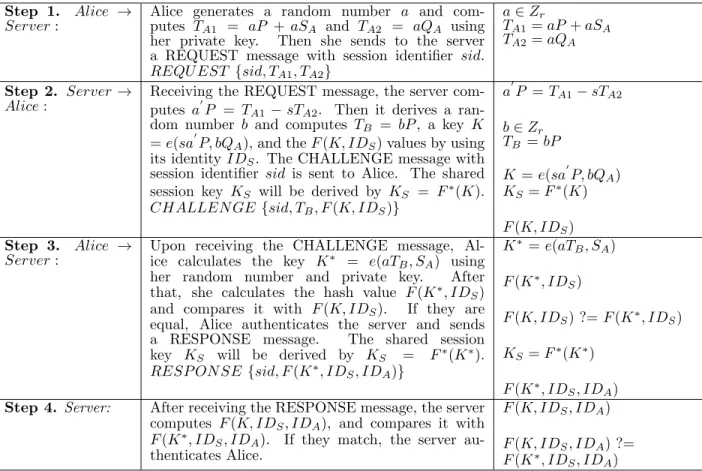
Table 1. Protocol I: Client-to-server authentication with pairing.
Step 1. Alice → Server:
Alice generates a random number a and com-putes TA1 = aP +aSA and TA2 = aQA using
her private key. Then she sends to the server a REQUEST message with session identifier sid. REQU EST {sid, TA1, TA2}
a∈Zr
TA1=aP+aSA
TA2=aQA
Step 2. Server→ Alice:
Receiving the REQUEST message, the server com-putes a′P = TA1−sTA2. Then it derives a ran-dom number b and computes TB = bP, a key K
=e(sa′P, bQA), and theF(K, IDS) values by using
its identity IDS. The CHALLENGE message with
session identifier sid is sent to Alice. The shared session key KS will be derived by KS = F∗(K).
CHALLEN GE {sid, TB, F(K, IDS)}
a′P =TA1−sTA2 b∈Zr
TB =bP
K =e(sa′P, bQA)
KS =F∗(K)
F(K, IDS)
Step 3. Alice → Server:
Upon receiving the CHALLENGE message, Al-ice calculates the key K∗ = e(aTB, SA) using
her random number and private key. After that, she calculates the hash value F(K∗, IDS)
and compares it with F(K, IDS). If they are
equal, Alice authenticates the server and sends a RESPONSE message. The shared session key KS will be derived by KS = F∗(K∗).
RESP ON SE {sid, F(K∗, IDS, IDA)}
K∗ =e(aTB, SA)
F(K∗, IDS)
F(K, IDS) ?= F(K∗, IDS)
KS =F∗(K∗)
F(K∗, IDS, IDA)
Step 4. Server: After receiving the RESPONSE message, the server computes F(K, IDS, IDA), and compares it with
F(K∗, IDS, IDA). If they match, the server
au-thenticates Alice.
F(K, IDS, IDA)
F(K, IDS, IDA) ?=
F(K∗, IDS, IDA)
consider the man-in-the-middle attack, the replay attack, forward secrecy, the key compromise impersonation attack, the ephemeral key reveal, and the known-key attack.
Protocol I:Protocol I in Table 1relies on the decisional bilinear Diffie–Hellman (DBDH) problem. A known-key attack or a reply attack cannot be realized because each session key relies on random ephemeral keys a and b. Each protocol will generate a new shared key that does not leak any information about other session keys. The man-in-the-middle attack cannot be realized because the adversary must calculate e(aTB, SA) in
order to share the same key with Alice. To calculate this value, the adversary has to know s and b or SA and
a.
Protocol I provides perfect forward secrecy because the compromise of long-term secret keys of all parties does not reveal the past session keys where each session key relies on random ephemeral keys a and b.
It can resist the ephemeral key reveal attack unless both ephemeral keys are revealed. To calculate e(abP, sQA) =e(abPpub, QA) it can be assumed that the adversary captured the ephemeral keyaand conducted
a man-in-the-middle attack. The adversary will choose an a′ to replace a, but to calculate e(a′bPpub, QA) , one
needs to know the value of b. The assumption that the server side ephemeral key is revealed is a strong one. Although by definition the key compromise impersonation attack is pointed toward client-to-client pro-tocols, it can be applied to this protocol. Even if the adversary compromises a client’s long-term secret key, this protocol can resist the key compromise impersonation attack because the adversary does not know aP, which is required to calculate the session key.
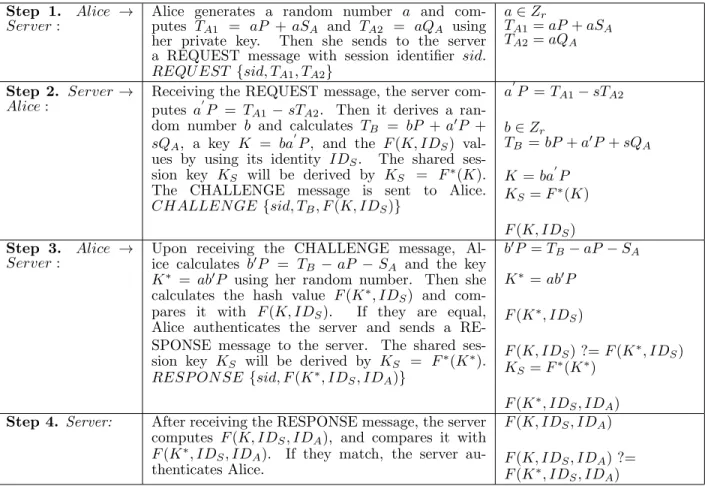
Table 2. Protocol II: Client-to-server authentication without pairing.
Step 1. Alice → Server:
Alice generates a random number a and com-putes TA1 = aP +aSA and TA2 = aQA using
her private key. Then she sends to the server a REQUEST message with session identifier sid. REQU EST {sid, TA1, TA2}
a∈Zr
TA1=aP+aSA
TA2=aQA
Step 2. Server→ Alice:
Receiving the REQUEST message, the server com-putes a′P = TA1−sTA2. Then it derives a ran-dom number b and calculates TB = bP +a′P +
sQA, a key K = ba
′
P, and the F(K, IDS)
val-ues by using its identity IDS. The shared
ses-sion key KS will be derived by KS = F∗(K).
The CHALLENGE message is sent to Alice. CHALLEN GE {sid, TB, F(K, IDS)}
a′P =TA1−sTA2 b∈Zr
TB =bP+a′P+sQA
K =ba′P KS =F∗(K)
F(K, IDS)
Step 3. Alice → Server:
Upon receiving the CHALLENGE message, Al-ice calculates b′P = TB −aP −SA and the key
K∗ = ab′P using her random number. Then she calculates the hash value F(K∗, IDS) and
com-pares it with F(K, IDS). If they are equal,
Alice authenticates the server and sends a RE-SPONSE message to the server. The shared ses-sion key KS will be derived by KS = F∗(K∗).
RESP ON SE {sid, F(K∗, IDS, IDA)}
b′P =TB−aP −SA
K∗ =ab′P F(K∗, IDS)
F(K, IDS) ?= F(K∗, IDS)
KS =F∗(K∗)
F(K∗, IDS, IDA)
Step 4. Server: After receiving the RESPONSE message, the server computes F(K, IDS, IDA), and compares it with
F(K∗, IDS, IDA). If they match, the server
au-thenticates Alice.
F(K, IDS, IDA)
F(K, IDS, IDA) ?=
F(K∗, IDS, IDA)
Protocol II: Protocol II in Table 2 relies on the elliptic curve decisional Diffie–Hellman (ECDDHP) problem. Similar to Protocol I, a known key attack or a replay attack could not be realized because of random ephemeral keys a and b. A man-in-the-middle attack could not be realized because the adversary does not know a or SA. It provides perfect forward secrecy because the compromise of long-term secret keys of all
parties does not reveal the past session keys where each session key relies on random ephemeral keys a and b. Protocol II can resist the ephemeral key reveal attack. When the client’s ephemeral key is revealed the adversary cannot calculate SA even knowing aQA and aSA. When the server side ephemeral key is revealed
the adversary cannot calculate aP. The protocol is secure against the key compromise impersonation attack as well. Knowing SA, the adversary cannot calculate aP and bP, which are necessary to calculate K or K∗.
Protocol III: Protocol III in Table 3 relies on the DBDH problem. A replay attack is not possible because of the random ephemeral keys. The man-in-the-middle attack cannot be realized because an adversary needs SA or SB to calculate a session key. It provides perfect forward secrecy because the session keys rely on
random ephemeral keys.
The proposed protocol can resist an ephemeral key reveal attack. Even if the adversary captures a ephemeral private key, it is clear that the shared key K cannot be calculated from the demonstrated key calculation. Without SA or SB, capturing a and b is not enough to calculate K.
The key-compromise impersonation attack is not applicable in here. Suppose an adversary captures the long-term private key SA of Alice and pretends to be Bob to establish communication with her. However, he
Table 3. Protocol III: Client-to-client authentication.
Step 1. Alice → Bob:
Alice generates a random number a and computes TA = aP + aQA using her
pub-lic key. Then she sends to Bob a RE-QUEST message with session identifier sid. REQU EST {sid, TA}
a∈Zr
TA =aP +aQA
Step 2. Bob →
Alice:
After Bob receives the REQUEST message, he derives a random number b and computes TB
= bP + bQB and a key K = e(bP + bQA +
TA, Ppub+SB), and the F(K, IDB) values by
us-ing his identity IDB. The shared session key
KS will be derived by KS = F∗(K).
Af-ter that, he sends the CHALLENGE message with session identifier sid given below to Alice. CHALLEN GE {sid, TB, F(K, IDB)}
b∈Zr
TB =bP +bQB
K=e(bP+bQA+TA, Ppub+
SB)
KS =F∗(K)
F(K, IDB)
Step 3. Alice → Bob:
Upon receiving the CHALLENGE message, us-ing her random number Alice calculates the ses-sion key K∗ = e(Ppub + SA, TB + aQB + aP).
Then she calculates the hash value F(K∗, IDB)
and compares it with F(K, IDB). If they are
equal, Alice authenticates Bob and sends a RE-SPONSE message to him. The shared session key KS will be derived by KS = F∗(K∗).
RESP ON SE{sid, F(K∗, IDB, IDA)}
K∗ = e(Ppub + SA, TB +
aQB+aP)
F(K∗, IDB)
F(K, IDB) ?= F(K∗, IDB)
KS =F∗(K∗)
F(K∗, IDB, IDA)
Step 4. Bob: After receiving the RESPONSE message, Bob computes F(K, IDB, IDA) and compares it with
F(K∗, IDB, IDA). If they match, Bob
authenti-cates Alice.
F(K, IDB, IDA)
F(K, IDB, IDA) ?=
F(K∗, IDB, IDA)
cannot calculate aQB+aP. If the adversary captures the long-term private key SB of Bob and pretends to be
Alice to establish communication with him, he will not be able to do so because he cannot calculate bP+bQA.
The proposed protocol has the key escrow property where the PKG is capable of recovering the session keys by capturing the message exchanges and using the master secret key. To disable this property, both parties should send the extra points aPpub and bPpub separately and the shared key should be calculated as
F∗(K, abPpub) .
K = e(Ppub+SA, TB+aQB+aP)
= e(Ppub+SA, TB)e(Ppub+SA, aQB+aP)
= e(sP+sQA, bP+bQB)e(sP+sQA, aQB+aP)
= e(bP +bQA, Ppub+SB)e(aP +aQA, SB+Ppub)
= e(bP +bQA+TA, Ppub+SB)
= K∗
4.3. Security proofs of Protocols I and III
In the proposed authentication and key agreement protocols the key confirmation part is realized within the last 2 steps. We can assume that the previous steps work as an AK protocol. The formal proofs given will be for the AK protocols. It is supposed that the DBDH problem [33] is hard. The proof of the security of Protocols I and III relies on this notion.
Definition 3 - The DBDH problem: LetG1, G2 be 2 groups of prime order q. Let P be a generator of G1 and e:G1×G1→G2 be an admissible bilinear mapping of 2 elements in G1 to an element in G2.
Instance: (P, xP, yP, zP, r) for some x, y, z, r∈Zn. Output: Yes if r≡e(P, P)xyz mod p.
Adversary E in solving decisional Diffie–Hellman (DDH) is defined by: AdvDDH
E = P r[E(P, xP, yP, zP, r) = 1] - P r[E(P, xP, yP, zP, e(P, P)xyz) = 1] : x, y, z, r∈Zn.
The DBDH assumption: AdvEDBDH is negligible.
Theorem I: Protocols I and III are secure AK protocols when the DBDH assumption is given. It is also assumed that the adversary E does not make any reveal queries and the hash functions used are random oracles.
Proof: Similar to the proof given by Chen and Kudla [20], the first 2 conditions in Definition 1 are satisfied when the oracles follow the protocol and accept with matching conversations. They will hold the same session keyKS due to the bilinear pairing function. In addition, the key will be distributed uniformly at random
on {0,1}k because the hash functions deployed are random oracles.
For the third condition we will assume that the adversary E can conduct a successful test query with nonnegligible advantage η(k) in time τ(k) . We further assume that during this attack the adversary makes at most TF queries to the random oracle HF and TC create queries.
Using E, we will build an algorithm D that solves the DBDH problem by calculating the output r ≡ e(P, P)xyz mod p given the input parameters G
1, G2,e,xP,yP,zP explained in Definition 3 with nonnegligible probability. D will simulate the oracles for all parties and maintain 2 additional random oracles HC and HF. HF can be queried by the adversary at any time whereas HC is not directly available to the
adversary. The HC oracle will only answer create queries. D will run a setup algorithm assigning the master
key of the PKG to xP.
Before the test query D will choose 2 distinct random values I and J, which are equal to or smaller than TC, and a value l, which is equal to or smaller than TF. D will start the adversary E and answer its
queries as explained below.
Queries to HC and HF: A random oracle answers queries in a consistent way. The HC oracle is
simulated with an HC-list that holds < IDi, Qi > tuples. If the HC oracle is queried with IDi and the tuple
< IDi, Qi > already exists the oracle answers with Qi. If the tuple does not exist and the query is the Jth
query the oracle answers with Qi=yP and adds the tuple < IDi, Qi> to its HC-list. Otherwise, the oracle
answers with Qi =riP where ri ∈Zn is selected randomly and adds the tuple < IDi, Qi > to its HC-list.
Similar to HC, the HF oracle is simulated with an HF-list. The difference is that it answers distinct queries
randomly.
Create queries: The HC oracle can only be queried via a create query. The create query will deliver an
IDi and D will simulate this query by querying HC to set up the public key Qi =riP and the private key
Si=rixP. The public key will be delivered to E. If the query to HC is the Jth query, or in other words the
Jth participant is created, the public key will be QJ =yP. In Protocol I, D will be able to calculate the secret
key for this participant whereas in Protocol III it will not.
Corrupt queries: IfE queriesDfor Ior J, Dgives up. Otherwise, Danswers by revealing the long-term private keys.
Send queries for Protocol I: For a normal oracle, D answers all send queries as specified. Protocol I is a client-server protocol. For the first send query to an initiator oracle, D generates a random value to calculate
the oracle’s contribution. If E asks ΠtJ,I for its first send query where ΠtJ,I is an initiator, D will generate a random j∈Zn and answer with jP+jSj. If E asks ΠnI,J for its first send query where Π
n
I,J is an responder
oracle, D will generate a random sn∈Zn and answer with snzP.
Send queries for Protocol III: For a normal oracle, D answers all send queries as specified. For the first send query to an initiator oracle, D generates a random value to calculate the oracle’s contribution. If E asks Πt
J,I for its first send query where Π t
J,I is an initiator, D will generate a random j ∈ Zn and answer with
jP+jQj. If E asks ΠnI,J for its first send query where ΠnI,J is a responder oracle, D will generate a random
sn∈Zn and answer with snzP +snrizP.
Reveal queries: The adversary is not allowed to ask reveal queries. Therefore, D will not answer any reveal queries.
Test queries for Protocol I: If E asks a test query to an oracle other than the ΠnI,J oracles, D aborts. Otherwise, the Πn
I,J must have accepted. I and J must be uncorrupted. Assuming that Π n
I,J received jP+jSj
and calculated jP+jSj−jxyP =jP+jSj−jS
′
j=jP before accepting, the oracle will hold the session key
F∗(e(xjP, snzyP)) . Because D cannot calculate this session key, it will not be able to simulate the test query
in a correct way. D will give a random answer in this case. If D does not abort for some reason and E does not detect the random answer, E’s probability of success is still η(k) . E can distinguish the session key from a random value only if it has queried oracle HF for the value of F∗(e(xjP, snzyP)) with nonnegligible probability
η(k)′. The number of HF queries is bounded by TF.
E’s state can become undefined if it detects D’s inconsistency. In this undefined state, E may not terminate. Therefore, D should terminate E’s attack if it lasts longer than time τ(k) .
At the end of the test query, if E has made fewer than l HF queries, D aborts. If not, D uses E’s
lth HF query (on some value h) guessing that its value is e(xjP, snzyP) =e(P, P)jsnxyz =e(P, P)xyzγ where
γ =jsn. D will output h1/γ as its guess for e(P, P)xyz. In this case, the probability that D outputs the
correct output is at least η(k)
′
T2
CTH
, which is nonnegligible.
Test queries for Protocol III: The test query for Protocol III progresses very similarly to the test query for Protocol I. We will point out the differences. Assuming that ΠnI,J received jP +jQj and calculated
snzP+snrizP before accepting, the oracle will hold the session keyF∗(e(snzP+snzyP+jP+jQj, xP+xriP)) . DusesE’s lthHF query (on some value h) guessing that its value ise(snzP+snzyP+jP+jQj, xP+xriP) =
e(P, P)xyz(sn+snri)+(xyj+snxz+xj)(1+ri)=δe(P, P)xyzγ where δ=e(P, P)(xyj+snxz+xj)(1+ri) and γ=s
n+snri. D will output (h/δ)1/γ as its guess for e(P, P)xyz. The rest is the same as for the test query for Protocol I
explained above.
As a result, at the end of a test query if adversary E is able to guess the value of b correctly with a nonnegligible advantage, D can estimate e(P, P)xyz with nonnegligible probability. However, this situation contradicts the DBDH assumption.
We will not give a formal proof for Protocol II. We note that the formal proof would be similar to the proof given for the other protocols and based on the ECDH problem, [34] which is hard.
4.4. Proof explanation of protocols
The formal proof based on the BJM security model does not allow the adversary to ask reveal queries because the adversary could alter the messages exchanged so that the communicating parties agree on a session key without achieving a matching conversation. The adversary can ask a test query to one of the parties and ask a reveal query to the other party. This is valid because the parties are uncorrupted, the test query is asked to an oracle that is not revealed, and the reveal query is asked to an oracle that does not have a matching conversation with the tested oracle. The work of Chen and Kudla includes a useful example for the case explained above [20].
As explained in the work of Chen and Kudla, the known key security and the unknown key share resilience properties implied by the definitions of the AK and AKC protocols. On the other hand, the BJM model does not allow the adversary to ask test queries to corrupted oracles. Therefore, the security model cannot model the key compromise impersonation attack and the forward secrecy properties. The attacks not covered by the security model are discussed based on heuristic arguments in Section 4.2.
To extend the proof to an AKC protocol we would follow a similar approach to the proof of Theorem 9 in the work of Blake-Wilson et al. [30]. However, we prefer to leave the proof for the interested reader.
5. Performance and security evaluation
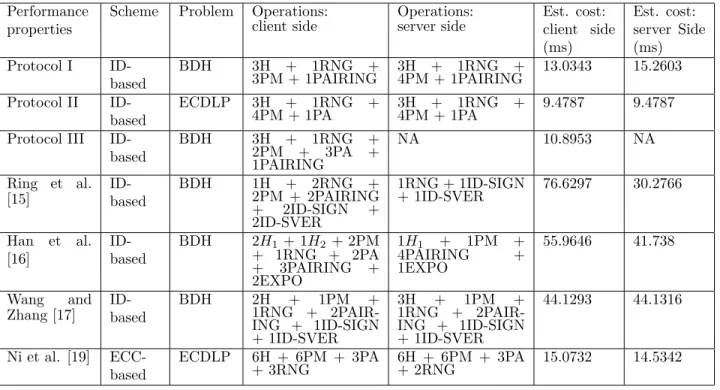
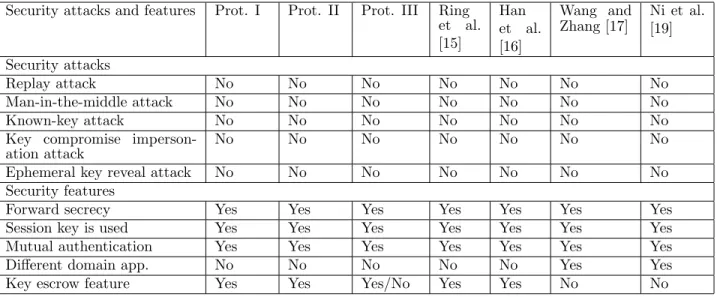
In this section, we evaluate the performance and security features of the ID-based protocols that are proposed in this study and compare them to some known ID-based protocols found in the literature. According to the primitive function timings given in Table 4, Table 5 demonstrates the computational costs and the related performance numbers for each protocol. Table6 evaluates each protocol against a number of security threats and lists the security features.
5.1. Performance evaluation
We will evaluate the performance of the proposed ID-based protocols and compare them to the ID-based SIP authentication schemes given in the literature with respect to the arithmetic and cryptographic operations. We used the PBC Library (version 0.5.12) to obtain the primitive function timings given in Table 4. The PBC Library is built on the GMP Library (version 5.0.5). Table4shows the arithmetic mean and the standard deviation of the following primitive operations for 1000 executions of each operation. The timings were obtained on a personal computer that had an Intel Pentium Dual CPU E2200 2.20GHz processor, 2048 MB of RAM, and the Ubuntu 12.04.1 LTS 32-bit operating system.
The symbols used for the primitive functions are given in the first column of Table4. A short explanation for each symbol, their arithmetic means, and their standard deviations are given respectively in columns 2, 3, and 4. The ID-based signature and ID-based verification operations are denoted by (ID-SIGN) and (ID-SVER). These timings were obtained by implementing the signature scheme of Hess using the PBC Library. Due to the fact that only arithmetic operations are involved, the standard deviations are quite low.
For ID-based operations, we used the Type A curves defined within the PBC Library because they are fast and efficient. In the PBC Library, the Type A curve is chosen as E(Fq) :y2 =x3+x, where q is some
prime. The group G1 is a subgroup of E(Fq) , while G2 is a subgroup of Fq2. The group order of G1 is 160 bits, and the order of the base field is 512 bits. The embedding degree k is 2 . Since the bilinear function is e:G1×G1→G2, this pairing is symmetric.
Table 4. PBC Library-based primitive timings.
Symbol Operation Arithmetic
mean (ms)
Standard deviation (ms)
RNG Select random number Zr 0.539 0.0000106
H String to number (hash) Zr 0.0023 0.0000006
H1 String to point (hash)G1 12.418 0.0000442
H2 String to point (hash)G2 0.947 0.0000260
PM Point multiplicationG2 2.226 0.0000733
PA Point additionG1 0.0288 0.0000025
PAIRING Pairing G1×G1→G2 5.811 0.0002854
ID-SIGN ID-based signature (Hess) 23.8662 0.0003236
ID-SVER ID-based verification (Hess) 5.87147 0.0001007 EXPO Modular exponentiation (1024 bit) 3.8500 0.0000464
demonstrated in Table5. The arithmetic and cryptographic operations performed on both the client side and the server side are given in column four and five respectively. The estimated timings for these operations can be found in the last two columns. We assumed that the signature scheme of Hess is used for the signature and verification operations.
The proposed ID-based schemes of Wang and Zhang [17], Ring et al. [15], and Han et al. [16] rely on ID-based signature schemes that use multiple pairing operations. The server side cost is relatively less in Ring et al.’s protocol, which can increase the performance of the server. In general, the overhead for these 3 protocols is considerably high for SIP authentication where tens of thousands of clients compete for the SIP proxy servers’ authentication service. SIP protocol implementations have to meet certain QoS requirements. When these
Table 5. Performance evaluations of the discussed schemes and proposed protocols. Performance
properties
Scheme Problem Operations: client side Operations: server side Est. cost: client side (ms) Est. cost: server Side (ms) Protocol I
ID-based
BDH 3H + 1RNG +
3PM + 1PAIRING 3H4PM + 1PAIRING+ 1RNG + 13.0343 15.2603 Protocol II
ID-based
ECDLP 3H + 1RNG +
4PM + 1PA 3H4PM + 1PA+ 1RNG + 9.4787 9.4787 Protocol III
ID-based
BDH 3H + 1RNG +
2PM + 3PA +
1PAIRING
NA 10.8953 NA
Ring et al. [15]
ID-based
BDH 1H + 2RNG +
2PM + 2PAIRING
+ 2ID-SIGN +
2ID-SVER
1RNG + 1ID-SIGN
+ 1ID-SVER 76.6297 30.2766
Han et al. [16]
ID-based
BDH 2H1 + 1H2 + 2PM + 1RNG + 2PA
+ 3PAIRING +
2EXPO
1H1 + 1PM +
4PAIRING + 1EXPO 55.9646 41.738 Wang and Zhang [17] ID-based
BDH 2H + 1PM +
1RNG + 2PAIR-ING + 1ID-SIGN + 1ID-SVER
3H + 1PM +
1RNG + 2PAIR-ING + 1ID-SIGN + 1ID-SVER
44.1293 44.1316
Ni et al. [19] ECC-based
ECDLP 6H + 6PM + 3PA
requirements are not satisfied, the requests are retransmitted, further increasing SIP traffic. Compared to these protocols, Ni et al.’s scheme achieves better performance results, but it cannot be exactly classified as an ID-based protocol. It uses elliptic curve point operations instead of pairing functions.
The first 3 rows in Table5 exhibit the computational costs of the new protocols proposed in this work. Protocol I is comparable to the protocols proposed by Wang and Zhang [17], Ring et al. [15], and Han et al. [16] because it aims to achieve the client-to-server authentication by using bilinear pairing functions. The overhead is considerably less because the protocol does not rely on a signature scheme and deploys only one pairing function. The second protocol is comparable to Ni et al.’s scheme [19]. It originates from the ID-based cryptosystem but eliminates the pairing function and uses elliptic curve point multiplications. Although it requires immediate disposal of the client’s ephemeral key, its overhead is significantly lower than the other protocols listed.
The protocols proposed by Wang and Zhang, Ring et al., Han et al., and Ni et al. can establish session keys between the clients. Similarly, the proposed third protocol is an authenticated key agreement protocol that uses only one bilinear pairing function. The performance achieved is significantly better than the comparable protocols, which is preferable for the SIP protocol.
Table 6. Security attack and feature evaluations of the discussed schemes and proposed protocols. Security attacks and features Prot. I Prot. II Prot. III Ring
et al. [15]
Han et al. [16]
Wang and Zhang [17]
Ni et al. [19] Security attacks
Replay attack No No No No No No No
Man-in-the-middle attack No No No No No No No
Known-key attack No No No No No No No
Key compromise imperson-ation attack
No No No No No No No
Ephemeral key reveal attack No No No No No No No
Security features
Forward secrecy Yes Yes Yes Yes Yes Yes Yes
Session key is used Yes Yes Yes Yes Yes Yes Yes
Mutual authentication Yes Yes Yes Yes Yes Yes Yes
Different domain app. No No No No No Yes Yes
Key escrow feature Yes Yes Yes/No Yes Yes No No
5.2. Security evaluation
Investigating Table6, we can state that the evaluated ID-based authentication schemes provide strong security against some well-known attacks such as the man-in-the-middle and reply attacks. The main reasons for this strength are the ephemeral keys and the public keys, which are chosen as unique identifiers.
The session keys of the ID-based schemes evaluated in Table 6 are calculated using the bilinear pairing function. Because the pairing function uses the ephemeral keys in addition to long-term private keys, the compromise of long-term private keys does not provide enough information to calculate the previous session keys. Based on this fact, we can state that ID-based authentication schemes provide forward secrecy.
The evaluated ID-based schemes can resist the known-key attack. An adversary that compromises a session key cannot compromise other session keys because, as described above, the calculation of each session
key includes ephemeral keys, as well. The schemes were also evaluated against the ephemeral key reveal attack. For each scheme it was verified that an adversary obtaining an ephemeral key does not have enough information to calculate the session key.
Eliminating the need for certificates, ID-based cryptography has become an important alternative to public key cryptography. However, ID-based protocols can suffer from the key escrow problem where the PKG can use the parties’ secret information to obtain the session keys. Depending on the purpose, the key escrow can be defined as a feature where authorities such as government agencies can conduct surveillance. Among the evaluated protocols, Wang and Zhang’s and Ni et al.’s schemes do not have the key escrow feature. These schemes use the certificateless public key cryptography concept to hide the client’s private key from the trusted third party and avoid the key escrow problem.
In practical implementations we observed that SIP proxy servers conducted the authentication process accessing the required secret information. Therefore, for the proposed protocols it was assumed that the SIP servers include the functions of the PKG. Among the proposed protocols, Protocol III is a client-to-client protocol where the key escrow feature can be disabled by sending an extra elliptic curve point and changing the session key calculation slightly. Protocols I and II are client-to-server authentication protocols where the key escrow concept is unrelated due to the PKG functionality of the SIP server.
On the other hand, there is an important disadvantage of architectures where SIP servers pose PKG functionalities. This type of architectures cannot be supported within a multidomain structure. As noted in Table6, only Wang and Zhang’s and Ni et al.’s schemes can be applied to a multidomain structure.
In the protocols of Wang and Zhang, Ring et al., and Han et al., the authenticity is established by using ID-based signature schemes. When the signature cannot be verified, the protocol will fail at that point. The proposed protocols use implicit key authentication and key confirmation, which avoids the use of expensive signature schemes. The authentication fails when the key confirmation fails at the end of the protocol. Although the proposed protocols fail one step later, avoiding the signature generation and verification reduces the overhead significantly.
6. Conclusion
ID-based cryptography presents convenient features for authentication and key agreement protocols. In the literature, various ID-based protocols are proposed, but their computational overhead is not very suitable for SIP. In this study, new ID-based protocols are proposed for the SIP authentication and key agreement protocols. These protocols minimize the use of expensive pairing functions but still resist notable attacks.
The security of the proposed protocols were analyzed and demonstrated with security proofs based on the BJM security model. Finally, the performance overhead and security of the proposed protocols were compared to other ID-based SIP authentication and key agreement protocols. Once the computational overhead of calculating the pairing function is reduced, ID-based cryptography will become more attractive.
A. Appendix
Parameters and meanings used in schemes
C Client (G1,+) and (G2, .) Cyclic groups of the same prime orderl
S Server P ∈E(F q) The generator point of the group G1
A Alice H1 {0,1}∗ → G∗1 where G∗1 := G1\{O}
(map-to-point)
B Bob H2 {0,1}∗×G2→(Z/lZ)∗ (map-to-number)
F() One-way hash function e:G1×G1→G2 Pairing function that has bilinear and nondegen-erate properties
K Session key SA Private key of Alice.
⊕ XOR operation QA=H1(IDA) Public key of Alice.
s Private key of the PKG SB Private key of Bob
Ppub Public key of the PKG QB =H1(IDB) Public key of Bob
Ring et al.’s scheme.
Step Message Calculation
The authentication scheme
C→S REQUEST (REGISTER or INVITE)
S→C CHALLENGE{Sign(nonce,realm,opaque,time,
uname)}
Also, the server responds “401 Unauthorized” message for REGISTER message or “407 Proxy Authentication Required” message for INVITE message with CHALLENGE message.
realm string: An identifier of the security domain
opaque string: A session identifier
Sign(nonce,realm,opaque,time,uname)
C→S RESPONSE{Sign(nonce,realm,opaque,uname,
response)}
VerifySign(nonce,realm,opaque,time, uname)
Sign(nonce,realm,opaque,uname,response)
S→C 200OK VerifySign(nonce,realm,opaque,uname,
response) The key agreement scheme
A→B IN V IT E {Sign(TA, T o, F rom, ...)} a∈Zr
TA=aP
Sign(TA, T o, F rom, ...)
B→A 200OK {Sign(TB, T o, F rom, ...)} VerifySign(TA, T o, F rom, ...)
b∈Zr
TB =bP
Sign(TB, T o, F rom, ...)
KBA =e(SB, TA)e(QA, bPP ub(P KGA))
K = F(A||B||TA||TB||KBA): The session
key
A→B ACK VerifySign(TB, T o, F rom, ...)
KAB =e(SA, TB)e(QB, aPP ub(P KGB)) K =F(A||B||TA||TB||KAB)
Han et al.’s scheme.
Step Message Calculation
A→B REQU EST{(u, v)} P1∈G1
k∈(Z/lZ)∗ r=e(P1, P)k t=H1∗(r)QA
v=H2(m, t), m can be time-based nonce u=vSA+kP1
B→A 200OK
(Note: if the values are same, the signature is verified and Alice is authenticated.)
t = H1∗(r)QA =
H1∗(e(u, P)e(QA,−Ppub)v)QA
v ?=H2(m, t)
A And
B
They can calculate the session key simultaneously. KA =e(SA, QB)H
∗
1(r)⊕e(SA, QB): Alice’s calculation
KB =e(t, SB)⊕e(QA, SB): Bob’s
calcula-tion
K =KA=KB: The session key
Wang and Zhang’s scheme.
Step Message Calculation
A→B or C→S
REQU EST {IDA, PA, s, TA} a∈Zq∗
TA=aP
IDA: Alice’s identity
PA=< XA, YA>: Alice’s public key
s: The session identifier B→A
or S→C
CHALLEN GE {nonce, realm, PB, TB,
signatureB}
b∈Zq∗
TB=bP
nonce=F(realm, time)
signatureB =
Sign(nonce, realm, IDA, TA, TB, PB):
The signature of Bob
PB =< XB, YB >: Bob’s public key
A→B or C→S
RESP ON SE{nonce, realm, IDA,
signatureA}
Verify signatureB =
Sign(nonce, realm, IDA, TA, TB, PB)
signatureA =
Sign(nonce, realm, IDA, TA, TB, PA)
KAB =e(SA, TB)e(QB, aYB)
K =KA =H(KAB): The session key
B→A or S→C
200OK Verify signatureB =
Sign(nonce, realm, IDA, TA, TB, PB)
signatureA =
Sign(nonce, realm, IDA, TA, TB, PA)
KBA =e(SB, TA)e(QA, bYA)
K = KA = KB = H(KBA): The session
References
[1] Rosenberg J, Schulzrinne H, Camarillo G, Johnston A, Peterson J, Sparks R, Handley M, Schooler E. SIP: Session Initiation Protocol. Internet Engineering Task Force 2002; RFC 3261.
[2] Geneiatakis D, Dagiouklas A, Kambourakis G, Lambrinoudakis C, Gritzalis S, Ehlert S, Sisalem D. Survey of
security vulnerabilities in session initiation protocol. IEEE Communications Surveys and Tutorials 2006; 8: 68–81.
[3] Salsano S, Veltri L, Papalilo D. SIP security issues: the SIP authentication procedure and its processing load. IEEE
Network 2002; 16: 38–44.
[4] Dantu R, Fahmyb S, Schulzrinne H, Cangussu J. Issues and challenges in securing VoIP. Computers & Security
2009; 28: 743–753.
[5] Franks J, Hallam-Baker P, Hostetler J, Lawrence S, Leach P, Luotonen A, Stewart L. HTTP authentication: basic and digest access authentication. Internet Engineering Task Force 1999; RFC 2617.
[6] Yang CC, Wang RC, Liu WT. Secure authentication scheme for session initiation protocol. Computers & Security
2005; 24: 381–386.
[7] Durlanik A, Sogukpinar I. SIP authentication scheme using ECDH. Enformatika 2005; 8: 350–353.
[8] Choi J, Jung S, Bae K, Moon H. A lightweight authentication and hop-by-hop security mechanism for sip network. In: Advanced Technologies for Communications;6-9 Oct 2008; Hanoi,Vietnam; pp. 235–238.
[9] Yoon EJ, Yoo KY. A new authentication scheme for session initiation protocol. In: International Conference on Complex, Intelligent and Software Intensive Systems;2009; Fukuoka, Japan.
[10] Geneiatakis D, Lambrinoudakis C. A lightweight protection mechanism against signaling attacks in a sip-based
voip environment. Telecommunication Systems 2007; 36: 153–159.
[11] Tsai JL. Efficient nonce-based authentication scheme for session initiation protocol. International Journal of Network Security 2009; 8: 312–316.
[12] Dacosta I, Traynor P. Proxychain: Developing a robust and efficient authentication infrastructure for carrier-scale VoIP networks. In: Proceedings of the 2010 USENIX Conference on USENIX Annual Technical Conference; 2010; pp. 10–10.
[13] Srinivasan R, Vaidehi V, Harish K, LakshmiNarasimhan K, LokeshwerBabu S, Srikanth V. Authentication of signaling in VoIP applications. In: 11th Asia Pacific Conference on Communication(APCC);2005; Perth, Australia.
[14] Nodooshan AM, Darmani Y, Jalili R, Nourani M. A robust and efficient SIP authentication scheme. Communications
in Computer and Information Science 2009; 6: 551–558.
[15] Ring J, Choo KKR, Foo E, Looi M. A new authentication mechanism and key agreement protocol for SIP using identity-based cryptography. In: AusCERT Asia Pacific Information Technology Security Conference; 23 May 2006; Gold Coast, Australia.
[16] Han K, Yeun C, Kim K. Design of secure VoIP using Id-based cryptosystem. In: The Symposium on Cryptography and Information Security (SCIS2008); 22-25 January 2008; Miyazaki,Japan.
[17] Wang F, Zhang Y. A new provably secure authentication and key agreement mechanism for SIP using certificateless public-key cryptography. Computer Communication 2008; pp. 2142–2149.
[18] Kilinc HH, Allaberdiyev Y, Yanik T. Performance evaluation of Id based authentication methods in the SIP protocol. In: Application of Information And Communication Technologies 3rd IEEE International Conference (AICT 2009); 2009.
[19] Ni L, Chen G, Li J. A pairing-free identity-based authenticated key agreement mechanism for sip. In: Proceedings of the 2011 International Conference on Network Computing and Information Security - Volume 01(NCIS 2011); 2011; Washington, DC, USA; pp. 209–217.
[21] Hess F. Efficient identity based signature schemes based on pairings. In: Proceedings of the 9thWorkshop on Selected Areas in Cryptography; 2003; pp. 310–324.
[22] Okamoto T, Tso R, Okamoto E. One-way and two-party authenticated id-based key agreement protocols using pairing. Modeling Decisions for Artificial Intelligence 2005; 3558/2005: 122–133.
[23] Patil HK, Chen TM, Willis D, Nguyen N. Authentication in SIP using identity based signature scheme. In: NIST workshop on Applications of Pairing-Based Cryptography: Identity-Based Encryption and Beyond; 3-4 June 2008; Gaithersburg, Maryland, USA.
[24] Al-Riyami S, Paterson K. Certificateless public key cryptography. Advances in Cryptology-Asiacrypt 2003; 2894: 452–473.
[25] Choon JC, Cheon JH. An identity-based signature from Gap Diffie-Hellman Groups. In: 6th International Workshop on Practice and Theory in Public Key Cryptography (PKC2003); January 2003; Miami, FL, USA; pp. 18–30. [26] Lynn B. Pairing-based cryptography library, available at http://crypto.stanford.edu/pbc/, accessed: 14 February
2013.
[27] OpenSIPs, available at http://www.opensips.org/, accessed: 14 February 2013.
[28] Shamir A. Identity-based cryptosystems and signature schemes. In: Advances in Cryptology: Proceedings of CRYPTO 84; 1984; pp. 47–53.
[29] Boneh D, Franklin MK. Identity-based encryption from the Weil Pairing. In: Advances in Cryptology: Proceedings of CRYPTO 01; 2001; pp. 213–229.
[30] Blake-Wilson S, Johnson D, Menezes A. Key agreement protocols and their security analysis. In: Proceedings of the 6th IMA International Conference on Cryptography and Coding; 1997; London, UK; pp. 30–45.
[31] Bellare M, Rogaway P. Entity authentication and key distribution. In: Proceedings of the 13th annual international cryptology conference on Advances in cryptology (CRYPTO’93); 1994; New York, NY, USA; pp. 232–249. [32] Strangio MA. On the resilience of key agreement protocols to key compromise impersonation. Cryptology ePrint
Archive, Report 2006/252, 2006, available at http://eprint.iacr.org/2006/252, accessed: 14 February 2013. [33] Cheon JH, Lee DH. Diffie-hellman problems and bilinear maps. Cryptology ePrint Archive, Report 2002/117, 2002,
available at http://eprint.iacr.org/2002/117, accessed: 14 February 2013.
[34] Hankerson D, Menezes AJ, Vanstone S. Guide to Elliptic Curve Cryptography. New York, USA: Springer-Verlag, 2004.