R E S E A R C H
Open Access
In high responding patients undergoing an initial
IVF cycle, elevated estradiol on the day of hCG
has no effect on live birth rate
Michael T Zavy
1*, LaTasha B Craig
1, Robert A Wild
1, Sana N Kahn
1, Dena O
’
Leary
2and Karl R Hansen
1Abstract
Background:The impact of elevated estradiol on the day of human chorionic gonadotropin (hCG) administration on in vitro fertilization (IVF) outcomes has been debated for over 25 years. Some investigators have shown a positive effect, others a negative effect; while most have shown no effect. Few studies have expressed their findings based on live birth. This study examined the relationship between estradiol level and other IVF cycle response parameters in relation to pregnancy, with a focus on live births after controlling for embryo quality.
Methods:We performed a retrospective cohort study on 489 patients <40 years old that underwent an initial IVF cycle. Estradiol concentration on the day of hCG was categorized as; low <2000 pg/ml), mid (2001-4000 pg/ml) and high (>4000 pg/ml) to determine how estradiol level on the day of hCG affected response variables during the IVF cycle. We performed a subgroup analysis restricted to patients with good/fair quality embryos transferred (n = 428), to control for embryo quality and assessed pregnancy outcome. The association between estradiol and live birth (LB) was then evaluated after identifying and controlling for confounding factors. Multivariate analysis was used to identify significant main effects and interactions in the model. Estradiol levels were also compared in patients having a LB or not (NLB) in both populations.
Results:We found that estradiol was significantly related to + hCG, clinical pregnancy rate, age, and most other IVF cycle response variables. After performing the subgroup analysis controlling for embryo quality, we found that LB rates were not different. Only the main effects of average embryo quality at transfer (AEQS), age and transferring two embryos influenced LB. Estradiol levels were also compared in patients having a LB or NLB in both populations and was found to be higher/not different in LB patients. LB rates and AEQS were also not different in a subgroup of patients having an elevated level of estradiol (>4200 pg/ml) on the day of hCG in patients having embryo transfer on day 3 or day 5.
Conclusions:After controlling for embryo quality, elevated estradiol on the day of hCG had no effect on LB.
Keywords:IVF, Estradiol level, High responder, Live birth rate, Age, Embryo quality, Day of embryo transfer
Background
In IVF cycles, high responding patients are character-ized as having a large number of follicles that are asso-ciated with elevated levels of estradiol and frequently by elevated levels of progesterone on the day of hCG administration. In most situations, this results in an in-creased number of embryos from which candidates can
be chosen for embryo transfer. Due to its potential clinical importance the impact of elevated estradiol on the day of hCG on IVF outcomes has been debated for over 25 years and even after this length of the time the issue of how, or if, the supra-physiological hormonal environment exhib-ited in high responding patients has an adverse effect on pregnancy outcome is still not settled. Regarding elevated estradiol and pregnancy outcome, some investigators [1-4] have shown a positive effect and others [5-8] a negative ef-fect; while most studies [9-18] have shown no effect. A meta-analysis conducted in 2004 [19] reviewed nine * Correspondence:[email protected]
1Section of Reproductive Endocrinology and Infertility Department of
Obstetrics and Gynecology, Oklahoma University Health Sciences Center, Oklahoma City, Oklahoma, USA
Full list of author information is available at the end of the article
studies and concluded that no high quality evidence existed to support or refute the value of estradiol levels on the day of hCG administration as a determining factor in establishing pregnancy in IVF cycles. Possibly contributing to the disparity in outcomes from these studies are differ-ences in the way trials were conducted, including the use of repeated measures, patient exclusion criteria, type of stimulation, day of transfer, number of embryos trans-ferred and how estradiol levels were categorized (cutoff, percentile or area under the curve). There is also consider-able variation among studies in how pregnancy rates were expressed with most using clinical pregnancy rate, with or without implantation rate. Few studies have based their conclusions on live birth outcome which arguably pro-vides the most information on the embryos ability to tol-erate the hormone environment to which it has been exposed.
The purpose of this study was to determine the rela-tionship between the levels of estradiol on the day of hCG administration and pregnancy outcomes, with em-phasis on live birth rate after controlling for embryo quality. We addressed this by initially categorizing pa-tients according to the level of estradiol on the day of hCG administration, which has been the basis of the majority of previously published studies. We then per-formed additional analyses controlling for embryo qual-ity and for confounding and interactions occurring between IVF response variables. In a secondary analysis we compared differences in estradiol levels between pa-tients achieving a live birth and those that did not (NLB), since differences in estradiol levels have been re-ported in previously published reports when stratified by birth outcome [17,20,21]. We also tested if the day of embryo transfer made a difference in live birth (LB) rate in patients with an elevated level of estradiol on the day of hCG since some prior studies [17,20,22] had suggested that elevated estradiol only had an adverse effect on pregnancy outcome when embryo transfer was conducted on day 3.
Methods Study design
We performed a retrospective cohort analysis (2006-2012) on patients that underwent an initial IVF cycle at the OU Reproductive Medicine Clinic at the University of Oklahoma. Of the 500 patients evaluated, 489 patients were included in the present study. Eleven patients were excluded due to; failed fertilization (4), only abnormal embryos available for transfer (3) or all embryos cryo-preserved due to threatened ovarian hyper-stimulation (4). This investigation was approved by the Oklahoma University Health Sciences Center Institutional Review Board (#2781, approved, 3/12/2013).
Patient population and stimulation protocols
Patients < 40 years of age with any etiology of infertility were included in the study; no patients using donor eggs were included. Following a baseline ultrasound, all patients underwent stimulation with recombinant follicle-stimulating hormone (FSH; Follistim, Organon USA or Gonal-F, Sereno) and in the majority of cases, in combin-ation with human menopausal gonadotropin (hMG; Menopur or Repronex, Ferring Pharmaceuticals). Total units of FSH administered were calculated for each patient with the exception of 19 patients in which this informa-tion was missing. Three different protocols were utilized for patients undergoing IVF during the study interval, in-cluding long gonadotropin releasing hormone (GnRH) agonist, micro-dose flare and GnRH antagonist protocols. The particular protocol chosen was based on anticipated patient response, with the majority of patients undergo-ing the long agonist protocol. Follicular monitorundergo-ing was carried out via serial vaginal ultrasound and serum
measurement of 17β-estradiol (estradiol) and
adjust-ments made in gonadotropin dose based upon follicular
development. When 2 or more follicles were ≥18 mm,
patients received a subcutaneous injection of hCG (5000 or 10000 IU) and follicular aspiration took place 35-36 hours later. A blood sample was taken at the last ultrasound, prior to hCG administration and analyzed for estradiol. Luteal phase supplementation was by daily IM injection of progesterone (50 mg). Fifteen days fol-lowing follicle aspiration, serum hCG was measured and considered positive if >20 mIU, biochemical preg-nancy (BCP). Clinical pregpreg-nancy (CP) was documented by observing a fetal sac(s) and heart rate by vaginal ultrasound at 6.5 - 7 weeks.
Hormone measurements
Serum levels of estradiol and hCG were measured by chemiluminescent enzyme immunoassays (Immulite; Diag-nostic Products, Los Angeles, CA, USA). Inter-assay and intra-assay coefficients of variation were 9.8% and 9.4% for estradiol and 5.6% and 3.0% for hCG.
IVF-embryo transfer
Following follicle aspiration, oocytes were held in modi-fied human tubal fluid (mHTF) + 5% (volume/volume) human serum albumen (HSA) (In Vitro Care; IVC) until placed into individual drops of HTF + 5% HSA with oil overlay (Sage) in a humidified atmosphere of
6% CO2and 94% air maintained at 37° until
Care) or Global medium +10% global protein supple-ment (GPS; Life Global) using oil overlay and cultured in a humidified tri-gas atmosphere (5-6.5% CO2; 5% O2 and residual nitrogen) at 37°C. Fertilization was checked between 17 and 18 hours and normally fertilized oocytes having 2 pronuclei were placed in groups of 3-4 and cul-tured as described previously. On day 2, embryos were graded and embryos allocated to new culture drops based on quality (good, fair or poor). A decision was made to perform embryo transfer on day 3 or day 5, based on the number of good quality embryos. Blastocyst transfer was elected if there were at least 6 good/fair quality embryos. If this criterion was not met, there were a low number of embryos or poor quality embryos; transfer on day 3 was elected. New culture plates were made daily and embryo development and video documentation was also con-ducted daily at approximately 24 hour intervals.
Embryo and blastocyst quality score at transfer
Cleavage stage embryos and blastocysts were graded as being good (1), fair (2) or poor quality (3) and numerical conversion of embryo grades were performed in order to statistically analyze the data. The embryos or blastocysts that were transferred for each patient were averaged to yield an average embryo quality score (AEQS). The nu-meric scoring is similar to that used by the Society for Assisted Reproductive Technology [23]. For cleavage stage embryos, the quality was determined by stage of development, blastomere symmetry and fragmentation of the embryos. Our grading system uses the following designation on day 3; A (good), B (fair) C (poor) with a (+/-) modifier for B quality embryos only. A good quality embryo (score of 1.0) had an A or B+ quality at the 6 cell to10 cell stage of development. A fair quality embryo (score of 2.0 for a “B” or 2.5 for a “B-”) at the 5 cell to 14 cell stage of development and a poor quality (score of 3) if the embryo was developmentally delayed (≤4 cells), had excessive fragmentation >40%) or extreme blasto-mere asymmetry. Blastocysts were graded as follows: a good quality blastocyst (score of 1) on day 5; the inner cell mass (ICM) quality was not less than B+ quality while the trophectoderm (TE) quality was no lower than B quality. In the case of blastocysts (+/-) modifiers were used for B quality for both the ICM and TE. The mini-mum stage of development of good quality blastocysts was 3 (expanded) or in the case of an early observation, 2 (cavitated). A day 6 good quality blastocyst was similar to day 5 except with more advanced development. A fair quality blastocyst (score of 2) for day 5; the minimum quality was 2BB- and for day 6 was 4BB-. A poor quality blastocyst (score of 3) for day 5 or day 6, included any blastocyst having a B-B, or lower quality regardless of stage of development.
Response variables
We evaluated if the estradiol level on the day of hCG was associated with BCP, CP and LB, in patients undergoing their initial IVF cycle. Estradiol concentration on the day of hCG was categorized as; low <2000 pg/ml), mid (2001-4000 pg/ml) and high (>(2001-4000 pg/ml) to determine how es-tradiol level on the day of hCG affected response variables during the IVF cycle. Given that a higher estradiol level on the day of hCG may be related to better embryo quality, we controlled for this factor by evaluating the relationship be-tween estradiol level and outcomes in a subpopulation (n = 428) containing only patients with good or fair embryo quality score at transfer. The poor quality group had an average embryo quality score range of 2.3 –3.0. To focus on LB rates, we examined if there was an association be-tween maternal estradiol levels and LB after controlling for potential confounders using multivariate logistic regression. We examined if estradiol levels and other response vari-ables were different by live birth status. The NLB group in-cluded those patients that did not become pregnant, or had a BCP or a CP but not a LB. We examined what effect the day of embryo transfer had on NLB and LB rate in a sub-group of patients from the entire population having an es-tradiol level of >3000 pg/ml on the day of hCG. We compared LB rate, number of embryos transferred and em-bryo transfer quality scores in patients having emem-bryo transfer on day 3 or day 5.
Statistical analyses
We evaluated differences between estradiol groups for re-sponse variables using Chi-square and analysis of variance (ANOVA), considering p < 0.05 as significant. Chi-Square, Student’s t-tests and univariate logistic regression was used to evaluate the association between the live births and each covariate. Multivariable logistic regression was performed, including all covariates with a significance level of p≤0.1 on univariable analysis, avoiding co-linearity. The model was assessed for the presence of two way interactions and confounding, with a difference between crude and adjusted odds ratios of >15% considered evidence of a significant confound in the regression model.
The entire population as well as the subgroup were par-titioned by NLB or LB, and differences in response vari-ables was assessed by two sample t-tests, with p < 0.05 considered significant. The same approach was taken when examining NLB and LB differences in the high es-tradiol populations by day of embryo transfer (day 3 or day 5). Chi square was used to evaluate differences in LB between days of transfer with a level of P < 0.05 consid-ered significant.
Results
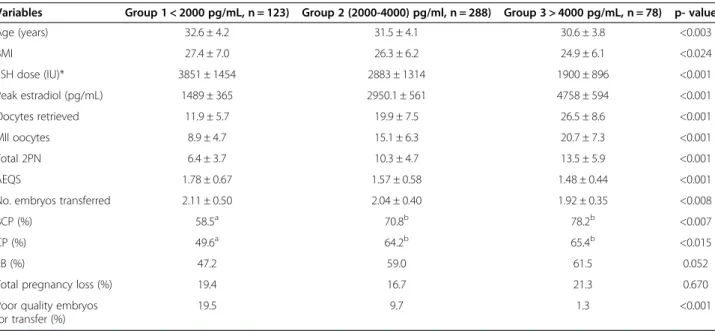
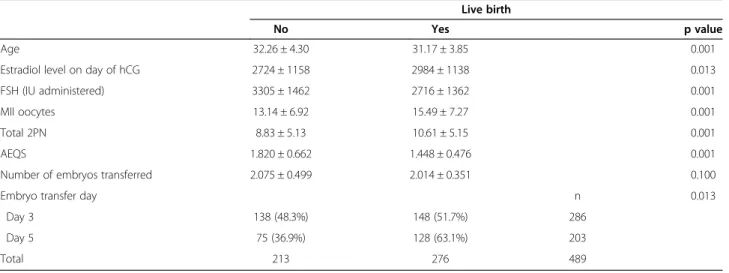
parameters for the entire population (n = 489) and the sub-group (n = 428) that had only good or fair quality embryos transferred, are summarized in Tables 2 and 3 respectively. For the entire population (Table 2), the higher estradiol groups were associated with greater biochemical and clin-ical pregnancy rates. Whereas, in the sub-group (Table 3), with fair to good embryo quality no association with estra-diol was observed on BCP, CPR or LBR in contrast to all other IVF response variables. Although live birth rates were greatest (NS, P = 0.052) in higher estradiol groups from the categorical analysis shown in Table 2, following the univariate analysis (Table 4) in which estradiol level was evaluated as a continuous variable, estradiol level had
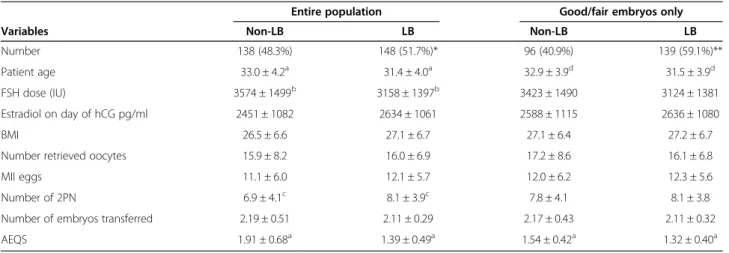
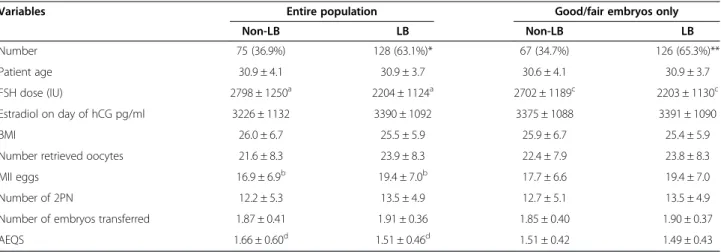
a significant (P = 0.013) effect on LB as did other covariates including age, FSH dosage, number of metaphase II (MII) oocytes, total 2PN embryos, AEQS and embryo transfer day. In the multivariate analysis (Table 5) however, estradiol level was not related to live birth. Only the main effects of AEQS, patient age, and the transfer of two embryos as opposed to 1 or 3, were found to significantly affect LB in the final model. The multivariate regression model also revealed significant two-way interactions be-tween transfer on day 5 and patient age (P < 0.01) and transfer on day 5 and FSH dose administered (P < 0.04). IVF response variables in the total population and in the subgroup containing only good and fair quality embryos on the day of embryo transfer were evaluated by live birth status. In the total population for day 3 transfers (Table 6) there were differences between the NLB and LB groups in patient age, FSH dose, number of 2PN embryos and AEQS, whereas, in the subgroup-only analysis, patient age and AEQS were different. In the total population for day 5 transfers (Table 7), FSH dose, number of MII eggs and AEQS differed. In the subgroup however, only FSH dose differed between NLB and LB. In the entire population the LB rate was greater for day 5 than for day 3 transfers. However, when the subgroup containing only good and fair embryos was evaluated, although the LB rate was slightly higher (65.3% vs 59.1%), the difference was no longer statistically significant.
In the final analysis, a subgroup of patients having em-bryo transfer on day 3 or day 5 that had an estradiol level of > 3000 pg/ml on the day of hCG were compared (Table 8). When embryo transfer was conducted on day
Table 1 Patient demographics of the entire population (n = 489)
Parameters Values
Age (years) 31.6 ± 4.1
BMI 25.9 ± 6.2
FSH administered (mIU) per patient 2969 ± 1434
Estradiol on day of hCG (pg/ml) 2871 ± 1153
Oocytes retrieved per patient 18.9 ± 8.6
MII oocytes per patient 14.5 ± 7.2
2PN embryos per patient 9.8 ± 5.2
Embryos transferred per patient 2.04 ± 0.42
Embryo quality at transfer (AEQS) per patient 1.61 ± 0.59
Percentage of day 3 transfers 286 (58.5%)
Percentage of day 5 transfers 203 (41.5%)
Mean ± 1SD.
Table 2 Estradiol groups in the entire population of patients and IVF outcome
Variables Group 1 < 2000 pg/mL, n = 123) Group 2 (2000-4000) pg/ml, n = 288) Group 3 > 4000 pg/mL, n = 78) p- value
Age (years) 32.6 ± 4.2 31.5 ± 4.1 30.6 ± 3.8 <0.003
BMI 27.4 ± 7.0 26.3 ± 6.2 24.9 ± 6.1 <0.024
FSH dose (IU)* 3851 ± 1454 2883 ± 1314 1900 ± 896 <0.001
Peak estradiol (pg/mL) 1489 ± 365 2950.1 ± 561 4758 ± 594 <0.001
Oocytes retrieved 11.9 ± 5.7 19.9 ± 7.5 26.5 ± 8.6 <0.001
MII oocytes 8.9 ± 4.7 15.1 ± 6.3 20.7 ± 7.3 <0.001
Total 2PN 6.4 ± 3.7 10.3 ± 4.7 13.5 ± 5.9 <0.001
AEQS 1.78 ± 0.67 1.57 ± 0.58 1.48 ± 0.44 <0.001
No. embryos transferred 2.11 ± 0.50 2.04 ± 0.40 1.92 ± 0.35 <0.008
BCP (%) 58.5a 70.8b 78.2b <0.007
CP (%) 49.6a 64.2b 65.4b <0.015
LB (%) 47.2 59.0 61.5 0.052
Total pregnancy loss (%) 19.4 16.7 21.3 0.670
Poor quality embryos for transfer (%)
19.5 9.7 1.3 <0.001
Mean ± 1SD.
3 or day 5 with high quality embryos, patients had simi-lar estradiol levels, with the number of oocytes retrieved, mature oocytes and number of 2PN embryos all being higher in the day 5 transfer group. However, there was no significant difference in the CPR or LBR for patients receiving a transfer on day 3 or day 5.
As another part of this analysis we examined if a high level of estradiol (>4200 pg/ml) on the day of hCG had a deleterious effect on pregnancy rate when compared to a group having moderate estradiol levels of >3000 pg ml and <4200 pg/ml, that had embryo transfer on day 3. As shown in Table 9, the estradiol level and number of oocytes retrieved were higher in the >4200 pg/ml group, but there was no difference in either the CPR or LBR between groups.
Discussion
This study examined the relationship between estradiol level and other IVF cycle response parameters in relation to pregnancy, with a focus on live births after controlling for embryo quality. In high responders there is usually an increased number of eggs retrieved resulting in more embryos and therefore, better embryo selection, leading to more patients undergoing transfer on day 5. In the case of poor responders the opposite is true as was dem-onstrated in the low estradiol group in Table 2. Here, there were fewer oocytes in spite of a higher dosage of FSH, which also resulted in fewer 2PN embryos and ul-timately poorer embryo selection at the time of transfer.
In our experience, patients having embryo transfer on day 3 can attain high pregnancy rates, but only if their
Table 3 Estradiol groups in a subpopulation having good or fair quality embryos for transfer and IVF outcome
Variables Group 1 (<2000 pg/mL, n = 95) Group 2 (2000-4000 pg/mL, n = 257) Group 3 > 4000 pg/mL, n = 76) p- value
Age (years) 32.6 ± 4.1 31.4 ± 3.9 30.6 ± 3.9 <0.003
BMI 28.3 ± 7.1 26.2 ± 6.1 24.8 ± 6.1 <0.002
FSH dose (IU)* 3677 ± 1416 2834 ± 1311 1904 ± 901 <0.001
Peak estradiol (pg/mL) 1506 ± 352 2965 ± 564 4763 ± 599 <0.001
Oocytes retrieved 12.5 ± 5.6 20.2 ± 7.4 26.7 ± 8.4 <0.001
MII oocytes 9.6 ± 4.7 15.5 ± 6.3 20.9 ± 7.3 <0.001
Total 2PN 7.0 ± 3.5 10.6 ± 4.7 13.7 ± 5.8 <0.001
AEQS 1.49 ± 0.43 1.43 ± 0.43 1.46 ± 0.42 <0.490
No. embryos transferred 2.11 ± 0.45 2.00 ± 0.35 1.91 ± 0.33 <0.002
BCP (%) 71.6 74.3 78.9 <0.640
CP (%) 62.1 68.5 65.8 <0.550
LB (%) 58.9 63.0 61.8 <0.810
Total pregnancy loss (%) 17.6 15.2 21.7 <0.540
Mean ± 1SD.
Chi-square and ANOVA tests as appropriate. For pregnancy related variables, within row, response variables with different superscripts differ at a minimum of P < 0.05. The number patients in the subpopulation were 428. *The n for FSH dose for the subpopulation was 413 due to missing values.
Table 4 Univariate analysis of the association of response variables with LB outcome
Live birth
No Yes p value
Age 32.26 ± 4.30 31.17 ± 3.85 0.001
Estradiol level on day of hCG 2724 ± 1158 2984 ± 1138 0.013
FSH (IU administered) 3305 ± 1462 2716 ± 1362 0.001
MII oocytes 13.14 ± 6.92 15.49 ± 7.27 0.001
Total 2PN 8.83 ± 5.13 10.61 ± 5.15 0.001
AEQS 1.820 ± 0.662 1.448 ± 0.476 0.001
Number of embryos transferred 2.075 ± 0.499 2.014 ± 0.351 0.100
Embryo transfer day n 0.013
Day 3 138 (48.3%) 148 (51.7%) 286
Day 5 75 (36.9%) 128 (63.1%) 203
embryo quality is not compromised. Therefore, we eval-uated a population of patients undergoing their initial IVF cycle to determine the relationship between serum estradiol level and IVF outcomes. We next evaluated a subgroup that included patients having only good or fair quality embryos transferred to study the influence of embryo quality on pregnancy rate and subsequent live birth outcome. Although our initial categorical analysis showed that in an unselected population of first time IVF patients, estradiol level was significantly related to better pregnancy rates (Table 2), in patients having only good or fair quality embryos transferred, (to control for embryo quality influence), estradiol level was no longer related to pregnancy outcome (Table 3). Patients in the
lowest estradiol group required the greatest amount of FSH, suggesting a significant component of this group was made up of poor responders. Since our primary interest was in understanding the relationship between live birth and elevated estradiol, we conducted a univari-ate analysis on the entire population to evaluunivari-ate the as-sociation of IVF response variables with LB outcome. This analysis showed that patient age, estradiol level, FSH dose, number of MII oocytes, total number of 2PN embryos, AEQS and day of transfer (day 3 or day 5) were all related to LB rate. After multiple regression to adjust for confounders and to test for interactions, the only main effects that significantly affected LBR were, AEQS (P < 0.001), the transfer of two embryos (P < 0.01)
Table 5 Multivariate logistic regression
Variables Beta Odds ratio Confidence limit p value
AEQS -1.07832 0.34017 (0.23316 - 0.49628) 0.001
Patient age -0.16244 0.85007 (0.73570 - 0.98221) 0.028
Estradiol level -0.00011 0.99989 (0.99968 - 1.00010) 0.308
Day 5 Embryo transfer -3.36729 0.03448 (0.00098 - 1.21223) 0.064
FSH dosage -0.00089 0.99911 (0.99782 - 1.00040) 0.175
Two embryos transferred 1.05610 2.87512 (1.25510–6.58623) 0.013
Three embryos transferred 1.02113 2.77634 (0.91250–8.44714) 0.072
Day 5 transfer X Age 0.14946 1.16121 (1.03430–1.30369) 0.011
Day 5 transfer X FSH dosage -0.00034 0.99966 (0.99933–0.99999) 0.042
Age X FSH dosage 0.00002 1.00002 (0.99999–1.00006) 0.224
Table 6 Response variables for the entire population and subgroup having good/fair quality embryos transferred on day 3
Entire population Good/fair embryos only
Variables Non-LB LB Non-LB LB
Number 138 (48.3%) 148 (51.7%)* 96 (40.9%) 139 (59.1%)**
Patient age 33.0 ± 4.2a 31.4 ± 4.0a 32.9 ± 3.9d 31.5 ± 3.9d
FSH dose (IU) 3574 ± 1499b 3158 ± 1397b 3423 ± 1490 3124 ± 1381
Estradiol on day of hCG pg/ml 2451 ± 1082 2634 ± 1061 2588 ± 1115 2636 ± 1080
BMI 26.5 ± 6.6 27.1 ± 6.7 27.1 ± 6.4 27.2 ± 6.7
Number retrieved oocytes 15.9 ± 8.2 16.0 ± 6.9 17.2 ± 8.6 16.1 ± 6.8
MII eggs 11.1 ± 6.0 12.1 ± 5.7 12.0 ± 6.2 12.3 ± 5.6
Number of 2PN 6.9 ± 4.1c 8.1 ± 3.9c 7.8 ± 4.1 8.1 ± 3.8
Number of embryos transferred 2.19 ± 0.51 2.11 ± 0.29 2.17 ± 0.43 2.11 ± 0.32
AEQS 1.91 ± 0.68a 1.39 ± 0.49a 1.54 ± 0.42a 1.32 ± 0.40a
All values are Mean ± 1SD.
Differences within row comparing the same response variable by pregnancy status (NLB or LB) for the entire population or patients having only good or fair quality embryos transferred having the same superscript are different;a
p <0.001;b
p <0.020;c
p <0.010,d
p <0.007. *Chi Square comparison for difference between Day 3 and Day 5 in the total population for Live Birth was p <0.02.
and the patient’s age (P < 0.03). The level of estradiol had no effect on LB rate (P = 0.308). We also found signifi-cant two-way interactions between transfer on day 5 and patient age (P < 0.01) as well as transfer on day 5 and FSH dose (P < 0.04). We interpret these interactions to mean that patients achieving a LB after transfer on day 5 were younger, and also required less FSH.
Some studies [20,21] have reported that estradiol was elevated in non-pregnant patients compared to preg-nant patients suggesting that an elevated estradiol level may be associated with not achieving pregnancy, al-though in one study [20] this was seen in patients hav-ing a day 3 transfer but not on day 5. To examine this question, we partitioned patients on the basis of LB sta-tus by day of transfer. Results from our study (Tables 6 and 7) and another study [17] do not support this
finding since estradiol was either higher or the same in LB patients compared to NLB patients.
Others [17,20,22] have proposed that elevated estradiol may have a negative influence on pregnancy but only when embryo transfer is performed on day 3, arguing that a supra-physiological estradiol environment may cause embryo-endometrial asynchrony which is allevi-ated if transfer is delayed until day 5. To address this question, we evaluated a subset of patients that had an estradiol level of > 3000 pg/ml on the day of hCG taken from the entire population (described in Table 2), which compares IVF cycle response variables for patients that had embryo transfer on day 3 or day 5. We chose to use the same estradiol cutoff range (>3000 pg/ml) used in a
Table 7 Response variables for the entire population and subgroup having good/fair quality embryos transferred on day 5
Variables Entire population Good/fair embryos only
Non-LB LB Non-LB LB
Number 75 (36.9%) 128 (63.1%)* 67 (34.7%) 126 (65.3%)**
Patient age 30.9 ± 4.1 30.9 ± 3.7 30.6 ± 4.1 30.9 ± 3.7
FSH dose (IU) 2798 ± 1250a 2204 ± 1124a 2702 ± 1189c 2203 ± 1130c
Estradiol on day of hCG pg/ml 3226 ± 1132 3390 ± 1092 3375 ± 1088 3391 ± 1090
BMI 26.0 ± 6.7 25.5 ± 5.9 25.9 ± 6.7 25.4 ± 5.9
Number retrieved oocytes 21.6 ± 8.3 23.9 ± 8.3 22.4 ± 7.9 23.8 ± 8.3
MII eggs 16.9 ± 6.9b 19.4 ± 7.0b 17.7 ± 6.6 19.4 ± 7.0
Number of 2PN 12.2 ± 5.3 13.5 ± 4.9 12.7 ± 5.1 13.5 ± 4.9
Number of embryos transferred 1.87 ± 0.41 1.91 ± 0.36 1.85 ± 0.40 1.90 ± 0.37
AEQS 1.66 ± 0.60d 1.51 ± 0.46d 1.51 ± 0.42 1.49 ± 0.43
All values are Mean ± 1SD.
Differences within row comparing the same response variable by pregnancy status (NLB or LB) for the entire population or patients having only good or fair quality embryos transferred having the same superscript are different;a
p <0.001;b
p < 0.010,c
p < 0.007,d
p <0.040. *Chi Square comparison for difference between Day 3 and Day 5 in the total population for Live Birth was p < 0.02.
**Chi Square comparison for difference between Day 3 and Day 5 in populations with only good or fair quality embryos used for transfer was NS.
Table 8 Comparison between patients having transfer on day 3 or day 5 with estradiol levels >3000 pg/ml on the day of hCG with *high quality embryos transferred
Variables Day 3 Day 5 p value
Number 52 80
Estradiol level 3859 ± 595 4037 ± 799 0.17 NS
Oocytes collected 21.6 ± 8.4 26.4 ± 8.8 < 0.002
Number of MII oocytes 15.2 ± 6.4 21.7 ± 7.2 < 0.0001
Number of 2PN embryos 8.5 ± 4.2 15.2 ± 5.5 < 0.0001
Number of embryos transferred 2.04 ± 0.19 1.85 ± 0.36 < 0.006
AEQS 1.18 ± 0.24 1.23 ± 0.25 0.25 NS
CPR 33/52 (63.5%) 55/80 (68.7%) NS
LBR 30/52 (57.8%) 52/80 (65.0%) NS
*High quality embryos were embryos having a AEQS of 1.0–1.5.
Table 9 Comparisons between patients having day 3 embryo transfer with moderate (>3000 < 4200 pg/ml) or high (>4200 pg/ml) estradiol levels on the day of hCG administration
Variables Estradiol Level p value
>3000 < 4200 pg/ml
>4200 pg/ml
Number 63 22
Estradiol level 3529 ± 303 4872 ± 619 < 0.0001
Oocytes collected 19.24 ± 8.12 25.0 ± 8.3 < 0.005
Number of 2PN embryos 8.35 ± 3.92 10.1 ± 4.15 < 0.08 NS
Number of embryos transferred
2.19 ± 0.40 2.09 ± 0.29 < 0.29 NS
AEQS 1.62 ± 0.66 1.51 ± 0.46 < 0.47 NS
CPR 37 (58.7%) 15 (68.2%) NS
SAB 5 (15.6%) 3 (20.0%) NS
recent publication [20]. Our results (Table 8) show that in contrast to this report, we found no statistical differ-ence in CPR or LBR in patients undergoing embryo transfer on day 3 or day 5 although CPR and LBR were slightly higher for patients having transfer on day 5. The study of Elgindy et al. [20] was a randomized controlled trial that had strict exclusion criteria (patient age <35 with regular cycles and a minimum of 4 good quality embryos on day 3 of culture). By design, the estradiol level, number of oocytes retrieved, number of 2PN em-bryos and number of good quality emem-bryos were all similar for the day 3 and day 5 transfer groups. Although ours was a retrospective cohort study we believe it is more reflective of a typical population of patients under-going an initial IVF cycle. In contrast to the referenced study [20] the day of embryo transfer in our study was decided based on the number and quality of embryos, an approach similar to that used in an earlier study [22]. Therefore some bias exists which placed more patients having numerous high quality embryos in the group hav-ing embryo transfer on day 5. In our study estradiol levels were not different between patients having transfer on day 3 or day 5 but there were a significantly greater number of oocytes retrieved and 2PN embryos with fewer embryos being transferred on day 5. Of the pa-tients used in our study, 17% were diagnosed as having PCOS using the Rotterdam criteria [24] and therefore probably constituted a significant number of high responding patients. These differences may at least par-tially explain the divergent conclusions drawn from the two studies. To further examine if patients having an el-evated level of estradiol on day 3 had a different preg-nancy rate compared to patients having a moderate level of estradiol undergoing embryo transfer on day 3, we performed an additional subgroup analysis. Our high es-tradiol group had a level of >4200 pg/ml and the moder-ate estradiol group had a level >3000 and < 4200 pg/ml, which are the same ranges used by Elgindy et al. [20]. Our results, shown in Table 9, demonstrate that the average estradiol level and number of oocytes collected were higher in the high estradiol group but there was no significant difference in CPR or LBR when compared to the moderate estradiol group, which is a conclusion not supported in the previous referenced study [20]. Under-standing and managing the high responding patient is a challenge to physicians in the clinical setting of IVF. There is an increased chance of patients developing ovarian hyper-stimulation syndrome (OHSS), which in our study was low, with only four patients out of 489 (0.08%) exhibiting moderate/severe OHSS that required paracentesis, all of which were in the moderate estradiol group (2000-4000 pg/ml) described in Table 2 and none of which had any long term adverse effects. Aside from the possibility of OHSS, much has been written about
supra-physiological levels of estradiol and progesterone potentially causing endometrial-embryo asynchrony which could negatively impact pregnancy rates.
Several reports have shown that in high responding patients there is a concomitant increase in estradiol, pro-gesterone and the number of retrieved oocytes [25-27] which may have a physiological linkage. In the case of high responders, the relationship between elevated levels of estradiol and progesterone was recently examined. Wu et al. [18] found that elevated levels of estradiol were not detrimental to live birth rate when progesterone levels were < 1.05 ng/ml whereas; when progesterone levels exceeded this threshold LB rates were compromised. Another study [27] examined this same relationship ex-cept the focus was on evaluating different progesterone thresholds. Their conclusion was that high progester-one correlated with high estradiol levels and that in
high responders’ progesterone levels did not show any
clinical impact, although a slight compromise was ob-served when a threshold of 1.8 ng/ml was exceeded. This study confirmed earlier work [28] which had shown that progesterone levels >1.5 ng/ml on the day of hCG reduced the chance of pregnancy in low and normal responders but not in high responders. On the basis of our results and the results of others, high responding patients are different than poor or normally responding patients regarding pregnancy outcomes and therefore this category of patients should be evaluated aside from the general population of patients. For this reason more large scale studies need to be performed that will elucidate if high responding patients are sub-ject to hormone thresholds that if exceeded, could im-pair live birth rates. A limitation of our study was that progesterone levels on the day of hCG were not in-cluded, but unfortunately these values were not avail-able. It is also important to point out that it is generally accepted that the supra-physiological hormone environ-ment found in high responding patients does not have a negative effect on embryo quality or developmental potential. This has been borne out by studies in which embryos exposed to this environment and transferred to embryo recipients [11] or cryopreserved and trans-ferred in a subsequent cycle [6] had no adverse effect on pregnancy rates. Results from our study indicate that, at least in the case of elevated levels of estradiol, no adverse effect on live birth rate is seen, regardless if embryo transfer was conducted on day 3 or day 5. Ra-ther, our results show that the quality of transferred embryos and patient age are the primary determinants of having a live birth.
Conclusions
estradiol on the day of hCG is neither directly detri-mental nor advantageous to having a live birth. Our study shows that average embryo quality at transfer is the primary determinant in establishing a LB while patient age and the transfer of two embryos are also important. Significant interactions showed that there is interplay occurring between embryo transfer on day 5 and a lower dose requirement of FSH and younger patient age, both of which appear to contribute to an increased LB rate. An elevated level of estradiol should be viewed in the context of being part of the profile of
a “high responder” requiring less FSH, more oocytes
retrieved, more mature oocytes and more 2PN em-bryos. Yet, it is interesting that all of these response variables were found to not impact LB rate. On the basis of comparable live birth rates, our data also sug-gest that embryos of high quality appear to tolerate an arguably sub-optimal uterine environment that has been exposed to supra-physiological levels of estradiol.
While our study has demonstrated that elevated estra-diol has no effect on live birth rate, in the light of some recent studies [29-31] showing that elevated estradiol may interfere with some aspects of placentation which in turn can contribute to an increased incidence of pre-eclampsia and small for gestational age (SGA) offspring, it is imperative that larger prospective studies be conducted to determine if this hormone environment is responsible for these effects. If the initial findings are substantiated perhaps it is time to seek a more compre-hensive definition of IVF success that encompasses fetal and neonatal well-being and to look beyond live birth as the singular metric by which IVF success is defined.
Abbreviations
2PN:Embryos with two pronuclei; ANOVA: Analysis of variance; AEQS: Average embryo quality score; BCP: Biochemical pregnancy; CP: Clinical pregnancy; CPR: Clinical pregnancy rate; FSH: Follicle stimulating hormone; GnRH: Gonadotropin releasing hormone; GPS: Global protein supplement; hCG: Human choronic gonadotropin; hMG: Human menopausal gonadotropin; HSA: Human serum albumen; HTF: Human tubal fluid; ICM: Inner cell mass; ICSI: Intracellular sperm injection; IM: Intramuscular; IVF: In Vitro Fertilization; LB: Live birth; LBR: Live birth rate; MII: Metaphase II; mHTF: Modified (HEPES) human tubal fluid; NLB: Non-live birth;
TE: Trophectoderm.
Competing interests
The authors declare that they have no competing interests.
Authors’contributions
MZ and KH played a role in the conception and design, analysis and interpretation of the data and drafting of the manuscript. LC played a role in the conception, design and review of the manuscript, RW played a role in the analysis and interpretation of the data and review of the manuscript. SK played a role in the initial conception and design of the manuscript and DO’L aided in the statistical interpretation of the data. All authors read and approved the final manuscript.
Acknowledgements
The authors thank Mr. Michael Bradford Zavy (Section of Reproductive Endocrinology and Infertility) for his help in database management used in this study.
Author details 1
Section of Reproductive Endocrinology and Infertility Department of Obstetrics and Gynecology, Oklahoma University Health Sciences Center, Oklahoma City, Oklahoma, USA.2Section of Uro-gynecology, Department of Obstetrics and Gynecology, Oklahoma University Health Sciences Center, Oklahoma City, Oklahoma, USA.
Received: 10 September 2014 Accepted: 20 November 2014 Published: 28 November 2014
References
1. Chenette PE, Sauer MV, Paulson RJ:Very high serum E2levels are not
detrimental to clinical outcome of in vitro fertilization.Fertil Steril1990, 54:858–863.
2. Gelety TJ, Buyalos RP:The influence of supraphysiologic E2levels on
human nidation.J Assist Reprod Genet1995,12:406–412.
3. Blazar AS, Hogan JW, Frankfurter D, Hackett R, Keefe DL:Serum estradiol positively predicts outcomes in patients undergoing in vitro fertilization. Fertil Steril2004,81:1707–1709.
4. Kummer N, Benadiva C, Feinn R, Mann J, Nulsen J, Engmann:Factors that predict the probability of a successful clinical outcome after induction of oocyte maturation with a gonadotropin-releasing hormone agonist. Fertil Steril2011,96:63–68.
5. Simon C, Cano F, Valbuena D, Remohi J, Pellicer A:Clinical evidence for a detrimental effect on uterine receptivity of high serum oestradiol concentrations in high and normal responder patients.Hum Reprod1995, 10:2432–2437.
6. Ng EHY, Yeung WSB, Lau EYL, So WWK, Ho PC:High serum estradiol concentrations in fresh IVF cycles do not impair implantation and pregnancy rates in subsequent frozen- thawed embryo transfer cycles. Hum Reprod2000,15:250–255.
7. Chen QJ, Sun XX, Li L, Gao XH, Wu Y, Gemzell-Danielsson K, Chen LN: Effects of ovarian high response on implantation and pregnancy outcome during controlled ovarian hyperstimulation (with GnRH agonist and rFSH).Acta Obstet Gynecol Scand2007,86:849–854.
8. Arslan M, Bocca S, Ozturk E, Hakan A, Duran E, Stadtmauer L, Oehninger S: Cumulative exposure to high estradiol levels during the follicular phase of IVF cycles negatively affects implantation.J Assist Reprod Genet2007, 24:111–117.
9. Sharara FI, McClamrock HD:High estradiol levels and high oocyte yield are not detrimental to in vitro fertilization outcome.Fertil Steril1999, 72:401–405.
10. Levi AJ, Drews MR, Bergh PA, Miller BT, Scott RT:Controlled ovarian hyperstimulation does not adversely affect endometrial receptivity in in vitro fertilization cycles.Fertil Steril2001,76:670–674.
11. Pena JE, Chang PL, Chan LK, Zeitoun K, Thornton MH, Sauer MV: Supraphysiological estradiol levels do not affect oocyte and embryo quality in oocyte donation cycles.Hum Reprod2002,17:83–87. 12. Papageorgiou T, Guibert J, Goffinet F, Patrat C, Fulla Y, Janssens Y, Zorn JR:
Percentile curves of serum estradiol levels during controlled ovarian stimulation in 905 cycles stimulated with recombinant FSH show that high estradiol is not detrimental to IVF outcome.Hum Reprod2002, 17:2846–2850.
13. Ulug U, Tosun S, Jozwiak EA, Mesut A, Sismanohlu A, Bahceci M:Subclinical pregnancy losses among women undergoing in-vitro fertilization with ICSI.J Assist Reprod Genet2006,23:261–267.
14. Wu CH, Kuo TC, Wu HH, Yeh GP, Tsai HD:High serum estradiol levels are not detrimental to in vitro fertilization outcome.Taiwan J Obstet Gynecol 2007,46:54–59.
15. Kong GWS, Cheung LP, Haines CJ:Comprehensive assessment of serum estradiol impact on selected physiologic markers observed during in-vitro fertilization and embryo transfer cycles.J Exp Clin Assist Reprod2009, 6:5–13.
16. Yoldemir T, Fraser IS:The effect of elevated serum estradiol levels on the day of human chorionic gonadotropin injection on pregnancy outcomes in an assisted reproduction program.Aust N Z J Obstet Gynecol2009, 49:545–550.
rates in patients treated with rec-FSH/GnRH antagonist?Hum Reprod 2009,24:2902–2909.
18. Wu Z, Li R, Ma Y, Deng B, Zhang X, Meng Y, Chen X, Liu P, Qiao J: Effect of HCG-day serum progesterone and oestradiol concentrations on pregnancy outcomes in GnRH agonist cycles.Reprod BioMed Online2012, 24:511–520.
19. Kosmas IP, Kolibianakis EM, Devroey P:Association of estradiol levels on the day of hCG administration and pregnancy achievement in IVF: a systematic review.Hum Reprod2004,19:2446–2453.
20. Elgindy EA, Abou-Setta AM, Mostafa MI:Blastocyst-stage versus cleavage-stage embryo transfer in women with high oestradiol concentrations; randomized controlled trial.Reprod BioMed Online2011,23:789–798. 21. Moraloglu O, Tongue EA, Ozel M, Ozaksit G, Var T, Sarikaya E:The effect of
peak and mid-luteal estradiol levels on in vitro fertilization outcome. Arch Gynecol Obstet2012,285:857–862.
22. Chen CH, Zhang X, Barnes R, Confino E, Milad M, Puscheck P, Kazer RR: Relationship between peak serum estradiol and treatment outcome in in vitro fertilization cycles after embryo transfer on day 3 or day 5. Fertil Steril2003,80:75–79.
23. Racowsky C, Vernon MV, Mayer J, Ball GD, Behr B, Pomeroy KO, Wininger D, Gibbons W, Conaghan J, Stern JE:Standardization of grading embryo morphology.Fertil Steril2010,94:1152–1153.
24. Fr DD, Tarlatzis R:Revised 2003 consensus on diagnostic criteria and long-term health risks related to polycystic ovarian syndrome. Fertil Steril2004,81:19–25.
25. Kyrou D, AlAzemi M, Papanikolaou EG, Donoso P, Tziomalos K, Devroey P, Fatemi HM:The relationship between premature progesterone rise with serum estradiol levels and number of follicles in GnRH antagonist/ recombinant FSH-stimulated cycles.Eur J Obstet Gynecol Reprod Biol2012, 162:165–168.
26. Fatemi HM, Doody K, Griesinger G, Witjes H, Mannaerts B:High ovarian response does not jeopardize ongoing pregnancy rates and increases cumulative pregnancy rates in GnRH-antagonist protocol.Hum Reprod 2013,28:442–452.
27. Requena A, Cruz M, Bosch E, Meseguer M, Garcia-Velasco JA:High progesterone levels in women with high ovarian response do not affect clinical outcomes: a retrospective cohort study.Reprod Biol and Endocrinol 2014,12:69–75.
28. Griesinger G, Mannaerts B, Andersen CY, Witjes H, Kolibianakis EM, Gordon K:Progesterone elevation does not compromise pregnancy rates in high responders: a pooled analysis of in vitro fertilization patients treated with recombinant follicle-stimulating hormone/gonadotropin-releasing hormone antagonist in six trials.Fertil Steril2013,100:1622–1628. 29. Farhi J, Haroush AB, Andrawus N, Pinkas H, Sapir O, Fisch B, Ashkenazi J:
High serum oestradiol concentrations in IVF cycles increase the risk of pregnancy complications related to abnormal placentation. Reprod BioMed Online2010,21:331–337.
30. Imudia AN, Awonuga AO, Doyle JO, Kaimal AJ, Wright DL, Toth TL, Styer AK: Peak serum estradiol level during controlled ovarian hyperstimulation is associated with increased risk of small for gestational age and preeclampsia in singleton pregnancies after in vitro fertilization. Fertil Steril2012,97:1374–1379.
31. Hu XL, Feng C, Lin XH, Zhong ZX, Zhu YM, Lv PP, Lv M, Meng Y, Zhang D, Lu XE, Jin F, Sheng JZ, Xu J, Huang HF:High maternal serum estradiol environment in the first trimester is associated with the increased risk of small-for-gestational-age birth.J Clin Endocrinol Metab2014,99:2217–2224.
doi:10.1186/1477-7827-12-119
Cite this article as:Zavyet al.:In high responding patients undergoing an initial IVF cycle, elevated estradiol on the day of hCG has no effect on live birth rate.Reproductive Biology and Endocrinology201412:119.
Submit your next manuscript to BioMed Central and take full advantage of:
• Convenient online submission
• Thorough peer review
• No space constraints or color figure charges
• Immediate publication on acceptance
• Inclusion in PubMed, CAS, Scopus and Google Scholar
• Research which is freely available for redistribution