AUSTRALIAN JOURNAL OF BASIC AND
Open Access Journal
Published BY AENSI Publication
© 2016 AENSI Publisher All rights reserved
This work is licensed under the Creative Commons Attribution International License (CC BY).
http://creativecommons.org/licenses/by/4.0/
To Cite This Article: M. Azees and P.Vijayakumar Networks. Aust. J. Basic & Appl. Sci., 10(2):
CEKD: Computationally Efficient Key Distribution Scheme for
Ad-Hoc Networks
1M. Azees and 2P.Vijayakumar
1
Research Scholar, University College of Engineering Tindivanam
2Dean, University College of Engineering Tindivanam
Address For Correspondence:
M. Azess, Research Scholar, Department of Computer Science and Engineering, University College of Engineering Tindivana Tamilnadu, India. Tel: +91-7708976657, email: [email protected]
A R T I C L E I N F O Article history:
Received 04 December 2015 Accepted 22 January 2016 Available online 14 February 2016
Keywords:
Group communication, Key distribution, Vehicular ad-hoc networks (VANETs), bilinear pairing, group key.
Today, vehicle accidents are one of the leading causes of death in the world and also the traffic jams make a terrific waste of time and fuel. So the Vehicular Ad
of research to improve the driving expe
VANET users. VANET can noticeably increase the knowledge of the surrounding environment of drivers in the road transport system (Zhang et al
vehicles or mobile nodes in which On Board Units (OBUs) are equipped for computation and communication purposes, Road Side Units (RSUs) that are fixed infrastructures located aside the roads, and a Trusted Authority (TA) has the responsibility of maintaining the whole transport system. In VANETs, a vehicle that can be shared the information with other vehicle through Vehicle
Vehicle-to-RSU (V2R) communications. The V2V communicat
improve traffic safety and traffic efficiency. For V2V and V2R communications, the Dedicated Short Range Communication (DSRC) radios [DSRC
communication and communication among RSU’s are performed through a secured wired channel. But the V2V communication and the V2R communications are performed through a wireless channel. Hence, it is necessary to protect the wireless channel from the various kin
protected then the private data, such as the group key for group com 2010).
Several approaches have been proposed to securely distribute the group key b key exchange protocol. However, the main problem with such approaches is that the man
In this attack, the intruder secretly alters the communication between two entities who believe that they are directly communicating with each other. The main purpose of the proposed key distribution scheme is to enable
AUSTRALIAN JOURNAL OF BASIC AND
APPLIED SCIENCES
ISSN:1991-8178 EISSN: 2309-8414 Journal home page: www.ajbasweb.com
2016 AENSI Publisher All rights reserved
This work is licensed under the Creative Commons Attribution International License (CC BY).
http://creativecommons.org/licenses/by/4.0/
M. Azees and P.Vijayakumar, CEKD: Computationally Efficient Key Distribution Scheme for Vehicular Ad ): 171-175, 2016
CEKD: Computationally Efficient Key Distribution Scheme for
University College of Engineering Tindivanam, Department of CSE, Tamilnadu, India. lege of Engineering Tindivanam, Tamilnadu, India.
M. Azess, Research Scholar, Department of Computer Science and Engineering, University College of Engineering Tindivana 7708976657, email: [email protected]
A B S T R A C T
In vehicular ad-hoc networks, secure and reliable group communication is an energetic area of research. Today, the most important research challenge is an efficient group key distribution for a secure group communication. Even though there are many group key distribution protocols, they have the security and performance weakness. In this paper, we propose a computationally efficient group key distribution scheme for secure group communication based on bilinear pairing. The proposed CEKD scheme provides better performance in comparison with most of the previously proposed key distribution schemes in terms of computation cost, making it suitable for secure group communication in VANETs.
INTRODUCTION
Today, vehicle accidents are one of the leading causes of death in the world and also the traffic jams make a terrific waste of time and fuel. So the Vehicular Ad-hoc Network (VANET) has become an unavoidable subject of research to improve the driving experience, traffic safety, and multimedia infotainment propagation for VANET users. VANET can noticeably increase the knowledge of the surrounding environment of drivers in the
et al., 2008). Basically, a VANET consists of three major components that are
vehicles or mobile nodes in which On Board Units (OBUs) are equipped for computation and communication purposes, Road Side Units (RSUs) that are fixed infrastructures located aside the roads, and a Trusted Authority sponsibility of maintaining the whole transport system. In VANETs, a vehicle that can be shared the information with other vehicle through Vehicle-to-Vehicle (V2V) communications, or with RSU, through RSU (V2R) communications. The V2V communications and the V2R communications are used to improve traffic safety and traffic efficiency. For V2V and V2R communications, the Dedicated Short Range DSRC] are deployed in each vehicle and in all RSUs. In VANETs, RSU to TA nication and communication among RSU’s are performed through a secured wired channel. But the V2V communication and the V2R communications are performed through a wireless channel. Hence, it is necessary to protect the wireless channel from the various kinds of security attacks. If the communication is not properly protected then the private data, such as the group key for group communication has to be revealed
Several approaches have been proposed to securely distribute the group key based on the Diffie key exchange protocol. However, the main problem with such approaches is that the man
In this attack, the intruder secretly alters the communication between two entities who believe that they are mmunicating with each other. The main purpose of the proposed key distribution scheme is to enable
Efficient Key Distribution Scheme for Vehicular Ad-Hoc
CEKD: Computationally Efficient Key Distribution Scheme for Vehicular
M. Azess, Research Scholar, Department of Computer Science and Engineering, University College of Engineering Tindivanam,
hoc networks, secure and reliable group communication is an energetic area of research. Today, the most important research challenge is an efficient group key secure group communication. Even though there are many group key distribution protocols, they have the security and performance weakness. In this paper, we propose a computationally efficient group key distribution scheme for secure group ed on bilinear pairing. The proposed CEKD scheme provides better performance in comparison with most of the previously proposed key distribution schemes in terms of computation cost, making it suitable for secure group
Today, vehicle accidents are one of the leading causes of death in the world and also the traffic jams make a hoc Network (VANET) has become an unavoidable subject rience, traffic safety, and multimedia infotainment propagation for VANET users. VANET can noticeably increase the knowledge of the surrounding environment of drivers in the ajor components that are vehicles or mobile nodes in which On Board Units (OBUs) are equipped for computation and communication purposes, Road Side Units (RSUs) that are fixed infrastructures located aside the roads, and a Trusted Authority sponsibility of maintaining the whole transport system. In VANETs, a vehicle that can be shared Vehicle (V2V) communications, or with RSU, through ions and the V2R communications are used to improve traffic safety and traffic efficiency. For V2V and V2R communications, the Dedicated Short Range ] are deployed in each vehicle and in all RSUs. In VANETs, RSU to TA nication and communication among RSU’s are performed through a secured wired channel. But the V2V communication and the V2R communications are performed through a wireless channel. Hence, it is necessary ds of security attacks. If the communication is not properly munication has to be revealed (Sun et al.,
the TA to securely and efficiently exchange the group key to the group members in the group. The proposed scheme depends on the hardness of computing discrete logarithms.
This paper is organized as follows. Section 2 provides the related works. Section 3 presents the system model and preliminaries. Section 4 discusses the proposed CEKD scheme. Section 5 and Section 6 analyze the security strength and performance respectively. Finally, we draw the conclusion in section 7.
Related Works:
In order to distribute a group key in a secure manner, large amounts of work have been proposed. However, most of these approaches suffer from the computation overhead during key distribution. Joux (2000) proposed a tripartite key agreement protocol based on bilinear pairings over the elliptic curves. Since there is no secure authentication protocol between the communicating parties, this scheme is affected by the man-in-the-middle attack.Hao et al. (2008) proposed a distributed key management scheme based on group signature for a secure group communication in VANETs. In this scheme, the RSUs act as the group key distributor for each group. Since, the RSUs are considered to be semi-trusted, the compromised RSU may misbehave and reveal the group key to adversaries. Xiaozhuo et al. (2015) proposed a Huffman-tree-based pairing free authenticated certificateless group key agreement protocol for minimizing the group key distribution time and the rekeying time in the join/departure events. Since there is no authentication procedure between the communicating parties before the group key distribution, this scheme has a security weakness in terms of man-in-the-middle attack.
System Model and Preliminaries:
3.1 System model:
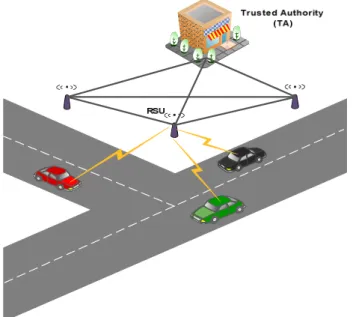
The system model of the proposed system is depicted in Fig.1. which includes a TA, fixed RSUs at the road side, and OBUs equipped in mobile vehicles.
• TA is a trusted administrative center, which provides registration to RSUs and OBUs when they join into the VANET system. The TA has the full responsibility to maintain the entire VANET system. It also divides the entire VANET system into several domains. Generally, it is assumed that the TA is infeasible to compromise by an adversary and it has high communication, computation and storage capabilities.
Fig. 1: System model
Table I: Location Based Safety Information(LBSI)
Information Range
Petrol station 20 m
Speed breaker 25 m
Traffic signal 50 m
Curve speed warning 71 m
School zone 114 m
Road intersections 170 m
Accident zone 200 m
• OBUs are installed in each vehicle to communicate with other vehicles and RSUs. OBUs broadcast traffic-related status information such as location, speed, and direction periodically to other vehicles to avoid road accidents.
3.2 Bilinear Pairing:
Let and be multiplicative cyclic groups generated by and respectively and be a multiplicative cyclic group. , and have the same prime order , i.e. , | | = | | = | | = . Let ∶ × → is a bilinear map, which satisfies the following properties:
1) Bilinear: ( , ) = ( , ) for all ∈ , ∈ and , ∈ ∗. 2) Nondegeneracy: There exist ∈ , ∈ such that ( , ) ≠ 1 . 3) Computable: Bilinear map is efficiently computable for any ∈ , ∈ .
Proposed CEKD Scheme:
This section has the following phases: system initialization, VANET license issuing and the proposed CEKD scheme.
4.1 System Initialization:
The TA first picks a random number ∈ ∗ as the TA’s master secret key and a random number ∈ ∗ as the TA’s private key. The public key of TA is computed by performing a elliptic curve based point multiplication of with a generator . != is the TA’s public key. Then the TA publishes { ,
!, , } as the system parameters.
4.2 VANET license issuing:
The vehicle user first directly goes to the TA and provides their personal information (i.e., username, address, mail id, personal password, license plate number and mobile phone number) for authentication when they connect to the VANET from his/her vehicle. After providing the personal information, the TA verifies and issues the certificate $%&'( to the vehicle )* as follows.
1. TA chooses a random number *∈ ∗ for each vehicle and considering this as the private key of )*, and computes its corresponding public key '( = * .
2. TA then generates the VANET license )+'( for )*, where )+'( = * . 3. Then, the TA computes a seed value ,= ( *+ ). for each vehicle )*.
4. The TA provides ,, *, '(and )+'( to )* in the offline mode after the successful completion of vehicle’s successful registration. The values , and *arekept secret by the VANET user.
5. Next, TA keeps(ID − )*, )+'(, ,, *) in its tracking list, where ID − )* is the identity of )* assigned by the TA.
6.
4.3 Proposed CEKD scheme:
a. For a secure group communication, each vehicle user )* first selects a session key 2* ∈ ∗ and computes
3*= 2*( '(+ !) 3*= 2*( * + )
3*= 2*( *+ )
Then, each user also computes the identification key (4*) as follows
4*= (3*, ,)
4*= (2*( *+ ) , ( *+ ). )
4*= ( , )5(( (67)∗ ( (67)89
After computing the value of 4*, each user sends {3*∥ )+'(} to the TA. After receiving these parameters from the vehicle user )*, the TA verifies the )+'(from it’s tracking list and then it computes the 4* value for each vehicle user )*.
b. Then the TA chooses a group key ;< ∈ ∗ and then creates a Lagrange interpolating polynomial of
degree = − 1, where = is the number of users in the group.
(>) = ∑ (;< +@
*A *)B∏@GA ED.E(.EFF
GH* I
= JK+ J > + ⋯ + J@. >@.
Then the TA sends (JK, J , … J@. ) to each user )*.
c. After receiving the coefficients (JK, J , … J@. ) from the TA each user )*uses its own 4* value to
recover the group key ;< as follows:
(4*) = JK+ J 4* + ⋯ + J@. 4*@.
= ;< + *
Then, each user recovers the group key by subtracting its own private key from ;< + *. This group key is
used to make group communication with the group members in the group.
Security analysis:
In this section, we evaluate the security strength of our proposed scheme with respect to the user authentication, impersonation attack and man-in-the-middle attack.
User Authentication:
The VANET license )+'( = * for each vehicle user )* is computed by the TA using each user’s private key and its master key. So, it is assured that no other users compute )+'(except the TA who has both the private key of )* and the master key. Since, each vehicle user )* sends {3*∥ )+'(} to the TA for getting the group key, the TA can authenticate )* from )+'( before providing the group key to them.
Impersonation:
Let’s consider that )*’s private key and its license )+'(is revealed. An adversary wants to pretend as the vehicle user )* to the TA to get the group key. However, cannot compute the identification key 4* without knowing the seed value , which is given by the TA to )* during the time of user registration.
Man-in-the-middle attack:
Based on the above analysis about user authentication, the proposed CEKD scheme for secure key distribution could provide authentication between the communicating parties. Therefore, the proposed CEKD scheme could withstand the man-in-the-middle attack.
Performance Analysis:
In this section, we compare the performance of our proposed CEKD scheme with the previously proposed key distribution schemes in terms of computational cost. The computational cost is defined as the total time required for the vehicle user to get the group key from the TA. The computational cost of CEKD scheme is compared with many existing schemes, namely DIKE (Lu et al., 2012), ID-AGKA (Du et al., 2003), HPF-CLGKA (Xiaozhuo et al., 2015) and Teng’s scheme [Teng and C.K Wu]. Let us consider &N represents the time required for performing a pairing operation, &O represents the time required for performing a hash operation and
&P represents the time required for performing point multiplication.
For performing the hash operation, point multiplication and pairing operation, the pairing-based cryptography (PBC) library [Pairing-Based Cryptography] is used in this paper. For the aforementioned operations, the Type-A curve defined in the PBC library is used with the default parameters. In order to measure the actual computation time of our proposed CEKD scheme, we have used a 2-GHz machine with 4-GB installed memory, running Cygwin 1.7.35–15 [Cygwin] with the gcc version 4.9.2 for our implementations.
All the results are analyzed over 100 randomized simulation runs and then the average of the results is considered. In our simulations, the time parameters &N, &O and &P are measured and it is found to be equal to 1.6 ms (milliseconds), 2.7 ms, and 0.001 ms, respectively.
Table II: Computational Cost of Various Key Distribution Schemes
Method For one user For = users
DIKE 3&N+ 2&O (2= + 1)&N+ 2=&OO
ID-AGKA 4&N+ 6&P 4=&N+ =(= + 1)&P
Teng’s
scheme 2&N+ 2&P+ &O 2=&N+ 2=&P+ =&O
CEKD
(PROPOSED) 2&N+ &P 2=&N+ =&P
From Table II, it can be observed that our proposed CEKD scheme requires only two pairing and one point multiplication operation to get the ;< from the TA and hence CEKD takes low computational cost compared to other existing schemes.
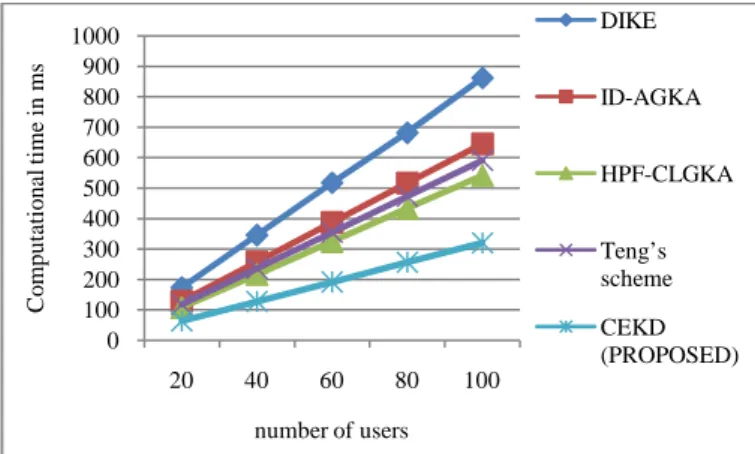
Fig. 2: Computational cost for key distribution
From Fig.2, it is very clear to understand that our proposed CEKD scheme takes only 320 ms for a secure group key distribution from the TA to the vehicle user. However, other existing schemes take more than 500 ms for secure group key distribution.
Conclusion:
In this paper, we have proposed CEKD scheme for secure group key distribution in VANETs. In order to avoid the man-in-the-middle attack, the TA performs the authentication process for each vehicle user )* before distributing the group key. The security analysis section shows that the weaknesses of previously proposed schemes can be overcome by the proposed CEKD scheme and hence satisfies the security requirements. The performance analysis section shows that the proposed CEKD scheme takes low computational cost which makes it suitable for the VANET environment.
REFERENCES
Zhang, C., R. Lu, X. Lin, P.-H. Ho and X. Shen, 2008. An efficient identity- based batch verification scheme for vehicular sensor networks. in Proc. IEEE INFOCOM, Phoenix, AZ, USA: 246-250.
DSRC, http://grouper.ieee.org/groups/scc32/top_lvl3.html
Sun, Y., R. Lu, X. Lin, X. Shen and J. Su, 2010. An efficient pseudonymous authentication scheme with strong privacy preservation for vehicular communications. IEEE Trans. Veh. Technol., 59(7): 3589-3603.
Joux, 2000. A one round protocol for tripartite Diffie-Hellman. 2000. Proc. ANTS IV, LNCS 1838, Springer-Verlag pp: 385-394.
Lu, R., X. Lin, X. Liang and X. Shen, 2012. A Dynamic Privacy-Preserving Key Management Scheme for Location-Based Services in VANET. 13(1): 127-139.
Du, X., Y. Wang, J. Ge and Y. 2003. Wang ID-based Authenticated Two Round Multi-Party Key Agreement. Cryptology ePrint Archive: Report.
Xiaozhuo, G., C. Zhenhuan and W. Yongming. 2015. How to Get Group Key Efficiently in Mobile Ad Hoc Networks?. Military Communications Conference, MILCOM, IEEE: 1009-1014.
Teng J.K., and C.K. Wu, 2012. A Provable Authenticated Certificateless Group Key Agreement With Constant Rounds. Journal of Communications and Networks, 14(1): 104-110.
Pairing-Based Cryptography [PBC] Library. [Online]. Available: http://crypto.stanford.edu/pbc/ Cygwin: Linux Environment Emulator for Windows. [Online]. Available: http://www.cygwin.com/
Hao, Y., Y. Cheng and K. Ren, 2008. Distributed key management with protection against RSU compromise in group signature based VANET. IEEE GLOBECOM.
0 100 200 300 400 500 600 700 800 900 1000
20 40 60 80 100
C
o
m
p
u
ta
ti
o
n
al
t
im
e
in
m
s
number of users
DIKE
ID-AGKA
HPF-CLGKA