Address for correspondence Dr. Anitta Sara Thampi
Department of Dermatology, Venereology and Leprology,
Mahatma Gandhi Medical College and Research Institute,Puducherry, India
Email: [email protected]
Original Article
A
study on the occurrence of sexually
transmitted infections among transgender
persons
at
a
transgender
clinic
in
Puducherry, India
Introduction
Transgender (TG) persons are biological males who dress and socially behave as females, whose identity or behaviour falls outside the usual stereotypical gender norms. This group is often stigmatized and may use sex for a living.1
To understand transgenders better, we need to first comprehend the difference between sex, gender, sexual orientation and sexual behaviour.
TGs constitute an important risk group for the transmission of sexually transmitted infections (STIs) and Human Immunodeficiency Virus (HIV).
Male sex work, in the Indian subcontinent, is predominantly practised by transsexuals and transvestites, referred to as ‘Hijras’ – who believe they are the incarnation of Lord Krishna. Kinnar, Khusra, Jankha, Paavaiyaa or Aravani, Anitta Sara Thampi, Moutusi Audhya
Mahatma Gandhi Medical College and Research Institute, Dermatology, Venereology and Leprology, Puducherry, India
Abstract Objective To determine the prevalence of sexually transmitted infections (STIs) among
transgenders.
Methods A study was carried out on 75 transgenders (TGs) who attended the Transgender Clinic, at
MGMC&RI, Puducherry, during the period from December 2011 to June 2013. All patients were clinically evaluated for any STI/HIV, along with routine screening tests for HIV, syphilis (VDRL), hepatitis B infection (HBsAg) and tuberculosis (Mantoux test).
Results Out of the 75 TGs, only 10 (13.3%) were diagnosed with STIs and 2 (2.7%) with 2 STIs
each. The most common STI was condylomata acuminata (6.7%) seen in 5 patients, followed by 1 person (1.3%) each with herpes genitalis, genital scabies and Reiter’s disease. Only 2 (2.7 %) people were diagnosed with HIV.
Conclusion A low prevalence of STIs was observed among our patients. In lieu of the rising
epidemic of HIV and STIs, there can be more intensive targeted interventions aimed at improving the STI screening, HIV counselling, testing and treatment, and also providing more awareness to this community.
Key words
are the various other names used in various regions. They indulge mainly in receptive anogenital intercourse with other men and are at high risk for acquiring and transmitting STIs and HIV.2,3
Worldwide, transgender people are marginalized and go through high levels of social exclusion and challenges. They are unable to achieve their full health potential as it is limited in a number of settings by laws that criminalize same-sex relationships and sexual/gender diversity.4
Our study was to determine the prevalence of STIs among the transgender persons attending the Transgender clinic at MGMC & RI, Puducherry.
Methods
This study was performed after getting approval from the human ethical committee and the postgraduate coordinating committee of Mahatma Gandhi Medical College and Research Institute. All the transgender persons, irrespective of emasculation status and/or attire, who attended the Transgender clinic of MGMC & RI, from December 2011 to June 2013, were taken up for the study. Each patient was informed about the purpose of the study, need for taking photographs and about using the data for publication and for the benefit of the society. They were told that their identity would not be disclosed and their HIV status would be kept confidential. An informed consent, in a language the patient understood was taken. A detailed history, including their behavioural history and sexual practices was taken. Also, the patient was asked for any history of hormone therapy, and substance abuse. A general and dermatological examination was carried out, which included the examination of the genital and perianal region. VDRL, HBsAg and Mantoux testing was carried out in each patient. HIV testing was done after a
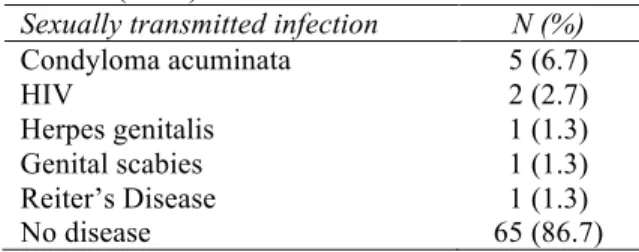
Table 1 Distribution of sexually transmitted infections (n=75).
Sexually transmitted infection N (%)
Condyloma acuminata 5 (6.7)
HIV 2 (2.7)
Herpes genitalis 1 (1.3)
Genital scabies 1 (1.3)
Reiter’s Disease 1 (1.3)
No disease 65 (86.7)
pre-test counselling. Other investigations if required, were carried out depending on the complaints the patient presented with.
Results
A total of 75 male to female transgender persons (MTF), attending the Transgender Clinic were involved in the study. Of the 75 transgender patients, only 10 (13.3%) were diagnosed with STIs. 5 (6.7%) patients were diagnosed with condylomata acuminata, 2 (2.7%) with HIV, 1 patient (1.3%) with herpes genitalis, 1 (1.3%) with genital scabies and 1 (1.3%) with Reiter’s disease (Table 1and Figure 1-3).
Discussion
Transgender, (TG) is an international umbrella term for individuals who relate to and/or behave sexually in a manner different from their birth sex. They often express discomfort with their biological gender.5,6
In India, the estimation of high-risk men having sex with men (MSMs) and transgender population is 4.27 lakh.7 The transgender
Figure 1 Large moist verrucous growth in the anal region in a transgender diagnosed with condyloma acuminata.
Figure 2 Erosions following vesicular rupture on the shaft of the penis is in a transgender diagnosed with herpes genitalis
Since the beginning of the human immunodeficiency virus (HIV) epidemic in the early 1980s and the alarming rise of STIs, the transgender people in low- and middle-income countries,9,10 as well as, in high-income
countries11 have been disproportionately
affected.
The STIs most commonly encountered among the transgender persons are, HIV, syphilis, gonorrhea, chlamydia infection, herpes simplex, hepatitis B, human papillomavirus, scabies, and pubic lice. Other nontraditional STIs include amoebiasis, giardiasis, cryptosporidiosis, shigellosis, and salmonellosis.12
Image 3 Photograph showing lateral hyperpigmentation over the dorsum of the tongue of a transgender diagnosed with HIV.
All the 75 patients in our study, identified themselves as male to female transgenders. The present study has shown, that of the 75 patients, only 10 (13.3%) were diagnosed with STIs, and only 3(4%) were diagnosed with two STI’s. There were 5 (6.7%) patients diagnosed with condylomata acuminata, followed by 1 (1.3%) each with herpes genitalis, genital scabies and Reiter’s disease. Only 2 (2.7%) were diagnosed with HIV, indicating a low prevalence of STIs compared to other studies. Shinde et al.8
reported a 32% prevalence of STIs in their study, with a majority of 9.3% each of perianal warts and genital scabies. As opposed to the other studies, by Brahman et al.,13 Khan et al.,14
Nemoto et al.15 and Setia et al.16 where there was
high prevalence of syphilis, chlamydia, gonorrhea, in our study there was only one clinically diagnosed case of Reiter’s Disease, and no case of syphilis, gonorrhea, trichomoniasis. The HIV prevalence in studies by Brahman et al.13 and Nemoto et al.15 was
prevalence of 1% and 3.6%, respectively, similar to ours.
Strengths and limitations
This study had limitations, which are worth noting. Data were derived from a clinic-based sample, which may not be a representation of the sexual prevalence of the transgender population at large. All the patients from our study were male to female transgenders/ transgender women, and there was no case of female to male transgender/ transgender men. Due to the limited resources available, tests for other STIs like gonorrhea, chlamydia, etc. were not carried out.
In spite of its limitations, our study does provide adequate information about the characteristics of transgenders and intervention strategies. The distinctive and unique roles of alcohol, sexual behaviours, and awareness and knowledge of STIs /HIV, play in intervention programs should aim at improving the knowledge and awareness about HIV /STIs in TGs and the health service providers, physicians, should be trained adequately, as this is a relatively new topic in the STI clinic.
Conclusion
The prevalence of sexually transmitted infections among transgender persons was low in our study, with condylomata acuminata being the most common, followed by HIV, genital scabies, herpes genitalis and Reiter’s disease.
Our data implicates, the need for more HIV and STI prevention programs for transgenders, improved information on symptom recognition, STI screening and treatment services. A good support system from the society will also enable the transgender community to come forward for health care services without the fear of being marginalized.
References
1. Russell D. Sexually transmitted infections in transgender persons. In: Russell D, Bradford D, Fairley C, editors. Sexual Health Medicine, 2nd edition. Sydney: IP
Communications; 2005. P. 951-4.
2. Sharma VK, Khandpur Epidemiology of STD’s. In: Sharma VK, Bhargava R, Usman N et al., editors. Sexually Transmitted Diseases and HIV/AIDS, 2nd edition. New Delhi: Viva Books; 2003. P-3-41.
3. Saravanamurthy PS, Rajendran P, Miranda PM et al. A cross-sectional study of sexual practices, sexually transmitted infections and human immunodeficiency virus among male-to-female transgender people. Am Med J. 2010;1:87-93.
4. Prevention and treatment of HIV and other sexually transmitted infections among men who have sex with men and transgender populations: report of a technical consultation. September 2008. Geneva, Switzerland.
5. Schulden JD, Song B, Barros A et al. Rapid HIV testing in transgender communities by community-based organizations in three cities. Public Health Rep. 2008;123 (Suppl 3):101-114.
6. Bockting WO, Simon Rosser BR, Coleman E. Transgender HIV prevention: a model education workshop. J Gay Lesbian Med Assoc. 2000;4:175-83.
7. NACO. Annual Report 2011 – 2012.Department of AIDS control. Ministry of family health and welfare. 8. Shinde S, Setia MS, Row-Kavi A et al.
Male sex workers: Are we ignoring a risk group in Mumbai, India? Indian J Dermatol Venereol Leprol. 2009;75:41-6. 9. Caceres CF, Konda K, Segura ER, Lyerla
R: Epidemiology of male same-sex behaviour and associated sexual health indicators in low- and middle-income countries: 2003–2007 estimates. Sex Transm Infect. 2008;84 (Suppl 1):49-56. 10. Smith AD, Tapsoba P, Peshu N et al. Men
who have sex with men and HIV/AIDS in sub-Saharan Africa. Lancet. 2009;374 (9687):416-22.
1996–2005. Ann Epidemiol. 2009;19:423-31.
12. Mayer KH, Carballo-Dieguez A. A homosexual and bisexual behaviour in men in relation to STDs and HIV infection. In: Holmes KK, Sparling PF, Stamm WE et al., editors. Sexually Transmitted Diseases, 4th edn. New York: McGraw-Hill; 2008. p 203-18.
13. Brahmam GNV, Kodavalla V, Rajkumar H et al. Sexual practices, HIV and sexually transmitted infections among self-identified men who have sex with men in four high HIV prevalence States of India. AIDS. 2008;22:45-57.
14. Khan AA, Rehan N, Qayyum K, Khan A. Correlates and prevalence of HIV and sexually transmitted infections among Hijras (male transgenders) in Pakistan . Int J STD AIDS. 2008;19:817-20.
15. Nemoto T, Operario D, Keatley J, Han L Soma T. HIV risk behaviors among male-to female transgender persons of color in San Francisco. Am J Public Health. 2004;94:1193-9.