ISSN: 2147-611X
www.ijemst.com
Investigating Modality, Redundancy and
Signaling Principles with Abstract and
Concrete Representation
Ekrem Kutbay, Yavuz Akpınar Bogazici University
To cite this article:
Kutbay, E. & Akpinar Y. (2020). Investigating modality, redundancy and signaling
principles with abstract and concrete representation.
International Journal of Education in
Mathematics, Science and Technology (IJEMST), 8
(2), 131-145.
This article may be used for research, teaching, and private study purposes.
Any substantial or systematic reproduction, redistribution, reselling, loan, sub-licensing,
systematic supply, or distribution in any form to anyone is expressly forbidden.
Authors alone are responsible for the contents of their articles. The journal owns the
copyright of the articles.
Volume 8, Number 2, 2020
Investigating Modality, Redundancy and Signaling Principles with
Abstract and Concrete Representation
Ekrem Kutbay, Yavuz Akpınar
Article Info
Abstract
Article History
Received: 17 April 2019
This study explored the effects of modality, redundancy, and signaling principles in multimedia learning with abstract and concrete representations of an animation on learning in real middle school settings. Based on these principles of the cognitive theory of multimedia learning, ten types of treatment conditions were tested with a pre-test and post-test quasi-experimental design. Data were collected from a large sample (n=826) sample of children with low prior electricity knowledge. Analyses showed that all treatments helped students to develop knowledge of the topic to some extent. However, while the modality effect holds true for middle school students’ studying electricity units with a multimedia instruction in real school settings, the signaling and redundancy principles do not hold true. The study also investigated interactions among prior science scores, prior knowledge about the topic, and multimedia treatments. Findings were discussed in relation to similar studies reported in the literature. Finally, the study raised a set of further research questions in the last section.
Accepted: 01 April 2020
Keywords
Modality principle Redundancy principle Signaling principle Abstract representation Concrete representation
Introduction
Many experimental studies have been conducted on the principles of multimedia learning and type of visual representation, and there are many promotive empirical findings about them, however there are still some crucial criticisms of weaknesses in those studies. First, principles of multimedia learning have most often been tested with unrealistic and narrow settings rather than authentic classroom settings and on entire learning units. (Ballantyne, 2008; Gall, 2004; Ginns, 2005; Harskamp, Mayer, & Suhre, 2007; Segers, Verhoeven, & Hulstijn-Hendrikse, 2008). Second, Mayer (2011) points out the need for more research on the principles in realistic learning environments with children to clarify the boundary conditions of the principles and to test these principles in computer-based environments, using simulations, animations, and games. Third, there is a lack of experimental research on how abstract and concrete representations in science influence younger students’ conceptual and procedural knowledge. Some research has yielded contradictory results; some studies claimed that concrete representation should be used because children are more receptive to concrete operations (Moyer, 2001), and others declared that children do not need concrete representation to understand science concepts (Kaminski et al, 2006). Fourth, most of the research about the principles, especially modality, redundancy, and signaling tested with learning material has been done in English. Although there are a few experimental studies with children using other languages such as Dutch and German (Harskamps et al., 2007; Witteman & Seger, 2010), there are not any studies examining the principles with science content in Turkish. To sum up, when the literature is taken into account, the multimedia principles—particularly with respect to modality, redundancy, and signaling—has not been tested sufficiently with whole learning units, including abstract components for young children in a real school setting. Hence, the main purpose of this study is to explore the effects of modality, redundancy, and signaling principles on abstract and concrete representations of an animation of electricity unit in real middle school settings.
Multimedia Learning
which states that people have two segregated channels, auditory and visual, for processing information (Clark & Paivio, 1991). However, the cognitive theory of multimedia learning (CTML) maintains that when people learn something, they have a limited cognitive capacity during the learning process. Their channels only employ a small quantity of cognitive procedure at each time (Mayer, 2011). Empirical studies provide guidance for reducing extraneous processing in multimedia learning with the help of five principles of multimedia learning: coherence, redundancy, temporal contiguity, signaling, and spatial contiguity (Mayer, 2017). Managing essential processing cannot be dependent on instructional designers’ decision of including or excluding materials in designing a multimedia instruction, but it is necessary to manage with some multimedia learning principles, such as segmenting, pre-training, and modality (Mayer, 2017). To promote generative processing, Mayer (2017) suggested implementing four multimedia principles: multimedia, personalization, voice and embodiment. People learn better from a multimedia instruction when they are familiar to the names and characteristic of the main concepts (Pre-training principle). When learners’ prior knowledge is absent from long-term memory, they have to distribute limited working memory to search for such information (Sweller, 2010). Thus, pre-training relevant knowledge to build coherent models will enable learners to effectively select and organize information for new learning (Mayer 2005). For a detailed discussion of findings on all principles of multimedia learning, see Kutbay (2016), but modality, redundancy, and signaling principles are discussed below.
The Redundancy Principle
The redundancy principle states that when one item of information is presented in various forms at the same time, redundancy occurs (Clark & Mayer, 2010). Several studies (Kalyuga et al., 2003; Leahy et al., 2003; Mayer et al., 2001; Mousavi et al., 1995) showed that students acquire knowledge more effectively from multimedia instructions containing visual materials and narration than from those containing visual materials, narration, and written text. According to Kalyuga et al. (1999), using several different sources for giving the same information may cause a split-attention effect and result in no learning. Mayer and Johnson (2008) explain this situation as learners’ inability to focus on the same verbal message presented as audial text and written text form at the same time. Although there is a common belief that using written and spoken text at the same time may enrich presentations, there are several potential handicaps related to it: learners may experience cognitive overload due to pictorial materials, written text can cause overload to the visual channel, and when learners try to focus only on written text, they probably pay less attention to the pictorial materials in a presentation (Clark & Mayer, 2010).
Kalyuga et al. (1999) tested the redundancy effect in electrical engineering: non-redundant group, who studied a multimedia presentation containing a printed diagram on the screen and an audio message with spoken words, outperformed redundant group, who studied with a multimedia presentation containing a printed diagram and printed text on the screen along with an audio message with spoken words that were identical to the printed words. A different study with university students (Austin, 2009), studied lightning by viewing a short animated narration or a short animated narration with corresponding text. The group that viewed the animated narration outperformed the group that viewed animated narration with text on a transfer test. Leahy, Chandler, and Sweller (2003) examined school children who studied temperature graphs using a graph with printed text (non-redundant), and a graph with printed text and concurrent audio commentary (redundant). A redundancy effect was observed, but this effect might be attributed to the differences between the study times of the two groups (Mayer, 2014). By contrast, the outcomes of some experiments did not confirm the redundancy principle. One such study with two groups of college students was conducted by Moreno and Mayer (2002) with a game about botany. One group viewed animations and listened a narration about botany explanations (non-redundant), and second group viewed animation, listened to a narration about botany explanations and saw on-screen text about what the narration explained (redundant). The experiment indicated that, although the non-redundant group’s test performance was better than redundant group’s test performance, there was a small effect size (d = .19).
The Signaling Principle
signaling, may be used in a multimedia learning environment for attracting learners’ attention to the essential aspects of learning units. For essential processing, learners may use their limited cognitive capacities with the help of this signaling. The signaling principle can be applied to written material, spoken material, and visual material such as animation, videos, graphics, diagrams, photographs or pictures. Loman and Mayer (1983) studied the effect of signaled expository passage in an experiment with materials consisted of a non-signaled passage or signaled passage about the life cycle of sea organism. The study showed that, whereas the signaling groups significantly outperformed the others on a recall test which required conceptual knowledge on high quality problem solutions, the non-signaling groups outperformed the others on a recall test which required conceptual knowledge on low quality problem solutions. The signaling effect with a cause-and-effect system setting was examined with college students by Mayer, Dyck and Cook (1984) in two experiments In the first experiment, learning materials was two sheets of paper with underpinning of the key variables about density and non-underpinning. In the second experiment, the learning unit was about the nitrogen cycle. Both experiments revealed that that signaling tended to enhance recall of conceptual information directly related to the cause-and-effect system, and to enhance problem solving performance.
In a different perspective; Mautone and Mayer (2001) examined the effect of signaling with not only written text, but also narration and animation via three different experiments with college students. The first experiment showed that signaling had no positive effect on retention scores, whereas it had a positive effect on transfer scores. In the second experiment with the same domain, however, the positive effect of signaling was observed on the retention and transfer scores. The third experiment showed that signaling for animation and narration did not have a significant effect on students’ retention and transfer scores. The meaning of signaling in multimedia knowledge representation was examined by Jamet, Govota, and Quaireau (2008). Two types of signaling, color change and stepwise presentation elements, were used with auditory explanations about the encephalic base of language construction to test the signaling principle. Undergraduate students were randomly assigned to study learning materials with 4 different display conditions: static and non-signaled, static and signaled, sequential and non-signaled, and sequential and signaled. The study showed that the signaling groups did not outperform the non-signaling groups on the transfer test. This result contradicted the investigated claims of the signaling principle. User reactions to signaling was investigated more closely with the evidence from eye movement experiments in a subject about turbofan jet engines (Ozcelik, Arslan-Ari & Cagiltay, 2010). Forty undergraduate students were presented terminological labels in the illustration using red when the item was voiced. Following the narration, the label was converted to black. On the other hand, label color was only black color in the non-signaled version. The analyses of data showed that the group which studied with the non-signaled material outperformed the group that studied with non-signaled material on matching and transfer tests. It also showed that signaling guided students to essential and relevant information, whereas the non-signaling group students usually ignored them.
The Modality Principle
Harskamp et al. (2007) carried out two experiments in a science lesson in a Dutch secondary school using two types of modality in their lesson about animal behavior: An illustration and written text lesson and an illustration and narration lesson. The study showed that the performance of the illustrations and narration group was greater than that of the illustrations and text group. In the second experiment, students had opportunity to repeat and the availability of self-study timing. The study revealed that while modality was observed for slow learners, it was not observed for fast learners. In a similar study, Witteman and Segers (2010) examined the modality effect with 6th grade children using adapted version of the work of Mayer (2001) about the formation of lightning. The study showed that, while the modality effect was observed after an immediate retention test, it was not observed at the second and third testing occasions.
At a college level, Schüler, Scheiter, & Gerjets (2013) conducted two experiments about modality in college science. In the first experiment, each one of four system-paced computer programs — (1) only spoken text, (2) only written text, (3) spoken text with animation, and (4) written text with animation about the phases of mitosis —was randomly given to university students to study. The experiment revealed that the modality effect was not strongly evident in this setting. The researchers attributed the result to presentation of longer text segments. In the second experiment, six multimedia conditions were used, and a redundancy effect was observed with the system paced animations. Nevertheless, only a small modality effect with the system and learner-paced presentations was observed. Another study with university students (Cheon, Crooks, & Chung, 2014) assigned participants to one of four experimental conditions about the formation of lightning of animations lasting 160 seconds: (a) spoken text and active pause, (b) spoken text and passive pause, (c) written text and active pause, and (d) written text and passive pause. The study showed that there were no significant effects of segmentation and modality although all test scores of the spoken-text groups were greater than all test scores of the written-text groups.
A meta-analysis on the modality effect (Ginns, 2005) demonstrated that participants who studied with a multimedia condition which contained graphics and spoken text outperformed those who studied with a multimedia condition which contained graphics and written text. The remarkable point of this study is that the modality effect was tested with adults in 33 experiments, with high-school students in six experiments, and with primary-school students in only four experiments. There are a few studies about the modality effect that focused on children in primary and middle school. This lack showed a research gap on modality effect, in 2005, and such gap hasn’t been filled yet.
Abstract versus Concrete Representation
School science has many abstract concepts which are generally very difficult to understand (Jaakkola & Veermans, 2015). Thus, students may learn these concepts inaccurately and incompletely (Nicoll, 2001). For example, the concept of electricity may cause learners to develop many misconceptions about circuit elements, current, power and potential difference (Lee & Law, 2001; Engelhardt & Beichner, 2004). In this context, there is an ongoing discussion about which type of representation, abstract or concrete, is more beneficial in science education, particularly in learning about electricity.
Concretization of an abstract concept often needs additional relevant information or materials. However, if this information or material is irrelevant to the concept in question, it may bring an extra complexity to a learning process. Contextualized details of concrete images alter learners’ attention from the essential points of a learning concept. Some recent empirical evidence (e.g., Jaakkola & Veermans, 2015) supports this view in its claim that abstract representations usually provide better learning outcomes in science education compared to concrete representations. This negative assertion for concrete representations is probably observed more in inexperienced students taking an extensive amount of detail and limited cognitive capacity of human into account. From another perspective, which representation type, concrete or abstract, is the more appropriate for younger students is still unclear. Only a few studies have been carried out with primary and secondary school students; many studies were done with adults and college students (Jaakkola & Veermans, 2015). Children under twelve years old are more adaptive to concrete operations in the problem solving process and they may be more focused in the learning process when the learning materials are presented concretely (Moyer, 2001). On the contrary, some studies (e.g., Kaminski et al. 2006) reported that children are not in need of concrete representation to understand abstract concepts as much as the older students are.
Research examined different types of representation (concrete-contextualized, abstract, and mixed abstract-concrete) about science and mathematics in middle schools. Some researchers (e.g., Ball, 1992; Moyer, 2001) claim that “children under the age of twelve are in the concrete operational stage of development in which thinking and problem solving are bound to the concrete representation.” In contrast, other researchers (e.g., Kaminski et al. 2006) asserted after a study with nineteen 6th grade students that concrete representation is not essential for children to comprehend abstract concepts. On the other hand, Jaakkola and Vermans (2015) showed that concrete elements provide a better opportunity for primary school students to understand electric circuits in a simulation. A different study approach for “contextualized versus abstract representation” was conducted by Johnson, Reisslein, and Reisslein (2014) with middle school students compared four sequences of electrical circuits representation (abstract-abstract, contextualized-contextualized, contextualized-abstract, or abstract-contextualized). The study showed that contextualized representations after abstract representations for the same items are more beneficial to students in near and far post tests.
Research Problems Emerging from the Literature Review
Though there is much supporting empirical data for the principles, there are still some important criticisms about them: The principles tested in CTML studies were usually tested with unrealistic and narrow settings (Ballantyne, 2008), without large scale simulations, animations, and games with children (Mayer, 2011). Another criticism asserts that these principles may not be observed in an immersive learning environment because they were mostly examined with a cause-and-effect system such as the understanding of physical and mechanical systems. Further, there is short of experimental studies investigating how the signaling of written text affect redundancy effect in a multimedia condition, and the nature of type of representations of animation, abstract or concrete, for better learning. Taking these into consideration, this study aims to examine the effects of modality, redundancy, and signaling effect in abstract and concrete representation of multimedia learning of electricity units in real middle school settings in Turkey. The study aimed to answer following research questions:
1. Do abstract and concrete representations of animations with the following five different text representations affect differently middle school students’ learning of an electricity unit?
written text representations
signaled written text representations spoken text representations
written text and spoken text representations
signaled written text and spoken text representations
2. Do the following effects in a multimedia setting with abstract or concrete representation of animation hold true for middle school students’ learning of an electricity unit?
modality effect redundancy effect signaling effect
3. Do the effects of the following modality matches on an electricity unit achievement differ in a multimedia setting with abstract or concrete representation of animation?
spoken text modality, and signaled written text and spoken text modality written text and spoken text modality, and signaled written text and spoken text
Method
The study was conducted with a pre-test and post-test quasi-experimental design (Creswell, 2013). The independent variables of the study were multimedia conditions designed to teach an electricity learning unit in a middle school science course, science grades of students, and pre-test scores of students. The dependent variable of the study is students’ achievement scores in the electricity unit. The difference between post-test scores and pre-test scores gives their achievement scores.
Sampling and Participants
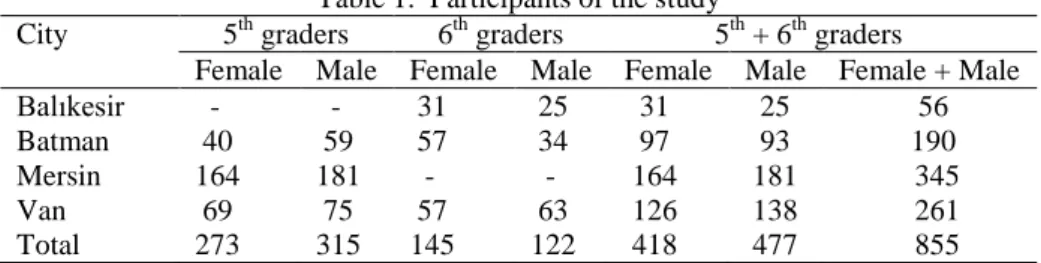
The target population of the study was public middle school students (aged 11-12) in Turkey. The method of sampling was convenience sampling because there was no chance to access participants randomly. However, treatment groups were assigned to multimedia conditions randomly. The research was conducted in several schools in four different cities. The participants, volunteered, did not study electricity unit before the experiment. Data were collected from 855 students of 34 classes in four public middle schools in Balıkesir, Batman, Mersin, and Van. Twenty-nine students who did not have either pre-test or post-test scores were dropped from the study. The number of students studied with each multimedia condition was almost the same. Table 1 displays the detail information about participants.
Table 1. Participants of the study
City 5th graders 6th graders 5th + 6th graders
Female Male Female Male Female Male Female + Male
Balıkesir - - 31 25 31 25 56
Batman 40 59 57 34 97 93 190
Mersin 164 181 - - 164 181 345
Van 69 75 57 63 126 138 261
Total 273 315 145 122 418 477 855
Treatments
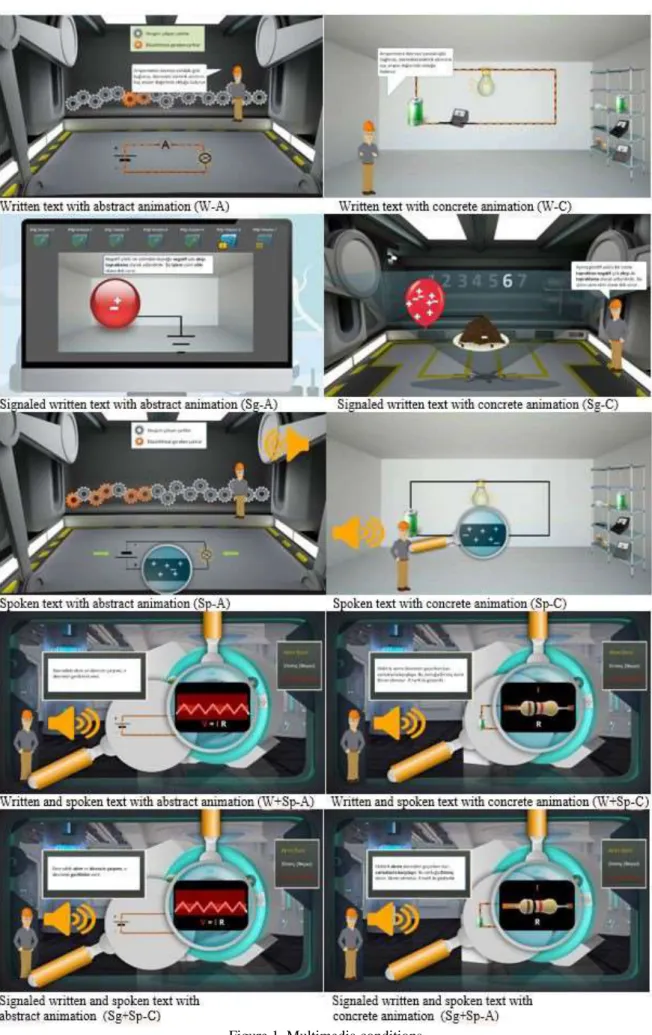
There were 10 different types of multimedia conditions (see Figure 1) prepared by the researchers using Articulate Storyline. These conditions aimed to accomplish the same learning objectives about electricity. During the preparation of the conditions, two science learning researchers with PhD degrees and two middle school science teachers checked validity of the learning material. They made necessary changes and determined important concepts for electricity to be highlighted in signaled written text information. The instruction language in all multimedia conditions was Turkish, and the text in all multimedia conditions subsumed 82 sentences with 715 words. Audition and visibility time of textual information was a total of 6 minutes and 7 seconds.
In the multimedia courseware, all ten conditions presented 24 screens with the inclusion of animations and text representations related to the objectives. Six introduction scenario screens and three task description screens of all conditions were the same in terms of animation representation, but they were different in terms of text representation. The text representation was prepared according to multimedia conditions. Each condition was divided into 15 segments. Each segment aimed to access one or two learning objectives, and lasted 10-30 seconds. They consisted of animation and textual information about electrical events. Students could see each segment only once. Transitions between the segments were provided by a mouse click when the users felt ready for a new task.
design principles, all ten different types of multimedia conditions were designed in line with those studies at which the principles revealed: The lessons contained merely information presentation stage of the instruction process, and provided students with limited opportunities to practice and apply knowledge in different contexts.
Data Collection Instruments
In the study, two sets of data collection instruments were used: (1) a pre-test to measure students’ prior knowledge of electricity and (2) a post-test to measure students’ electricity knowledge after the treatments. Each test had 20 multiple-choice questions with four alternatives; 9 questions measured conceptual knowledge and 11 questions measured the students’ ability to apply their knowledge of electricity in a novel situation (procedural knowledge). Students’ science teachers provided their science grades.
In all the classes, on the first day, the computer teacher and the science teacher of the class worked cooperatively and all participants were given the pre-test to determine prior knowledge about electricity. After a week, the second and third sessions of the study were performed on the same day. In the second session, students studied an electricity unit in one randomly assigned multimedia condition on their own using a computer under the supervision of the computer teacher for about 25 minutes. After a 20-minute break, the third session started, with the computer teacher and the science teacher again working cooperatively to administer the post-test to measure the learning outcome of the electricity unit. Both the pre and post-test phase lasted approximately 40 minutes each.
Data Analysis
A series of different statistical tests were conducted to answer the research questions. First the data were checked for normality, then, an analysis of variance and post hoc tests were run on students’ prior knowledge in electricity unit and indicated that the groups were initially equivalent on prior knowledge in the unit. Because one set of data was used for testing more than one hypothesis; a Bonferroni correction was conducted. They were confirmed by t tests which are reported here to demonstrate more detailed information. Further, all comparison tests were verified with their non-parametric equivalent test. Finally, a general linear model 2x2x10 ANOVA test was conducted to test whether prior science score, prior knowledge about the learning unit and the multimedia treatments together or pairwise influence the students’ learning.
Results
Achievement Scores
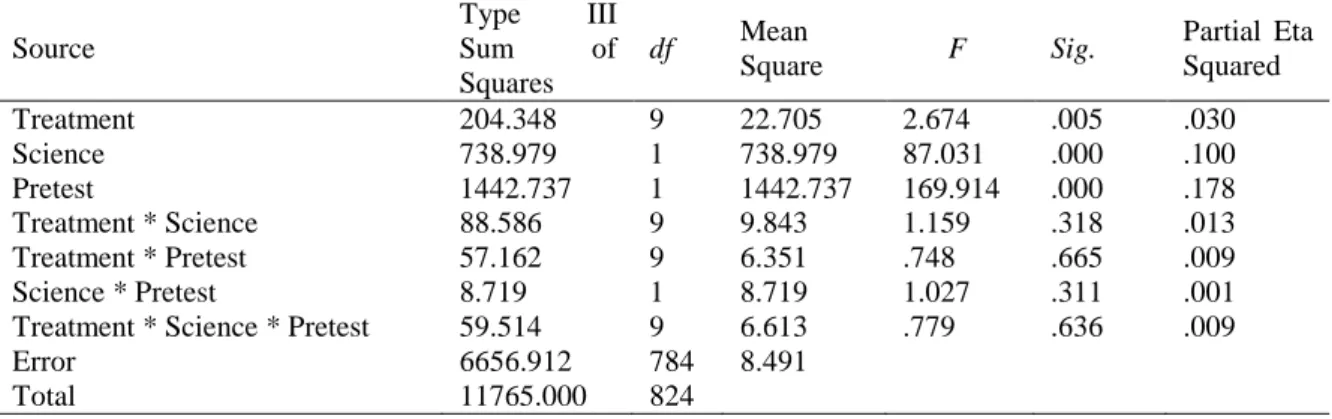
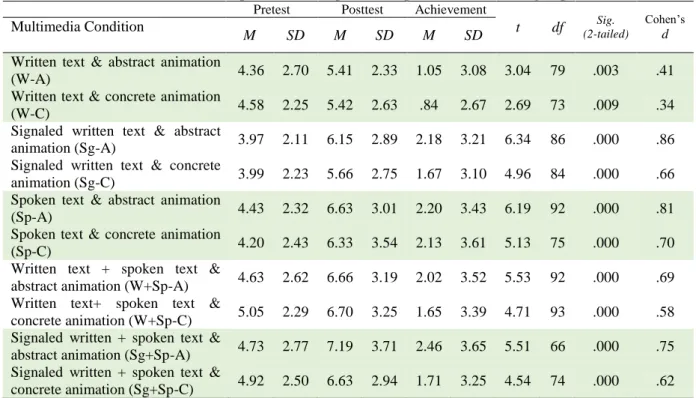
Achievement scores of the students were calculated by subtracting their pre-test scores from the post-test scores. An ANOVA test (see Table 2) and paired t-tests (see Table 3) were conducted to determine whether there was a statistically significant mean difference between post-test and pre-test scores of each group. The analyses showed that each group’s mean post-test scores were significantly higher than pre-test mean scores, yielding a medium or high effect size (see Table 2).
Table 2. Three-way ANOVA test for students’ achievement scores in multimedia conditions
Source
Type III
Sum of
Squares
df Mean
Square F Sig.
Partial Eta Squared
Treatment 204.348 9 22.705 2.674 .005 .030
Science 738.979 1 738.979 87.031 .000 .100
Pretest 1442.737 1 1442.737 169.914 .000 .178
Treatment * Science 88.586 9 9.843 1.159 .318 .013
Treatment * Pretest 57.162 9 6.351 .748 .665 .009
Science * Pretest 8.719 1 8.719 1.027 .311 .001
Treatment * Science * Pretest 59.514 9 6.613 .779 .636 .009
Error 6656.912 784 8.491
Table 3. Paired sample tests for the pretest and posttest scores of the groups
Pretest Posttest Achievement
t df (2-tailed)Sig. Cohen’s
d Multimedia Condition
M SD M SD M SD
Written text & abstract animation
(W-A) 4.36 2.70 5.41 2.33 1.05 3.08 3.04 79 .003 .41
Written text & concrete animation
(W-C) 4.58 2.25 5.42 2.63 .84 2.67 2.69 73 .009 .34
Signaled written text & abstract
animation (Sg-A) 3.97 2.11 6.15 2.89 2.18 3.21 6.34 86 .000 .86
Signaled written text & concrete
animation (Sg-C) 3.99 2.23 5.66 2.75 1.67 3.10 4.96 84 .000 .66
Spoken text & abstract animation
(Sp-A) 4.43 2.32 6.63 3.01 2.20 3.43 6.19 92 .000 .81
Spoken text & concrete animation
(Sp-C) 4.20 2.43 6.33 3.54 2.13 3.61 5.13 75 .000 .70
Written text + spoken text &
abstract animation (W+Sp-A) 4.63 2.62 6.66 3.19 2.02 3.52 5.53 92 .000 .69 Written text+ spoken text &
concrete animation (W+Sp-C) 5.05 2.29 6.70 3.25 1.65 3.39 4.71 93 .000 .58 Signaled written + spoken text &
abstract animation (Sg+Sp-A) 4.73 2.77 7.19 3.71 2.46 3.65 5.51 66 .000 .75 Signaled written + spoken text &
concrete animation (Sg+Sp-C) 4.92 2.50 6.63 2.94 1.71 3.25 4.54 74 .000 .62
Abstract and Concrete Representation of Animation
To examine effects of abstract or concrete representation of animation in a multimedia setting, five independent sample t-tests were conducted and revealed that there is not a significant difference between abstract or concrete representation of animations with (a) written text (t (152) = .45, p = .650), (b) signaled written text (t (170) = 1.06, p = .288), (c) spoken text (t (167) = .13, p = .894), (d) written text and spoken text (t (185) = .73, p = .462) or (e) signaled written text and spoken text (t (140) = 1.30, p = .194) on students’ learning.
The Modality Effect
To examine modality effect in a multimedia setting with abstract or concrete representation of animation, two independent sample t-tests were conducted and revealed that there was a significant difference between the mean achievement scores of the Sp-A group and of the W-A group; t (171) = 2.31, p = .022; d = .35, and between the mean achievement scores of the Sp-C group and of the W-C group; t (148) = 2.49, p = .014; d = .35.
Spoken Text Modality or Signaled Written Text Modality
To examine effects of spoken text modality and signaled text modality with abstract or concrete representation of animation, two independent sample t-tests were conducted, and revealed that there was not a significant difference between the mean achievement scores of the Sp-A group and of the Sg-A group; t (178) = .47, p = .967, and between the mean achievement scores for the Sp-C group and of the Sg-C group; t (159) = .87, p = .385.
The Redundancy Effect
Spoken Text Modality or Signaled Written Text and Spoken Text Modality
To examine effects of spoken text modality, and signaled written text modality and spoken text modality with abstract or concrete representation of animation, two independent sample t-tests were conducted and revealed that there was not a significant difference between the mean achievement scores for the Sp-A group and for the Sg+Sp-A group; t (158) = -.45, p = .648, and between the achievement scores for the Sp-C and for the Sg+Sp-C group; t (149) = .759, p = .449.
The Signaled Effect
To examine signaling effect in a multimedia setting with abstract or concrete representation of animation, two independent sample t-tests were conducted and revealed that there was a significant difference between the mean achievement scores of Sg-A group and of the W-A group; t (184) = 2.32, p = .021; d = .35, and that there was not a significant difference between the mean achievement scores of Sg-C group and of the W-C group; t
(157) = 1.79, p = .074.
Written Text and Spoken Text Modality or Signaled Written Text and Spoken Text Modality
To examine effects of written text and spoken text modality or signaled written text and spoken text modality with abstract or concrete representation of animation, two independent sample t-tests were conducted and revealed that there was not a significant difference between the mean achievement scores of Sg+Sp-A group and of the W+Sp-A group; t (158) = .76, p = .441, and between the mean achievement scores of Sg+Sp-C group and of W+Sp-C group; t (167) = .11, p = .911.
Covariate Effects on the Achievement Scores
In order to test whether prior science score level, prior knowledge level about the learning unit and the multimedia treatments together or pairwise influence the students’ learning of the unit, a general linear model 2x2x10 ANOVA test was conducted. The test revealed that all these three independent variables, multimedia treatments [F (9, 784) = 2.674, p = .005], students’ prior science level [F (1, 784) = 87.031, p = .0001], and students’ unit pre-test level [F (1, 784) = 169.914, p = .0001] independently influence students’ unit achievement scores, but not pairwise.
Discussion and Conclusion
Abstract versus Concrete Representation
Five different independent sample t-tests were conducted to find whether abstract or concrete representation of animations with text representations (written, signaled written, spoken, written and spoken, or signaled written and spoken) affect middle school students’ achievement in electricity unit. All tests revealed that the mean achievement scores of the matched groups were not significantly different. Such findings confirmed earlier findings (e.g., Kaminski et al. 2006) alleging that children don’t need concrete representation to understand science concepts. However, this finding is in contrast with yet other research studies; for example, Jaakkola et al. (2011) found that concrete components in a multimedia instruction resulted in better learning compared to abstract components. Moyer (2001) claimed that children are more adaptive to concrete representations. In addition, a few other researchers (e.g., Moreno et al., 2011; Johnson et al., 2014) found out that the use of abstract representations results in better learning compared to concrete representations.
The Modality Effect
The tests revealed that there was a significant difference between the achievement scores of spoken text groups and written text groups. The spoken text representation groups (Sp-A and Sp-C) had significantly higher achievement scores than the written text representation groups (W-A and W-C) in electricity unit. While this result confirms the findings of many other studies investigating the modality effect (e.g., Mayer & Moreno, 1999), the result is not the same for all studies (e.g., Cheon et al., 2014) which had counter-arguments for modality. The first assumption of CTML, the dual-channel assumption, advises one to present information in more than one modality (Mayer, 2001). Similarly, some researchers (e.g., Mousavi et al., 1995; Velayo & Quirk, 2000) found that students performed better when information was presented with dual modality. While this assumption claims that human information-processing system consists of an auditory channel and a visual channel, the limited capacity assumption asserts that each of these channels is limited to processing information simultaneously (Baddeley, 1992). The achievement score differences between the two matched groups may be explained by claims of these assumptions because, while the spoken text groups had opportunity to study with a multimedia instruction consisting of auditory explanations and abstract or concrete animation, the written text groups studied with a multimedia instruction consisting of visual text explanations and abstract or concrete animation. The written text groups probably had to split their attention between pictorial information and textual information. This plausible situation caused trouble for their limited visual channel capacity.
The tests revealed that the spoken text representation groups (Sp-A and Sp-C) had higher achievement scores than the signaled written text representation groups (Sg-A and Sg-C) in the electricity unit, but the difference was not significant. This finding is not in line with the modality principle of the CTML. According to CTML, presenting visual pictorial information and visual textual information simultaneously in a multimedia instruction overloads students’ visual channel. Signaling used in the written text possibly reduced extraneous processing in the students’ visual channel by providing guidance which may have helped them to focus on the most important concepts, detail, and information in the multimedia instruction.
Our findings suggest that the modality principle may be applied to middle school learners when they study abstract or concrete representations of animation of multimedia learning in a science context. However, the finding must be interpreted with caution, as this finding provides conflicting results for the modality principle. The result from these findings have implications for the CTML; that is, if it is possible to present textual information in spoken form, it should be presented; but if it is not, it should be presented in the form of written text with signaling.
The Redundancy Effect
The tests revealed that the non-redundant groups (Sp-A and Sp-C) have higher achievement scores than the redundant groups: W+Sp-A and W+Sp- in electricity unit; nevertheless, the difference was not significant. According to CTML, it was predicted that the non-redundant groups would get higher achievement scores than the redundant groups; Kalyuga et al. (2003), also found that using several different sources for giving the same information or message may cause split-attention effect, and results in no learning. In addition, Clark and Mayer (2010) claimed that learners probably pay less attention to the pictorial materials in a multimedia instruction when redundant materials are used. Many researchers (e.g., Austin, 2009; Clark & Mayer, 2010; Leahy et al., 2003) advised that when designing an online learning environment, redundancy should be considered. Further, Moreno and Mayer (2002) found that redundancy did not have a significantly positive or negative effect on learning. Similarly, McTigue (2009 did not support the redundancy principle, and argued that the redundancy principle should not be applied to younger learners in a classroom setting. Mayer (2009) further asserted that there is a possible visual or verbal channel overload for learners with a redundant presentation. One possible explanation for this result is that the students who studied with redundant instruction probably ignored the written text representation, and hence unintentionally avoided cognitive overload. If eye-tracking tools had been used to collect data from the participants during the multimedia instruction, whether they ignored the written text representation or not could be determined more precisely.
(2002) also found only a small effect size of redundancy. If the students had studied with the multimedia instruction consisting of redundant signaled written text, the authors explained, the students might have ignored the redundant material, and their processing of the material might have been similar to those who studied with the multimedia instruction consisting of non-redundant material.
The Signaled Effect
The first test conducted with students studying in a multimedia instruction consisting of abstract representation of animation revealed that the signaling group (Sg-A) had significantly higher achievement scores than the non-signaling group (W-A). Also, the second test conducted with students studying in a multimedia instruction consisting of concrete representation of animation revealed that the signaling group (Sg-C) had higher achievement scores than the non-signaling group (W-C), but the difference was not significant. Mayer (2009) stated that "signaling reduces extraneous processing by guiding the learner's attention to the key elements in the lesson and guides the learner's building of connections between them" (p. 108). Multimedia learning environments may contain many extraneous or unimportant components. Thus, learners, especially low-experienced ones, usually have trouble eliminating unimportant components and focusing on important components, and these environments may also bring extraneous cognitive overload to them. Ozcelik et al. (2010 showed that signaling guided students to essential and relevant information about the learning unit, whereas non-signaling group students usually ignored them. According to CTML, it is expected that a signaling group will significantly outperform the non-signaling group in achievement. The current study doesn’t entirely agree with CTML, and doesn’t agree with the signaling principle of CTML because, while the achievement of the group with abstract representation was significantly affected by signaling effect, the group with the concrete representation was not. A possible explanation is that even though students in the non-signaling group with concrete representation of animation had to split their attention between the text and animation, they still had time to construct a mental model of the information. On the other hand, the non-signaling group with an abstract representation of animation possibly did not have time to construct a mental model of the information. This conflicting result may serve as a catalyst for additional research.
In contrast to the earlier studies of signaling principles (e.g., Ozcelik et al., 2010), the tests revealed that the signaling groups (Sg+Sp-A and Sg+Sp-C) had higher achievement scores than the non-signaling groups: the W+Sp-A group and the W+Sp-C, but the difference was not significant. This may be explained as that the compared groups possibly ignored the written or signaled written text, and they listened to the spoken text to acquire information.
Covariate Effects on Learning
A general linear model 2x2x10 ANOVA test revealed that there were not any significant three-way or two-way interactions among prior science scores, prior knowledge about the unit, or the multimedia treatments on students’ achievement scores. However, all these three independent variables, multimedia treatments, students’ prior science level, and students’ unit pre-test level independently influence students’ unit achievement scores. It has to be noted that the treatments of the study provided students with limited opportunities to practice and apply conceptual and procedural knowledge in different settings and problem cases.
Implication for Practice
negative effect on learning. One possible explanation for this result is that the students who studied with redundant instruction probably ignored the written text representation, and hence unintentionally avoided cognitive overload. In addition, even though students in the non-signaling group had to split their attention between the text and animation, they still had time to construct a mental model of the information. For this reason, these principles need further research with children.
According to Mayer and Moreno (2003), special attention should be paid when the type of visual representation is used in multimedia animations because it may cause cognitive overload for learners. The findings about animation representation type are consistent with some previous studies (e.g., Kaminski et al. 2006). This study found that children do not always need concrete representation to understand science concepts, and suggests that multimedia designers may not always need to use concrete representation throughout a courseware for a learning unit. Sometimes, using an abstract representation may be beneficial to students’ learning. Multimedia designers and teachers should be aware of the degree of cognitive load correlated with abstract or concrete representation may change according to learning unit, learning objectives, and students’ background knowledge.
The Limitation of the Study and Recommendations for Further Research
This study was limited by following factors in terms of sampling and methodology. First, the results of the study should be cautiously generalized to larger population of students. While the study was conducted with large number of students in four different cities, convenience sampling was used, so the current study should be replicated using a true experimental design to increase generalizability. Second, important variables such as reading comprehension skills, working memory and attitude towards the treatment conditions were not measured. These measurements may provide further information about variables which are critical to learning. In addition to this, interviewing students may provide some useful information about the principles of multimedia. Third, using only immediate post-testing in the study may be considered a limitation. After a certain period of time, students’ learning and recall should be measured. Fourth, the differences between abstract and concrete representation of animation were not sufficiently presented, because the electricity unit had many abstract concepts and it was difficult to present them in a concrete way in computer-based settings. For this reason, the current study should be replicated with different treatment materials (e.g., hands-on activities along with multimedia materials) aimed to teach science content to increase generalizability. Fifth, the findings cannot be generalized to multimedia instructions for all science learning units in middle school; more research is necessary with other middle school units. Finally, measuring cognitive load may allow testing of the multimedia principles more accurately. Eye-tracking and electroencephalography can be used to examine the multimedia principles of CTML thoroughly.
Acknowledgements
We thank teachers and students who participated in the design and implementation studies, and anonymous reviewers.
References
Austin, K. A. (2009). Multimedia learning: Cognitive individual differences and display design techniques predict transfer learning with multimedia learning modules. Computers & Education, 53(4), 1339-1354. Baddeley, A. (1992). Working memory. Science, 255(5044), 556-559.
Ball, D. L. (1992). Magical Hopes: Manipulatives and the Reform of Math Education. American Educator: The Professional Journal of the American Federation of Teachers, 16(2), 14-18.
Ballantyne, N. (2008). Multimedia learning and social work education. Social Work Education, 27(6), 613-622. Clark, J. M., & Paivio, A. (1991). Dual coding theory and education. Educational Psychology Review, 3(3),
149-210.
Clark, R. C., & Mayer, R. E. (2010). Applying the segmenting and pretraining principles: managing complexity by breaking a lesson into parts. e-Learning and the Science of Instruction: Proven Guidelines for Consumers and Designers of Multimedia Learning, Third Edition (pp. 204-220). New York: John Wiley & Sons.
Cheon, J., Crooks, S., & Chung, S. (2014). Does segmenting principle counteract modality principle in instructional animation? British Journal of Educational Technology, 45(1), 56-64.
Creswell, J. W. (2013). Qualitative Inquiry & Research Design. Third Edition. Thousand Oaks, CA: SAGE Dori, Y. J., Belcher, J., Bessette, M., Danziger, M., McKinney, A., & Hult, E. (2003). Technology for active
learning. Materials Today, 6(12), 44-49.
Dwyer, F. M. (1978). Strategies for improving visual learning: A handbook for the effective selection, design, and use of visualized materials. State College, PA: Learning Services.
Engelhardt, P. V., & Beichner, R. J. (2004). Students’ understanding of direct current resistive electrical circuits.
American Journal of Physics, 72(1), 98-115.
Gall, J. E. (2004). Multimedia Learning/The cognitive style of PowerPoint. Educational Technology, Research and Development, 52(3), 87-90. Retrieved from http://search.proquest.com/docview/218052773?accountid=9645
Ginns, P. (2005). Meta-analysis of the modality effect. Learning and Instruction, 15(4), 313-331.
Harskamp, E. G., Mayer, R. E., & Suhre, C. (2007). Does the modality principle for multimedia learning apply to science classrooms? Learning and Instruction, 17(5), 465-477.
Jaakkola, T., Nurmi, S., & Veermans, K. (2011). A comparison of students' conceptual understanding of electric circuits in simulation only and simulation‐ laboratory contexts. Journal of research in science teaching, 48(1), 71-93.
Jaakkola, T., & Veermans, K. (2015). Effects of abstract and concrete simulation elements on science learning: Abstract & concrete simulation elements. Journal of Computer Assisted Learning, 31(4), 300-313. Jamet, E., Gavota, M., & Quaireau, C. (2008). Attention guiding in multimedia learning. Learning and
Instruction, 18(2), 135-145.
Jeung, H. J., Chandler, P., & Sweller, J. (1997). The role of visual indicators in dual sensory mode instruction.
Educational Psychology, 17(3), 329-345.
Johnson, A. M., Butcher, K. R., Ozogul, G., & Reisslein, M. (2014). Introductory circuit analysis learning from abstract and contextualized circuit representations: Effects of diagram labels. IEEE Transactions on Education, 57(3), 160-168.
Johnson, A. M., Reisslein, J., & Reisslein, M. (2014). Representation sequencing in computer-based engineering education. Computers & Education, 72, 249-261.
Kalyuga, S., Ayres, P., Chandler, P., & Sweller, J. (2003). The expertise reversal effect. Educational Psychologist, 38(1), 23-31.
Kalyuga, S., Chandler, P., & Sweller, J. (1999). Managing split‐ attention and redundancy in multimedia instruction. Applied Cognitive Psychology, 13(4), 351-371.
Kaminski, J. A., Sloutsky, V. M., & Heckler, A. F. (2006). Do children need concrete instantiations to learn an abstract concept? In Proceedings of the 28th Annual Conference of the Cognitive Science Society (pp. 411-416). NJ:LEA.
Kutbay, E. (2016). An investigation of modality, redundancy and signaling effects in multimedia learning with abstract and concrete representation (Master’s thesis, Bogazici University, Istanul, Turkey).
Leahy, W., Chandler, P., & Sweller, J. (2003). When auditory presentations should and should not be a component of multimedia instruction. Applied Cognitive Psychology, 17(4), 401-418.
Lee, Y., & Law, N. (2001). Explorations in promoting conceptual change in electrical concepts via ontological category shift. International Journal of Science Education, 23(2), 111-149.
Loman, N. L., & Mayer, R. E. (1983). Signaling techniques that increase the understandability of expository prose. Journal of Educational Psychology, 75(3), 402-412.
Mautone, P. D., & Mayer, R. E. (2001). Signaling as a cognitive guide in multimedia learning. Journal of Educational Psychology, 93(2), 377-389.
McTigue, E. M. (2009). Does multimedia learning theory extend to middle-school students? Contemporary Educational Psychology, 34(2), 143-153.
Mayer, R. E. (2005). Principles for reducing extraneous processing in multimedia learning: Coherence, signaling, redundancy, spatial contiguity, and temporal contiguity principles. In R. E. Mayer (Ed.), The Cambridge handbook of multimedia learning (pp. 183-200). Cambridge: Cambridge University Press. Mayer, R. E. (2005). Cognitive theory of multimedia learning. In R. E. Mayer (Ed.), The Cambridge handbook
of multimedia learning (pp. 31-48). Cambridge: Cambridge University Press.
Mayer, R. E. (2005). The multimedia principle. In R. E. Mayer (Ed.), The Cambridge handbook of multimedia learning (pp. 117-133). Cambridge: Cambridge University Press.
Mayer, R. E. (2009). Multimedia learning. Cambridge: Cambridge University Press.
Mayer, R. E. (2011). Applying the science of learning to multimedia instruction. Psychology of Learning and Motivation-Advances in Research and Theory, 55, 77-108.
Mayer, R. E., Dyck, J. L., & Cook, L. K. (1984). Techniques that help readers build mental models from scientific text. Journal of Educational Psychology, 76(6), 1089-1105.
Mayer, R. E., & Johnson, C. I. (2008). Revising the redundancy principle in multimedia learning. Journal of Educational Psychology, 100, 380-386.
Mayer, R. E., & Moreno, R. (2003). Nine ways to reduce cognitive load in multimedia learning. Educational Psychologist, 38(1), 43-52.
Moreno, R., & Mayer, R. E. (1999). Cognitive principles of multimedia learning: The role of modality and contiguity. Journal of Educational Psychology, 91(2), 358-368.
Moreno, R., & Mayer, R. E. (2002). Verbal redundancy in multimedia learning: When reading helps listening.
Journal of Educational Psychology, 94(1), 156-163.
Moreno, R., Ozogul, G., & Reisslein, M. (2011). Teaching with concrete and abstract visual representations: Effects on students' problem solving, problem representations, and learning perceptions. Journal of Educational Psychology, 103(1), 32-47.
Moyer, P. S. (2001). Are we having fun yet? How teachers use manipulatives to teach mathematics. Educational Studies in Mathematics, 47, 175-197.
Nicoll, G. (2001). A report of undergraduates' bonding misconceptions. International Journal of Science Education, 23(7), 707-730.
Ozcelik, E., Arslan-Ari, I., & Cagiltay, K. (2010). Why does signaling enhance multimedia learning? Evidence from eye movements. Computers in Human Behavior, 26(1), 110-117.
Tversky, B., Morrison, J. B., & Betrancourt, M. (2002). Animation: Can it facilitate? International Journal of Human-Computer Studies, 57(4), 247-262.
Segers, E., Verhoeven, L., & Hulstijn‐ Hendrikse, N. (2008). Cognitive processes in children's multimedia text learning. Applied Cognitive Psychology, 22(3), 375-387.
Schüler, A., Scheiter, K., & Gerjets, P. (2013). Is spoken text always better? Investigating the modality and redundancy effect with longer text presentation. Computers in Human Behavior, 29(4), 1590-1601. Sweller, J. (2010). Element interactivity and intrinsic, extraneous, and germane cognitive load. Educational
Psychology Review, 22(2), 123-138.
Witteman, M. J., & Segers, E. (2010). The modality effect tested in children in a user‐ paced multimedia environment. Journal of Computer Assisted Learning, 26(2), 132-142.
Velayo, R. S., & Quirk, C. (2000). How do presentation modality and strategy use influence memory for paired concepts? Journal of Instructional Psychology, 27(2), 126-126.
Author Information
Ekrem Kutbay Bogazici University Turkey
Contact e-mail: [email protected]