AUSTRALIAN JOURNAL OF BASIC AND
APPLIED SCIENCES
ISSN:1991-8178 EISSN: 2309-8414 Journal home page: www.ajbasweb.com
Open Access Journal
Published BY AENSI Publication
© 2017 AENSI Publisher All rights reserved
This work is licensed under the Creative Commons Attribution International License (CC BY).
http://creativecommons.org/licenses/by/4.0/
To Cite This Article: Abdelelah Khider Mahmood and Huthaifa Salman Khairy., Time delay compensation for wireless networked control systems based on modified smith predictor. Aust. J. Basic & Appl. Sci., 11(4): 14-23, 2017
Time delay compensation for wireless networked control systems based on
modified smith predictor
1Abdelelah Khider Mahmood and 2Huthaifa Salman Khairy
1Abdelelah Khider Mahmood ,Prof assistant, Electrical Department, college of engineering, University of Mosul, Kirkuk, Kirkuk, Iraq, 2Huthaifa Salman khairy, MSc. Student, Electrical Department, college of engineering , University of Mosul, Kirkuk, Kirkuk, Iraq,
Address For Correspondence:
Huthaifa salman khairy, Msc. Student, Electrical Department, Faculty of Engineering, University of Mosul, Kirkuk, Kirkuk, Iraq, E-mail: [email protected]
A R T I C L E I N F O A B S T R A C T Article history:
Received 18 December 2016 Accepted 16 March 2017
Available online 25 March 2017
Keywords:
Time delay, networked control systems, smith predictor
The wireless networked control systems considered one of the modern systems which are used in many scientific and industrial and commercial areas because of its high efficiency and low cost in addition easily installed compared to that wired. But they do not have abandoned the challenges they face at work such as time-delay, limited range, and type of network topology et al. One of the most prominent is time-delay caused by the network between the controller and actuator in addition with the delay between sensor and controller which causes system instability or may be causes packet loss. This paper deals with the study of the most prominent wireless networks used in wireless networked control systems as well as simulation of wireless networked control system depends on IEEE802.15.4 ZigBee standard. Also computation and compensation of the time delay caused by the proposed wireless network based on Markov model and using the most prominent time-delay compensation strategies which are proportional integral differential (PID) controller, Smith predictor and modified Smith predictor. Simulation has been done using MATLAB/Simulink. And the results for the proposed model show that the modified smith predictor was more efficient in time delay compensation for WNCS in compression with smith predictor and PID controller.
INTRODUCTION
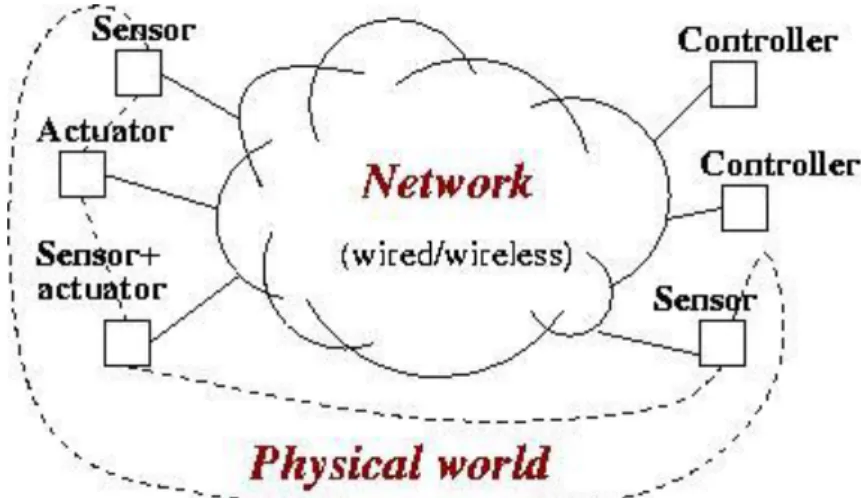
Rapid integration and convergence between telecommunications, computer networks, and control systems over the past decade pay researchers and practitioners from various disciplines to interest in the field of network control systems NCS. In general, the NCS consists of sensors, motors (actuators) and controllers, which are distributed in different geographic locations and exchange information across the network. A typical feature of NCS lies in its asynchronous operations, diverse functions and complex organizational structures. More recently, the NCS contributed to the emergence and spread of telecommunications and computing systems with a high degree in the construction of these systems to monitor and manage a variety of complex systems, which have become more popular in the automation processes, computer-integrated manufacturing, and commercial operations, and public administration.
However, building a distributed control system supported by a wireless network is a challenging task. Simultaneously, the most communication networks introduce delays and packet loss that negatively affect control performance. These communication faults are a lot more pronounced in wireless networks due to their time-varying channels, limited communication bandwidth, node limited computational power and limited energy. Many researchers aimed to compensate the time-delay in the WNCS and many strategies used for that purpose such as: Wencai and Feng (2009) proposed novel approach of new Smith predictor combined with single neural adaptive control for IEEE 802.15.4 (ZigBee) Wireless networked control systems, the results of
simulation show validity of the control scheme. Eduardo Godoy et al. (2012) designed a WNCS based on
RS-232 ZigBee devices and they used PID controller to improve the performance of the system. Chen beng et al.
(2015) proposed a higher energy efficient mixed sampling scheme (MSE) for networked control systems over IEEE 802.15.4 wireless networks to compensate the time-delay, and the results show the effectiveness of the proposed method.Mahmoud et al. (2016) proposed delay compensation scheme using classical and adaptive Smith predictor was applied to IEEE 802.15.4 wireless NCS and they used Markov model to compute the estimated network delay, simulation results show that the proposed scheme improves the NCS performance significantly and reduces the effect of the delay on the system.
Fig. 1: data exchange between system components via network.
Wired wireless networked control systems:
After learning about the network control systems can improve the efficiency, flexibility and reliability of distributed control systems in industrial applications by reducing the number of wires and parts distribution system intelligently. So it leads to lower cost of installation, reconfiguration, and maintenance. As well as the network is different from conventional Fieldbus systems. In the control systems technology, the control unit, station, sensors, and motors physically separated and sending the control signal to the control unit over the network either sensor emerging data from the station and sending it to the controller over the network too. Recent advances in the wireless sensor networks technology has led to the development of low-cost, low-power, and multi-functional sensors. With these developments, a new trend has emerged in the use of wireless networks in the network control systems is called the wireless network control systems (WNCS) (Eduardo Godoy et al., 2012).
Many of the interesting and inherent in wireless networking features pushed to find and develop the wireless networked control systems (WNCS). In the wired network control systems always there is a danger lies in cutting the carrier that connects all system devices. So using of wireless networks can eliminate all the problems resulting from the wiring in the system. As well as the wireless network control systems can work in a wide range of environments, this allows interoperability between wired and wireless systems operating advantages and also possesses the ability and flexibility compared to wired systems. Another advantage of the wireless network control systems is the possibility of WNCS installed in places where cables are impossible, such as sensors in hazardous areas, and in the regions of security stations (Park et al., 2011).
Time-delay:
There are many difficult issues that arise in the design of NCS, among those factors time delay in the network. The time-delay is the time that the system takes for measurements and sending control signals to the other components in the network, and depends on the properties of the network, such as network topology, and routing algorithms used in the network.
it could also lead to a complete system failure. An examples of applications sensitive to the time delay used in operations under the sea, and surgeries operations.
In general, the delay time is the total time expense resulting from the measurement time, processing time, the time control unit takes to send control signal to the actuator over the network, and the time that the sensors take to collect the signals from the plant and sending it to the controller over the network too. The design of NCS will become complex in the case of the entry unspecified time delay in the components of the NCS (motors, sensors, controllers). As well as the worst performance of the system may be happened in the case of data packets loss. Moreover, the time delay in the network control systems leads to destabilize the system, which does not give the desired response, so it is become necessary to compensate the time delay in the controller design to improve the performance and stability of the network control systems.
Time delay computation
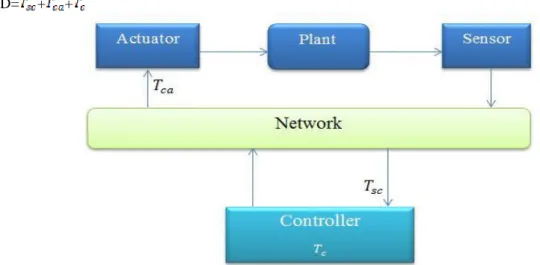
There are three kinds of delays in Networked Control Systems: 1- Data transfer delay between the sensor and the controller, . 2- Data transfer delay between controller and actuator, . 3- Computational delay in the controller, .
So that resulting time delay D for the NCS can be seen below in the equation and fig. 2 (Vardhan and Kumar, 2011).
D= + +
Fig. 2: kinds of the time-delay in the wireless NCS. Time-delay compensation strategies:
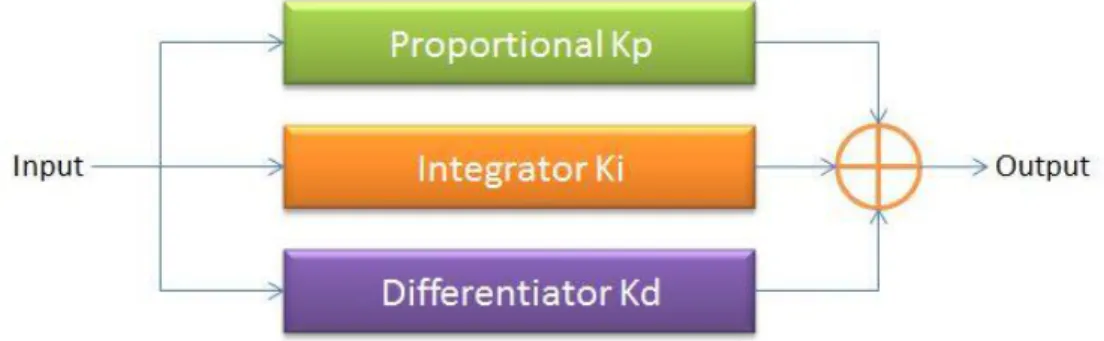
There are various strategies for delay compensation and for making the system stable. These include Smith Predictor control, PID control, LQR control, fuzzy control, adaptive control, intelligent control, robust control and various control algorithms. These strategies have been developed according to the requirements of delay compensation and unpredictability. Moreover, we will study the proportional integral differential controller PID briefly with a focus on Smith predictor for the purpose of using it in our project (Qing-Chang, 2006).
PID controller:
Fig. 3: PID controller Smith predictor:
Smith predictor is one of the best strategies and the most widely used for time-delay compensation. It has been proposed in the late fifties of the last century, and aims to design a controller to compensate the time-delay of the control systems by cancellation of delayed response time-delay to be outside of the reverse closed loop. Thus design and analysis of the system will be simple to a great extent. Also smith predictor consists of two parts: first a primary controller C (s) which is usually dominated by PID controller, but could have been one of the other controllers. The second is prediction structure (predictor) Z (s), which consists of the plant model without time delay P (s), and the latest model of the plant with a time-delay as shown in Fig. 4 and equations below. Plant model without time delay in the prediction structure used in calculation of time-delay for open loop, and also added the difference with a second model, which includes a time-delay system to overcome the disturbances and instability of the system. In the absence of disturbances or errors in modeling the difference between the current plant output and typically it would be zero. So that, the output signal of the predictor at the end will be free from time-delay. Also the elements of C(s) can be tuned as if there is no time-delay in the system.
Fig. 4: smith predictor controller
Modified smith predictor:
Classical Smith predictor cannot be applied to unstable time-delay systems. It is not a problem to design a controller C to stabilize the delay-free part of the system; the problem is that the predictor Z is unstable. If it is possible to find a stable Z, then the Smith predictor may still be of use. This is known as the modified Smith predictor. So if Z in equation (2-8) is plugged into Figure 2.7, then the scheme is applicable to unstable systems provided that Z is implemented as one stable block.
Assume that the delay-free part of the plant P is:
And delayed part of the plant is:
Then the value of the predictor Z is:
Simulation of time-delay for IEEE 802.15.4 Zigbee:
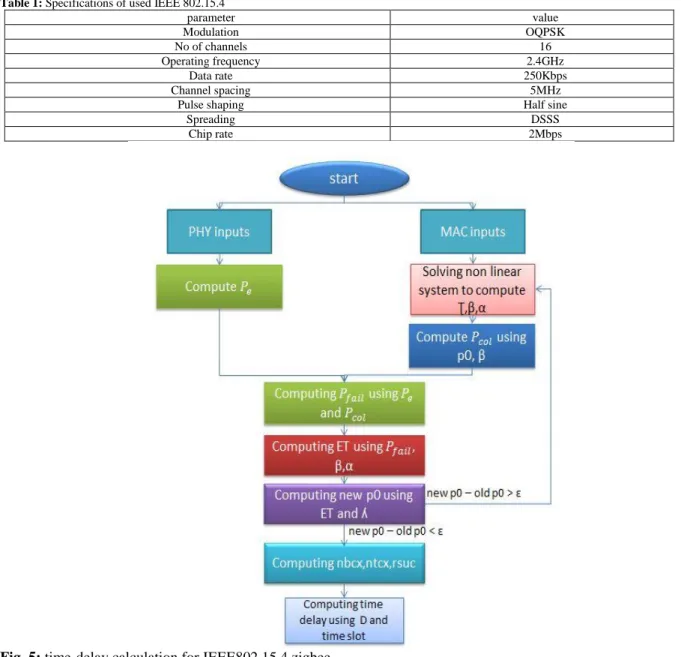
Specifications of used IEEE 802.15.4 in table 1. Then the model of IEEE 802.15.4 is inspired from Park et al. 2009 Markov chain. The Park et al. approach consists in a generalized analytical model of the slotted CSMA/CA mechanism of beacon enabled IEEE 802.15.4 with retry limits for each packet transmission. The model takes the scenario of N stations that try to communicate with a sink. Park et al. 2009 define the probabilities for the following events: a node attempts a first carrier sensing to transmit a frame, a node finds the channel busy during first clear channel assessment CCA1 or a node finds the channel busy during CCA2. They are denoted by the variables Ʈ, α and β respectively.
Time-delay calculation of the network starts from the moment of sending data package until they reach its destination successfully. The time-delay of the network is calculated based on MATLAB software by solving nonlinear equations for the probabilities Ʈ, α and β in equations below using MATLAB fsolve function, to find
the probabilities , and in the equations below respectively. Then the value of D can be obtained by
calculating the variables , and in equations below respectively as in Azadeh Faridi et al., 2010. After finding D which is represents the average number of slots multiply it by the slot time (0.96ms) to calculate the time-delay it takes while sending data from the sender until the arrival successfully to the receiver as shown in Fig. 5.
Where the parameter represents the probability of a failed transmission attempt, is the probability of an occurring collision, y the probability of sensing the channel free in two consecutive slots, m is the maximum number of backoffs the CSMA/CA algorithm will attempt before declaring a channel access failure, n is the maximum number of retries allowed after a transmission failure, L is the length of the data frame in slots (a slot has a length of 80 bits), LACK is the length of an acknowledgement in slots, N is the number of stations and is the state where the state variables of the backoff stage counter, the backoff counter and the
retransmission counter are equal to 0, and are the mean number of slots spent performing backoff and
CCA, respectively, during an attempt that ends in transmission, is the average number of times a packet has
to be retransmitted until it is transmitted with success (Mohamed-Haykel et al., 2011). Table 1: Specifications of used IEEE 802.15.4
value parameter
OQPSK Modulation
16 No of channels
2.4GHz Operating frequency
250Kbps Data rate
5MHz Channel spacing
Half sine Pulse shaping
DSSS Spreading
2Mbps Chip rate
Fig. 5: time-delay calculation for IEEE802.15.4 zigbee
Simulation of time-delay compensation for IEEE802.15.4 zigbee:
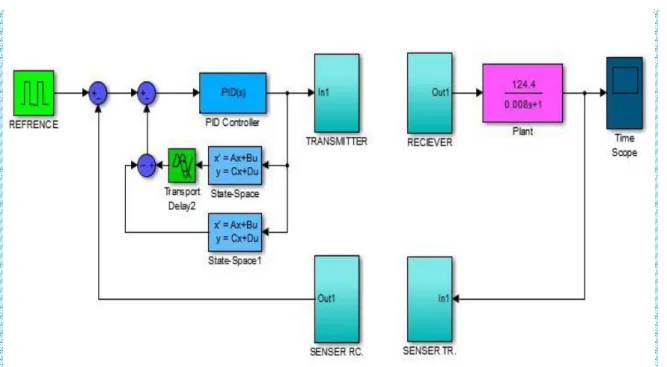
Fig. 6: time-delay compensation using modified smith predictor Simulation results:
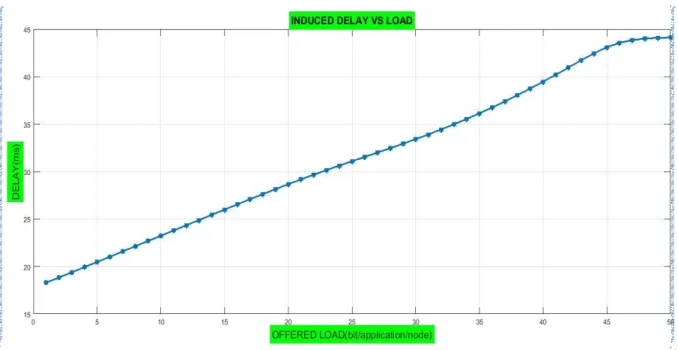
Simulation results of calculated time-delay shows that the time-delay is directly proportional to increase the number of nodes, this is mean time-delay has been increases when the number of nodes increased. So, the value of time-delay 19 milliseconds when the number of nodes equal to one, and increased gradually until it reached 188.05 milliseconds when the number of nodes was 10 as shown in Figure (4-33). As well as it is directly proportional to increase the load in the network for a constant number of nodes. So that the value of the time-delay at a load of 1 frame per second is 18.229 milliseconds and gradually increased until it became 44.133 milliseconds when the load reaches 50 frame per second (40,000 bits per sec) as shown in Figure (4-34).
Fig. 8: time-delay with offered load
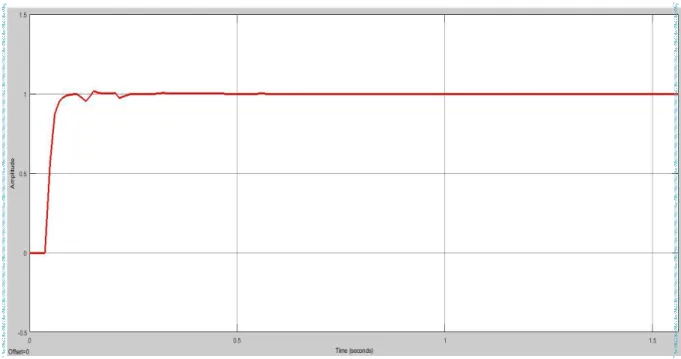
The time-delay for 2 nodes and a load of 36,000 bits per second is 43.11 millisecond which represents the delay between controller transmitter (controller output signal) and plant receiver, also the time itself between the sensor sender (plant output) and sensor receiver. Then the output response of time-delay compensation using PID controller, smith predictor, and modified smith predictor as in figures 9,10 and 11 respectively. Moreover, the calculated output characteristics of the system output such as rise time Rise, Settling Time, Maximum Overshoot, and Peak Time are as shown in Table 2. Results of output response and table shows modified smith predictor priority in compression with Smith predictor and PID controller.
Fig. 11: system response using smith predictor
Fig. 11: system response using modified smith predictor Table 2: system response
Settling Time(s) Rise Time (s)
Peak Time (s) Maximum Overshoot (%)
0.517
0.0784
0.025
12.5 PID
0.5 0.032
0.06
1.4 SMITH
0.4 0.0732
0 0
MODIFIED
Conclusions and future work:
and the type of protocol used in the process of sending and receiving data. Simulation results of the proposed model using MATLAB/SIMULINK show that the time-delay compensation for WNCS using PID controller has a poor response compared with smith predictor and modified smith predictor. As well as modified smith predictor in time-delay compensation for wireless networked control systems has a better response and more efficient compared with smith predictor, also it can be used for stable and instable plants. So that, choosing the right strategy from time-delay compensation strategies is an important point to improve system stability for wireless networked control systems. However, time-delay compensation can be improved to be used in future work for mobile plants by computing the time-delay from round trip time (RTT) of each accessed packet. Also mesh connection can be used to expand the network by increasing the number of nodes. Also, time-delay compensation for the proposed model can be applied practically if there is a way to compute the delayed time between each two nodes practically for IEEE 802.15.4 (Zigbee).
REFRENCES
Azadeh Faridi, Maria Rita Palattella, Angel Lozano, Mischa Dohler, Gennaro Boggia, Luigi Alfredo Grieco, Pietro Camarda., 2010. Comprehensive Evaluation of the IEEE 802.15.4 MAC Layer Performance with Retransmissions, IEEE TRANSACTIONS ON VEHICULAR TECHNOLOGY.
Chen Peng, Dong Yue, Min-Rue Fie, 2015. A Higher Energy Efficient Sampling Scheme for Networked Control Systems over IEEE 802.15.4 Wireless Networks, IEEE Transactions on Industrial Informatics, pp: 1-9.
Fischione, C.P., P. Park, K. Di Marco, H. Johansson, 2011. Design Principles of Wireless Sensor Networks Protocols for Control Applications, Wireless Networking Based Control, Ch. 9: 203-238.
Eduardo Paciencia., Godoy, Fernando Scorzoni, Arthur Jose Vieira Porto, 2012. Evaluating Serial ZigBee Devices for Application in Wireless Networked Control Systems, IEEE, pp: 3176-3181.
Mahmoud Gamal, Nayera Sadek, Mohamed R., M. Rizk, Ahmed K. Abou-elSaoud, 2016. Delay compensation using Smith predictor for wireless network control system, Alexandria Engineering Journal, 55: 1421-1428.
Mohamed-Haykel Zayani, Vincent Gauthier, and Djamal Zeghlache, 2011, " A Joint Model for IEEE 802.15.4 Physical and Medium Access Control Layers", IEEE
Park, P., P. Di Marco, P. Soldati, C. Fischione and K.H. Johansson, 2009. A generalized Markov chain model for effective analysis of slotted IEEE 802.15.4, IEEE, 130-139.
Qing-Chang Zhong, 2006. Robust Control of Time-delay Systems, Springer-Verlag London Limited, The University of Liverpool, pp: 17-30.
Sumit Vardhan, and Rajiv Kumar., 2011. An Implementation of Time-Delay Compensation Scheme for Networked Control Systems using MATLAB /Simulink, IEEE, International Conference on Computational Intelligence and Communication Systems, pp: 149-153.