AUSTRALIAN JOURNAL OF BASIC AND
APPLIED SCIENCES
ISSN:1991-8178 EISSN: 2309-8414 Journal home page: www.ajbasweb.com
Open Access Journal
Published BY AENSI Publication
© 2017 AENSI Publisher All rights reserved
This work is licensed under the Creative Commons Attribution International License (CC BY). http://creativecommons.org/licenses/by/4.0/
ToCite ThisArticle:Saba Farhan. H., Study Of Some Physical And Optical Properties Of Bi2o3-Teo2- V2o5 Glasses. Aust. J. Basic & Appl. Sci., 11(9): 171-178, 2017
Study Of Some Physical And Optical Properties Of Bi
2o
3-Teo
2-V
2o
5Glasses
Saba Farhan. H
Assistant lecturer,Department of Physics, Faculty Science, Wasit University, Iraq
Address For Correspondence:
Saba Farhan. H, Assistant lecturer,Department of Physics, Faculty Science, Wasit University, Kut, Wasit, Iraq.
A R T I C L E I N F O A B S T R A C T
Article history:
Received 28 March 2017 Accepted 22 May 2017
Available online 26 June 2017
Keywords:
(XRD) analysis, Tellurite,glass, optical band gap, Optical absorption coefficient
In This paper an experimental studying for Preparation of a glass series consisting of four samples with different composition of 60Bi2O3-(40-X) (TeO2) -X (V2O5), where
(x=0, 5, 10 and15mol %)were fabricated by conventional melt-quenching technique. We have fabricated from high-purity raw materials by the melting 950 ºC and then annealing at350 ºC .The main objective of the present study the effect different content of V2O5on the optical and physical properties of the prepared glass. The an amorphous
nature of the prepared glasses was determined by X-ray diffraction (XRD) analysis. The physical properties (density, molar volume and oxygen packing density) were determined and calculated. At room temperature by UV-Vis analysis the optical properties of the glasses in this work were determined in the wavelength range 380–800 nm. The results showed that the fundamental absorption edge shifts to higher wavelengths as the amount of V2O5 increases. An optical energy band gap direct
transition 𝐄𝐨𝐩𝐭𝐃 , indirect transition 𝐄𝐨𝐩𝐭𝐈𝐧, ΔE, and refractive index values of these glasses has been determined.The optical band gap energy values corresponding to the direct and indirect allowed transitions decreases while the Urbach energy increases. By using Lorentz–Lorentz formula the polarizability of oxide ion have been evaluated. Metallization criterion M has been calculated on the basis of refractive indexn and energy gap.Based on relation proposed by Duffy and Ingram optical basicity Λ of the glasses is estimated. Molar refraction RM have been calculated and explained on the
basis of structural changes.
INTRODUCTION
"The most famous of glassesuse depend on optical transparency in the visible region in a designed range of wavelengths. It is based on the application of glasses for the manufacture of optical instruments and lenses on characteristics such as refraction and dispersion coefficient, which can vary according to the different chemical compositions. Oneof the most basic applications on the basis of the optical properties of glass in the field of information technology through the use of glass fibersubmarine cables across the Atlantic, telecommunications and cable TV"(Tong Hoang Tuan, et a., 2013). Choose the suitable host matrix is one of the imperative for the stability and optical characteristics (Morri, A., 2008; Sushama, D., P. Predeep, 2014).For many application such as lasers and non-linear, photonic applications ,telluriteglass is best material for used (Prakash, G.V.,et al., 2001)."Among the various oxides glasses, tellurium oxide (TeO2) as a conditional glass former does not easily
form a glass on its own, but it readily forms glass with a modifier such as alkali metal oxide or alkaline earth metal oxide and transition metal oxides (TMOs)"(Rajendran, V.,et al., 2003; Reddy, C.N.,et al., 2008)It is important to mention TeO2 forms glass with the addition of other glass formers like V2O5, MoO3, B2O3 and
P2O5(El-Mallawany, R.,et al., 2006; Mosner, P.,et al., 2011). The addition of V2O5 which is another well known
2-Experimentalwork:
60Bi2O3- (40-x) (TeO2) –x (V2O5) a system of Tellurite glass where(x=0, 5, 10and15mol %). By using
weighing machine the chemical powder was weighedand mixed with each to other. We have fabricated from high-purity raw materialsbythemelting950 degrees Celsius and then pre-heated (annealing)at350 degrees Celsius, allfabricatedsamplespolishedbyapolishingmachinewith various types of sand papers toIn order to geta flat , fine and smooth surface, in order to meet the requirement of optical analysis measurements. By Archimedes principlethe density was measured of each glass at room temperature with toluene such as the reference liquidor the buoyant medium. We can estimate the corresponding molar volume Vm according to the following rule:
Where Mglass=0.6 M(BiO3)+(0.4-X) M (TeO2)+X M (V2O5)
"The oxygen packing density of the glass samples in this workwas calculated using the following relation
Where ρ, the density, M, molecular weight of the sample and n, the number of oxygen atoms in the composition" (Saddeek, Y.B.,et al., 2008). In the table1 the class composition of the samples is given. The construction of the glass was explored by X-ray diffraction (XRD) analysis.At roomtemperaturetheUVabsorption measurements usingan ultraviolet spectrophotometer, wavelengthintherange (380-800nm)for bulkglass sample with the two faces polished parallel.
RESULTS AND DISCUSSION
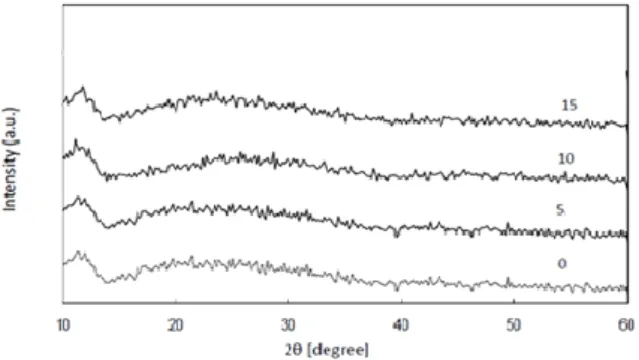
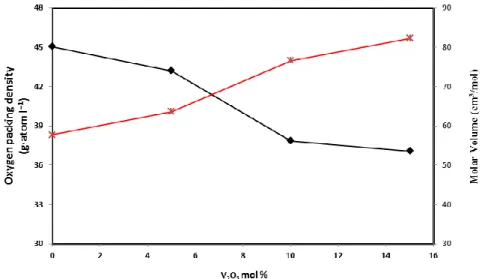
Every one of the glasses werecreatedamorphous,measuring the X-Ray diffraction was utilized to affirm amorphous or crystalline statein materials. The outcomes indicate, demonstrate have the long range disorder structural which is the feature of an amorphous nature like show in Fig. 1 a broad peak characteristic of amorphous materials. Molar volume increased, but Oxygen packing density decreased show in figure 2 and collected in Table1 due to growth in the number of spaces in the arrangement and creating non-bridging oxygen atoms cause bond breaking (Mott, N.F., E.A. Davis, 1979).Structure becomes loose packed as it is adding more content V2O5 to base matrix glasses.
Fig. 2: Variation Oxygen packing density and molar volume vs V2O5 mol%
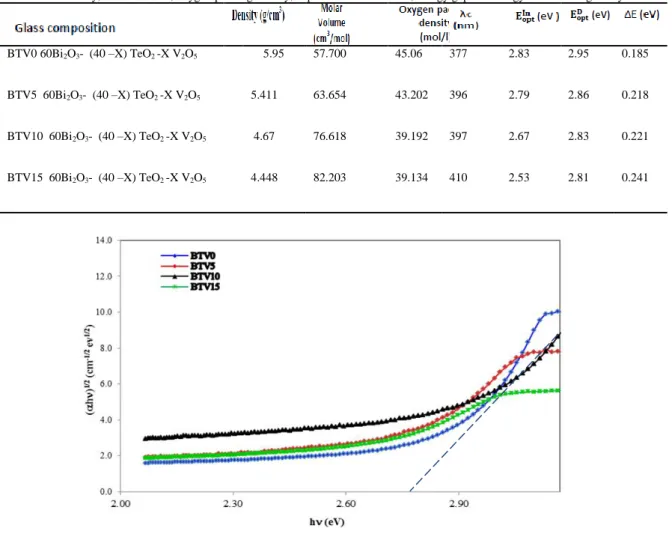
At room temperature and In the range of 380–800 nm optical absorption spectra analysis of the fabricated BTV glass system It was found that the absence of an acute edge of optical absorption clearly indicates that it was the distinctive character of the glass state. The cutoff wavelength λc was in the ranges from 377 to 410 nm.Is an important to investigate To determine optical band gap energy and optical absorption.By Davis and Mott relation We can calculate optical band gap Eopt values of the glasses using the relationship between the
absorption coefficient α (ν) and photon energy (ћν) for direct optical transition and indirect optical transition, and is given as regards below (Al-Ani, K.,et al., 1985)
Where Eopt is theopticalbandgapenergyC is constant,where α is the absorption coefficient, hv is the energy
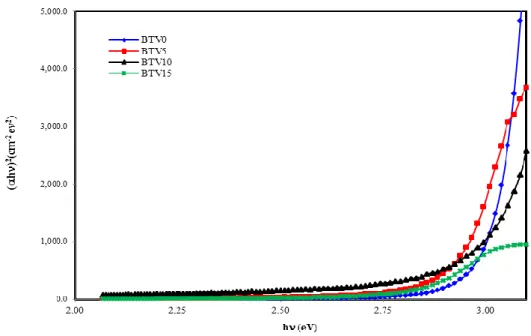
of photon incident, the values of n is depending on the transition type.The values of indirect optical band gap energy Eoptcan get it from Eq.1 tocalculate the band gap energy for direct and indirect transitions(αћν)2 and
(αћν)1/2 .We was used the slope of the plotting likeshow in Fig. 4 and5.Put E
opt values for samples of glass in
Table 1. ValuesEoptreduced from (2.83to2.53 ev)arrangement formation of high of the non-bridging oxygens
which alteration the glass structure atoms (Yousef, E.,et al., 2007). Character of disorder in the amorphous materials Urbach energy assumed(ΔE) is givenas arelation (Dimitrov, V., S. Sakka, 1996):
Fig. 3: UV absorption spectra BTV glass system
Table 1: The density, molar volume, oxygen packing density, experimental UV cutoff, energy gap and energy tail of BTV glass system
BTV0 60Bi2O3- (40 –X) TeO2 -X V2O5 5.95 57.700 45.06 377 2.83 2.95 0.185
BTV5 60Bi2O3- (40 –X) TeO2 -X V2O5 5.411 63.654 43.202 396 2.79 2.86 0.218
BTV10 60Bi2O3- (40 –X) TeO2 -X V2O5 4.67 76.618 39.192 397 2.67 2.83 0.221
BTV15 60Bi2O3- (40 –X) TeO2 -X V2O5 4.448 82.203 39.134 410 2.53 2.81 0.241
Fig. 5: Determination of the direct optical band gab (eV) for glasses studied
Fig. 6: Variation of urbach energy (∆E) vs V2O3 mol%
The refractive index is used to determine the suitability of glassy materials to be optical devices. The refractive index value is listed inTable 2.Refractive index of these glasses studied is calculated by using the relation(El-Diasty, F.,et al., 2006):
Increases the refracetive index of (2.441to2.536)as in Table2 and shown in Figure 8. "Creation of more non-bridging oxygen atom (NBO) in the possess a highestnumber of polarizability compared to (BO) bridging oxygen which results to the increasing number of refractive index of glass samples"(Dimitrov, V. and T. Komastu, 1999).
"Where VM is molarvolume,Eopt is opticalbandgapenergy,αi polarizabilityofthe cation (molar cation
Data were obtained from electronic polarizability in Table 2. Shows an increase the value of the electronic polarization effect of the concentration of V2O5 on polarization.Inaddition, ofV2O5 in glasses addedincrement
the number of non-bridging oxygen atom (NBO), which leads to making the glasses become more polarized."Dimitrov and Komatsu explained on predicting the nature of solids which is metallic or non-metallic based on the condition of Rm/Vm<1 (non-metal) and Rm/Vm> 1 (metal)".
Where "M:metallizationcriterion in this study. Itslieintherangeof(0.3824 – 0.3852) tabuled in Table 2.Mofmosttelluriteglasses lies intherange of(0.35–0.45)".Basicity can becalculated from the relationship of basicity and refractivity.Basicity of the glass medium ᴧ by the following correlation:
Duffy Explained there is a fundamental relationship between oxide ion polariezability and optical basicity of the glass in this workdata of optical basicity are listed in Table 7 and plotted in Figure 7.The increase the number of optical basiceiety ᴧ means that the abileitey of oxide ions to means electrons to surrounding cations to be high ase more V2O5 content is added.
Table 2: Rrefractive index, Molar refraction RM, Rm/Vm, metallization criterion M, electronic polarizability oxide ion polarizability of
material and optical basicity A for glasses studied
60Bi2O3- (40 –X) TeO2 -X V2O5 2.441 35.950 0.623 14.265 0.376 4.552 1.303
60Bi2O3- (40 –X) TeO2 -X V2O5 2.453 39.835 0.625 15.807 0.374 4.889 1.328
60Bi2O3- (40 –X) TeO2 -X V2O5 2.514 47.313 0.639 18.775 0.360 5.628 1.373
Fig. 7: Variation optical basicity, electronic polarizability vs V2O5 mol%
Fig. 8: Variation molar refraction RM , refractive index (n) V2O5 mol%
Conclusion:
Glasses in this study Replacement TeO2 by V2O5 change:
Molar volume and Oxygen packing density increases and with the increase of V2O5 content.
At room temperature, the spectrum of optical absorption was measured within the spectral range (380– 800 nm).It has been observed that the fundamental absorption edge shifts to higher wavelength as the amount of V2O5 increases.The indirect absorption edges of the glass were in the range (2.83-2.53) for the direct
transformations were in the range (2.95-2.81) both transitions showed decrease, due to highly (NBO). The parameters λcutoff,ΔE and the refractive index showed an increase with increasing V2O5 content .
The increase in αo2- is related tothe formationof non-bridging oxygen (NBO) and increase the numberof
free electrons
Most tellurite glasses Metallization criterion lies in the range of (0.35–0.45)in this study was from(0.37694to 0.3558)
133.
Montani, R.A., M.A. Frechero, 2006. Solid State Ionics, 177: 2911. Mori, H., J. Igarashi, H. Sakata, J. Ceram. 1993. Soc. Jpn. 101(2): 1351. Mori, H., K. Gotoh, H. Sakata, 1995. J. Non-Cryst. Solids,pp: 183-122.
Mori, H., T.Kitami, H.Sakata, 1994. Electrical conductivity of W2O5–Sb2O3–TeO2 glasses. J. Non-Cryst. Solids, 168: 157-166.
Morri, A., 2008. Ceram.Soc.Jpn., 116: 1040-1051.
Mosner, P., K. Vosejpkova, L. Koudelka, L. Montagne, B. Revel, 2011. J. Non-Cryst. Solids,357-2648. Mott, N.F., E.A.Davis, 1979. ElectronicProcessesinNonCrystallineMaterials,ClarendonPress,Oxford. Prakash, G.V., D.N.Rao and A.K.Bhatnagar, 2001. Solid State Commun., 119: 39-44.
Rajendran, V., N. Palanivelu, B.K. Chaudhuri, K. Goswami, 2003. J. Non-Cryst. Solids, 320: 195. Reddy, C.N., V.C.V. Gowda, R.P.S. Chakradhar, 2008. J. Non-Cryst. Solids, 354-32.
Saddeek, Y.B., E.R.Shaaban, E.Moustafa and H.M.Moustafa, 2008. J. Physica B, 403 pp: 2399-2407. Saritha, D., Y. Markandeya, M. Salagram, M. Vithal, A.K. Singh and G. Bhikshamaiah, 2008. J. Non-Cryst. Solids, 354: 5573-5579.
Sushama, D., P. Predeep, 2014. Int.J.ApplPhysMath., 139: 4-143.
Szu, S.P., F.-S.Chang, 2005. Impedance study of V2O5–TeO2–BaO glasses. Solid State Ion, 176: 2695-2699.
Tong Hoang Tuan, Tonglei Cheng, Koji Asano, Zhongchao Duan, Weiqing Gao, DinghuaDeng,Takenobu Suzuki, and Yasutake Ohishi, 2013. "Optical parametric gain and bandwidth in highly nonlinear tellurite hybrid microstructured optical fiber with four zero-dispersion wavelengths" pp: 20303-20312.