Address for correspondence Dr. PV Bhagwat, MD (SKIN & VD)
Associate Professor, Department of Skin and STD, Karnataka institute of medical sciences,
Hubli-580022, Karnataka, India Email: [email protected]
Original Article
A study on effectiveness of
dexamethasone-cyclophosphamide pulse therapy, dexamethasone
pulse therapy and dexamethasone-methotrexate pulse
therapy in cases of pemphigus vulgaris and
pemphigus foliaceus
Introduction Pemphigus is a group of chronic autoimmune
blistering diseases. It is characterized clinically by flaccid bullae leading to erosions; histologically by the formation of intraepidermal blisters resulting from acantholysis, and immunopathologically by the presence of in vivo
Pradeep Vittal Bhagwat, Varsha N Raj, Chandramohan Kudligi
Department of Skin & STD, Karnataka Institute of Medical Sciences, Hubli, Karnataka, India
Abstract
Objective To report our 5-year experience in the treatment of pemphigus with dexamethasone-cyclophosphamide pulse therapy, with a slight modification in phase I which resulted in higher rates of remission and no relapses.Methods All patients diagnosed as pemphigus on the basis of clinical and histopathological grounds were started on DCP therapy, but patients in the reproductive age group, both unmarried and those who had not completed their families were started on dexamethasone pulse therapy and Dexamethasone methotrexate pulse therapy was considered in patients with prolonged phase I (>9cycles).
Results A total of 51 cases diagnosed with pemphigus were included in the study, of which 21 were males and 30 were females. 49 cases were of Pemphigus vulgaris type and 2 cases were of Pemphigus foliaceus. DCP therapy was started on 46 patients and dexamethasone pulse therapy was started in 5 females of reproductive age group who were yet to complete their families. 2 patients with prolonged phase I (>9cycles) were shifted to dexamethasone methotrexate pulse therapy, of which one patient was initially on dexamethasone pulse therapy, who was unmarried and methotrexate was started after taking informed consent. 9 patients discontinued the treatment in phase I after around 3-4cycles and 7 patients were lost for follow up during phase II. The average duration of phase I was 6 months. At present, 13 patients are in phase I and a total of 6 patients in phase II, 7 patients in phase III and 9 patients in phase IV are in complete clinical remission, with absolutely no relapses in compliant patients except for defaulters.
Conclusion Phase I was continued not only until the new lesions stopped appearing, but was extended for 3 more months even after the new lesions ceased, to appear to reduce the relapse rates when the patient enters phase II.
Key words
bound and circulating IgG autoantibodies against keratinocyte cell-surface components, the desmosomal desmoglein 3 and desmoglein 1.1,2 Indian patients of pemphigus are also known to present at a younger age.1 The disease used to be fatal in 60-90% cases before the advent of corticosteroids.1,3 After the introduction of corticosteroid therapy in the 1950s, the mortality rate of patients with pemphigus declined from 90% to 24%.4,5 But high dose steroids given for a prolonged period of time led to many adverse effects which also contributed to mortality. In an attempt to overcome these side effects of conventional daily dose regimens, pulse doses of corticosteroids and immunosuppressive drugs were introduced. This has further reduced the mortality rate to 5-10%.1,3 Dexamethasone-cyclophosphamide pulse (DCP) therapy was introduced by Pasricha et al.6 in 1981 which has revolutionized the treatment of pemphigus. Later it underwent several modifications.
We, here by present in this article a study of 51 pemphigus patients treated with DCP,
dexamethasone pulse (DP) and dexamethasone-methotrexate pulse (DMP) therapy with a slight modification of phase I being extended for a duration of 3 more months after cessation of new lesions.
Methods
All patients clinically diagnosed as pemphigus
were confirmed by Tzanck smear and
histopathology. Patients with major medical illness like uncontrolled diabetes mellitus, hypertension, HIV, patients with pemphigus on previous treatment with other immunosuppressant therapy and in whom steroids and cyclophosphamide were contraindicated were excluded.
Complete demographic details of the patients were obtained including age, sex, occupation,
residence, marital status and comorbidities. Duration of the disease prior to the presentation and any previous therapy received was noted. The extent of skin lesions, presence and extent of mucosal involvement, presence of Nikolsky’s sign was noted in each case. All patients were admitted and baseline investigations were done which included complete hemogram, liver and renal function tests, blood sugar, urine routine examination and chest X-ray.
Treatment protocol
All patients were put on Condy’s compresses, chlorhexidine mouth washes, triamcinolone oral gel and topical lignocaine gels. Intravenous antibiotics were given in selected cases with presence of cutaneous infection and topical antifungals in those cases complicated by secondary oral candidiasis.
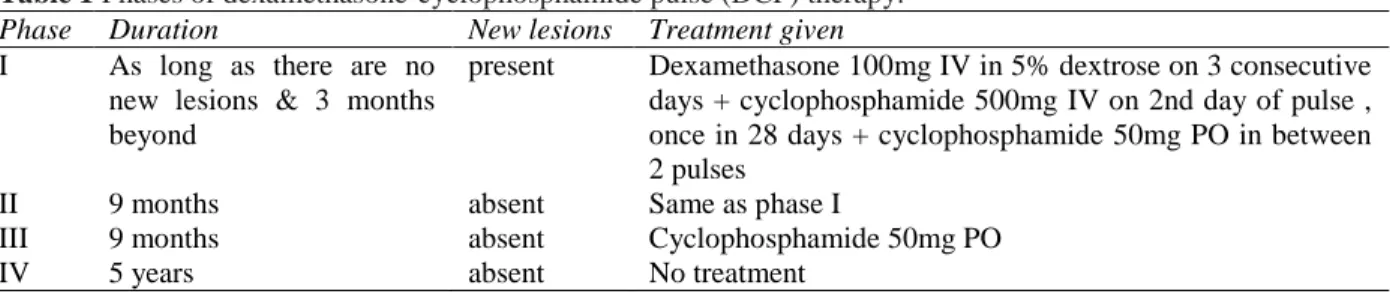
DCP therapy (Table 1) was given to all patients except for 6 females in the reproductive age group who were started on DP therapy (Table 2). 2 patients with prolonged phase I (>9 cycles) were shifted to DMP therapy (Table 3).
8 units of insulin were added to the infusion in case of diabetics. All patients were routinely given calcium and vitamin D supplementation. After completion of phase III, patients were followed up at 3 month interval. Drop-outs during the study period were noted.
Follow-up Patients were followed up regularly and monitored for any side effects of the therapy, clinical activity of the disease in terms of healing of existing lesions, appearance of new lesions and Nikolsky’s sign.
Table 1 Phases of dexamethasone-cyclophosphamide pulse (DCP) therapy. Phase Duration New lesions Treatment given I As long as there are no
new lesions & 3 months beyond
present Dexamethasone 100mg IV in 5% dextrose on 3 consecutive days + cyclophosphamide 500mg IV on 2nd day of pulse , once in 28 days + cyclophosphamide 50mg PO in between 2 pulses
II 9 months absent Same as phase I
III 9 months absent Cyclophosphamide 50mg PO
IV 5 years absent No treatment
Table 2 Phases of dexamethasone pulse (DP) therapy.
Phase Duration New lesions Treatment given I As long as there are no
new lesions & 3 months beyond
present Dexamethasone 100mg IV in 5% dextrose on 3 consecutive days, once in 28 days
II 9 months absent Same as phase I
III 9 months absent Monthly follow up
IV 5 years absent Follow up
Table 3 Phases of dexamethasone-methotrexate pulse (DMP) therapy. Phase Duration New lesions Treatment given I As long as there are no
new lesions & 3 months beyond
present Dexamethasone 100mg IV in 5% dextrose on 3 consecutive days, once in 28 days + Tab. methotrexate 7.5mg single dose weekly
II 9 months absent Same as phase I
III 9 months absent Tab. methotrexate 7.5mg single dose weekly
IV 5 years absent No treatment
pulse therapy and 1 patient with uncorrectable leucopenia was shifted to dexamethasone pulse therapy towards the end of phase II.
Severity of disease Severity of the disease at the time of presentation was quantified using Autoimmune Bullous Skin disorder intensity score (ABSIS)7,8 which involves a cutaneous
score, oral extent score and oral severity score and a total score which is summation of all these entities. According to this scale, maximum cutaneous score can be 150, oral extent score 11, oral severity score 45 and total score 206.
ABSIS is internationally accepted and validated score to assess disease severity and activity in cases of pemphigus as well as other autoimmune bullous disorders. ABSIS was chosen as the ideal severity scale for the study, as none of the patients had mucosal involvement other than oral mucosa.
ABSIS was assessed at the time of presentation and reassessed after 6 months of DCP in all the patients to evaluate response to the treatment. A time period of 6months of therapy was fixed to reassess ABSIS since the duration of phase I in most of the patients was 6 months.
Results
Demographic profile Out of the total 51 patients, 21 (41.2%) were males and 30 (58.8%) were females. One pregnant patient was included in the study. The oldest patient was 66-year-old and the youngest one in the study was 20-year-old. Age distribution of the patients is shown in Figure 1.
average of 1-3 months. Mucous membranes other than oral were not involved in any patients. Mean duration of the disease at the time of presentation was 2-4 months in most of the patients, with the longest being 2 years of disease at the time of presentation in one female and shortest was 1 month.
5 patients had received continuous oral prednisolone therapy for a variable period of 3-6 months before presentation, in spite of which there was not much of clinical improvement.
Severity of disease All patients who had completed 6 months of DCP therapy were included for calculation of ABSIS irrespective of still in phase I or shifted to phase II. All the defaulters who had received 6months of DCP therapy before discontinuation were also included. Patients excluded from ABSIS assessment were defaulters in phase I who discontinued the treatment before 6months, patients currently in phase I, but not yet completed 6 months, 2 cases of pemphigus foliaceus and 6 patients who were started on dexamethasone pulse therapy
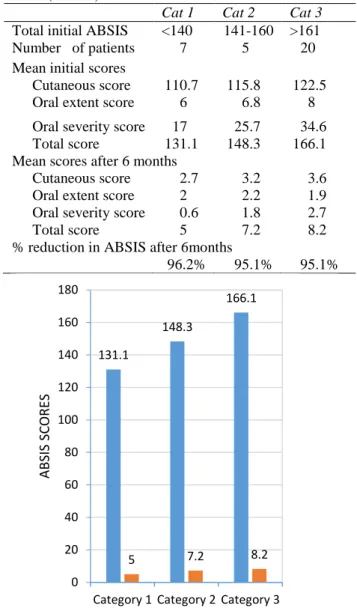
A total of 32 patients were included for ABSIS assessment and they were divided into 3 categories based on their initial total ABSIS (Table 4 and Figure 2).
Table 4 Autoimmune Bullous Skin disorder intensity score (ABSIS) before and six month after treatment.
Cat 1 Cat 2 Cat 3 Total initial ABSIS <140 141-160 >161
Number of patients 7 5 20
Mean initial scores
Cutaneous score 110.7 115.8 122.5
Oral extent score 6 6.8 8
Oral severity score 17 25.7 34.6 Total score 131.1 148.3 166.1 Mean scores after 6 months
Cutaneous score 2.7 3.2 3.6
Oral extent score 2 2.2 1.9
Oral severity score 0.6 1.8 2.7
Total score 5 7.2 8.2
% reduction in ABSIS after 6months
96.2% 95.1% 95.1%
Figure 2 Autoimmune Bullous Skin disorder intensity score (ABSIS) before and six month after treatment.
Associated diseases 3 patients had well-controlled type II diabetes mellitus on regular treatment, 2 patients had essential hypertension on treatment and 1 female patient had seizure disorder, who was on regular treatment. She did not develop any episode of seizures while on DCP therapy. An emergency kit for the management of acute attack of epilepsy was kept ready during the infusion.
22 23
6
0 5 10 15 20 25
20-39 40-59 >60
No
.
o
f
p
atien
ts
Years
Figure 1 Age distribution of the patients
131.1
148.3
166.1
5 7.2 8.2
0 20 40 60 80 100 120 140 160 180
Category 1 Category 2 Category 3
ABS
IS
SC
ORE
S
Treatment 46 patients were started on DCP therapy and 5 females in the reproductive age group including the one pregnant female, were started on dexamethasone pulse therapy. The pregnant lady presented during her second trimester and she was started on dexamethasone pulse therapy after obtaining clearance from obstetricians. But she was lost to follow-up after the first cycle of DP. 2 patients with prolonged phase I (>9 months) were shifted to DMP out of which 1 was initially put on dexamethasone pulse therapy. 1 patient with untreatable leucopenia was shifted to dexamethasone pulse therapy towards the end of phase II (after phase II cycle 7).
Defaulters 9 patients were lost to follow-up in phase I after 3-4 cycles, 7 patients during phase II.
Relapsed after default 1 patient discontinued the therapy after phase I cycle 5 and relapsed after 6months. 1 patient discontinued treatment after phase II cycle 4 due to development of ocular surface neoplasia and relapsed after 1year. 1 patient relapsed after discontinuing therapy in phase III cycle 3 and presented 2years later. Longer duration of remission was observed in the patients who discontinued during phase III.
Phases Mean duration of phase I was 6 months in most of the patients with shortest being 4 months and the longest being 20 months. This patient was a prisoner and had previous history of pulmonary tuberculosis for which he was treated for 6 months and was declared cured 10 years back and hence he was continued on DCP therapy for 20 cycles as DMP could not be considered in him.
Phase I was longer than 6 months in all those patients who had signs of severe disease at the time of presentation like paronychia, periungual
hemorrhagic bullae and extensive skin lesions (cutaneous ABSIS score> 125).
Skin lesions resolved earlier (after around 2-3 cycles) in most of the patients and oral lesions tend to persist for longer. 2 patients had recalcitrant oral ulcers which persisted even during phase II, but there was no appearance of new lesions.
3 patients with severe disease required oral prednisolone in between the pulses during phase I, in whom complete remission and total stoppage of intermittent steroids was ensured before shifting to phase II
The time required to achieve clinical remission was quite longer in patients on dexamethasone pulse therapy as compared to DCP.
At present 13 patients are in phase I, and a total of 6 patients in phase II, 7 patients in phase III and 9 patients in phase IV are in complete remission.
Ocular surface neoplasia developed in a 40-year-old male patient which led to discontinuation of therapy in phase II cycle 4. He did not have previous history of any ophthalmic complaints and no risk factors for development of ocular surface neoplasia were elucidated in him. He was treated with intralesional interferon therapy for the same, following which he was cured of it but he relapsed with pemphigus lesions after 1 year.
One female patient on dexamethasone pulse therapy with intermittent steroids developed seizure disorder secondary to cerebral venous thrombosis with in 1week after phase I cycle I and thus DP was continued. At present she is in remission with no new skin/oral lesions and she is under monthly follow-up and she is not put on any treatment.
Other minor side effects encountered were sleep disturbances, fatigue, bad taste and headache following initial few days of pulse, cushingoid features and weight gain, menstrual disturbance with polymenorrhagia in 2 females. No cases of secondary amenorrhea were noted.
No incidences of serious adverse events like cardiac arrest, MI, was noted during the study and no mortality occurred during the study period.
Statistical analysis Student T test was applied to the sample size of 32 patients who were included for ABSIS assessment, mean ASIS score before 155.67+/-15.255 and after 6 months 7.34+/-3.884, T value obtained was 58.683 at
p<0.0001. There was significant reduction in the mean value before and after 6months of DCP therapy.
Discussion
Pemphigus is a group of chronic autoimmune blistering diseases characterized by the presence of antibodies against desmosomal adhesion proteins. It affects all races and both sexes particularly in their middle ages.1
Introduction of DCP therapy for pemphigus by Pasricha et al.9 in 1981 revolutionized the therapy for pemphigus from mere control of the disease to probable cure. Since then it has been widely used in various centres and complete remission of pemphigus has been reported.10-12It has also been implemented successfully in countries like Serbia, UK and South Africa with a few modifications.4,13,14
In our institute, DCP therapy is being used for the treatment of pemphigus since 2013. In this article report our 5-year experience of 51 pemphigus patients treated with DCP, DP and DMP therapy.
Indian patients are known to present at a younger age.1 43% of the patients were less than 40-year old and 45% of the patients were aged between 40-60 years. This is almost consistent with earlier studies which showed around 50% of cases occurring in individuals aged less than 40years.15-17 The earlier the pemphigus appears, more severe is the disease.17 This was an observation made in our study also as the patients less than 22 years suffered from more severe form of disease, which took longer time for remission. The youngest patient in the study was aged 20-year and the oldest was 66-year-old.
Pemphigus vulgaris was the commonest type (96%) and pemphigus foliaceus was observed only in 2 patients. Pemphigus vulgaris cases showed more severe involvement as compared to pemphigus foliaceus.1 All the cases of pemphigus vulgaris showed oral mucosal involvement. Other mucosae were not involved.1 Oral lesions heralded the disease process in 85% of the patients by an average of 1-3months. Mean duration of the disease at the time of presentation was 2-4 months with longest being 2 years and shortest being 1month.
Diabetes mellitus and essential hypertension were found to be associated disorders1 but other autoimmune diseases like rheumatoid arthritis, hyper-/hypothyroidism were not observed. 1 patient had seizure disorder on regular treatment and DCP therapy was successfully given without any recurrence of seizures during the treatment period.
46 patients were started on DCP therapy and 5 females in the reproductive age group were given dexamethasone pulse therapy. Skin lesions resolved earlier with in an average of 2-3 cycles but oral lesion persisted for long as observed in other studies.1
More severe the disease, the longer was the duration of phase I. Patients with dexamethasone pulse therapy took longer time for remission (phase I average of 6-8 cycles) as compared to patients on DCP (phase I average of 4-6 cycles). Only 3 patients with severe disease required intermittent steroids in between the pulses during phase I. 2 patients with prolonged phase I (>9 cycles) were shifted to DMP after which lesions healed faster and new lesions stopped appearing, which showed that DMP can be promising in patients not responding with DCP therapy.
Drop-out rate was around 31%, same as around 15-26% drop rate reported in few studies.11,19 Side effect profile was similar to other studies1 except for ocular surface neoplasia in 1 patient, which may be unrelated to the therapy. Leucopenia was observed in 2 patients towards end of phase II and a similar observation was made in other studies.4
9 patients in phase IV are in complete clinical remission for a period of 3-6 years owing to long-term remission as observed in other studies11,20 and also can be considered virtual cure as reported by Pasricha et al.9
Conclusion
By this study, we can conclude that DCP therapy is effective in achieving long-term remissions, as well as, offers virtual cure in patients of pemphigus with minimal adverse events. DCP therapy was found to be more effective than dexamethasone pulse therapy in achieving early remission and thus lesser number of cycles in phase I and overall lesser duration of treatment.
DMP therapy proved to be effective in cases failing on DCP/DP therapy in our study.
Limitations of the study
References
1. Mahajan VK, Sharma NL, Sharma RC, Garg G. Twelve‐year clinico‐therapeutic experience in pemphigus: A retrospective study of 54 cases. Int J Dermatol. 2005;44:821-7.
2. Robinson ND, Hashimoto T, Amagai M, Chan LS. The new pemphigus variants. J Am Acad Dermatol. 1999;40:649-71. 3. Korman NJ. New immunomodulating drugs
in autoimmune blistering diseases. Dermatol Clin. 2001;19:637-48.
4. Zivanovic D, Medenica L, Tanasilovic S, Vesic S, Skiljevic D, Tomovic M et al. Dexamethasone-Cyclophosphamide Pulse Therapy in Pemphigus. Am J Clin Dermatol. 2010;11:123-9.
5. Rosenberg FR, Sanders S, Nelson CT. Pemphigus: a 20-year review of 107 patients treated with corticosteroids. Arch Dermatol. 1976;112:962-70.
6. Pasricha JS, Gupta R. Pulse therapy with dexamethasone cyclophosphamide in pemphigus. Indian J Dermatol Venereol Leprol. 1984;50:199-203.
7. Grover S. Scoring systems in pemphigus. Indian J Dermatol. 2011;56:145-9.
8. Daniel BS, Hertl M, Werth VP, Eming R, Murrell DF. Severity score indexes for blistering diseases. Clin Dermatol. 2012;30:108-13.
9. Pasricha JS, Khaitan BK. Curative treatment for pemphigus. Arch Dermatol. 1996;132:1518-9.
10. Lever WF, Schaumburg-Lever G. Treatment of pemphigus vulgaris: results obtained in 84 patients between 1961 and 1982. Arch Dermatol. 1984;120:44-7.
11. Kaur S, Kanwar AJ. Dexamethasone‐ cyclophosphamide pulse therapy in pemphigus. Int J Dermatol. 1990;29:371-4. 12. Masood Q, Hassan I, Majid I, Khan D,
Manzooi S, Qayoom S et al. Dexamethasone cyclophosphamide pulse therapy in pemphigus: experience in Kashmir valley. Indian J Dermatol Venereol Leprol. 2003;69:97-9.
13. Saha M, Powell AM, Bhogal B, Black MM, Groves RW. Pulsed intravenous cyclophosphamide and methylprednisolone therapy in refractory pemphigus. Br J Dermatol. 2010;162:790-7.
14. Shaik F, Botha J, Aboobaker J, Mosam A. Corticosteroid/cyclophosphamide pulse treatment in South African patients with pemphigus. Clin Exp Dermatol. 2010;35:245-50.
15. Mascarenhas MF, Hede RV, Shukla P, Nadkarni NS, Rege VL. Pemphigus in Goa. J Indian Med Assoc. 1994;92:342-3.
16. Sehgal VN. Pemphigus in India. A note. Indian J Dermatol. 1972;18:5-7.
17. Singh R, Pandhi RK, Pal D, Kalla G. A Clinicopathological Study of Pemphigus. Indian J Dermatol Venereol Leprol. 1973;39:126-32.
18. Kanwar AJ, Ajith AC, Narang T. Pemphigus in North India. J Cutan Med Surg. 2006;10:21-5.
19. Pasricha JS. Pulse therapy in pemphigus and other diseases. Pulse Therapy and
Pemphigus Foundation. New
Delhi:[Available from: http://www. ijdvl. com/article. asp. 2000.