
QUALITY ACCOUNT
2014/2015
Table of Contents
Page
1. Chief Executive’s Statement 3
Statement of Director’s Responsibilities in Respect of the Quality Account 4 2. Looking Back to 2014/15 – Review of Quality Performance 5 2.1 Progress with last year’s Priorities for Improvement 5 2.2 Managing Quality Better in 2014/15 7
2.3 National Reporting Requirements 7
2.4 Indicators of Quality – Patient Safety 10
2.5 Clinical Effectiveness 15
2.6 Indicators of Quality – Patient Experience 17
3. Looking Forward to Improving Care 26
3.1 Delivering and sustaining Red Call response times 26 3.2 Further improving the management of Mental Health patients 26 3.3 Further improving the management of patients suffering falls 27 3.4 Reducing harm to patients, especially those not transported
(Safe Care Closer to Home) 27
3.5 Reducing staff harm 27
3.6 Introducing a Clinical Performance Indicator for the management of
maternity conditions 27
4. Formal Statements on Quality 28
4.1 Review of Services 28
4.2 Participation in Clinical Audits 28
4.3 Participation in Clinical Research 29 4.4 Use of the CQUIN Payment Framework 30 4.5 Statement on Relevance of Data Quality and your actions to improve it 30 5. Statements from Commissioners, Healthwatch and OSCs 32
5.1 Commissioners 32
5.2 Healthwatch 33
5.3 Overview and Scrutiny Committees 36
Appendices
1 Glossary of Terms 41
1
Chief Executive’s Statement
Welcome to the Quality Account for North West Ambulance Service NHS Trust, which describes how we have delivered and improved quality during 2014/15, and sets out our quality priorities for the year ahead.
The Board of Directors is proud of our commitment to all aspects of clinical quality - delivering the Right Care at the Right Time and in the Right Place. In 2014/15 we made improvements in each of these areas.
I would like to draw your attention to some particular headlines from the year:
Whilst we have kept a strong focus on performance, it is disappointing that we were unable to meet the three national response time targets for Red calls. The number of 999 calls was far higher than predicted and the proportion of those calls categorised as “Red”, was higher (Section 2.6). It has been a very busy year. For the same reason, our aspiration to improve compliance with clinical care bundles was not met (Section 2.5). We are addressing these issues with our Commissioners to ensure that we meet the response time standards in 2015/16.
On a more positive note, we have improved our quality performance in our Patient Transport Service (PTS) and the improvement notice issued in February 2014 was withdrawn in August. Since then we have continued to deliver against the majority of the contracted quality standards.
Satisfaction from patients and staff is high. As an early implementer of the Friends and Family Test we have been able to develop a range of ways for patients to tell us what they think, and the results have been very positive. A comparison of staff satisfaction levels across English Ambulance services has shown that our staff have reported the highest levels of satisfaction.
This year, we have fulfilled our ambition to create a team of trained volunteer doctors able to respond to Trauma emergencies. The MERIT team will grow in the year ahead to provide comprehensive cover across the North West.
A positive development further to the 2013/14 CQUIN programme has been the expansion of the Frequent Callers team, identifying vulnerable people who call 999 services frequently, and working with partner agencies to provide appropriate support.
Last but not least, in 2014/15 the Trust was awarded a five year contract to provide 111 services from October 2015. This gives us the potential to expand the work that we do in providing safe care, closer to home, and is a reflection of our success in running the service as a stability partner since October 2013.
I would like to record my deep appreciation and thanks to all NWAS staff for their continuing commitment to their patients and the quality of care that they provide, and to the organisations that work with us every day to deliver the most appropriate care. I would also like to give my thanks to the many volunteers who do so much to support the Service.
I hope that you find this Quality Account informative. Please get in touch if you have any questions.
Bob Williams
STATEMENT OF DIRECTORS' RESPONSIBILITIES IN RESPECT OF THE QUALITY ACCOUNT
The directors are required under the Health Act 2009, National Health Service (Quality Accounts) Regulations 2010 and National Health Service (Quality Account) Amendment Regulation 2011 to prepare Quality Accounts for each financial year. The Department of Health has issued guidance on the form and content of annual Quality Accounts (which incorporate the above legal requirements). In preparing the Quality Account, directors are required to take steps to satisfy themselves that:
the Quality Account presents a balanced picture of the Trust’s performance over the period covered;
the performance information reported in the Quality Account is reliable and accurate;
there are proper internal controls over the collection and reporting of the measures of performance included in the Quality Account, and these controls are subject to review to confirm that they are working effectively in practice;
the data underpinning the measures of performance reported in the Quality Account is robust and reliable, conforms to specified data quality standards and prescribed definitions, is subject to appropriate scrutiny and review; and the Quality Account has been prepared in accordance with Department of Health guidance.
The directors confirm to the best of their knowledge and belief they have complied with the above requirements in preparing the Quality Account.
By order of the Board
Wyn Dignan
Chairman
Bob Williams
2
Looking back to 2014/2015 - Review of Quality Performance
This section of the Quality Account describes what we have done during 2014/15 to improve the quality of our services. It includes:
Delivery of the five priorities for improvement identified in last year’s Quality Account
Improvements in the way that we measure and manage quality
Our performance against the national Ambulance Quality Indicators
Improvements made in patient safety, clinical effectiveness and patient experience.
2.1
Progress with last year’s priorities for improvement
In the 2013/14 Quality Account we identified five areas for improvement. This section sets out our progress.
2.1.1
Introduction of a Clinical Performance Indicator for Mental Health patients
This was achieved with the introduction and testing of a “care bundle” performance measure for patients who self-harm. The care bundle was developed by the Trust on behalf of the National Ambulance Services Group for Mental Health using the NICE self-harm guidance. It is one of a range of initiatives designed to improve the quality of care for this patient group.
The care bundle includes the clinical assessment of patients and the identification of relevant risk factors. As is common with all new care bundles initial performance was low at less than 40%, and a slight revision to the content has been identified as necessary, which will be completed during 2015/16. This measure in its final form will identify areas for improvement and provide a benchmark for assessing care against other English ambulance trusts.
2.1.2
Introduction of a Clinical Performance Indicator for patient falls
This was achieved with the introduction and testing of a care bundle for patients suffering falls. The care bundle measures whether patients have a full clinical assessment, appropriate risk assessments and signposting to available community based services where needed.
Care Bundle performance for this indicator was less than 40% at March 2015, an improvement to initial performance which was below 20%.
2.1.3
Improvements in care for patients with dementia
NWAS joined the Dementia Action Alliance in July 2014 and is committed to increasing staff awareness and knowledge in this area.
NWAS has developed and implemented learning packages that are tailor made to support patients using the emergency service and the patient transport service. The packages include areas such as understanding dementia, adaptive communication techniques and patient specific assessment. Our staff have access to online education resources containing dementia specific modules, completed as part of their continual professional development.
NWAS are committed to the Dementia Friend’s initiative. Staff from all levels and departments in the organisation have been trained to become Dementia Friends.
2.1.4
Improving the experience of PTS patients
In February 2014 the Trust received notice from our lead Commissioner NHS Blackpool that our compliance against the Quality standards must improve.
Following the introduction of a Quality Improvement team, increased public engagement and implementation of new technology, we were able to demonstrate that we were meeting the majority of the standards. The improvement notice was rescinded in August 2014. Since then, the Trust has consistently met all but one of the standards (see Section 6.2.1).
As part of the PTS CQUIN scheme, a dedicated Healthwatch Engagement Manager was designated to improve Healthwatch and public awareness of the PTS service and the eligibility criteria. Thirteen PTS awareness and information sessions were held with 220 people attending. Surveys and focus groups showed a good understanding of the eligibility criteria.
In addition the Trust launched an education and awareness campaign called ‘GoPTS’ to improve awareness of the PTS service, the eligibility criteria and where to get information about the service. Evaluation of the campaign shows improved awareness and understanding. The campaign has provided more information for patients in terms of leaflets, website and a new information line for those patients not eligible for transport so they can be signposted elsewhere.
Complaints about the eligibility criteria have fallen by 85%.
An advance booking and on the day collection reminder service has been introduced for patients who travel with the PTS. Receiving reassurance about their transport ahead of their hospital appointment and confirmation that they are to be picked up on the day is an important improvement for patients, introduced as a result of feedback through surveys and other engagement activity.
Patients who elect to use the service and who provide a mobile telephone number when making their booking are able to receive an SMS text confirming details of their journey; both in advance and on the day of travel. More work to publicise this service will be undertaken in 2015/16 to increase the number of patients able to benefit from this service.
Satisfaction with the PTS service has increased during 2014/15.
2.1.5
Introduction of MERIT
This has been achieved, with the recruitment and training of a team of 28 on-call doctors to form a Medical Emergency Response Incident Team (MERIT). The team covers the North West with a minimum of one Doctor on call at any one time.
The key aim in providing a MERIT response to a major incident is to improve clinical outcomes and increase survival rates amongst casualties.
MERIT doctors must have full registration with the GMC, have a substantive employer or be a GP principal, and be competent in a number of emergency procedures including airway management. The aim is for the team to expand to 75 doctors, working in five teams of 15, one team per county. This will allow for a capability of five Doctors on call at any one time.
2.2
Managing Quality Better in 2014/15
The Board affirmed its commitment to the delivery of quality services by approving a revised Quality Strategy in May 2014, taking into account the recommendations of the final report of the Mid Staffordshire NHS Foundation Trust Public Inquiry by Sir Robert Francis (2013).
The Quality Strategy sets out how we will improve quality under the domains of right care, right time and right place.
The revised Quality Strategy was underpinned by a comprehensive implementation plan for 2014/15 to ensure that quality improvement is embedded in the organisation. Progress was monitored throughout the year by the Quality Committee.
2.2.1 Care Quality Commission Chief Inspector of Hospitals Inspection
The North West Ambulance Service is required to register with the Care Quality Commission (CQC) and its current registration status is fully compliant without conditions.
The CQC has not taken enforcement action against the North West Ambulance Service during 2014/15. The North West Ambulance Service has not participated in any special reviews or investigations by the CQC.
An internal audit review of these systems gave significant assurance.
External assurance on compliance was provided from the Care Quality Commission inspection in August 2014. NWAS was the first ambulance trust in the country to undergo the Chief Inspector of Hospitals inspection process for ambulance services. A team from the CQC visited the Trust to carry out an inspection of compliance with the five domains of quality and safety. These are:
Safe
Effective
Caring
Responsive
Well-led
The CQC report confirms that NWAS provides safe and effective services which are well-led and with a clear focus on quality. However, the CQC also identified some areas for improvement such as the improved provision of mandatory training and appraisals for staff. As this was a pilot inspection the Trust did not receive a CQC rating. The full report is available to view from the CQC website:
http://www.cqc.org.uk/directory/RX701
2.2.2 Station Level Quality Reports
This year we have produced more detailed reporting on a three monthly cycle covering the three key areas of right care, right time, right place. Our clinical leaders (Advanced and Senior Paramedics) use this information with local teams of staff to improve performance.
2.3
National Reporting Requirements
Under the national reporting requirements for Quality Accounts, ambulance trusts are required to report on performance against four national Quality Indicators.
2.3.1
Category A (Red 1 & 2) Response times
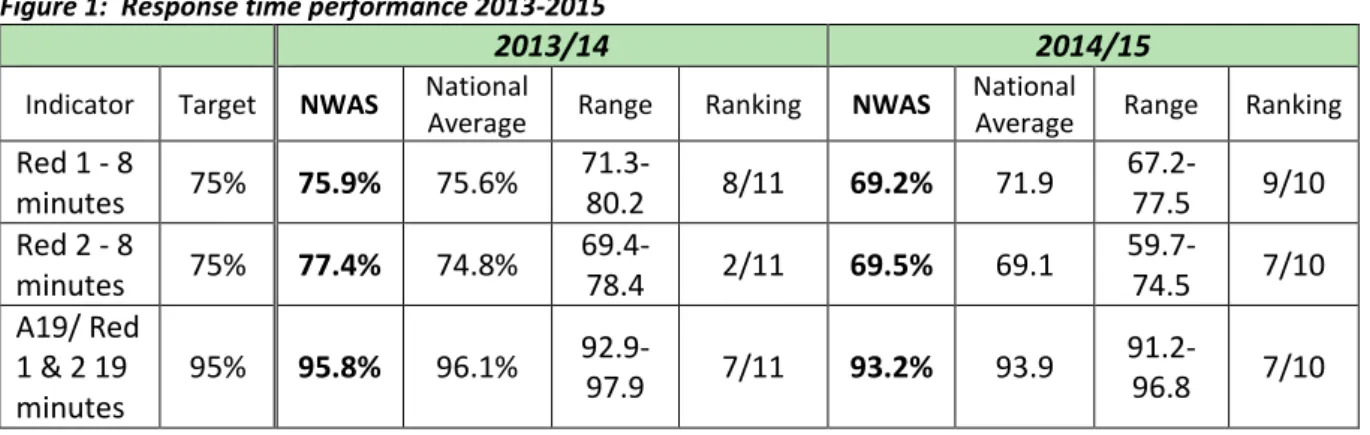
All 999 calls identified as immediately life-threatening are placed in one of two categories: Red 1 and Red 2. Red 1 includes approximately 10% of red patients who are most at risk through conditions such as cardiac or respiratory arrest. For Red 1 calls the clock starts immediately the call arrives at the Trust switchboard, whereas for Red 2 and Green calls the clock starts once the nature and location of the call has been confirmed. There are three national response time targets:
Red 1 - 8 minutes: Respond to 75% of Red 1 calls within 8 minutes with a suitably trained and equipped response. This could be an ambulance, a rapid response vehicle or a community responder
Red 2 - 8 minutes: Respond to 75% of Red 2 calls within 8 minutes with a suitably trained and equipped response. This could be an ambulance, a rapid response vehicle or a community responder
Ambulance response – 19 minutes (A19): Respond to 95% of Category A (Red 1 & 2) calls within 19 minutes with a vehicle capable of carrying a patient
All other calls are placed in the four green categories; Green 1 to Green 4
Figure 1 shows our performance over the last two years and includes the NWAS ranking position amongst ambulance trusts in England. A detailed report can be found in Section 2.6.
Figure 1: Response time performance 2013-2015
2013/14 2014/15
Indicator Target NWAS National
Average Range Ranking NWAS
National
Average Range Ranking
Red 1 - 8 minutes 75% 75.9% 75.6% 71.3- 80.2 8/11 69.2% 71.9 67.2-77.5 9/10 Red 2 - 8 minutes 75% 77.4% 74.8% 69.4- 78.4 2/11 69.5% 69.1 59.7-74.5 7/10 A19/ Red 1 & 2 19 minutes 95% 95.8% 96.1% 92.9- 97.9 7/11 93.2% 93.9 91.2-96.8 7/10
2.3.2
Quality Outcomes for Myocardial Infarction (MI) and Stroke
Ambulance Clinical Quality Indicators (ACQIs) are reported nationally four months in arrears as they are dependent on gathering outcome information from hospital trusts. For this reason the most recent figures available are for November 2014. Figure 2 gives details of performance over the last two years.
2.3.3
Patient Safety Incidents
Details of Patient Safety incidents are included in section 2.4. In the last financial year there were three reported clinical incidents that resulted in patient injuries that were categorised as “severe harm or death”. These were investigated under the Strategic Executive Information System (StEIS) and reported in full to Commissioners.
Figure 2: ACQI Care Bundle Performance - 2013/15
Reporting Period 2: April 2013 – November 2013
AQI Care Bundle Performance Apr 13 May 13 Jun 13 Jul 13 Aug 13 Sep 13 Oct 13 Nov 13 Dec 13 Jan 14 Feb 14 Mar 14
NWAS: Outcomes from Acute ST-elevation Myocardial Infarction— Care Bundle 84.0% (173/206) 85.1% (166/195) 87.2% (170/195) 86.4% (185/214) 84.9% (180/212) 88.8% (166/187) 88.9% (177/199) 86.9% (173/199) 85.2% (202/237) 86.0% (160/186) 83.4% (156/187) 76.9% (150/195)
National Average (%) & Range (%) 78.9 (89.5 – 33.3) 77.8 (85.9 – 67.2) 82.2 (100 – 69.8) 80.6 (91.3 – 64.1) 80.0 (88.1 - 61.5) 82.4 (91.2 – 50.0) 81.7 (91.4 – 67.4) 80.8 (94.0 – 57.1) 68.2 – 100 (80.2) 69.3 – 89.1 (78.5) 72.3 – 100 (80.7) 70.0 – 93.1 (78.1) Ranking 2/11 2/11 3/11 2/11 4/11 3/11 2/11 3/11 4/11 4/11 5/11 8/11 NWAS:
Outcomes from Stroke — Care Bundle 98.5% (945/959) 99.4% (969/975) 99.6% (929/933) 99.4% (996/1002) 99.7% (1054/1057) 99.2% (978/986) 99.3% (1071/1079) 99.8% (1056/1058) 99.6% (1123/1128) 99.5% (1086/1091) 99.8% (946/948) 99.6% (1310/1315)
National Average (%) & Range (%) 96.1 (100 – 91.6) 95.7 (99.4– 89.1) 96.5 (100 -90.7 96.6 (99.4 – 93.3) 96.5 (93.0 - 99.7) 96.1 (100 – 90.9) 96.4 (100 – 90.0) 96.6 (100 – 93.0) 94.7 – 99.6 (96.2) 93.2 – 100 (96.5) 94.0 – 99.8 (96.8) 91.8 – 100 (96.9) Ranking 3/11 1/11 2/11 1/11 1/11 2/11 2/11 2/11 1/11 2/11 1/11 3/11
Reporting Period 2: April 2014– November 2014
AQI Care Bundle Apr 14 May 14 Jun 14 Jul 14 Aug 14 Sep 14 Oct 14 Nov 14 Dec 14 Jan 15
Feb 15
Mar 15
NWAS: Outcomes from Acute ST-elevation Myocardial
Infarction— Care Bundle
90.0% (N=231) 82.4% (N=238) 93.0% (N=186) 84.2% (N=222) 91.2% (N=193) 85.7% (N=224) 85.0% (N=280) 90.3% (N=227) 91.8% (N=233)
Data not available at time of writing
National Average & Range
67.3 – 95.1 (82.3) 70.9 – 100.0 (81.1) 66.0 – 93.4 (79.8) 66.4 – 91.0 (78.8) 71.4 – 91.2 (80.2) 62.2 – 100 (78.8) 70.2 – 93.0 (80.1) 68.7 – 90.3 (79.2) 53.7 – 100 (76.8)
*National data not published at time of writing
Ranking 2/11 5/11 2/11 4/11 1/11 4/11 3/11 1/11 2/11
NWAS:
Outcomes from Stroke — Care Bundle 99.3% (N=813) 99.4% (N=664*) 99.4% (N=1081) 98.2% (N=389*) 99.0% (N=408*) 99.6% (N=525*) 99.6% (N=1340) 99.1% (N=1226) 99.1% (N=1466)
Data not available at time of writing
National Average & Range
94.7 – 100 (97.2) 91.3 – 99.6 (97.1) 92.9 – 100 (97.1) 91.1 – 99.0 (96.9) 91.7 – 99.0 (97.0) 86.7 – 99.6 (96.8) 95.4 – 99.6 (97.2) 92.9 – 99.1 (96.9) 91.9 – 99.7 (96.8) Ranking 3/11 2/11 2/11 4/11 1/11 1/11 1/11 1/11 1/11
2.4
Indicators of Quality – Patient Safety
The reports into the themes and lessons learnt from NHS investigations into matters relating to Jimmy Savile, the Mid Staffordshire NHS Foundation Trust Public Inquiry and the findings of the Morecambe Bay Investigation remind all NHS organisations of the need to maintain a focus on patient safety.
Our suite of Clinical Safety measures (CSI) includes safeguarding vulnerable adults and children, infection prevention & control, Medicines Management and Clinical Risk. These are reported to each meeting of the Board of Directors and are used to improve safety at all levels of the organisation.
2.4.1 Safeguarding
The Trust has a legal duty to protect patients, staff and the public from harm. The implementation of the new Care Act 2014 provides a legal framework for the assessment and protection of adults including those at risk, with an emphasis on the wellbeing of the patient. There has been an increase in adult safeguarding activity over the year (Figure 3), including concerns raised about the welfare of vulnerable adults requiring assessment. Children’s safeguarding activity has steadily increased (Figure 4), particularly within the Paramedic Emergency Service and at a slower rate than for adults. Our Safeguarding Policy and associated procedures have been updated to include the principles of adult safeguarding, with care pathways for victims of Child Sexual Exploitation (CSE), Female Genital Mutilation (FGM) and the radicalisation of vulnerable people (PREVENT).
2.4.1.1 Engagement with Safeguarding Boards
The Trust has a named contact for each of the 46 Safeguarding Boards across the North West. This strengthens working together and information sharing, reflected in the increased number of Serious Case Reviews, Safeguarding Adult Reviews and Domestic Homicide Reviews. Staff access multi-agency training and share learning and expertise with their peers.
2.4.1.2 Frequent Caller Project
NWAS Safeguarding and Frequent Caller teams share information to ensure that vulnerable people have the right assessment and care and are protected from harm or abuse. This includes sharing concerns in relation to nursing and care homes.
2.4.1.3 PREVENT awareness and training
Over 75% of all NWAS staff have received WRAP 3 training which is the ‘workshop to raise awareness of PREVENT’ and part of the Government’s anti-terrorism strategy. WRAP is included within mandatory training for all staff and compliance with this national requirement has increased during 2014/15.
2.4.1.4 Adult Safeguarding
Figure3 Adult Safeguarding Referrals by area
2.4.1.5 Child Safeguarding
Figure 4 Child referrals by area
During 2015/16 we will work with partner agencies in three key areas:
Developing safeguarding alerts via the Electronic Information Sharing System (ERISS), the bespoke web-based system used by the Trust for sharing safeguarding referral information with Children’s and Adult Social Care. This system has the functionality to place warning flags to alert the attending crew about child or adult protection issues. The application will be piloted over the forthcoming year. The current position of staff raising alerts with the Trust Safeguarding Team remains in place.
Developing processes in relation to Domestic Abuse. Following the success of the pilot last year a referral form will be developed with provision for enhanced information sharing which links to guidance from the National Institute of Health and Care Excellence (NICE).
Developinglinks with Child Sexual Exploitation teams in the North West to enable efficient and timely information sharing in addition to the safeguarding procedures already in place. There is a process to capture data relating to female genital mutilation which has been communicated to all staff. This will be monitored during the year.
Tackling issues relating to slavery and trafficking of children and adults. This work is in the initial scoping phase and identified actions will be added to the Safeguarding Work Plan for the year. 746 507 1131 2384 739 587 1130 2456 800 605 1078 2483 830 616 1083 2529 0 1000 2000 3000
Cumbria & Lancs Cheshire & Mersey Greater Manchester Total
Safeguarding adult referrals 2014-2015
Qtr 1 Qtr 2 Qtr 3 Qtr 4 270 232 329 831 216 208 315 739 195 194 327 716 271 236 339 846 0 200 400 600 800 1000
Cumbria & Lancs Cheshire & Mersey Greater Manchester Total
Safeguarding child referrals 2014-2015
Qtr 1 Qtr 2 Qtr 3 Qtr 4
2.4.2
Clinical Incident Reporting
The reporting of clinical incidents is encouraged and supported throughout the Trust. Following the introduction of web based reporting it is now much easier for staff to report matters. As a result, the Trust has witnessed an increase in reporting over the last year. All incidents are notified to the appropriate local manager who is responsible for risk scoring and investigation.
Clinical safety incidents are reviewed by the Risk and Safety Department to ensure reporting to the National Patient Safety Agency (NPSA), Medicines and Healthcare Products Regulatory Agency (MHRA) as required and where appropriate Health and Safety Executive (HSE) reporting. The Department are responsible for the collation of the data working with colleagues to identify risks and the corresponding control measures for implementation.
All clinical and patient safety incidents are reported to the Clinical Governance Management Group on a regular basis, including those reported through the Strategic Executive Information System (StEIS). The Trust’s Incident Learning Forum, chaired by the Deputy Director of Quality, considers identified trends and seeks assurance that appropriate action plans are in place to address weaknesses.
Where another healthcare professional or body raises a concern, this is overseen and managed by the Clinical Safety team. All incidents are risk rated, recorded and investigated appropriately. A focus on high risk events ensures that risks are identified and mitigated quickly. Local managers retain responsibility for low risk incidents, which are more commonly reported.
For the year ending March 2015, the Trust recorded 6,327 clinical and patient safety incidents and near-misses showing a major increase on the previous year. This was partially due to now reporting on 111 incidents and notification and ‘raising a concern’ incidents. The Trust continues to welcome an increasing level of incident reporting as there is no supporting evidence to suggest that serious incidents are becoming more frequent. The increase in overall reporting reflects the fact that the incident reporting system is well established and embedded in Trust processes.
A total of 1823 incidents were reported to the NPSA, a significant increase in reporting on last year. This is accounted for by the increase in accessibility for staff reporting incidents and the inclusion of the NHS 111 figures. 25 incidents were reported to Commissioners through the Strategic Executive information System (StEIS). Each StEIS report is subject to a detailed investigation and approved by the appropriate Executive Director. No overall trend has been identified through the StEIS reports. Significant incidents are reviewed by the Incident Learning Forum to ensure that lessons are learned and shared with staff,
Figure 5 below shows the total number of clinical incidents and near misses reported last year by category.
Figure 5 Clinical Safety Incidents by Type 2014/2015
Category Type Number
111 22 111 Assessment/Advice 406 111 Data Protection 1103 111 Directory of Services 11 111 Documentation 186 111 Equipment Fault/Failure 27
111 Issue with other service 23
111 OOH's Referral 168
Abuse/Inappropriate Use of Service 1001 Access/Admission/Transfer issue 309 Clinical Assessment 154 Clinical Treatment 242 Communication 352 Consent/Communication/Confidentiality 70 Controlled Drugs 405 Documentation 89
Driving skills issue 22
End of Life Care 22
Equipment Damaged 55
Equipment Fault/Failure 107
Equipment Missing / Lost 246
Exposure to Harmful Substance 5
Infection Control 205 Manual Handling 67 Medicine Management 275 Pathfinder 60 Physical Assault 3 RTC/ Vehicle 9 Safeguarding Adult 154 Safeguarding Child 19 Security Incident 45
Sharps Injury/ Incident 16
Slips, Trips or Falls 65
Staff Welfare 104 Theft Incident 7 Threating Behaviour 82 Vehicle Issue 113 Verbal Abuse 54 Total 6327
2.4.3
Infection Prevention and Control
The Trust’s Director of Quality fulfils the role of Director of Infection Prevention and Control (DIPC), supported by the Head of Clinical Safety, two full-time Clinical Safety Practitioners (CSPs), and one full time Clinical Safety Officer. The team IS responsible for supporting staff to ensure they adopt best practice, and provide expert advice on safe environment, equipment and vehicles and the health and wellbeing of the staff, patients and visitors. The CSPs provide assurance for Infection Prevention Control for the stations and vehicles through independent audits as well as liaising with the Service Delivery teams to ensure goals and targets are met.
The Trust has Advanced Paramedics who lead on clinical safety and IPC within Service Delivery and support the CSPs in the development and implementation of new initiatives and improving standards.
During 2014/15 we have made a number of improvements to both IPC reporting and ensuring high standards of cleanliness and infection prevention and control. These include:
999 vehicle assurance audits are conducted by Advanced Paramedics, increasing the number of audits each month.
Specialist and local audit data presented to both PES and PTS Business Groups to consider ways to improve standards.
IPC policies and procedures have been reviewed and updated including the Communicable Disease Policy and specialist procedures to deal with the potential Ebola outbreak.
Reports are presented to the Quality Committee on a bi-monthly basis for scrutiny and to give assurances that IPC standards are being met.
IPC awareness weeks are planned twice a year to raise awareness and provide staff support across NWAS.
Central Infection control help line and email address has been set up to assist staff and management teams.
A Clinical Quality Improvement Action Plan is in place and the Board receives information on compliance with clinical safety measures (care bundles) relating to cleanliness of vehicles and stations. The compliance rate for 2014/2015 was PES 89.4%, PTS 96.7%, and Stations 76.9%.
Figure 6 Infection Prevention and Control Incidents 2014/2015
Incident type No. of incidents 2013/14
No. of incidents 2014/15
Clean needle 8 9
Dirty needle and dirty needle near misses 48 51
Ampoule/glass incident 22 12
Contact with bodily fluids 38 36
Crew contact with known infectious disease 13 10
Razor injuries 11 6
Contaminated vehicles 10 3
Infestation 1 1
Not notified of patients’ infectious status 5 12
Sterile equipment 0 1
Lack of Personal Protective Equipment (PPE) 2 3
Contaminated equipment 9 11
Medical equipment 7 5
Other factors 17 9
Splash/ingestion incident 13 29
Staff welfare 9 7
HCAI reported incidents 0 0
Totals: 213 205
Examples of improvements made in practice to reduce the number of incidents include:
Needle stick injury/Blood splash discussions at IPC awareness week to assist staff.
A review of all sharps related clinical equipment ensuring we are using the safest, most appropriate and cost effective products.
Establishment of an immunisation status database of all clinical staff and ensure robust procedures are in place to address issues of infectious outbreaks e.g. Measles.
Training and development packages delivered to staff across NWAS.
Review and acquisition of safe equipment e.g. cannulas, ampoule openers, razors.
Issue of regular bulletins and articles in the Trust’s clinical newsletter, Clear Vision on IPC related topics.
Ensuring that all vehicles have personal protective equipment available to use.
Having an established deep clean program for all vehicles as well as having robust acute cleaning as part of the vehicle daily checks.
2.5
Clinical Effectiveness
The Trust has been in the forefront of the measurement of the effectiveness of clinical interventions by ambulance staff, both locally and nationally.
2.5.1
Ambulance Clinical Quality indicator (ACQI): Clinical Quality Outcomes
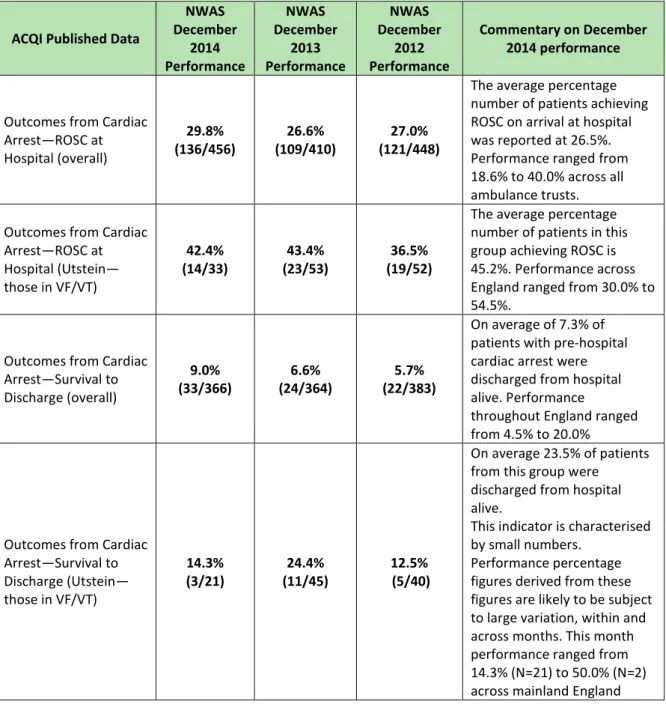
National clinical outcome measures are derived from the audit of ambulance Patient Report Forms, and from information provided by receiving hospitals. The outcomes are four months in arrears to allow for full data collection. For some measures the numbers of relevant cases is relatively small and there is significant variation between months. To give an overall picture of the Trust’s performance, a summary of the December 2014 performance is shown below:
Figure 7 ACQI Performance
ACQI Published Data
NWAS December 2014 Performance NWAS December 2013 Performance NWAS December 2012 Performance Commentary on December 2014 performance
Outcomes from Cardiac Arrest—ROSC at Hospital (overall) 29.8% (136/456) 26.6% (109/410) 27.0% (121/448)
The average percentage number of patients achieving ROSC on arrival at hospital was reported at 26.5%. Performance ranged from 18.6% to 40.0% across all ambulance trusts. Outcomes from Cardiac
Arrest—ROSC at Hospital (Utstein— those in VF/VT) 42.4% (14/33) 43.4% (23/53) 36.5% (19/52)
The average percentage number of patients in this group achieving ROSC is 45.2%. Performance across England ranged from 30.0% to 54.5%.
Outcomes from Cardiac Arrest—Survival to Discharge (overall) 9.0% (33/366) 6.6% (24/364) 5.7% (22/383) On average of 7.3% of patients with pre-hospital cardiac arrest were discharged from hospital alive. Performance
throughout England ranged from 4.5% to 20.0%
Outcomes from Cardiac Arrest—Survival to Discharge (Utstein— those in VF/VT) 14.3% (3/21) 24.4% (11/45) 12.5% (5/40) On average 23.5% of patients from this group were discharged from hospital alive.
This indicator is characterised by small numbers.
Performance percentage figures derived from these figures are likely to be subject to large variation, within and across months. This month performance ranged from 14.3% (N=21) to 50.0% (N=2) across mainland England
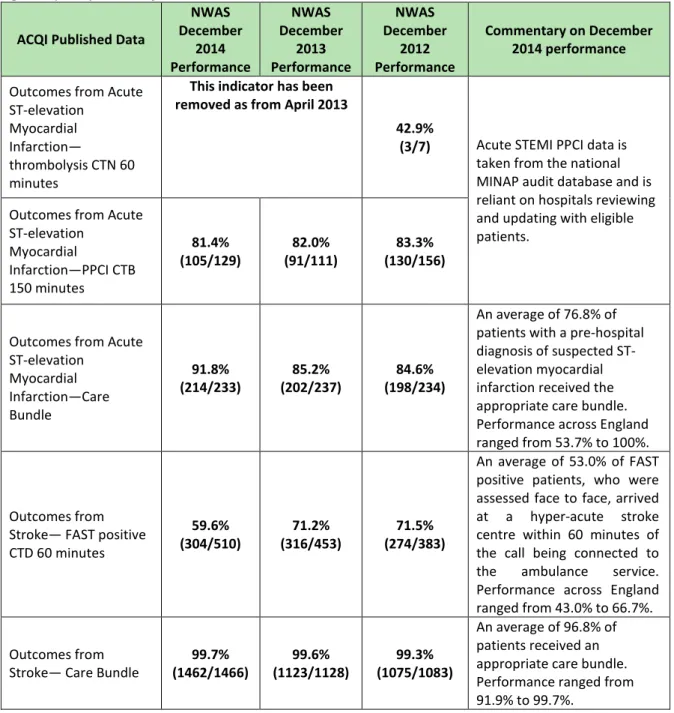
Figure 7 (cont.) ACQI Performance
ACQI Published Data
NWAS December 2014 Performance NWAS December 2013 Performance NWAS December 2012 Performance Commentary on December 2014 performance
Outcomes from Acute ST-elevation
Myocardial Infarction—
thrombolysis CTN 60 minutes
This indicator has been removed as from April 2013
42.9%
(3/7) Acute STEMI PPCI data is taken from the national MINAP audit database and is reliant on hospitals reviewing and updating with eligible patients.
Outcomes from Acute ST-elevation Myocardial Infarction—PPCI CTB 150 minutes 81.4% (105/129) 82.0% (91/111) 83.3% (130/156)
Outcomes from Acute ST-elevation Myocardial Infarction—Care Bundle 91.8% (214/233) 85.2% (202/237) 84.6% (198/234) An average of 76.8% of patients with a pre-hospital diagnosis of suspected ST-elevation myocardial infarction received the appropriate care bundle. Performance across England ranged from 53.7% to 100%.
Outcomes from Stroke— FAST positive CTD 60 minutes 59.6% (304/510) 71.2% (316/453) 71.5% (274/383) An average of 53.0% of FAST positive patients, who were assessed face to face, arrived at a hyper-acute stroke centre within 60 minutes of the call being connected to the ambulance service. Performance across England ranged from 43.0% to 66.7%. Outcomes from
Stroke— Care Bundle
99.7% (1462/1466) 99.6% (1123/1128) 99.3% (1075/1083) An average of 96.8% of patients received an appropriate care bundle. Performance ranged from 91.9% to 99.7%.
Full details of the ACQI performance for all ambulance trusts is available at:
http://www.england.nhs.uk/statistics/ambulance-quality-indicators/
2.5.2
Clinical Performance Indicators (CPIs)
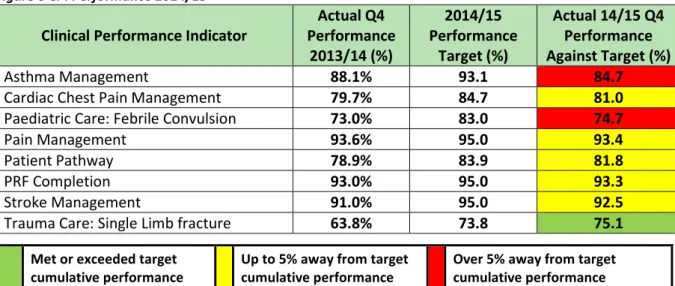
Local clinical performance measures (care bundles) are used to ensure that staff comply with best practice in clinical care. In 2014/15 the measures were revised to reflect consistently good performance in the management of hypoglycaemia and the need to improve practice in two other areas. Paediatric febrile convulsion and trauma single limb fracture care bundles are the two new pilot care bundles for the year.
Six indicators demonstrated an in-year improvement in compliance: Cardiac chest pain management improved by 1.3%, Paediatric Care by 1.7%, Patient Pathway by 2.9%, Patient record completion (PRF) by 0.3%, Stroke Management by 1.5% and Trauma Care by 11.3%.
Each year a challenging improvement target is set for each indicator and as can be seen in Figure 8 below Asthma Care and Paediatric Care missed the agreed improvement targets by 8.4% and 8.3% respectively.
Figure 8 CPI Performance 2014/15
Clinical Performance Indicator
Actual Q4 Performance 2013/14 (%) 2014/15 Performance Target (%) Actual 14/15 Q4 Performance Against Target (%) Asthma Management 88.1% 93.1 84.7
Cardiac Chest Pain Management 79.7% 84.7 81.0
Paediatric Care: Febrile Convulsion 73.0% 83.0 74.7
Pain Management 93.6% 95.0 93.4
Patient Pathway 78.9% 83.9 81.8
PRF Completion 93.0% 95.0 93.3
Stroke Management 91.0% 95.0 92.5
Trauma Care: Single Limb fracture 63.8% 73.8 75.1
2.6
Indicators of Quality – Patient Experience
2.6.1
Access – Emergency Service
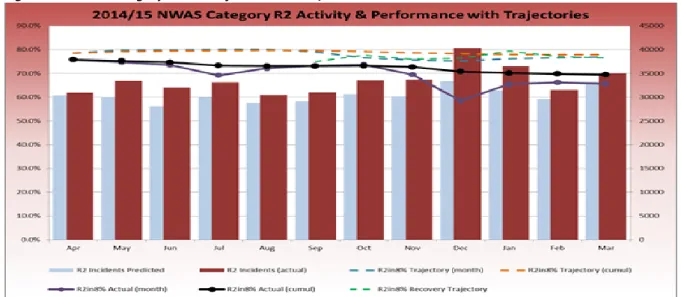
In 2014/15 the Trust was unsuccessful in meeting the three national 999 response time standards for ambulance trusts in England. The figures below demonstrate the pattern of activity and performance over the year.
The blue bars each month show the predicted levels of Red call activity and the red columns are the actual levels of activity. They demonstrate the pattern of increased activity that was seen across the country in 2014/15.
The Trust has performance management arrangements to ensure that the Trust maintains a grip on response times, however, this year has seen unprecedented levels of activity. Despite the non-achievement of the headline targets the Trust has maintained a safe position in relation to increased long wait times for emergency responses.
Figure 9 NWAS Category Red 1 Performance 2014/15
Met or exceeded target cumulative performance
Up to 5% away from target cumulative performance
Over 5% away from target cumulative performance
Figure 10 NWAS Category Red 2 Performance 2014/15
Figure 11 NWAS Category A19 Performance 2014/15
The number of 999 calls and incidents this year was considerably above the commissioned level, and we are working with our Commissioners to deliver a sustainable solution for 2015/16 and beyond. There is variation in response time performance across the FIVE counties of the North West (Figure 12).
Figure 12 NWAS Category Red 1, Red 2 and A19 Performance 2014/15
Red 1
Red 2
A19%
Greater Manchester
68.6%
69.4%
94.3%
Lancashire
68.4%
69.0%
91.3%
Cheshire
66.5%
66.8%
93.7%
Merseyside
74.8%
73.8%
94.7%
Cumbria
65.1%
66.7%
85.6%
NWAS Overall
69.2%
69.5%
93.1%
Performance is more challenging in rural counties. Where there is a lower population density and longer journey times performance is adversely affected. We are working with CCGs and agencies such as the British Red Cross, St John Ambulance, the Police, and Fire and Rescue services to deliver the best solutions for communities. Expansion of our Community First Responder and Staff Responder schemes are a priority for rural areas.
2.6.2
Access – Patient Transport Service (PTS)
Throughout 2014/15, the PTS service has experienced a period of change during which quality has been significantly improved. The contract improvement notices, which were served on NWAS in February 2014 were withdrawn in September. Figure 13 and 14 show the improvements made in quality with the most marked being on the time of arrival, which has improved from 74% to 88% overall and is marginally below the target threshold. The standards for time on vehicle, collection after treatment and call answering performance are all being achieved each month.
These improvements have been achieved as a result of a number of actions taken, the most significant being the introduction of mobile data. This system allows data to flow seamlessly between control and the vehicle in addition to ensuring full visibility of the vehicles. This provides real time performance information and allows control staff to make informed decisions about the best use of resources. Changes to planning practices, improved third party data capture and recruitment and greater understanding of management information have all improved quality. Figure 13 PTS Contract quality indictor performance
Indicator Target 2013/14 2014/15
Arrival to Appointment: -45 minutes to +15
minutes 90% 74% 88%
Time on vehicle – No greater than 60 minutes 80% 90% 92%
Collection after treatment within 60 minutes 80% 82% 84%
Collection after treatment within 90 minutes 90% 92% 94%
PTS Calls Answered 90% 89% 98%
PTS Calls answered in 20 Seconds 75% 73% 84%
PTS Average Answer Delay 1 min 0:51 0:13
Figure 14 PTS performance by contract
Indicator Target Cheshire Cumbria Lancashire Merseyside 2013/14 2014/15 2013/14 2014/15 2013/14 2014/15 2013/14 2014/15 Arrival to Appointment: -45 minutes to +15 minutes 90% 57% 84% 88% 89% 83% 90% 59% 84% Time on vehicle – No greater than 60 minutes 80% 88% 91% 88% 89% 92% 94% 89% 92%
Figure 14 (cont.) PTS performance by contract
Indicator Target Cheshire Cumbria Lancashire Merseyside 2013/14 2014/15 2013/14 2014/15 2013/14 2014/15 2013/14 2014/15 Collection after treatment within 60 minutes 80% 82% 84% 91% 89% 81% 84% 77% 82% Collection after treatment within 90 minutes 90% 92% 93% 96% 95% 92% 94% 89% 93% PTS Calls Answered 90% 88% 98% 84% 98% 91% 98% 92% 98% PTS Calls answered in 20 Seconds 75% 74% 84% 72% 83% 74% 84% 72% 84% PTS Average
Answer Delay 1 min 0:51 0:13 0:56 0:13 0:44 0:13 0:53 0:13
2.6.3
Patient and Public Engagement
It is only through listening, recording and acting on our patients’ views that quality can be improved. The Trust is recognised as an innovator and leader in this field for ambulance trusts.
The Trust was successful in winning two Family and Friends Test (FFT) Pathfinder bids which were delivered successfully and influenced the content of the national Family and Friends Test guidance effective from 1 April 2015. The Trust was an early implementer for the new FFT guidance, using a range of methods for patients to give feedback as near to real time as possible. The Trust has stated its readiness for delivering the FFT requirements for ambulance services from 1 April 2015.
More than 16,000 patients have provided feedback this year (Figure 15). The FFT figures are lower as this came on line during 2014/15.
Figure 15 Survey Methods Table
2014/15 PE Programme Surveys (01 Apr 2014 - 31 Mar 2015) Completed Returns % of Total
Patient Transport Service (Postal/Telephone) 2,446 14.6%
Paramedic Emergency Service (Postal/Telephone) 3,257 19.5%
Urgent Care Desk Service (Postal) 584 3.5%
NHS 111 Service (Postal) 2,915 17.4%
PTS FFT (Postcards) 289 1.7%
PTS FFT (SMS Text) 4,546 27.2%
PES FFT (Postcards) 87 0.5%
PES FFT - See and Treat (SMS Text) 24 0.1%
PES FFT (Kiosks - Partnership Working) 2,582 15.4%
Figure 16 Summary of FFT Feedback Results by Quarter
Survey results are overall very positive with satisfaction being high across all service areas. They are slightly lower in the urgent care service and this will be monitored into next year’s programme. Figure 17 shows equality and diversity engagement activity (community events and focus groups). Figure 17 Protected Characteristics Engaged during 2014/15
Qtr 1 Qtr 2 Qtr 3 Qtr 4 YTD Qtr 1 Qtr 2 Qtr 3 Qtr 4 YTD Qtr 1 Qtr 2 Qtr 3 Qtr 4 YTD
Patient Transport Service 97.82% 96.97% 96.88% 96.31% 96.81% 96.07% 96.97% 96.88% 96.58% 96.73% 89.52% 95.18% 94.29% 93.55% 93.88%
Paramedic Emergency Service 96.22% 96.96% 96.55% 97.39% 96.78% 96.55% 96.41% 96.69% 96.86% 96.63% 93.65% 94.20% 93.90% 94.89% 94.18%
Urgent Care Desk Service No Data No Data 83.75% 87.31% 85.81% No Data No Data 76.25% 76.43% 76.36% No Data No Data 80.83% 78.55% 79.51%
NHS 111 Service n/a n/a n/a n/a n/a 91.05% 92.85% 93.37% 90.12% 91.73% 91.17% 92.84% 93.05% 91.07% 91.94% 2014/15
Patient Experience Programme Surveys (Postal/Telephone)
Overall Service Received (Very Good/Fairly Good)
Recommend Ambulance Service to Friends and Family (Extremely Likely/Likely) Cared for appropriately with
Dignity, Compassion and Respect (Strongly Agree/Agree)
The Equality Act 2010 introduced the term "protected characteristics" to refer to groups that are protected under the Act. These are cited as: age, disability, gender reassignment, race, religion or belief, sex, sexual orientation, marriage and civil partnership, and pregnancy and maternity.
Service delivery managers receive a monthly dashboard of patient feedback results as well as recommendations for improvement. Quarterly reports are presented to the Quality Committee and Board of Directors as well as an annual “What Our Patients Say” report.
Patient Stories are a powerful tool to describe patients’ experiences and the learning that has resulted and are presented to the Board of Directors, to staff as part of mandatory training, and are part of education and awareness campaigns.
An analysis of the feedback received from patients provided us with themes for learning and quality improvement. Some examples are;
The #Team 999 initiative to support understanding in communities of what to expect from a 999 call.
Raising awareness with 999 ambulance staff of health passport schemes and the ‘message in a bottle scheme’.
Helping patients understand what to expect from the PTS service using introduction and personal information cards for regular PTS users, and the ‘GoPTS’ marketing campaign recently launched in communities.
Improving health care professionals’ understanding of booking the correct PTS transport by producing and distributing a pictorial mobility guide to all hospitals and booking ward clerks in the region.
Reviewing Urgent Care Desk processes to keep patients informed when an agreed action has been delayed, e.g. call back within 60 minutes not achieved
Developing a number of case studies for the Trust’s clinical bulletin, Clear Vision to promote best practice in clinical care based on feedback topic areas
Exploring with PTS contact centres the low levels of awareness with regard to the PTS booking reminder service, shown by survey results (28%).
2.6.4
Complaints, PALS and Compliments
For the year ending March 2015, the Trust received 2,132 complaints, 319 general enquiries (including comments) and 1,362 compliments. This includes all aspects of Trust activity, including the 111 service. A monthly breakdown of the complaints received is shown in Figure 18.
Figure 18 Complaints by month received 2014/15
0 50 100 150 200 250
The numbers of complaints received during the winter months increased in comparison with 2013/14 reflecting the high levels of activity witnessed across the NHS and the Service itself. Figure 19 Complaint Risk Score
Figure 20 Compliments by month received 2014/15
The Patient Transport Service generated 35.3% of the complaints against the Trust; a decrease from 2013/14. The most common reasons for complaining include late collection from home and on return journey, unsuitable vehicles and extended discharge processes. Figure 21 below details the types of complaints defined by service type and Figure 22 details the area.
Figure 21 PTS Complaint categories by service type
Patient Transport Service Operations Patient Transport Service Control Patient Transport Service Contract Provider Voluntary Car Service Total PTS Transport 147 305 124 36 612 Staff Conduct 26 8 13 14 61
Care and Treatment 25 1 6 2 34
Driving Standards 11 1 6 6 24
Communication and Information 1 11 2 0 14
Damage or loss to property 3 0 2 0 5
Safeguarding 0 1 1 0 2
End Of Life Care 0 1 0 0 1
Total 213 328 154 58 753 359 1233 410 98 6 1 - Minimum 2 - Minor 3 - Moderate 4 - Major 5 - Serious 0 20 40 60 80 100 120 140 160 Apr 2014 May 2014 Jun 2014 Jul 2014 Aug 2014 Sep 2014 Oct 2014 Nov 2014 Dec 2014 Jan 2015 Feb 2015 Mar 2015
Figure 22 PTS Complaint categories by area
Greater
Manchester Lancashire Mersey Cheshire Cumbria Total
PTS Transport 2 210 151 152 97 612
Staff Conduct 0 27 13 13 8 61
Care and Treatment 0 19 6 4 5 34
Driving Standards 1 12 2 4 5 24
Communication/Information 0 1 2 4 7 14
Damage or loss to property 0 1 0 2 2 5
Safeguarding 0 1 1 0 0 2
End Of Life Care 0 0 0 1 0 1
Total 3 271 175 180 124 753
The Paramedic Emergency Service (PES) generated 55% of all complaints, representing an increase on previous years and reflecting the increased levels of activity.
Figure 23 PES Complaint categories by service type
Paramedic Emergency Services Operations Emergency Operations Centre Urgent Care Service Community First
Responder Other Total
Emergency Response 99 492 0 0 0 591
Staff Conduct 179 25 1 1 4 210
Care and Treatment 177 10 0 0 0 187
Driving Standards 77 6 0 0 3 86
Communication/Information 46 29 0 0 1 76
Damage or loss to property 19 0 0 0 0 19
Navigation 2 1 0 0 0 3
End Of Life Care 2 0 0 0 0 2
Total 601 563 1 1 8 1174
Figures 23 and 24 detail the total numbers of PES complaints by both geographical and service area. The main areas of concern continue to be emergency response, followed by staff conduct and care and treatment.
Figure 24 PES Complaint categories by area
Greater
Manchester Lancashire Mersey Cheshire Cumbria Total
Emergency Response 186 147 126 92 40 591
Staff Conduct 73 49 39 40 9 210
Care and Treatment 79 49 17 27 15 187
Driving Standards 29 13 14 19 11 86
Communication and
Information 20 16 12 18 10 76
Damage or loss to property 5 6 1 4 3 19
Navigation 0 1 2 0 0 3
End Of Life Care 1 0 1 0 0 2
Complaints regarding the NHS 111 service represent 9.4% of the overall complaint activity for the Trust. Figure 25 details the NHS 111 complaints.
Figure 25 NHS 111 Complaints categories
111 Call Handler 111 Shift Supervisor 111 Clinical
Advisor 111 Service Total
Emergency Response 0 0 0 1 1
Staff Conduct 5 1 1 1 8
Communication/Information 65 3 29 31 128
Care and Treatment 28 0 24 11 63
Total 98 4 54 44 200
An essential component of the complaints process is ensuring that lessons are learned. Areas where improvements have been made are:
A review of the “second call” procedure in EOC to understand whether the content or application is appropriate.
Improvements to the process for call handling in PTS Control, reducing the time in which calls are answered.
Improvements in taking sufficient information during the PTS booking process and keeping patients informed about their transport.
Location of equipment in emergency vehicles, application of Paramedic Pathfinder, clinical assessment, record keeping and communication.
Informing patient expectations in NHS 111, ensuring patients are referred to the correct service, adhering to the processes within NHS Pathways and use of “Toxbase” (poisons information) to ensure appropriate calculation of medication dosages.
Examples of compliments from patients are:
Daughter of a patient contacted the Trust to say thank you to the paramedic who attended her mother on the day before she died. The plan in place enabled the patient to stay at home with the family, for which they were very thankful. The paramedic was described as caring, patient and very reassuring.
Thanks were received from the family of a patient, following intervention by the Frequent Caller Team. The family were unaware of the situation and the patient is now receiving the right care.
Thank you card received for the multiple PTS crews who have assisted the patient at numerous hospital appointments.
Caller reported receiving excellent care from the NHS 111 service and particularly being treated as a person and not an injury; the staff member was described as very professional, extremely polite and very helpful.
3
Looking Forward to Improving Care
The Trust has agreed, in consultation with our stakeholders, six key quality improvement areas for 2015/16. These are identified as priorities within our Quality Strategy.
3.1
Delivering and sustaining red call response times.
The Trust is committed to ensuring the achievement of Category A Red 1, Red 2 and A19 red calls as a priority for the Trust during 2015/16. The Trust recognises that Red call response performance standards play a pivotal role in ensuring our patients receive appropriate care in a timely manner and is therefore working very closely with its Commissioning bodies to ensure delivery and sustainability of these national requirements.
Performance is more challenging in rural counties. Where there is a lower population density and longer journey times performance is adversely affected. We are working with CCGs and agencies such as the British Red Cross, St John Ambulance, the Police, and Fire and Rescue services to deliver the best solutions for communities. Expansion of our Community First Responder and Staff Responder schemes are a priority for rural areas.
Measure: National Category A Red 1, Red 2 and A19 red calls performance measures. Local Green 1,2,3 & 4 performance measures.
Monitoring: Live performance reporting can be accessed via the Trust’s intranet, is monitored on a daily basis and reported throughout the Trust up to Trust Board level.
3.2
Improving the management of mental health patients.
The Trust signed five County-level multi-agency Crisis Care Concordat Agreements during 2014/15 as part of its commitment to improve the care of mental health patients. The implementation of multi-agency action plans to support these agreements is the focus of improvement work for 2015/16. This will include further development of crisis care triage and referral pathways to ensure patients can access mental health care services quickly and directly, reducing attendance at Emergency Departments and police stations. The provision of remote mental health clinical advice will be developed in partnership with other agencies.
NWAS will continue to work in close partnership with other agencies and care organisations across the North West, developing system-wide improvements in mental health care and parity of esteem. NWAS will work with mental health care trusts to encourage adoption of ERISS for mental health patients to improve awareness and utilisation of care planning for patients with known mental health needs.
Measure: Increased availability of mental health referral pathways across the NW region. Measure: Increased number of MH Care Plans registered on ERISS.
Monitoring: Review NWAS MH Action Plan for 2015/16 (a consolidated plan of the 5 county-level action plans and timescales) on a quarterly basis.
The new NWAS mandatory training programme will include delivery of Tier 2 level dementia training. Appropriate restraint technique training will be delivered to help protect patients detained under the Mental Health Act and cared for under the Mental Capacity Act.
Measure: Number of staff who have completed mandatory training programme during 2015/16 Monitoring: Monthly review of Mandatory Training Programme as part of the Trust’s Integrated Performance Report.
New self-directed learning packs will be developed to help give all staff a better understanding of the laws relating to mental health, their roles in applying and complying with the law and the roles of partner agencies.
Measure: Production and issue of the self-directed learning packs to all frontline staff. Monitoring: Quarterly review of completion return rates for the Self-directed learning packs. Dementia Friend awareness sessions will continue during 2015/16.
Measure: Number of staff who attend the dementia friendly sessions during 2015/16. Monitoring: Quarterly review of attendances rates for dementia friendly sessions.
3.3
Improving the management of patients suffering falls
The Trust will improve the use of falls referral pathways by building local referral activity and feedback reports for staff. In addition, the Trust will work with AQUA and Academic Health Science Networks to identify opportunities for improved, more proactive screening and risk assessment for those at risk of falling. Team-based improvement training will be delivered to help focus on local falls improvement activities. The Trust will involve falls patients to obtain their feedback on their experiences and to ensure assessment and referral systems are as patient friendly as possible. The Trust will improve the safety of patients who fall and are left at home, reducing the number who need to re-contact the ambulance service within 24 hours.
Measure: Participation in Greater Manchester Academic Health Science Network “Improving Medicines Safety” collaborative improvement programme – to improve screening for patients at higher risk of falling.
Measure: Participation of falls patients in the improvement work to seek their views and ideas for improving falls assessment and referral pathways.
Measure: A reduction in the proportion of 24 hour re-contact cases that are a result of a fall.
Monitoring: Monthly review of the Safe Care Closer to Home Safety Monitoring Report and reports of falls improvement progress through via Paramedic Emergency Service Quality Business Group.
3.4
Reducing harm to patients, especially those not transported (Safe Care
Closer to Home)
The Trust has identified two themes from patients who re-contact the ambulance service within 24 hours of being left at home. Falls are the most common reason for re-contact (first and second incident). Patient refusal without further referral is the most frequent reason for leaving patients at home.
Therefore, the management of falls patients and those that refuse care will be the two main areas of improvement activity during 2015/16. This will include building on the Fylde and Wyre CCG emergency falls car pilot work to further support our collaborative work on falls, improving staff awareness through more frequent feedback of the learning from re-contact audit, reviewing the clinical review process for re-contact cases to improve identification of causal factors and improvement opportunities (individual and organisational) and development of a ‘real-time’ review process of patients to help triangulate against the audit results and capture more accurate outcome measures.
Measure: Updated clinical review process for re-contact cases with a quarterly feedback summary on outcomes and learning points for staff.
Monitoring: Progress monitoring via the Paramedic Emergency Service Quality Business Group and Clinical Leadership Board.
3.5
Reducing harm to staff
As part of the Trust’s commitment to the national ‘Sign up to Safety’ campaign, NWAS has developed a 3 year Safety Improvement Plan, which has been approved by the Executive Management team and endorsed by the Board of Directors.
An element of this Plan is to reduce the number of ‘harms’ currently experienced by staff, by at least 50%, over the next 3 – 5 years, as a direct result of manual handing activities.
Measure: Reduce the number of staff harms by 50% over the next 3 – 5 years.
Monitoring: Analysis of Incident reporting forms, RIDDOR information, sickness and claims data.
3.6
Introduction of a Clinical Performance Indicator for the management of
specified maternity conditions
As part of the Trust’s ongoing work to improve the care of patients, a CPI will be developed to measure how well we care for women during maternity. The indicator will be developed and piloted during 2015/16. The care bundle will be designed to focus upon clinical assessment and identification of relevant risk factors.
Measure: Development and piloting of a care bundle for the management of maternity conditions. Monitoring: Review of pilot care bundle reports on a monthly basis via the Paramedic Emergency Service Quality Business Group and Clinical Leadership Board.
4
Formal Statements on Quality
The Trust is required to make the following formal statements within its Quality Account. It should be noted that some of the statements relate to hospitals and are not relevant for ambulance trusts.
4.1 Review of Services
The Trust has reviewed all the data available on the quality of care in the services provided by us in 2014/15. The income generated by the NHS services reviewed in 2014/15 represents 100 per cent of the total income generated from the provision of NHS services by the Trust for the year.
4.2 Participation in Clinical Audits
During 2014/15, 6 national clinical audits and 0 national confidential enquiries covered NHS services that NWAS NHS Trust provides.
During that period NWAS NHS Trust participated in 100% of national clinical audits (as a provider of information only) and 0% national confidential enquiries of the national clinical audits and national confidential enquiries which it was eligible to participate in.
The national clinical audits and national confidential enquiries the NWAS NHS Trust participated in during 2014/15 are as follows;
National Ambulance Clinical Quality Performance Indicators, a national audit of the care of the patient who:
• Suffered a pre-hospital cardiac arrest • Suffered a pre-hospital heart attack • Suffered a stroke
MINAP (Myocardial Ischaemia National Audit Project) a national audit of the care of patients suffering a heart attack.
TARN Trauma Audit and Research Network) a national audit of the care of patients suffering acute trauma.
National Ambulance Non-Conveyance Audit, a national audit of non-conveyed patients and the re-contact rates during a 24 hour period.
Out of Hospital Cardiac Arrest Outcomes Audit, a national audit as a result of an observational study sponsored by the University of Sheffield.
Stroke Sentinel Stroke National Audit Programme, a national audit to improve the quality of stroke care by auditing stroke services against evidence based standards.
The reports of 6 national clinical audits were reviewed by the provider in 2014/15 and there is no requirement for NWAS NHS Trust to take any further actions to improve the quality of healthcare provided.
The reports of 17 local clinical audits were reviewed by the provider in 2014/15 and the NWAS NHS Trust is currently reviewing the actions required to improve the quality of healthcare provided.
4.3 Participation in Clinical Research
A number of patients receiving NHS services provided or sub-contracted by NWAS NHS Trust in 2014/15 were recruited during that period to participate in the following research approved by a research ethics committee;
Figure 26 Research Study Participation 2014/15
NHS Portfolio Studies UKCRN
ID Nº
Topic Study Type Study Title University/ Institution Closure Date 13566 Injuries & Emergencies Observational PhOEBE
Developing New Ways of Measuring the Impact of Ambulance Service Care
University of Sheffield
31/05/15
11917 Stroke Observational A study of major system reconfiguration in stroke services University College London 31/08/15 12553 Generic Relevance & Cross Cutting Themes (co-adopted by Primary Care) Observational Identification of emergency and urgent care system characteristics affecting preventable emergency admission rates University of Sheffield 31/05/14 15001 Injuries & Emergencies
Observational Epidemiology and Outcome from Out of Hospital Cardiac Arrest (OHCA) University of Warwick 20/10/15 18284 Injuries Emergencies (co-adopted by Health Services)
Observational Understanding variation in rates of ambulance service ‘non-conveyance of patients to an emergency department’ University of Sheffield 31/12/16 17605 All Health services and delivery research
Observational Mapping Study: Phase 1 of a Longitudinal National Evaluation of Schwartz Centre Rounds: an intervention to enhance compassion in the relationships between staff and patients though providing support for staff and promoting their wellbeing
Kings College London
31/05/16
NWAS has expressed an interest in participating in a number of other studies which may open during 2015/16.





![Comparative Study of the Antibacterial Quality of Aseptical Prepared [Dawadawa] from Locus Beans and Soybeans](data:image/gif;base64,R0lGODlhAQABAIAAAP///wAAACH5BAEAAAAALAAAAAABAAEAAAICRAEAOw==)