Volume 10 (2008)
Proceedings of the
Seventh International Workshop on
Graph Transformation and Visual Modeling Techniques
(GT-VMT 2008)
Type Checking C++ Template Instantiation by Graph Programs
Karl Azab and Karl-Heinz Pennemann
14 pages
Guest Editors: Claudia Ermel, Reiko Heckel, Juan de Lara
Managing Editors: Tiziana Margaria, Julia Padberg, Gabriele Taentzer
ECEASST
Type Checking C++ Template Instantiation by Graph Programs
Karl Azab and Karl-Heinz Pennemann
[email protected],[email protected]
Carl v. Ossietzky Universit¨at Oldenburg, Germany
Abstract: Templates are a language feature of C++ and can be used for metapro-gramming. The metaprogram is executed by the compiler and outputs source code which is then compiled. Templates are widely used in software libraries but few tools exist for programmers developing template code. In particular, error messages are often cryptic. During template instantiation, a compiler looks up names that depend on a template’s formal parameters. We use graphs to represent the rele-vant parts of the source code and a graph program for the name lookup and type checking for expressions involving such names. This technique provides compiler writers with a visual way of writing algorithms that generate error messages and forms the basis for a visual inspection of type problems and suggested remedies for the programmer. Our graph program terminates and emits correct error messages.
Keywords: Graph programs, Type checking, C++
1
Introduction
Templates are a feature of the C++ programming language for generic programming, i.e. pro-grammed code generation. Generic source code is written by omitting the specific data types of variables and instead supplying those as parameters (parameterized types). A parameterized type and variable of that type can be used as any other type or variable, e.g. the type name can be used to resolve names and the variable’s members can be accessed. This way, templates separate types from algorithms in design, and combines them into new class-types and functions at com-pile time. Compared to non-template code which uses a generic type likevoid *, an immediate advantage from templates is improved static type checking. Templates are used extensively in the Standard Template Library and Boost libraries [Jos99,AG04]. They have also found use in per-formance critical domains, such as scientific computing and embedded systems [Vel98,Str04]. An introduction to templates can be found in e.g. [Str00].
A class type or function containing generic source code is called a template definition. A list of type parameters for a particular template definition is called a declaration. For each unique declaration, the template instantiation mechanism generates a specialization of that template definition. A specialization is a copy of the definition where the parameterized types are replaced by the declaration’s actual type parameters. Non-types, i.e. constants, are allowed as template parameters, allowing e.g. array sizes to be set at compile time. Templates form a computationally complete metalanguage [CE00], a sub-language of C++ executed during compilation.
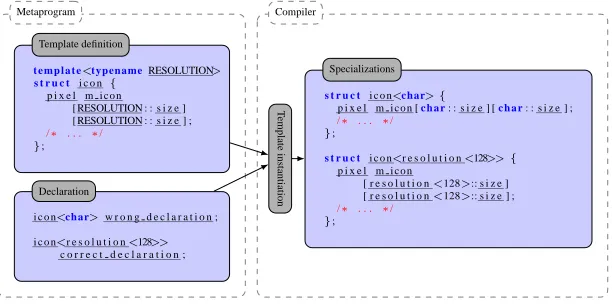
Consider the following example: A parameterized type is used to resolve the namesizein the template definition in Figure1. The first specialization is for the declarationicon<char>
and will not compile since the provided typecharhas no field namedsizeand can therefore
not be used for the expression defining the array size. For the second specialization, if the type
resolution<128>contains a static field namedsizeof an unsigned integer type, then the second specialization will compile.
t e m p l a t e<typenameRESOLUTION>
s t r u c t i c o n {
p i x e l m i c o n [ RESOLUTION : : s i z e ] [ RESOLUTION : : s i z e ] ; /∗ . . . ∗/
};
Template definition
i c o n<char>w r o n g d e c l a r a t i o n ; i c o n<r e s o l u t i o n<128>>
c o r r e c t d e c l a r a t i o n ; Declaration
Metaprogram
s t r u c t i c o n<char>{
p i x e l m i c o n [c h a r: : s i z e ] [c h a r: : s i z e ] ; /∗ . . . ∗/
};
s t r u c t i c o n<r e s o l u t i o n<128>>{
p i x e l m i c o n
[ r e s o l u t i o n<128>:: s i z e ] [ r e s o l u t i o n<128>:: s i z e ] ; /∗ . . . ∗/
}; Specializations
T
em
p
la
te
in
st
an
tia
tio
n
Compiler
Figure 1: C++ template instantiation.
Even though templates are a useful technique, they can be complex and difficult to read and write. In particular, error messages are often cryptic. This has led to the development of methods and tools to analyze template code. The usage of specializations can be analyzed by debuggers, software patterns like tracers [VJ02], and tools like TUAnalyzer [GPG04]. For the metaprogram itself, research is being done on a debugging framework Templight [PMS06].
To improve error messages, we suggest modeling definitions and declarations by graphs, while name lookup and type checking of such graphs is made by graph programs that emit error messages as graphs instead of text. Graphs allow an abstract and visual representation of all necessary information, while graph programs provide an intuitive way of writing programs that detect problems and suggests remedies. In combination with presentation techniques such as focusing (on relevant parts) and hierarchical depiction, we believe that our model is usable as a basis for a visual inspection of type problems and suggested remedies.
Graph transformation systems is a well investigated area in theoretical computer science. An overview on the theory and applications is given in the book Fundamentals of Algebraic Graph Transformation [EEPT06]. Graph transformation systems rewrite graphs with (graph transfor-mation) rules. A rule describes a left- and right-hand side. A transformation step is done by matching the left-hand side to a subgraph of the considered graph and modifying that subgraph according to the difference of the left- and right-hand side. Graph programs [HP01,PS04] pro-vide a computationally complete programming language based on graph transformations. Graph conditions [HP05] can be used to express properties of graphs by demanding or forbidding the existence of specific structures. In a similar way, graph conditions can limit the applicability of rules in a graph program, by making demands on elements local to the subgraph matched by a rule.
ECEASST
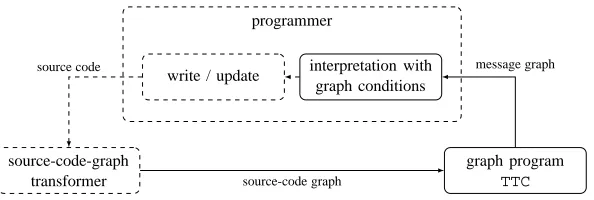
A graph program TTC (Template-Type Checker) looks up dependent names and detects type clashes in expressions for a subset of the C++ template features. TTCattempts to solve type clashes by implicit type casts. If such a cast loses precision, a warning message is generated. If no appropriate cast is found, an error message is generated, indicating the location of the error and suggesting a remedy for the programmer. TTCoutputs a message graph, where errors and warnings are embedded. The message graph is interpreted by the programmer with the help of graph conditions. Graph conditions detect warning and error messages in graphs and when an error is present, they can determine for which declarations a definition can successfully be instantiated. Figure2gives an overview.
graph program TTC source-code-graph
transformer
programmer
write / update interpretation with graph conditions
message graph
source-code graph source code
Figure 2:TTCtype checks graphs and outputs error messages.
The paper is structured as follows. Graph programs are introduced in Section 2. Section 3
informally describes how C++ source code is transformed into source-code graphs and defines type safety for graphs. In Section4we present the graph programTTCfor transforming a source-code graph into a message graph. In Section5 we give proof ideas for how to show thatTTC
terminates and that the error messages generated by it correctly indicate that the input is not type safe. We conclude our results in Section6. A long version of this paper, with complete proofs and more examples, is available as a technical report, see [AP07].
2
Graph Programs
In this section, we review conditions, rules, and programs, in the sense of [HP05] and [HP01]. In the following, we consider the category of directed labeled graphs with all injective graph mor-phisms. Labels distinguish different types of nodes and edges and directions model relationships between nodes. We use the standard definition of labeled graphs and labeled graph morphisms, see [EEPT06] or [AP07] for details. For expressing properties on graphs we use so-called graph conditions. The definition is based on graph morphisms.
Definition 1 (Graph conditions) A graph condition over an object P is of the form∃a or∃(a,c), where a : P→C is a morphism and c is a condition over C. Moreover, Boolean formulas over conditions (over P) are conditions (over P). A morphism p : P→G satisfies a condition ∃a (∃(a,c)) over P if there exists an injective morphism q : C→G with q◦a=p (satisfying c). An object G satisfies a condition ∃a (∃(a,c)) if all injective morphisms p : P→G satisfy the
condition. The satisfaction of conditions over P by objects or morphisms with domain P is extended to Boolean formulas over conditions in the usual way. We write p|=c (G|=c) to denote that morphism p (object G) satisfies c. In the context of rules, conditions are called application conditions.
We rewrite graphs with rules in the double-pushout approach [EEPT06]. Application conditions specify the applicability of a rule by restricting the matching morphism.
Definition 2 (Rules) A plain rule p= L←K→R consists of two injective morphisms with a common domain K. L is the rule’s left-hand side, and R its right-hand side. A left application condition ac for p is a condition over L. A rule ˆp= p,ac consists of a plain rule p and an
application condition ac for p.
L K R
G D H
m (1) (2) m∗
Given a plain rule p and injective morphism K→D, a direct derivation consists of two pushouts (1) and (2) where the match m and comatch m∗ are required to be injective. We write a direct derivation G⇒p,m,m∗ H. Given a graph G together with an injective match m : L→G, the direct
derivation G⇒p,m,m∗ H can informally be described as: H is obtained by deleting the image
m(L−K)from G and adding R−K. Given a rule ˆp= p,ac and a morphism K→D, there is a direct derivation G⇒pˆ,m,m∗H, if G⇒p,m,m∗ H, and m|=ac.
We now define graph programs as introduced in [HP01].
Definition 3 (Graph programs) Every rule p is a (graph) program. Every finite set S of programs is a program. If P and Q are programs, then(P; Q), P∗and P↓are programs. The se-mantics of a program P is a binary relationJPK⊆GC×GC on graphs: (1) For every rule p,JpK=
{ G,H |G⇒pH}. (2) For a finite setS of programs,JSK=∪P∈SJPK. (3) For programs P
and Q,J(P; Q)K=JQK◦JPK,JP∗K=JPK∗andJP↓K={ G,H ∈JPK∗| ¬∃M. H,M ∈JPK}.
Programs according to (1) are elementary and a program according to (2) describes the nonde-terministic choice of a program. The program(P; Q)is the sequential composition of P and Q. P∗is the reflexive, transitive closure of P, and P↓the iteration of P as long as possible. Programs of the form(P;(Q; R))and((P; Q); R)have the same semantics and are considered as equal; by convention, both can be written as P; Q; R. We use P↓+as a shortening of P; P↓.
ECEASST
3
From Source Code to Source-Code Graphs
In this section, we introduce source-code graphs, the input for our type-checking program, and informally describe how source code is transformed into such graphs. A source-code graph is a graph representation of template definitions, declarations, and expression’s specializations. The type signature of every declared method, function, and operator in a template definition is represented in the graph by an overload forest, see below. Expressions that involve parameterized types are represented in the graph by expression paths, explained shortly. For every declaration, the above mentioned graph representations are copied and the parameterized types are replaced by the actual types provided by the declaration.
The basic elements of our source-code graphs are nodes for template definitions, declarations, data types, names, type signatures, and expression trees. For quick reference, node and edge labels together with a short explanation are listed below. Note that a visualization of an edge as dashed or solid denotes a difference in labels.
Nodes Edges
D declaration p actual parameter = comparison
E error message t data type c cast without precision loss ex (sub)expression T template definition d deduced type of expression ol overloaded operator W warning message p parameter
op operator name pc cast with precision loss
r return type
R recovered comparison
Template definitions are represented by T-nodes. Two declarations are equivalent if they are based on the same template and have equal lists of template parameters. Each class of equivalent declarations are represented by a D-node and denotes a future specialization. Each D-node has an incoming edge from the T-node representing the template definition the declaration means to instantiate. Possible template parameters are represented by t-nodes. Such parameters include classes, structures, fundamental types, and constants. Operator-, function- and method names are represented by op-nodes. In [AP07] we show a graph program that generates source-code graphs.
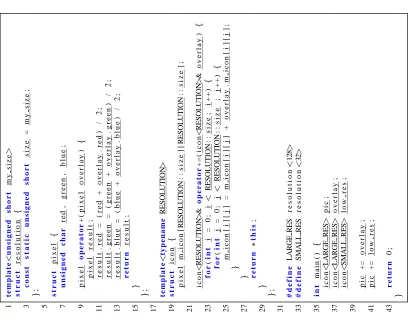
Example 1 Consider the source code with two class-type templates, line 1 and 18, in Figure3. The principal data type is theiconstructure with a template parameter for its resolution type. Theresolutionstructure has a constant template parameter for a (quadratic) resolution. For the two unique declarations inmain, name lookup and type checking is needed for the expres-sions on lines 3, 20, 23, 24, 25, 40, and 41. In Section4we will show how the graph program
TTCreports the type clash in the expression on line 41. Note that Figure4shows the source-code graph of the source code example from Figure3where the above mentioned lines are represented as expression paths. That source-code graph also shows the overload trees for the operators on line 3 and 22. For completeness, some overload paths representing used operations native to C++ are also included, e.g. comparison (<) of integers.
We will now introduce some necessary graph-theoretic notions. In particular, we introduce and use expression paths and overload trees to define type safety for graphs. Expression paths
1 te m p la te < u n s ig n e d s h o r t m y s iz e > s t r u c t r e s o l u t i o n { 3 c o n s t s t a t i c u n s ig n e d s h o r t s i z e = m y s iz e ; } ; 5 s t r u c t p ix e l { 7 u n s ig n e d c h a r re d , g r e e n , b lu e ; 9 p ix e l o p e r a t o r + ( p ix e l o v e r la y ) { p i x e l r e s u l t ; 1 1 r e s u l t . r e d = ( r e d + o v e r la y . r e d ) / 2 ; r e s u l t . g r e e n = ( g r e e n + o v e r la y . g r e e n ) / 2 ; 1 3 r e s u l t . b lu e = ( b lu e + o v e r la y . b lu e ) / 2 ; r e t u r n r e s u l t ; 1 5 } } ; 1 7 te m p la te < ty p e n a m e R E S O L U T IO N > 1 9 s t r u c t ic o n { p ix e l m ic o n [ R E S O L U T IO N : : s iz e ] [ R E S O L U T IO N : : s iz e ] ; 2 1 ic o n < R E S O L U T IO N > & o p e r a t o r + = ( ic o n < R E S O L U T IO N > & o v e r la y ) { 2 3 f o r ( in t i = 0 ; i < R E S O L U T IO N : : s iz e ; i + + ) { f o r ( in t j = 0 ; j < R E S O L U T IO N : : s i z e ; j + + ) { 2 5 m ic o n [ i ] [ j ] = m ic o n [ i ] [ j ] + o v e r la y . m ic o n [ i ] [ j ] ; } 2 7
} re
t u r n ∗ t h is ; 2 9 } } ; 3 1 # d e f in e L A R G E R E S r e s o lu ti o n < 12 8 > 3 3 # d e f in e S M A L L R E S r e s o lu ti o n < 32 > 3 5 in t m a in ( ) { ic o n < L A R G E R E S > p ic ; 3 7 ic o n < L A R G E R E S > o v e r la y ; ic o n < S M A L L R E S > lo w r e s ; 3 9 p ic + = o v e r la y ; 4 1 p ic + = lo w r e s ; 4 3 r e t u r n 0 ; }
Figure 3: Two class-type templates.
resent the type information from an expression tree and are modeled by ex- and p-nodes. The root of the tree becomes an ex-node and has an incoming edge from the D-node that represents the specialization in which it will exist. Each ex-node has an edge to the op-node denoting the operation’s name. We allow for operators with an arbitrary number of operands, so the children of the root in an expression tree are modeled by a path of p-nodes. If such a child is a subex-pression, then the corresponding p-node has an edge to a new expression node. If it is not, then it denotes a type and its p-node has an edge to the t|D-node denoting that type.
Definition 4 (Expression paths) Given a graph G and a natural number i, an i-expression path in G is a path ex p0. . .pi, where the head, ex, is an ex-node and p0, . . . ,pi are p-nodes such that,
from every node pk, 0≤k<i, the only edge to another p-node is to pk+1.
Example 2 Figure5shows (to the left) an expression tree denoting line 41 in Example 1 to-gether with its corresponding 2-expression path (to the right).
E C E A S S T op:< D:icon<resolution<32>> D:icon<resolution<128>> op:+= op:=
t:functions & operators
t:unsigned short
t:int
t:bool
t:unsigned long long
op:::size
D:resolution<128>
D:resolution<32>
t:const 128
t:const 32 T: main D: main
ex p p p ex p p p T:icon<resolution> ex p p p ex p ex p p p ex p ex p p p ex p ex p p p ex p T:resolution<size> ex p p p ex p p p op:< D:icon<resolution<32>> D:icon<resolution<128>>
op:+=
op:=
t:functions & operators
t:unsigned short
t:int
t:bool
t:unsigned long long
op:::size
D:resolution<128>
D:resolution<32>
t:const 128
t:const 32 c pc c pc c pc c pc c pc c pc c pc c c c pc c c ol p ol p ol p ol r ol
pp ol
+=
pic low res
op:+=
D:icon<resolution<128>>
D:icon<resolution<32>>
t:functions & operators
ex
p
p
p
p p
p
Figure 5: Expression paths represent expression trees.
and another edge to the t|D-node representingclass. The ol-node at position k (2≤k≤n+1) in the path has an edge to the node denoting the type of the variable at parameter position k−1. The last ol-node in the path has an edge to the t|D-node denoting the return type of method. Functions are modeled as methods but as declared in a special class with a name not allowed in the source language, e.g. functions & operators. Operator overloading is modeled as functions. In the following operators, methods, and functions are collectively referred to as operators.
Definition 5 (Overload forest) A graph G contains an overload forest iff all ol-nodes in G are part of exactly one overload tree and there exist no pair of overload trees with equivalent roots, see below. An overload tree is a maximal connected subgraph T in G, consisting of only ol-nodes. T is maximal in the sense that, if an ol-node in T has an edge to an ol-node, then that node is also in T . Furthermore, T must have a tree structure, i.e. no cycles and every node has one parent, except for the root. For nodes in T the following holds for them in G: (1) Each internal (leaf) node has exactly one p-edge (r-edge) to a t|D-node, one edge from its parent, and no other incoming edges. (2) The root of T has an additional edge to an op-node. (3) No two siblings have a p-edge to the same t|D-node. (4) Every node has at most one child that is a leaf. Requirements 3 and 4 are necessary to prevent ambiguous type signatures. Two roots are equivalent iff there exists an op-node o and t|D-node t, such that both roots have edges to o and t. An i-overload path o0. . .oi+1is a path in T from the root to a leaf. The t|D-node to which an
r-edge exist from oi+1is called the return type of the i-overload path.
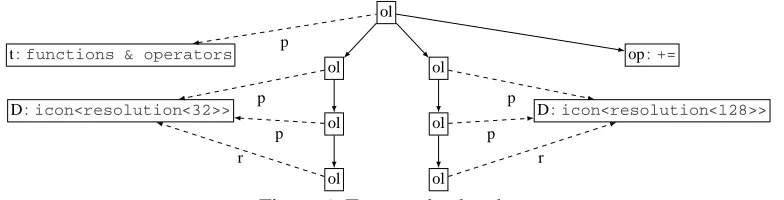
Example 3 The overload tree in Figure6has two 2-overload paths, representing the type sig-natures of two overloaded operators. The tree represents the operator template on line 22 and the two paths are generated for the two declarations on line 40 and 41 in Figure3.
op:+=
D:icon<resolution<128>>
t:functions & operators
D:icon<resolution<32>>
ol
p
ol
p
ol p
ol r
ol
p
ol p
ol
r
ECEASST
Remark 1. The size of a source-code graph grows linearly with the size of the source code that would be output by the template instantiation mechanism in a C++ compiler. An expression or declared operator that exists in such source code is represented only by a single expression path or overload path, respectively.
The main property in this paper is the one of type safety. A graph is type safe if for every expres-sion path, there exists an overload path with the same type signature. This property corresponds to type safety for template instantiation in C++ programs, where every generated expression must be type checked against the existing and generated operators.
Definition 6 (Type-safe graphs) A graph G is type safe iff it contains an overload forest and is i-type safe for all natural numbers i. G is i-type safe iff every i-expression path in G is type safe. An i-overload path o0. . .oi+1makes the i-expression path ex p0. . .pitype safe iff:
1. There exists an op-node op and two edges: one from ex to op, the other from o0to op.
2. For all k, where 0≤k≤i, there exists a t|D-node t and two edges, one from ok to t and the
other is from pkto either t or the head of a type safe j-expression path such that t is the
deduced type of the that j-expression path.
The deduced type of the i-expression path is the t|D-node with an incoming r-edge from oi+1.
It is easy to see that no overload path from Figure6makes the expression path in Figure5type safe.
4
The Type-Checking Program
This section describes the graph programTTCwhich performs the name lookup and type checks source-code graphs. The section also shows how message graphs are interpreted with graph conditions.
A schematic of how the subprograms of TTC interact is shown in Figure 7. Intuitively,
TTCworks as follows: The input is a source-code graph, each expression path is marked by
MarkExpression, andComparemoves this marker through the path until it reaches the tail or a type clash. At a type clash,Recovereither solves it or generates an error message. For markers at a tail, Resolvefinds the deduced type of the expression path (i.e. it resolves the type of a subexpression). This chain is then iterated as long as new work is made available by
Recoverand ResolveforCompare. The yield ofTTCis a message graph. Programs and rules are described in more detail below.
Definition 7 (TTC) Let the graph program TTC = MarkExpression↓;TypeCheck↓
with the subprograms:
TypeCheck = Compare↓+;Recover↓;AfterRecover↓;Resolve↓
Compare =
Lookup,CompareNext,FindType Recover = {Cast,Warning,Error}
Resolve =
ResolveSubexpression,
ResolveExpression1,ResolveExpression2
MarkExpression↓
Compare↓+ Recover↓ AfterRecover↓ Resolve↓
source-code graph
message graph
TypeCheck↓
Figure 7: Structure ofTTC.
MarkExpression↓ is executed before the actual type checking starts and markss each ex-node with an=-edge to show where the evaluation starts. To avoid duplicate evaluation, a loop is also placed at the ex-node and checked for in the application condition.
MarkExpression: op ex ⇒ op
= ex ,¬∃
op ex
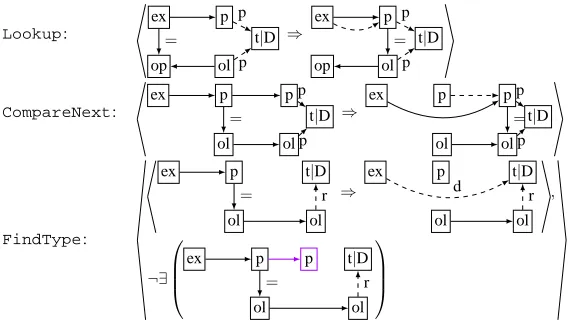
Compare↓+ consists of the rulesLookup,CompareNext, andFindType, see Figure8. They move the=-edge generated byMarkExpressionthrough the expression path as long as a matching overload path can be found. The program halts when it completes this matching or encounters a problem: that no overload path makes this expression path type safe or that this node in the path depends on the deduced type of a subexpression. The ruleLookupfinds the overload tree for a marked expression’s name. CompareNextmatches the type signature of the expression path to an overload path parameter by parameter. The ruleFindTypeis applied at the tail of the expression path and deduces the expression’s type via the matched overload path’s return type. The rule’s application condition makes sure that this is actually the tail of the expression path.
Lookup:
ex p
t|D
ol op
p
p
= ⇒
ex p
t|D
ol op
p
p
=
CompareNext:
ex p p
t|D
ol ol
p
p
= ⇒
ex p p
t|D
ol ol
p
p
=
FindType:
ex p t|D
ol ol
r
= ⇒
ex p t|D
ol ol
d
r ,
¬∃
ex p p t|D
ol ol
r
=
ECEASST
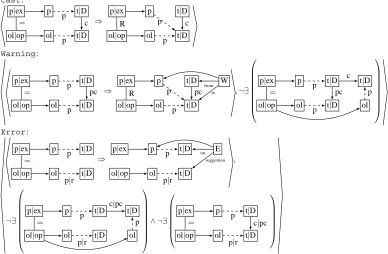
Recover↓ consists of the rules Figure9and tries to find alternative overload paths by implicit type casts. The ruleCastfinds a type cast that causes no loss of precision.Warningworks as
Castbut uses a cast with a possible loss of precision. For this we generate a warning, a W-node with three outgoing edges: the location of the problem, the original type, and the cast type. The application condition make sure thatCastis preferred. The ruleErroris applied when there is no solution by implicit type casts. An error node is therefore generated. It has three outgoing edges, to the p-node where it occurred, the faulting type, and a suggested type. The application condition limitsErrorfrom being applied whereCastorWarningcould be applied instead.
Cast: p|ex
ol|op p
ol t|D t|D
= p
p
c ⇒ p|ex
ol|op p
ol t|D t|D
R p
p c
Warning:
p|ex
ol|op p
ol t|D t|D
= p
p
pc ⇒ p|ex
ol|op p
ol t|D t|D
R p
p pc
W
from
to ,¬∃
p|ex
ol|op p
ol t|D t|D
= p
p pc
ol t|D
p c
Error:
p|ex
ol|op p
ol t|D t|D
= p
p|r ⇒
p|ex
ol|op p
ol t|D t|D p
p|r
E
on
suggestion ,
¬∃
p|ex
ol|op p
ol t|D t|D
= p
p|r ol
t|D p c|pc
∧ ¬∃
p|ex
ol|op p
ol t|D t|D
= p
p|r c|pc
Figure 9: Rules for the programRecover.
AfterRecover↓ performs some cleanup work forRecover↓, generated R-edges are reset to=-edges.
AfterRecover: ex|p
R op|ol ⇒ ex|p = op|ol
Resolve↓ consists of three rules, as shown in Figure 10: ResolveSubexpression re-places a subexpression with its deduced return type.ResolveExpression1marks an expres-sion as evaluated with a dashed edge. ResolveExpression2does the same in the special case when the return type is the same as the specialization in where the expression occurs.
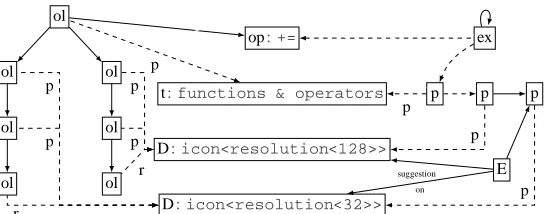
Example 4 The graph in Figure11is the yield ofTTCapplied to the overload tree from Figure6
and the expression path from Figure5. See [AP07] for more examples.
ResolveSubexpression: p
t|D ex
d ⇒
p
t|D ex p
ResolveExpression1: D
t|D ex
d ⇒
D
t|D ex
ResolveExpression2: D
d
ex ⇒ D ex
Figure 10: Rules inResolve.
op:+=
t:functions & operators
D:icon<resolution<128>>
D:icon<resolution<32>>
ol
p ol
ol
ol
ol
ol
ol p
p
r
p
p
r
ex
p
p p
p p
p E
on suggestion
= =
=
Figure 11: Portion of a message graph.
Remark 2. After the termination of TTC, graph conditions can help to interpret the message graph. A graph is an error (warning) graph iff it satisfies the condition ∃(/0→ E) (∃(/0→
W)). A particular declaration can safely be instantiated if its corresponding D-node satisfies
the condition¬∃(D → D ex). If that condition is not satisfied, then one of its expressions could not be resolved and the programmer must take appropriate actions. A message graph will contain all the detected errors for the corresponding source code. Graph conditions can therefore help programmers to locate the areas of the graph that contain such errors. An implementation of this approach should be able to highlight the areas containing the errors.
Remark 3. The size of the resulting message graph will not grow more than linearly with the size of the corresponding source-code graph. This is so since every expression tree can at most be marked by one error message. For size of source-code graphs, see Remark1
5
Correctness and Termination
We now define correctness with respect to errors and termination for graph programs. We give the ideas for proving thatTTCterminates and is correct w.r.t. errors.
ECEASST
Theorem 1 (Correctness) The graph programTTCis correct with respect to errors.
Proof idea. Errors are only generated byRecoverand consumes an=-edge that should have been consumed byCompare↓+, given thatTTCwere initially dealing with a type-safe source-code graph. A complete proof is given in [AP07].
Fact 1. The graph programTTCis not complete with respect to errors. E.g. Recoveruses implicit type casts, and thereby avoids generating errors for some non-type-safe graphs. It has not yet been investigated whether or not other counterexamples exist.
Definition 9 (Termination) Termination of a graph program is defined inductively on the struc-ture of programs: (1) Every rule p is terminating. (2) For a finite setS of terminating programs, S is a terminating program. (3) For terminating programs P and Q, (P; Q) is terminating.
Moreover, P∗and P↓is terminating if for every graph G, there is no infinite chain of derivations G⇒PG1⇒P. . .where⇒Pdenotes the binary relationJPKon graphs.
Theorem 2 (Termination) The graph programTTCis terminating.
Proof idea.Compareis applied at least once for every iteration ofTypeCheckand consumes solid edges that are not generated by the other subprograms. A complete proof is given in [AP07].
6
Conclusions
We considered the template instantiation mechanism in C++ and showed how to write visual rules for type checking and error message generation. We informally described how source code was transformed into source-code graphs and defined type safety for graphs. We transformed source-code graphs into message graphs, a transformation given by the graph program TTC
which type checked source-code graphs. The program automatically corrected some errors by implicit type casts. It emitted error messages for type clashes that it could not correct. Proof ideas were given for termination and correctness w.r.t. errors.
Further topics include:
1. Analysis of source-code graphs by generalized graph conditions. Graph properties like “There exists a warning or error node” can be expressed by graph conditions in the sense of [HP05]. It would be interesting to generalize graph conditions so more complex graph properties like “The graph is type safe” becomes expressible.
2. Debugging and a transformation from message graphs to source code. The error messages generated byTTCcontained suggestions for remedies. In the double-pushout approach to graph transformation, a central property is the existence of an inverse rule, that when ap-plied reverses the rewrite step of the rule [EEPT06]. In this way, the inverse rule allows for back tracking to a previous graph which can be manipulated to experiment with suggested remedies. The changes are logged in the output graph (message/change graph) and used by a source-code transformer to update the source code.
3. Implementation of the approach. This would include a formalization of the transformation from source code to source-code graphs and an extension of the set of considered template features.
Acknowledgements: This work is supported by the German Research Foundation (DFG) un-der grant no. HA 2936/2 (Development of Correct Graph Transformation Systems). We thank Annegret Habel for constructive suggestions that improved the paper.
Bibliography
[AG04] D. Abrahams, A. Gurtovoy. C++ Template Metaprogramming: Concepts, Tools, and Techniques from Boost and Beyond. Addison-Wesley Professional, 2004.
[AP07] K. Azab, K.-H. Pennemann. Type Checking C++ Template Instantiation (long version). Technical report 04/07, University of Oldenburg, 2007. Available at
http://formale-sprachen.informatik.uni-oldenburg.de/%7Eskript/fs-pub/templates long.pdf.
[CE00] K. Czarnecki, U. W. Eisenecker. Generative Programming: Methods, Tools, and
Applica-tions. Addison-Wesley, 2000.
[EEPT06] H. Ehrig, K. Ehrig, U. Prange, G. Taentzer. Fundamentals of Algebraic Graph
Transforma-tion. EATCS Monographs of Theoretical Computer Science. Springer, 2006.
[GPG04] T. Gschwind, M. Pinzger, H. Gall. TUAnalyzer–Analyzing Templates in C++ Code. In Proc.
of WCRE’04. Pp. 48–57. IEEE Computer Society, 2004.
[HP01] A. Habel, D. Plump. Computational Completeness of Programming Languages Based on Graph Transformation. LNCS 2030, pp. 230–245. Springer, 2001.
[HP05] A. Habel, K.-H. Pennemann. Nested Constraints and Application Conditions for High-Level Structures. LNCS 3393, pp. 293–308. Springer, 2005.
[Jos99] N. M. Josuttis. The C++ Standard Library: a tutorial and reference. Addison-Wesley, 1999.
[PMS06] Z. Porkol´ab, J. Mihalicza, ´A. Sipos. Debugging C++ template metaprograms. In Proc. of
GPCE’06. Pp. 255–264. ACM, 2006.
[PS04] D. Plump, S. Steinert. Towards Graph Programs for Graph Algorithms. LNCS 3256, pp. 128– 143. Springer, 2004.
[Str00] B. Stroustrup. The C++ Programming Language. Addison-Wesley, 3rd edition, 2000.
[Str04] B. Stroustrup. Abstraction and the C++ Machine Model. LNCS 3605, pp. 1–13. Springer, 2004.
[Vel98] T. L. Veldhuizen. Arrays in Blitz++. LNCS, pp. 223–230. Springer, 1998.