
DOI: 10.17628/ECB.2013.2.887
CORRELATIONS OF SOLUTE PARTITIONING AND
ENTHALPIES OF SOLVATION FOR ORGANIC SOLUTES IN
IONIC LIQUIDS USING A TEMPERATURE INDEPENDENT
FREE ENERGY RELATIONSHIP
Timothy W. Stephens
a, Bria Willis
a, Nishu Dabadge
a, Amy Tian
a, William E. Acree, Jr.
a,
Michael H. Abraham
bKeywords: partition coefficient,1-hexyl-3-methylimidazolium tetracyanoborate, 1-(2-methoxyethyl)-1-methylpiperidinium bis(trifluoro-methylsulfonyl)imide and 1-(2-methoxyethyl)-1-methylpyrrolidinium bis(trifluorobis(trifluoro-methylsulfonyl)imide, ionic liquids, temperature independence, linear free energy relationships, enthalpies of solvation.
Experimental data have been collected from the published literature for the gas-to-ionic liquid partition coefficients and molar enthalpies of solvation for over 60 solutes in the ionic liquids 1-hexyl-3-methylimidazolium tetracyanoborate ([MHIm]+[B(CN)
4]–),
1-(2-methoxyethyl)-1-methylpiperidinium bis(trifluoromethylsulfonyl)imide ([MeoeMPip]+[Tf
2N]–), and 1-(2-methoxyethyl)-1-methylpyrrolidinium
bis(trifluoromethylsulfonyl)imide ([MeoeMPyrr]+[Tf
2N]–) over the temperature range 318.15 K to 368.15 K. The logarithm of the
gas-to-ionic liquid partition coefficient, logKL, have been correlated to a temperature independent free energy relationship utilizing known
Abraham solvation parameters. The resulting mathematical expressions describe the experimental logKL values to within a standard
deviation of 0.077 log units or less and Hsolv to within a standard deviation of 1.344 kJ mol-1 or less.
.
* Corresponding Authors Fax: 940-565-4318 E-Mail: [email protected]
[a] Department of Chemistry, 1155 Union Circle Drive #305070, University of North Texas, Denton, TX 76203-5017 (USA) [b] Department of Chemistry, University College London, 20
Gordon Street, London, WC1H OAJ (UK)
Introduction
For over twenty years, room-temperature ionic liquids (RTILs) have been used in an ever growing area of study with regards to chemical separations. One of the most prominent features of ionic liquids is the ability to fine-tune and target specific solubilizing effects based on the choice of cation or anion, or even the side chains on the cation. The RTILs 1-(2-methoxyethyl)-1-methylpiperidinium bis(trifluoromethylsulfonyl)imide ([MeoeMPip]+[Tf
2N]–), and 1-(2-methoxyethyl)-1-methylpyrrolidinium bis(tri-fluoromethylsulfonyl)imide ([MeoeMPyrr]+[Tf
2N]–), specifically the 2-methoxyethyl side chain, have both been shown to be particularly good at separations involving polar/non-polar azeotropic mixtures,1,2 while the RTIL 1-hexyl-3-methylimidazolium tetracyanoborate ([MHIm]+ [B(CN)4]–) has been shown to be very selective for aromatic and aliphatic hydrocarbons.3 RTILs that contain the anion [Tf2N]– have been shown to be completely immiscible with water while RTILs containing the cation [MHIm]+ have been shown to be partly soluble in water. These solubilizing characteristics allow for RTILs of this type of be used in liquid-liquid extractions between the RTIL and aqueous solution.
To date, the Abraham Solvation Parameter Model has been used to predict various solvation processes in a variety of types of solvent systems, including: the partitioning of solutes in polar organic solvents,4-9 the partitioning of solutes in non-polar organic solvents,10-12 the partitioning
within micelles,13,14 solute partitioning within important biological systems,15-17 toxicity in aquatic organisms,18-21 solute partitioning in RTILs,22-27 and solute partitioning in binary solvent systems.28 The Abraham Model can be written to predict the logarithm of the gas-to-solvent partition coefficient (logKL) and the logarithm of the water-to-solvent partition coefficient logP, as shown in Eqns. 1 and 2 respectively. The Abraham Model has also been applied in the prediction of enthalpies of solvation,29-34 as shown in Eqn. 3.
log KL = cK + eK E + sK S + aK A + bK B + lK L (1)
log P = cP + eP E + sP S + aP A + bP B + vP V (2)
ΔHsolv = cH,solv + eH,solv E + sH,solv S + aH,solv A + bH,solv B + lH,solv L (3)
measure of the solvent system’s interactions with the solute’s - and non-bonding electrons, s is a measure of the solvent system’s combined polarizability and dipolarity, a is a measure of the solvent system’s hydrogen-bond basicity and is complimentary to the solute’s hydrogen-bond acidity,
b is a measure of the solvent system’s hydrogen-bond acidity and is complimentary to the solute’s hydrogen-bond basicity, and l and v are measures of general dispersion forces necessary to create a cavity in the solvent system for solubilizing the solute. When the solvent coefficients are combined with their complimentary descriptors, the resulting product can be used to characterize that particular solute-solvent interaction. For the partitioning between two condensed phases, the coefficient values can be used to indicate the differences between the two phases of that particular property.
Sprunger, et al.41-43 have expanded the Abraham Model so that the gas-to-RTIL partition coefficient can be predicted based on ion-specific coefficients for individual cations and anions, as shown in Eqn. 4. Utilizing the ion-specific coefficients, RTILs can be synthesized that take advantage of specific properties that may be attractive for specific separations.
log KL = (cK,cation + cK,anion) + (eK,cation + eK,anion) E + (sK,cation + sK,anion) S + (aK,cation + aK,anion) A + (bK,cation + bK,anion) B + (lK,cation + lK,anion) L (4) Mintz, et al.44 and Sprunger, et al.45 describe a basis for incorporating temperature dependent terms into the Abraham Model that comes from the Gibbs’ Free Energy Relationship, Eqn. 5, and the relation between Gsolv and KL, Eqn. 6, where R is the universal gas constant in units of J mol-1 K-1, T is the temperature of the system in Kelvin, and KL is the gas-to-solvent partition coefficient.
ΔGsolv = ΔHsolv – T ΔSsolv (5) ΔGsolv = –RT ln KL (6)
Converting Eqn. 6 from base e to base 10 so that the results correspond to previous Abraham Model correlations, yields Eqn. 7.
ΔGsolv = –2.303 RT log KL (7)
Using Eqns. 1, 3, 5 and 7, the Abraham Model can be applied to the prediction of Ssolv, expressed as Eqn. 8.
ΔSsolv = cS,solv + eS,solvE + sS,solvS + aS,solvA + bS,solvB
+ lS,solvL (8)
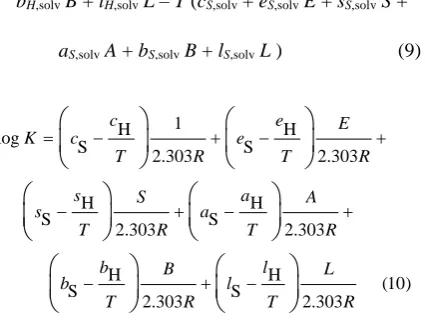
Eqns. 3, 5, 7, and 8 can now be combined and rewritten as Eqn. 9, and simplified into Eqn. 10.
–2.303 RT log KL = cH,solv + eH,solvE + sH,solvS + aH,solvA + bH,solvB + lH,solvL – T (cS,solv + eS,solvE + sS,solvS +
aS,solvA + bS,solvB + lS,solvL ) (9)
Because of the relationship between log KL and ΔHsolv, the cH, eH, sH, aH, bH, and lH coefficients from Eqn. 10 should
yield the same coefficients as for Eqn. 3.
Data sets and computation methodology
Gas-to-solvent partition coefficients KL were found for the RTILs 1-hexyl-3-methylimidazolium tetracyanoborate ([MHIm]+[B(CN)
4]–),3 1-(2-methoxyethyl)-1-methylpipe-ridinium bis(trifluoromethylsulfonyl)imide ([MeoeMPip]+ [Tf2N]–),2 and 1-(2-methoxyethyl)-1-methylpyrrolidinium bis(trifluoromethylsulfonyl)imide ([MeoeMPyrr]+[Tf
2N]–)1 by performing a search of the chemical literature. All of the partition coefficients were converted to logKL and tabulated with the necessary solute descriptors in a 12 column matrix. Enthalpies of solvation were calculated using the relationship given in Eqn. 11 and tabulated with the necessary solute descriptors into a 5 column matrix. A linear regression was performed on each matrix using the statistical software program SPSS 20.0. For the logKL correlation, the linear regression was forced through the origin. For the Hsolv correlation, the linear regression was not forced through the origin.
ΔHsolv = –2.303 R [d log KL/ d(1/T)] (11)
Table 1 lists all solute descriptors used for the analysis of the three RTILs. The solute descriptors used came from a database that the authors have compiled and were initially obtained using experimental data such as water-to-solvent partition coefficients, gas-to-solvent partition coefficients, solubility, and chromatographic data. Numerical values for the descriptors used in the analysis of the three ionic liquids cover the same area of predictive space, with values for each descriptor ranging from: E = –0.063 to E = 0.851, S = 0.000 to S = 0.950, A = 0.000 to A = 0.820, B = 0.000 to B = 0.640, and L = 0.260 to L = 4.686. The solutes used in each correlation show a wide range of functionality as well as non-polar and polar characteristics. For all correlations, the authors report the N (number of data points), R2 (square of the correlation coefficient), F (Fisher’s F-Statistic), and SD
(standard deviation).
1
H H
log
S S
2.303 2.303
H H
S S
2.303 2.303
H H (10)
S S
2.303 2.303
c e E
K c e
T R T R
s S a A
s a
T R T R
b B l L
b l
T R T R
DOI: 10.17628/ECB.2013.2.887
Table 1. Solute descriptors used in the analyses
Solute E S A B L
Pentane 0.000 0.000 0.000 0.000 2.162
Hexane 0.000 0.000 0.000 0.000 2.668
3-Methylpentane 0.000 0.000 0.000 0.000 2.581 2,2-Dimethylbutane 0.000 0.000 0.000 0.000 2.352
Heptane 0.000 0.000 0.000 0.000 3.173
Octane 0.000 0.000 0.000 0.000 3.677
2,2,4-trimethylpentane
0.000 0.000 0.000 0.000 3.106
Nonane 0.000 0.000 0.000 0.000 4.182
Decane 0.000 0.000 0.000 0.000 4.686
Cyclopentane 0.263 0.100 0.000 0.000 2.477 Cyclohexane 0.310 0.100 0.000 0.000 2.964 Methylcyclohexane 0.244 0.060 0.000 0.000 3.319 Cycloheptane 0.350 0.100 0.000 0.000 3.704 Cyclooctane 0.413 0.100 0.000 0.000 4.329 Pent-1-ene 0.093 0.080 0.000 0.070 2.047
Hex-1-ene 0.080 0.080 0.000 0.070 2.572
Cyclohexene 0.395 0.280 0.000 0.090 2.952 Hept-1-ene 0.092 0.080 0.000 0.070 3.063
Oct-1-ene 0.090 0.080 0.000 0.070 3.568
Dec-1-ene 0.093 0.080 0.000 0.070 4.554
Hex-1-yne 0.166 0.220 0.100 0.120 2.510
Hept-1-yne 0.160 0.230 0.090 0.100 3.000
Oct-1-yne 0.155 0.220 0.090 0.100 3.521
Benzene 0.610 0.520 0.000 0.140 2.786
Toluene 0.601 0.520 0.000 0.140 3.325
Ethylbenzene 0.613 0.510 0.000 0.150 3.778
o-Xylene 0.663 0.560 0.000 0.160 3.939
m-Xylene 0.623 0.520 0.000 0.160 3.839
p-Xylene 0.613 0.520 0.000 0.160 3.839
Styrene 0.849 0.650 0.000 0.160 3.856
α-Methylstyrene 0.851 0.640 0.000 0.190 4.290
Thiophene 0.687 0.570 0.000 0.150 2.819
Methanol 0.278 0.440 0.430 0.470 0.970
Ethanol 0.246 0.420 0.370 0.480 1.485
Propan-1-ol 0.236 0.420 0.370 0.480 2.031 Propan-2-ol 0.212 0.360 0.330 0.560 1.764 Butan-1-ol 0.224 0.420 0.370 0.480 2.601 Butan-2-ol 0.217 0.360 0.330 0.560 2.338 2-Methyl-1-propanol 0.217 0.390 0.370 0.480 2.413
tert-Butanol 0.180 0.300 0.310 0.600 1.963
Water 0.000 0.600 0.590 0.460 0.245
Acetic acid 0.265 0.640 0.620 0.440 1.816 Tetrahydrofuran 0.289 0.520 0.000 0.480 2.636 1,4-Dioxane 0.329 0.750 0.000 0.640 2.892
tert-Butyl methyl ether
0.024 0.220 0.000 0.550 2.372
tert-Butyl ethyl ether -0.020 0.160 0.000 0.600 2.720
tert-Amyl methyl ether
0.050 0.210 0.000 0.600 2.916
Diethyl ether 0.041 0.250 0.000 0.450 2.015 Dipropyl ether 0.008 0.250 0.000 0.450 2.954 Diisopropyl ether -0.063 0.170 0.000 0.570 2.501 Dibutyl ether 0.000 0.250 0.000 0.450 3.924
Acetone 0.179 0.700 0.040 0.490 1.696
Pentan-2-one 0.143 0.680 0.000 0.510 2.755 Pentan-3-one 0.154 0.660 0.000 0.510 2.811 Methyl acetate 0.142 0.640 0.000 0.450 1.911 Ethyl acetate 0.106 0.620 0.000 0.450 2.314
Solute E S A B L
Methyl propanoate 0.128 0.600 0.000 0.450 2.431 Methyl butanoate 0.106 0.600 0.000 0.450 2.893
Butanal 0.187 0.650 0.000 0.450 2.270
Acetonitrile 0.237 0.900 0.070 0.320 1.739
Pyridine 0.631 0.840 0.000 0.520 3.022
1-Nitropropane 0.242 0.950 0.000 0.310 2.894
RESULTS AND DISCUSSION
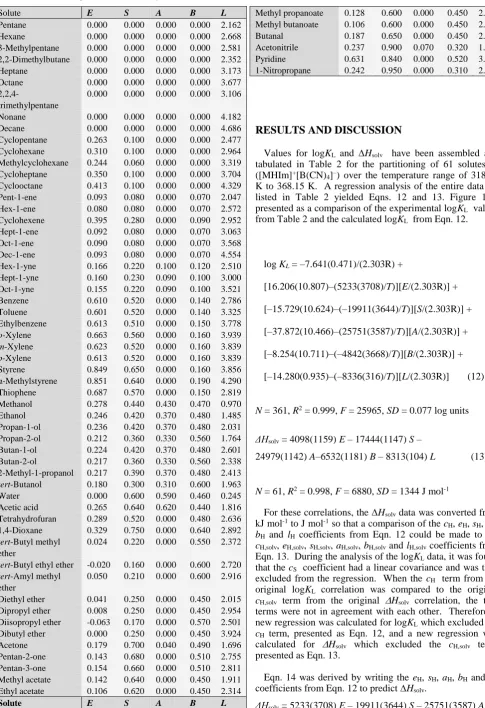
Values for logKL and Hsolv have been assembled and tabulated in Table 2 for the partitioning of 61 solutes in ([MHIm]+[B(CN)
4]–) over the temperature range of 318.15 K to 368.15 K. A regression analysis of the entire data set listed in Table 2 yielded Eqns. 12 and 13. Figure 1 is presented as a comparison of the experimental logKL values from Table 2 and the calculated logKL from Eqn. 12.
log KL = –7.641(0.471)/(2.303R) +
[16.206(10.807)–(5233(3708)/T)][E/(2.303R)] +
[–15.729(10.624)–(–19911(3644)/T)][S/(2.303R)] +
[–37.872(10.466)–(25751(3587)/T)][A/(2.303R)] +
[–8.254(10.711)–(–4842(3668)/T)][B/(2.303R)] +
[–14.280(0.935)–(–8336(316)/T)][L/(2.303R)] (12)
N = 361, R2 = 0.999, F = 25965, SD = 0.077 log units ΔHsolv= 4098(1159) E – 17444(1147) S –
24979(1142) A–6532(1181) B – 8313(104) L (13) (13)
N = 61, R2 = 0.998, F = 6880, SD = 1344 J mol-1
For these correlations, the Hsolv data was converted from kJ mol-1 to J mol-1 so that a comparison of the c
H, eH, sH, aH, bH and lH coefficients from Eqn. 12 could be made to the cH,solv, eH,solv, sH,solv, aH,solv, bH,solv and lH,solv coefficients from Eqn. 13. During the analysis of the logKL data, it was found that the cS coefficient had a linear covariance and was thus excluded from the regression. When the cH term from the original logKL correlation was compared to the original cH,solv term from the original Hsolv correlation, the two terms were not in agreement with each other. Therefore, a new regression was calculated for logKL which excluded the cH term, presented as Eqn. 12, and a new regression was calculated for Hsolv which excluded the cH,solv term, presented as Eqn. 13.
Eqn. 14 was derived by writing the eH, sH, aH, bH and lH, coefficients from Eqn. 12 to predict Hsolv.
4842(3688) B – 8336(316) L (14)
SD = 1424 J mol-1, AAE = 1064 J mol-1, AE = 192 J mol-1 Reported are the SD, AAE (absolute average error), and
AE (average error) for the prediction of Hsolv based on Eqn. 14. As shown, Eqn. 14 predictsHsolv to within a similar standard deviation as Eqn. 13. The very low AE and AAE
values show very little bias between using Eqn. 13 or Eqn. 14 to predictHsolv. Eqn. 14 also illustrates that the eH, sH, aH, bH and lH coefficients from Eqn. 12 and the eH,solv, sH,solv, aH,solv, bH,solv and lH,solv coefficients from Eqn. 13 are individually within the statistical error of their respective counterparts.
Figure 1. Graph of experimental logarithm of gas-to-[MHIm]+[B(CN)
4]- partition coefficient (logKL) versus calculated
logKL based on Eq. 12.
As an informational note one could develop Abraham model correlations for each individual temperature. As noted by Mintz et al.44 and Sprunger et al.45 offers over such temperature-specifc correlations is that one can develop correlations for more partitioning process and for more ionic liquid solvents. For example, lets assume that one was able to find log KL data 20 solutes in ([MHIm]+[B(CN)4]–) at 298 K, log KL data for a different set of 20 solutes in
([MHIm]+[B(CN)
4]–) at 318.15 K, and log KL data for a third
set of 20 different solutes in ([MHIm]+[B(CN)
4]–) at 368 K. There would be insufficient experimental data to develop a meaningful Abraham model correlation at any of the three temperatures mentioned. However, by pooling the 60 log
KL values for ([MHIm]+ [B(CN)4]–) into a single dataset, one could develop a predictive correlation based on Eqn. 10. Such predictions would not be possible with Eqn. 1 which requires that all of the experimental data be at the same temperature.
To determine the predictability of Eqn. 12, the data in Table 2 was analyzed using a training set and test analysis. In this method of analysis, the complete data set is randomly split in half and divided into a training set and a test set. In the event that the complete data set has an odd number of data points, the extra data point is included in the training set. A linear regression is then performed on the training set and a new training correlation is calculated. This training
correlation is then used to predict the values in the test set, and the SD, AAE, and AE are reported. Eqn. 15 is the resultant correlation from randomly splitting half of the logKL data reported in Table 2. Using Eqn. 15 to predict the values in the test set yielded a SD = 0.083 log units, AAE = 0.055, and AE = -0.004. The very small difference in the coefficient values calculated between the training set and parent set show that the training set compounds and temperatures are representative of the parent compounds and temperatures. The low AE value shows very little bias between using Eqns. 12 and 15.
log KL = –7.699(0.653)/(2,303 R) +
[15.446(14.979) – (4914(5133)/T)] [E/(2.303 R)] +
[–14.226(15.704) – (–19294(5388)/T)][S/(2.303 R)] +
[–58.028(17.935) – (–33067(6232)/T)] [A/(2.303 R)] +
[–9.661(15.007) – (–5405(5189)/T)] [B/(2.303 R)] +
[–14.012(1.297) – (–8245(445)/T)] [L/(2.303 R)] (15)
N = 181, R2 = 0.999, F = 13690, SD = 0.074 log units Values for logKL and Hsolv have been assembled and tabulated in Table 3 for the partitioning of 61 solutes in ([MeoeMPip]+[Tf
2N]–) over the temperature range of 318.15 K to 368.15 K. A regression analysis of the entire data set listed in Table 3 yielded Eqns. 16 and 17. Figure 2 is presented as a comparison of the experimental logKL values from Table 3 and the calculated logKL from Eqn. 16.
log KL = –10.878(0.387)/(2.303 R) +
[0.536(6.437) – (–14440(2202)/T)][S/(2.303 R)] +
[–29.947(9.729) – (–23020(3325)/T)] [A/(2.303 R)] +
[–17.927(7.920) – (–7332(2707)/T)] [B/(2.303 R)] +
[–12.721(0.706) – (–7802(239)/T)] [L/(2.303 R)] (16)
N = 365, R2 = 0.999, F = 31686, SD = 0.069 log units
ΔHsolv = –14486(805) S – 22955(1223) A –
7248(991) B –7791(88) L (17)
N = 61, R2 = 0.998, F = 7868, SD = 1335 J/mol
For these correlations, the Hsolv data was converted from kJ mol-1 to J mol-1 so that a comparison of the c
H, eH, sH, aH, bH and lH coefficients from Eqn. 16 could be made to the cH,solv, eH,solv, sH,solv, aH,solv, bH,solv and lH,solv coefficients from Eqn. 17. Coincidentally, during the analysis of the logKL data for ([MeoeMPip]+[Tf
DOI: 10.17628/ECB.2013.2.887
the original logKL correlation was compared to the original cH,solv term from the original Hsolv correlation, the two terms were also not in agreement with each other, as occurred for ([MHIm]+[B(CN)
4]–). Further analysis of the correlation for logKL showed that the eS and eH terms were very small, 9.267(8.538) and 1986(2921) respectively. These terms were subsequently set equal to zero and the regression was performed once again. Eqn. 16 is the resultant correlation obtained by removing the cH, eS and eH terms and Eqn. 17 is the resultant correlation obtained when the cH,solv and eH,solv terms are removed.
Eqn. 18 was derived by writing the sH, aH, bH and lH, coefficients from Eqn. 16 to predict Hsolv.
ΔHsolv = –14440(2202) S – 23020(3325) A – 7332(2707) B – 7802(239) L (18)
SD = 1335 J mol-1, AAE = 1011 J mol-1, AE = -93 J mol-1. Reported are the SD, AAE, and AE for the prediction of
Hsolv based on Eqn. 18. As shown, Eqn. 18 predicts Hsolv to within the same standard deviation as Eqn. 17. The very low AE and AAE values show very little bias between using Eqn. 17 or Eqn. 18 to predictHsolv. Eqn. 18 also illustrates that the sH, aH, bH and lH coefficients from Eqn. 16 and the sH,solv, aH,solv, bH,solv and lH,solv coefficients from Eqn. 17 are individually within the statistical error of their respective counterparts.
Figure 2. Graph of experimental logarithm of gas-to-([MeoeMPip]+[Tf
2N]–) partition coefficient (logKL) versus
calculated logKL based on Eqn. 16.
To determine the predictability of Eqn. 16, the data in Table 3 was also analyzed using a training set and test analysis. Eqn. 19 is the resultant correlation from randomly splitting half of the logKL data reported in Table 3. Using Eqn. 19 to predict the values in the test set yielded a SD = 0.071 log units, AAE = 0.053, and AE = 0.002.
The very small difference in the coefficient values calculated between the training set and parent set show that the training set compounds and temperatures are representative of the parent compounds and temperatures. The low AE value shows very little bias between using Eqns. 16 and 19.
log KL = –10.992(0.562)/(2.303 R) +
[5.061(9.173) – (–12834(3131)/T)][S/(2.303 R)] +
[–16.206(14.399) – (–18341(4871)/T)] [A/(2.303 R)] +
[–27.181(12.155) – (–10547(4150)/T)] [B/(2.303 R)] +
[–12.610(0.926) – (–7777(307)/T)] [L/(2.303 R)]
(19)
N = 183, R2 = 0.999, F = 17102, SD = 0.068 log units It should be noted that Marciniak and Wlazło2 also corelated the log KL data for ([MeoeMPip]+[Tf2N]–) in terms of the Abraham model. The authors developed temperature-specific correlations in the form of Eqn. 1 for each of the six temperatures studied. A total of 36 curve-fit equation coefficients were needed to describe the 365 experimental data points to an average standard deviation of SD = 0.059 log units. Our method, Eqn. 16, has only nine curve-fit equation coefficients and describes the 365 log KL values to
within SD = 0.069 log units. Very little loss in predictive ability resulted from our method of combining all 365 experimental values into a single regression analysis.
Values for logKL and Hsolv have been assembled and tabulated in Table 4 for the partitioning of 61 solutes in ([MeoeMPyrr]+[Tf
2N]–) over the temperature range of 318.15 K to 368.15 K. A regression analysis of the entire data set listed in Table 4 yielded Eqns. 20 and 21. Figure 3 is presented as a comparison of the experimental logKL values from Table 4 and the calculated logKL from Eqn. 20.
log KL = –10.033(0.375)/(2.303 R) +
[10.075(8.499) – (2557(2905)/T)] [E/(2.303 R)] +
[–7.117(8.475) – (–16471(2897)/T)][S/(2.303 R)] +
[–33.881(9.165) – (–24144(3132)/T)] [A/(2.303 R)] +
[–12.474(8.752) – (–6027(2992)/T)] [B/(2.303 R)] +
[–13.508(0.763) – (–7875(258)/T)] [L/(2.303 R)] (20)
N = 366, R2 = 0.999, F = 30869, SD = 0.064 log units
ΔHsolv = –2534(1090) E – 16481(1086) S –
24066(1175)A– 5998(1123) B – 7856(97) L (21)
N = 61, R2 = 0.998, F = 6976, SD = 1260 J/mol
For these correlations, the Hsolv data was converted from kJ mol-1 to J mol-1 so that a comparison of the c
H, eH, sH, aH, bH and lH coefficients from Eqn. 20 could be made to the cH,solv, eH,solv, sH,solv, aH,solv, bH,solv and lH,solv coefficients from Eqn. 21. Coincidentally, during the analysis of the logKL data for ([MeoeMPyrr]+[Tf
thus excluded from the regression. When the cH term from the original logKL correlation was compared to the original cH,solv term from the original Hsolv correlation, the two terms were also not in agreement with each other, as occurred for ([MHIm]+[B(CN)
4]–) and ([MeoeMPip]+ [Tf2N]–). Once again, Eqn. 20 is the resultant correlation obtained by removing the cH term and Eqn. 21 is the resultant correlation obtained when the cH,solv term is removed.
Eqn. 22 was derived by writing the eH, sH, aH, bH, and lH coefficients from Eqn. 20 to predict Hsolv.
ΔHsolv = 2557(2905) E – 16471(2897) S –
24144(3132) A – 6027(2992) B – 7875(258) L (22)
SD = 1263 J mol-1, AAE = 1005 J mol-1, AE = -7 J mol-1 Reported are the SD, AAE, and AE for the prediction of
Hsolv based on Eqn. 22. As shown, Eqn. 22 predicts Hsolv to within a similar standard deviation as Eqn. 21. The very low AE and AAE values show very little bias between using Eqn. 21 or Eqn. 22 to predictHsolv. Eqn. 22 also illustrates that the eH, sH, aH, bH and lH coefficients from Eqn. 20 and the cH,solv, eH,solv, sH,solv, aH,solv, bH,solv and lH,solv coefficients from Eqn. 21 are individually within the statistical error of their respective counterparts.
Table 2. Logarithm of gas-to-([MHIm]+[B(CN)
4]–) partition coefficients at various temperatures and enthalpies of solvation (in kJ mol-1)a
Solute logKL Hsolv
kJ mol-1
Temperature, K 318.15 328.15 338.15 348.15 358.15 368.15
Pentane 0.917 0.820 0.732 0.645 0.569 0.496 -18.887
Hexane 1.246 1.130 1.021 0.919 0.827 0.736 -22.814
3-Methylpentane 1.215 1.100 0.997 0.898 0.808 0.720 -22.131
2,2-Dimethylbutane 1.025 0.923 0.830 0.739 0.658 0.580 -19.965
Heptane 1.567 1.431 1.305 1.188 1.079 0.977 -26.423
Octane 1.884 1.728 1.583 1.446 1.322 1.204 -30.448
2,2,4-Trimethylpentane 1.491 1.362 1.241 1.124 1.021 0.922 -25.547
Nonane 2.196 2.021 1.857 1.703 1.565 1.431 -34.262
Decane 2.508 2.310 2.130 1.959 1.805 1.658 -38.033
Cyclopentane 1.365 1.255 1.155 1.057 0.970 0.885 -21.531
Cyclohexane 1.679 1.555 1.439 1.332 1.228 1.134 -24.481
Methylcyclohexane 1.840 1.704 1.581 1.459 1.350 1.246 -26.650
Cycloheptane 2.179 2.033 1.892 1.760 1.640 1.526 -29.312
Cyclooctane 2.615 2.442 2.283 2.134 1.994 1.863 -33.670
Hex-1-ene 1.459 1.336 1.220 1.111 1.009 0.915 -24.433
Cyclohexene 1.985 1.846 1.720 1.593 1.484 1.378 -27.185
Hept-1-ene 1.779 1.634 1.501 1.375 1.260 1.149 -28.194
Oct-1-ene 2.093 1.930 1.777 1.633 1.504 1.380 -31.974
Dec-1-ene 2.714 2.508 2.324 2.146 1.985 1.832 -39.487
Hex-1-yne 2.029 1.879 1.740 1.606 1.486 1.371 -29.510
Hept-1-yne 2.352 2.182 2.025 1.873 1.736 1.607 -33.403
Oct-1-yne 2.666 2.476 2.299 2.130 1.980 1.836 -37.206
Benzene 2.629 2.471 2.320 2.182 2.053 1.931 -31.295
Toluene 2.982 2.801 2.629 2.473 2.326 2.188 -35.599
Ethylbenzene 3.252 3.053 2.866 2.695 2.534 2.384 -38.901
o-Xylene 3.464 3.254 3.058 2.879 2.710 2.553 -40.820
m-Xylene 3.316 3.110 2.919 2.744 2.579 2.425 -39.887
p-Xylene 3.310 3.103 2.915 2.737 2.574 2.420 -39.850
Styrene 3.441 3.239 3.052 2.878 2.715 -41.945
α-Methylstyrene 3.614 3.395 3.195 3.007 2.831 -45.191
Methanol 2.400 2.250 2.111 1.984 1.865 1.757 -28.807
Ethanol 2.582 2.418 2.267 2.127 1.994 1.874 -31.737
Propan-1-ol 2.925 2.739 2.569 2.408 2.260 2.127 -35.771
Propan-2-ol 2.625 2.452 2.292 2.143 2.009 1.884 -33.194
Butan-1-ol 3.279 3.072 2.880 2.703 2.542 2.391 -39.749
Butan-2-ol 2.952 2.759 2.582 2.417 2.267 2.127 -36.920
2-Methyl-1-propanol 3.087 2.891 2.708 2.539 2.384 2.238 -38.043
tert-Butanol 2.631 2.452 2.290 2.137 1.993 1.864 -34.386
Water 2.668 2.505 2.356 2.217 2.090 1.964 -31.458
Acetic acid 3.540 3.340 3.153 2.979 2.816 -41.860
DOI: 10.17628/ECB.2013.2.887
Temperature, K 318.15
kJ mol
-1 338.15 348.15 358.15 368.15 kJ mol-1Thiophene 2.759 2.593 2.441 2.301 2.167 2.045 -31.953
Tetrahydrofuran 2.626 2.465 2.318 2.179 2.053 1.935 -30.959
1,4-Dioxane 3.295 3.101 2.921 2.754 2.599 2.452 -37.775
tert-Butyl methyl ether 1.914 1.768 1.634 1.507 1.391 1.281 -28.346
tert-Butyl ethyl ether 1.839 1.689 1.553 1.422 1.301 1.188 -29.186
tert-Amyl methyl ether 2.248 2.083 1.933 1.790 1.660 1.535 -31.894
Diethyl ether 1.623 1.496 1.378 1.265 1.161 1.064 -25.063
Dipropyl ether 2.076 1.920 1.775 1.636 1.511 1.391 -30.694
Diisopropyl ether 1.759 1.612 1.473 1.342 1.225 1.114 -28.922
Dibutyl ether 2.689 2.496 2.316 2.143 1.987 1.839 -38.115
Acetone 2.621 2.468 2.326 2.196 2.072 1.958 -29.707
Pentan-2-one 3.176 2.987 2.813 2.650 2.501 2.360 -36.526
Pentan-3-one 3.182 2.993 2.816 2.652 2.502 2.360 -36.822
Methyl acetate 2.456 2.299 2.152 2.021 1.893 1.773 -30.557
Ethyl acetate 2.661 2.486 2.326 2.182 2.041 1.915 -33.372
Methyl propanoate 2.735 2.559 2.394 2.243 2.104 1.975 -34.044
Methyl butanoate 3.002 2.810 2.630 2.467 2.316 2.173 -37.080
Butanal 2.944 2.789 2.644 2.512 2.387 2.272 -30.120
Acetonitrile 3.502 3.309 3.125 2.958 2.800 2.651 -38.133
Pyridine 3.473 3.285 3.111 2.950 2.797 -39.012
1-Nitropropane 3.473 3.285 3.111 2.950 2.797 -39.012
a Experimental gas-to-liquid partition coefficient data taken from Domańska et al.3
Table 3. Logarithm of gas-to-([MeoeMPip]+[Tf
2N]–) partition coefficients at various temperatures and enthalpies of solvation
(in kJ mol-1)a
Solute logKL Hsolv
kJ mol-1
Temperature, K 318.15 K 328.15 K 338.15 K 348.15 K 358.15 K 368.15 K
Pentane 0.751 0.653 0.565 0.486 0.413 0.344 -18.120
Hexane 1.061 0.944 0.841 0.746 0.658 0.574 -21.706
3-Methylpentane 1.041 0.926 0.824 0.732 0.648 0.566 -21.169
2,2-Dimethylbutane 0.884 0.780 0.688 0.604 0.525 0.452 -19.293
Heptane 1.365 1.230 1.111 0.999 0.899 0.798 -25.292
Octane 1.662 1.509 1.371 1.246 1.127 1.021 -28.653
2,2,4-Trimethylpentane 1.360 1.228 1.111 1.000 0.901 0.804 -24.804
Nonane 1.958 1.785 1.630 1.490 1.358 1.236 -32.259
Decane 2.248 2.057 1.888 1.730 1.583 1.444 -35.887
Cyclopentane 1.176 1.068 0.969 0.879 0.794 0.714 -20.638
Cyclohexane 1.476 1.350 1.238 1.134 1.037 0.947 -23.604
Methylcyclohexane 1.627 1.491 1.369 1.260 1.155 1.057 -25.445
Cycloheptane 1.926 1.780 1.645 1.524 1.413 1.307 -27.621
Cyclooctane 2.326 2.161 2.009 1.870 1.742 1.621 -31.537
Pent-1-ene 0.961 0.857 0.765 0.679 0.601 0.526 -19.393
Hex-1-ene 1.274 1.155 1.041 0.943 0.846 0.758 -23.104
Cyclohexene 1.763 1.628 1.508 1.393 1.288 1.190 -25.619
Hept-1-ene 1.579 1.438 1.307 1.193 1.083 0.983 -26.638
Oct-1-ene 1.876 1.716 1.569 1.438 1.312 1.196 -30.392
Dec-1-ene 2.458 2.262 2.083 1.919 1.765 1.618 -37.540
Hex-1-yne 1.862 1.713 1.576 1.450 1.332 1.223 -28.601
Hept-1-yne 2.161 1.995 1.841 1.699 1.566 1.442 -32.200
Oct-1-yne 2.456 2.272 2.100 1.943 1.795 1.658 -35.754
Benzene 2.505 2.348 2.201 2.064 1.941 1.825 -30.493
Toluene 2.833 2.654 2.489 2.336 2.193 2.061 -34.568
Ethylbenzene 3.084 2.889 2.708 2.539 2.384 2.238 -37.904
o-Xylene 3.289 3.085 2.895 2.719 2.556 2.403 -39.667
m-Xylene 3.166 2.967 2.783 2.612 2.452 2.303 -38.658
p-Xylene 3.146 2.945 2.760 2.589 2.430 2.279 -38.806
Styrene 3.502 3.289 3.090 2.908 2.740 2.580 -41.258
α-Methylstyrene 3.457 3.244 3.050 2.866 2.693 -44.091
Thiophene 2.636 2.473 2.322 2.182 2.053 1.932 -31.538
Temperature, K 318.15 K 318.15 K 318.15 K 318.15 K 318.15 K 318.15 K
kJ mol
-1Pyridine 3.314 3.125 2.948 2.784 2.631 2.490 -36.943
Methanol 2.158 2.017 1.887 1.770 1.660 1.556 -26.906
Ethanol 2.336 2.182 2.037 1.906 1.781 1.665 -30.082
Propan-1-ol 2.640 2.465 2.303 2.158 2.017 1.889 -33.637
Propan-2-ol 2.391 2.223 2.068 1.930 1.800 1.679 -31.795
Butan-1-ol 2.970 2.773 2.592 2.428 2.274 2.134 -37.420
Butan-2-ol 2.669 2.481 2.316 2.161 2.021 1.889 -34.815
2-Methyl-propan-1-ol 2.799 2.607 2.431 2.274 2.127 1.992 -36.095
tert-Butanol 2.408 2.230 2.072 1.926 1.792 1.671 -32.935
Water 2.427 2.281 2.137 2.013 1.898 1.788 -28.590
Methyl acetate 2.288 2.134 1.993 1.862 1.742 1.630 -29.419
Methyl propanoate 2.542 2.371 2.215 2.068 1.936 1.811 -32.713
Methyl butanoate 2.786 2.602 2.433 2.274 2.130 1.994 -35.447
Ethyl acetate 2.493 2.324 2.167 2.025 1.893 1.770 -32.340
Tetrahydrofuran 2.373 2.220 2.079 1.948 1.827 1.714 -29.489
1,4-Dioxane 3.034 2.850 2.679 2.520 2.373 2.233 -35.879
tert-Butyl methyl ether 1.686 1.545 1.418 1.299 1.190 1.090 -26.666
tert-Butyl ethyl ether 1.590 1.450 1.322 1.204 1.097 0.994 -26.629
tert-Amyl methyl ether 1.986 1.831 1.688 1.556 1.435 1.320 -29.814
Diethyl ether 1.380 1.262 1.152 1.053 0.959 0.872 -22.752
Dipropyl ether 1.819 1.668 1.530 1.403 1.286 1.176 -28.761
Diisopropyl ether 1.508 1.371 1.243 1.127 1.021 0.919 -26.331
Dibutyl ether 2.375 2.190 2.021 1.866 1.721 1.584 -35.348
Acetone 2.452 2.303 2.164 2.037 1.917 1.806 -28.926
Pentan-2-one 2.947 2.765 2.598 2.441 2.297 2.161 -35.193
Pentan-3-one 2.938 2.757 2.588 2.430 2.286 2.149 -35.338
Butanal 2.507 2.348 2.201 2.064 1.941 1.824 -30.568
Acetonitrile 2.830 2.679 2.538 2.407 2.283 2.170 -29.577
1-Nitropropane 3.478 3.280 3.097 2.927 2.769 2.621 -38.370
a Experimental gas-to-liquid partition coefficient data taken from Marciniak and Wlazło.2
Table 4. Logarithm of gas-to-([MeoeMPyrr]+ [Tf
2N]–) partition coefficients at various temperatures and enthalpies of solvation
(in kJ mol-1)a
Solute
Temperature, K
logKL Hsolv
kJ mol-1
318.15 K 328.15 K 338.15 K 348.15 K 358.15 K 368.15 K
Pentane 0.717 0.623 0.537 0.458 0.386 0.322 -17.685
Hexane 1.029 0.919 0.817 0.719 0.633 0.551 -21.422
3-Methylpentane 1.009 0.897 0.794 0.702 0.614 0.538 -21.093
2,2-Dimethylbutane 0.855 0.754 0.662 0.577 0.500 0.430 -19.036
Heptane 1.328 1.196 1.072 0.960 0.859 0.766 -25.159
Octane 1.623 1.476 1.336 1.210 1.093 0.984 -28.630
2,2,4-Trimethylpentane 1.326 1.196 1.076 0.965 0.860 0.768 -25.033
Nonane 1.920 1.747 1.589 1.444 1.310 1.188 -32.791
Decane 2.217 2.021 1.849 1.688 1.543 1.407 -36.186
Cyclopentane 1.146 1.037 0.941 0.851 0.769 0.694 -20.221
Cyclohexane 1.436 1.318 1.210 1.104 1.013 0.925 -22.900
Methylcyclohexane 1.591 1.459 1.336 1.225 1.124 1.033 -24.988
Cycloheptane 1.887 1.745 1.616 1.493 1.382 1.276 -27.333
Cyclooctane 2.288 2.124 1.975 1.833 1.707 1.587 -31.386
Pent-1-ene 0.938 0.834 0.740 0.656 0.574 0.504 -19.433
Hex-1-ene 1.248 1.127 1.017 0.913 0.822 0.735 -22.965
Cyclohexene 1.735 1.600 1.474 1.362 1.255 1.158 -25.801
Hept-1-ene 1.544 1.403 1.272 1.155 1.045 0.946 -26.747
Oct-1-ene 1.834 1.678 1.535 1.398 1.279 1.164 -30.000
Dec-1-ene 2.417 2.217 2.037 1.875 1.722 1.579 -37.417
Hex-1-yne 1.838 1.691 1.558 1.431 1.316 1.210 -28.134
Hept-1-yne 2.130 1.966 1.815 1.673 1.543 1.422 -31.742
Oct-1-yne 2.420 2.236 2.068 1.912 1.766 1.630 -35.323
Solute logKL Hsolv
DOI: 10.17628/ECB.2013.2.887
Benzene 2.473 2.314 2.167 2.033 1.906 1.790 -30.556
Toluene 2.792 2.613 2.447 2.294 2.152 2.017 -34.664
Ethylbenzene 3.039 2.843 2.663 2.494 2.338 2.193 -37.874
o-Xylene 3.241 3.037 2.848 2.673 2.511 2.358 -39.558
m-Xylene 3.111 2.911 2.726 2.554 2.394 2.246 -38.744
p-Xylene 3.091 2.892 2.708 2.538 2.378 2.230 -38.554
Styrene 3.444 3.231 3.037 2.855 2.687 2.530 -40.911
α-Methylstyrene 3.625 3.398 3.188 2.992 2.808 2.637 -44.261
Thiophene 2.605 2.442 2.290 2.152 2.021 1.903 -31.487
Pyridine 3.293 3.103 2.927 2.763 2.611 2.470 -36.885
Methanol 2.176 2.033 1.903 1.780 1.668 1.562 -27.475
Ethanol 2.346 2.188 2.045 1.909 1.785 1.669 -30.297
Propan-1-ol 2.647 2.465 2.301 2.152 2.013 1.885 -34.069
Propan-2-ol 2.393 2.225 2.072 1.930 1.800 1.678 -31.990
Butan-1-ol 2.967 2.766 2.588 2.417 2.265 2.121 -37.832
Butan-2-ol 2.665 2.479 2.310 2.155 2.013 1.882 -34.994
2-Methyl-propan-1-ol 2.796 2.605 2.435 2.272 2.124 1.991 -36.062
tert-Butanol 2.415 2.236 2.076 1.928 1.792 1.671 -33.264
Water 2.473 2.318 2.176 2.045 1.922 1.813 -29.568
Methyl acetate 2.299 2.143 2.004 1.872 1.751 1.638 -29.535
Methyl propanoate 2.545 2.373 2.215 2.068 1.936 1.812 -32.829
Methyl butanoate 2.780 2.594 2.423 2.262 2.114 1.979 -35.938
Ethyl acetate 2.497 2.328 2.173 2.029 1.895 1.770 -32.544
Tetrahydrofuran 2.364 2.210 2.068 1.938 1.816 1.704 -29.528
1,4-Dioxane 3.027 2.841 2.670 2.511 2.362 2.223 -36.006
tert-Butyl methyl ether 1.672 1.534 1.408 1.290 1.182 1.083 -26.395
tert-Butyl ethyl ether 1.574 1.435 1.305 1.185 1.076 0.977 -26.763
tert-Amyl methyl ether 1.969 1.815 1.673 1.542 1.422 1.310 -29.515
Diethyl ether 1.369 1.250 1.140 1.037 0.943 0.856 -22.996
Dipropyl ether 1.790 1.639 1.504 1.377 1.260 1.152 -28.517
Diisopropyl ether 1.493 1.356 1.228 1.107 1.000 0.899 -26.642
Dibutyl ether 2.340 2.155 1.987 1.831 1.688 1.551 -35.271
Acetone 2.465 2.316 2.176 2.049 1.928 1.818 -29.028
Pentan-2-one 2.945 2.762 2.593 2.436 2.290 2.155 -35.390
Pentan-3-one 2.932 2.751 2.582 2.425 2.279 2.143 -35.373
Butanal 2.511 2.350 2.204 2.068 1.942 1.825 -30.665
Acetonitrile 2.853 2.700 2.558 2.425 2.301 2.185 -29.943
1-Nitropropane 3.488 3.290 3.107 2.936 2.777 2.630 -38.435
a Experimental gas-to-liquid partition coefficient data taken from Marciniak and Wlazło1.
Figure 3. Graph of experimental logarithm of gas-to-([MeoeMPyrr]+[Tf
2N]–) partition coefficient (logKL) versus
calculated logKL based on Eqn. 20.
To determine the predictability of Eqn. 20, the data in Table 4 was also analyzed using a training set and test
analysis. Eqn. 23 is the resultant correlation from randomly splitting half of the logKL data reported in Table 4. Using Eqn. 23 to predict the values in the test set yielded a SD = 0.068 log units, AAE = 0.051, and AE = 0.007. The very small difference in the coefficient values calculated between the training set and parent set show that the training set compounds and temperatures are representative of the parent compounds and temperatures. The low AE value shows very little bias between using Eqns. 20 and 23.
For comparison, the six temperature-specitic Abraham model correlations developed by Marciniak and Wlazło1 for soltues dissolved in ([MeoeMPyrr]+[Tf
2N]–) had an average standard deviation of SD=0.058 log units. Each temperature specific correlation used six curve-fit equation coefficients. Equations 20 and 23 require far fewer equation coefficients and are able to describe the experimental data to within a standard deviation of less than 0.064 log units.
log KL = –10.280(0.514)/(2.303 R) +
[3.492(14.742) – (–13094(4958)/T)] [S/(2.303 R)] +
[–30.517(16.211) – (23364(5530)/T)] [A/(2.303 R)] +
[–29.979(16.360) – (–11689(5524)/T)] [B/(2.303 R)] +
[–13.310(1.037) – (–7834(340)/T)] [L/(2.303 R)] (23)
N = 183, R2 = 0.999, F = 15882, SD = 0.062 log units The removal of the cH term from each of the three logKL expressions and subsequent removal of cH,solv from the three
Hsolv expressions is purely coincidental. Mintz, et al.43 and Sprunger, et al.44 have shown that temperature independent logKL correlations for humic acid and polyurethane ether foam, respectively, produce twelve unique terms for all of the coefficients in Eqn. 11. The covariance encountered by the authors of this paper will most likely not occur with a data set that covers a much larger area of predictive space. In order to widen the area of predictive space, new partition coefficients will need to be determined for more acidic and more basic solutes.
CONCLUSIONS
Mathematical correlations are determined for predicting the gas-to-IL partition coefficients based on the Abraham solvation parameter model with temperature independent equation coefficients. The derived mathematical correlations (Eqns. 12, 16, and 20) are shown to provide reasonably accurate predictions the logarithm of the gas-to-IL partition coefficient for a wide variety of nonpolar and polar organic solutes dissolved in ([MHIm]+[B(CN)
4]–), ([MeoeMPip]+ [Tf2N]–), and ([MeoeMPyrr]+[Tf2N]–) at temperatures from 318.15 K to 368.15 K to within a standard deviation of 0.077 log units or less. The success of the derived equations in predicting gas-to-ionic liquid partition coefficients suggests that the model can be used for other gas-to-condensed phase partitioning and for correlating gas chromatographic retention factor data measured at temperatures. As part of the present study, mathematical expressions (Eqns. 13, 17, and 21) were also derived for predicting the enthalpy of solvation for the dissolution of solutes in ([MHIm]+[B(CN)
4]–), ([MeoeMPip]+[Tf2N]–), and ([MeoeMPyrr]+[Tf
2N]–) to within a standard deviation of 1.344 kJ/mol.
The method of regression analysis used in developing the log KL correlations involved determining each of the
equation coefficients solely from the measured gas-to-IL partition coefficient data. An alternative computational method could be to first regress the experimental ΔHsolvdata, and then to insert the computed ΔHsolv equation coefficients into Eqn. 10. This would ensure identical values of cH,solv, eH,solv, sH,solv, aH,solv, bH,solv and lH,solv for both the log KL and ΔHsolv correlations. This latter method was not pursued in
the current study because our primary focus was in documenting the ability of Eqn. 10 to correlate gas-to-IL partition coefficient determined at different temperatures.
ACKNOWLEDGMENTS
Nishu Dabadge and Amy Tian thank the University of North Texas’s Texas Academy of Math and Science (TAMS) program for a summer research fellowship. Bria Willis thanks the National Science Foundation for support received under NSF-REU grant (CHE-1004878).
REFERENCES
1Marciniak, A., Wlazło, M. J. Chem. Thermodyn., 2012, 54, 90. 2Marciniak, A., Wlazło, M. J. Chem. Thermodyn., 2012, 49, 137. 3Domańska, U., Lukoshko, E. V., Wlazło, M. J. Chem. Thermodyn.,
2012, 47, 389.
4Sprunger, L. M., Achi, S. S., Acree, W. E. Jr., Abraham, M. H. Fluid Phase Equilibr., 2010, 288, 139.
5Sprunger, L. M., Achi, S. S., Pointer, R., Acree, W. E. Jr.,
Abraham, M. H. Fluid Phase Equilibr., 2010, 288, 121.
6Abraham, M. H., Acree, W. E. Jr., Leo, A. J., Hoekman, D. New J. Chem., 2009, 33, 568.
7Grubbs, L. M., Saifullah, M., De La Rosa, N. E., ye, S., Achi, S.
S., Acree, W. E. Jr., Abraham, M. H. Fluid Phase Equilibr.,
2010, 298, 48.
8Sprunger, L. M., Achi, S. S., Acree, W. E. Jr., Abraham, M. H.,
Leo, A. J., Hoekman, D., Fluid Phase Equilibr., 2009, 281, 144.
9Sprunger, L. M., Proctor, A., Acree, W. E. Jr., Abraham, M. H.,
Benjelloun-Dakhama, N. Fluid Phase Equilibr., 2000, 270, 30.
10Stephens, T. W., De La Rosa, N. E., Saifullah, M., Ye, S., Chou,
V., Quay, A. N.., Acree, W. E. Jr., Abraham, M. H. Fluid Phase Equilibr., 2011, 308, 64.
11Stephens, T. W., Quay, A. N., Chou, V., Loera, M., Shen, C.,
Wilson, A., Acree, W. E. Jr., Abraham, M. H. Glob. J. Phys. Chem., 2012, 1/1.
12Stephens, T. W., Wilson, A., Dabadge, N., Tian, A., Hensley, H.
J., Zimmerman, M., Acree, W. E. Jr., Abraham, M. H. Glob. J. Phys. Chem., 2012, 3, 9/1.
13Sprunger, L. M., Gibbs, J., Acree, W. E. Jr., Abraham, M. H. QSAR Comb. Sci., 2009, 28, 72.
14Sprunger, L., Acree, W. E. Jr., Abraham, M. H. J. Chem. Inf. Model., 1997, 47, 1808.
15Abraham, M. H., Ibrahim, A., Acree, W. E. Jr. Eur. J. Med. Chem., 2008, 43, 478.
16Abraham, M. H., Ibrahim, A., Acree, W. E. Jr. Eur. J. Med. Chem., 2007, 42, 743.
17Sprunger, L. M., Gibbs, J., Acree, W. E. Jr., Abraham, M. H. QSAR Comb. Sci., 2008, 27, 1130.
18Bowen, K. R., Flanagan, K. B., Acree, W. E. Jr., Abraham, M. H.,
Rafols, C. Sci. Total Environ., 2006, 371, 99.
19Bowen, K. R., Flanagan, K. B., Acree, W. E. Jr., Abraham, M. H. Sci. Total Environ., 2006, 369, 109.
20Hoover, K. R., Flanagan, K. B., Acree, W. E. Jr., Abraham, M. H. J. Environ. Eng. Sci., 2007, 6, 165.
21Hoover, K. R., Acree, W. E. Jr., Abraham, M. H. Chem. Res. Toxicol., 2005, 18, 1497.
22Anderson, J. L., Ding, J., Welton, T., Armstrong, D. W. J. Am. Chem. Soc., 2002, 124, 14247.
23Domańska, U., Krolikowska, M., Acree, W. E. Jr., Baker, G. A., J. Chem. Thermodyn., 2011, 43, 1050.
24Mutelet, F., Revelli, A.-L., Jaubert, J.-N., Sprunger, L. M., Acree,
DOI: 10.17628/ECB.2013.2.887
25Stephens, T. W., Acree, W. E. Jr., Twu, P., Anderson, J. L.,
Baker, G. A., Abraham, M. H. J. Solution Chem., 2012, 41, 1165.
26Twu, P., Anderson, J. L., Stephens, T. W., Acree, W. E. Jr.,
Abraham. M. H. Eur. Chem. Bull., 2012, 1, 212.
27Jiang, R., Anderson, J. L., Stephens, T. W., Acree, W. E.,
Abraham, M. H. Eur. Chem. Bull., 2013, 2, 741.
28Abraham, M. H., Acree, W. E. Jr., J. Solution Chem., 2011, 40,
1279.
29Mintz, C., Gibbs, J., Acree, W. E. Jr., Abraham, M. H. Thermochim. Acta, 2009, 484, 65.
30Mintz, C., Burton, K., Ladlie, T., Clark, M., Acree, W. E. Jr.,
Abraham, M. H. J. Mol. Liq., 2009, 144, 23.
31Mintz, C., Ladlie, T., Burton, K., Clark, M., Acree, W. E. Jr.,
Abraham, M. H. QSAR Comb. Sci., 2008, 27, 627.
32Mintz, C., Burton, W. E. Jr., Abraham, M. H., QSAR Comb. Sci.,
2008, 27, 179.
33Stephens, T. W., Chou, V., Quay, A. N., Acree, W. E. Jr.,
Abraham, M. H., Thermochim. Acta, 2011, 519, 103.
34Stephens, T. W., De La Rosa, N. E., Saifullah, M., Ye, S., Chou,
V., Quay, A. N., Acree, W. E. Jr., Abraham, M. H.
Thermochim. Acta, 2011, 523, 214.
35Abraham, M. H., Whiting, G. S., Doherty, R. M., Shuely, W. J. J. Chem. Soc., Perkin Trans. 2, 1990, 1451.
36Abraham, M. H., Whiting, G. S., Doherty, R. M., Shuely, W. J. J. Chromatogr., 1991, 587, 213.
37Abraham, M. H., Grellier, P. L., Prior, D. V., Duce, P. P., Morris,
J. J., Taylor, P. J. J. Chem. Soc., Perkin Trans. 2, 1989, 699.
38Abraham, M. H., Grellier, P. L., Prior, D. V., Morris, J. J., Taylor,
P. J., J. Chem. Soc., Perkin Trans. 2, 1990, 521.
39Abraham, M. H., McGowan, J. C. Chromatographia, 1987, 23,
243.
40Abraham, M. H., Grellier, P. L., McGill, R. A., J. Chem. Soc., Perkin Trans 2, 1987, 797.
41Sprunger, L. M., Gibbs, J., Proctor, A., Acree, W. E. Jr.,
Abraham, M. H., Meng, Y., Yao, C., Anderson, J. L. Ind. Eng. Chem. Res., 2009, 48, 4145.
42Grubbs, L. M., Saifullah, M., De La Rosa, N. E., Acree, W. E.
Jr., Abraham, M. H., Zhao, Q., Anderson, J. L., Glob. J. Phys. Chem., 2010, 1, 1.
43Grubbs, L. M., Ye, S., Saifullah, M., McMillan-Wiggins, M. C.,
Acree, W. E. Jr., Abraham, M. H. Fluid Phase Equilibr.,
2011, 301, 257.
44Mintz, C., Ladlie, T., Burton, K., Clark, M., Acree, W. E. Jr.,
Abraham, M. H., QSAR Comb. Sci., 2008, 27, 483.
45Sprunger, L., Acree, W. E. Jr., Abraham, M. H. Anal. Chem.,
2007, 79, 6891.
![Figure 1. Graph of experimental logarithm of gas-to-[MHIm]+[B(CN)4]- partition coefficient (logKL) versus calculated logKL based on Eq](https://thumb-us.123doks.com/thumbv2/123dok_us/7834859.2089854/4.595.51.279.246.433/figure-graph-experimental-logarithm-partition-coefficient-versus-calculated.webp)
![Figure 2. Graph of experimental logarithm of gas-to-([MeoeMPip]+[Tf2N]–) partition coefficient (logKL) versus calculated logKL based on Eqn](https://thumb-us.123doks.com/thumbv2/123dok_us/7834859.2089854/5.595.50.279.395.580/figure-graph-experimental-logarithm-meoempip-partition-coefficient-calculated.webp)
![Table 2. Logarithm of gas-to-([MHIm]+[B(CN)4]–) partition coefficients at various temperatures and enthalpies of solvation (in kJ mol-1)a](https://thumb-us.123doks.com/thumbv2/123dok_us/7834859.2089854/6.595.45.540.264.775/table-logarithm-partition-coefficients-various-temperatures-enthalpies-solvation.webp)
![Table 3. Logarithm of gas-to-([MeoeMPip]+[Tf2N]–) partition coefficients at various temperatures and enthalpies of solvation (in kJ mol-1)a](https://thumb-us.123doks.com/thumbv2/123dok_us/7834859.2089854/7.595.43.541.374.784/logarithm-meoempip-partition-coefficients-various-temperatures-enthalpies-solvation.webp)
![Table 4. Logarithm of gas-to-([MeoeMPyrr]+ [Tf2N]–) partition coefficients at various temperatures and enthalpies of solvation (in kJ mol-1)a](https://thumb-us.123doks.com/thumbv2/123dok_us/7834859.2089854/8.595.41.539.465.785/logarithm-meoempyrr-partition-coefficients-various-temperatures-enthalpies-solvation.webp)
![Figure 3. Graph of experimental logarithm of gas-to-([MeoeMPyrr]+[Tf2N]–) partition coefficient (logKL) versus calculated logKL based on Eqn](https://thumb-us.123doks.com/thumbv2/123dok_us/7834859.2089854/9.595.50.279.520.706/figure-graph-experimental-logarithm-meoempyrr-partition-coefficient-calculated.webp)
