Available online through
ISSN 2229 – 5046
THE EFFECT OF HALL CURRENTS, RADIATION ABSORPTION AND CHEMICAL REACTION
ON TRANSIENT MIXED CONVECTIVE HEAT AND MASS TRANSFER FLOW
IN A VERTICAL WAVY CHANNEL UNDER AN INCLINED MAGNETIC FIELD
K. MADHU SUDHANA*
1, Dr. B. SREENIVASA REDDY
2, Dr. M. SREEDHAR BABU
21Dept. of Mathematics,
RGU I II T, R.K. Valley, Vempalli(M), Kadapa (d), (A.P.), India.
2Asst.Professor, Dept. of Mathematics, Yogi Vemana University, Kadapa, (A.P.), India.
(Received On: 05-07-16; Revised & Accepted On: 22-07-16)
ABSTRACT
The topic deals with the effect of hall currents, radiation absorption and chemical reaction on transient mixed
convective heat and mass transfer flow in a vertical wavy channel under an inclined magnetic field. We investigate the effect of chemical reaction Hall currents on unsteady mixed convective heat and mass transfer flow of a viscous, electrically conducting fluid in a vertical channel under the influence of an inclined magnetic fluid with heat sources. The equations governing the flow, heat and mass transfer are solved by employing perturbation technique with aspect ratio δ as perturbation parameter. The velocity, temperature and concentration distributions are investigated for different values of G, M, m, k, N, α and x +γt. The rate of heat and mass transfer are numerically evaluated for different variations of the governing parameters.Key words: Nusselt numbers, Sherwood number, porous media, radioactive, recirculation pattern
1. INTRODUCTION
There are many physical processes in which buoyancy forces resulting from combined thermal and species diffusion play an important role in the convective transfer of heat and mass. The engineering applications include the chemical distillatory processes, formation and dispersion of fog, design of heat exchangers, channel type solar energy collectors, and thermo-protection systems. Therefore, the characteristics of natural convection heat and mass transfer are relatively important. Convection flows driven by temperature and concentration differences have been studied extensively in the past.
The study of heat and mass transfer from an irregular surface has many applications. It is often encountered in heat transfer devices to enhance heat transfer. For examples, flat-plate solar collectors and flat-plate condensers in refrigerators. The natural convective heat transfer from an isothermal vertical wavy surface was first studied by Yao [64, 65]. Vajravelu and Nayfeh [61] have investigated the influence of the wall waviness on friction and pressure drop of the generated coquette flow. Vajravelu and Sastry [59] have analysed the free convection heat transfer in a viscous, incompressible fluid confined between long vertical wavy walls in the presence of constant heat source. Later Vajravelu and Debnath [60] have extended this study to convective flow in a vertical wavy channel in four different geometrical configurations. This problem has been extended to the case of wavy walls by McMichael and Deutsch [33], Deshikachar et al. [19], Rao et al. [47, 48] and Sree Ramachandra Murthy [57]. Hyan Goo Kwon et al. [24] have analyzed that the Flow and heat/mass transfer in a wavy duct with various corrugation angles in two dimensional flow regimes. Kumar [31] has studied heat transfer with radiation and temperature dependent heat source in MHD free convection flow confined between two vertical wavy walls. Mahdy [32] have studied the mixed convection heat and mass transfer on a vertical wavy plate embedded in a saturated porous media (PST/PSE). Comini et al. [13] have analyzed the Convective heat and mass transfer in wavy finned-tube exchangers. Jer-Huan Jang et al. [27] have analyzed that the Mixed convection heat and mass transfer along a vertical wavy surface. Cheng [9, 10] has investigated coupled heat and mass transfer by natural convection flow along a wavy conical surface and vertical wavy surface in a porous medium.
The effect of hall currents, radiation absorption and chemical reaction on transient… / IJMA- 7(7), July-2016.
Heat generation in a porous media due to the presence of temperature dependent heat sources has number of applications related to the development of energy resources. It is also important in engineering processes pertaining to flows in which a fluid supports an exothermic chemical or nuclear reaction. Proposal of disposing the radioactive waste material b burying in the ground or in deep ocean sediment is another problem where heat generation in porous medium occurs, Foroboschi and Federico [20] have assumed volumetric heat generation of the type
(
)
0 0 0
0
0
T
T
for
T
T
for
T
T
θ
θ
=
−
≥
<
David Moleam [16] has studied the effect of temperature dependent heat source Q = 1/ a + bT such as occurring in the electrical heating on the steady state transfer within a porous medium. Chandrasekahr [6], Palm et al. [41] reviewed the extensive work and mentioned about several authors who have contributed to the force convection with heat generating source. Mixed convection flows have been studied extensively for various enclosure shapes and thermal boundary conditions. Due to the super position of the buoyancy effects on the main flow there is a secondary flow in the form of a vortex recirculation pattern.
Configuration of the Problem
2. FORMULATION AND SOLUTION OF THE PROBLEM
We consider the unsteady flow of an incompressible, viscous ,electrically conducting fluid confined in a vertical channel bounded by two wavy walls under the influence of an inclined magnetic field of intensity Ho lying in the plane (x-z).The magnetic field is inclined at an angle α1 to the axial direction and hence its components are
))
(
),
(
,
0
(
H
0Sin
α
1H
0Cos
α
1 .In view of the traveling thermal wave imposed on the wallx
=
+
Lf
(
mz
)
the velocity field has components(u,0,w)The magnetic field in the presence of fluid flow induces the current()
,
0
,
(
J
xJ
z .We choose a rectangular Cartesian co-ordinate system O(x,y,z) with z-axis in the vertical direction andthe walls at
x
=
±
Lf
(
mz
)
.When the strength of the magnetic field is very large we include the Hall current so that the generalized Ohm’s law is modified to
(
)
e e e
J
+
ω τ
JxH
=
σ
E
+
µ
qxH
(2.1)where
q
is the velocity vector.H
is the magnetic field intensity vector.E
is the electric field, J is the current density vector,ω
eis the cyclotron frequency,τ
e is the electron collision time,σ is the fluid conductivity andµ
eis themagnetic permeability. Neglecting the electron pressure gradient, ion-slip and thermo-electric effects and assuming the electric field E=0, equation (2.1) reduces
0
Sin(
1)
0Sin(
1)
x z e
j
−
m H J
α
= −
σµ
H w
α
(2.2)0
Sin(
1)
0Sin(
1)
z x e
On solving equations (2.2) & (2.3) we obtain
0 1
0 1
2 2 2
0 1
Sin(
)
(
Sin(
)
)
1
Sin (
)
e x
H
j
mH u
w
m H
σµ
α
α
α
=
−
+
(2.4)0 1
0 1
2 2 2
0 1
Sin(
)
(
Sin(
))
1
Sin (
)
e z
H
j
u
mH w
m H
σµ
α
α
α
=
+
+
(2.5) where u, w are the velocity components along x and z directions respectively,The Momentum equations are
2 2
0 1
2 2 e
(
zSin(
))
u
u
u
p
u
u
u
w
H J
t
x
z
x
µ
x
z
µ
α
∂
+
∂
+
∂
= −
∂
+
∂
+
∂
+
−
∂
∂
∂
∂
∂
∂
(2.6)2 2
0 1
2 2 e
(
xSin(
))
w
W
W
p
W
W
u
w
H J
t
x
z
z
µ
x
z
µ
α
∂
∂
+
∂
= −
∂
+
∂
+
∂
+
∂
∂
∂
∂
∂
∂
(2.7)Substituting Jx and Jz from equations (2.4) & (2.5) in equations (2.6) & (2.7) we obtain
2 2
2 2
0 0 1
0 1
2 2 2 2 2
0 1
Sin (
)
(
Sin(
))
1
Sin (
)
e
H
u
u
u
p
u
u
u
w
u
mH w
g
t
x
z
x
x
z
m H
σµ
α
µ
α
ρ
α
∂
∂
∂
∂
∂
∂
+
+
= −
+
+
−
+
−
∂
∂
∂
∂
∂
∂
+
(2.8)2 2
2 2
0 1
0 1
2 2 2 2 2
0 1
Sin (
)
(
Sin(
))
1
Sin (
)
e
H
w
W
W
p
W
W
u
w
w mH u
t
x
z
z
x
z
m H
σµ
α
µ
α
α
∂
∂
∂
∂
∂
∂
+
+
= −
+
+
−
−
∂
∂
∂
∂
∂
∂
+
(2.9)The energy equation is
2 2
1 0
2 2
(
)
p f
T
T
T
T
T
C
u
w
k
Q Q C
C
t
x
z
x
z
ρ
∂
+
∂
+
∂
=
∂
+
∂
+ +
′
−
∂
∂
∂
∂
∂
(2.10)The diffusion equation is
2 2
1 2 2 1
(
0)
C
C
C
C
C
u
w
D
k C
C
t
x
z
x
z
∂
∂
∂
∂
∂
+
+
=
+
−
−
∂
∂
∂
∂
∂
(2.11)The equation of state is
0
(
T
T
o)
(
C
C
0))
ρ ρ
−
= −
β
−
−
β
•−
(2.12) Where T, C are the temperature and concentration in the fluid. kf is the thermal conductivity, Cp is the specific heat
constant pressure, k is the permeability of the porous medium,
β
is the coefficient of thermal expansion,β
•is the volumetric coefficient of expansion with mass fraction coefficient, D1 is the molecular diffusivity, Q is the strength ofthe heat source, k1 is the chemical reaction coefficient,
′
1Q
is the radiation absorption coefficient.,The flow is maintained by a constant volume flux for which a characteristic velocity is defined as
∫
−
=
Lf
Lf
wdz
L
q
1
(2.13)The boundary conditions are
u= 0, w=0 T=T1, C=C1 on
x
=
−
Lf
(
mz
)
(2.14)w=0, w=0, T=T2 + ((T1-T2) Sin(mz+nt), C=C2 on
x
=
−
Lf
(
mz
)
(2.15)Eliminating the pressure from equations (2.8) & (2.9) and introducing the Stokes Stream function ψ as
,
u
w
z
x
ψ
ψ
∂
∂
= −
=
The effect of hall currents, radiation absorption and chemical reaction on transient… / IJMA- 7(7), July-2016.
The equations (2.8)-(2.11) in terms of ψ are
2 2 2
2 2 2
4 0 1 2
2 2 2
0 1
(
)
(
)
Sin (
)
(
)
(
)
(
)
1
Sin (
)
o o e
T
T
C
C
H
g
g
t
z
x
x
z
x
x
m H
σµ
α
ψ
ψ
ψ
ψ
ψ
µ ψ β
β
ψ
α
•
∂ −
∂
−
∂ ∇
−
∂ ∂ ∇
+
∂ ∂ ∇
= ∇
+
+
−
∇
∂
∂
∂
∂
∂
∂
∂
+
(2.18)
2 2
1
2 2
(
)
p f o
T
T
T
T
T
C
k
Q Q C
C
t
x
z
z
x
x
z
ψ
ψ
ρ
∂
+
∂ ∂
−
∂ ∂
=
∂
+
∂
+ +
′
−
∂
∂ ∂
∂ ∂
∂
∂
(2.19)2 2
1 2 2 1
(
0)
C
c
C
C
C
D
k C
C
t
x
z
z
x
x
z
ψ
ψ
∂
∂ ∂
∂ ∂
∂
∂
+
−
=
+
−
−
∂
∂ ∂
∂ ∂
∂
∂
(2.20)On introducing the following non-dimensional variables
( , )
x z
′ ′ =
( / ,
x L mz
)
, 2 21 2 1 2
,
T
T
,
C
C
C
qL
T
T
C
C
ψ
ψ
′
=
θ
=
−
′
=
−
−
−
The equation of momentum, energy and diffusion in the non-dimensional form are
2 2
4 2 2 2
1
(
)
(
)
(
(
)
G
C
M
N
R
R
z
z
t
z
x
x
z
θ
ψ
ψ
ψ
ψ
ψ
ψ
∂
∂
δ δ
∂
ψ
∂ ∂ ∇
∂ ∂ ∇
∇
−
∇
+
+
=
∇
+
−
∂
∂
∂
∂
∂
∂
∂
(2.21)2 2
2
1
2 2
P
Q C
t
x
z
z
x
x
z
θ
ψ θ
ψ θ
θ
θ
δ
δ
∂
+
∂ ∂
−
∂ ∂
=
∂
+
δ
∂
+ +
α
∂
∂ ∂
∂ ∂
∂
∂
(2.22)2 2
2
2 2
C
C
C
C
C
Sc
KC
t
x
z
z
x
x
z
ψ
ψ
δ
δ
∂
+
∂ ∂
−
∂ ∂
=
∂
+
δ
∂
−
∂
∂ ∂
∂ ∂
∂
∂
(2.23)2 2
2 2
x
δ
z
∂
∂
∇ =
+
∂
∂
where
3
2
e
g T L
G
β
ν
∆
=
(Grashof Number) ,δ
=
mL
(Aspect ratio)2 2 2 2
2
e
H L
oM
σµ
ν
=
(Hartman Number), 2 1 2 2 2 11
)
(
m
Sin
M
M
+
=
α
qL
R
ν
=
(Reynolds Number) ,f p
k
C
P
=
µ
(Prandtl Number)(
)
2
1 2
f p
QL
k C
T
T
α
=
−
(Heat Source Parameter), 1Sc
D
ν
=
(Schmidt Number))
(
)
(
2 1
2 1
T
T
C
C
N
−
−
=
•β
β
(Buoyancy ratio),
2 1
1
k L
k
D
=
(Chemical reaction parameter))
(
)
(
2 1
2 1 2 1 1
T
T
k
C
C
L
Q
Q
f
−
−
′
=
(Radiation absorption parameter)The corresponding boundary conditions are
(1)
( 1) 1
ψ
−
ψ
− =
,0,
0,
1,
C
1
at x
f z
( )
z
x
ψ
ψ
θ
∂
=
∂
=
=
=
= −
∂
∂
0,
0,
Sin(
z
t
),
C
0
at x
f z
( )
z
x
ψ
ψ
θ
γ
∂
∂
=
=
=
+
=
= +
3. ANALYSIS OF THE FLOW
On introducing the transformation
)
(
z
f
x
=
η
(3.1)The equations (2.21)-(2.23) reduce to
3 2 2
4 2 2 2 2
1
(
)
(
)
(
)
Gf
C
(
)(
(
)
F
F
F
M f
F
N
Rf
F
R
z
z
t
z
z
θ
ψ
ψ
ψ
ψ
ψ
ψ
δ
δ
ψ
η
η
∂
∂
∂
∂ ∂
∂ ∂
−
+
+
=
+
−
∂
∂
∂
∂
∂
∂
∂
(3.2)2 2
2 2 2 2
1
2 2
(
Pf
)
f
(
f
) (
Q f
)
C
t
z
z
z
θ
ψ θ
ψ θ
θ
θ
δ
δ
δ
α
η
η
η
∂
+
∂ ∂
−
∂ ∂
=
∂
+
∂
+
+
∂
∂ ∂
∂ ∂
∂
∂
(3.3)2 2
2 2 2 2
2 2
(
Scf
)
f
C
C
C
C
f
C
(
kf
)
C
t
z
z
z
ψ
ψ
δ
δ
δ
η
η
η
∂
+
∂ ∂
−
∂ ∂
=
∂
+
∂
−
≤
∂
∂ ∂
∂ ∂
∂
∂
(3.4)Assuming the aspect ratio δ to be small we take the asymptotic solutions as 2
0 1 2
( , , )
x z t
( , , )
x z t
( , ., )
x z t
( , , ) ...
x z t
ψ
=
ψ
+
δψ
+
δ ψ
+
2
1 2
( , , )
x z t
o( , , )
x z t
( , , )
x z t
( , , ) ...
x z t
θ
=
θ
+
δθ
+
δ θ
+
2
1 2
( , , )
o( , , )
( , , )
( , , ) ...
C x z t
=
C x z t
+
δ
C x z t
+
δ
C x z t
+
(3.5)Substituting (3.5) in equations (3.2)-(3.4) and equating the like powers of δ the equations and the respective boundary conditions to the zero th order are
2
2 2
0
1 2
(
f
)
(
Q f
)
C
oθ
α
η
∂
= −
= −
∂
(3.6) 22 0
0
2
(
)
0
C
kf
C
η
∂
−
=
∂
(3.7)4 2 3
2 2
0 0 0 0
1
4
(
)
2C
Gf
M f
N
R
z
z
ψ
ψ
θ
η
η
∂
−
∂
= −
∂
+
∂
∂
∂
∂
∂
(3.8)With
0 0
0 0
0 0
0 0
0 0
( 1)
( 1)
1
0,
0,
1,
1
1
0,
0,
Sin(
),
0
1
C
at
z
z
t
C
at
z
ψ
ψ
ψ
ψ
θ
η
η
ψ
ψ
θ
γ
η
η
+ −
− =
∂
=
∂
=
=
=
= −
∂
∂
∂
=
∂
=
=
+
=
= +
∂
∂
(3.9)
and to the first order are 2
0 0 0 0
1
2
(
PRf
)
z
z
ψ θ
ψ θ
θ
η
η
η
∂
∂
∂
∂
∂
=
−
∂
∂
∂
∂ ∂
(3.10) 22 0 0 0 0
1
1
2
(
)
(
)
C
C
C
kf
C
ScRf
z
z
ψ
ψ
η
η
η
∂
∂
∂
∂
∂
−
=
−
∂
∂
∂
∂
∂
(3.11)3 3
4 2 3
2 2 0 0 0 0
1 1 1 1
1
4
(
)
2(
)
3 2C
Gf
M f
N
Rf
R
z
z
z
z
z
ψ
ψ
ψ
ψ
ψ
ψ
θ
η
η
η
η
∂
∂
∂
∂
∂
−
∂
= −
∂
+
∂
+ +
−
The effect of hall currents, radiation absorption and chemical reaction on transient… / IJMA- 7(7), July-2016. With 1 1 1 1 1 1 1 1 1 1
( 1)
( 1)
0
0,
0,
0,
0
1
0,
0,
0,
0
1
C
at
z
C
at
z
ψ
ψ
ψ
ψ
θ
η
η
ψ
ψ
θ
η
η
+ −
− =
∂
=
∂
=
=
=
= −
∂
∂
∂
=
∂
=
=
=
= +
∂
∂
(3.13)4. SOLUTIONS OF THE PROBLEM
Solving the equations (3.6) - (3.8) and (3.10) – (3.12) subject to the boundary conditions (3.9) & (3.13) we obtain
0
2
0
0.5 (
x
1) 0.5Sin(
z
t
)(1
x
) 0.5(1
x
)
θ
=
α
− +
+
γ
+ +
−
1 1 1
0 3
1 1 1
(
)
(
)
(
)
0.5
1
(
)
(
)
(
)
Ch
x
S
hx
Ch
x
C
a
Ch
Sh
Ch
β
β
β
β
β
β
=
−
+
−
0
a
9Cosh(
M x
1)
a
10Sinh(
M x
1)
a x
11a
12 1( )
x
ψ
=
+
+
+
+
ϕ
2 3
1
( )
x
a x
6a x
7a x
8ϕ
= −
+
−
Similarly the solutions to the first order are
2 3 4 5 6
1
a
36(
x
1)
a
37(
x
x
)
a
38(
x
1)
a
39(
x
x
)
a
40(
x
1)
θ
=
− +
− +
− +
− +
−
41 43 1
(
a
xa
)(
Ch M x
(
)
Ch M
(
)
+
+
−
+
a
42(
Sh M x
(
1)
−
xSh M
(
1))
44
(
(
1)
(
1))
a
xSh M x
Sh M
+
−
1 1 47 1(
)
1
(
)
Ch
x
C
a
Ch
β
β
=
−
+
1 48 1(
)
(
)
Sh
x
a
x
Sh
β
β
−
2 1 49 1(
)
(
)
Ch
x
a
x
Ch
β
β
+
−
3 1 50 1(
)
(
)
Sh
x
a
x
Sh
β
β
+
−
+
4 1 51 1(
)
(
)
Ch
x
a
x
Ch
β
β
−
152 1 1
1
(
)
(
)
(
)
(
)
Ch
x
a
Ch M x
Ch M
Ch
β
β
+
−
153 1 1
1
(
)
(
)
(
)
(
)
Sh
x
a
Sh M x
Sh M
Sh
β
β
+
−
154 1 1
1
(
)
(
)
(
)
(
)
Sh
x
a
xCh M x
Ch M
Sh
β
β
+
−
155 1 1
1
(
)
(
)
(
)
(
)
Ch
x
a
xSh M x
Sh M
Ch
β
β
+
−
13 2 2
1
(
)
(
)
(
)
(
)
Sh
x
b
Sh
x
Sh
Sh
β
β
β
β
+
−
14 3 3
1
(
)
(
)
(
)
(
)
Sh
x
b
Sh
x
Sh
Sh
β
β
β
β
+
−
15 2 2
1
(
)
(
)
(
)
(
)
Ch
x
b
Ch
x
Ch
Ch
β
β
β
β
+
−
16 3 2
1
(
)
(
)
(
)
(
)
Ch
x
b
Ch
x
Ch
Ch
β
β
β
β
+
−
17 1 1
1
(
)
(
)
(
)
(
)
Ch
x
b
xSh
x
Sh
Ch
β
β
β
β
+
−
2 18 1 1
1
(
)
(
)
(
)
(
)
Ch
x
b
x Sh
x
Sh
Ch
β
β
β
β
+
−
3 19 1 1
1
(
)
(
)
(
)
(
)
Ch
x
b
x Sh
x
Sh
Ch
β
β
β
β
+
−
111 1 1
1
(
)
(
)
(
)
(
)
Sh
x
b
xCh
x
Ch
Sh
β
β
β
β
+
−
212
(
(
1)
(
1))
b
x Ch
β
x
Ch
β
+
−
3 1
13 1 1
1
(
)
(
)
(
)
(
)
Sh
x
b
x Ch
x
Ch
Sh
β
β
β
β
+
−
1
d
2Cosh(
M x
1)
d
3Sinh(
M x
1)
d x
4d
5 4( )
x
2 3 4 5 6 7 2 3
4
( )
x
b x b x
65 66b x
67b x
68b x
69b x
70b x
71(
b x
72b x
74b x
77) Cosh(
M x
1)
ϕ
=
+
+
+
+
+
+
+
+ +
+
+
(
b x b x
73+
75 2+
b x
76 3)Sinh(
M x
1)
+
b
78Cosh(
β
1x
)
+
b
79Sinh(
β
1xx
)
5. NUSSELT NUMBER and SHERWOOD NUMBER
The rate of heat transfer (Nusselt Number) on the walls has been calculated using the formula
1
1
(
m w)
xNu
x
θ
θ
θ
=±∂
=
−
∂
where
1
1
0.5
m
dx
θ
θ
−
=
∫
1 24 22
1
(
)
(
)
Sin(
)
xm
N u
b
b
z
t
δ
θ
γ
=+
=
−
+
+
1 25 23
1
(
)
(
)
(
1)
xm
Nu
b
δ
b
θ
=−
=
−
+
26 27
m
b
b
θ
=
+
δ
The rate of mass transfer (Sherwood Number) on the walls has been calculated using the formula
1
1
(
m w)
xC
Sh
C
C
x
=±∂
=
−
∂
where
1
1
0.5
mC
C dx
−
=
∫
1 18 16
1
(
)
x(
)
m
Sh
b
b
C
δ
=+
=
+
1 19 17
1
(
)
(
)
(
1)
xm
Sh
b
b
C
δ
=−
=
−
+
20 21
m
C
=
b
+
δ
b
where a1, a2,…,a90, b1, b2,…,b79 are constants given in the appendix
6. DISCUSSION OF THE NUMERICAL RESULTS
We investigate the effect of Hall currents on the unsteady convective heat and mass transfer flow in a vertical wavy channel in the presence of heat generating sources under the influence of an inclined magnetic field. The equations governing the flow, heat and mass transfer are solved by employing a perturbation technique with the aspect ratio δ as a perturbation parameter. The unsteadiness in the flow is due to the traveling thermal waves imposed on the walls.
The effect of hall currents, radiation absorption and chemical reaction on transient… / IJMA- 7(7), July-2016.
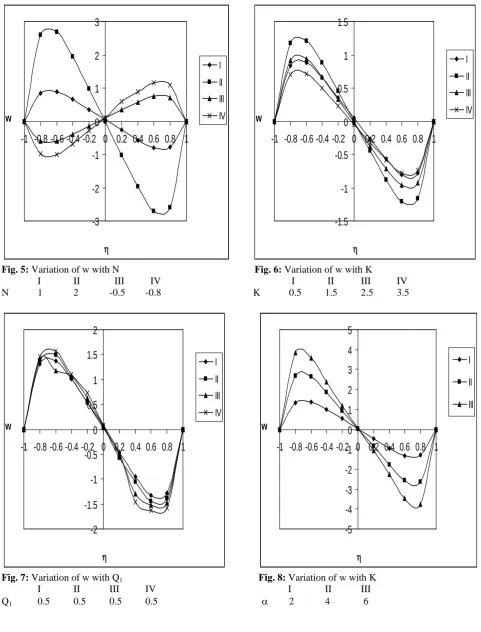
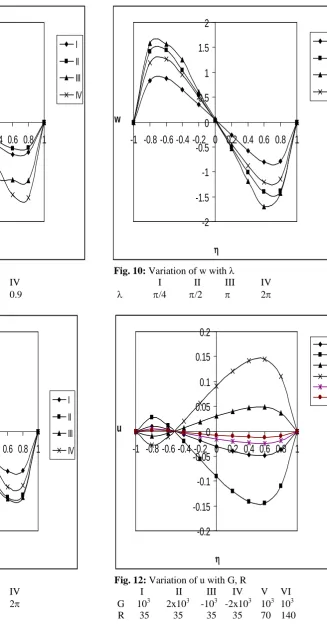
that the higher the dilation of the channel walls lesser |w| in the flow region and for further higher dilation larger |w|. Fig-7 represents w with chemical reaction parameter k. Higher the chemical reaction parameter k larger |w|. An increase in Q1 results in an enhancement in |w| (fig.8). Fig-11 represents the variation of w with inclination λ of the
magnetic field. It is found that |w| depreciates with increase in
2
π
λ
≤
and enhances with higher λ = π and again depreciates with still higher λ = 2π. Fig-12 represents variation of w with phase x+γt of boundary temperature. Anincrease in
2
π
γ
≤
+
t
x
enhances |w| and depreciates with higher x+γt ≥ π.
The average Nusselt number (Nu) is exhibited in tables. 1-6 for different values of G, R, M, D-1,m, Sc, β, α, N, k, Q1
and x+γt. It is found that average Nusselt number enhances with increases in |G|. The variation of Nu with Hartmann number M shows that higher the Lorentz force smaller |Nu| and for further higher Lorentz force (M≥10) larger |Nu| at both the walls. An increase in m<1.5 reduces |Nu| and enhances with higher m≥2.5 at η = ±1. With reference to D-1
we find that the rate of heat transfer increases with increase in D-1 at both the walls. With respect to Schmidt number Sc we find that lesser the molecular diffusivity larger |Nu| at both the walls. The variation of θ with β shows that higher the dilation of the channel walls larger |Nu| for G>0 and for higher |β| ≥ 0.7 larger |Nu| in the heating case and smaller |Nu| in the cooling case at η = 1 and at η = -1, larger |Nu| for all G (tables. 1&4). The variation of θ with α shows that an increase in α reduces |Nu| at η = 1 and enhances at η = -1. When the molecular buoyancy force dominates over the thermal buoyancy force, the rate of heat transfer reduces at η = ±1, when buoyancy forces act in same direction and for the forces acting in opposite directions |Nu| enhances at η = 1 and reduces at η = -1. An increase in the chemical reaction parameter k≤1.5 enhances |Nu| at η = -1 and reduces at η = -1 and for higher k≥2.5 it reduces at η = -1 and enhances at η = +1. An increase in the radiation absorption parameter Q1 enhances |Nu| at η = 1 and at η = -1, |Nu|
enhances with Q1≤1.5 and reduces with Q1≥2.5 (tables. 2&5). From tables 3&6 we find that the rate of heat transfer
reduces at η = 1 and enhances at η = -1 with increase in
2
π
γ
≤
+
t
x
and for higher x+γt ≥ π, |Nu| enhances at η = 1and reduces at η = -1.
The rate of mass transfer (Sherwood number) (Sh) at η = ±1 is shown in tables.7-12, for different variations. It is found that the rate of mass transfer enhances with increase in |G| at η = ±1.With respect to M, we find that the rate of mass transfer at η = 1 reduces with M≤5 and enhances with M≥10 and at η = -1, it enhances with M for all G. An increase in m≤1.5 reduces |Sh| at η = ±1 and enhances with higher m≥2.5. With reference to D-1
we find that the rate of mass transfer increases at both the wall with increase in D-1 .The variation of Sh with Sc shows that lesser the molecular diffusivity larger |Sh| at η = 1 and at η = -1 larger |Sh| and for further lowering of the diffusivity smaller |Sh|. Higher the of dilation of the channel walls larger |Sh| at η = 1. At η = -1, for |β| ≤ 0.5, larger |Sh| for G>0 and smaller |Sh| for G<0 and for still higher |β| ≥ 0.7, larger |Sh| for all G (tables.7&10). The variation of Sh with α shows that |Sh| depreciates with α at η = 1. A η = -1, |Sh| depreciates with α≤4 and enhances with α≥6 in heating case and in cooling case |Sh| depreciates with α.The rate of mass transfer enhances with increase in N>0 and reduces with N<0. The variation of |Sh| with chemical reaction parameter k shows that |Sh| at η = 1 reduces with k≤1.5 and enhances with higher k≥2.5 while at η = -1, |Sh| depreciates for all G (tables. 8&11). From tables 8&12, the rate of mass transfer
depreciates with increase in
2
π
γ
≤
+
t
x
and enhances with higher at x+γt ≥ π at both the walls.CONCLUSION
The impact of chemical reaction on boundary layer flow, heat and mass transfer analysis over wavy channel by taking inclined magnetic field, heat source/sink and heat generation /absorption into the account. The governing partial differential equations with represents the flow, temperature and concentration equations are transformed into the ordinary differential equations using non-dimensional variables. These equations together with boundary conditions are solved using perturbation method. The important findings of the problem are listed below.
It is observed that the primary velocity exhibits reversal flow in the regions y = -1 and y = 1. As the values of M increases the fluid velocity decreases in the region left side of y=0, whereas the primary velocity of the fluid elevates in the right side of y = 0.
It is found that the higher the dilation of the channel walls lesser |w| in the flow region and for further higher dilation larger |w|.
With respect to M, we find that the rate of mass transfer at η = 1 reduces with M≤5 and enhances with M≥10 and at η = -1, it enhances with M for all G.
The variation of Nu with Hartmann number M shows that higher the Lorentz force smaller |Nu| and for further higher Lorentz force (M≥10) larger |Nu| at both the walls.
An increase in
2
π
γ
≤
+
t
x
leads to an enhancement in the actual temperature and for further higher x+γt = πdepreciates in the flow region and for still higher x+γt = 2π we notice an enhancement in the actual temperature in the entire region
Table – 1: Nusselt number (Nu) at η = -1
G I II III IV V VI VII VIII
103 0.84807 8.49226 18.46640 0.49555 0.31766 0.24111 9.414443 34.77412 3x10³ 0.64259 8.46882 12.87020 0.24784 0.04344 -0.04589 9.390341 34.48839 -103 1.05343 8.51569 24.06260 0.74313 0.59173 0.52794 9.43850 35.05983 -3x10³ 1.25868 8.53909 29.65880 0.99056 0.86563 0.81461 9.46255 35.34553
M 2 5 10 2 2 2 2 2
m 0.5 0.5 0.5 1.5 2.5 3.5 0.5 0.5
D-1 102 102 102 102 102 102 2x10² 3x10²
Table – 2: Nusselt number (Nu) at η = -1
G I II III IV V VI VII
103 -9.23091 -12.11372 0.84807 45.48327 0.74990 12.65173 16.55357 3x10³ -6.88343 -9.08440 0.64259 46.84024 -2.46809 -5.57878 -8.68947 -103 -11.57849 -15.14316 1.05343 44.12621 3.96778 6.88212 9.79648 -3x10³ -13.92616 -18.17271 1.25868 42.76904 7.18555 13.11242 19.03929
Sc 0.24 06. 1.3 2.01 1.3 1.3 1.3
Q1 0.5 0.5 0.5 0.5 1.5 2.5 3.5
Table – 3: Nusselt number (Nu) at η = -1
G I II III IV V VI VII VIII
103 0.84807 2.36200 2.69940 4.84361 7.66118 0.59982 -6.01953 3.02482 3x10³ 0.64259 1.56700 2.30140 3.97976 6.52332 0.45450 -4.56108 2.29195 -103 1.05343 2.15700 2.69730 2.70732 2.79882 0.74507 -7.47719 3.757229 -3x10³ 1.25868 1.95200 2.49530 - 3.42912 -4.06378 0.94900 -8.93404 4.48939
K 0.5 1.5 2.5 0.5 0.5 05. 0.5 0.5
α 2 2 2 4 6 2 2 2
x+γt π/4 π/4 π/4 π/4 π/4 π/2 π 2π
Table – 4: Nusselt number (Nu) at η = -1
G I II III IV V VI
103 0.84807 1.61045 3.14310 -0.73323 -5.94848 -4.00712 3x10³ 0.64259 1.41270 2.97655 -0.65632 -5.07739 -2.92070 -103 1.05343 1.80814 3.0963 0.18982 -6.81964 -5.09359 -3x10³ 1.25868 2.00577 3.47613 1.11282 -7.69088 -6.18011
R 35 70 140 35 35 35
N 1 1 1 2 -0.5 -0.8
Table – 5: Nusselt number (Nu) at η = +1
G I II III IV V VI
103 0.84807 1.53567 0.15299 0.12513 -0.41718 1.12052 3x10³ 0.64259 1.38720 -0.14992 -0.10000 -0.33156 0.92891 -103 1.05343 1.68406 0.45572 0.4009 -0.50292 1.81203 -3x10³ 1.25868 1.83237 0.75826 0.70487 -0.68877 2.50344
λ π/4 π/2 π 2π π/4 π/4
The effect of hall currents, radiation absorption and chemical reaction on transient… / IJMA- 7(7), July-2016.
Table – 6: Nusselt number (Nu) at η = -1
G I II III IV V VI VII VIII
103 2.21259 2.04264 2.44740 2.38630 2.47162 2.50776 -2.58156 -18.00035 3x10³ 3.94029 4.85867 16.95600 3.99265 4.01571 4.02485 1.54687 -8.65330
-103 0.48481 5.94396 6.93870 0.77986 0.92743 0.99054 -10.83836 -36.69445 -3x10³ -1.24305 9.84530 10.43010 -1.82668 -2.61688 -0.52679 -10.83836 -36.69445
M 2 5 10 2 2 2 2 2
m 0.5 0.5 0.5 1.5 2.5 3.5 0.5 0.5
D-1 102 102 102 102 102 102 2x10² 3x10²
Table – 7: Nusselt number (Nu) at η = +1
G I II III IV V VI VII
103 9.33545 11.51723 2.21259 -28.13209 2.04689 1.88119 1.71550 3x10³ 9.30579 11.15669 3.94029 -27.12052 5.71409 7.48788 6.26169 -103 9.36505 11.87769 0.48481 -29.14372 -1.62038 -3.72557 -5.83076 -3x10³ 9.39457 12.23807 -1.24305 -30.15543 -5.28774 -9.33242 -13.37711
Sc 0.24 06. 1.3 2.01 1.3 1.3 1.3
Q1 0.5 0.5 0.5 0.5 1.5 2.5 3.5
Table – 8: Nusselt number (Nu) at η = +
G I II III IV V VI VII VIII
103 2.21259 3.38200 4.93080 0.56032 -0.33580 2.20259 2.61259 1.91259 3x10³ 3.94029 4.83300 6.67840 -0.87561 -0.46892 3.34029 4.04029 3.24029 -103 0.48481 0.93000 1.18330 1.19614 -0.20285 0.40481 0.68481 0.42481 -3x10³ -1.24305 -2.47900 -2.43570 1.83186 -0.67006 -1.19310 -1.64305 -1.20305
K 0.5 1.5 2.5 0.5 0.5 05. 0.5 0.5
α 2 2 2 4 6 2 2 2
x+γt π/4 π/4 π/4 π/4 π/4 π/2 π 2π
Table – 9: Nusselt number (Nu) at η = +1
G I II III IV V VI
103 2.21259 1.60420 0.38096 3.68095 6.49449 5.01648 3x10³ 3.94029 3.32768 2.08300 6.61623 6.41093 4.57067 -103 0.48481 -0.11932 -1.32110 0.74564 6.57800 5.46224 -3x10³ -1.24305 -1.84288 -3.02319 -2.18969 6.66145 5.90797
R 35 70 140 35 35 35
N 1 1 1 2 -0.5 -0.8
Table – 10: Nusselt number (Nu) at η = +1
G I II III IV V VI
103 2.21259 1.86088 2.54886 2.56927 5.48769 -9.75756 3x10³ 3.94029 3.81750 4.03475 4.13010 6.35225 -6.68952 -103 0.48481 -0.09579 1.06284 1.22831 4.62305 -12.82568 -3x10³ -1.24305 -1.05252 -2.42331 -1.57276 3.75833 -15.89386
λ π/4 π/2 π 2π π/4 π/4
β 0.5 0.5 0.5 0.5 0.3 0.7
Table – 11: Sherwood number (Sh) at η = -1
G I II III IV V VI VII VIII
103 -0.60283 01.48065 2.27096 -0.60956 -0.70510 -0.72088 0.89160 3.14650 3x10³ 0.91369 4.19855 7.03995 0.71001 0.90117 0.55272 4.53455 12.26601
-103 -2.01728 -3.08903 -4.72418 -1.95171 -2.01691 -1.90149 -3.19892 -5.73169 -3x10³ -3.33961 -6.51917 -7.96411 -3.14641 -3.24416 -2.998964 -6.84567 -14.37800
M 2 5 10 2 2 2 2 2
m 0.5 0.5 0.5 1.5 2.5 3.5 0.5 0.5
Table – 12: Sherwood number (Sh) at η = -1
G I II III IV V VI VII
103 -0.05300 -0.07553 -0.60283 -1.53381 -0.61283 -0.62283 -0.66283 3x10³ 0.71485 1.05916 2.91369 02.02094 0.92369 0.94369 0.96368 -103 -0.80454 -1.20237 -2.01728 -3.02698 -2.02728 -2.21728 -2.61728 -3x10³ -1.54027 -2.32142 -3.33961 -4.46216 -3.36961 -3.43961 -3.63961
Sc 0.24 06. 1.3 2.01 1.3 1.3 1.3
Q1 0.5 0.5 0.5 0.5 1.5 2.5 3.5
-5 -4 -3 -2 -1 0 1 2 3 4 5
-1 -0.8 -0.6 -0.4 -0.2 0 0.2 0.4 0.6 0.8 1
η
w
I II III IV V VI
-3 -2 -1 0 1 2 3
-1 -0.8 -0.6 -0.4 -0.2 0 0.2 0.4 0.6 0.8 1
η
w
I II III IV
Fig. 1: Variation of w with G, R Fig. 2: Variation of w with M
I II III IV V VI I II III IV G 103 2x10³ -103 -2x10³ 103 103 M 2 5 7 9 R 35 35 35 35 70 140
-3 -2 -1 0 1 2 3
-1 -0.8 -0.6 -0.4 -0.2 0 0.2 0.4 0.6 0.8 1
η
w
I II III IV V VI VII
-1.5 -1 -0.5 0 0.5 1 1.5 2
-1 -0.8 -0.6 -0.4 -0.2 0 0.2 0.4 0.6 0.8 1
η
w
I II III IV
The effect of hall currents, radiation absorption and chemical reaction on transient… / IJMA- 7(7), July-2016.
-3 -2 -1 0 1 2 3
-1 -0.8 -0.6 -0.4 -0.2 0 0.2 0.4 0.6 0.8 1
η
w
I II III IV
-1.5 -1 -0.5 0 0.5 1 1.5
-1 -0.8 -0.6 -0.4 -0.2 0 0.2 0.4 0.6 0.8 1
η
w
I II III IV
Fig. 5: Variation of w with N Fig. 6: Variation of w with K
I II III IV I II III IV
N 1 2 -0.5 -0.8 K 0.5 1.5 2.5 3.5
-2 -1.5 -1 -0.5 0 0.5 1 1.5 2
-1 -0.8 -0.6 -0.4 -0.2 0 0.2 0.4 0.6 0.8 1
η
w
I II III IV
-5 -4 -3 -2 -1 0 1 2 3 4 5
-1 -0.8 -0.6 -0.4 -0.2 0 0.2 0.4 0.6 0.8 1
η
w
I
II III
Fig. 7: Variation of w with Q1 Fig. 8: Variation of w with K
-3 -2 -1 0 1 2 3
-1 -0.8 -0.6 -0.4 -0.2 0 0.2 0.4 0.6 0.8 1
η
w
I II III IV
-2 -1.5 -1 -0.5 0 0.5 1 1.5 2
-1 -0.8 -0.6 -0.4 -0.2 0 0.2 0.4 0.6 0.8 1
η
w
I II III IV
Fig. 9: Variation of w with β Fig. 10: Variation of w with λ
I II III IV I II III IV
β 0.3 0.5 0.7 0.9 λ π/4 π/2 π 2π
-2 -1.5 -1 -0.5 0 0.5 1 1.5 2
-1 -0.8 -0.6 -0.4 -0.2 0 0.2 0.4 0.6 0.8 1
η
w
I II III IV
-0.2 -0.15 -0.1 -0.05 0 0.05 0.1 0.15 0.2
-1 -0.8 -0.6 -0.4 -0.2 0 0.2 0.4 0.6 0.8 1
η
u
I II III IV V VI
Fig. 11: Variation of w with x+γt Fig. 12: Variation of u with G, R I II III IV I II III IV V VI x+γt π/4 π/2 π 2π G 103