DESIGN, SYNTHESIS AND BIOLOGICAL EVALUATION OF
STEROIDAL TETRAZOLES AS ANTIPROLIFERATIVE AND
ANTIOXIDANT AGENTS
Shamsuzzaman,
[a] *Mohd Asif,
[a]Abad Ali,
[a]Ashraf Mashrai,
[a]Hena Khanam,
[a]Asif Sherwani
[b]and Mohammad Owais
[b]Keywords: Tetrazoles, steroids, anti-tumour activity, antioxidants, DPPH.
A series of steroidal tetrazole derivatives (7-9) has been obtained by facile and convenient method in a two-step process. All the newly synthesized compounds were characterized by means of elemental analyses, IR, 1H NMR, 13C NMR and MS. The mean surface roughness
value (Ra) of compound 9 was found to be 10.32 measured with AFM. Lipinski’s ‘Rule of Five’ analysis and biological score predicted
higher intrinsic quality and revealed that these compounds possess good passive oral absorption. The antiproliferative activity was tested in vitro against HeLa (cervical cancer), KCL-22 (myeloid leukemia), MDA-MBA-231 (breast cancer) and normal cell lines, blood peripheral mononuclear (PBMC) by MTT assay. The synthesized compounds exhibited moderate to good activity against the three human cancer cell lines and were found to be nontoxic to the normal cell lines. In addition, the synthesized compounds were tested for their in vitro
antioxidant activity by DPPH method in which compound 9 exhibited good antioxidant activity.
*Corresponding Authors Phone: +91-9411003465
E-Mail: [email protected]
[a] Steroid Research Laboratory, Department of Chemistry, Aligarh Muslim University, Aligarh 202 002, India [b] Interdisciplinary Unit of Biotechnology, Aligarh Muslim
University, Aligarh 202 002, India
Introduction
Nitrogen heterocycles form a fundamental core of numerous pharmacophores and occupy a prominent position in medicinal chemistry.1-3 They demonstrate diverse
biological and pharmacological activities due in part to the similarities with many natural and synthetic molecules with known biological activity.4 Furthermore, compounds that
contain heterocyclic moieties illustrate improved solubilities and can facilitate salt formation properties, both of which are known to be important for oral absorption.5 A large
number of drugs contain these scaffolds.6 Tetrazoles are one
of the most stable nitrogen rich heterocyclic compounds among other systems. These heterocyclic systems are studied extensively due to their wide range of biological and commercial applications.7 Tetrazoles have gained wide
attention due to their use in drug design as an isosteric replacement for carboxylic acids.8 Applications of tetrazole
includes its use in pharmaceuticals, explosives and as a precursor for a variety of nitrogen containing heterocyclic compounds.9 In addition they have been successfully used in
the field of material science and synthetic organic chemistry as analytical reagents and synthons.10 Some well known
tetrazoles having various synthetic and pharmacological properties are given in Figure 1.11-14
Steroids due to their diverse properties have gained much focus among the researchers, as they constitute an important class of biologically active molecules that comprises of tetra-cyclic cyclopenta[a]phenanthrene arrangement constituting ABCD ring system and also compounds where extra rings are annulated to the main skeletal framework.15
Figure 1. Some well-known tetrazoles having synthetic and pharmacological properties
The steroids are well known for promoting growth, sexual development and regulating metabolism.16-18 In addition,
steroids are also part of plasma membrane, thus modifying the permeability of membrane in animals.19 In recent time a
lot of attention have been paid on structural modification of steroid compounds through incorporation of heteroatoms probably due to reason that various advantages associated with steroid based drug therapies.20,21 These hetero atoms
may be present in the main ring system or in the additional fused ring. The incorporation of different types of heteroatoms to steroid skeleton enhanced their various biological activities.22 Some of the modified steroid
derivatives have also been reported as active pharmacophores.23 As a part of our extensive research
program to develop facile and convenient route for the synthesis of steroid based compounds containing heteroatoms and screening their biological activities24 and
Experimental
General
Chemicals and solvents used in this study were of ACS grade and used directly without further purification. Melting points were determined on a Biogen digital auto melting point apparatus. The IR spectra were recorded on KBr pellets with Perkin Elmer FT-IR Spectrometer spectrum Two and values are given in cm-1. 1H and 13C NMR spectra
were run in CDCl3 on a Bruker Avance II 400 NMR
Spectrometer (operating at 400 MHz for 1H and at 100 MHz
for 13C NMR) with tetramethylsilane (TMS) as internal
standard and values are given in parts per million (ppm) (δ). Mass spectra were recorded on a JEOL D-300 mass spectrometer. Elemental analyses were recorded on Perkin Elmer 2400 CHN Elemental Analyzer. Topographical images of the synthesized compounds were taken using AFM, with a uniform thin film in acetonitrile on a 10-2.5 cm glass slide. To evaporate excess solvent, the slide was kept in vacuum at room temperature for 24 h. Thin layer chromatography (TLC) plates were coated with silica gel and exposed to iodine vapours to check the homogeneity as well as the progress of reaction. Sodium sulphate (anhydrous) was used as a drying agent.
General procedure for the synthesis of steroidal cyanoacetylhydrazone derivatives (4-6)
To a solution of cholest-6-one 1-3 (1 mmol) in ethanol (20 mL), cyanoacetylhydrazine (1 mmol) was added. The reaction mixture was refluxed for 8-10 h. The progress of reaction was monitored by TLC. After completion of reaction, the excess solvent was removed to three-fourths of the original volume under reduced pressure. The reaction mixture was taken in diethyl ether, washed with water and dried over anhydrous sodium sulfate. Removal of solvents gave the crude product which was recrystallized from methanol to afford respective products (4-6).
General procedure for the synthesis of steroidal tetrazole derivatives (7-9)
To a solution of steroidal cyanoacetylhydrazones 4-6 (1 mmol) in DMF (20 mL), sodium azide (1 mmol) and two equimolar amount of ammonium chloride were added. The reaction mixture was refluxed for 12-15 h. The progress as well as completion of the reaction was monitored by TLC. After completion of the reaction, the excess solvent was removed under reduced pressure. The reaction mixture was then taken in diethyl ether, washed with water and dried over anhydrous sodium sulphate. Evaporation of solvents and recrystallization from methanol afforded the respective products 7-9.
3β-Acetoxy-5α-cholestane-6-ylidene-tetrazol-5yl-acetylhydrazone (7)
Yield (80 %); solid m.p. 162-164 οC; IR (KBr cm-1): 3325
(NH), 1735 (OCOCH3), 1669 (C=O), 1625 (C=N), 1325
(C-N); 1H NMR (400 MHz, CDCl
3): δ 8.6 (brs, 2H, NH,
exchangeable with D2O), 4.7 (m, 1H, C3α-H, W½=15 Hz),
2.7 (dd, 1H, C5α-H, J =12 Hz, 4 Hz), 2.03 (s, 3H,
OCOCH3), 1.18 (s,3H, C10-CH3), 0.70 (s, 3H, C13-CH3),
0.97 & 0.83 (other methyl protons); 13C NMR (100 MHz,
CDCl3): δ 172.3 (NHCO), 171.3 (OCOCH3), 160.3
(N-C=N), 158.1 (C6), 72.5 (C3), 46 (C14), 44 (C13), 42 (C4), 39
(C10), 35 (C5), 26 (C19), 24 (C11), 22 (C18), 20 (C15), 17 (C16);
Anal. Calc. for C32H52N6O3: C, 67.60, H, 9.21, N, 14.78 %
found: C, 67.64, H, 9.17, N, 14.74 %. ESI MS: m/z 568 [M+.].
3β-Chloro-5α-cholestane-6-ylidene-tetrazol-5yl-acetylhydrazone (8)
Yield (73 %); solid m.p. 174-176 οC; IR ( KBr cm-1): 3328
(NH), 1670 (C=O), 1627 (C=N), 1328 (C-N), 741(C-Cl); 1H
NMR (400 MHz, CDCl3):δ 8.4 (brs, 2H, NH, exchangeable
with D2O), 3.8 (m, 1H, C3α-H, W½ = 17 Hz), 2.6 (dd, 1H,
C5α-H, J =12.05 Hz, 4.1 Hz), 1.18 (s, 3H, C10-CH3), 0.70 (s,
3H, C13-CH3), 0.97 & 0.83 (other methyl protons); 13C NMR
(100 MHz, CDCl3): δ 171.2 (NHCO), 161.8 (N-C=N), 157.8
(C6), 57.7 (C3), 45.3 (C14), 43.3 (C13), 42.6 (C4), 39 (C10), 35
(C5), 26 (C19), 24.2 (C11), 22.1 (C18), 20 (C15), 17 (C16); Anal.
Calc. for C30H49N6ClO: C, 66.09; H, 9.06; N, 15.41 % found
C, 66.05, H, 9.10, N, 15.45 %. ESI MS: m/z 544/546 [M+.].
5α-Cholestane-6-ylidene-tetrazol-5yl-acetylhydrazone (9)
Yield (70 %); solid m.p. 141-142 οC; IR (KBr cm-1): 3337
(NH), 1673 (C=O), 1635 (C=N), 1330 (C-N); 1H NMR (400
MHz, CDCl3): δ 8.4 (brs, 2H, NH, exchangeable with D2O),
2.4 (dd, 1H, C5α-H, J =12.01 Hz, 4.2 Hz), 1.18 (s, 3H, C10-
CH3), 0.70 (s, 3H, C13-CH3), 0.97 & 0.83 (other methyl
protons); 13C NMR (100 MHz, CDCl
3): δ 171.8 (NHCO),
161.5 (N-C=N), 157.8 (C6), 42.2 (C14), 42.2 (C4), 39 (C10),
35 (C5), 26 (C19), 24 (C11), 22 (C18), 20 (C15), 17 (C16); Anal.
Calc. for C30H50N6O: C, 70.55; H, 9.87; N, 16.45 % found:
C, 70.51, H, 9.83, N, 16.49 %. ESI MS: m/z 510[M+.].
Physicochemical properties
The physicochemical parameters including octanol partition coefficients (miLogP), Mw, HBD, HBA and TPSA were determined. The bioactivity scores were calculated using molinspiration server (http://www.molinspiration.com/cgi-bin/properties) and ChemAxon (chemicalize.org).
Antiproliferative assay
The anti-tumor potential of steroidal derivatives against three cancer cell lines, viz. HeLa (cervical cancer), KCL-22 (myeloid leukemia) and MDA-MBA-231 (breast cancer) obtained from NCCS Pune, Maharashtra and normal cells was assessed by determining the number of viable cells surviving after their incubation with drug for set time period using MTT (3-(4,5-Dimethylthiazol-2-yl)-2,5-diphenyl tetrazolium bromide) method. The cancer cell lines and normal cells (PBMC) were maintained in RPMI-1640 culture medium supplemented with 10% heat-inactivated fetal calf serum (FCS). The cells were plated at a density of 5 × 10⁴ cells per well in a 96-well plate, and cultured for 24
h at 37 oC. Stock solutions of the synthesized compounds
The cells were later exposed to drugs. The plates were incubated for 48 h, and cell proliferation was measured by adding 20 µL of MTT dye 5 mg mL-1 in phosphate-buffered
saline (PBS) per well. Further the plates were incubated for more 4 h at 37 oC in a humidified chamber containing 5 %
CO2. Formazan crystals formed due to reduction of dye by
mitochondrial dehydrogenase activity of viable cells in each well were dissolved in 150 µL DMSO, and absorbance was read at 570 nm with a microplate reader (Bio-Rad Instruments). The absorption values were expressed as the cell viability (%), according to the control group as 100 %. (IC50) was calculated using the software ‘‘Prism 3.0’’
Blood peripheral mononuclear cell isolation
Fresh blood (20-15 mL) was kindly provided by Blood bank Jawahar Lal Nehru Medical College, AMU Aligarh. The blood sample was diluted with the same volume of PBS. Then, diluted blood was layered on Ficoll-Histopaque. The mixture was centrifuged under at 400g for 30 min at 20-22
oC. The undisturbed lymphocyte layer was transferred out.
The lymphocyte was washed and pelleted down with three volumes of PBS for twice and resuspended RPMI-1640 media with antibiotic and antimycotic solution 10 %, v/v (FCS). Cell counting was performed to determine the PBMC cell number with equal volume of trypan blue.
Antioxidant activity
The synthesized compounds were evaluated for their antioxidant property by 2, 2-diphenyl-1-picryl-hydrazyl (DPPH) method. Stock solution of the drug (1 mg mL-1)
was diluted to final concentration of 2, 4, 6, 8, 10 and 12 mg mL-1 in methanol. After that Methanolic DPPH solution (1
mL, 0.3 mmol) was added to 3.0 mL of drug solution of different concentrations. The tube was kept at an ambient temperature for 30 min and the absorbance was recorded at 517 nm. The radical scavenging activity of the compounds so synthesized was calculated by the following formula where Acontrol is the absorbance of the L-ascorbic acid
(Standard) and Asample is the absorbance of different
compounds. The methanolic DPPH solution (1 mL, 0.3 mM) was used as control.
(1)
Results and Discussion
Chemistry
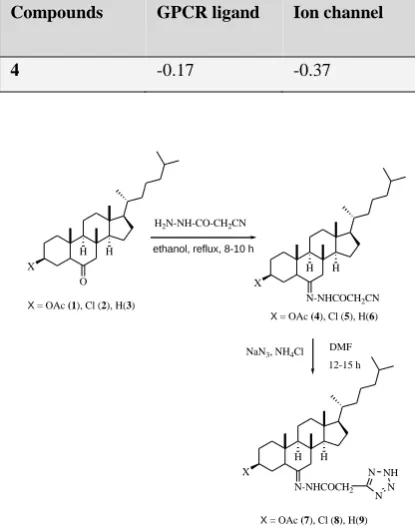
Synthesis of highly potent molecules from simpler ones always gained attention among the chemists. So herein, we report the synthesis of new steroidal tetrazole derivatives ( 7-9) using literature method.25 All target compounds 7-9 as
shown in (Scheme 1) were obtained by two-step process by reaction of compounds 4-6 with sodium azide in presence of ammonium chloride and DMF as solvent under refluxed condition for about 12-15 h, on the completion of the reaction, the products were obtained in good yields
(70-80 %). The structures of the compounds were established by means of their IR, 1H NMR, 13C NMR, MS and
analytical data. The selected diagnostic bands in IR spectra of synthesized products provide useful information for determining structures of the tetrazole derivatives. The absorption bands at 3325-3337 cm-1, 1625-1635 cm-1 and
1325-1330 cm-1 confirmed the presences of NH, C=N and
C-N groups, respectively,while a strong absorption band at 1669-1673 cm-1 attributed to amide group incompounds 7-9.
The 1H NMR spectra of the synthesized compounds, besides
the expected signals of cholestane moiety, exhibited broad singlet at δ 8.6-8.4 (exchangeable with D2O) was ascribed to
NH proton. The singlets at δ 1.18 and 0.70 were assigned to three protons of the methyl group attached to ‘C10’ and three
protons of the methyl group attached to ‘C13’ respectively.In 13C NMR spectra, the signals at δ172.3-171.8, 161.8-160.3
and 158.1-157.8confirmed the presence of NHCO, N-C=N and C=N, respectively. Finally the presence of distinct
molecular ion peak [M+.] at m/z: 568, 544/546 and 510 also
proved the formation of compounds (7-9).
Atomic force microscopy study
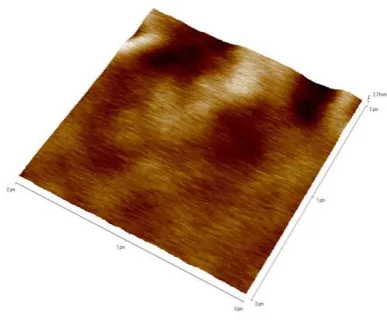
Morphological study of the compounds is generally important to understand their physicochemical role, topology and size distribution, which play crucial role in drug studies. Topographical images of compound 9 were taken using AFM, with a uniform thin film. The sample was scanned using non-contact tapping mode and obtained 3D topological image (Figure 2).
Figure 2. Topographic image of 9 using atomic force microscopy
The vertical and horizotal line analysis of images showed roughness parameters such as minimum and maximum surface value. Mean roughness (Ra) values which was found
to be 10.32 nm. The other roughness parameters like mid-value (average of maximum and minimum), mean, peak to valley of the line (Rpv, difference between minimum and
maximum), root-mean-squared roughness, ten point average roughness area (Rz, is the arithmetic average of the five
highest and five lowest valleys peaks in the line calculated by ten point average), skewness (Rsk) and kurtosis (Rku)
values of line are given in Table 1.
control sample
control
%(inhibition) 100 A A
A
Table 1. AFM topographical mean surface parameters (nm) for compound 9.
Line Min Max Mid Mean Rpv Rq Ra Rz Rsk Rku
Horizontal -20.14 14.10 -3.11 0.00 42.45 10.32 11.45 22.51 0.25 2.21 Vertical -11.12 10.11 -1.10 0.00 22.60 5.90 4.12 22.45 0.69 3.34
Table 2. Calculated physicochemical properties of steroidal derivatives (4-9).
Compounds Mw ClogP HBD HBA TPSA No. of violations
4 511.75 6.207 0 1 91.559 2
5 488.16 6.740 0 1 65.254 1
6 453.715 6.887 0 1 65.250 1
7 554.78 5.971 0 2 122.234 2
8 531.189 6.505 0 2 95.929 2
9 496.744 6.652 0 2 95.929 1
Table 3. Bioactivity score of steroidal derivatives (4-9).
Compounds GPCR ligand Ion channel Modulater
kinase
Protease inhibitor
Nuclear receptor ligand
Enzyme inhibitor
4 -0.17 -0.37 -0.68 -0.10 -0.16 0.20
Scheme 1. Synthesis of steroidal tetrazoles 7-9
In silico study
Rule of Five and bioactivity score
The use of Lipinski’s rule as a filter to choose the reasonable scaffolds for biological activity is well known. The rule states that most molecules with good membrane permeability have logP ≤ 5, molecular weight ≤ 500, number of hydrogen bond acceptors ≤ 10, number of hydrogen bond donors ≤ 5 and polar surface area less than 140 Å2. Synthesized compounds showed two violations of
Lipinski rules due to a calculated ClogP value above the limit
of 5 and the molecular weight above 500 (Tables 2). Based on the above results we can say that the synthesized compounds adhere to Lipinski’s “Rule of Five”.
The exceptions to the Lipinski’s rule are recognized and involve anticancer drugs such as Doxorubicin. The physico-chemical properties of these new scaffolds suggest that the synthesized compounds are reasonable starting points for a drug discovery effort. The bioactivity scores of the synthesized compounds were also calculated for six criteria, GPCR ligand activity, ion channel modulation, kinase inhibition activity, protease inhibitor, enzyme inhibitor and nuclear receptor ligand activity.
For organic molecules if the bioactivity score is more than 0.00 then the compound is active but if it is between -0.50 to 0.00 then the compound is moderately active and if the compound has less than -0.50 then it is inactive compound.26
As we can see in Table 3, the synthesized compounds show good bioactivity score.
Antiproliferative activity
The IC50 values (concentration required to inhibit tumor
cell proliferation by 50%) for the synthesized steroids compounds against three human cancer cell lines including HeLa, KCL-22 and MDA-MBA-231 were determined using the MTT assay,while PBMCs were used as normal cells. A period of 48 h of drug exposure was chosen to test cytotoxicity. The well known anticancer drugs 5-Fluorouracil (5-Fu) and Doxorubicin (Dox) were used as references.
As shown in Table 4, all of the synthesized compounds showed moderate to good antiproliferative activities against the cancer cell lines. From the antiproliferative screening data (Table 4) it was found that compounds 4-6 were less active than compounds 7-9 as they exhibits much higher IC50 values and this could be explained on basis of the fact
that compounds 7-9 contains heterocyclic moiety which
X
H H
O
H2N-NH-CO-CH2CN
ethanol, reflux, 8-10 h
X
H H
N-NHCOCH2CN
NaN3, NH4Cl DMF
12-15 h
X
H H
N-NHCOCH2
NN NH N
X = OAc (1), Cl (2), H(3)
X = OAc (4), Cl (5), H(6)
results in better activity. During the cytotoxic screening of steroidal tetrazoles 7-9, their potential behaviour against given cancer cells was depicted: compound 7 showed IC50 =
18.01 µM (HeLa), 19.14 µM (KCL-22), 17.12 µM (MDA-MBA-231). Compound 8 also showed IC50 value in the
range of 15.15 µM (HeLa), 17.22 µM (KCL-22), 18.14 µM (MDA-MBA-231). While compound 9 demonstrated improved anti-proliferative activities with the IC50 = 11.18
µM (HeLa), 14.24 µM (KCL-22), 21.03 µM (MDA-MBA-231).
The compound 9 was found to be the most active among all synthesized compounds, and showed marked inhibitory effect against Hela. To confirm the result of cytotoxicity the synthesized compounds 4-9 were evaluated against non cancerous cell line PBMC, and none of the synthesized compounds were found to be toxic, all compounds showed IC50 >60 µM. Further modifications and derivatization may
lead to the development of more active antiproliferative agents.
Antioxidant activity
The in vitro antioxidant activity and scavenging effects of
steroidal derivatives 4-9 were evaluated by using different reactive species assay containing DPPH radical scavenging activity. The free radical scavenging activity of the synthesized compounds was evaluated through their ability to quench the DPPH. using ascorbic acid as a reference.
Table 4. Antiproliferative activity of steroidal derivatives (4-9).
Comp-ounds
HeLa KCL22
MDA-MBA-231
PMBC
4 38.27±0.1 39.15±0.2 45.03±0.5 67
5 39.21±2.5 49.11±0.8 47.24±0.2 68
6 36.61±1.8 23.22±0.2 37.34±0.8 69
7 18.01±1.2 19.14±0.6 17.12±0.2 64
8 15.15±0.4 17.22±0.6 18.14±2.5 69
9 11.18±0.7 14.24±0.6 21.03±1.5 64 Dox 4.1±0.1 3.1±0.3 4.12±0.6 - 5-Flu 8.1±0.3 6.5±0.2 9.04±0.4 - Value represent the mean ± standard error mean (SEM) of three experiment.
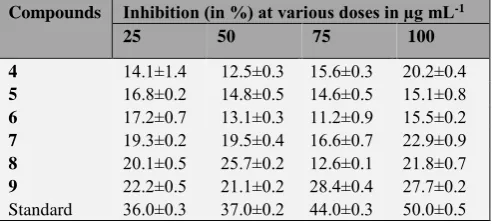
Table 5. The antioxidant activity data of steroidal derivatives ( 4-9)a
Compounds Inhibition (in %) at various doses in µg mL-1
25 50 75 100
4 14.1±1.4 12.5±0.3 15.6±0.3 20.2±0.4 5 16.8±0.2 14.8±0.5 14.6±0.5 15.1±0.8
6 17.2±0.7 13.1±0.3 11.2±0.9 15.5±0.2 7 19.3±0.2 19.5±0.4 16.6±0.7 22.9±0.9
8 20.1±0.5 25.7±0.2 12.6±0.1 21.8±0.7 9 22.2±0.5 21.1±0.2 28.4±0.4 27.7±0.2 Standard 36.0±0.3 37.0±0.2 44.0±0.3 50.0±0.5
aValue represent the mean ± standard error mean (SEM) of three
experiment. Standard: ascorbic acid.
Potencies for the antioxidant activity of the synthesized compounds to the reference drug are shown in Table 5. In general, all the synthesized compounds were less potent than the reference. Among the synthesized compounds, compound 9 exhibited a slightly more antioxidant activity.
Conclusion
In summary, we have developed a facile and expedient approach for the synthesis of new steroidal tetrazole derivatives which involves the reaction of steroidal cyanoacetylhydrazone with sodium azide in DMF as solvent. The reaction completed in 12-15 h and on completion, better yields (70-80 %) were obtained. This approach offered a very straight forward and efficient method for access to steroidal tetrazoles. From in vitro antiproliferative screening, it is clear that compound 9 showed better cytotoxic behaviour among all synthesized compounds with minimum
IC50 value against HeLa cell line. All synthesised
compounds were also screened for their in vitro antioxidant activity and compound 9 was found to be slightly more activite. In conclusion, the present study showed that synthesized compounds can be used as a template for future development through modification and derivatization to design more potent and selective antiproliferative as well as antioxidant agents.
Acknowledgments
The authors thank the Chairman, Department of Chemistry, A.M.U. Aligarh, for providing the necessary research facilities. MA and AA acknowledge UGC, New Delhi India for providing research fellowship.
References
1Polshettiwar, V., Varma, R. S., Curr. Opin. Drug Discover Dev.,
2007, 10, 723-737.
2Padwa, A., Bur, S. K., Tetrahedron, 2007, 63, 5341-5378. 3D’Souza, D. M., Muller, T. J., Chem. Soc. Rev., 2007, 36,
1095-1108.
4DeSimone, R. W., Currie, K. S., Mitchell, S. A., Darrow, J. W.,
Pippin, D. A., Comb. Chem. High Throughput Screening,
2004, 7, 473-494.
5Leeson, P. D., Springthorpe, B., Nat. Rev. Drug Discov.,2007, 6,
881-890.
6McGrath, N. A., Brichacek, M., Njardarson, J. T., J. Chem. Educ.,
2010, 87, 1348-1349.
7Butler, R. N., Katritzky, A. R., Rees, C. W., Scriven, E. F.V.,
Comprehensive Heterocyclic Chemistry, Pergamon Oxford,
1996.
8Herr, R. J., Bioorg. Med. Chem., 2002,10, 3379-3393.
9(a) Ostrovskii, V.A., Pevzner, M .S ., Kofmna, T.P., Shcherbinin,
10Moskvin, L. B., Bulatov, A.V., Griogorjev, G. L., Koldobkij, G.
I., Flow. Inject. Anal. 2003, 20, 53.
11Mohite, P. B., Bhaskar, V. H., Int. J. Pharm Tech. Res., 2011,
3 ,1557-1566.
12Osheroff, N., Zechiedrich, E. L., Gale, K. C., BioEssays, 1991, 13,
269-275.
13 Issell, B. F., Cancer Chemother. Pharmacol., 1982, 7,73-80. 14Beers, S. A., Imakura, Y., Dai, H. J., Li, D. H., Cheng, Y. C.,
Lee, K. H., J. Nat. Prod.,1988, 5,901-905.
15 Turner, C. I., Williamson, R. M., Turner, P.,Sherburn, M. S.,
Chem. Commun.,2003, 610-1611.
16Issemann, I., Green, S., Nature, 1990, 347, 645-650.
17Ahtiainen, J. P., Hulmi, J. J., Kraemer, W. J., Lehti, M., Nyman,
K., Selänne, H., Steroids, 2011, 76, 183-192.
18Evans, R. M., Science, 1988, 240, 889-895. 19Morzycki, J. W., Steroids, 2014, 83,62-79.
20Zhang, B. L., Zhang,E., Pang, L. P., Song, L. X., Li, Y. F., Yu,
B., Liu, H.M., Steroids, 2013, 78, 1200-1208.
21Elmegeed, G. A., Khalil, W. K. B., Mohareb, R. M., Ahmed, H.
H., Abd-Elhalim, M. M., Elsayed, G. H., Bioorg. Med. Chem.,
2011, 19, 6860-6872.
22Singh, H., Jindal, D. P., Yadav, M. R., Kumar, M.,
Heterosteroids and Drug Rresearch, in Progr. Med. Chem.,
Elsevier, Amsterdam , 1991, 28, 233-315.
23Morand, P., Lyall, J., Chem. Rev., 1968, 68, 85-124.
24(a)Shamsuzzaman, Khanam, H., Mashrai, A., Sherwani, A.,
Owais, M., Siddiqui, N., Steroids, 2013, 78, 1263-1272; (b) Shamsuzzaman, Ali, A., Asif, M., Mashrai, A., Khanam, H.,
Eur. Chem. Bull.,2014, 3,939-945.
25Faria, J. V., Santos, M. S. D., Bernardino, A. M. R., Becker, K.
M., Machado, G. M. C., Rodrigues, R. F., Canto-Cavalheiro, M. M., Leon, L. L., Bioorg. Med. Chem. lett., 2013, 23, 6310-6312.
26Uetrecht, J., Curr. Opin. Drug Discover Dev., 2001, 4, 55-59.