ARTIGO ORIGINAL
RESUMO
Introdução: A Associação Internacional para o Estudo da Dor defende um curriculum mandatório sobre dor crónica nos cursos de Medicina. Foi objectivo deste estudo conhecer a opinião dos estudantes finalistas de Medicina e dos internos do ano comum sobre o ensino da dor crónica nas oito escolas médicas Portuguesas.
Material e Métodos: Estudo quantitativo. Questionário electrónico (30 questões), com respostas voluntárias e anónimas; disponível no primeiro trimestre 2016.
Resultados: Houve 251 respostas provenientes de 142 finalistas e 109 internos (mulheres 72,9%; idade 25,3 ± 1,6 anos). A dor é um sinal vital (92,4%); mas 18,7% apenas a avaliava caso o doente se queixasse. As escalas de auto-avaliação da dor eram conhecidas (87,2%) e as de hétero-avaliação não (70,9%). A dor não era avaliada porque o doente não manifestava dor; falta de tempo; consultas de duração curta. A formação foi insuficiente sobre opioides (78,1%), fisiopatologia e tratamento da dor (66,1%) e como entrevistar o doente com dor (67,7%); durou 1 a 10 horas (49,8%). A depressão respiratória por opioides é preocupante (56,2%). O risco de usar opioides é superior ao benefício clínico (33,5%).
Discussão: O ensino da dor crónica é disperso, pouco estruturado e opcional. Para 98,4% da amostra é relevante haver mais edu-cação sobre dor crónica. Esta deve ocorrer no quinto ano do curso médico, com mais de 15 horas. São aconselhados estágios em consultas de dor crónica.
Conclusão: São necessárias mudanças nos curricula pré-graduados para que os futuros médicos desenvolvam competências e combatam o sofrimento ‘evitável’ dos seus doentes.
Palavras-chave: Analgésicos Opioides; Dor Crónica; Ensino Médico; Estudantes de Medicina; Internato e Residência
Chronic Pain Education in Portugal: Perspectives from
Medical Students and Interns
O Ensino da Dor Crónica em Portugal: As Perspectivas
dos Estudantes de Medicina e dos Internos do Ano
Comum
1. Internship in General Surgery. Unidade Local de Saúde do Nordeste. Bragança. Portugal. 2. Unidade de Cuidados Paliativos. Casa de Saúde da Idanha. Sintra. Portugal. 3. Unidade de Cuidados Paliativos. Domus Fraternitas. Montariol. Braga. Portugal. 4. Faculdade de Medicina. Universidade de Lisboa. Lisboa. Portugal.
Autor correspondente: Paulo Reis-Pina. [email protected]
Recebido: 09 de maio de 2018 - Aceite: 26 de novembro de 2018 | Copyright © Ordem dos Médicos 2019 Irina CRISTÓVÃO1, Paulo REIS-PINA2,3,4
Acta Med Port 2019 May;32(5):338-347 ▪ https://doi.org/10.20344/amp.10773 ABSTRACT
Introduction: The International Association for the Study of Pain advocates a mandatory curriculum on chronic pain in medical schools. The objective of this study was to assess the opinions of final year medical students and interns about chronic pain education in eight Portuguese medical schools.
Material and Methods: Cross-sectional study. Online questionnaire (30 questions; voluntary and anonymous responses) available in the first quarter of 2016.
Results: A total of 251 responses were received from 142 finalists and 109 interns (women 72.9%; 25.3 ± 1.6 years). Pain is a vital sign (92.4%), but 18.7% only assessed pain if the patient complained of it. Pain self-assessment scales were known (87.2%), but the hetero-evaluation was not (70.9%). Pain was not assessed regularly because patients may not express pain; lack of time; short dura-tion of consultadura-tions. Educadura-tion was insufficient on opioids (78.1%), pathophysiology and treatment of pain (66.1%) and interviewing patients with pain (67.7%); it lasted 1 to 10 hours (median). Respiratory depression was the most worrying effect of opioids (56.2%). The risks of opioids outweigh the clinical benefit (33.5%).
Discussion: Education on chronic pain is scattered, unstructured and optional. More education is required in medical schools (98.4%). It should occur in year 5 and last more than 15 hours. Clinical stages are advised in chronic pain clinics.
Conclusion: There is a need for improvement in the medical undergraduate curricula so that young doctors develop competencies to adequately control pain and fight the avoidable suffering of their patients.
Keywords: Analgesics, Opioid; Chronic Pain; Education, Medical; Internship and Residency; Students, Medical
INTRODUCTION
Chronic pain (CP), in addition to suffering and reduced quality of life, causes pathophysiological changes in im-mune, endocrine and nervous systems. These changes contribute to the emergence of organic and psychological comorbidities and can lead to the perpetuation of pain.1 CP, persisting beyond the healing of the lesion that originated it, should be seen not as a symptom, but as a disease, as recognized by the EFIC (European Federation of the
Inter-national Association for the Study of Pain - IASP) in 2001.2 In Portugal, the prevalence of CP in the adult population is 36.7%, with an average duration of 10 years, recurrent or continuous in 85% of cases, with moderate to severe inten-sity in 68% of people.3
ARTIGO ORIGINAL reducing their morbidity and more humanization of health
care.1 There should be training strategies aimed at health professionals and the awareness of medical schools (MS) about the need to improve pre- and post-graduate curricula in the areas of pain.1 The undergraduate curricular offer in health-related courses is deficient in disciplines dedicated to pain. In addition, in Portugal, continuing medical training in pain is not compulsory and lifelong learning is based on casual opportunities or personal tastes.4
The main objective of this study is to know the opinions about the teaching of CP of the final year medical students (FMS) and the interns (newly qualified graduates carrying out the first year of postgraduate medical training) (IFYR) in Portugal.
MATERIAL AND METHODS Type of study
Quantitative.
Participants
Convenience sampling composed by FMS and IFYR. Inclusion criteria: FMS must be enrolled in any of the eight Portuguese MS in the academic year 2015/2016; IFYR must be working in Portugal, in 2016. Exclusion criteria: IFYR who are graduates of any foreign MS.
Data sampling
An online questionnaire was created from the Google Docs® software. The answers were voluntary, anonymous, unpaid and confidential. Each participant could only fill out a questionnaire. The data were only available to research-ers. The questionnaire consisted of two parts. The first one, with five questions, aimed to characterize the sample. The second part, with 25 questions about CP, namely, general knowledge, classification, characterization, therapy and training. Each response was attributed a numeric code ac-cording to the order of entry in the study (R1, R2, R3, etc.). The collected data was uploaded to an Excel© file (with a password) on a computer whose access also depended on another password; both passwords were known only by re-searchers.
Modus operandi
The Secretariats and the Student Associations of the eight MS were contacted requesting the submission of questionnaires to the mailing list of all FMS. In the case of IFYR, the questionnaires were shared in Facebook groups as “IACS 2016” and “Harrison 2016”, as well as in the Face-book groups of each MS. The questionnaires were avail-able online during the first quarter of 2016. Moreover, the authors searched throughout the websites of the eight MS to find out theirs undergraduate curricula, particularly disci-plines related to CP education.
Ethical considerations
The study was approved by the Ethics Committee of the Faculty of Health Sciences of the University of Beira
Interior, Portugal.
Data processing
Excel spreadsheet (Microsoft Office 2016®).
Data analyses
Data were analyzed using IBM® SPSS Statistics 20. Me-dians are expressed with the interquartile range. Categori-cal variables were compared using Chi-square or Fisher’s exact tests, as adequate. Statistical significance was set at p < 0.05.
RESULTS
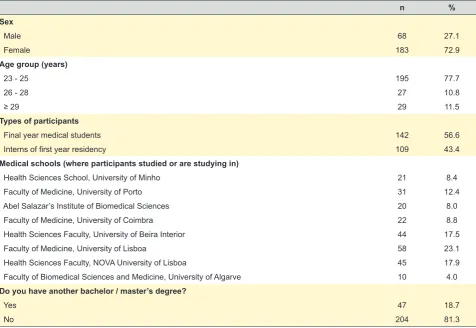
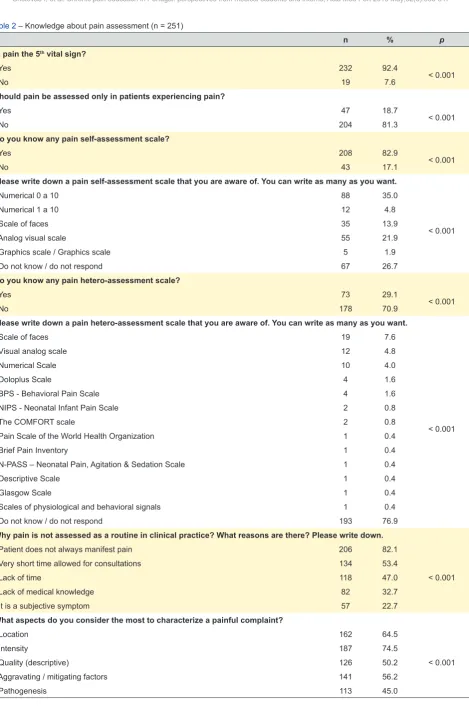
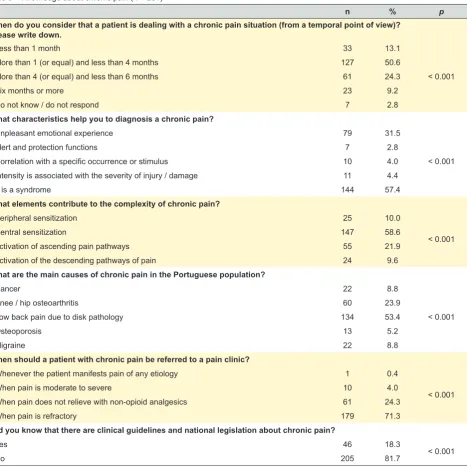
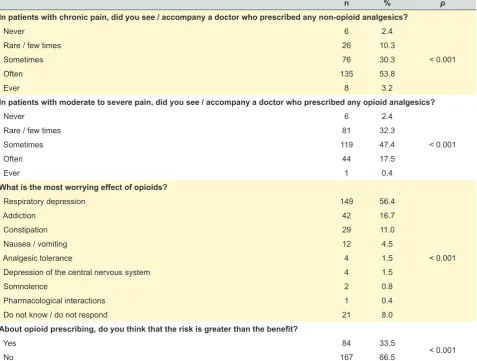
The sample consisted of 251 individuals, mainly FMS (56.6%), women (72.9%), median age of 24 years (inter-quartile range 23 – 25; minimum and maximum ages of 23 and 45) (Table 1). Knowledge about pain assessment and CP are presented in Table 2 and Table 3, respectively. The recognized aspects of analgesics prescribed for CP appear in Table 4. The questions about CP education are presented in Table 5.
Figure 1 describes the frequency of prescription of opi-oids according to the existence of cancer. The most pre-scribed opioids – in the consultations or hospitalizations, where the participants were allocated (FMS) or worked (IFYR) – were: tramadol (n = 218), morphine (n = 10), fen-tanyl (n = 8), codeine (n = 6), buprenorphine (n = 3), ta-pentadol (n = 2), pethidine (n = 2), oxycodone (n = 1) and hydromorphone (n = 1).
DISCUSSION
Knowledge about pain
ARTIGO ORIGINAL
plan a CP treatment. Thus, all MEDS should use pain as-sessment scales and make therapeutic decisions based on their scores. An intervention should be initiated when pain is greater than three (of ten), and all pain above seven should be considered an emergency.8,9
Pain is not evaluated in consultations and hospitaliza-tions because patients do not seem to have pain or do not complain about it. More than a third of the sample attributed the absence of pain assessment to “lack of medical knowl-edge”. Although a multidimensional assessment is recom-mended, it is necessary to have enough time;10 almost half of the respondents mentioned that as a cause of non-evalu-ation. Without an appropriate assessment of pain, a profes-sional duty, the right of the patient to adequate pain control is compromised.
More than 50% of respondents correctly enumerated important aspects to characterize pain and only 45% in-dicated the pathogenesis of pain. The PMCC emphasizes that all MEDS should be prepared to collect information about the quality of pain, its location and intensity, as well as aggravating or mitigating factors of pain.8,9
Knowledge about chronic pain
The National Plan for the Fight against Pain defined CP as being prolonged and difficult to identify, etiological and temporally, producing suffering and being able to manifest in many ways, generating various pathological stages.11 Half of the sample considered that the duration of CP ranged
from 30 days to 4 months; more than a third said CP lasted more than 4 months. The International Classification of Dis-eases (ICD-11) states that CP persists more than 3 months, in one or more anatomical regions, and is not explained by another clinical condition.12 CP, while persisting beyond the healing of the lesion or the impossibility of detecting an in-jury, should be understood as a disease.1,13
Most people recognized CP as a syndrome, but only a third of the respondents recognized the unpleasant emo-tional experience. There was some confusion between CP (disease) and ‘acute pain’ (symptom): 11.2% of the sample associated CP with the alertness and the protective func-tion that are attributes of the ‘acute’ phenomenon. For the majority, central sensitization is the main contribution to the complexity of CP, and less important is the activation of the descending pathways of pain. The PMCC recommends that all MEDS should understand the physiology of pain and peripheral/central sensitization leading to the complexity of CP.8,9
Most reported low back pain and knee/hip arthrosis as the main etiologies of CP. These were also identified in a recent Portuguese study, along with other osteoarticular and musculoskeletal disorders, as well as headaches and neuropathic pain.3 Most of the sample stated that patients with pain refractory to analgesics should be referred to Pain clinics. In fact, all cases of undiagnosed, unresponsive or highly disabling pain should be referred.11 However, almost a quarter of respondents defended the referral when “pain Table 1 – Characteristics of participants (n = 251)
n %
Sex
Male 68 27.1
Female 183 72.9
Age group (years)
23 - 25 195 77.7
26 - 28 27 10.8
≥ 29 29 11.5
Types of participants
Final year medical students 142 56.6
Interns of first year residency 109 43.4
Medical schools (where participants studied or are studying in)
Health Sciences School, University of Minho 21 8.4
Faculty of Medicine, University of Porto 31 12.4
Abel Salazar’s Institute of Biomedical Sciences 20 8.0
Faculty of Medicine, University of Coimbra 22 8.8
Health Sciences Faculty, University of Beira Interior 44 17.5
Faculty of Medicine, University of Lisboa 58 23.1
Health Sciences Faculty, NOVA University of Lisboa 45 17.9
Faculty of Biomedical Sciences and Medicine, University of Algarve 10 4.0 Do you have another bachelor / master’s degree?
Yes 47 18.7
ARTIGO ORIGINAL Table 2 – Knowledge about pain assessment (n = 251)
n % p
Is pain the 5th vital sign?
Yes 232 92.4
< 0.001
No 19 7.6
Should pain be assessed only in patients experiencing pain?
Yes 47 18.7
< 0.001
No 204 81.3
Do you know any pain self-assessment scale?
Yes 208 82.9
< 0.001
No 43 17.1
Please write down a pain self-assessment scale that you are aware of. You can write as many as you want.
Numerical 0 a 10 88 35.0
< 0.001
Numerical 1 a 10 12 4.8
Scale of faces 35 13.9
Analog visual scale 55 21.9
Graphics scale / Graphics scale 5 1.9
Do not know / do not respond 67 26.7
Do you know any pain hetero-assessment scale?
Yes 73 29.1
< 0.001
No 178 70.9
Please write down a pain hetero-assessment scale that you are aware of. You can write as many as you want.
Scale of faces 19 7.6
< 0.001
Visual analog scale 12 4.8
Numerical Scale 10 4.0
Doloplus Scale 4 1.6
BPS - Behavioral Pain Scale 4 1.6
NIPS - Neonatal Infant Pain Scale 2 0.8
The COMFORT scale 2 0.8
Pain Scale of the World Health Organization 1 0.4
Brief Pain Inventory 1 0.4
N-PASS – Neonatal Pain, Agitation & Sedation Scale 1 0.4
Descriptive Scale 1 0.4
Glasgow Scale 1 0.4
Scales of physiological and behavioral signals 1 0.4
Do not know / do not respond 193 76.9
Why pain is not assessed as a routine in clinical practice? What reasons are there? Please write down.
Patient does not always manifest pain 206 82.1
< 0.001
Very short time allowed for consultations 134 53.4
Lack of time 118 47.0
Lack of medical knowledge 82 32.7
It is a subjective symptom 57 22.7
What aspects do you consider the most to characterize a painful complaint?
Location 162 64.5
< 0.001
Intensity 187 74.5
Quality (descriptive) 126 50.2
Aggravating / mitigating factors 141 56.2
ARTIGO ORIGINAL does not alleviate with non-opioid analgesics”. Most of the respondents were not aware of the clinical guidelines and national legislation on CP. This seems to express the re-duced education on CP that FMS and IFYR have had, so far.
Knowledge about analgesics prescribed for chronic pain
Most of the sample found that non-opioid analgesics were “often” prescribed for CP. In moderate to severe pain opioid use was reported by 17.5%. However, more than a third has “never” or rarely verified opioid use. It happened “sometimes”/”always” in cancer patients. In non-cancer sit-uations opioids were never prescribed according to 12.7% of the respondents (versus 3.6% in cancer). Opioids remain the most effective and commonly used analgesics in mod-erate to severe pain, especially in cancer.14 However, the
use of opioids in non-cancer CP is also recommended as they can help in patients’ functional recovery, physically and mentally, and consequently, there is quality of life im-provement.15 Moderate to severe pain is not yet adequately treated, with opioids being prescribed rarely or infrequently, as noticed by a third of the sample.
Cancer CP is also inadequately treated due to the lack of knowledge in prescribing opioids and clinicians’ inappro-priate attitudes towards these analgesics.14,16 In addition, there is reluctance of patients to report on their pain or to use self-assessment scales.17,18 On the other hand, both cli-nicians and patients fear addiction and respiratory depres-sion, which may lead to subclinical use of opioids even in cancer CP.14
Tramadol was the most prescribed opioid according to the respondents. This is because tramadol is a weak opioid,
Table 3 – Knowledge about chronic pain (n = 251)
n % p
When do you consider that a patient is dealing with a chronic pain situation (from a temporal point of view)? Please write down.
Less than 1 month 33 13.1
< 0.001 More than 1 (or equal) and less than 4 months 127 50.6
More than 4 (or equal) and less than 6 months 61 24.3
Six months or more 23 9.2
Do not know / do not respond 7 2.8
What characteristics help you to diagnosis a chronic pain?
Unpleasant emotional experience 79 31.5
< 0.001
Alert and protection functions 7 2.8
Correlation with a specific occurrence or stimulus 10 4.0 Intensity is associated with the severity of injury / damage 11 4.4
It is a syndrome 144 57.4
What elements contribute to the complexity of chronic pain?
Peripheral sensitization 25 10.0
< 0.001
Central sensitization 147 58.6
Activation of ascending pain pathways 55 21.9
Activation of the descending pathways of pain 24 9.6 What are the main causes of chronic pain in the Portuguese population?
Cancer 22 8.8
< 0.001
Knee / hip osteoarthritis 60 23.9
Low back pain due to disk pathology 134 53.4
Osteoporosis 13 5.2
Migraine 22 8.8
When should a patient with chronic pain be referred to a pain clinic?
Whenever the patient manifests pain of any etiology 1 0.4
< 0.001
When pain is moderate to severe 10 4.0
When pain does not relieve with non-opioid analgesics 61 24.3
When pain is refractory 179 71.3
Did you know that there are clinical guidelines and national legislation about chronic pain?
Yes 46 18.3
< 0.001
ARTIGO ORIGINAL whose mechanism of action brings together μ agonism and
the inhibition of serotonin and adrenaline reuptake. It can be useful in nociceptive, neuropathic and fibromyalgia pain.19 More than half of the sample thought that respiratory depression was the most worrying effect of opioids, fol-lowed by addiction, constipation and nausea/vomiting. Clinical practice says that usual opioid side effects are: constipation, nausea/vomiting, drowsiness and pruritus.20 Some rarer effects include respiratory depression, changes in body weight and hormonal effects (such as decreased adrenal gland activity, reduced sexual function and infertil-ity).15 Respiratory depression is extremely rare, and when it occurs, it is associated with dosage errors that can be prevented through well-performed clinical titration.8,9,20 More than a third of the participants believe that risks of opioid use outweigh its clinical benefit. Opioids are the analgesics of choice for the treatment of moderate to severe nocicep-tive CP. They are effecnocicep-tive, with dose manageable risks and are easy to titrate. Two of the effects associated with chronic opioid use are physical dependence and tolerance, which are often confounded by clinicians and patients with psychological dependence or addiction.14,15
Considering the PMCC guidelines, MEDS should know about opioids’ pharmacodynamics and pharmacokinetics,
as well as the advantages and disadvantages of their pre-scription.8,9 Training is required on the clinical use of opi-oids both in under and postgraduate education. This should move beyond prescription by also including multimodal pain management.8,9,21 Appropriate education will allow clinicians to make prudent choices about initiating, continuing, modi-fying or discontinuing opioid therapy, considering patients’ various contexts.21,22
Education on chronic pain
Respondents, almost unanimously, stated that educa-tion on CP, particularly on pain physiopathology and pain management was of utmost importance in MS. Educa-tion was considered insufficient by respondents mainly on pathophysiology of CP, interview training with patients with CP, and prescription of opioids. Half of the sample had edu-cation on CP topics that lasted 1 to 10 hours.
In an European comparative study (15 countries, 242 MS), it was found that in France “pain medicine” was taught in undergraduate curricula in almost every MS (31 MS, 84% compulsory and 3% optional).23 The “second best” was Switzerland (5 MS, 40% mandatory and 40% optional).23 In Southern Europe, the framework was worse, like Spain (36 MS, 14% mandatory and 8% optional) and Portugal (7 MS,
Table 4 – Knowledge about analgesics prescribed to chronic pain (n = 251)
n % p
In patients with chronic pain, did you see / accompany a doctor who prescribed any non-opioid analgesics?
Never 6 2.4
< 0.001
Rare / few times 26 10.3
Sometimes 76 30.3
Often 135 53.8
Ever 8 3.2
In patients with moderate to severe pain, did you see / accompany a doctor who prescribed any opioid analgesics?
Never 6 2.4
< 0.001
Rare / few times 81 32.3
Sometimes 119 47.4
Often 44 17.5
Ever 1 0.4
What is the most worrying effect of opioids?
Respiratory depression 149 56.4
< 0.001
Addiction 42 16.7
Constipation 29 11.0
Nausea / vomiting 12 4.5
Analgesic tolerance 4 1.5
Depression of the central nervous system 4 1.5
Somnolence 2 0.8
Pharmacological interactions 1 0.4
Do not know / do not respond 21 8.0
About opioid prescribing, do you think that the risk is greater than the benefit?
Yes 84 33.5
< 0.001
ARTIGO ORIGINAL
14% optional).23
Pain curriculum in MS lasted 13 hours on average, in the United Kingdom,24 and about 16 hours, in Canada.25 In-terestingly, pain education in Canadian veterinary schools lasted for 87 hours on average.25
In the United States of America, an extensive study (104 MS) revealed that classes on pain education lasted 9 hours (mean), with a median of 7 hours.26 Only 4 MS have integrated pain courses with clinical cases and 17 MS have elective pain education.26 There are some exceptions, such as the University of Washington’s MS, where a 4-year
integrated pain curriculum exists, with 25 hours (theory) and 318 hours (clinical elective courses).27 Training based on multidisciplinary clinical cases improves knowledge and skills in bio-psycho-social assessment, pain narrative and risk assessment. In addition, it improves the understanding of CP as a complex disease and develops an interprofes-sional treatment policy centered in patients with pain. Con-sequently, future clinicians will be more prepared for clinical practice.27
Physicians have a central role in pain management.28 There are unquestionable links between undertreatment
Figure 1 – Frequency of prescription of opioids according to the cancer status (n = 251) Never
32 33 120 61 5
9 33 138 58 13
Non-cancer patients Cancer patients
Rarely Sometimes Often Always
p < 0.001
p < 0.001
0 20 40 60 80 100 120 140
Table 5 – Education on chronic pain in medical schools (n = 251)
n % p
Did you have enough training as to conduct an interview with patients with pain?
Yes 81 32.3
< 0.001
No 170 67.7
Did you have enough education on the pathophysiology of chronic pain?
Yes 85 33.9
< 0.001
No 166 66.1
How many hours did last the education you had on “pathophysiology and treatment of chronic pain”?
1 a 10 125 49.8
< 0.001
11 a 20 13 5.2
> 20 3 1.2
Do not know / do not respond 110 43.8
Education on opioids and pain management. Was it enough?
No 196 78.1
< 0.001
Yes 55 21.9
Would it be important to have more education on pain pathophysiology and chronic pain management?
No 4 1.6
< 0.001
ARTIGO ORIGINAL of pain and the precarious pain education status in MS.26
One barrier that prevents optimal CP treatment is the lack of education on adverse effects, communication, addition and tolerance.10,14,29-31 Adequate CP treatment requires a consistent knowledge on pharmacology, psychology, phys-iotherapy and physiology of pain.21,22,28
Education on chronic pain in medical schools in Por-tugal
In Portugal, the teaching of CP occurs in a dispersed way in some MS. In others, pain medicine is taught in op-tional curricular units (CUN). When the eight Portuguese MS websites were consulted, for the preparation of this study, it was noticed that acute pain (symptom) was privi-leged in undergraduate curricula, namely in disciplines re-lated to anesthesiology and surgery (e.g. general and or-thopedics). When the focus was CP the difficulty arose as curricular plans were thoroughly looked at.
In the MS websites of the Universities of Porto, Lisbon and Algarve, CUN contents were not specified, therefore it was not possible to understand where CP was taught nor its assigned workload.
In the MS website of the University of Minho, in Year 3, there was CUN Pathophysiology of the Organic Systems - Nervous System, where pain pathophysiology was consid-ered. In years 4 and 5 there were CUN Medical Residency I and II, respectively, whose contents included “continued care in chronic illness, improvement of suffering, pain re-lief and palliative care”. It is assumed that CP topics were addressed in those CUN, but assigned workload was not available.
In the MS website of the Abel Salazar Institute of Bio-medical Sciences, it was found that, in year 5, there were two optional CUN on Palliative Care and Oncology, with 37 hours each, where it is assumed that CP topics were ap-proached.
In the MS website of the University of Coimbra, it was noticed that, in year 4, there were two optional CUN: Pallia-tive Care and Pain Therapy and Physical Medicine and Re-habilitation where CP teaching could occur, but no contents nor workload were disclosed. In year 2, in CUN Introduction to Medical Practice III there was teaching about end-of-life care. In year 3, in CUN Pharmacology I there was teaching about pain neurotransmission, neuromodulation, and phar-macology; and in CUN Ethics, Deontology and Professional Exercise pain and palliative care were considered. In year 5, in CUN Musculoskeletal Pathology generalized pain syn-dromes were explained. Unfortunately, there was no men-tion of the number of hours allocated to CP.
In the MS website of the University of Beira Interior, in year 1, in CUN Art of Medicine there were contents about pain, suffering and palliative care. In year 3, in CUN Intro-duction to Pathology, analgesics were mentioned in the Pharmacology block; in CUN Geriatrics there were contents associated with CP. In year 4, there was a course on Medi-cal Oncology, where possibly cancer CP and its treatment were approached. Again, it was not possible to know the
assigned workload.
In the MS website of NOVA Medical School, education on CP was not mentioned. However, in years 4 and 5, in CUN The Elderly Patient and The Patient with Cancer, re-spectively, it is presumed that education on CP occurred; again, the allocated hourly load was not disclosure.
Pain education: some considerations
The IASP recommends that MS should have an under-graduate pain curriculum in year 5, lasting more than 15 hours.32 It is also important to attend clinical stages in the field of CP, namely in pain clinics.
Pain education is fragmented and limited by multiple disciplines, making the integration of knowledge more dif-ficult and complex.4,28,33,34 Some barriers hamper the imple-mentation of CP teaching in MS, such as: the shortage of human resources, in particular pain specialists; the percep-tion that pain medicine is not essential to medical educa-tion; the resistance to an increasing workload, allocated to pain education, in an already overcrowded schedule.10,14 The Institute of Medicine reports that the key-problems of MS are the lack of: diversity in the presentation of the top-ic ‘pain’; integration between the bastop-ic sciences and clintop-ical knowledge; clinical examples/models, particularly of spe-cialists in CP.35 In most academic medical centers, teachers self-report their competence in CP as inadequate.35 Pain education requires not only the teaching of ana-tomic-physiological processes and pain modulation, but also the transposition to clinical practice (diagnoses of CP and treatment strategies). This will allow better clinical inter-vention in all its bio-psycho-social complexity.4
The American Academy of Pain Medicine defends that MS curricula should foster competence and compassion.36 Empathy and communication skills centered on the person with CP should also be integrated into undergraduate cur-ricula.33,36-38 Empathy is one of the qualities that improves physician effectiveness in the management of people with chronic diseases.36
In clinical settings it is known that MEDS learn to man-age pain by imitating their tutors, adopting the beliefs and behaviors of their future peers. Clinical education with phy-sicians of various specialties involved in the treatment of acute and CP can provide an optimal context for learning as well as for changing attitudes. Thus, MEDS should have tutors who are true examples of good practice in CP.31,39,40 As a recommendation for a new curriculum, MS should focus on integrated CP courses, which contain both cogni-tive and affeccogni-tive dimensions of CP,37 with greater student-teacher involvement. It is also important to use the online platforms with didactic content and clinical case
stud-ies.27,36,37,39 This is more appealing and interactive for MEDS,
ARTIGO ORIGINAL related to medical education in order to implement in the undergraduate curricula some disciplines associated with the diagnosis and treatment of CP. The authors believe that the implementation of these measures will attract more professionals to Pain Medicine, currently a certified compe-tence/expertise by the Portuguese Medical Council.
Limitations of the study
This study has several limitations.
A convenience sampling was used. The size and quality of the sample does not allow generalization of the results. The method used presents some weaknesses, namely a great heterogeneity in the number of respondents by MS. The number of responders is particularly low in some MS with the highest number of FMS and IFYR, as the MS of the Universities of Porto and Coimbra, which limits the conclu-sions.
There were a small number of questionnaires answered, despite the efforts made. It was not possible to send the questionnaires directly to the IFYR, since there was no mailing list available. Some MS have put some obstacles in sending the questionnaires out to the FMS; namely, they requested that the Director and the Ethics Committee of each MS should be formally contacted and asked for a term of authorization. When the number of FMS enrolled in each of the eight MS was requested electronically, only two MS replied. It should also be noted that no MS confirmed, as it was requested by the authors with some anticipation, whether they had sent the questionnaires to the FMS mail-ing list or not.
The collected data were uploaded to an Excel© sheet, which allowed the authors to understand the frequencies of the answers, but limited the statistical analysis of the data, namely the associations between some of the variables.
CONCLUSION
In this survey it was found that, although most of the 251 respondents considered pain as the 5th vital sign, almost 1 in 5 people thought that pain should only be evaluated if the patient complained of it. Most of the sample could properly name some pain self-assessment scales, but few were able to name hetero-evaluation scales. Most said that pain was not assessed in consultations/hospitalizations because pa-tients did not manifest their pain and more than a third indi-cated “lack of medical knowledge” as a reason. In moderate
to severe pain, the use of opioids was reported by one sixth of the sample. More than a third of the respondents believed that the risks of opioid use outweigh its clinical benefit. Half of the participants were fearful of respiratory depression. This study highlights the need for MS to provide more education about CP in the undergraduate curriculum. In fact, MS need a greater investment in the field of CP that will allow MEDS to pour the indispensable theoretical knowledge into a transforming reality. The vision of future physicians, therefore, will modify; they will feel empowered and will contribute to fight the avoidable suffering of their putative patients. Consequently, MEDS and young doctors will strive to respectfully dignify the Montreal Declaration, facilitating the access of vulnerable people to pain control, as a fundamental human right.41
The IASP chose 2018 as the Global Year for Excellence in Pain Education with interventions in 4 domains: public and governmental education, patient education, education of professionals and research on pain education.42 This is a Portuguese contribution.
ACKNOWLEDGMENTS
The authors are grateful for the support throughout the study of Professor Miguel Castelo Branco of the Faculty of Health Sciences of the University of Beira Interior, Portugal.
PROTECTION OF HUMANS AND ANIMALS
The authors declare that the procedures were followed according to the regulations established by the Clinical Re-search and Ethics Committee and to the Helsinki Declara-tion of the World Medical AssociaDeclara-tion.
DATA CONFIDENTIALITY
The authors declare having followed the protocols in use at their working center regarding patients’ data publica-tion. Patient consent obtained.
CONFLICTS OF INTEREST
All authors report no conflict of interest.
FUNDING SOURCES
This research received no specific grant from any fund-ing agency in the public, commercial, or not-for-profit sec-tors.
REFERENCES
1. Direção-Geral da Saúde. Circular Normativa n.º 11. Programa Nacional de Controlo da dor. 2008. [accessed 2018 mar 04]. Available from: https://www.dgs.pt/documentos-e-publicacoes/programa-nacional-de-controlo-da-dor.aspx.
2. Direcção-Geral da Saúde. Plano Estratégico Nacional de Prevenção e Controlo da Dor. 2001. [accessed 2018 mar 04]. Available from: https:// www.dgs.pt/documentos-e-publicacoes/plano-estrategico-nacional-de-prevencao-e-controlo-da-dor-penpcdor-pdf.aspx.
3. Azevedo LF, Costa-Pereira A, Mendonça L, Dias C, Castro-Lopes JM. Epidemiology of chronic pain: a population-based nationwide study on its prevalence, characteristics and associated disability in Portugal. J Pain. 2012;13:773–83.
4. Centro Nacional de Observação em Dor - Observdor. Estado da arte do ensino da dor em Portugal. 2010. [accessed 2018 mar 04]. Available from: https://www.dgs.pt/documentos-e-publicacoes/estado-da-arte-do-ensino-da-dor-em-portugal-relatorio-final.aspx.
5. Direção-Geral da Saúde. A dor como 5º sinal vital. Registo sistemático da intensidade da dor. Circular normativa nº 9/DGCG de 14/06/2003. 2003. [accessed 2018 mar 04]. Available from: https://www.dgs.pt/ directrizes-da-dgs/normas-e-circulares-normativas/circular-normativa-n-9dgcg-de-14062003.aspx.
ARTIGO ORIGINAL
7. Direção-Geral da Saúde. Orientações técnicas sobre a avaliação da dor nas crianças. Orientação nº 014/2010 de 14/12/2010. 2010. [accessed 2018 mar 04]. Available from: https://www.dgs.pt/?cr=16946.
8. European Federation of IASP Chapters. Committee on Education. The Pain Management Core Curriculum for European Medical Schools. 2013. [accessed 2018 mar 04]. Available from: http://www. europeanpainfederation.eu/core-curriculum/pain-management-core-curriculum-european-medical-schools/.
9. Bredanger S, Hege-Scheuing G, Karst M, Kopf A, Michel S, Ruschulte H, et al. The pain management core curriculum for German medical schools. 2008. [accessed 2018 mar 04]. Available from: https://www. dgss.org/fileadmin/pdf/KerncurriculumEnglish_2009_07_16_complete_ version_final.pdf.
10. Reis-Pina P. Generalidades e especificidades sobre a dor crónica. In: Manual de dor crónica. 2.ª ed. Depósito legal 419888/16. Lisboa: Fundação Grünenthal; 2017. p.25–56.
11. Direção-Geral da Saúde. Plano Nacional de Luta contra a Dor. 2001. [accessed 2018 mar 04]. Available from: http://www.aped-dor.org/index. php/sobre-a-dor/controlo-da-dor/30-plano-nacional-de-luta-contra-a-dor.
12. Treede RD, Rief W, Barke A, Aziz Q, Bennett MI, Benoliel R, et al. A classification of chronic pain for ICD-11. Pain. 2015;156:1003–7. 13. Turk DC, Okifuji A. Pain terms and taxonomies. In: Loeser D, Butler SH,
Chapman JJ, Turk DC, editors. Bonica’s management of pain. 3rd ed.
Philadelphia: Lippincott Williams & Wilkins; 2001. p. 18–25.
14. Reis-Pina P, Lawlor PG, Barbosa A. Cancer-related pain and the optimal use of opioids. Acta Med Port. 2015;28:376–81.
15. Direção-Geral da Saúde. Utilização dos medicamentos opioides fortes na dor crónica não oncológica. Circular Informativa nº 09/DSCS/DPCD/ DSQC de 24/03/2008. 2008. [accessed 2018 Mar 04]. Available from: https://www.dgs.pt/?cr=12375.
16. Reis-Pina P, Lawlor PG, Barbosa A. Adequacy of cancer-related pain management and predictors of undertreatment at referral to a pain clinic. J Pain Res. 2017;10:2097–107.
17. Elliott TE, Murray DM, Elliott BA, Braun B, Oken MM, Johnson KM, et al. Physician knowledge and attitudes about cancer pain management: a survey from the Minnesota cancer pain project. J Pain Symptom Manage. 1995;10:494–504.
18. Ger LP, Ho ST, Wang JJ. Physicians’ knowledge and attitudes toward the use of analgesics for cancer pain management: a survey of two medical centers in Taiwan. J Pain Symptom Manage. 2000;20:335–44. 19. Reis-Pina P. Tratamento farmacológico da dor crónica. Fármacos
não opioides. Analgésicos opioides (em doses fracas). In: Manual dor crónica. 2.ª ed. Lisboa: Fundação Grünenthal; 2017. p. 121–51. 20. Reis-Pina P. Tratamento farmacológico da dor crónica. Os analgésicos
opioides (doses fortes). Os efeitos adversos dos opioides. In: Manual dor crónica. 2.ª ed. Lisboa: Fundação Grünenthal; 2017. p. 153–98. 21. Weinstein SM, Laux LF, Thornby JI, Lorimor RJ, Hill CS, Thorpe DM,
et al. Medical students’ attitudes toward pain and the use of opioid analgesics: implications for changing medical school curriculum. South Med J. 2000;93:472–8.
22. Alford DP. Opioid prescribing for chronic pain - achieving the right balance through education. N Engl J Med. 2016;374:301–3.
23. Briggs EV, Battelli D, Gordon D, Kopf A, Ribeiro S, Puig MM, et al. Current pain education within undergraduate medical studies across Europe: Advancing the provision of pain education and learning (APPEAL) study. BMJ Open. 2015;5(8):e006984.
24. Briggs EV, Carr EC, Whittaker MS. Survey of undergraduate pain curricula for healthcare professionals in the United Kingdom. Eur J Pain. 2011;15:789–95.
25. Watt-Watson J, McGillion M, Hunter J, Choiniere M, Clark AJ, Dewar A,
et al. A survey of prelicensure pain curricula in health science faculties in Canadian universities. Pain Res Manag. 2009;14:439–44.
26. Mezei L, Murinson BB. Pain education in North American medical schools. J Pain. 2011;12:1199-208.
27. Tauben DJ, Loeser JD. Pain education at the University of Washington School of Medicine. Pain. 2013;14:431-7.
28. Ung A, Salamonson Y, Hu W, Gallego G. Assessing knowledge, perceptions and attitudes to pain management among medical and nursing students: a review of the literature. Br J Pain. 2016;10:8–21. 29. Reis-Pina P. A complexidade do tratamento da dor oncológica: a
intensidade da dor como factor preditivo. In: Barbosa A, editor. Investigação quantitativa em cuidados paliativos. Lisboa: Faculdade de Medicina da Universidade de Lisboa; 2012. p. 163–204.
30. Sun VC, Borneman T, Ferrell B, Piper B, Koczywas M, Choi K. Overcoming barriers to cancer pain management: an institutional change model. J Pain Symptom Manage. 2007;34:359–69.
31. Furstenberg CT, Ahles TA, Whedon MB, Pierce KL, Dolan M, Roberts L, et al. Knowledge and attitudes of health-care providers toward cancer pain management: a comparison of physicians, nurses, and pharmacists in the state of New Hampshire. J Pain Symptom Manage. 1998;15:335–49.
32. Kopf A, Treede RD, Graven-Nielsen T, Cadavid A, Rathmell J. IASP curriculum outline on pain for medicine. [accessed 2018 mar 04]. Available from: http://www.iasp-pain.org/Education/CurriculumDetail. aspx?ItemNumber=729.
33. Carr EC, Briggs EV, Briggs M, Allcock N, Black P, Jones D. Understanding factors that facilitate the inclusion of pain education in undergraduate curricula: perspectives from a UK survey. Br J Pain. 2016;10:100–7. 34. Argyra E, Siafaka I, Moutzouri A, Papadopoulos V, Rekatsina M,
Vadalouca A, et al. How does an undergraduate pain course influence future physicians’ awareness of chronic pain concepts? A comparative study. Pain Med. 2015;16:301–11.
35. National Research Council. Relieving pain in America: A blueprint for transforming prevention, care, education, and research. Washington: The National academies Press. 2011. [accessed 2018 Mar 04]. Available from: https://www.uspainfoundation.org/wp-content/uploads/2016/01/ IOM-Full-Report.pdf.
36. Murinson BB, Gordin V, Flynn S, Driver LC, Gallagher RM, Grabois M. Medical Student Education Sub-committee of the American Academy of Pain Medicine. Recommendations for a new curriculum in pain medicine for medical students: toward a career distinguished by competence and compassion. Pain Med. 2013;14:345–50.
37. Murinson BB, Nenortas E, Mayer RS, Mezei L, Kozachik S, Nesbit S, et al. A New Program in pain medicine for medical students: integrating core curriculum knowledge with emotional and reflective development. Pain Med. 2011;12:186–95.
38. Niemi-Murola L, Nieminen JT, Kalso E, Pöyhiä R. Medical undergraduate students’ beliefs and attitudes toward pain: how do they mature? Eur J Pain. 2007;11:700–6.
39. Puljak L, Sapunar D. Web-Based elective courses for medical students: an example in pain. Pain Med. 2011;12:854–63.
40. Wilson JF, Brockopp GW, Kryst S, Steger H, Witt WO. Medical students’ attitudes toward pain before and after a brief course on pain. Pain. 1992;50:251–6.
41. International Association for the Study of Pain. International Pain Summit. Declaration of Montréal: declaration that access to pain management is a fundamental human right. J Pain Palliat Care Pharmacother. 2011;25:29–31.