Research Article
a
April
2018
Special Issue: National Conference on Emerging Trends in Engineering 2018
Conference Held at Sri Venkatesa Perumal College of Engineering & Technology, Puttur, A.P., India Computer Science and Software Engineering
ISSN: 2277-128X (Volume-8, Issue-4)
Medical and Smart Health Care System Using Internet of
Things
M. Malli, S. Natesan
Department of Computer Science Engineering, Sri Venkatesa Perumal College of Engineering Technology, Puttur, Andhra Pradesh, India
Abstract— The recent advancements in technology and the availability of the Internet make it possible to connect various devices that can communicate with each other and share data. The Internet of Things (IoT) is a new concept that allows users to connect various sensors and smart devices to collect real-time data from the environment. However, it has been observed that a comprehensive platform is still missing in the e-Health and m-Health architectures to use smartphone sensors to sense and transmit important data related to a patient’s health. In this paper, our contribution is twofold. Firstly, we critically evaluate the existing literature, which discusses the effective ways to deploy IoT in the field of medical and smart health care. Secondly, we propose a new semantic model for patients’ e-Health. The proposed model named as ‘k-Healthcare’ makes use of 4 layers; the sensor layer, the network layer, the Internet layer and the services layer. All layers cooperate with each other effectively and efficiently to provide a platform for accessing patients’ health data using smart phones.
Keywords: IoT; e-Health; m-Health; RFID; Healthcare; Body sensor; Cloud storage; Remote monitoring;
I. INTRODUCTION
In the new era of communication and technology, the explosive growth of electronic devices, smart phones and tablets which can be communicated physically or wirelessly has become the fundamental tool of daily life. The next generation of connected world is Internet of Things (IoT) which connects devices, sensors, appliances, vehicles and other “things”. The things or objects may include the radio-frequency identification (RFID) tag, mobile phones, sensors, actuators and much more
[1]. With the help of IoT, we connect anything, access from anywhere and anytime, efficiently access any service and information about any object. The aim of IoT is to extend the benefits of Internet with remote control ability, data sharing, constant connectivity and so on. Using an embedded sensor which is always on and collecting data, all the devices would be tied to local and global networks. The term IoT, often called Internet of everything, was 1st introduced by Kevin Ashton in 1999 who dreams a system where every physical object is connected using the Internet via ubiquitous sensors. The IoT technology is nowadays used in different fields of life including digital oilfield, home and building automation, intelligent Grid, digital medical treatment, intelligent transportation etc. RFIDs use the radio frequency tags to identify real objects, and a RFID sensor transfers data between a reader and an object which is identified track and categorize [2]. RFID can use two different types of tags: Active and Passive.
The IoT technology can provide a large amount of data about human, objects, time and space. While combining the current Internet technology and IoT provides a large amount of space and innovative service based on low-cost sensors and wireless communication. IPv6 and Cloud computing promote the development of integration of Internet and IoT [3]. It is providing more possibilities of data collecting, data processing, port management and other new services. Every object which connects to IoT requires a unique address or identification which can be accomplished with the help of IPv6.
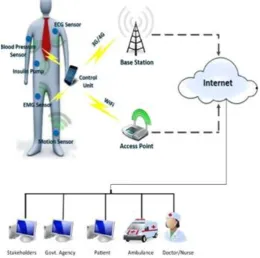
There are so many people in the world whose health may suffer because they do not have proper access to hospitals and health monitoring. Due to the latest technology, small wireless solutions which are connected to IoT can make it possible to monitor patients remotely instead of visiting the physical hospital. A variety of sensors which are attached to the body of a patient can be used to get health data securely, and the collected data can be analyzed (by applying some relevant algorithms) and sent to the server using different transmission media (3G/4G with base stations or Wi-Fi which is connected to the Internet) [4]. All the medical professionals can access and view the data, take decision accordingly to provide services remotely.
ISSN(E): 2277-128X, ISBN: 978-93-87396-07-4, pp. 236-245
Fig. 1. An application Scenario of k-Healthcare model
With the help of IoT we can easily capture the process of production, anti-counterfeit and tracing of medical equipment delivery. We can also mange medical information with the help of IoT, including sample identification and medical record identification. We can construct systems which can continuously monitor the patients, remote consultation, critically-ill patients and health care management platform using different techniques and equipment which can sense, capture, measure and transmit the information of body or things
[6].In June 2013, the U.S Department of Veterans Affairs (VA) decided to deploy RFID in American hospitals to improve care and reduce the costs of treatment [7].
Combining sensors and the microcontroller to get accurate measurement, and monitoring and analyzing the health status increase the power of IoT in healthcare. These can include blood pressure, heart rate, oxygen saturation in blood, levels of glucose and motion of body [5]. For working effectively, smart sensors and microcontroller components have several capabilities: low power operation, integrated precision-analog capabilities and GUI’s. To keep device footprint small and extend the life of battery to make the device usable, make the sensors possible to achieve high accuracy at low cost, improve the usability and read the information in a good manner. The end-to-end connectivity using sensors and other devices in healthcare is shown in Fig 1.
Most of the users are using smartphones with built-in sensors. The existing research in IoT, more specifically, in the field e-health does not make use of smartphone sensors to monitor patients’ health. The motivation of this paper is to use the existing smartphones sensor to monitor e-health. In this paper, we propose a novel model named k-Healthcare in IoT. The proposed model provides platform for physical sensors, which are connected directly with patient’s smartphone to obtain data at run time. This data is processed and stored in the cloud storage. The stored data can be accessed by practitioners and medical staff later on to observe and monitor patients’ health. The rest of the paper is organized as follows: Section II presents the related work; Section III demonstrates a comparison and contrast analysis of different e-health based techniques used in IoT; Section IV presents our proposed four layers based k-Healthcare model; Section V provides a case study of proposed k-Healthcare model usage. The paper concluded in Section VI.
II. RELATED WORK
As mentioned in previous section, the IoT takes important place in e-Health and medical care by using different sensing devices and wireless sensor networks (WSNs). Much research on this topic has been done, which can be further categorized and enumerated.
A. Architecture
ISSN(E): 2277-128X, ISBN: 978-93-87396-07-4, pp. 236-245
Jin et al [5] present a model/ framework to realize the smartcities through IoT. This framework encircles the complete
UIS (Urban Information System), from network support structure and sensory level to Cloud based integration and data management. The architecture has 3 main components (Network-Centric IoT, Cloud-Centric IoT, and Data-Centric IoT), under different standards, protocols and devices. RFID, WSN, crowd sourcing, IPv6, TCP/IP architecture, QoS mechanism, Crossbow’s iMote, IRIS, Crossbow’s XMesh are used and suggested.
Jara et al[8] presented their own architecture for Remote Monitoring based on IoT, integration of different systems
like hospital information system, services provider system, Context Management Framework, Knowledge Base Systems and Environment Integration Platform. This architecture uses RFID, wireless personal devices, embedded systems,
Monere and Movital hardware, 6LoWPAN, HDP and, the most important, a novel protocol called YOAPY. The
proposed protocol appears to be promising, however, it does not explain the handling of emergency situations.
Weihua et al [9] research on the e -Health records standards, how to access and display the data shared by organizations. They also design the interface between the platform and medical establishment’s w.r.t. network construction. The architecture uses HL7/XML, DICOM (Digital Imaging Communication-in), ADSL, WLAN, 3G, WCDMA, MASP, UMMP and UAAP standards and Web Services. Like [8], the proposed model does not specify the capability to handle the emergency situation. Also, they didn’t implement their proposed solution to test its correctness and accuracy.
RMMP-HI (Remote Monitoring & Management Platform of Healthcare Information) is presented by Wei et al [10].
The proposed platform is consisted of body sensors, a sensor network, wireless communication modules, home gateway or mobile phone/tablet and information storage. The authors analyze their platform with existing telemedicine services. Though different layers have been used in RMMP-Hi, but there is no information available on how will different layers communicate with each other and with the sensor, and what type of data storage is used.
Swiatek and Rucinski [11] present a new service to integrate the e-Health and IoT with the help of service science denoted by SSME/IoT/eHealth. The concept of this paper is to provide universal communication platform for delivering the complex services. The e-Health services are delivered through 3 phases using different standards and protocols such as XML-RPC protocol, SIP and XMPP protocol, RTP, HTTP, UDP and TCP/SCTP. Although, this service makes use of interesting concepts, they didn’t prove their claims and are unable to express how all components are functional. Castillejo et al developed an application to collect the data in smart spaces and focused not only the environment but also on firefighting and sports [12]. The application which was tested in gymnasium also suggests different exercises to sportsmen / women. The proposed solution contains 3 subsystems: physical devices from which requests are generated with the help of GUI (Smart phones, Tablets and PC), WSN and Body Area Network (BAN). The important things are that authors developed an Open API called RESTFul so anyone can use it and build a new application / system. The authors used different technologies and protocols like Enterprise Service Bus (ESB), Apache Service Mix, Service Oriented Architecture model (SOA), Zephyr Bioharness v3, SPP profile and RFID.
Min et al [13] present 2G-RFID based e -Healthcare system with emergency response service. The proposed system
consists of RFID tags, Wireless BAN, Cell phone and Communication Gateway, Healthcare Database, Pilot Services (Automated Services, Emergency Medical Response Service). They also explained the architecture of 2G- RFID System in detail, including how it works and different parts of system.
Yang et al. [14] proposed and implemented an intelligent home based platform for IoT called iHome Health-IoT. The proposed system involves 3 things: i) Intelligent Medical Box (iMedBox) which is based on open platform; ii) iMedPack Intelligent pharmaceutical packaging; and iii) Bio-Patch biomedical sensor devices. iHome Health-IoT has a 3 layer structure: sensor data collecting layer, medical resource management layer, and smart medical service layer. The proposed system provides different services like Remote Prescriptions, Medication Reminder, Medication Non-compliance Control and Intelligent Analysis and First Aid Alarm. They used different standards and technologies like RFID, CDM (Control Delamination Materials), Ethernet, ZigBee, Wi-Fi, Bluetooth and 3G/4G network.
Xu et al. [15] introduced the architecture of Smart Community and applications of IoT. The applications are
Neighborhood Watch and Pervasive Healthcare. The smart community architecture has three domains: Home Domain, Community Domain, and Service Domain. They also explain the model of Pervasive Healthcare in normal situation, emergency situation, and critical situation. The proposed system used different IEEE standards, tools and technologies like wireless communication technologies, WiFi, 3G cellular network, bluetooth, phone line communication technology, body sensors, HomePNA and Ethernet. They also explain the security and reliability requirements during whole communication process.
Istepanian et al [16] present an architecture called 6LoWPAN-based IoT architecture and application concept to connect the real timeglucose sensor with m-IoT in Diabetic patients. They implemented and tested the system performance using Java with the help of 6LoWPAN and TelsoB sensors. Their proposed 6LoWPAN based IoT architecture has five layers: Application, Transport, Network, Adaptation and Link PHY. The limitation of architecture is that it does not generate an alarm when the patient's condition is critical.
ISSN(E): 2277-128X, ISBN: 978-93-87396-07-4, pp. 236-245 B. Emergency Handling
Boyi et al.proposed a semantic data model to store and access the IoT data. The proposed system, called UDA- IoT,
highlights how it is used in emergency medical services [4].
They implement the DSS (decision support system) to solve the emergency problems. Jara et al [8] present new
architecture for Remote Monitoring based on IoT and makes use of a newprotocol called YOAPY. The proposed system
is capable to continuously monitor the patient health. The architecture is the integration of different systems like Identification Management system (IDM), Context Management Framework (CMF), Environment Integration Platform (EIP), Hospital information system (HIS), Knowledge Base systems (KBS). Wei at al [10] present a platform called RMMP-HI (Remote Monitoring & Management Platform of Healthcare Information). With the help of RMMP-HI, Government and health authorities can send emergency aid, information and notification to users and residents. The proposed model consists of e-body sensors, sensor network, short range communication module, medical information storage, analysis and processing module, and telemedicine services.
Castillejo et al [12] proposed a system which is fully implemented and tested. The proposed system collects the data in smart spaces with focus mainly on fire fighting and sports men/women. The proposed system can generate the alarms when the body parameter exceeds the standard level in two different ways and sends a message to user to stop the exercise. Min et al [13] proposed a 2G-RFID based e-healthcare system. The architecture uses RFID, automated services, Wireless BAN, Tablets, cell phone and communication gateway, healthcare database and Pilot Services. The proposed system can provide Emergency Medical Response Service, and when new pharmacy open, the information is sent to patient. Yang etal [14] proposed and implemented a system called iHomeHealth-IoT. The proposed system has different parts and provides different services, e.g., Medication Reminder, Remote Prescriptions, Medication Non-compliance Control and Intelligent Analysis, and First Aid Alarm using RFID, WLAN, GPRS and 3G Technology. Xu et al [15] present smart community with the help of IoT and also elaborate two major applications (Neighborhood Watch and Pervasive Healthcare). The pervasive healthcare application sends notification to healthcare workers when an emergency occurs. The workers provide the proper first aid and also the system informs healthcare institutes who provide immediate support and provide emergency measures. No case study has been discussed for [15] which can reveal the effectiveness of the proposed model.
C. Access Mechanism
To obtain the patient data and process it for further use, different researchers use different mechanisms. Some of them use RFID, few use 3G and 4G, and some use WLAN.
• RFID
Amendola et al. [18] conducts a survey on the RFID for bodycentric systems which can get information about the surrounding area of a user’s living environment (temperature, humidity and other gases). The survey covers the passive devices which use the UHF band. They discuss different types of sensors: temperature tags (Threshold Temp. Sensors, Continuous Temp. Sensors, Digital Data Loggers), and Body-Centric RFID (Wearable RFID Tags, Implantable RFID Tags). They also work on data processing and human behavior analysis such as Tracking human motion inside rooms, gesture recognition, remote monitoring and control of overnight living environment. They finally point out some issues which are still open and challenging. RFID has been used by many of authors to sense and collect data [2], [3]-[6], [8], [12]-[23].
• 2G/3G/4G
These are mobile communications standards which allow the IoT users to access the Internet wirelessly using different devices, e.g., mobile phones, tablets and other portable electronics devices. Some proposed models used 3G, and few used 4G [3],[5],[9]-[10],[13]-[19].
• WLAN
WLAN is a computer network that can help connect different IoT devices with the help of wireless distribution method within small geographical area such as home, office building, labs etc. The WLAN is used in some studeis to communicate the devices and transfer the data to Internet / Cloud storage [3]-[6], [8]-[9], [11]-[21],[23].
D. Applications
Fang et al [6] explain the applications of IoT, such as Constant Real time Monitoring, the Anti-counterfeit of Medical Equipment and Medication, Medical Refuse Information Management, Medical Information Management, Medical Emergency Management, Patient Information Management, Medication Storage Management, Blood Information Management, Telemedicine and Mobile Medical Care and Health Management. Dongxin and Tao [19] summarize the concept of IoT which includes the structure and implementation of IoT functions. An overview of IoT architecture is provided in their study, which consists of three layers: Perceptual Layer, Network Layer, and Application Layer. They present thattelemedicine has two kinds: Interactive and non-Interactive consultation. They introduce some advantages of telemedicine and also propose two applications of IoT in health, i.e., clinical care and remote real time ECG monitoring.
ISSN(E): 2277-128X, ISBN: 978-93-87396-07-4, pp. 236-245
Jingran et al [21] present a system based on IoT called Remote Monitoring Information System. The system can collect and process the information intelligently with the help of human monitoring sensors and WSN technology. It can monitor the user physical information like temperature, heart rate, oxygen, blood pressure etc. The system also monitors motion information like physical exertion, speed, respiration rate etc. The only limitation in this research is they have assumed the system to be secure by default.
Boric-Lubecke et al [22] discuss different applications of IoT in e -Healthcare. In particular, the authors focus on sleep studies and elderly care w.r.t remote monitoring applications. They explain the concept of Remote Sleep Monitoring and Elderly Monitoring in the context of IoT. They also discuss the privacy and security issues related to electronic medical data. Atzori et al [23] conduct a survey on IoT and show different technologies and industrial standards which are already in use. The authors introduced and compared different visions of IoT paradigms, applications of IoT in medical like identification and authentication, tracking of patient flow or moment, data collection of patients, and sensing for diagnosing patent conditions.
Sebestyen et al. [24] implement and test an application called CardioNet, which is a distributed medical system linking different medical entities and systems like hospitals, emergency units, general practitioner cabinets, laboratories, personnel and patients. The implemented system is web based using ontology and can provide different services such as remote monitoring, online consultations, and hospital activity administration.
III. COMPARISON AND CONTRAST ANALYSIS
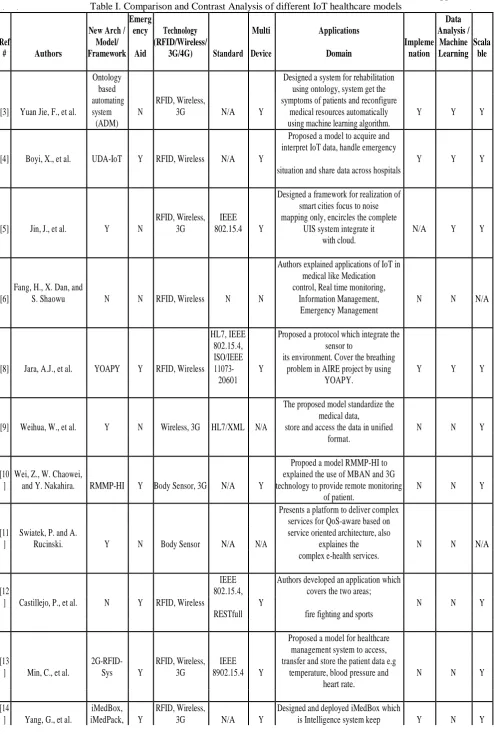
We investigated the relevant studies reported in the referenced papers, we notice that some of researchers proposed new architectures and models for IoT, which help to deploy IoT in the field of medical and healthcare. It is also noticed that some of the authors follow IEEE and other standards to implement their proposed IoT model to provide remote monitoring and emergency aid while some of the authors simply explain the applications of IoT in healthcare. We present a performance comparison and analysis of different IoT structures in Table 1. We evaluate the proposed IoT models based on some parameters such as provision of emergency aid, technology used, standard followed, support for multi device and artificial intelligence implementation.
A. Emergency Aid: Using IoT in the field of medical andhealthcare, the focus should be on data and on the provision of
the support in emergencies. The system must generate alarms, inform the patients and consultants.
B. Technology: IoT supports different and latest technologies like RFID, WSN, 3G, 4G networks etc. Using these
technologies, one can obtain data related to patient’s health and send it to a remote server for further processing and storage [25]. We can compare different systems/architectures on the bases of these technologies.
C. Standards: IoT supports different standards and protocols,e.g. IEEE 802.11/b/g/n, IEEE 802.15.4, IEEE 802.15.6,
ZigBee, WBAN, and NL 7 etc. Using standards and protocols, we can find the distance, accuracy and time to take a system to complete his work.
D.Multi device support: We can compare different models and systems on the bases of multi device support. The
efficient systems support many devices such as RFID sensors, body sensors, smart phone sensors, tablets, and wearable devices.
It should be noted that the existing research in IoT mostly focus on RFID sensors and external wearable sensors (as shown in Table 1). There is no formal use of smart phone sensors in the existing literature. Our proposed model particularly makes use of built-in smartphone sensors to monitor the patient health data.
IV. PROPOSED SYSTEM
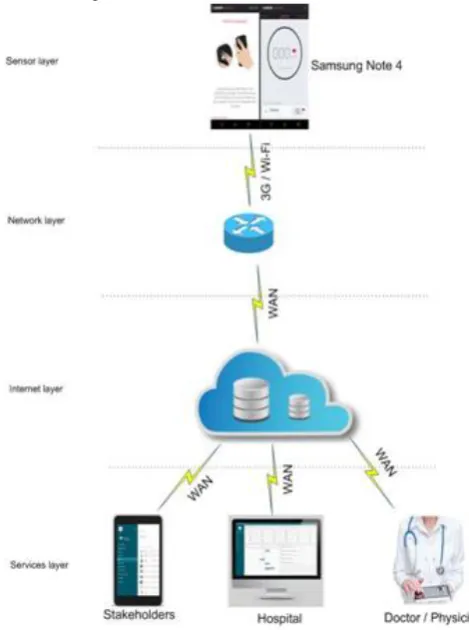
The k-Healtcare model proposed in this paper for efficient deployment of IoT in the field of medical and healthcare consists of four layers (See Figure 2).
A. Sensor Layer
The bottom layer of the model is called a sensor layer which is the heart of the model, there are different sensors lying on this layer, e.g., RTX-4100, wireless two-lead EKG, Arduino & Raspberry Pi, blood oxygen sensor, pulse oximetry, and Smart Phone sensors. RFID performs the object identification automatically by reading the tag, which attached to objects. The passive RFID is mostly used which has no power/ battery requirement, it takes power from the RFID reader and becomes active to communicate with the reader. The main idea of WSN is to get data from the environment and pass data through the network to the centralized storage. The modern smartphones have certain sensors built-in by default, e.g., accelerometer, gyroscope, proximity, barometer, temperature, humidity, gesture, etc., which makes it easier to use (as no external sensors are used). In k-Healthcare we use these built-in sensors to get data and send the data to remote data storage for further processing. The communication between the sensor layer and the network layer is done using IEEE 802.11/b/g/n, IEEE 802.15.4, IEEE 802.15.6, ZigBee etc.
B. Network Layer
ISSN(E): 2277-128X, ISBN: 978-93-87396-07-4, pp. 236-245
Table I. Comparison and Contrast Analysis of different IoT healthcare models
Ref
# Authors
New Arch / Emerg ency Technology Standard Multi Applications Impleme nation Data Analysis / Scala ble Model/ Framework Aid (RFID/Wireless/
3G/4G) Device Domain
Machine Learning Ontology based RFID, Wireless, 3G
Designed a system for rehabilitation using ontology, system get the
Y Y Y
[3] Yuan Jie, F., et al.
automating
system N N/A Y
symptoms of patients and reconfigure medical resources automatically (ADM) using machine learning algorithm.
[4] Boyi, X., et al. UDA-IoT Y RFID, Wireless N/A Y
Proposed a model to acquire and interpret IoT data, handle emergency
Y Y Y
situation and share data across hospitals
RFID, Wireless, 3G
Designed a framework for realization of smart cities focus to noise
[5] Jin, J., et al. Y N
IEEE 802.15.4 Y
mapping only, encircles the complete
UIS system integrate it N/A Y Y with cloud.
RFID, Wireless
Authors explained applications of IoT in medical like Medication
[6]
Fang, H., X. Dan, and
S. Shaowu N N N N
control, Real time monitoring,
Information Management, N N N/A Emergency Management
RFID, Wireless
HL7, IEEE 802.15.4,
Proposed a protocol which integrate the sensor to
[8] Jara, A.J., et al. YOAPY Y
ISO/IEEE 11073- Y
its environment. Cover the breathing
problem in AIRE project by using Y Y Y
20601 YOAPY.
[9] Weihua, W., et al. Y N Wireless, 3G HL7/XML N/A
The proposed model standardize the medical data,
N N Y
store and access the data in unified format.
[10 ]
Wei, Z., W. Chaowei,
and Y. Nakahira. RMMP-HI Y Body Sensor, 3G N/A Y
Propoed a model RMMP-HI to explained the use of MBAN and 3G
N N Y
technology to provide remote monitoring of patient.
Body Sensor
Presents a platform to deliver complex services for QoS-aware based on [11
]
Swiatek, P. and A.
Rucinski. Y N N/A N/A
service oriented architecture, also
explaines the N N N/A complex e-health services.
[12
] Castillejo, P., et al. N Y RFID, Wireless IEEE 802.15.4,
Y
Authors developed an application which covers the two areas;
N N Y
RESTfull fire fighting and sports
RFID, Wireless, 3G
Proposed a model for healthcare management system to access, [13
] Min, C., et al.
2G-RFID-Sys Y
IEEE 8902.15.4 Y
transfer and store the patient data e.g
temperature, blood pressure and N N Y heart rate.
[14
] Yang, G., et al.
iMedBox, iMedPack, Y
RFID, Wireless,
3G N/A Y
Designed and deployed iMedBox which
ISSN(E): 2277-128X, ISBN: 978-93-87396-07-4, pp. 236-245
Bio-Patch
record of medicine and monitor ECG and Temperature of body
RFID, Wireless, 3G
Author designed system which have 2 main applications: [15
] Xu, L., et al.
Smart community Y
IEEE
802.11 Y 1) Neighborhood watch N N N/A 2) Pervasive Healthcare
[16
] Istepanian, R.S.H., et al Y N
RFID, Wireless, 3G
6LoWPAN Y
Proposed a system which use the 6LoWPAN and TelsoB nodes sensor
Y N Y
IEEE 802.15.4
for measurment of glucose level of patient
RFID, Wireless, 3G/4G
Proposed a platform use two sensor node to sending [17
] Tabish, R., et al Y Y
IEEE 802.15.4 Y
temprature and ECG data, to collete data
use external Y N Y devices MSP430 and CC2420
RFID, Wireless, 3G
Presents a survey on RFID implementaton to get data, process it,
and [18
] Amendola, S., et al. N N Y Y
use it in different applicatons like
Tracking human motion, Gesture Y N Y recognition, Remote monitoring
[19 ]
Dongxin, L. and L.
Tao. N N
RFID, CDMA,
3G N/A N/A
Author point out IoT and its structure, Telemedicine Technology and
N N N/A its advantages, and Remote real-time
ECG monitoring process
[20 ]
Turcu, C.E. and C.O.
Turcu N N RFID, Wireless N N
Determined how to combine the RFID and IoT in Healthcare,
N N N
explained some projects which is already deployed
[21
] Jingran, L., et al Y N RFID, Wireless IEEE 802.15.4 Y
Presents a system to get data from RFID, store data
N N N
and inform corresponding organization in urgent situation
[22
] Boric-Lubecke, O., et al N N RFID, Zigbee
IEEE 802.15.4 N/A
Athor focus on remote monitoring applications for
N N N
elderly care and sleep studies using IoT
RFID, Wireless
6LoWPAN
Explained how to encapsulate RFID message onto IPv6 packet,
N N N/A [23
]
Atzori, L., A. Iera, and
G. Morabito N N Y
also explain application of IoT in medical like
IEEE
802.15.4 Identification & authentication, and tracking of patient
[24
] Sebestyen, G., et al N N N/A N Y Y Y N Y
C. Internet Layer
ISSN(E): 2277-128X, ISBN: 978-93-87396-07-4, pp. 236-245 D. Services Layer
This layer provides direct access of data to professional medical facilities and stakeholders such as doctors, emergency centers, hospitals, and medicine supply chains. The doctor can easily manage the patients, view the medication history, and provide remote support in case of emergency. The patient can also access the data on provided interface any time anywhere. This layer supports different protocols and techniques like HTTP, HTTPS, JavaScript, RESTful web services etc.
Fig. 2. Proposed k-Healthcare model
V. CASE STUDY OF K-HEALTHCARE IOT
There are many cases where a system like this can be used. The proposed system is able to use the wearable devices and smart phone sensors to collect the patient data, which is integrated with Internet of Things. In our case, a patient used built-in Heart Rate sensor of his/her smart phone like Samsung Note 4 / S4 to get health related data. The data displayed on the screen of the smart phone, and sent automatically to cloud storage for processing and storing using 3G or Wi-Fi. Machine learning algorithms are applied on data to verify the conditions of the patient. If the value is out of the normal range, then an alert message is sent to a doctor/physician, and the doctor will take appropriate action accordingly. The whole scenario of the process shown in Figure 3.
ISSN(E): 2277-128X, ISBN: 978-93-87396-07-4, pp. 236-245 VI. CONCLUSION
m-Health and e-Health are providing different services remotely, such as prevention and diagnosis against disease, risk assessment, monitoring patient health, education and treatment to users. This is why e -Health and m-Health is being widely accepted in the society. The emerging of state of the art tools and technologies of IoT can be really beneficial for e-Health and m-Health. Different e-Health and m-Health architectures for IoT have been developed which handle an emergency situation efficiently. However, the existing e-Health and m-Health architectures do not use smart phone sensors to sense and transmit important data related to the patients’ health. We proposed a novel framework for e-Health and m-Health which makes use of smart phone sensors and body sensors to obtain, process and transmit patient health related data to centralize storage in the cloud. This stored data could be retrieved by patients’ and other stakeholders in the future. Our proposed model, named k-Healthcare, makes use of four layers which work closely together and provide efficient storing, processing and retrieving of valuable data. We have provided a comparative analysis of different architectures and applications of IoT which can be used in e-Health and m-Health. The ongoing work focuses on the actual development and deployment of k-Healthcare. One way could be the design of a software or smartphone application which will obtain the data directly from the sensors and process it automatically. Furthermore, we will investigate the security and privacy issues of k-Healthcare.
REFERENCES
[1] G. Kortuem, F. Kawsar, D. Fitton, and V. Sundramoorthy, "Smart objects as building blocks for the Internet of things," Internet Computing, IEEE, vol. 14, pp. 44-51, 2010.
[2] M. Kärkkäinen and J. Holmström, "Wireless product identification: enabler for handling efficiency, customisation and information sharing," Supply Chain Management: An International Journal, vol. 7, pp. 242-252, 2002.
[3] F. Yuan Jie, Y. Yue Hong, X. Li Da, Z. Yan, and W. Fan, "IoT-Based Smart Rehabilitation System," Industrial Informatics, IEEE Transactions on, vol. 10, pp. 1568-1577, 2014.
[4] X. Boyi, X. Li Da, C. Hongming, X. Cheng, H. Jingyuan, and B. Fenglin, "Ubiquitous Data Accessing Method in IoT-Based Information System for Emergency Medical Services," Industrial Informatics, IEEE Transactions on, vol. 10, pp. 1578-1586, 2014
[5] J. Jin, J. Gubbi, S. Marusic, and M. Palaniswami, "An information framework for creating a smart city through Internet of Things," IEEE Internet of Things Journal, vol. 1, pp. 112-121, 2014.
[6] H. Fang, X. Dan, and S. Shaowu, "On the Application of the Internet of Things in the Field of Medical and Health Care," in Green Computing and Communications (GreenCom), 2013 IEEE and Internet of Things (iThings/CPSCom), IEEE International Conference on and IEEE Cyber, Physical and Social Computing, 2013, pp. 2053-2058.
[7] R. Journal. (2013). Veterans Affairs to Install RFID in Hospitals across America. Available: http://www.rfidjournal.com/articles/view?10663
[8] A. J. Jara, M. A. Zamora-Izquierdo, and A. F. Skarmeta, "Interconnection Framework for mHealth and Remote Monitoring Based on the Internet of Things," Selected Areas in Communications, IEEE Journal on, vol. 31, pp. 47-65, 2013.
[9] W. Weihua, L. Jiangong, W. Ling, and Z. Wendong, "The internet of things for resident health information service platform research," in Communication Technology and Application (ICCTA 2011), IET International Conference on, 2011, pp. 631-635.
[10] Z. Wei, W. Chaowei, and Y. Nakahira, "Medical application on internet of things," in Communication Technology and Application (ICCTA 2011), IET International Conference on, 2011, pp. 660-665.
[11] P. Swiatek and A. Rucinski, "IoT as a service system for eHealth," in e-Health Networking, Applications & Services (Healthcom), 2013 IEEE 15th International Conference on, 2013, pp. 81-84.
[12] P. Castillejo, J. F. Martinez, J. Rodriguez-Molina, and A. Cuerva, "Integration of wearable devices in a wireless sensor network for an E-health application," Wireless Communications, IEEE, vol. 20, pp. 38-49, 2013.
[13] C. Min, S. Gonzalez, V. Leung, Z. Qian, and L. Ming, "A 2G-RFID-based e-healthcare system," Wireless Communications, IEEE, vol. 17, pp. 37-43, 2010..
[14] G. Yang, L. Xie, M. Mantysalo, X. Zhou, Z. Pang, L. D. Xu, et al., "A Health-IoT Platform Based on the Integration of Intelligent Packaging, Unobtrusive Bio-Sensor, and Intelligent Medicine Box," Industrial Informatics, IEEE Transactions on, vol. 10, pp. 2180-2191, 2014.
[15] L. Xu, L. Rongxing, L. Xiaohui, S. Xuemin, C. Jiming, and L. Xiaodong, "Smart community: an internet of things application," Communications Magazine, IEEE, vol. 49, pp. 68-75, 2011.
[16] R. S. H. Istepanian, S. Hu, N. Y. Philip, and A. Sungoor, "The potential of Internet of m-health Things “m-IoT” for non-invasive glucose level sensing," in Engineering in Medicine and Biology Society,EMBC, 2011 Annual International Conference of the IEEE, 2011, pp. 5264-5266.
[17] R. Tabish, A. M. Ghaleb, R. Hussein, F. Touati, A. Ben Mnaouer, L. Khriji, et al., "A 3G/WiFi-enabled 6LoWPAN-based U-healthcare system for ubiquitous real-time monitoring and data logging," in Biomedical Engineering (MECBME), 2014 Middle East Conference on, 2014, pp. 277-280.
ISSN(E): 2277-128X, ISBN: 978-93-87396-07-4, pp. 236-245
[19] L. Dongxin and L. Tao, "The application of IOT in medical system," in IT in Medicine and Education (ITME), 2011 International Symposium on, 2011, pp. 272-275.
[20] C. E. Turcu and C. O. Turcu, "Internet of Things as Key Enabler for Sustainable Healthcare Delivery," Procedia - Social and Behavioral Sciences, vol. 73, pp. 251-256, 2/27/ 2013.
[21] L. Jingran, C. Yulu, T. Kai, and L. Junwen, "Remote monitoring information system and its applications based on the Internet of Things," in BioMedical Information Engineering, 2009. FBIE 2009. International Conference on Future, 2009, pp. 482-485.
[22] O. Boric-Lubecke, G. Xiaomeng, E. Yavari, M. Baboli, A. Singh, and V. M. Lubecke, "E-healthcare: Remote monitoring, privacy, and security," in Microwave Symposium (IMS), 2014 IEEE MTT-S International, 2014, pp. 1-3.
[23] L. Atzori, A. Iera, and G. Morabito, "The Internet of Things: A survey," Computer Networks, vol. 54, pp. 2787-2805, 10/28/ 2010.
[24] G. Sebestyen, A. Hangan, S. Oniga, and Z. Gal, "eHealth solutions in the context of Internet of Things," in Automation, Quality and Testing, Robotics, 2014 IEEE International Conference on, 2014, pp. 1-6.