© 2019 by the Serbian Biological Society How to cite this article: Andrejić G, Šinžar-Sekulić J, Prica M, Gajić G, 687 Dželetović Ž, Rakić T. Assessment of the adaptive and phytoremediation
potential of Miscanthus×giganteus grown in flotation tailings. Arch Biol Sci. 2019;71(4):687-96.
Assessment of the adaptive and phytoremediation potential of
Miscanthus×giganteus
grown in flotation tailings
Gordana Andrejić1, Jasmina Šinžar-Sekulić2, Milijana Prica2, Gordana Gajić3, Željko Dželetović1 and Tamara Rakić2,*
1Department of Agrochemistry and Radioecology, Institute for the Application of Nuclear Energy, University of Belgrade,
Banatska 31b, 11080 Zemun, Serbia
2Department of Plant Ecology and Phytogeography, Faculty of Biology, University of Belgrade, Studentski trg 16, 11000
Belgrade, Serbia
3Department of Ecology, Institute for Biological Research "Siniša Stanković" – National Institute of Republic of Serbia, University
of Belgrade, Bulevar Despota Stefana 142, 11000 Belgrade, Serbia
*Corresponding author: [email protected]
Received: July 9, 2019; Revised: August 14, 2019; Accepted: August 15, 2019; Published online: August 30, 2019
Abstract: Mining activities produce enormous amounts of metal-contaminated waste that is the source of ecosystem pollution by metals. Owing to complex adverse environmental conditions, the surface of abandoned flotation tailings is completely devoid of vegetation cover and is therefore very susceptible to fluvial erosion, wind dispersal to neighboring ecosystems and leaching of heavy metals into ground waters. The aim of this study was to estimate the adaptive potential
of Miscanthus×giganteus (Poaceae) to grow on flotation tailings without any input. In this field experiment, plants were
grown for four months in flotation tailings and in unpolluted control chernozem soil. Plants accumulated and retained the major part of metals within their roots, exhibiting their very low transfer to aerial parts, which all define M.×giganteus as a phytoexcluder plant species. Plants grown in flotation tailings showed significant reduction in the net CO2 assimilation rate and growth parameters, and there was no negative impact on pigment content, maximum quantum yield of PSII pho-tochemistry, lipid peroxidation level and total antioxidative capacity in leaves. The obtained results indicate that despite reduced growth, M.×giganteus can be cultivated for phytoremediation of flotation tailings.
Keywords: Miscanthus×giganteus; chlorophyll a fluorescence; lipid peroxidation; heavy metals; photosynthesis
Abbreviations: 1,1-diphenyl-2-picrylhydrazyl (DPPH);2-thiobarbituric acid (TBA); net CO2 assimilation rate (A); con-centration of chlorophyll (Chl); concon-centration of total carotenoids (Car); malondialdehyde (MDA); maximum quantum efficiency of PSII photochemistry (Fv/Fm); stomatal conductance (gs); reactive oxygen species (ROS); transpiration rate (E)
INTRODUCTION
Mining activities and ore processing produce large amounts of fine-grained waste material that is discard-ed with water as mud into the flotation tailing pond. Flotation tailings that remain after the abandonment of a mine are distinguished by multiple unfavorable phys-ical and chemphys-ical properties, such as surface mobility, poor granulometric structure and sturdiness, absence of organic matter and macronutrients and high metal contamination, which altogether seriously aggravate plant growth [1,2]. As a result, its surface is devoid
of vegetation cover and is extremely prone to fluvial erosion and wind dispersal. Its impact on the environ-ment can be summarized as: (i) run-off of heavy metals into the surface and ground waters; (ii) precipitation of fine-grained particles on adjacent cultivated and graz-ing land and forests; (iii) bioabsorption of metals and their transfer between trophic levels; (iv) overall loss of ecosystem productivity and biodiversity.
initiating natural processes of re-establishment of an ecosystem’s form and functions [3]. Ecological resto-ration of a specific ecosystem requires evaluation of the local climate, the physical and chemical proper-ties of the substrate and the selection of the most ap-propriate plant species. Sustainable managements of technosols, such as flotation tailings, can be achieved by phytostabilization, an economically acceptable and eco-friendly phytoremediation procedure. Phytostabi-lization reduces the risk of heavy metal contamination of natural ecosystems by immobilizing the pollutants within the soil and decreasing their bioavailability [4]. It is achieved by chelation of metals in the rhizosphere by root exudates, or metal absorption and their ac-cumulation in roots. In phytostabilization, plant roots mechanically bind substrate particulates and render surface layers less prone to erosion, reducing water percolation and metal leaching to underground water. The effectiveness of phytostabilization depends on the plant’s tolerance to metal contamination and its ability to accumulate metals in its underground organs. Only plant species tolerant to the prolonged and extreme multiple stress conditions that dominate at flotation tailings can form a self-sustainable vegetation cover and improve the ecological conditions in its surface layers by their presence and biological activity. Plants suitable for phytostabilization are those that develop strong roots with high efficiency in erosion control and heavy metal absorption. Effective biological restoration and phytostabilization of heavy metal polluted soils in temperate climates have already been achieved with grasses belonging to genera Festuca, Poa and Agrostis and legumes such as Medicago and Vicia [5].
Heavy metals cause a series of harmful effects on physiological processes, from gene transcription to photosynthesis and respiration [6-8]. They induce disorder in nutrient uptake and lead to a deficiency of some essential microelements in a plant’s organism or inhibit the activity of different enzymes substitut-ing their optimal metal cofactor [8]. When present in higher concentrations, transition metals increase ROS generation in Heber-Weiss and Fenton reactions. The formed ROS induce oxidative damage to membrane lipids, proteins, pigments and nucleic acids, thus dis-rupting the structure of various cellular components and their related processes. Oxidative damage to membrane unsaturated fatty acids results in the for-mation of MDA, which is therefore a good indicator
of ROS-induced lipid membrane oxidative damage. In order to remove ROS, plants have developed an efficient antioxidative system whose nonenzymatic component is involved in direct ROS detoxification.
The photosynthetic process is very sensitive to heavy metal stress because it induces changes in the photosynthetic pigment content, activities of enzymes involved in CO2 fixation, structure of photosystem II and chloroplast ultrastructure [9,10]. As a result, both the CO2 assimilation rate and chlorophyll a fluores-cence parameters are disturbed by heavy metal stress and therefore are very good indicators of elemental disorders in a plant organism.
Both light-harvesting pigments, chlorophylls and carotenoids, are very sensitive to environmental stress and variations in their amounts and ratios represent a reliable marker of plant stress. Heavy metals can affect the pigment content in leaves directly, causing inhibition of activities of enzymes involved in their biosynthetic pathways or substitution of the central Mg ion in the chlorophyll molecule by other divalent metal cations, or indirectly, causing ROS-induced oxi-dative damage [11]. Carotenoids are a large group of pigments that perform different functions in the plant cell, and are involved in direct ROS detoxification.
On the basis of its tolerance to various envi-ronmental stress conditions, we hypothesized that M.×giganteus possesses a good capability to grow in flotation tailings and provide phytostabilization ef-fects. The high heavy metal content in flotation tail-ings is expected to change the amounts of chlorophyll and carotenoids, induce ROS generation, increase membrane lipid peroxidation and reduce photosyn-thetic efficiency and growth of M.×giganteus plants. The aims of this field study were to (i) determine metal accumulation in the plant’s underground and above-ground organs; (ii) assess the adaptive response of M.×giganteus to heavy metal stress, and (iii) evaluate its capability for phytostabilization of flotation tailings.
MATERIALS AND METHODS Site description
A microplot field experiment was carried out in 2016. It was set on two localities: (i) in the flotation tail-ings of the mine “Rudnik”, and (ii) at an unpolluted site at the Institute for Application of Nuclear Energy (INEP), Zemun, Serbia (Supplementary Fig. S1A).
The mine “Rudnik” is located on Mt. Rudnik in central Serbia (44°06´N, 20°29´E). During the last fifty years, over 80% of the estimated ore has been excavated, which is more than 10 million tons. Lead, zinc and cop-per are extracted after the mechanical crushing of the polymetallic ore into small-sized particles (ø=75 μm) and the flotation process of their minerals. The result-ing flotation tailresult-ings are discharged with water as mud into a tailing pond, bordered by natural birch forest and grazing fields (Supplementary Fig. S1B). The section of the flotation tailings that is temporarily abandoned was used as an experimental field for plant cultivation (Supplementary Fig. S1C, D). The control plants were cultivated at INEP (44°51´N, 20°22´E) in unpolluted, high quality carbonate chernozem soil [29].
Temperatures and precipitation at each experi-mental site during the growth period [30] are shown in Supplementary Table S1.
Plant material
The planted rhizomes derived from the clonal M.×giganteus grown in the field at INEP. The material
is the clone of M.×giganteus purchased as rhizomes from Walter Kellner (Austria) in 2007, since when it has been continuously cultivated at INEP.
Experimental design
Pre-grown M.×giganteus rhizomes 7-10 cm long were planted at the beginning of March 2016. They were planted at 10-cm depth with a planting density of 2 rhizomes per m2 (equivalent to 20000 plants ha-1). The experimental plants were organized in four plots (2.5m×2.0m=5m2 each) with a 2-m distance from each other. The substrate and plant material were sampled for analysis in June 2016.
Determination of the chemical properties of the substrate
The control soil and flotation tailings were sampled up to 20-cm depth, which corresponds to the depth at which the major portion of plant roots was present at the time of plant sampling.
For determination of pH, actual (pHH2O) and ex-changeable (pHKCl), 25 mL of double distilled water or 25 mL 1M KCl were added to 10 g of soil and stirred for 30 min. The pH values were measured directly in the suspensions (Iskra MA 5730, Slovenia).
Organic carbon was measured [31] and was used for calculation of organic matter [32].
The total contents of elements (Pb, Cu, Zn) in the soil were determined after the digestion of sieved soil samples (<200 µm) in HCl:HNO3 (3:1, v/v) according to method 3051 [33]. The total nitrogen content was determined by Kjeldahl digestion [34].
In order to determine the content of the avail-able formsof metalsin the soil, dried and sieved soil samples were mixed continuously for 2 h in 1 M am-monium acetate and 0.01 M EDTA mixture (pH 7), and then filtered (Sartorius filter paper No. 391) [35]. Available forms of phosphorus and potassium were analyzed using the standard AL-method [36].
Determination of metal accumulation in the plant
Concentrations of metals were determined in roots, rhizomes, stems and leaves. After sampling, the plant material was thoroughly washed in tap water; roots and rhizomes were also washed using an ultrasonic cleaner in order to avoid surface contamination of samples by small substrate particulates. All plant ma-terial was washed in deionized water. Air-dried plant material was ground with a ceramic mortar and pes-tle and dried at 105°C to constant weight. Powdered plant material was digested in HCl:HNO3 (3:1, v/v) [33]. Concentrations of metals in samples were deter-mined with an atomic absorption spectrophotometer by comparison of their absorption values with those of known standards.
Assessment of plant phytostabilization potential
The phytostabilization potential of M.×giganteus was estimated using the bioconcentration factor (BCF) and translocation factor (TF) [37], and calculated as follows:
Gas exchange rates and chlorophyll a fluorescence
Measurements of gas exchange rates and chlorophyll a fluorescence were performed on an intact penultimate leaf using an infrared gas analyzer (CIRAS 2, PP Sys-tem, USA) equipped with a chlorophyll fluorescence module (CFM). The net CO2 assimilation rate (A), transpiration rate (E) and stomatal conductance (gs) were measured on the penultimate leaf enclosed in a universal automatic PLC (U) cuvette. Conditions in the leaf chamber were as follows: leaf temperature 25°C, relative air humidity 60%, 380 µmol mol−1 CO
2. The light response curves (A/PPFD) were obtained at descending photosynthetic photon flux density (PPFD) values from 2000 to 0 µmol m−2 s−1.
The CFM provides measurements of chlorophyll fluorescence using the pulse amplitude modulation (PAM) technique. For measuring fluorescence param-eters, leaves were pre-darkened for 30 min before
ex-posure to the saturation pulse of actinic light. Before the saturating pulse was applied, the minimal level of fluorescence in the dark (Fo) was measured. A saturat-ing flash of 5100 µmol photon m-2 s-1 and duration of 0.7 s was then applied to the leaf in order to obtain the maximal fluorescence yield (Fm). At the Fm level, all PSII electron acceptors were fully reduced, prevent-ing photochemistry. The parameters Fo and Fm were used to calculate the maximum quantum efficiency of PSII photochemistry (Fv/Fm). All measurements were performed in the midmorning.
Pigment quantification
The amounts of chlorophyll a (Chl a), chlorophyll b (Chl b) and total carotenoids (Car) in leaves were detected [38]. The absorption of Chl a, Chl b and Car were determined by UV-Vis spectrophotometer (Shimadzu UV-1800, Japan) at 663 nm, 645 nm and 480 nm, respectively. The pigment contents were cal-culated [39,40] and their amounts were expressed as mg g-1 ofthe leaf dry weight (dw).
Lipid peroxidation
The lipid peroxidation in the penultimate leaf was de-termined by measuring the amount of MDA produced in the reaction with TBA [41]. The absorbance of the extract was measured spectrophotometrically at 450 nm, 532 nm and 600 nm. The level of lipid peroxida-tion was expressed as µmol MDA g−1 dw.
Determination of total antioxidant capacity
The total antioxidant capacity of the penultimate leaf was determined using the stable free radical DPPH [42]. Spectrophotometric measurements were performed at 517 nm. The total antioxidant capacity of samples was expressed as relative to control plants (100%).
Plant biometric parameters
Statistical analysis
All data are expressed as the mean±standard devia-tion (SD) of six replicates per treatment. The obtained results between two groups were compared using the Mann-Whitney U Test (p<0.05). Spearman’s rank cor-relation coefficient was performed in order to analyze the relationships between measured parameters. Sta-tistical analyses were performed in R (v3.5.1; R Core Team 2018).
RESULTS
Chemical characteristics of the control soil and flotation tailings
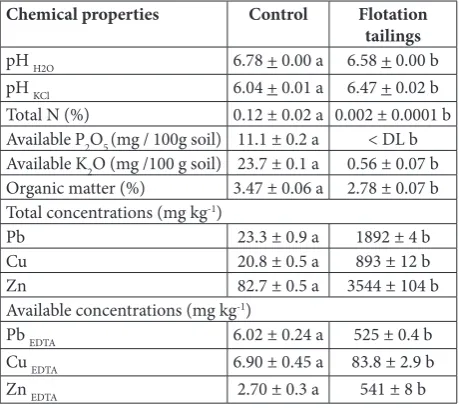
The pH values of the control soil (C) and flotation tailings (FT) were very similar, both being neutral, as shown in Table 1. The pHH2O of the control soil was higher by more than a half of a unit than pHKCl, whereas pHH2O and pHKCl of the FT were very similar. Although C- and FT- substrates contained similar percentages of organic matter, they showed pronounced differ-ences in N, P and K concentrations. Total available N and K were 60-fold and 42-fold lower in FT than in C soil, respectively, whereas available P in the FT was under the detection limit. The total amounts of Pb, Cu and Zn in the FT were 81-, 43- and 43-fold higher in comparison with their concentrations in control soil, respectively (Table 1). Although their available forms represent a small portion of their total amounts in the FT, their concentrations were far higher in comparison with those detected in the control soil.
Metal accumulation by plants
Plants cultivated in the flotation tailings accumulated significantly higher concentrations of Pb, Cu and Zn in all plant organs compared to the control plants (Ta-ble 2). The highest concentrations of all metals in both C and FT plants were detected in roots. In FT plants, BCF>1 was detected only for Cu, whereas the BCF for Zn was slightly lower than 1, indicating a high level of accumulation in roots. TFs for all analyzed metals were significantly below 1.
Table 1. Chemical characteristics of the control soil and flotation tailings with total and EDTA-available metal concentrations.
Chemical properties Control Flotation tailings
pH H2O 6.78 + 0.00 a 6.58 + 0.00 b
pH KCl 6.04 + 0.01 a 6.47 + 0.02 b
Total N (%) 0.12 ± 0.02 a 0.002 ± 0.0001 b
Available P2O5 (mg / 100g soil) 11.1 ± 0.2 a < DL b Available K2O (mg /100 g soil) 23.7 ± 0.1 a 0.56 ± 0.07 b
Organic matter (%) 3.47 ± 0.06 a 2.78 ± 0.07 b
Total concentrations(mg kg-1)
Pb 23.3 ± 0.9 a 1892 ± 4 b
Cu 20.8 ± 0.5 a 893 ± 12 b
Zn 82.7 ± 0.5 a 3544 ± 104 b
Available concentrations(mg kg-1)
Pb EDTA 6.02 ± 0.24 a 525 ± 0.4 b
Cu EDTA 6.90 ± 0.45 a 83.8 ± 2.9 b
Zn EDTA 2.70 ± 0.3 a 541 ± 8 b
< DL − lower than detection limit. The same letters indicate no significantly different values according to Mann-Whitney U test (p≤0.05).
Table 2. Metal accumulation in M.×giganteus grown in control soil (C plants) and the flotation tailings (FT plants), and BCF and TF of plants grown on the flotation tailings.
Pb Cu Zn
C plants FT plants C plants FT plants C plants FT plants
Root (mg kg-1) 4.00 ± 1.47 a 222 ± 0.35 b 8.22 ± 0.78 a 124 ± 16 b 24.7 ± 0.7 a 511 ± 17 b
Rhizome (mg kg-1) <DL a 38.8 ± 7.4 b 5.32 ± 1.24 a 17.4 ± 6.6 b 11.8 ± 0.7 a 47.8 ± 0.7 b
Stem (mg kg-1) <DL a 42.1 ± 10.3 b 3.47 ± 0.64 a 7.81 ± 0.63 b 14.6 ± 0.4 a 43.3 ± 1.2 b
Leaves (mg kg-1) <DL a 47.9 ± 0.9 b 6.23 ± 0.66 a 9.14 ± 0.16 b 18.1 ± 1.2 a 64.8 ± 2.6 b
BCF 0.42 1.48 0.94
TF 0.22 0.07 0.13
Physiological and biochemical parameters
Plants grown in the flotation tailings exhibited a sig-nificantly reduced net CO2 assimilation rate (A) in comparison with control plants, which was especially pronounced at higher light intensities, as described by the light response curves (A/PPFD) (Fig. 1). Control plants reached their highest mean photosynthetic ac-tivity (A=16 µmol CO2 m-2 s-1) at the highest applied PPFD of 2000 µmol photon m-2 s-1, whereas FT plants reached their maximum A (9.2 µmol CO2 m-2 s-1) at far lower light intensity (1000 µmol photon m-2 s-1).
The parameters of gas exchange (A, E, gs) at a light intensity of 1000 µmol photon m-2 s-1 were significantly lower in FT plants than in the control ones, as shown in Table 3. The maximum quantum yield of PSII pho-tochemistry (Fv/Fm) was similar between treatments. Moreover, no statistically significant difference was found in pigment contents (Chl a, Chl b, Chl a+b, Car) between control and FT plants. However, the slightly higher con-centration of Chl a in FT plants led to a significantly higher Chl a/b ratio in comparison to that measured in the control. There were no statistically significant dif-ferences in MDA concentration and total antioxidative capacity between the two treatments (Table 3).
Biometric parameters
Plants grown on the flotation tailings showed signifi-cantly smaller plant dimensions: stem height and stem width, penultimate leaf length and width (Table 4). Also, they had a significantly higher percentage of senescent leaves per plant.
DISCUSSION
Flotation tailings represent a specific substrate clas-sified as technosol. Having in mind its origin, we ex-pected to detect very high concentrations of heavy metals acquired from the parent rock, predominantly Pb, Cu and Zn, which were the main metals extracted from the ore. The total Pb, Cu and Zn concentrations in the flotation tailings were in the range characteristic for soils heavily contaminated by sewage sludge, metal Fig. 1. Light response curves (A/PPFD) of M.×giganteus plants
culti-vated in the control soil (C plants) and flotation tailings (FT plants).
Table 3. Physiological and biochemical parameters of leaves in M.× giganteus cultivated in control soil (C plants) and flotation tailings (FT plants).
Parameters C plants FT plants
Gas exchange
A (µmol CO2 m-2s-1) 12.1 ± 1.0 a 8.27 ± 0.47 b
gs (mmol m2 s-1) 110 ± 33 a 63.7 ± 10.5 b
E (mmol m2 s-1) 1.90 ± 0.42 a 1.37 ± 0.31 b
Chlorophyll a fluorescence
Fv/Fm 0.79 ± 0.01 a 0.79 ± 0.01a
Pigment content
Chl a (mg g-1dw) 5.04 ± 0.42 a 5.55 ± 1.04 a
Chl b (mg g-1dw) 1.08 ± 0.13 a 1.06 ± 0.16 a
Chl a+b (mg g-1dw) 6.12 ± 0.54 a 6.61 ± 1.20 a
Chl a/b 4.67 ± 0.23 a 5.22 ± 0.24 b
Car (mg g-1dw) 1.32 ± 0.29 a 1.23 ± 0.19 a
Lipid peroxidation
MDA (µmol g−1 dw) 1.98 ± 0.13 a 1.61 ± 0.20 a
Total antioxidant capacity
DPPH (%) 100 a 94.5 a
A – net CO2 assimilation rate; gs – stomatal conductance; E –
transpiration rate; Fv/Fm – maximum quantum efficiency of PSII photochemistry; Chl – chlorophyll; Car – total carotenoids; MDA – the amount of formed malondialdehyde; DPPH – capacity of leaf extract to reduce DPPH, expressed as relative to the control plants. The same letters indicate no significantly different values according to Mann-Whitney U test (p≤0.05).
Table 4. Biometric parameters of M.×giganteus plants grown in control soil (C plants) and the flotation tailings (FT plants).
Parameter C plants FT plants
Survival (%) 100 a 100 a
No. shoots per plant 1.63 ± 0.77 a 1.81 ± 0.75 a
Stem height (cm) 23.9 ± 6.1 a 12.0 ± 5.8 b
Stem width (mm) 7.5 ± 1.7 a 5.6 ± 1.2 b
No. leaves per plant 7.7 ± 1.2 a 5.6 ± 1.0 a
Dry leaves (%) 0 a 3.6 b
Penultimate leaf length (cm) 53.8 ± 6.3 a 29.6 ± 7.0 b
Penultimate leaf width (mm) 14.3 ± 1.5 a 12.9 ± 3.4 b
smelting processes and industrial sources of pollu-tion, and were far higher than in unpolluted soils [43]. Their available concentrations were greater than those considered toxic to most plants (>30 mg kg-1 for Pb, >20 mg kg-1 for Cu, >300 mg kg-1 for Zn) and back-ground values detected in different soils in the world (5-90 mg kg-1 for Pb, 14-109 mg kg-1 for Cu, 60-89 mg kg-1 for Zn) [43]. Flotation tailings are characterized by the complete absence of vegetation cover, mosses and lichens on the surface. Therefore, it can be in-ferred that the relatively high percentage of organic matter detected in the flotation tailings derives from the used organic collector xanthate that remained after the flotation process.
In this real-field experiment, M.×giganteus was shown to be capable of developing and growing in flotation tailings loaded with heavy metals. By far the largest portions of accumulated Pb, Cu and Zn were retained in the roots, which corresponded to data re-ported for different Miscanthus species grown on metal polluted substrates [29,44-46]. Such pronounced reten-tion of metals by the roots is due to their effective im-mobilization, mostly within the cell walls of the cortex parenchyma cells, and efficiently prevented transport toward the stele and aerial parts by the Casparian strip [47,48]. Although metal concentrations in roots ex-ceeded those that are toxic to shoots in most plants, their critical concentrations in roots are expected to be much higher, mostly due to their immobilization in the extracellular spaces of the root cortex. As a result of the relatively low transfer of all three metals to leaves, their translocation factors were far below 1, being 0.07 for Cu, 0.13 for Zn, and 0.22 for Pb. Owing to their low translocation to aboveground organs, the concen-trations of Cu and Zn in both stems and leaves were under the critical values considered toxic to various plants (20-100 mg kg-1 for Cu, 100-200 mg kg-1 for Zn) [43,49,50]. In contrast to Cu and Zn, which are neces-sary in small amounts for normal plant functioning, Pb has no physiological role in plant organisms and at even very low concentrations it can disturb metabolic processes and be harmful to normal cell functioning. The detected concentration of Pb in leaves is similar to that reported for M.×giganteus grown in soil severely contaminated with Pb [27].
After several months of plant growth, there was no difference in the amounts of photosynthetic pigments
between control plants and those cultivated in the flotation tailings. However, the light response curves showed prominent reduction in the net CO2 assimila-tion rate in FT plants, which is evident at higher light intensities (500-2000 µmol photon m-2 s-1). In control plants, A continuously increased in parallel with in-creasing light intensity up to 2000 µmol photon m-2 s-1, whereas in FT plants, A reached the maximum values at far lower PPFD (1000 µmol photon m-2 s-), which points to the limitation of photosynthesis. Elevated Pb concentrations in M.×giganteus leaves negatively affected several parameters of gas exchange: it caused a significant decline in A (ρ=-0.502), gs (ρ=-0.986) and increased respiration in the dark (ρ=0.477). Similarly, a decrease in A and gs was reported for M.×giganteus plants grown in Zn contaminated land [51], and in As, Pb, and Sb highly contaminated technosols [27]. Inves-tigations related to Pb toxicity in different plant species have shown that it inhibits photosynthesis by causing negative effects on various components of the photo-synthetic machinery; the authors detected Pb-induced distortions of chloroplast ultrastructure, obstruction of electron transport rate, decreased stomatal conduct-ance and gas exchange, inhibition of the activities of enzymes involved in the Calvin cycle, etc. [9,52-55].
Several parameters that are very useful in the assessment of plant stress, such as Fv/Fm, lipid per-oxidation level and total antioxidative capacity in leaves, were not negatively affected by elevated Pb in M.×giganteus plants grown in the flotation tailings. Namely, their Fv/Fm values were as in the control, and within the optimal range for plants (0.75-0.85) [56], indicating the absence of photoinhibition of Pho-tosystem II. The obtained results point to the high efficiency of mechanisms involved in the acclimation process against metal stress, such as metal immobiliza-tion in leaves, and effective antioxidative protecimmobiliza-tion of the photosynthetic system and membrane lipids against oxidative damage [56]. Several authors found that in the case of Pb, its complexation with pectin carboxyl groups in the cell wall and its retention in the extracellular spaces represent the main mechanism of Pb immobilization and Pb tolerance in plants [48,58], although Pb can also be sequestered in the cell vacuole [48] and endoplasmatic reticulum [59].
photosynthetic rate during plant growth, FT plants showed significantly reduced growth, represented by the smaller dimensions of their stems and penultimate leaves. It is known that heavy metals alter metabolism and impede plant growth after prolonged metal-stress exposure [60]. The higher percentage of non-func-tional senescent leaves per plant may also have had a negative impact on overall plant growth.
CONCLUSION
The results of this real-field experiment showed that M.×giganteus can (i) efficiently adapt to the hostile en-vironmental conditions of flotation tailings for growth and development, and (ii) form a sustainable plant cover at flotation tailings with relatively low metal transfer to aboveground parts. Plants accumulated and retained the major portion of metals within their roots, restricting their further transfer to aboveground organs and their negative impact on the leaf biochemi-cal functions. Based on heavy metal accumulation and distribution in the plant, M.×giganteus can be con-sidered a phytoexcluder plant species. The low metal transfer to aerial parts is of high importance because of the relatively low probability of metal entry into the food web, which makes this plant suitable for cultiva-tion for both bioenergy produccultiva-tion and the restora-tion of heavy metal degraded land. Since only Pb was translocated to shoots in amounts that are normally toxic to plants, the detected significant reduction in net CO2 assimilation rate and biometric parameters can be attributed to Pb-induced metabolic disorders. Due to reduced growth on the flotation tailings, this bioenergy crop cannot be used for satisfactory bio-mass production. However, our results recommend M.×giganteus for the design of a suitable technical solution for the phytostabilization of Pb-Zn-Cu-rich flotation tailings. The plant cover formed with M.×giganteus plants could mitigate water erosion and the wind-blow of small particulates from its surface, improve the chemical, physical and biological prop-erties of its surface layers and thus reduce the risk of pollution of the neighboring environment and health risks, as well as provide a hiding place for local wildlife and aesthetically complement the landscape.
Funding: This study was funded by The Serbian Ministry of Ed-ucation, Science, and Technological Development (Grant Nos. 173030, TR31057 and 173018).
Acknowledgements: We are grateful to the staff of the Mine “Rudnik” for providing us the experimental field on the flotation tailings and for their technical support.
Author contributions: GA – biochemical analysis, analysis of photosynthesis, analysis of metal concentrations in samples, article writing; JŠS – statistical analysis; MP – analysis of metal concen-trations in samples; GG - manuscript setting, biochemical analysis; ŽDž – experiment design, providing the rhizomes, analysis of metal concentrations in samples; TR – analysis of photosynthesis, statistical analysis, article writing.
Conflict of interest disclosure: The authors declare that they have no conflict of interest.
REFERENCES
1. Barbosa B, Fernando AL. Aided Phytostabilization of mine waste. In: Prasad MNV, de Campos Favas PJ, Maiti SK, editors. Bio-Geotechnologies for Mine Site Rehabilitation. Atlanta: Elsevier Inc; 2018. p. 147-57.
2. Ciarkowska K, Hanus-Fajerska E, Gambuś F, Muszyńska E, Czech T. Phytostabilization of Zn-Pb ore flotation tailings with Dianthuscarthusianorum and Biscutellalaevigata after amending with mineral fertilizers or sewage sludge. J Envi-ron Manage. 2017;189:75-83.
3. Dickinson NM, Baker AJM, Doronila A, Laidlaw S, Reeves RD. Phytoremediation of inorganics: Realism and Synergies. Int J Phytoremediation. 2009;11(2):97-114.
4. Berti WR, Cunningham SD. Phytostabilization of metals. In: Raskin I, Ensley BD, editors. Phytoremediation of toxic metals: using plants to clean up the environment. New York: Wiley; 2000. p. 71-88.
5. Smith RAH, Bradshaw AD. The use of metal tolerant plant populations for the reclamation of metalliferous wastes. J Appl Ecol. 1979;595- 612.
6. Küpper H, Šetlík I, Spiller M, Küpper FC, Prášil O. Heavy metal-induced inhibition of photosynthesis: targets of in vivo heavy metal chlorophyll formation. J Phycol. 2002;38(3):429-41.
7. Hossain MA, Piyatida P, da Silva JAT, Fujita M. Molecular mechanism of heavy metal toxicity and tolerance in plants: central role of glutathione in detoxification of reactive oxy-gen species and methylglyoxal and in heavy metal chelation. J Bot. 2012;2012:872875.
8. Singh S, Parihar P, Singh R, Singh VP, Prasad SM. Heavy Metal Tolerance in Plants: Role of Transcriptomics, Proteomics, Metabolomics, and Ionomics. Front Plant Sci. 2015;6:1143. 9. Sharma P, Dubey RS. Lead Toxicity in Plants. Braz. J Plant
Physiol. 2015;17:1-19.
10. Küpper H, Andresen E. Mechanisms of metal toxicity in plants. Metallomics. 2016;8:269-85.
11. Sharma SS, Dietz KJ. The relationship between metal toxicity and cellular redox imbalance. Trends Plant Sci. 2009;14(1):43-50.
DNA sequences from ITS nuclear ribosomal DNA and plas-tid trnL intron and trnL-F intergenic spacers. J Plant Res. 2002;115(5):381-92.
13. Naidu SL, Moose SP, Al-Shoaibi AK, Raines CA, Long SP. Cold tolerance of C4 photosynthesis in Miscanthus × gigan-teus: Adaptation in amounts and sequence of C4 photosyn-thetic enzymes. Plant Physiol. 2003;132(3):1688-97. 14. Purdy SJ, Maddison AL, Jones LE, Webster RJ, Andralojc J,
Donnison I, Clifton-Brown J. Characterization of chilling-shock responses in four genotypes of Miscanthus reveals the superior tolerance of M. × giganteus compared with M. sinen-sis and M. sacchariflorus. Ann Bot. 2013;111(5):999-1013. 15. Nsanganwimana F, Pourrut B, Waterlot C, Louvel B, Bidar G,
Labidi S, Fontaine J, Muchembled J, Lounès-Hadj Sahraoui A, Fourrier H, Douay F. Metal accumulation and shoot yield of Miscanthus × giganteus growing in contaminated agricul-tural soils: Insights into agronomic practices. Agric Ecosyst Environ. 2015;213:61-71.
16. Pidlisnyuk V, Stefanovska T, Lewis EE, Erickson LE, Dais LC. Miscanthus as a Productive Biofuel Crop for Phytoremedia-tion. Crit Rev Plant Sci. 2014;33(1):1-19.
17. Ježovski S, Buckby S, Cerazy-Waliszewska J, Owczarzak W, Mocek A, Kaczmarek Z, McCalmont JP. Establishment, Growth, and Yield Potential of the Perennial Grass Miscan-thus × Giganteus on Degraded Coal Mine Soils. Front Plant Sci. 2018;8:726.
18. Brosse N, Dufour A, Meng X, Sun Q, Ragauskas A. Miscan-thus: a fast- growing crop for biofuels and chemicals produc-tion. Biofuel Bioprod Biorefin. 2012;6(5):580-98.
19. McCalmont JP, Hastings A, McNamara NP, Ricther GM, Robson P, Donnison IS, Clifton-Brown J. Environmental costs and benefits of growing Miscanthus for bioenergy in the UK. Glob Change Biol Bioenergy. 2017;9(3):489-507. 20. Pogrzeba M, Rusinowski S, Krzyżak J. Macroelements
and heavy metals content in energy crops cultivated on contaminated soil under different fertilization- case studies on autumn harvest. Environ Sci Pollut Res Int. 2018;25(12):12096-106.
21. Bang J, Kamala-Kannan S, Lee KJ, Cho M, Kim CH, Kim YJ, Bae JH, Kim KH, Myung H, Oh BT. Phytoremediation of Heavy Metals in Contaminated Water and Soil Using
Miscanthus sp. Goedae-Uksae 1. Int J Phytoremediation.
2015;17(6):515-20.
22. Figala J, Vranová V, Rejšek K, Formánek P. Giant Miscan-thus (Miscanthus × giganteus Greef et Deu.) ‒ a promising plant for soil remediation: a mini review. Acta Univ Agric Fac Agron.2015;63(6):2241-6.
23. Pandey V, Bajpai O, Singh N. Energy crops in sustainable phytoremediation. Renew Sust Energ Rev.2016;54:58-73. 24. Pavel PB, Puschenreiter M, Wenzel WW, Diacu E, Barbu
CH. Aided phytostabilization using Miscanthus sinensis × giganteus on heavy metal-contaminated soils. Sci Total Envi-ron. 2014;479:125-31.
25. Pelfrêne A, Kleckerová A, Pourrut B, Nsanganwimana F, Douay F, Waterlot C. Effect of Miscanthus cultivation on metal fractionation and human bioaccessibility in metal-contaminated soils: comparison between green-house and field experiments. Environ Sci Pollut Res Int. 2015;22(4):3043-54.
26. Técher D, Laval-Gilly P, Bennasroune A, Henry S, Martinez-Chois C, D’Innocenzo M, Falla J. An appraisal of Miscanthus x giganteus cultivation for fly ash revegetation and soil res-toration. Ind Crops Prod.2012;36(1):427-33.
27. Wanat N, Austruy A, Joussein E, Soubrand M, Hitmi A, Gauthier-Moussard C, Lenain J-F, Vernay P, Munch JC, Pichon N. Potential of Miscanthus x giganteus grown on highly contaminated technosols. J Geochem Explor. 2013;126:78-84.
28. Al-Lami MK, Oustriere N, Gonzales E, Brken JG. Amend-ment-assisted revegetation of mine tailings: improvement of tailings quality and biomass production. Int J Phytoremedia-tion. 2019;21(5):425-34.
29. FAO (Food and Agriculture Organization of the United Nations. Land and Water Development Division). Guide-lines: land evaluation for rainfed agriculture / Soil Resources Management and Conservation Services, Land and Water Development Division. Soils Bulletin. 1983;52:237. 30. Republički hidrometeorološki zavod. Meteorološki
godišnjak-klimatološki podaci 2016. Beograd: Republički hidrometeorološki zavod; 2017. 192 p.
31. Bel’chicova NP. Determination of the humus of soils by I.V. Tyurin’s method. In: Tyurin IV, editor. Agrochemical methods in study of soils. 4th ed. Moscow: Nauka; 1965. p. 75-102.
32. Jackson ML. Soil Chemical Analysis. Englewood Cliffs: Prentice-Hall; 1958.
33. USEPA (United States Environmental Protection Agency). Microwave assisted acid digestion of sediments, sludges and oils. In: Test Methods for Evaluating Solid Waste, SW-846 Method 3051. Washington, DC (USA): Environmental Pro-tection Agency; 1998. p. 1997.
34. Bremner JM. Nitrogen - Total. In: Sparks DL, editor. Meth-ods of Soil Analysis Part 3: Chemical MethMeth-ods. Wisconsin, Madison: American Society of Agronomy; 1996. p. 1085-22. 35. Pansu M, Gautheyroy J. Handbook of Soil analysis: miner-alogical, organic and inorganic methods. Berlin: Springer; 2007.
36. Egner H, Riehm H, Domingo WR. Untersuchungen über die chemische Bodenanalyse als Grundlage für die Beur-teilung des Nahrstoffzustandes der Boden, II: Chemische Extractionsmetoden zu Phosphorund Kaliumbestimmung. Kungliga Lantbrukshügskolans Annaler. 1960;26:199-215. 37. Baker AJ. Accumulators and excluders‐strategies in the
response of plants to heavy metals. J Plant Nutr. 1981;3(1-4):643-54.
38. Hiscox JD, Israelstam GF. A method for the extraction of chlorophyll from leaf tissue without maceration. Can J Bot. 1979;57(12):1332-4.
39. Arnon DI. Copper enzymes in isolated chloroplasts: poly-phenoloxidases in Beta vulgaris. Plant Physiol. 1949;24(1):1. 40. Wellburn AR. The spectral determination of chlorophylls a and b, as well as total carotenoids using various solvents with spectrophotometers of different resolution. J Plant Physiol. 1994;144(3):307-13.
42. Brand-Williams W, Cuvelier ME, Berset C. Use of a free rad-ical method to evaluate antioxidant activity. LWT - Food Sci Technol. 1995;28(1):25-30.
43. Kabata-Pendias A. Trace Elements in Soils and Plants. 4th ed. Boca Raton (FL): Taylor and Francis; 2011.
44. Korzeniowska J, Stanislawska‒Glubiak E. Phytoremediation potential of Miscanthus x giganteus and Spartina pectinata in soil contaminated with heavy metals. Environ Sci Pollut Res Int. 2015;22(15):11648-57.
45. Guo H, Hong C, Chen X, Xu Y, Liu Y, Jiang D, Zheng B. Different Growth and Physiological Responses to Cadmium of the Three Miscanthus Species. PLoS One. 2016;11(4): e0153475.
46. Pidlisnyuk V, Erickson L, Trögl J, Shapoval P, Davis L, Popelka J, Stefanovska T, Hettiarachchi G. Metals uptake behaviour in Miscanthus x giganteus plant during growth at the contaminated soil from the military site in Sliač, Slova-kia. Polish J Chemic Technol. 2018;20(2):1-7.
47. Seregin IV, Shpigun LK, Ivanov VB. Distribution and toxic effects of cadmium and lead on maize roots. Russ J Plant Physiol. 2004;51(4):525-33.
48. Meyers DER, Auchterlonie GJ, Webb RI, Wood B. Uptake and localization of lead in the root system of Brassica juncea. Environ Pollut. 2008;153(2):323-32.
49. Kloke A, Sauerbeck DR, Vetter H. The contamination of plants and soils with heavy metals and the transport of met-als in terrestrial food chains. In: Changing metal cycles and human health. Berlin: Springer; 1984. p. 113-41.
50. Macnicol RD, Beckett PHT. Critical concentrations of poten-tially toxic elements. Plant Soil. 1985;85(1):107-29. 51. Andrejić G, Gajić G, Prica M, Dželetović Ž, Rakić T. Zinc
accumulation, photosynthetic gas exchange, and chlorophyll
a fluorescence in Zn-stressed Miscanthus × giganteus plants.
Photosynthetica. 2018;56(4):1249-58.
52. Ahmad MSA, Ashraf M, Tabassam Q, Hussain M, Firdous H. Lead (Pb)-induced regulation of growth, photosynthesis,
and mineral nutrition in maize (Zea mays L.) plants at early growth stages. Biol Trace Elem Res. 2011;144(1-3):1229-39. 53. Pourrut B, Shahid M, Dumat C, Winterton P, Pinelli E. Lead uptake, toxicity, and detoxification in plants. In: Reviews of Environmental Contamination and Toxicology. Vol. 213. New York: Springer; 2011. p. 113-6.
54. Yang YR, Han XZ, Liang Y, Ghosh A, Chen J, Tang M. The Combined Effects of Arbuscular Mycorrhizal Fungi (AMF) and Lead (Pb) Stress on Pb Accumulation, Plant Growth Parameters, Photosynthesis, and Antioxidant Enzymes in
Robinia pseudoacacia L. PLoS One. 2015;10:e0145726.
55. Zhou J, Zhang Z, Zhang Y, Wei Y, Jiang Z. Effects of lead stress on the growth, physiology, and cellular structure of privet seedlings. PLoS One. 2018;13(3):e0191139.
56. Björkman O, Demmig B. Photon yield of O2 evolution and chlorophyll fluorescence at 77 K among vascular plants of diverse origins. Planta. 1987;170(4):489-504.
57. Mittler R, Vanderauwera S, Gollery M, VanBreusegem F. Reactive oxygen gene network of plants. Trends Plant Sci. 2004;9(10):490-8.
58. Jiang W, Liu D. Pb-induced cellular defense system in the root meristematic cells of Allium sativum L. BMC Plant Biol. 2010;10(1):40.
59. Wierzbicka MH, Przedpełska E, Ruzik R, Ouerdane L, Połe´c-Pawlak K, Jarosz M, Szpunar J, Szakiel A. Compari-son of the toxicity and distribution of cadmium and lead in plant cells. Protoplasma. 2007;231(1):99-111.
60. Nagajyoti PC, Lee KD, Sreekanth TVM. Heavy metal, occur-rence and toxicity for plants: a review. Environ Chem Lett. 2010;8(3):199-216.
Supplementary Material