© 2019 by the Serbian Biological Society 721
The impact of puffball autolysis on selected chemical and biological properties: puffball
extracts as potential ingredients of skin-care products
Predrag Petrović1,*, Katarina Ivanović2, Aleksandra Jovanović1, Milica Simović3, Violeta Milutinović4, Maja
Kozarski5, Miloš Petković6, Anka Cvetković7, Anita Klaus5 and Branko Bugarski8
1Innovation Center of the Faculty of Technology and Metallurgy, University of Belgrade, Karnegijeva 4, 11060 Belgrade, Serbia 2NIC Pharmaceutical doo, Osme crnogorske brigade 3, 11090 Belgrade, Serbia
3Department of Biochemical Engineering and Biotechnology, Faculty of Technology and Metallurgy, University of Belgrade, Karnegijeva 4, 11060 Belgrade, Serbia
4Department of Pharmacognosy, Faculty of Pharmacy, University of Belgrade, Vojvode Stepe 450, 11221 Belgrade, Serbia 5Institute for Food Technology and Biochemistry, Faculty of Agriculture, University of Belgrade, Nemanjina 6, 11080 Belgrade, Serbia
6Department of Organic Chemistry, Faculty of Pharmacy, University of Belgrade,Vojvode Stepe 450, 11221 Belgrade, Serbia 7Laboratory for Gas Chromatography, Institute for Public Health of Belgrade, Bulevar despota Stefana 54A, 11000 Belgrade, Serbia
8Department of Chemical Engineering, Faculty of Technology and Metallurgy, University of Belgrade, Karnegijeva 4, 11060 Belgrade, Serbia
*Corresponding author: [email protected]
Received: July 25, 2019; Revised: August 26, 2019; Accepted: August 28, 2019; Published online: September 5, 2019
Abstract: Puffballs are fungi that produce globose fruiting bodies that undergo autolysis, transforming their insides into a spore bearing, powdery mass. Mature fruiting bodies are traditionally used to treat open skin wounds. In this study, methanol extracts of two puffball species, Handkea excipuliformis and Vascellum pratense, were examined and compared in order to provide insight into the changes these mushrooms undergo during maturation, with respect to their potential use in skin care and wound treatment. Some compounds involved in skin care and regeneration were quantified, and it was found that maturation increases the concentrations of almost all of these compounds. Antioxidant activity was also more pronounced in mature fruiting body extracts, which was in correlation with the higher content of antioxidants. Tyrosinase inhibition was vastly improved with autolysis, correlating with the higher phenolic content in mature fruiting body extracts. Antimicrobial activity was negatively affected by autolysis in the case of H. excipuliformis, whereas autolysis had little effect on the antimicrobial activity of V. pratense. Autolysis generally improved the biological activity and increased the concentra-tions of compounds involved in skin care, which justifies the traditional use of puffballs and makes them good candidates for various potential cosmetic and medicinal skin-care products.
Keywords: puffballs; mushrooms; tyrosinase inhibitory activity; antioxidant; cosmeceutical
How to cite this article: Petrović P, Ivanović K, Jovanović A, Simović M, Milutinović V, Kozarski M, Petković M, Cvetković A, Klaus A, Bugarski B. The impact of puffball autolysis on selected chemical and biological properties: Puffball extracts as potential ingredients of skin-care products. Arch Biol Sci. 2019;71(4):721-33.
INTRODUCTION
Puffballs are a group of fungi which produce char-acteristic globose fruiting bodies [1]. They are ed-ible when young and some species are considered a delicacy [2]. However, they are better known for their traditional uses for wound treatment, as hemostyptics and for other skin conditions. Upon maturation, the
constituents of interest is also poorly understood. In a previous studythatexamined the effect of the process of autolysis on the chemical and biological properties of mosaic puffball Handkea utriformis, it was shown that the maturation of the fruiting bodies improved the extraction yield of some pharmacologically ac-tive compounds, such are ergosterol (provitamin D2), α-tocopherol (vitamin E) and N-acetylglucosamine; autolysis also greatly improved the antioxidant capac-ity of the mushroom extracts and the abilcapac-ity to inhibit certain enzymes involved in pathological processes[4].
In the present study, which represents a con-tinuation of previous research, methanol extracts of immature and mature fruiting bodies of two related puffball species, Handkea excipuliformis (syn.
Lyco-perdon excipuliforme) and Vascellum pratense (syn.
Lycoperdon pratense) were examined and compared
with regard to their chemical composition (with an emphasison the compounds involved in skin care and regeneration)and selected biological activities, with the aim of providing better insight into the changes caused by autolysis and of exploring possible mecha-nisms that could have beneficial effects in the treat-ment of some skin disorders. Compounds involved in skin care and regeneration, including total phenols and various phenolic acids, ergosterol, α-tocopherol,
N-acetylglucosamine, trehalose and free unsaturated fatty acids, were quantified. The antioxidant activi-ties were evaluated using three in vitro assays and the extracts were also tested for their tyrosinase inhibitory and antimicrobial activities.
MATERIALS AND METHODS Materials
Phenol, gallic acid, β-carotene, α-tocopherol, ergoster-ol, L-DOPA, neocuproine, the Folin-Ciocalteu reagent, linoleic acid, copper (II) chloride (CuCl2) 5,5’-dith-iobis-(2-nitrobenzoic acid) (DTNB), 2,2’-azino-bis(3-ethylbenzothiazoline-6-sulfonic acid) (ABTS), triphenyltetrazoliumchloride (TTC), o-coumaric, p -coumaric, caffeic, chlorogenic, 1,3-dicaffeoylquinic, 1,5-dicaffeoylquinic, 3,5-dicaffeoylquinic, ferulic, protocatechuic, rosmarinic, sinapic and syringic acid, Supelco® 37 Component FAME Mix, and tyrosinase from Agaricus bisporus were purchased from Sigma
Chemical Co. (St. Louis, MO, USA). Glucose, fruc-tose, mannose, xylose, rhamnose, arabinose, glucu-ronic acid, galactuglucu-ronic acid, N-acetylglucosamine, trehalose andp-hydroxybenzoic acid were obtained from Acros Organics (Geel, Belgium). Potassium hydroxide (KOH), sodium carbonate (Na2CO3) and potassium dihydrogen phosphate (KH2PO4) were obtained from Fagron B.V. (Capelle aan den IJssel, Netherlands). Malt broth, malt agar, Müller-Hinton broth and Müller-Hinton agar were purchased from Biolife (Milan, Italy). Sulfuric acid (H2SO4), formic acid, potassium persulfate (K2S2O8) and ammonium acetate (CH3COONH4) were obtained from Centro-hem (Stara Pazova, Serbia). Tween 80 was purchased from Croda International (Snaith, UK). Methanol, ethanol, ethyl acetate, acetonitrile and dimethyl sul-foxide (DMSO) were purchased from Fisher Scientific (Loughborough, UK), while chloroform was obtained from Carlo Erba Reagents (Barcelona, Spain).
V. pratensefruiting bodies were collected in Bor,
Serbia, and fruiting bodies of H. excipuliformis were collected near Bor and Belgrade, Serbia. Material iden-tification was done by Boris Ivančević, custodian at the Natural History Museum in Belgrade, where the refer-ence material is kept (catalogue numbers BEO21100 and BEO21121 for H. excipuliformis and V. pratense
fruiting bodies, respectively). Mycelium cultures, ob-tained from the reference fruiting bodies, are kept at the Faculty of Technology and Metallurgy, Belgrade, Serbia.
Extract preparation
The extracts were prepared as previously described [4]. The immature fruiting bodies of H. excipuliformis
and V. pratense (HEI and VPI, respectively) were
sliced and lyophilized in a Christ BETA 2-8 LD plus freeze dryer (Osterode, Germany) and then powdered; The mature fruiting body’s gleba (HEM – H.
excipuli-formis; VPM – V. pratense) is dry and has a powdery
Phenol analysis: total phenols
Total phenols were determined using a colorimet-ric assay [5], adapted for 96-well microplates [4]. Methanol solutions of extracts (12.5 µL, 4 mg/mL), Folin-Ciocalteu reagent water solution (25 µL, 1:5 v/v), Na2CO3 water solution (75.5 µL, 20% m/V) and water (175 µL) were mixed and the absorbance of the mixture was read after 2h at 630 nm, on a BioTek ELx808 microplate reader (Winooski, VT, USA). The standard curve was calculated using gallic acid and the results were expressed as mg of gallic acid equivalents per gram of extract (mg GAE/g).The analysis was ap-plied only to the immature fruiting bodies extracts, as the results referring to the mature fruiting bodies extracts were previously published [7].
High performance liquid chromatography (HPLC) mass spectroscopy (MS) analysis of phenolic acids
HPLC-MS analysis of phenolic acids was performed on a Agilent LC/MS system 1260/6130 (Agilent Tech-nologies, Waldbronn, Germany), with ChemStation software Rev. B.04.03-SP1, coupled with a Zorbax SB-Aq column (150×3.0 mm; 3.5 μm particle size, Agilent Technologies), UV detector (DAD) (G4212B) and single-quadrupole API-ESImass detector (6130). Methanol solutions of the samples (50 mg/mL) were centrifuged and the supernatant was used for fur-ther analysis. The column was incubated at 25°C and
separation of the compounds was achieved using the mobile phase that consisted of a 0.1% HCOOH water solution (v/v) (A) and methanol (B). A linear gradient program was used (5-95% B, 30 min), with post run (5 min) and a constant flow of 0.3 mL/min. DAD spectra were recorded on 210, 254 and 330 nm. Mass spectra were recorded in negative mode (the full-scan). p-hydroxy benzoic, o-coumaric, p -coumaric, caffeic, chlorogenic, 1,3-dicaffeoylquinic, 1,5-dicaffeoylquinic, 3,5-dicaffeoylquinic, ferulic, pro-tocatechuic, rosmarinic, sinapic and syringic acid were used as standards. The compounds were identified by comparing the retention times and mass spectra with those of standards.
Sugar analysis: total sugars
Total sugars were estimated by the phenol-sulfuric acid method [6]. The extracts were dissolved in wa-ter (2 mg/mL) and 200 µL of the solution was mixed with 200 µL of water and 400 µL of phenol water solution (5% w/v). Concentrated sulfuric acid was added (2 mL) and the absorbance of the mixture was read after 40 min at 490 nm on a Shimadzu UV-1800 spectrophotometer (Kyoto, Japan). Glucose was used for standard curve calculation, and the results were expressed as sugar percentages (%).The analysis was applied only to the immature fruiting bodies extracts, as the results referring to the mature fruiting body extracts were previously published [7].
HPLC analysis of mono- and disaccharides
The analysis was performed as previously described [4]. Sugars were extracted from the methanol extracts with water (50 mg/mL), using an ultrasonic bath (10 min, 320 W, 35 kHz), obtained from Sonorex Digitec Bandelin Electronic, Germany. After centrifugation ofthe suspension, the supernatant was collected and used for further analysis. Separation and determina-tion of sugars was performed on a Thermo Scien-tific Dionex Ultimate 3000 HPLC system (Waltham, USA), using a carbohydrate column (Hyper REZ XP Carbohydrate Ca2+, 300 mm×7.7 mm, 8µm) and a RI
detector (RefractoMax 520, ERC, Germany). The col-umn was incubated at 80°C and the mobile phase was water, withan elution rate of 0.6 mL/min. The data were processed using Chromeleon Software. Sugar standards (glucose, fructose, galactose, mannose, xy-lose, rhamnose, fucose, arabinose, glucuronic acid, galacturonic acid, N-acetylglucosamine and treha-lose) were used to calculate the standard curves. Sug-ars were identified by comparing the retention times with those of the standards.
Determination of ergosterol and free fatty acids
solu-tion (10 mL) and stirred for 3h at 40oC. The acid was
neutralized with an equimolar amount of H2CO3 and methanol was evaporated under low pressure using a Heidolph Hei-VAP Value Rotary Evaporator (Schwa-bach, Germany). Esterified fatty acids were extracted with n-hexane (2 mL).Determination of both ergos-terol and free fatty acids was achieved using the same program [7]. Analysis was performed using an Agilent Technologies 6890N GC System coupled with an Agi-lent 5973 Network Mass Selective Detector and MSD ChemStation Software G 1701BA. An HP-5 MS col-umn with the following dimensions: 30mx0.25mm x 0.25µm, was used. Injection was performed in pulsed splitless mode, with a splitless time of 1 min and with an injection volume of the samples of 1 µL (Agilent 7683 Injector Series autosampler). The temperature of the injector was 260oC; helium (5.0, Messer, Bad
Soden, Germany) was used as a carrier gas, with a constant flow rate of 1mL/min. The initial oven tem-perature was 50oC and it was held for 2 min; the
tem-perature was then increased to 150oC (25oC/min), held
for 4 min, then increased further to 250oC (4oC/min)
and finally to 300oC (10oC/min),which was maintained
for 5 min. Mass spectra were acquired in electron im-pact mode. A MS quad detector was used; transfer line temperature was set at 280oC, MS quad at 150oC
and MS source at 230oC. The analysis was performed
in full scan mode and the scan rate was 6 scan/s; the range of the scanned mass was from 50 to 600 m/z. The NIST05 MS Library Database was used to confirm the identity of ergosterol and esterified free fatty acids. A methanol solution of a standard mixture of a total of 37 fatty acid methyl esters (Supelco F.A.M.E. Mix C4-C24) was used to identify and quantify the fatty acids in the extracts, while an ethyl acetate solution of ergosterol was used for ergosterol determination and calculation of the standard curve; standards were analyzed under the same conditions as samples. The results were expressed as mg/g of extract. The free fatty acids analysis was applied only to immature fruiting body extracts, as the results referring to mature fruiting body extracts were previously published [7].
α-tocopherol determination
The analysis was performed as previously described [4]. α-tocopherol was determined by the HPLC method onan Agilent HPLC System 1260 (Agilent
Technologies, Waldbronn, Germany), coupled with Zorbax SB-C18 column (250 × 4.6 mm; 5 μm particle size; Agilent Technologies) and a diode-array detector (DAD) (G4212B), with ChemStation software Rev. B.04.03-SP1. The extracts (25 mg/mL) were dissolved in a methanol:n-hexane mixture (9:1) and filtered through a membrane filter (Whatman®, 0.2 µm). The mobile phase consisted of 0.1% (v/v) formic acid in water (mobile phase A) and methanol (mobile phase B). The injection volume was 5 μL and the analysis was performed at 25ºC. The gradient program was as follows: 10-90% B (15 min), 90-100% B (5 min), isocratic elution with 100% B (5 min), 100-10% B (5 min), with a flow rate of 0.8 mL/min. α-tocopherol was used for standard curve construction. The results were expressed as mg/g of extract.
In vitro antioxidant activity assessment ABTS radical scavenging assay
The ability of the extract to neutralize free radicals was investigated by the ABTS assay [8], adapted for 96-well microplates [4]. ABTS radicals were generated by adding K2S2O8 water solution (3.8%, 88 µL) to an ABTS water solution (0.38%, 5 mL) and keeping the reaction mixture for 16 h in a refrigerator. Methanol solutions of the samples (20 µL, 0.0625-4 mg/mL) were mixed with a diluted ABTS radical solution (200 µL, 0.0037%) and the absorbance (As) was read after 20 min at 630 nm on a BioTek ELx808 microplate reader (Winooski, VT, USA).A mixture of the ABTS radical solution and pure methanol was used as the control (Ac). The percentage of radical scavenging ac-tivity was calculated using the following formula: (Ac -As)/Acx100. The concentrations that neutralized 50% of radicals (EC50, mg/mL) were calculated from the standard curves created for each sample. Ascorbic acid was used as a standard. The results were expressed as the concentration of the extracts that neutralized 50% of radicals (EC50).
CUPRAC reduction power assay
solu-tion (50 µL, 7.5 mM) and CH3COONH4 buffer (60 µL, 1 M, pH 7.0) and the mixtures incubated for 1h at 30oC. The absorbance was read at 450 nm, on a
Bi-oTek ELx808 microplate reader (Winooski, VT, USA). Trolox was used for standard curve calculation and the results were expressed as mmol/L equivalents of Trolox (Trol. mM eq.).
β-carotene bleaching assay
The ability of the extracts to prevent oxidation of lin-oleic acid was investigated using a β-carotene-linlin-oleic acid model system [10], adapted for 96-well micro-plates [4]. β-carotene was dissolved in chloroform (0.2 mg/mL) and 2 mL of the solution were subjected to evaporation under low pressure until the chloroform was completely removed. The working emulsion was prepared by adding linoleic acid (40 mg), Tween 80 (400 mg) and water (100 mL) in small portions, with constant mixing. Sample methanol solutions (20 µL, 0.156-10 mg/mL) were mixed with the emulsion (250 µL) and incubated for 1h at 50oC, in a water bath. A
mixture of methanol (20 µL) and the emulsion (250 µL) was used as the control. The absorbance was read at 470 nm, on a BioTek ELx808 microplate reader (Winooski, VT, USA), immediately after mixing and incubation. The following formula was used to calcu-late the percentage of β-carotene bleaching inhibition: [(Ac0-Ac1)-(As1-As0)]/(Ac0-Ac1), where the letters “c” and “s” in the subscript indicate the absorbance of control and samples, respectively, while numbers “0” and “1” indicate the absorbance before and after incubation, respectively. Ascorbic acid was used as a standard. The results were expressed as the concentration of the samples that prevented 50% of β-carotene bleaching.
Tyrosinase inhibitory assay
The ability of the extracts to inhibit tyrosinase activity was examined using an in vitro assay [11], with slight modifications [4]. Tyrosinase (46 U/mL) and L-DO-PA (2.5 mM) solutions were prepared in a phosphate buffer (0.067M, pH 6.8). The buffer was prepared by dissolving KH2PO4 in water and adjusting pH with a KOH aqueous solution (1M). Samples (0.156-5 mg/ mL) were dissolved in a DMSO/phosphate buffer solu-tion (5% v/v).The samples and reagents were mixed as follows: A: phosphate buffer (120 µL), enzyme
(40 µL); B: phosphate buffer (160 µL); C: phosphate buffer (80 µL), sample (40 µL), tyrosinase (40 µL); D: phosphate buffer (120 µL), sample (40 µL). After 10 min, 40 µL of L-DOPA solution was added and the microplates were incubated for 20 min at 25oC. The
absorbance was read on a BioTek ELx808 microplate reader (Winooski, VT, USA) at 490 nm. Enzyme in-hibition (%) was calculated according to the formula: [(A-B)-(C-D)]/(A-B)x100; results were expressed as the sample concentration that inhibited 50% of the enzyme reaction (IC50, mg/mL), with kojic acid used as the control (1 mg/mL).
Broth microdilution antibacterial assay
Minimum inhibitory (MIC) and bactericidal/fun-gicidal concentrations (MBC/MFC) of the extracts were determined by the broth microdilution method [12,13]. Antimicrobial activity was tested against five microbial strains of the American Type Culture Col-lection (ATCC): Staphylococcus aureus 6538,
Entero-coccus faecalis 29212, Pseudomonas aeruginosa 27853,
Escherichia coli 25922, Candida albicans 10259, and
one clinical strain of methicillin-resistant
Staphylo-coccus aureus (MRSA), obtained from the City
Insti-tute of Public Health (Belgrade, Serbia). The extracts were prepared in a 5% (v/v) DMSO water solution. Microbial suspension density was set at 105 colony
forming units, using the Müller Hinton broth for bac-terial strains and malt broth for C. albicans. 2,3,5-tri-phenyltetrazolium chloride (TTC) was added as the growth indicator, at a concentration of 0.0075%. The extract dilutions (50 µL, 0.01-20 mg/mL) and bial suspensions (50 µL) were mixed in 96-well micro-plates and incubated for 24h at 37oC (bacterial strains)
or for 48h at 30oC (C. albicans). A positive control
containing only the microbial suspensions and DMSO water solution (5%) was included. The concentration of the sample at which there was no visible microbial growth in both replications (absence of red color for bacterial strains and absence of visible colonies for
C. albicans) was taken as the MIC value. MBC/MFC
was determined by serial subcultivation of the sam-ples taken from each well on a solid medium (Müller Hinton agar for bacterial strains and malt agar for
C. albicans); the lowest concentration of the sample
used as a standard for bacterial strains (0.05-50 µg/ mL) and fluconazole for C. albicans (0.1-100 µg/mL). The analysis was applied only to the immature fruiting bodies extracts, except in the case of MRSA, as the results referring to the mature fruiting body extracts were previously published [7].
Statistical analysis
All measurements were performed in triplicate, and the data are expressed as the mean±standard de-viation, if not stated otherwise. The experimental data were subjected to one-way analysis of variance (ANOVA), and Tuckey’s HSD test was used to detect significant differences (α=0.05). MS Excel (Microsoft Office 2010 Professional) was used to calculate EC50 and IC50 values, and OriginPro 8 was used for the statistical analyses.
RESULTS
Extraction yields and chemical analysis
The yields of the extractions were very similar for both species, with the drug:extract ratio (DER) being 4.6 and 5.1 for HEI and VPI, respectively. Of all of the tested compounds, sugars made up the largest part of
the extracts (Table 1), reaching values between 25 and 30%; the total sugar content of HEM and VPM was previously published [7]. Trehalose was the dominant sugar in all four extracts, making up about 90% of the sugar content of HEI and the entire sugar frac-tion of HEM. The sugar fracfrac-tion of V. pratenseextracts contained less trehalose, about 60% in VPI and 50% in VPM. The rest of the V. pratense sugar fraction remains unknown; oligosaccharides could also be pre-sent in the extracts. The extracts of the mature fruiting bodies contained another sugar of interest, N -acetyl-glucosamine, although in relatively low amounts (5.34 and 10.24 mg/g for HEM and VPM, respectively).
The contents of phenolic compounds, estimated using the Folin-Ciocalteu reagent, were very similar for both species (HEI=11.22 mg/g; VPI=13.67 mg/g); the phenolic content in mature fruiting body extracts was previously published [7].α-tocopherol (vitamin E) was detected in all of the extracts, except for HEI; however, it was present in the mature gleba of H. excipuliformis
(HEM=0.49 mg/g),and in both the immature and ma-ture fruiting body extracts of V. pratense (VPI=0.29 mg/g, VPM=0.34 mg/g, respectively).Another fungal
Table 1. Content of selected molecular fractions/compounds of the methanol extracts of the immature and mature fruiting bodies of Handkea excipuliformis (HEI and HEM, respectively) and Vascellum pratense (VPI and VPM, respectively), expressed as mean±SD
HEI HEM VPI VPM
Total carbohydrates
(%) 26.83±1.01a1 [9.46±0.74b2] 28.64±1.19a [9.01±0.87b2] Trehalose
(mg/g) 238.00±10.79a 105.20±6.07c 160.80±6.92b 47.20±2.31d
N-acetylglucosamine
(mg/g) nd3 5.34±0.09b nd 10.24±0.23a
Total phenols
(mgGAEs/g)4 11.22±0.43b [14.93±0.81b2] 13.67±0.58b [20.25±0.92a2]
α-tocopherol
(mg/g) nd 0.49±0.07a 0.29±0.02b 0.34±0.08ab
Ergosterol
(mg/g) 0.36±0.04c 0.47±0.12c 1.11±0.08b 2.85±0.07a
1Different letters in the rows stand for statistically different values
(p=0.05, ANOVA, Tukey’s HSD test);
2Previously published data [7]. 3Not detected/found in traces.
4mg of gallic acid equivalents per g of extract
Table 2. Free fatty acid composition of the methanol extracts of immature and mature fruiting bodies of Handkea excipuliformis (HEI and HEM, respectively) and Vascellum pratense
(VPI and VPM, respectively), (mg/g); C14 – myristic acid; C15 – pentadecylic acid; C16:1 – palmitoleic acid; C16 – palmitic acid; C17 – margaric acid; C18:2 – linoleic acid; C18:1 – ole-ic acid; C18 – stearole-ic acid; C22 – behenole-ic acid; Tri – tricosanoic acid; C24 – lignoceric acid.
HEI VPI
C14 0.04±0.00b1 0.06±0.02a
C15 0.24±0.04b 0.44±0.09a
C16:1 0.24±0.07b 0.98±0.06a
C16 0.97±0.08b 1.43±0.20a
C17 0.10±0.01b 0.17±0.02a
C18:2 4.60±0.21a 4.90±0.36a
C18:1 0.15±0.03b 0.23±0.02a
C18:0 0.67±0.08b 0.88±0.04a
C22 nd3 nd
C24 0.04±0.01a 0.04±0.00a
Total 7.05±0.46b 9.13±0.81a
1Different letters in different rows stand for
statisti-cally different values (p=0.05, ANOVA, Tukey’s HSD test).
metabolite with (pro)vitamin activity, ergosterol (pro-vitamin D2), was also quantified in the extracts; once more, higher concentrations were found in the mature gleba extracts of both species. The amount of extracted ergosterol was significantly higher in the case of V.
pratense (HEI=0.36 mg/g, HEM=0.47 mg/g, VPI=1.11
mg/g and VPM=2.85 mg/g).The total free fatty acid contents (Table 2) in the immature fruiting body ex-tracts were similar, although slightly higher in the case
of V. pratense (HEI=7.05 mg/g; VPI=9.13 mg/g).
Li-noleic acid was the most abundant component of the free fatty acid fraction; palmitic and stearic acid were also found in relatively high concentrations. Palmit-oleic acid was found in an unusually high amount in VPI (>10% of the free fatty acid fraction); free fatty acid analysis of mature fruiting body extracts was pre-viously published [7].
Biological activity
As regards antioxidant activity (Table 3, Fig 1), there was a significant difference between the immature and mature fruiting body extracts. In the radical scav-enging activity, young fruiting body extracts showed very similar activities, while there was a significant difference between HEM and VPM, with VPM being more active in free radical neutralization. The mature fruiting body extracts were more active in the metal ion reduction assay (CUPRAC) as well, although the difference was noticeable at concentrations higher than 1 mg/mL. There was no significant difference in the activities of HEM and VPM, however HEI showed sig-nificantly higher activity than VPI at concentrations ≥5 mg/mL, reaching almost the same reduction capacity of the mature gleba extracts at the highest concentra-tion used (10 mg/mL).The superiority of the mature fruiting body extracts in terms of antioxidant capac-ity is best seen in the β-carotene bleaching assay, with
Table 3. The results of antioxidant and tyrosinase inhibitory activities (mean±SD) of the methanol extracts of the immature and mature fruiting bodies of Handkea excipuliformis (HEI and HEM, respectively) and Vascellum pratense (VPI and VPM, respectively), expressed as EC50/IC50 (concentration that exhibited 50% of the activity) or Trolox mM eq.
ABTS
(EC50, mg/mL) (Trolox mM eq at 10 mg/mL)CUPRAC β-Carotene Bleaching Assay (EC50, mg/mL) Tyrosinase inhibition(IC50, mg/mL)
HEI 1.93±0.13a1 8.41±0.22a 5.11±0.2a >5
HEM 1.13±0.04b 8.74±0.34a <0.156 <0.156
VPI 2.08±0.19a 6.19±0.14b 1.26±0.17b >5
VPM 0.55±0.00c 8.81±0.30a <0.156 0.28±0.02
1In the same column, means followed by different letters are significantly different (p = 0.05, ANOVA, Tukey’s HSD test).
Fig. 1. In vitro antioxidant activity of methanol extracts of the immature and mature fruiting bodies of Handkea excipuliformis
both of the extracts exceeding EC50 values at the lowest concentration used; at 0.156 mg/mL, HEM and VPM prevented oxidative degradation of ~60 and ~75% of β-carotene, respectively, and reached almost 100% of the activity at the concentration of 2.5 mg/mL. How-ever, in the case of VPM, the activity decreased with further increase in concentration, and fell to ~53% at the concentration of 10 mg/mL, while HEM reached the plateau of activity and showed no change.
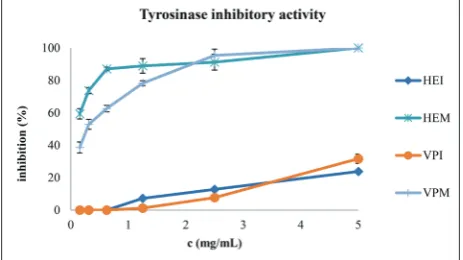
Autolysis had a huge impact on the ability of puff-ball extracts to inhibit tyrosinase as well (Table3, Fig 2). HEI and VPI only weakly inhibited tyrosinase, reaching 24 and 32%, respectively, of the activity at the highest concentration (5 mg/mL). On the other hand, HEM and VPM showed excellent inhibitory activity, attaining more than 90% of enzyme inhibi-tion at the concentrainhibi-tion of 2.5 mg/mL; in the case of HEM, the IC50was below the lowest concentration used (<0.156 mg/mL), while for VPM it was higher, but still significant (0.28 mg/mL).
The extracts exhibited varying activities towards bacterial strains but no activity against C. albicans (Ta-ble 4). HEI had the best overall activity, displaying inhibitory activity on the growth of alltested bacterial strains, which was slightly more pronounced against Gram(-) bacteria (E. coliandP. aeruginosa, MIC=1.25 mg/mL).Significant activity was achieved against MRSA (MIC=5 mg/mL; MBC=20 mg/mL). The same MIC was obtained for the ATCC strain of S. aureus, and the sample was shown to be even more active against E. faecalis (MIC=2.5 mg/mL). On the other
hand,VPI was less active against all examined strains, with best activity achieved against E. coli (MIC=5 mg/ mL) and no activity against E. faecalis and C. albicans. The growth of other strains was inhibited only at the highest concentration used (20 mg/mL), and the sam-ple showed no bactericidal activity. HEM and VPM were tested only against MRSA(MIC=20 mg/mL), as their antimicrobial activity against other ATCC strains was the subject of a previous study.
DISCUSSION
When compared with the extraction yields previously obtained for mature fruiting bodies (DER=6.1 and 5.9 for HEM and VPM, respectively [7]), the extraction yield for the immature fruiting bodies differed signifi-cantly. The slightly greater yield obtained for HEI and VPI was probably due to the fact that mature gleba represents a spore-bearing mass, with thick-walled spores being more difficult to extract; this could be overcome by modification of the extraction conditions.
The autolysis clearly led to a decrease in the sugar content in the extracts, as the total sugar content in the immature fruiting body extracts was between 25-30
Fig. 2. In vitro tyrosinase inhibitory activity of the methanol ex-tracts of the immature and mature fruiting bodies of Handkea
excipuliformis (HEI and HEM, respectively) and Vascellum
prat-ense (VPI and VPM, respectively). Results are presented as the mean±SD.
Table 4. Antimicrobial activities of the methanol extracts of im-mature and im-mature fruiting bodies of Handkea excipuliformis
(HEI and HEM, respectively) and Vascellum pratense (VPI and VPM, respectively), amoxicillin (AMX) and fluconazole (FLU), expressed as minimum inhibitory (MIC, mg/mL) and minimum bactericidal concentration (MBC, mg/mL), determined by the broth microdilution method.
Microbial
strain HEISampleVPI AMX FLUStandard
Staphylococcus
aureus 65381 MICMBC -52 20- 0.00020.0014
Staphylococcus
aureus MRSA* MICMBC 205 20- -
-Enterococcus
faecalis 29212 MICMBC 2.5- -- 0.00030.0027
Pseudomonas
aeruginosa 27853 MICMBC 1.25 - 20- 0.02170.0434
Escherichia coli
25922 MICMBC 1.25- 5- 0.00540.0217
Candida
albicans 10259 MICMBC -- -- 0.01250.0500
1ATCC number of the microbial strain. 2Not achieved.
%, and in the mature fruiting body extracts less than 10% [7]. Sugars can be used for energy during autoly-sis or, in the case of trehalose, they can accumulate in the spores [14], which would make the extraction difficult. Trehalose is an important stress protectant in fungi, helping them to survive periods of unsuitable conditions, such is extremely dry or cold weather [15]. It is therefore used in medicine and science as cryo-protectant for various types of cells, tissues, proteins and lipid membrane systems, as well as in cosmetic products [16].
The extracts of the mature fruiting bodies con-tained another physiologically active sugar, N -acetyl-glucosamine, the monomer of the polysaccharide chitin, which is one of the constituents of fungal cell wall. N-acetylglucosamine is also one of the building units of hyaluronic acid, the polysaccharide of human connective tissue, which is important for maintaining skin integrity and which has acquired growing us-age in anti-aging skin products. It was proposed that
N-acetylglucosamine itself could be used in wound healing and wrinkle treatment products as well [17]. This sugar is not present in young mushrooms, since it is the product of chitinolysis. In a previous study, it was speculated that the total N-acetylglucosamine content in the extract of the mature gleba of another puffball species, Handkea utriformis (26 mg/g), would have been higher [4] since chitin contributes to a con-siderable percentage of fungal tissue [18]. However, if hydrolysis was incomplete, there could be oligomers of N-acetylglucosamine present in the mature gleba [4]. N-acetylglucosamine oligomers were found to be biologically active as well, possessing immunomodu-lating properties [19].
The extracts of the mature fruiting bodies have higher contents of phenolic compounds (HEM=14.93 mg/g; VPM=20.25 mg/g), as was previously report-ed [7], although the difference was not as significant when considering DER differences. The phenolic content in young puffball extracts is very similar to that determined for other mushrooms [20] and for
Lycoperdon molle and L. perlatumpuffballs (11.48 and
10.57 mgGAEs/g of extract, respectively) [21]. None of the tested ubiquitous phenolic acids were detected in the extracts, indicating that different structures were present in these mushrooms. Phenolic acids were not detected in L. perlatum either, while only traces
ofp-hydroxybenzoic and vanillic acid were found in
L. molle (41.66 and 39.99 mg/kg dry mass,
respec-tively) [22]. Phenolic compounds and antioxidants in general have been shown to have beneficial effects on the skin, especially in preventing premature skin aging and wrinkling [23].
The difference in the total amount of metha-nol-extractable α-tocopherol present in young and mature fruiting bodies of V. pratense practically does not exist when the difference in DER is con-sidered. In a previous study, the higher content of α-tocopherol was found in the methanol extract of the mature fruiting bodies of H. utriformis [4], as in the case of H. excipuliformis. Since tocopherols are responsible for maintaining cell membrane integrity in plants by preventing lipid oxidation, their concen-trations may vary depending on different stress fac-tors [24], and their role in fungi could be the same. Autolysis does not affect α-tocopherol concentration negatively and may actually cause its production and/or better availability for extraction. In a previ-ous study, several mushroom specieswere tested for the presence of α-, β- and γ-tocopherols, and only α-tocopherol was found in two puffball species (
Ly-coperdon perlatum and L. molle), while most of the
other tested mushrooms contained higher levels of β-tocopherol [21].Autolysis leads to higher avail-ability of extractable ergosterol, which is associated with cell membranes,although much higher contents of both ergosterol and α-tocopherol were reported for the methanol extract of the mature fruiting bod-ies of H. utriformis [4]. Higher amounts of total free fatty acids were also reported earlier for the extracts of the mature fruiting bodies of H. excipuliformis and
V. pratense [7], especially in the case of V. pratense
(HEM=9.64 mg/g; VPM=20.27 mg/g).Linoleic acid, which was found to be important in wound healing and skin regeneration processes [25], was the most abundant component of the free fatty acid fraction in HEM and VPM as well, and autolysis led to its syn-thesis or/and higher availability. Another unsaturated fatty acid, oleic acid, which was shown to have similar properties [26], was also found in higher concentra-tion in the extracts of mature fruiting bodies.
-acetylglucosamine, α-tocopherol, ergosterol, linoleic acid and phenolics), and many of them are probably involved in skin regeneration [23,26-28]. However, the extraction processes need to be optimized as these compounds have different hydrophilic/hydrophobic characteristics. Methanol extracts of H. utriformis were shown to follow the same pattern [4], which may be universal for all puffballs, or even for all “gasteromycet-es”. In the case of H. utriformis, all tested compounds were found in significantly higher amounts in the mature gleba extract, which may be due to interspe-cific differences, or it could be linked to the degree of autolysis. The mature gleba of the aforementioned species, which was the subject of a previous study [4], has a more powdery consistence, a property hard to quantify, which may be due to the higher activity of hydrolytic enzymes involved in autodigestion.
Mature fruiting body extracts possessed better antioxidant activity, in general. Radical scavenging activity correlates well with the total phenolic content of the samples (R2=0.8), whereas the reduction
abil-ity of the extracts clearly depends on other types of molecular groups as well, since HEI showed almost the same activity as HEM and VPM at higher concen-trations. The greatest difference in activity between the extracts of immature and mature fruiting bodies was detected in the β-carotene bleaching assay, with EC50 values of HEM and VPM being below the lowest concentration used (<0.156 mg/mL), indicating that these extracts could provide great protection of lipid membranes against damage caused by (per)oxidation. However, at higher concentrations, there was a decline in the activity of VPM. It was shown that antioxidants, such are phenolics, may also have prooxidant activ-ity, depending on the circumstances, and VPM might contain such molecular groups [29].
Phenolic compounds, α-tocopherol and ergoster-ol all possess antioxidant activity [24,29-31] and are found in higher concentrations in the extracts of ma-ture fruiting bodies; however, many other unknown metabolites are probably involved. Although phenolics may prevent lipid peroxidation [32], lipophilic com-pounds such are tocopherols and ergosterol may show a greater effect in the β-carotene bleaching assay.
Tyrosinase inhibitory activity correlates with the total phenol content, and since the aromatic amino
acids, tyrosine and L-DOPA are tyrosinase sub-strates[33], it was found that other natural phenolic compounds found in plants may act as tyrosinase in-hibitors as well. Phenolic acids such are ferulic, caffeic, ellagic and p-coumaric acid are known inhibitors of tyrosinase and are found in many extracts of different mushroom species [34-37], but none of these com-pounds were detected in our extracts. As the extracts of mature fruiting bodies possess much more pro-nounced activities than those obtained from young fruiting bodies(with HEM and VPM reaching EC50 at 0.156 and 0.28 mg/mL, respectively, while the ex-tracts of the immature fruiting bodies did not reach EC50 even at the highest concentration used (5 mg/ mL)), it is probable that specific phenolic compounds that are created during the maturation process could be responsible for the activity; however, they are yet to be isolated and characterized. These compounds may be methanol-soluble puffball pigments, as the gleba turns dark brown during autolysis of puffballs and the methanol extracts of the mature fruiting bod-ies are darker in color. There are only a few studbod-ies about mushroom inhibitory activity towards tyrosi-nase, and mature gleba extracts have been shown to be much more potent inhibitors than extracts from most mushroom species, except for petroleum and butanol extracts of the medicinal mushroom chaga
(Inonotus obliquus) [11,34,38]. A phenoxazine
com-pound (2-amino-3H-phenoxazin-3-one) isolated from the white button mushroom (Agaricus bisporus) was shown to be a potent tyrosinase inhibitor, but this compound does not act as a direct inhibitor of the enzyme, it acts as a gene expression regulator [39]. Tyrosinase inhibitors such is kojic acid isolated from
Aspergillus spp. are used in medicinal and cosmetic
products to treat hyperpigmentation [40]. Retinoids are also used as they downregulate enzyme synthe-sis [41] but may cause an adverse reaction, known as “retinoid dermatitis” [42]. Hyperpigmentation occurs as a consequence of several medical conditions, most important being postinflammatory hyperpigmenta-tion, solar lentigos and melasma [41]. The mature puffball extracts are good candidates to be used in the treatment of such conditions as they might regu-late pigmentation on several levels. Aside from direct inhibition of the enzyme, these extracts contain free
the extracts possess very strong radical scavenging activity and reactive oxygen species (ROS) are among the known stimulators of melanocytes [41]. The cop-per reduction ability may lower the available Cu2+
ions, which are required as tyrosinase cofactors [43]. Maturation affected the antimicrobial activity of the extracts differently. In H. excipuliformis it caused a decrease in antibacterial activity, which was several times lower for HEM, with MIC values against most bacterial strains being 20 mg/mL (previously pub-lished, except for MRSA [7]). Also, the slight selectiv-ity of HEI towards two Gram(-) strains was not ob-served in HEM. Similar results were found in previous studies in which the antimicrobial activity of another puffball species, H. utriformis, was examined [4,7]. On the other hand, there wasa little difference in the activity of VPI and VPM (the resultsof antimicrobial activity of VPM were previously published [7], except for MRSA), which were not active against all tested strains, and the obtained MIC values were relatively high (mostly 20 mg/mL for both samples). There was, however, a trend of decrease in the activity against Gram(-) strains upon maturation, the same as in the case of H. excipuliformis.While VPI was active against
P. aeruginosa (MIC=20 mg/mL), VPM did not show
any activity. Also, VPI was most active against E. coli
(MIC=5 mg/mL) and maturation of the fruiting bodies caused some decrease in the activity (MIC=20 mg/mL for VPM). On the other hand, VPM was most active againstE. faecalis (MIC=5 mg/mL), the strain against which VPI showed no activity at all. Calvatic acid is an antibacterial agent isolated from several species of puffballs [44,45], although it could not be detected or quantified in the extracts. The gleba of mature fruiting bodies, despite the fact that it has been used in tradi-tional medicine to treat open wounds, doesnot seem to possess significant antimicrobial activity.
All samples were active against MRSA, which is a multiresistant strain that causes complications in hos-pitalized patients (mostly skin infections), in particu-larHEI, which exhibited bactericidal activity against it. Puffballs, which have been used in their ma-ture stadium as wound dressings and for the treat-ment of some skin conditions, are indeed a promis-ing candidates for wound healpromis-ing and various skin care products. The autolysis they undergo slightly
increasesthe availability of some biologically active compounds involved in skin care and skin regenera-tion, such are N-acetylglucosamine, ergosterol (provi-tamin D2), α-tocopherol (vitamin E), linoleic acid and phenolic compounds. Optimization of the extraction conditions could improve their yields, since these are compounds with different polarity. Nevertheless, the extracts proved very active in biological assays. Au-tolysis affected positively the antioxidant capacity of the extracts and vastly improved their ability to inhibit tyrosinase, the enzyme responsible for the produc-tion of melanin, which is sometimes undesired, as for example in cases of postinflammatory hyperpigmen-tation. Although autolysis may negatively affect the antimicrobial activity of the extracts, they still possess relatively good activity, including inhibitory activity on MRSA, which mostly causes skin infections. The extracts also contain trehalose, a sugar thatis used in cosmetic products as a very effective humectant. The findings of this and previous studies not only justify the traditional use of puffballs, but they also open a new chapter in the potential exploitation of these unique mushrooms.
Funding: This investigation was financially supported by the Min-istry of Science and Technological Development of the Republic of Serbia, project III 46010.
Acknowledgments: The authors wish to express their gratitude to Boris Ivančević (Department of Mycology and Lichenology, Natural History Museum, Belgrade) for the identification of the samples used in this research.
Author contributions: PP participated in all experiments and wrote the draft version of the manuscript. KI and MK were both involved in the experiments concerning antioxidant and tyrosi-nase inhibitory activities, the literature search and review of the manuscript. MS and MP were involved in sugar analysis. VM performed HPLC analysis of α-tocopherol and phenolic acids. AC performed GC-MS analysis of ergosterol and free fatty acids. AJ participated in literature search and writing. The whole process was supervised by BB and AK, who also reviewed the manuscript. All authors approved the final manuscript.
Conflicts of interest disclosure: The authors have no conflicts of interest to declare.
REFERENCES
2. Coetzee J, van Wyk A. The genus Calvatia (Gasteromycetes, Lycoperdaceae): A review of its ethnomycology and biotech-nological potential. Afr J Biotechnol. 2009;8(22):6007-15. 3. Læssøe T, Spooner B. The uses of ‘Gasteromycetes’.
Mycolo-gist. 1994;8(4):154-9.
4. Petrović P, Vunduk J, Klaus A, Carević M, Petković M, Vuković N, Cvetković A, Žižak Ž, Bugarski B. From myce-lium to spores: A whole circle of biological potency of mosaic puffball. S Afr J Bot. 2019;123:152-60.
5. Skotti E, Anastasaki E, Kanellou G, Polissiou M, Tarantilis PA. Total phenolic content, antioxidant activity and toxic-ity of aqueous extracts from selected Greek medicinal and aromatic plants. Ind Crop Prod. 2014;53:46-54.
6. DuBois M, Gilles KA, Hamilton JK, Rebers PA, Smith F. Col-orimetric Method for Determination of Sugars and Related Substances. Anal Chem. 1956;28(3):350-6.
7. Petrović P, Vunduk J, Klaus A, Kozarski M, Nikšić M, Žižak Ž, Vuković N, Šekularac G, Drmanić S, Bugarski B. Bio-logical potential of puffballs: A comparative analysis. J Funct Foods. 2016;21:36-49.
8. Re R, Pellegrini N, Proteggente A, Pannala A, Yang M, Rice-Evans C. Antioxidant activity applying an improved ABTS radical cation decolorization assay. Free Radic Biol Med. 1999;26(9-10):1231-7.
9. Özyürek M, Güçlü K, Apak R. The main and modified CUPRAC methods of antioxidant measurement. Trac-Trend Anal Chem. 2011;30(4):652-64.
10. Barros L, Ferreira M, Queirós B, Ferreira IC, Baptista P. Total phenols, ascorbic acid, β-carotene and lycopene in Portu-guese wild edible mushrooms and their antioxidant activi-ties. Food Chem. 2007;103(2):413-9.
11. Alam N, Yoon KN, Lee JS, Cho HJ, Lee TS. Consequence of the antioxidant activities and tyrosinase inhibitory effects of various extracts from the fruiting bodies of Pleurotus ferulae Saudi J Biol Sci. 2012;19(1):111-8.
12. CLSI. Performance standards for antimicrobial susceptibil-ity testing: 15th informational supplement. CLSI document M100-S15PA, USA: Wayne. 2005.
13. Klaus A, Kozarski M, Vunduk J, Todorovic N, Jakovljevic D, Zizak Z, Pavlovic V, Levic S, Niksic M, Van Griensven LJ. Bio-logical potential of extracts of the wild edible Basidiomycete mushroom Grifola frondosa. Food Res Int. 2015;67:272-83. 14. Thevelein JM. Regulation of Trehalose Metabolism and Its
Relevance to cell Growth and Function. In: Brambl R, Mar-zluf GA, editors. Biochemistry and Molecular Biology. The Mycota (A Comprehensive Treatise on Fungi as Experimen-tal Systems for Basic and Applied Research). Vol 3. Berlin, Heidelberg: Springer; 1996. p. 395-420.
15. Wiemken A. Trehalose in yeast, stress protectant rather than reserve carbohydrate. Antonie van Leeuwenhoek. 1990;58(3):209-17.
16. Richards A, Krakowka S, Dexter L, Schmid H, Wolterbeek A, Waalkens-Berendsen D, Shigoyuki A, Kurimoto M. Tre-halose: a review of properties, history of use and human tolerance, and results of multiple safety studies. Food Chem Toxicol. 2002;40(7):871-98.
17. Pedrali A, Bleve M, Capra P, Jonsson T, Massolini G, Peru-gini P, Marrubini G. Determination of N-acetylglucosamine in cosmetic formulations and skin test samples by
hydro-philic interaction liquid chromatography and UV detection. J Pharmaceut Biomed. 2015;107:125-30.
18. Nitschke J, Altenbach H, Malolepszy T, Mölleken H. A new method for the quantification of chitin and chitosan in edible mushrooms. Carbohydr Res. 2011;346(11):1307-10. 19. Harish Prashanth K, Tharanathan R. Chitin/chitosan:
modi-fications and their unlimited application potential—an over-view. Trends Food Sci Technol. 2007;18(3):117-31. 20. Butkhup L, Samappito W, Jorjong S. Evaluation of bioactivities
and phenolic contents of wild edible mushrooms from north-eastern Thailand. Food Sci Biotechnol. 2017;27(1):193-202. 21. Barros L, Venturini BA, Baptista P, Estevinho LM, Ferreira
IC. Chemical Composition and Biological Properties of Por-tuguese Wild Mushrooms: A Comprehensive Study. J Agric Food Chem. 2008;56(10):3856-62.
22. Barros L, Dueñas M, Ferreira IC, Baptista P, Santos-Buelga C. Phenolic acids determination by HPLC–DAD–ESI/MS in sixteen different Portuguese wild mushrooms species. Food Chem Toxicol. 2009;47(6):1076-9.
23. Cujic N, Zugic A, Zivkovic J, Zdunic G, Savikin K. Pre-liminary safety estimate of cosmetic anti-age creams with chokeberry extract, using in vivo bioengineering techniques. Lekovite Sirovine. 2017;37:41-4.
24. Saini RK, Keum Y. Tocopherols and tocotrienols in plants and their products: A review on methods of extraction, chromatographic separation, and detection. Food Res Int. 2016;82:59-70.
25. Silva JR, Burger B, Kühl CM, Candreva T, Dos Anjos MB, Rodrigues HG. Wound Healing and Omega-6 Fatty Acids: From Inflammation to Repair. Mediat Inflamm. 2018; 2018:1-17.
26. Pereira LM, Hatanaka E, Martins EF, Oliveira F, Liberti EA, Farsky SH, Curi R, Pithon-Curi TC. Effect of oleic and lin-oleic acids on the inflammatory phase of wound healing in rats. Cell Biochem Funct. 2008;26(2):197-204.
27. Hobson R. Vitamin E and wound healing: an evidence-based review. Int Wound J. 2014;13(3):331-5.
28. Ding J, Kwan P, Ma Z, Iwashina T, Wang J, Shankowsky HA, Tredget EE. Synergistic effect of vitamin D and low con-centration of transforming growth factor beta 1, a potential role in dermal wound healing. Burns. 2016;42(6):1277-86. 29. León-González AJ, Auger C, Schini-Kerth VB. Pro-oxidant
activity of polyphenols and its implication on cancer che-moprevention and chemotherapy. Biochem Pharmacol. 2015;98(3):371-80.
30. Amirullah NA, Zainal Abidin N, Abdullah N. The potential applications of mushrooms against some facets of athero-sclerosis: A review. Food Res Int. 2018;105:517-36. 31. Jovanovic A, Petrovic P, Ðordjevic V, Zdunic G, Savikin
K, Bugarski B. Polyphenols extraction from plant sources. Lekovite Sirovine. 2017;37:45-9.
32. Nestorovic-Zivkovic J, Zivkovic S, Siler B, Anicic N, Dmi-trovic S, Divac-Rankov A, Giba Z, Misic D. Differences in bioactivity of three endemic Nepeta species arising from main terpenoid and phenolic constituents. Arch Biol Sci. 2018;70(1):63-76.
34. Taofiq O, González-Paramás AM, Martins A, Barreiro MF, Ferreira IC. Mushrooms extracts and compounds in cosmet-ics, cosmeceuticals and nutricosmetics-A review. Ind Crop Prod. 2016;90:38-48.
35. Zengin, G, Uysal S, Ceylan R, Aktumsek A. Phenolic con-stituent, antioxidative and tyrosinase inhibitory activity of Ornithogalum narbonense L. from Turkey: A phytochemical study. Ind Crop Prod. 2015;70:1-6.
36. Paun G, Neagu E, Albu C, Radu GL. Verbascum phlomoides
and Solidago virgaureae herbs as natural source for
prevent-ing neurodegenerative diseases. J Herb Med. 2016;6(4):180-6. 37. Arumugam R, Kirkan B, Sarikurkcu C. Phenolic profile, antioxidant and enzyme inhibitory potential of methanolic extracts from different parts of Astragalus ponticus Pall. S Afr J Bot. 2018;120:268-73.
38. Kozarski M, Klaus A, Jakovljevic D, Todorovic N, Wan-Mohtar W, Niksic M. Ganoderma lucidum as a cosmeceu-tical: Antiradical potential and inhibitory effect on hyper-pigmentation and skin extracellular matrix degradation enzymes. Arch Biol Sci. 2019;71(2):253-64.
39. Miyake M, Yamamoto S, Sano O, Fujii M, Kohno K, Ushio S, Iwaki K, Fukuda S. Inhibitory Effects of
2-Amino-3H-phenoxazin-3-one on the Melanogenesis of Murine B16 Melanoma Cell Line. Biosci Biotechnol Biochem. 2010;74(4):753-8.
40. Ariff A, Salleh M, Ghani B, Hassan M, Rusul G, Karim M. Aeration and yeast extract requirements for kojic acid pro-duction by Aspergillus flavus link. Enzyme Microb Technol. 1996;19(7):545-50.
41. Ortonne J, Bissett DL. Latest Insights into Skin Hyperpig-mentation. J Invest Derm Symp P. 2008;13(1):10-4. 42. Darlenski R, Surber C, Fluhr J. Topical retinoids in the
manage-ment of photodamaged skin: from theory to evidence-based practical approach. Brit J Dermatol. 2010;163(6):1157-65. 43. Solano F. On the Metal Cofactor in the Tyrosinase Family.
Int J Mol Sci. 2018;19(2):633
44. Gasco A, Serafino A, Mortarini V, Menziani E, Bianco MA, Ceruti Scurti J. An antibacterial and antifungal compound from Calvatia lilacina. Tetrahedron Lett. 1974;15(38):3431-2. 45. Umezawa H, Takeuchi T, Iinuma H, Ito M, Ishizuka M,