Proceedings of the
Eighth International Workshop on
Graph Transformation and Visual Modeling Techniques
(GT-VMT 2009)
Parallelization of Graph Transformation
Based on Incremental Pattern Matching
G´abor Bergmann, Istv´an R´ath, D´aniel Varr´o
15 pages
Guest Editors: Artur Boronat, Reiko Heckel
Managing Editors: Tiziana Margaria, Julia Padberg, Gabriele Taentzer
Parallelization of Graph Transformation
Based on Incremental Pattern Matching
G´abor Bergmann1, Istv´an R´ath2, D´aniel Varr´o3
1 2 3(bergmann,rath,varro)@mit.bme.hu,http://www.inf.mit.bme.hu/FTSRG/
M´er´estechnika ´es Inform´aci´os Rendszerek Tansz´ek (MIT),
Budapesti M˝uszaki ´es Gazdas´agtudom´anyi Egyetem (BME), Budapest, Hungary
Abstract: Graph transformation based on incremental pattern matching explicitly stores all occurrences of patterns (left-hand side of rules) and updates this result cache upon model changes. This allows instantaneous pattern queries at the expense of costlier model manipulation and higher memory consumption.
Up to now, this incremental approach has considered only sequential execution de-spite the inherently distributed structure of the underlying match caching mecha-nism. The paper explores various possibilities of parallelizing graph transformation to harness the power of modern multi-core, multi-processor computing environ-ments: (i) incremental pattern matching enables the concurrent execution of model manipulation and pattern matching; moreover, (ii) pattern matching itself can be parallelized along caches.
Keywords:graph transformation, incremental pattern matching, parallelization
1
Introduction
Nowadays, a main challenge of software engineering is the adaptation to parallel computing ar-chitectures. In order to increase execution speed, algorithm designers need to think of new ways to exploit the computing power of multi core processors instead of purely relying on more effi-cient processor designs. Experience has shown that this is a complicated task: whether parallel execution can actually be effectively applied depends largely on the problem itself.
Model transformation is an application domain where speed optimization based on parallel execution has a lot of potential, especially in case of large, industrial models. In fact, model transformations seem to be an ideal target for parallel execution as in practical transformations, many similar, or almost identical model structures need to be traversed and transformed. Fre-quently, these model manipulation sequences are non-conflicting, which naturally calls for an execution model where these sequences are executed on the available processors in parallel.
Incremental pattern matching [B ¨OR+08] offers an entirely different execution model com-pared to local search-based implementations. The match sets for all patterns involved in the graph transformation are computed in an initialization phase prior to execution (e.g. when the model itself is loaded into memory), and as the transformation progresses, this match set cache is incrementally updated as the model graph changes (update phases). Thus, model search phases are reduced to fast read-from-cache operations, in exchange for the overhead imposed by cache update phases which occur synchronously with model manipulation operations. Benchmark-ing [BHRV08] has shown that in certain scenarios, this approach leads to several orders-of-magnitude increases in speed.
In the current paper, we introduce novel extensions to the incremental pattern matcher of the VIATRA2 framework, which is based on RETE networks [For82], to exploit parallelism based on asynchronous model updates and multi-threaded match set caching.
First,update phases may be executed concurrentlyto the model transformation’s main execu-tion thread. In this case, the cache validaexecu-tion thread of the match set may execute concurrently with model manipulation sequences or textual output emission, e.g. in the case of code genera-tion transformagenera-tions. This approach aims to reduce the overhead imposed by update phases, in the case when parallel computing power is available.
Then, if further scaling up is required, the implementation of thematch set cache updating can be multi-threaded. It is important to point out that both of these approaches are significantly different from parallelized pattern search. Finally, as incremental pattern matching provides fast cache-reading operations, it supportsparallel transformation executionby allowing simultane-ous access to caches from multiple threads. By improving this scenario with concurrent update phases, model manipulation protected by locks will no longer force other transformation threads to wait for the termination of the time-consuming update. As a consequence, read-intensive transformations are expected to scale well with parallel computational capacity.
The rest of the paper is structured as follows. Section 2 gives a brief introduction on graph transformations.Section 3describes RETE, and its implementation in the VIATRA2 model
trans-formation framework. The main contributions of the paper are presented inSection 4, where we present ways of parallelizing both pattern matching and model manipulation. Implementation details are revealed inSection 5. Finally, we discuss related work inSection 6and conclude the paper inSection 7.
2
Foundations of model transformation
This section gives an overview on the foundations of the specification and simulation of model-ing languages. In order to specify the abstract syntax of the modelmodel-ing language, the concept of metamodeling is used. For transforming models to other models or generated code, and simulat-ing the behaviour of models, the paradigm of graph transformation [Roz97] is applied.
2.1 Model transformation example: Petri nets
simulation example.
Figure 1: A sample Petri net.
Petri nets (Figure 1) are widely used to formally capture the dynamic semantics of concurrent systems due to their easy-to-understand visual notation and the wide range of available analysis tools. Petri nets are bipartite graphs, with two disjoint sets of nodes: PlacesandTransitions. Places may contain an arbitrary number of Tokens. A token distribution (marking) defines the state of the modelled system. The state of the net can be changed by firing enabled transitions. A transition is enabled if each of its input places contains at least one token and no place connected with an inhibitor arc contains a token (if no arc weights are considered). When firing a transition, we remove a token from all input places (connected to the transition by Input Arcs) and add a token to all output places (as defined by Output Arcs).
2.2 Foundations of metamodeling
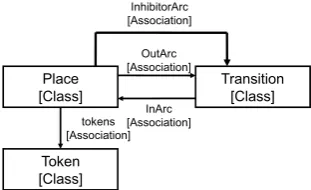
Figure 2: Petri net metamodel.
A metamodel describes the abstract syntax of a
mod-eling language. Formally, it can be represented by a type graph. Nodes of the type graph are called
classes. A class may have attributes that define
some kind of properties of the specific class.
Inher-itance may be defined between classes, which means
that the inherited class has all the properties its par-ent has, but it may further contain some extra
at-tributes. Associations define connections between
classes. Figure 2 shows a simple Petri net meta-model.
2.3 Graph patterns and graph transformation
Graph patternsare frequently considered as the atomic units of model transformations [VB07]. They represent conditions (or constraints) that have to be fulfilled by a part of the instance model in order to execute some manipulation steps on the model. A basic graph pattern consists of graph elements corresponding to the metamodel. Anegative application condition(NAC) prescribes contextual conditions for the original pattern which are forbidden in order to find a successful match. Figure 10presents a simple graph pattern consisting of a PlaceP, a TransitionT and an OutArcAto enumerate the source places connected to a given transition.
P: Place : OutArc T : Transition
sourcePlace (T,P) pattern sourcePlace(T, P) = {
transition(T); place(P); outArc(A, P, T); }
Figure 3: Matcher for thesourcePlacepattern
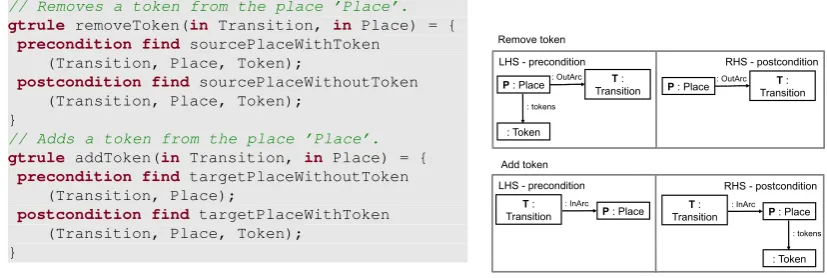
deleted, elements that are present only in the RHS are created, and other model elements remain unchanged (in accordance with the single-pushout approach in VIATRA2). For instance, a GT rule may specify how to remove (or add) a token from a place, as shown inFigure 4.
// Removes a token from the place ’Place’.
gtrule removeToken(in Transition, in Place) = {
precondition find sourcePlaceWithToken (Transition, Place, Token);
postcondition find sourcePlaceWithoutToken (Transition, Place, Token);
}
// Adds a token from the place ’Place’.
gtrule addToken(in Transition, in Place) = {
precondition find targetPlaceWithoutToken (Transition, Place);
postcondition find targetPlaceWithToken (Transition, Place, Token);
}
Figure 4: Graph transformation rules for firing a transition
Complex model transformation can be assembled from elementary graph patterns and graph transformation rules using some kind of control language. In our examples, we use abstract state machine (ASM) [BS03] for this purpose as available in the VIATRA2 framework. The following transformation simulates the firing of a transition, i.e. the removal of tokens from input places and the addition of tokens to output places (seeFigure 5).
rule fireTransition(in T) = seq {
if (find isTransitionFireable(T)) // confirm that the transition is fireable
seq {
forall Place with find sourcePlace(T, Place) // remove tokens from all source places
do apply removeToken(T, Place); // GT rule invocation
forall Place with find targetPlace(T, Place) // add tokens to all target places
do apply addToken(T, Place); }
}
3
RETE-based incremental graph pattern matching
The incremental graph pattern matcher of the VIATRA2 framework adapts [B ¨OR+08] the RETE algorithm, which is a well-known technique in the field of rule-based systems.
RETE network for graph pattern matching RETE-based pattern matching relies on a net-work of nodes storing partial matches of a graph pattern. A partial match enumerates those model elements which satisfy a subset of the constraints described by the graph pattern. In a relational database analogy, each node stores aview. Matches of a pattern are readily available at any time, and they will be incrementally updated whenever model changes occur.
Input nodesserve as the underlying knowledge base representing a model. There is a separate input node for each entity type (class), containing a view representing all the instances that conform to the type. Similarly, there is an input node for each relation type, containing a view consisting of tuples with source and target in addition to the identifier of the edge instance.
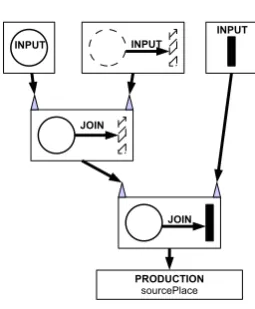
Figure 6: Simple RETE matcher
At eachintermediate node, set operations(e.g. filter-ing, projection, join, etc.) can be executed on the match sets stored at input nodes to compute the match set which is stored at the intermediate node. The match set for the entire pattern can be retrieved from the outputproduction node. One kind of intermediate node is the join node, which performs a natural join on its parent nodes in terms of relational algebra; whereas a negative node contains the set of tuples stored at the primary input which donot
match any tuple from the secondary input (which corre-sponds to anti-joins in relational databases).
As an illustration, Figure 6 shows a RETE network matcher built for thesourcePlace(seeFigure 10) pattern illustrating the use of join nodes. By joining three in-put nodes (the top-most nodes onFigure 6), this sample RETE net enforces two entity type constraints (’Place’ and ’Transition’ entity types on the left and right input nodes) and an edge (connectivity) con-straint (corresponding to the relation connecting the ’Place’ and ’Transition’ entity types), to find pairs of Places and Transitions connected by an out-arc.
Updates after model changes.Input nodes receive notifications about each elementary model change (i.e. when a new model element is created or deleted) and release an update token on each of their outgoing edges. Such an update token represents changes in the partial matches stored by the RETE node. Positive update tokens reflect newly added tuples, and negative updates refer to tuples being removed from the set. Upon receiving an update token, a RETE node determines how the set of stored tuples will change, and release update tokens of its own to signal these changes to its child nodes. This way, the effects of an update will propagate through the network, eventually influencing the result sets stored in production nodes.
4
Parallel transformation with incremental pattern matching
This sectionpresents our conceptual contributions to the parallel execution of model transforma-tions. First,Subsection 4.1will discuss in detail how the asynchronous RETE approach allows the update phases to be executed in the background, while the transformation continues uninter-rupted. InSubsection 4.2, we generalise this approach to multiple RETE threads for systems with more than two CPU cores, based on the multi-threaded RETE maching set cache. The proposed pattern matcher is applied to a multi-threaded model manipulation context inSubsection 4.3to let the model manipulation phase take advantage of the number of CPU cores.
4.1 Concurrent pattern matching and model manipulation
Contrary to our previous work, the RETE net implementation used throughout this paper relies onasynchronousmessage passing. This involves amessage queueattached to the network, con-taining update messages manifested as objects. Each message object specifies a recipient node, the tuple representing the update, and the sign (insertion or deletion). The message consump-tion cycle fetches the first message from the queue and delivers it to the appropriate node; the node will place any propagated output messages to the end of the queue, thereby achieving asyn-chronous messaging. Change notifications issued by model manipulation are simply put into the queue; then the update propagation phase consists of looping the message consumption cycle until the queue becomes empty.
transformation RETE
change notification
change notification
pattern query
(a) General concept
transformation RETE
sourcePlace query
token removed notification
targetPlace query
token removed notification
token added notification
(b)fireTransitionconcurrently (c) Petri net states
Figure 7: Concurrent pattern matching
The thread of the pattern matcher will execute the update propagation in the background, ideally, without imposing a performance penalty on the transformation thread. When the message queue becomes empty, the RETE network has reached afixpoint; the pattern matcher thread then goes to sleep and will not resume its operation until a new update message is posted.
When the transformation initiates pattern matching, it has to assure that background update propagations have terminated and the matches stored at the production nodes are up-to-date; so if necessary, it will have to sleep until RETE reaches its fixpoint.
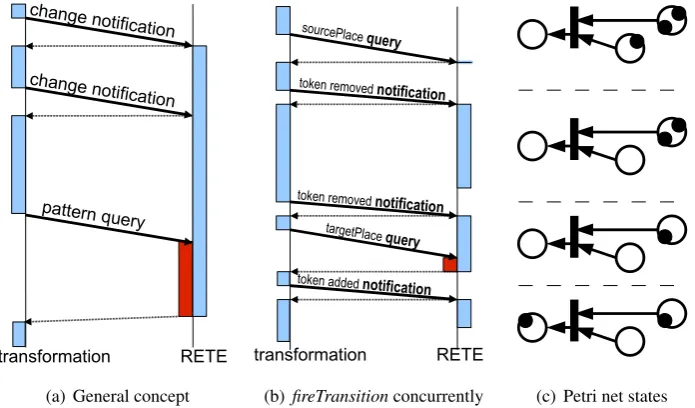
Figure 7(b)shows how the Petri net firing rulefireTransition(defined inFigure 5) may behave in such a concurrent system. (i) First, the set of source places is fetched instantaneously from the pattern matcher. (ii) Then, one token is deleted in every source place, each of them issueing a notification to the pattern matcher thread that results in some update propagation in the RETE net. (iii) Next, the list of target places is retrieved after update propagation is finished. (iv) Finally, a new token is created at each target place, resulting in subsequent notifications. Figure 7(c) displays the corresponding states of the Petri net model.
Initial performance results. While the local search based pattern matchers operate with cheap model changes and costly pattern queries, the sequential RETE-based matcher [B ¨OR+08] has a moderate overhead on model change balanced by instant pattern queries. This novel concurrent incremental pattern matching approach combines the advantages of the former two: it has cheap model manipulation costs, and potentially instant pattern queries. Although the transformation might have to wait for the termination of the background pattern matcher thread, the worst case of this time loss is still comparable to the update overhead of the original RETE approach.
This concurrent approach is expected to improve performance over a non-concurrent im-plementation (as described inSection 3) if there are comparatively infrequent pattern matcher queries and complex model changes between them. This would correspond to aforallstyle con-trol flow when all matches of a pattern are obtained first, and then each of them is processed (po-tentially) simultaneously, which is common in model-to-model transformation scenarios. This complements the traditional advantage of incremental pattern matching, which manifested espe-cially onas long as possiblestyle control flows: when single matches are selected and processed one by one until there are no matches of the pattern.
Initial experiments1have shown that the concurrent approach improves performance by up to 20% on the Sierpinsky benchmark of [SNZ08]. For building a Sierpinsky-triangle of 8, 9 and 10 generations, our original RETE ran for 2.6s, 8.3s, and 26.2s, while the concurrent solution took 2.2s, 6.9s, 22.8s to terminate, respectively.
4.2 Multi-threaded pattern matching with RETE
The concurrent patten matching approach can be improved further given that the hardware ar-chitecture is capable of running multiple threads efficiently. There are various approaches of parallelizing the RETE algorithm, seeSection 6for details. Here we present a simple solution.
The basic idea is to employ multiple pattern matcher threads to consume update messages. However, if these threads share the same message queue and RETE nodes, and multiple threads
could access the same node simultaneously, this could easily lead to complex inconsistency problems, which could not be easily avoided by locks.
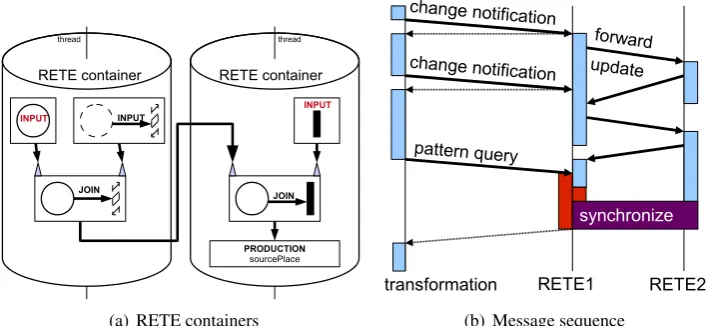
Our proposal splits the network into separate RETEcontainers, each of which is responsible for matching a set of subpatterns. A container has its own distinct set of nodes, and assigns each RETE container to a dedicated pattern matcher thread consuming update messages of a dedicated queue. Each container is responsible for forwarding messages to its nodes using the dedicated message queue. This way, two threads are not allowed to operate on the same RETE node, thus maintaining mutual exclusions is not necessary.
Forwarding messages between two containers is accomplished by enqueueing the message in the target container. Figure 8(a)depicts a parallel version version ofFigure 6illustrating how a RETE net can be split into several containers for parallel execution.
PRODUCTION sourcePlace INPUT
INPUT
INPUT
JOIN
JOIN RETE container RETE container
thread thread
(a) RETE containers
transformation RETE1
change notification
pattern query
RETE2
forward update
synchronize change notification
(b) Message sequence
Figure 8: Multi-threaded pattern matching
Figure 8(b)illustrates how changes performed by the transformation induce update propaga-tion in the RETE net. The update propagapropaga-tion spreads between containers, and is processed in parallel. When the transformation needs to match a pattern, however, it will have to synchronize with the pattern matcher and wait until all RETE activity has settled.
If a container runs out of update messages to process, it reaches alocal fixpoint, otherwise it remainsactive. Theglobal fixpointis reached when all containers are in a local fixpoint. In order to retrieve up-to-date and consistent match sets, the transformation thread has to wait for a global fixpoint. This thread synchronisation goal, however, is not trivial to accomplish, since a container can leave its local fixpoint and become active again before a global fixpoint is reached due to incoming messages from other, still active containers. To address this issue, we have developed and implemented a termination protocol based on logical clocks.
Termination protocol for RETE containers Each containerCi is equipped with a logical clock(denoted asclocki) that is incremented whenever a local fixpoint is reached by the message
consumption thread of the container (denotedthreadi). Each time containerCi sends an update
clockk is retrieved and stored inci ascriterioni[k], all as a single atomic step2. The retrieved
clock value imposes atermination criterion: the network can only reach a global fixpoint if the value ofclockk exceeds the received snapshot. This means that the relayed message has been
delivered to the recipient node inCk and all of the (local) consequences have been resolved,
resulting in a new local fixpoint inCk, which is required for a global fixpoint.
WhenCireaches its local fixpoint, it atomically increments its clock and reports the event to a global RETE network object; this report includes the incrementedclocki, along with the values criterioni[k]for eachk. Similarly, when the transformation changes the model and consequently
sends a change notification (formulated as an update message) to an input node in containerCk,
it hands over the message to the message queue ofCk, fetches theclockkfrom that container and
reports it to the network object as a termination criterion, also performed as a single atomic step. The global network object maintains an array criterionglobal[k] storing the largest reported
criterion for eachk, andclockreported[i]for the latest clock value reported byCi. Upon receiving
the report, the global network object evaluates whether a global fixpoint is reached and wakes the transformation thread when appropriate. Determining whether a global fixpoint holds is as simple as checking, for each container, whether the highest reported termination criterion value stemming from that container is exceeded by its the latest reported fixpoint-time clock value. This Termination Condition is formulated as:
∀k:clockreported[k]>criterionglobal[k] (1)
The above protocol is proven to be able to determine global fixpoints. The proof and further details are available in [Ber08].
Performance discussion. It is important to point out that the performance of such a system may depend highly on the amount of synchronization and replication that is necessary when messages are passed between the containers. In theory, it would seem beneficial if the subpat-terns (deployed to separate RETE containers) had a low number of interconnections, but further research is necessitated to achieve this in practice. An ideal application scenario would be sev-eral transformations or parts of the same transformation that are known to use different patterns; allowing easy, straightforward splitting and parallelisation of the RETE net, with a low amount of inter-connectedness. By partitioning the patterns into relatively independent containers, a multi-threaded RETE pattern matcher may achieve high performance.
4.3 Multi-threaded model manipulation
In case of incremental pattern matching, the usefulness of optimizing the pattern matcher has its limitations, as significant CPU time is spent on the rule application itself. Further gains in performance can only be achieved by accelerating the execution of rule application and model manipulation. For this purpose, we exploit multi-core architectures to provide multi-threading for the model manipulation component as well.
2 the outlined procedure is only necessary ifk6=i; messages sent and received within the same container can use
Multi-threading for model manipulation can be achieved easier if pattern matching is per-formed in a separate thread, as described inSubsection 4.1 (or multiple threads, as in Subsec-tion 4.2). When model manipulaSubsec-tion threads change the model, they send update notificaSubsec-tions atomically, which involves inserting an update message addressed to the appropriate input node into the message queue of the node’s container. When a transformation thread requires the set of matches for a certain pattern, the pattern matcher call returns them immediately if the network is in a global fixpoint, or suspends the thread (but not others) until that fixpoint state is reached.
Conflict prevention Several approaches aim to achieve serializable (i.e. thread-safe) paral-lelisation of graph transformation rule applications, either for rule instances within one trans-formation sequence, or for separate transtrans-formation runs. Most advanced solutions exploit the declarative nature and concurrency theory of graph transformation (critical pairs, etc.) to execute non-conflicting rules in parallel [Mez07].
Unfortunately, in many practical cases, model transformations are intertwined with hard-to-analyze imperative actions, or simply, there are too many conflicts. Furthermore, even if conflict-free high-level behaviour is guaranteed, there can still be conflicts caused by low-level imple-mentation details (concurrent access to edge lists, etc.) that have not been taken into account. Therefore low-level solutions are necessary for ensuring exclusion in parallel execution.
Locking scheme Exclusion can be provided by imposing a locking system on the model space. If a thread acquires a lock, other threads will have to wait until it is released before they can ac-quire a conflicting lock. The lock system can have, for instance, a model-level, an element-level, or hierarchy-based lock granularity; locks may be held for the length of an elementary model manipulation operation, or longer sequences; also, a read lock / write lock model is preferable. However, our experiments (see below) showed that great care must be taken in the choice of locking strategy.
A high ratio of lock conflicts could mean that the lock scheme itself becomes a bottleneck and prevents the improvement of performance by parallelization, therefore locks should be compat-ible whenever posscompat-ible. On the other hand, over-specializing locks for the sake of compatibility would result in too many individual lock acquisitions, which can have a considerable overhead. Therefore the transformation system must strike a balance in order to achieve good scalability even in write-intensive scenarios. The locking strategy can be predetermined, configurable by the transformation author, or decided by reasoning on the declarative description of the graph rules. This is a challenge that necessitates further research.
Initial performance results. A high amount of synchronization can diminsh performance both through waiting and overhead. Parallel execution of read-intensive transformations, however, is relatively conflict-free, therefore it does not heavily suffer from waiting, and can scale up to multiple CPU cores efficiently. A suggested application scenario would be parallel code genera-tion, with each thread producing a separate output file from a corresponding aspect of the source model. Code generation is usually a read-only operation; we also believe that using different aspects of the model aids in the partitioning of the RETE net.
pattern matching, and model-level R/W locking. We used this system to measure the perfor-mance of parallel code generation, namely generating PNML [JKW02] descriptions of several Petri nets within the model space. This application scenario has the advantage that transformation jobs are entirely read-only. However, since all generation jobs basically follow the same algo-rithm and use similar Petri-nets, it does not easily lead to partitioning the RETE net; therefore, we used concurrent pattern matching, but with a single RETE container. The initial expriments3 show that this system has a quasi-linear scalability. A Petri-net generated by the procedure in [BHRV08] as “Size 50000” was used as a sample input. Two PNML code generators in se-quence ran for 2.9s each, 5.8s altogether. Two code generators in parallel ran for 3.7s each, but they took only 3.9s altogether.
On the other hand, we have also conducted preliminary measurements on the AntWorld case study of GraBaTs 2008 [Gra08]. Our parallel solution to this benchmark turned out not to scale well; in fact, it was slower than the sequential one. The results have showed that a naive lock-ing scheme (the entire model has to be locked on each elementary operation) results in poor scalability in case of a write-intensive transformation like AntWorld.
Due to the complexity (and sometimes strange characteristics) of parallel algorithms, further measurements are required to compare its performance with non-incremental approaches.
5
Integration into the V
IATRA2 model transformation framework
This section describes how the concepts described inSection 4were incorporated into VIATRA2. Subsection 5.1gives a basic overview of the architecture of VIATRA2 and how it was changed to support parallelized graph transformation. Subsection 5.2 briefly introduces how the proposed parallelization techniques are made available in the transformation language of VIATRA2.
5.1 Architecture XForm Interpreter Thread Thread Thread Threads
Viatra2 Model Space
Incremental Pattern Matcher Container Thread Container Thread Container thread notification model manipulation pattern matching RETE updates Container thread Locks Locks Locks Locks
Figure 9: Architecture and workflow
VIATRA2 was designed with a modular architecture. In the context of this paper, the most important com-ponents are the model space, the transformation inter-preter, and the incremental pattern matcher (see Fig-ure 9). The model space contains and manages all modeling data, including models and metamodels. The transformation interpreter executes the ASM program that defines the transformation; during the process, tern queries are directed towards the incremental pat-tern matcher and the model is potentially manipulated. Finally, pattern matcher modules are responsible for re-turning the results of pattern queries. The incremen-tal pattern matcher accomplishes this by using pattern caches that are continously maintained in accordance to change notifications received from the model space and internal RETE updates.
The parallelization of graph transformation required changes in all three presented modules. The model space now offers a locking scheme to deal with conflicting transformation threads, as required bySubsection 4.3. The RETE net is divided into one or more containers, each operated by its dedicated thread, as described inSubsection 4.1andSubsection 4.2. RETE updates can now either happen within one container, or be delivered as an asynchronous message between containers. Transformations are run by several interpreter threads that are executed in parallel, as proposed inSubsection 4.3.
5.2 Language features
VIATRA2 transformation designers have the option to select either a local search-based pattern
matcher module or the incremental pattern matcher (see [BHRV09] for details). This annotation has been extended with a parameter to enable the parallelized pattern matching features described inSubsection 4.1andSubsection 4.2.
The first listing in Figure 10 shows how this option was specified for the PNML generator example, selecting the parallelized version of the incremental pattern matcher for all pattern queries of the transformationpetrinet2PNML. The annotation can also specify the type of pattern matcher on a per-pattern basis, thus the incremental and the local search-based pattern matchers can be combined. However, for performance considerations, it is not wise to mix the parallel and the non-parallel versions of the incremental pattern matcher, because it would cause two separate RETE nets to be built for the two techniques, which can result in a significant increase of memory consumption.
Multi-threaded model manipulation is also available from the language; the second listing in Figure 10shows two ASM rule invocations (the two PNML generation jobs) executed in parallel, instead of sequentially, as proposed inSubsection 4.3.
@incremental(’parallel’=’1’)
machine petrinet2PNML{ ...
rule generate(in Key, in PN) = seq { ...
} }
...
parallel
{
call generate("out2.pnml", ...);
call generate("out3.pnml", ...); }
...
Figure 10: Language elements enabling parallel features
6
Related work
[HLR06]. The uniform, incremental handling of model elements and patterns can be considered a unique, advanced feature of the approach. [VVS06] proposes to store a tree for the partial matches of a pattern, and incrementally updates it upon model changes.
RETE networks.RETE networks [For82], which stem from rule-based expert systems, have already been used as an incremental graph pattern matching technique in several application sce-narios including the recognition of structures in images [BGT90], and the co-operative guidance of multiple uninhabited aerial vehicles in assistant systems as suggested by [MMS08]. Our con-tribution extends this approach by supporting a more expressive and complex pattern language.
Parallel RETE.There is also some work in literature in the context of parallel or distributed RETE implementations. For instance, [AT98] focuses on parallelizing rule applications, [MK90] parallelizes pattern matching. Unfortunately, certain approaches focusing on expert systems are hard to be accessed, e.g. due to vague patent descriptions [Lin05], and certain industrial solutions might not be published at all. Anyhow, these approaches rarely provide proofs to guarantee the global termination of local updates as mentioned in Subsection 4.2, which is specific to our model transformation context.
Parallel graph transformations. In addition to large amount of theoretical work on concur-rent and parallel aspects of graph transformation, relatively little practical work has been carried out. Some advanced solutions were proposed by G. Mezei [Mez07] who analyses pattern con-flicts and groups executable rules intoindependence blocksto execute them in parallel. Further contributions also introduced parallel pattern search for first occurence and all occurrences. Our current work is complementary to his work, as it offers parallelization with a different pattern matching paradigm. Future research shall be conducted to identify how to combine the strength of the two approaches.
The GrGen.NET transformation system follows a different approach [Sch08] to avoiding par-allelization conflicts: the model itself is split into several partitions, and different threads operate on different fragments. Pattern matches bridging multiple partitions are dealt with separately.
As an alternative solution to managing conflicts, Roberto Bruni has recommendended that we should investigate the possibility of employing an optimistic concurrency strategy in the future.
7
Conclusion
The paper introduced various techniques for parallelizing graph transformation systems using incremental pattern matching. More specifically, we discussed how to exploit the power of mod-ern computers with multiple processor cores, tailored to the specialities of incremental pattmod-ern matching. Our approach decouples model manipulation and pattern matching, and then paral-lelizes each of these phases.
We also sketched conditions when the proposed solutions are expected to perform best: (i) transformations with longer model manipulation sequences, (ii) transformation runs accessing different patterns, and (iii) transformation runs that are read-intensive.
Acknowledgements: This work was partially supported by EU projects SENSORIA (IST-3-016004) and SecureChange (ICT-FET-231101), and the L´aszl´o Schnell Foundation.
Bibliography
[AT98] M. M. Aref, M. A. Tayyib. Lana—Match algorithm: a parallel version of the Rete— Match algorithm.Parallel Comput.24(5-6):763–775, 1998.
doi:http://dx.doi.org/10.1016/S0167-8191(98)00003-9
[Ber08] G. Bergmann. Incremental graph pattern matching and applications. Master’s thesis, Budapest University of Technology and Economics, May 2008.
http://home.mit.bme.hu/∼bergmann/publications/bergmann diploma 2008.pdf
[BGT90] H. Bunke, T. Glauser, T.-H. Tran. An Efficient Implementation of Graph Gram-mars Based on the RETE Matching Algorithm. In Ehrig et al. (eds.),
Graph-Grammars and Their Application to Computer Science. Lecture Notes in Computer
Science 532, pp. 174–189. Springer, 1990.
[BHRV08] G. Bergmann, A. Horv´ath, I. R´ath, D. Varr´o. A Benchmark Evaluation of Incremen-tal Pattern Matching in Graph Transformation. InICGT. 2008.
[BHRV09] G. Bergmann, A. Horv´ath, I. R´ath, D. Varr´o. Efficient Model Transformations by Combining Pattern Matching Strategies. InProc. of ICMT ’09 , 2nd Intl. Conference on Model Transformation. Springer, 2009. Accepted.
[B ¨OR+08] G. Bergmann, A. ¨Okr¨os, I. R´ath, D. Varr´o, G. Varr´o. Incremental Pattern Matching in the VIATRA Model Transformation System. In Karsai and Taentzer (eds.),Graph
and Model Transformation (GraMoT 2008). ACM, 2008.
[BS03] E. B¨orger, R. S¨ark.Abstract State Machines. A method for High-Level System Design and Analysis. Springer-Verlag, 2003.
[EEKR99] H. Ehrig, G. Engels, H.-J. Kreowski, G. Rozenberg (eds.). Handbook on Graph
Grammars and Computing by Graph Transformation. Volume 2: Applications,
Lan-guages and Tools. World Scientific, 1999.
[For82] C. L. Forgy. Rete: A fast algorithm for the many pattern/many object pattern match problem.Artificial Intelligence19(1):17–37, September 1982.
[GMS93] A. Gupta, I. S. Mumick, V. S. Subrahmanian. Maintaining views incrementally (Ex-tended abstract. In In: Proc. of the International Conf. on Management of Data, ACM. Pp. 157–166. 1993.
[HLR06] D. Hearnden, M. Lawley, K. Raymond. Incremental Model Transformation for the Evolution of Model-Driven Systems. In Nierstrasz et al. (eds.), MoDELS. Lecture Notes in Computer Science 4199, pp. 321–335. Springer, 2006.
[JKW02] M. Jungel, E. Kindler, M. Weber. The Petri Net Markup Language. InIn S. Philipi, editor, Algorithmen und Werkzeuge fur Petrinetze (AWPN), Koblenz. June 2002.
[Lin05] P. Lin. System and method to distribute reasoning and pattern matching in forward and backward chaining rule engines. US Patent application 20050246301, 02 2005.
[LS05] M. Lawley, J. Steel. Practical Declarative Model Transformation With Tefkat. In B´ezivin et al. (eds.),Proc. of the International Workshop on Model Transformation in Practice (MTiP 2005). October 2005.http://sosym.dcs.kcl.ac.uk/events/mtip05/.
[Mez07] G. Mezei. Supporting Transformation-Level Parallelism in Model Transformations.
InAutomation and Applied Computer Science Workshop. Budapest, Hungary, 2007.
[MK90] M. Mahajan, V. K. P. Kumar. Efficient parallel implementation of RETE pattern matching.Comput. Syst. Sci. Eng.5(3):187–192, 1990.
[MMS08] A. Matzner, M. Minas, A. Schulte. Efficient Graph Matching with Application to Cognitive Automation. In Sch¨urr et al. (eds.),AGTIVE 2007. Springer Verlag, 2008.
[Roz97] G. Rozenberg (ed.).Handbook of Graph Grammars and Computing by Graph Trans-formations: Foundations. World Scientific, 1997.
[Sch08] J. Schimmel. Parallelisierung von Graphersetzungssystemen. Master’s thesis, Uni-versitat Karlsruhe, 2008.
[SNZ08] A. Sch¨urr, M. Nagl, A. Z¨undorf (eds.).Applications of Graph Transformations with Industrial Relevance, Third International Symposium, AGTIVE 2007, Kassel, Ger-many, October 10-12, 2007, Revised Selected and Invited Papers. Lecture Notes in Computer Science 5088. Springer, 2008.
[SWZ99] A. Sch¨urr, A. J. Winter, A. Z¨undorf. The PROGRES approach: language and envi-ronment. Pp. 487–550, 1999.
[VB07] D. Varr´o, A. Balogh. The model transformation language of the VIATRA2 frame-work.Sci. Comput. Program.68(3):214–234, 2007.
[VVS06] G. Varr´o, D. Varr´o, A. Sch¨urr. Incremental Graph Pattern Matching: Data Structures and Initial Experiments. In Karsai and Taentzer (eds.),Graph and Model