ISSN-L: 2501 - 1235 Available on-line at: www.oapub.org/edu
doi: 10.5281/zenodo.1450736 Volume 4 │ Issue 11 │ 2018
THE EFFECT OF PHYSICAL CHARACTERISTICS
OF STADIUM ON SATISFACTION LEVELS OF
FOOTBALL SPECTATORS' AGE GROUPS
iBulgurcuoğlu A.1ii,
Küçük V.2,
Kepoğlu A.3,
Yorulmazlar M. M.2,
Özçalı Ü.4
1Cyprus International University,
School of Physical Education and Sports, TNRC
2Marmara University,
Faculty of Sport Sciences, Turkey
3Muğla Sıtkı Koçman University,
Faculty of Sport Sciences, Turkey
4Haliç University, Vocational School of
Physical Education and Sports, Turkey
Abstract:
The spectators are one of the most important basic articles of stadiums that are part of the sport industry. When a team of supporters and a winning team are involved, determining the reasons affecting the satisfaction levels of physical characteristics of stadiums according to age groups are important in terms of sports clubs and stadiums managers. This study was carried out in order to determine the physical characteristics of the stadiums and the satisfaction levels of the spectators watching football matches according to age groups. For this purpose, a questionnaire consisting of 17 questions was prepared by taking the opinion of 10 academicians and sector managers who are experts in sport management and sports marketing. Information and data were presented in simple and cross-tabular form, and Chi-square interest analysis was used in the evaluations. The main mass of the study is composed of the population of 15 years old and over who watch the match in four stadiums (Atatürk Olympic Stadium, BJK İnönü Stadium, FB Şükrü Saraçoğlu Stadium and GS Turk Telekom Arena) in Istanbul borders. Our sampling is 1025 people watching the match in these stadiums. Our research hypotheses were accepted at a significance level of 0.05. Accordingly, It was determined that spectators had an interest in their level of satisfaction with their
i The study was presented orally on the 11th International Scientific Conference on Transformation
use experience between age groups and the physical characteristics of stadiums. Ergonomic approaches, use comfort, health and safety considerations for people of all ages who will use the stadiums while constructing the physical characteristics of the stadiums are important for the creation of satisfaction levels.
Keywords: spectator, physical characteristics of stadiums, age groups and satisfaction
levels
1. Introduction
The stadium is an area for the realization of the sporting event and a separate part for the spectators to watch this activity. With the same basic logic, it is known throughout history that many stadium designs of different shapes and qualities are applied in many parts of the world's geography stadiums have come to face as different sizes and special spaces such as natural land areas, natural or synthetic grass fields, neighborhood areas, miniature landscapes, carpet fields, athletic tracks and big stadiums. Different types of stadiums can be mentioned according to the architectural designs of today or the fact that they can not be closed on top of the field.
In addition to these features stemming from the nature of the stadiums, football has become a game played in the stadiums since the 19th century, as the massive interest in football has increased, the increase in the number of visual athletes as a sport scene, and the social and economic influences have reached remarkable dimensions. Wide acceptance all over the world has resulted in the investment of football and the construction of football stadiums only.
In line with the socialization process and the massification of sporting activities, stadiums have also become differentiated and larger, more functional, more comfortable, safer, more technical, more aesthetic. Today, stadiums have come to be regarded only as venues for sporting events and have begun to be accepted as systems of demonstrations. In fact, the stadium has always been more meaningful than being a
place where sports are produced.(5)
We think that the construction of the stadiums in our country is far behind in the physical features and the management sense of operation compared to the rapidly developing examples in the world. The countries that have gone ahead are particularly concerned with physical characteristics in the construction of sports facilities. Sport is considered a branch of sports science as well as sports architecture and engineering services as well as the relationship between customer satisfaction and productivity in stadiums.
The operation of stadiums and sports facilities is carried out by some or all private sector enterprises in some countries. In Turkey, both from the social and cultural importance of the private sector in sufficient quantities and directed by the state sports center half because of inability to meet the qualifications investments are
and football stadiums plays a very important role in the clubs and local governments in the recent period. Fans have now begun to live in or around the stadium to be closer to the battle they hold. In fact, the surrounding settlement has also acquired a different dimension. The streets of stadiums are now the most central places of the city as workplaces and dwellings.
In football matches, spectators and supporters are defined within the concept of the customer. Defining the customer concept is traditionally based on demographic information. Beyond the variables such as age, gender, occupation, income and learning situation, it is necessary to learn in detail that their lifestyles, habits, preferences, anticipations will be in the foreground. Indeed, information such as name, age, occupation, marital status, education, what products and services are purchased, when, where, at which price, preferred media channels, hobbies, products or services bought most is required(16)
The users in the stadiums where football matches are offered differ from the general customer concept. In the stadiums, the understanding of the customer, the spectator and the fan relationship is necessary. The watching takes place in amateur and professional sports events, which are generally held in the elite sports arena. The spectator follows only the presentation. Sports services for watching can be single-disciplinary or multisingle-disciplinary. A soccer competition in the stadium is an example of one discipline, and Olympic Games in the Olympic Games are examples of multidisciplinary services. The spectator is the person or persons who spend time,
money and energy to watch sports competitions and enjoy it(22).
In order to be able to create a difference in the eyes of spectators watching football matches and to create loyalty, it is first necessary to know and understand the spectators who come to watch the soccer game. There is a wide need for feedback on questions about "Who is the spectator and the fans? What are the expectations? What are the factors that influence purchasing behavior and decision-making processes? What are the factors that affect their level of satisfaction?" Having detailed information about the audience and not using it effectively is a different matter. It is about you that you cannot best apply the information in your hand to the way you do business. Some of them also know the customers well, but they do not have the physical infrastructure that they can provide the service they want.
It is to meet the most important spectator needs of the stadium managers and satisfy their expectations. The effectiveness of football organizations depends largely on how they work to create and retain participants connected to sports marketers. In every football organization, audience commitment is the main objective. Because audiences provide support to the organization on the one hand, and on the other hand they provide great support for the organization's goals(19). The revenue obtained from the
audience, a recreational participant, is the most fundamental factor that enables professional sports teams to survive(18).
supporter. The physical characteristics of soccer spectators, detailed in the following section, and their use experience and satisfaction levels according to age groups are notable in terms of the continuity of the perception of stadium marketers as customers or spectators. It would be more effective to define 'being a party' as the only supporter of a sport team, and as 'active' supporters in the social relations grounds in stadiums. In a sense, supporters are stubborn about being 'passive spectators' of sports (football, basketball, etc.) games and trying to be an active audience.
According to the age groups of football spectators using stadiums, it is important for stadium managers and sports clubs to understand their behavior, their needs and the appropriateness of the physical characteristics of stadiums. Otherwise, club managers, stadium managers and stadium marketers who do not have enough information about the physical characteristics of the stadiums and the level of satisfaction according to their age groups at a sufficient level in their hands will be adversely affected.
For this reason, it has become compulsory to draw attention to the importance of the physical characteristics of the stadiums, whose importance has not yet been understood in our country, and to determine the level of satisfaction according to age groups and to re-evaluate the world with the changing economic and social conditions. As a result of this work, the stadiums in our country are suitable for constructing the physical characteristics according to the needs of the age groups, establishing the operational infrastructure that can be used for stadiums, safety and comfort in the international field, the efficiency of the facilities, and secure organization are the main objectives.
The purpose of this study is to examine the physical characteristics of stadiums and define the relationship between age groups and satisfaction levels.
2. Methods
The work to identify the interests specified in the purpose of the study would be appropriate to apply all over Turkey. Considering that Istanbul is composed of people from various regions of Anatolia, a significant part of the population and socio-economic structure as we consider that Turkey has a population distribution that can represent all segments of, saying that the application of research within the province of Istanbul could give valid results for whole Turkey as well, will not be misleading.
the stadiums according to the needs of the age groups and in the architectural designs or planning of the stadiums.
The universe of the study is the spectators, whose age is 15 and above, coming to the stadium in Turkey Super League football match while 1025 spectators, who come to Atatürk Olympic Stadium, İnönü Stadium, Şükrü Saraçoğlu Stadium and Turk Telekom Arena Stadium in Istanbul to watch the football match, create the sampling.
Our study was conducted with a descriptive research model. It is known that in this model, it is aimed to determine the relationship between two or more variables without changing the independent variables. In this study, according to the age groups of the spectators coming to football matches organized in stadiums; the definition of the interest among the stadiums' level of satisfaction with their physical characteristics constitutes the main purpose of the research. In accordance with the purpose of the study, "the satisfaction levels of the spectators watching the matches from different age groups in the stadiums differ from the physical characteristics of the stadiums”. This finding has been identified as the main hypothesis of our study. The questionnaire was used to test this hypothesis. For this purpose, a questionnaire consisting of 17 questions was prepared by taking the opinion of 10 academicians and sector managers who are experts in sport management and sports marketing. In addition, with a 5-question survey reflecting participants' demographics, participants were asked about meaningful differences in their views about the physical characteristics of the stadiums.
In order to determine the validity and reliability of the questionnaire, the validity of the scale and the fitness of the data to the factor analysis were determined by the Kaiser-Meyer-Olkin (KMO) and Bartlett test. In the analysis of key components, the KMO value was found to be 0.914. Cronbach's Alpha coefficient was used to determine the internal consistency of the prepared questionnaire, in other words, its reliability. The coefficient was found to be an internal consistency of 0.915. This ratio indicates that the survey is highly reliable.
The reliability of a measurement tool is calculated by various methods and the most common method is the internal consistency method. The Cronbach Alpha reliability criterion calculated using this method was used in our study. The Cronbach Alpha value is a coefficient ranging from 0 to 1, and as the number approaches 1, the reliability of the scale is considered high. The reliability of the Stadium Marketer and Customer Satisfaction Scale was calculated as 0.91 in pilot practice with 306 spectators.
The information gathered through the questionnaire forms has been pre-checked during the preparation of the analysis. Unavailable questionnaire forms have been extracted. The number of surveys analyzed is 1025. Surveys were later coded and poured into tables that were developed so that the variable codes in each questionnaire could fit in a row, moving thoughtfully before the data was entered into the computer. SPSS packet statistical program was used for analysis of information and data.
3. Results and Discussions
In our work, "The satisfaction levels of the spectators watching the matches from different age groups in the stadiums differ from the physical characteristics of the stadiums." This was determined as the main hypothesis of our study. The questionnaire was used to test this hypothesis.
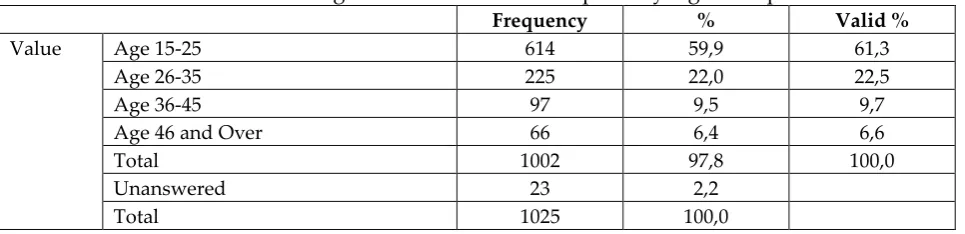
Table 1: Percentage Distributions of Participants by Age Groups
Frequency % Valid %
Value Age 15-25 614 59,9 61,3
Age 26-35 225 22,0 22,5
Age 36-45 97 9,5 9,7
Age 46 and Over 66 6,4 6,6
Total 1002 97,8 100,0
Unanswered 23 2,2
Total 1025 100,0
61.3% of the participants were in the age group of 15-25, 22.5% in the age group of 26-35, 9,7% in the age group of 36-45 and 6,6% in the age group of 45 years and over.
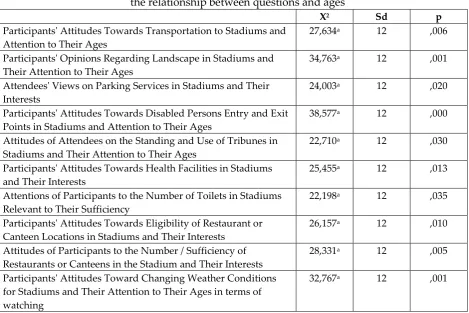
According to age groups of participants, there are 10 varieties of interest among the 17 different participants' satisfaction levels, demographic characteristics, age groups, and 7 variables of interest, as indicated in the questionnaire on the physical characteristics of the stadiums. In other words, as the ages of the participants change in 10 varieties, their views on physical characteristics also differ. However, although the age of the participants varies in 7 variants, there is no change in their views.
As age changes, the physical characteristics of the 10 different variables on which the thoughts and opinions differ, respectively;
Stadium accessibility, Stadiums parking arrangement, Stadiums parking lots for
disabled people, Stadium seating and use, Health facilities in stadiums, Number of toilets in stadiums, Suitability of restaurants or canteens in stadiums, Number of restaurants/canteens in stadiums and Suitability of stadiums for changing weather conditions in terms of watching. As the age is different, the physical characteristics of the 7 different variables on which the thoughts and opinions do not differ are, respectively;
The stadium's location, the architectural atmosphere of the stadiums, the
Table 2: The participants' chi-square results, which examined the relationship between questions and ages
X2 Sd p
Participants' Attitudes Towards Transportation to Stadiums and Attention to Their Ages
27,634a 12 ,006
Participants' Opinions Regarding Landscape in Stadiums and Their Attention to Their Ages
34,763a 12 ,001
Attendees' Views on Parking Services in Stadiums and Their Interests
24,003a 12 ,020
Participants' Attitudes Towards Disabled Persons Entry and Exit Points in Stadiums and Attention to Their Ages
38,577a 12 ,000
Attitudes of Attendees on the Standing and Use of Tribunes in Stadiums and Their Attention to Their Ages
22,710a 12 ,030
Participants' Attitudes Towards Health Facilities in Stadiums and Their Interests
25,455a 12 ,013
Attentions of Participants to the Number of Toilets in Stadiums Relevant to Their Sufficiency
22,198a 12 ,035
Participants' Attitudes Towards Eligibility of Restaurant or Canteen Locations in Stadiums and Their Interests
26,157a 12 ,010
Attitudes of Participants to the Number / Sufficiency of Restaurants or Canteens in the Stadium and Their Interests
28,331a 12 ,005
Participants' Attitudes Toward Changing Weather Conditions for Stadiums and Their Attention to Their Ages in terms of watching
32,767a 12 ,001
As the age group of participants increases, the level of satisfaction with reaching the stadiums decreases. Young participants are more satisfied with the transportation to stadiums than middle-aged and old people. There is interest between the two variables (p <0.05). As the age group of participants decreases, the level of satisfaction with the landscape is increasing in stadiums.
Younger participants are more satisfied with the landscape of stadiums than middle-aged and older. There is interest between the two variables (p <0.001). According to the age group of the participants, the judgments about parking services in stadiums are changing. Young participants are more satisfied with the parking services of stadiums than middle-aged and older. There is interest between the two variables (p <0.05). 15-25 Age group of participants are more satisfied with the entry and exit points of the disabled spectators in the stadiums than the participant in the other age group.
There is interest between the two variables (p <0.05).
15-25 and 36-45 Age group of participants were found to be satisfied with the appropriateness of the restaurants or canteen places in the stadiums while participants in other age groups are less satisfied. There is interest between the two variables (p <0.05). 15-25 Age group of participants are more satisfied with the number of restaurants or canteens than other age groups. There is interest between the two variables (p <0.05). It is observed that compared to other age groups, 15-25 and 36-45 Age group of participants, which are of spectators, are not satisfied with the suitability of the changing weather conditions for stadiums in terms of watching. There is interest between the two variables (p <0.05).
In stadiums, it is possible to group physical characteristics as factors that can affect the level of satisfaction according to age groups. This discussion is limited to the determination of the physical characteristics and satisfaction levels according to age groups. In this context, the satisfaction levels of the spectators watching the match according to the age groups were evaluated with respect to physical features.
As is known, sporting organizations' marketing focus has increased the need for physical fitness of customers and quality of service at the highest level(23). Now the
audience is more participatory, more valuable and freer. Because the products presented in the rapidly developing world of football are more diversified compared to the old ones. It consists of the information that the customer's identity information and expectations, the lack of customer identification, the ability to distinguish one customer from another, provide the ability to monitor your relationships with that customer over
time, or allow you to pass an individual one with the customer (21). In the market where
the sport industry is located, the success of the sport organizations depends on the degree of satisfaction with the quality of the service offered by the organization to the
customers(14) . In this context, the behaviors of sports consumers are not about the place
to be attained but about the journey(8).The atmosphere and physical characteristics of a
sporting event are among the main factors in the value-creating factors for the sport consumer. According to the theory supported by empirical findings, an emotionally appealing atmosphere in the stadium motivates people to go to the competition to feed the need for pleasure in humans(25).
In a good physical environment, the interactions of the spectator can also take place at a high level. According to the age group of the participants, the judgments about parking services in stadiums are changing. Young participants are more satisfied with parking services at stadiums than middle-aged and elderly. Studies conducted by Bitner and Melnick have found that parking spaces in stadiums increase audience satisfaction, especially in areas where traffic are intense. Most of the time, the audience is frustrated by looking for a car park space and parking the car at a distance away from the stadium(3,17) .
prevent illegal spectators in order to increase revenues. In the old stadiums, the entrance and exit doors were already limited. These numbers must definitely increase in order to allow the audience to easily enter and exit the stadium and to allow the
audience to empty the stadium easily in extraordinary situations(6). Nowadays, even in
normal life, there are promising developments about the studies that are particularly pleased with young audiences, even though the measures to facilitate their lives with disabled people are not taken in full.
While it was observed that Participants in the 15-25 age group were pleased with the seating and use of the stadiums, it was determined that middle age and over participants found the seating and use of stadiums to be inadequate. The use of seating and use in stadiums means that as the age groups of the spectators watching the matches in the stadiums increase, the levels of comfort and expectations increase. Berger and Broombergerin studies also support our findings: Each section in the stadiums for the spectators in the stadium; the comfort it has, the position of the grandstand where it is located, the angle of view of the playground, the side of the playground, the distance to the playground and, of course, the price. The audience considers all these features when buying a seat to watch the game. This conscious choice may be indicative of the audience group that makes the choice.
For example: "Having a seat near goal areas is a sign of his richness, power or position". For all these reasons, the stadium can be described as a small-scale city plan. Moving through the Olympic Marseille - Olympique Marseille - a French football team, it can be concluded that the stadiums are one of the rare places where the urban community is able to reflect itself in both a whole and a segregation. Contrary to widespread belief in this context, masses that are passionate about sport do not form an amorphous anonymous mass, where different social statues melt in a coexistence. The tribunes that have been divided hierarchically, the tribunes that see the field in the distance, the tribunes behind the castle, and the tribunes that surround the corners, are in a community or neighborhood by occupation, ethnic or territorial discipline. The format and timing of each spectator's category being specific habits stadiums; alone, by family, with a friend's surroundings, a very specific state of affairs and gestures, sounds,
clothes. The stadium is both a sporting event and a collective watching venue(4).
Participants' opinions on health facilities in stadiums vary from age group to age, but it appears to be the general belief that health facilities are on average but need to be improved. Doğu and Müniroğlu's work: The ambulance system to intervene urgently in health problems of the tribunes and in the field is mostly absent from statues outside the First League. Therefore, the distance of the hospital to the stadiums becomes
important. 91.6% of the stadiums have a distance to the hospitals of less than 5 km(6) .
other common areas were one of the reasons that affected fan participation in subsequent competitions(26,27) .
Considering the opinions of the participants, it seems that the restaurant or canteen places are not suitable. Among the participants, young people in the age group 15-25 found it very good with 80.2%, while the other participants found it moderate with 28.4%, inadequate level with 24.2% inadequate level and 14.9% in general level. Clubs have chosen to differentiate areas such as canteens, restaurants, and cafes in the stadiums while refreshing their stadiums.
In the Premier League, Manchester United and Arsenal teams have renewed their stadiums last season. While Manchester United has raised the Old Trafford stadium from 69,000 to 76,000, the Arsenal team has also built a new stadium for 60,000 people after converting the stadium of 39,000 to a trade center. Both clubs play their games with a capacity of 100% occupancy today, as they increase their stadium capacities. Both clubs have improved their capacity as well as stadium facilities. Entrance areas, waiting areas, toilets, elevators, including stores, cafes, bars, conference rooms, children's playrooms, betting halls, club museums, and club products are completely renovated(12) .
Many researchers indicate that there are significant relationships between some elements of physical characteristics in stadiums and age variation. Satisfaction depends on the core sporty product as well as the existence and characteristics of many concrete items complementary to this product, tangible items can be based on a good experience and the permanence of the experience. Buying a team form on a fanatic level or hiding the tickets of a lock competition indicates the permanence of the experience. Physical items have no influence only on the psychological structure of the spectator. This
environment and items also have an impact on sportsmen(1). These significant
differences are between the age and the physical characteristics of the stadiums. Basic physical evidence in-stadium marketing; the design and cleaning of the toilets, the departure for the journalists, the presence and operation of the seats and the numbering system in the seats, the design of the stadiums, the parking, the exterior design, the interior design, the equipment, the features of the entrances and exits, the cafeterias, positive discrimination on every issue for the disability, competence and experience of staff in the service production process(11). Found that audiences over 50 years of age,
perceived by service personnel and physical environment are at a higher level than
younger audiences(9). Kelly and Turley reported that between age groups, audiences
between the ages of 46 and 55 gave more importance to the stadium entrances than to
the 18-30 and 31-45 age group(13,28) stated that older audiences are more concerned about
physical environment quality than stadiums(28). It can be said that drawing young
in the stadium by ensuring that their attention focused on basic service (Soccer) is spread over a wider area.
The stadium rating system, which is used by UEFA (the European Football League and Clubs Association) to honor and expose well-maintained stadiums in terms of use and physical characteristics, adds five stars to the stadiums, while the stadium itself makes it more easily marketable. Taking these characteristics into account when
investing in this area will make stadiums easier to market(2) .
While there are many factors other than the stadium that can naturally affect the service quality in the watching sport, the fact that the factors related to the stadium in the results of the research are at the forefront reveals the importance of the
modernization of the stadiums(13). In the context of modernization studies, It comes to
the mental issues such as increasing the audience capacity, creating VIP local area, expanding parking areas, developing food and beverage services in the stadium, opening shops, setting up the ground floor, increasing the cleanliness and capacity of the toilets. It is seen that the stadiums that are most liked by football lovers have no athletic track, the stands are very close to the field, and the stadium is the perfect stadium
Even more important today, there are branded sporting venues, facilities, and stadiums. Branding makes sporting goods different from competitors' products and makes the product life longer. Sports facilities built on satisfaction with physical features also allow fans to come to the games not only to compete but also to take advantage of facilities offered. Branded stadiums encourage the participation of fans in many ways and from the point of contact, regardless of which athletes are involved in the race, team performances and what the match results are. These links are somewhat
insignificant and extend the connection points(20). The perceptions of the physical
environment of spectators contribute to the perceptions of approach and departure, which determine participation(9,10,24).
It seems that the spectators watching the soccer matches in the stadiums are outcasting their dissatisfaction in different forms than the classical spectators. While it is very common for classical customers to relate to a product that is not satisfied or to the business that produces it, it is a rare occurrence to leave the club and support another club, although the fans are not satisfied with the service they receive The reaction of dissatisfied supporters can be summarized as follows, with differentiation from one person to another:
Not to go to matches;
Not to buy licensed products or turn to counterfeit products;
To create violence and irregularity;
To unsubscribe from publisher organization;
To change team or not to be a team fan.
similar expressions. Fox; "The stadium will be able to sell something due to the love of the future customer's team. It is the team that the customer, that is to say, the fans, is interested in the physical features, use, and services offered in the stadium. This is an identity for themselves, for teams means the source of income," he said stadiums and stadium features in terms of the audience attention.(15)
4. Conclusions
In our country, the stadiums' administrative understandings, variable structural features, stadiums acquisition processes, business models, audience expectations, contradictions and complexities in terms of the physical characteristics of the stadiums. These structures, which are part of everyday life, stand out with symbolic meanings for socio-economic and socio-cultural expectations as well as functional expectations for sport.
Managers of stadiums and managers of sports clubs, physical characteristics of stadiums; access to stadiums, environmental regulation of stadiums, parking of stadiums, the entrance and exit points of disabled spectators in stadiums, the seating arrangement and use of the stands in stadiums, health facilities in stadiums, number / sufficiency of toilets in stadiums, the suitability of the places of the restaurants or canteens in the stadium, number / sufficiency of restaurants or canteens in stadiums and the works to make the stadiums suitable for changing weather conditions in terms of watching.
While stadium managers and club administrators in our country manage or rebuild stadiums;
Stadium designs and physical characteristics should focus on building
human-friendly structures that provide a maximum level of comfort and safety.
Soccer stadiums are increasingly becoming architectural symbols in the urban
landscape with a great influence in terms of a city and region. This work must be studied for protection.
Even low-budget clubs can achieve high income by creating an impressive
stadium with a bold design and physical characteristics.
The physical features of the stadiums should aim to serve a broad age group. It
should strive to design physical attributes that allow families to target all age groups of individuals and to be able to perform both football matches and other events.
The stadiums' physical characteristics and their use should be developed in a
wide range to maximize their commercial potential.
The stadium design should include the latest technological innovations to
encourage people coming to matches and present the best of all age groups to the audience.
characteristics of the stadiums are configured. Those who manage stadiums need to know their needs, goals, and priorities. Through this research, we think that sports clubs and stadium managers can benefit from creating marketing strategies.
References
Argan M., Katirci H. (2002). SporPazarlaması.Anadolu Üniversitesi, Acık Ogretim Fakültesi Yayınları
Aşkar T. (2010). Futbolun Ekonomi Politiği. İstanbul: Literatür Yayınları.
Bitner M.J. (1992). Servicescapes: the impact of physical surroundings on customer and employees. Journal of Marketing. 56: 57-71.
Broomberger, C. (1993). “Stadyumdaki Kent”, Futbol ve Kültürü, Derleyenler: Roman Hora – Wolfgang Reiter - Tanıl Bora. İstanbul: İletişim Yayınları: 41-56 Bulgurcuoğlu A.N. (2014). Stadyum Pazarlaması ve Stadyum Memnuniyeti, Doktora
Tezi, Marmara Üniversitesi Sağlık Bilimleri Enstitüsü.
Doğu G. (1990). “Spor tesislerinin planlanması”. Spor Bilimleri 1. Ulusal Sempozyum Bildirisi, Ankara, Hacettepe Üniversitesi.
Ekenci G. (1990). “Spor tesisleri işletmesinde kumu kuruluşlarının etkinliği”. Marmara Üniversitesi Atatürk Eğitim Fakültesi Spor Bilimleri Dergisi. 2:86-92. Funk D. (2008). Consumer behaviour in sport and events. Marketing Action:
Routledge. p. 4-45.
Greemvell T.C. Fink J.S. and Pastore D.L. (2002). Perceptions of the service experience: using demographic variables to identify customer segments. Sports Marketing Quarterly. 11 (4): 233-241.
Hill B. and Green B.C. (2000). Repeat attendance as a function of involvement, loyalty, and the sportscape across three football context. Sport Management Review. 3:145-162.
https://www.uefa.com/MultimediaFiles/Download/EuroExperience/competitions/Gener al/01/74/38/69/1743869_DOWNLOAD.pdf
İnan T. (2007). Türkiye’deki Futbol Kulüplerinin Gişe Gelirlerini Arttırmaya Yönelik Uygulamaların İncelenmesi. Doktora Tezi, T.C. Çukurova Üniversitesi Sağlık Bilimleri Enstitüsü, Adana.
Kelly S.W. and Turley L.W. (2001). Consumer perceptions on service quality attrîbutes at sporting event. Journal of Business Research. 54:161-166.
Ko J. and Pastore D.L. (2004) A hierarchical model of service quality for the recreational sport industry
(korayyonca.blogspot.com/2012/.../sporpazarlamassports-marketing.htm, 17.12.2012)
(www.bilgiyonetimi.org/cm/pages/mk/-gos.php?int=188, 01.03.2013)
Mull, B., K.G. Ross and Jameison L.M. (1997) Recreational Sport Management. 3rd Edition. Human Kinetics. Champaing, IL.
Park SH. and Kim YM. (2000). Conceptualizing and measuring the attitudinal loyalty construct in recreational sport contexts. Journal of Sport Management. 14 (3): 197-207.
Rein I. Kotler P. and Shields B. (2007). İşte Taraftar İşte Marketing. (Çev: Umut Esra Kaplan), İstanbul: MediaCat Yayınları.
Şahin, H. M. (2005). Beden Eğitimi ve Spor Sözlüğü, İstanbul: Morpa Kültür Yayınları
Serarslan MZ. (2009). Futbol Pazarlaması. İstanbul: TFF-FGM Futbol Eğitim Yayınları - 9.
Shank M.D. (1999). Sport Marketing: A Strategic Perspective. Prentice Hall. Upper Saddle River. New Jersey
Tomlinson M. Buttle F. and Moores B. (1995). The fan as a customer: customer service in sports marketing. Sport Marketing Quarterly, 3(1): 19-33.
Uhrich S. and Königstorfer J. (2009). Effects of atmosphere at major sports events: a perspective from environmental psychology.
Wakefıeld K.L., Sloan H. (1995). The effects of team loyalty and selected stadium factors on spectator attendance. Journal of Sport Management. 9 (2): 153-172
Wakefield KL. (1995). The pervasive effects of social influence on sporting event attendance. Journal of Sports and Social Issues. 19: 335-351.
Creative Commons licensing terms