Segmentation Based On Background Boundary
Detection
Abstract
The most important problem in computer visualization is Image segmentation. A segmentation algorithm for outdoor image is proposed where perceptual organization plays a major role in finding the structurally challenging objects in the image. The background objects are normally unstructured and it can easily be identified as they are having homogeneous surface. The challenging task on heterogeneous surface is a structure object. The perceptual organization model is developed for getting the structural associations between the pieces of the structured objects. And will group them accordingly by detecting the boundaries of the structured object without any prior knowledge about those objects that is present in the image taken outdoor.
Keywords-
image segmentation, background identification, boundary detection, perceptual organization.1.
INTRODUCTION
An image is an identical, copy, or other reproduction of an object, especially an optical reproduction formed by a lens or mirror. It may be two-dimensional pictures of a human, or thing thus providing a specification of it. It is a personification of something specified. In imaging science, Image processing is a method to convert an image into digital form and do some processes on it, in order to get an improved image or to abstract some vital knowledge from it. It is a type of signal dispensation in which input is image, like video clip or photo and result may be image or features associated with that image. Generally Image Processing adds assuming the image as a two-dimensional signal and applying classical signal-processing designs to it. In computer vision, image segmentation is the process of dividing an image into multiple parts. This is typically used to identify objects or other relevant information in digital images. Image segmentation is considered to be one of the basic problems in computer view. The aim of segmentation is to reduce complexity and/or change the representation of an image into something that is more meaningful and easier to analyze.
More precisely, image segmentation is the process of assigning a label to every pixel in an image such that pixels with the same label share certain visual characteristics. The image segmentation result is a set of segments that everything covers the whole image, or a set of shapes extracted from the image. Individual pixels in a distribution are related with respect to some characteristic or computed property, such as color, concentration, or texture. Adjacent regions are significantly different with respect to the same characteristics. Several general-purpose algorithms and techniques have been developed for image segmentation.
Anitha.M
Department of CSE, Panimalar EngineeringCollege,Chennai.
Malathi.N
Department of CSE, Panimalar EngineeringCollege,Chennai.
Padmapriya.R
Department of CSE, Panimalar EngineeringSince there is no general solution to the image segmentation problem, these techniques often have to be combined with domain knowledge in order to effectively solve an image segmentation problem for a problem domain. Many methods are there for image segmentation like, thresholding, clustering methods, compression based methods, histogram based methods, edge detection, region growing methods, split and merge methods, graph partitioning methods, etc.
It has been long known that perceptual organization playa a powerful role in human visual perception. Perceptual organization, in general refers to basic capability of the human visual system to derive relevant groupings and structures from an image without prior knowledge of the contents. The Gestalt psychologists summarized some underlying principles (eg. proximity, similarity, continuity, symmetry, etc.) that lead to human perceptual grouping. They believed that these laws capture some basic abilities of the human mind to proceed from the part to whole[6]. Gestalt laws can be summarized by a single principle, i.e., the principle of non accidentalness, which means that these structures are most likely produced by an object or process and are unlikely to arise at random.
However, there are several challenges for applying Gestalt law to real world applications. One challenge is to discover the quantitative and objective measures of these grouping laws. Another challenge consists of discovering a way to combine a variety of grouping factors since object parts can be attached in many different ways. Under different situations, different laws may be applied. Therefore, a perceptual organization system requires combining as many Gestalt laws as possible. The main contribution here is developing a perceptual organization model (POM) for boundary detection. With this model, we are able to detect the boundaries of various salient structured objects under different outdoor environments.
2.
LITERATURE SURVEY
Chang Cheng, Andreas Koschan, Chung – Hao Chen, David L.Page, and Mongi A. Abidi [1] , proposed a outdoor scene image segmentation algorithm. The outdoor scene image can be divided into two categories, namely unstructured objects(e.g., sky, roads, trees, grass, etc.) and structured objects(e.g., cars, buildings, people, etc.). Unstructured objects usually comprise the background of the images. The background objects such as the sky, the ground, and vegetation based on color and texture information is recognized. For structurally challenging objects, which usually consists of multiple constituent parts, without certain knowledge about an object, it is difficult to group the parts of the structured objects. A perceptual organizational model is developed to capture the non accidental structural relationships among the constituent parts of the structured objects and group them together accordingly without depending on prior knowledge of the specific object..
E. Borenstein and E. Sharon [2], showed how to combine bottom-up and top down approaches into a single figure-ground segmentation process. The top-down approach uses object representation learned from examples to detect an object in a given input image and provide an approximation to its figure-ground segmentation. The bottom up approach uses image-based criteria to define coherent groups of pixels that are likely to belong together to either the figure or the background part. The bottom up segmentation method is used in the proposed system because this method segments the outdoor image without any prior knowledge about the objects in the image and it helps in identifying the unstructured objects in the image. The bottom up segmentation method is used to segment an outdoor image into uniform regions. Then some of the regions must belong to the background objects and are easily identified first.
efficiently. The learned model was used for automatic visual understanding and semantic segmentation of photographs and visually pleasing results was obtained for the objects that are highly textured (grass, trees, etc), highly structured (cars, faces, bicycles, airplanes,etc), and even articulated (body,cow,etc). Limitation in this model is that when moving to more classes, each pixel is assigned only one class label which can lead to semantic confusion. It is difficult in classifying complex environments, should have prior knowledge about the objects in the image. But in the proposed system, segmentation is done without any prior knowledge about the objects in the outdoor image and there is no need to label each pixel in the image with predefined object class.
Ruth Bergman and Hila Nachlieli [4], published a journal on automatic tagging of perceptual objects in images, including sky, skin, and foliage. Photographers might modify each object in an image separately. Photo applications, in contrast, use low – level descriptors to guide similar tasks. Typical descriptors, such as color histograms, noise level, JPEG artifacts and overall sharpness, can guide an image application and safe guard against blunders. However there is a gap between the outcome of such operations and the same task performed by a person. And they believed that gap can be bridged by automatically understanding the contents of the image. Tagging approach combines the knowledge gained in the offline stage, with a segmentation of the image. By locating a region or segment which have high confidence that this region indeed describes the object of interest which is used to learn the way in which the object’s characteristics are expressed in the specific image. Limitations are cannot distinguish between blue sky and gray sky, sand, sunset sky, sea and water. It is difficult in classifying complex environments.
U. Rutishauser and D. Walther [5], A key problem in learning multiple objects from unlabelled images is that it is a priori impossible to tell which part of the image corresponds to each individual object and which part is irrelevant clutter which is not associated to the objects. Investigations is done empirically to what extent pure bottom-up attention can extract useful information about the location, size and shape of objects from images and demonstrate how this information can be utilized to enable unsupervised learning of objects from unlabelled images. Their experiments demonstrate that the proposed approach to using bottom-up attention is indeed useful for a variety of applications which can be used in our image segmentation algorithm.
IMAGE SEGMENTATION ALGORITHM
Image segmentation algorithm can be separated into the following three steps. 1) Given an image, use bottom-up method to segment it into uniform patches. 2) Use background classifiers to identify background patches.
3) Use POM to group the remaining patches (parts) to larger regions that correspond to structured objects or semantically meaningful parts of structured Objects.
Image segmentation algorithm is inspired by a POM, which is the main contribution. The POM quantitatively incorporates a list of Gestalt cues. By doing this the POM can detect many structured object boundaries without having any object specific knowledge of these objects.
Most studies[7], [8], to date apply Gestalt laws on zero or 1-D image features (e.g., points, lines, curves, etc.). Different to these studies, in the proposed method applies Gestalt laws on 2-D image features, i.e., object parts.
Formal definition of object part is a homogeneous portion of salient structured object surface in an image. Most object parts have approximately homogeneous surfaces (e.g., color, texture, etc.). Therefore, the homogeneous patches in an image approximately correspond to the parts of the objects in the image.
3.1 Bottom up segmentation method
Bottom-up segmentation method is used to segment an outdoor image into uniform regions. Bottom up image segmentation methods only utilize low level features such as colors, textures, and edges to decompose an image into uniform regions. The key for this method is to use textons to represent object appearance information. The term texton is first presented for describing human textual perception.
3.2 Background identification
Images appearing in usual views can be approximately divided into two sections, namely, unstructured and structured items. Unstructured items have nearly homogenous surfaces, whereas structured items typically consist of several component parts, with each part having individual parts (e.g., image color, texture, etc.). The general backgrounds in outside images are those unstructured items such as sky, roads, and grasses. The surroundings items have low visual variability and, in most cases, are noticeable from other structured items in an image. For example, a sky usually has a uniform look with blue or white colors. Therefore, these background items can be accurately acknowledged solely based on look information. To recognize these background regions, textons and Euclidean – distance K – means clustering algorithm is used.
3.3 Boundary detection using POM
The boundary detection algorithm used to find the best region. We finish one round of perceptual organization procedure and use the grouped regions in this round as inputs for the next round of perceptual organization. At the beginning of a new round of perceptual organization, we merge the adjacent components if they have similar colors and build a new graph for the new components. This perceptual organization procedure is repeated for multiple rounds until no components can be grouped with other components.
3.
PROBLEM DEFINITION
4.
EXPERIMENTAL RESULTS
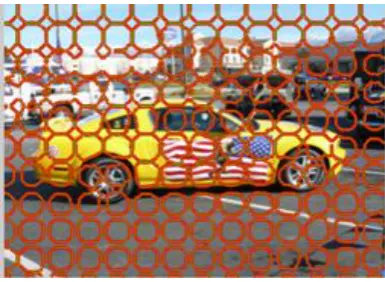
Figure 1. Original image Figure 2. Segmented image using bottom up method
Figure 3. Segmented image using color map Figure 4. Finding the threshold
Figure 5. Performing the POM Operation
background is identified in the given image and the threshold of the image is obtained as shown in fig 4. The POM operation is started based on the structural relationships based on the boundary, intensity, color, etc as shown in fig 5.
The boundary detection algorithm is mainly for detecting the best region in the image. We finish one round of perceptual organization procedure and use the grouped regions in this round as inputs for the next round of perceptual organization. At the beginning of a new round of perceptual organization, we merge the adjacent components if they have similar colors and build a new graph for the new components. This perceptual organization procedure is repeated for multiple rounds until no components can be grouped with other components.
5.
CONCLUSION
It is well established that segmentation and recognition should not be divided and should be treat as an interleaving procedure. This method basically follows this scheme and requires identifying some background objects as a starting point. Compared to the large number of structured object classes, there are only a few common background objects in outdoor scenes. These background objects have low visual multiplicity and hence can be dependably recognized. After the image background objects are detected, we coarsely know where the structured objects are and delimit perceptual organization in definite areas of an image. For various objects with polygonal shapes, such as the main object classes emerging in the streets (e.g., buildings, vehicles, signs, people, etc.) and many other objects, our method can section the whole object or the main portions of the objects together without requiring recognition of the individual object parts. In other words, for these object classes, our technique provides a way to divide segmentation and recognition. This is the major difference between this technique and other class segmentation techniques that involve recognizing an object in order to segment it. This paper illustrates that, for various fairly articulated objects, recognition may not be a constraint for segmentation. The geometric correlations of the essential parts of the objects provide useful cues indicating the associations of these parts.
6.
REFERENCES
[1] Chang Cheng, Andreas Koschan, Member, IEEE, Chung-Hao Chen, David L. Page, and Mongi A. Abidi ,” Outdoor Scene Image Segmentation Based on Background Recognition and Perceptual Organization,” IEEE Transaction on image processing, vol. 21, no. 3, March.2012.
[2] E.Borenstein and E. Sharon, “Combining top-down and bottom-up segmentation,” in Proc. IEEE Workshop Perceptual Org. Comput. Vis., CVPR, pp. 46–53, 2004.
[3] J.Shotton, J. Winn, C.Rother, and A. Criminisi, “Textonboost for image understanding: Multi-class object recognition and segmentation by jointly modeling texture, layout, and context,” Int. J. Comput. Vis., vol. 81, no. 1, pp. 2–23, Jan. 2009.
[4] Ruth Bergman and Hila Nachlieli ,”Perceptual Segmentation: Combining Image Segmentation With Object Tagging,” IEEE Transaction on image processing, vol. 2, no. 6, June .2011.
[5] U.Rutishauser and D.Walther, “Is bottom-up attention useful for object recognition?” in Proc. IEEE CVPR, vol. 2, pp. 37–44, 2004.
[7] D. W. Jacobs, “Robust and efficient detection of salient convex groups,” IEEE Trans. Pattern Anal. Mach. Intell., vol. 18, no. 1, pp.23– 37, Jan. 1996.