AJPRHC
Research Article
SCREENING THE ANTIMICROBIAL ACTIVITY OF SOME MEDICINAL PLANTS AGAINST MULTIDRUG RESISTANCE ESCHERICHIA COLI TYPE (1)
SHAZA ANWAR AL LAHAM *, FRDOOS MOHAMMAD AL FADEL
Pharmacology & Toxicology Department, Faculty of Pharmacy, Damascus University, Damascus, Syria.
* Author for correspondence:[email protected]
This paper is available online at www.jprhc.in
ABSTRACT
The increasing number of Escherichia coli causing mastitis and of bacteria resistant to conventional antibiotics has become a serious problem in recent years. So the search for new antibiotics and alternative products to solve this problem is the question of the age. This research aims to investigate the effectiveness of the extracts prepared from different parts of the following plants: Olea europea Linn (Oleaceae)،Myrtus communis Linn (Liliaceae)،Majorana syriacus Linn (Laminaceae)، Zingiber officinale Linn (Zingiberaceae)، Achillea falcata Linn (Asteraceae) against resistant Escherichia coli Type (1). Investigation began for E.coli bacteria in 667 milk samples. The bacteria were identified culturally, morphologically and biochemically. Antibiotic susceptibility testing against E.coli by Kirby-Bauer disk diffusion method were conducted. Then using the blood agar, MacConkey agar, salmonella - shigella agar, and biochemical testing method [API 20 E testing Enterobacteriaceae] were made to type E.coli. Plants were extracted with water, absolute alcohol, then ether using a soxhlet apparatus and rotary vacuum evaporator. Then extracts susceptibility testing against antibiotic resistant E.coli Type (1) were studied. E. coli was defined as oxidase negative, indole positive, catalase positive. The studied antibiotics did not show any antibacterial effect against E.coli . By the results of the biochemical analysis (API20e) on resistant E.coli , E.coli type (1) was 33.35% of the total number of samples. The anti-bacterial effectiveness against E.coli type (1) of ethanol extracts prepared from different parts of the studied plants were variant, whereas the Myrtus communis extract effectively has the most powerful antibacterial effect for these bacteria, while the Zingiber officinale extract has the lowest influence.
KEY WORDS
Olea europea،Myrtus communis ,Achillea falcata ،Majorana syriacus ،Zingiber officinale،E.coli،resistant bacteria.
INTRODUCTION
Mastitis is the inflammation of milk gland with physical, chemical and microbiological changes characterized by an increase in somatic cells especially, leukocytes in the milk. This disease possess the risk for the transmission of zoonotic diseases like tuberculosis, brucellosis, leptospirosis and streptococcal sore throat to human beings(1). The inflammation of the mammary gland is usually a consequence of invasion and colonization in the secretory tissue by one or more microorganisms, especially Staphylococcus aureus, Streptococcus agalactiae, Streptococcus dysgalactiae, Streptococcus uberis, and Escherichia coli (2). Escherichia coli are facultative anaerobes in the normal intestinal flora of humans and animals; however, pathogenic strains of these bacteria are an important cause of bacterial infections. In humans, these strains are the foremost cause of urinary tract infections. Infection with Shiga toxin–producing E. coli (STEC) may also result in complications including thrombocytopenic purpura, severe hemorrhagic colitis, and hemolytic uremic syndrome (3). Multi-drug resistant strains of Escherichia coli are widely distributed. Thus, it is urgent need to find out new antimicrobial agents. For this reason, researchers are increasingly turning their attention to herbal products, looking for new leads to develop better drugs against multidrug resistant microbe strains. Philip et al. reveled that none of the extracts of Pereskia bleo, pereskia grandifoila, Curcuma aeruginosa Roxb., Curcuma zedoria, curcuma mangga, curcuma inodora aff.Blatter, and zingiber officinale var. that used by Malaysia traditional health care systems, showed activity against Escherichia coli(4).
MEDICINAL PLANTS AGAINST MULTIDRUG RESISTANCE ESCHERICHIA COLI TYPE (1)
Asian J Pharmaceut Res Health Care Volume 6 Issue 1 11-18
Recent studies reported that Achillea species had constituents such as flavonoids (aglycones & glycosides), sesquiterpene lactones and essential oils, the major constituent are 1,8-cineole, camphor, piperitone and ascaridole (8).Some studies have pointed to its anti-bacterial effect(9). The Olea europea Linn from the Oleaceae, is an evergreen long-lasting fruit tree, and is rooted in the Mediterranean region(9). Olive leaves are a good source of several antioxidants including oleuropeoside compounds such as oleuropein and verbascoside, and flavonoid compounds such as luteolin, luteolin-7-glucoside, apigenin-7-glucoside, diosmetin, diosmetin-7-glucoside, rutin and catechin, and simple phenolic compounds such as tyrosol, hydroxytyrosol, vanillin, vanillic acid and caffeic acid(10). Most of these phenolic compounds have been shown to possess substantial antimicrobial and antioxidant activities in vitro, while other non-phenolic components such as aldehydes have also been studied for their antimicrobial properties(5). A number of studies have shown the antibacterial, antiviral, and antifungal compounds(10, 11). Zingiber officinale Linn (Zingiberaceae)،is a minor chemical irritant, and has a sialagogue action. Mature Zingiber officinale (Ginger) roots are fibrous and nearly dry. Its roots are used as spice in cooking(12). Ginger possesses other interesting pharmacological and physiological properties. For instance, it acts as an anti-inflammatory, analgesic, antipyretic, anti-hepatotoxic and cardiotonic substance. Several studies also revealed its anti-bacterial effect(13, 14). The main constituents of Ginger are sesquiterpenoids with zingiberene as the main component. Gingerone, shoagoles and gingerols, volatile oils (12). Gingerol-related components have been reported to possess antimicrobial and antifungal properties, as well as several pharmaceutical properties(15). Finally Majorana syriacus Linn (Marjoram or Origanum syriaca L.) (Laminaceae family). The genus Origanum majorana L. is an aromatic, perennial, herbaceous plant. The plant has been used as a flavouring and herbal spice from time immemorial. The plant is pungent, bitter, hot, stomachic, anthelmintic, alexipharmic, useful in diseases of the heart and blood, fevers, leucoderma and inflammation. The plant is reported to posse antibacterial activity(16). The major volatiles and semi-volatiles of Palestinian wild M. syriaca are ,a-phellandrene, a-pinene, b-myrecene, o-cymene, p-cymene, c-terpinene, thymol, and carvacrol (17). Marjoram (Origanum majorana),as well as wide use in cooking, marjoram has a long history of medicinal use, by the Creeks as an antidote to poisoning and snake venom, by the Romans for stomach disorders and more recently for digestive, antispasmodic and sedative properties(18).
MATERIAL & METHODS
1- Preparing plant extracts: Myrtus communis, Olea europea, and Majorana syriacus leaves, and Achillea falcata flowers, were collected in the early morning hours during the period from June to August from Damascus rural area, while the Zingiber officinale roots were purchased from Damascus markets, which were identified by Prof. Dr. Anwar Al-Khatib from Damauscs University. Plant parts were extracted separately by continuous extraction device (Soxhlet apparatus), adopted method described by Wang(19)for preparing plant extracts by organic solvents, which are respectively: water, absolute ethanol, and then Light Petroleum.
2- Sampling method:
667 milk samples were collected from dairy cows with clinical mastitis (as veterinary diagnosis). These samples were investigated for the presence of Escherichia coli. The bacteria were identified culturally, morphologically and biochemically. Microscopic examination was conducted after 24 hours of incubation on blood agar (HiMedia) plates. All of the following tests were conducted : oxidase, catalase ,Indole test.
3-A bacterial growth inhibition test of antibiotics by the disk diffusion method: Pure cultures of udder pathogens were tested for antibacterial susceptibility by the disc diffusion method (Kirby-Bauer Disk Diffusion Susceptibility Test Protocol) using the 15 antimicrobial substances (Becton Dikinson, Microbiology Systems, MD, USA )on Mueller- Hinton agar medium. Testing was performed according to the recommendation of the Clinical and Laboratory Standards Institute (CLSI) document M100-S17 in 2009(20, 21).
5 mm diameter standard discs contain certain concentrations of the following antibiotics (Bioanalyse): amikacin (30 µg), Cephalexin (30 µg), cephalothin(30 µg), Doxycyclin(30 µg), Cefadroxil (30 µg), ciprofloxacin (5 µg), chloramphenicol (30 µg), gentamicin (10 µg), Norfloxacin (10 µg), Oxytetracycline (30 µg), Pefloxacin (5 µg), Oxacillin (1 µg), Enrofloxacin (5 µg), tetracycline (30 µg), and Amoxicillin (25 µg). The resistance breakpoints were those defined by the National Committee for Clinical Laboratory Standards (NCCLS, 2000) for gram-positive bacteria(20, 21).Negative controls were prepared using the same solvents as used to prepare the extracts. The size of the zones of inhibition was measured.
4–Analytical Profile Index technique (API20E):
The bacterial colonies, which were susceptibility to the antibiotic, were abandoned.
23 differential biochemical tests were performed by API20E system (Analytical Profile Index) manufactured by Bio Merieux , France:
a- Investigate the effectiveness of enzymes: 2 - nitrophenyl-βD-galactopyranoside, Arginine dihydrolase, oxidase. b- Decarboxylation Interactions of amino acids: L-lysine, L-omithine.
c- Deaminase interaction of the amino acid: L-tryptophan.
d- Fermentation reactions of the following sugars: glucose, mannitol, Inositol, sorbitol, L-rhamnose, sucrose, D-melibiose, Amygdaline Arabinose.
e- Production reactions: indole, Asitoen.
g- Study the interactions of Recipes: gelatin diluted, citrate use, hydrolysis of urea (urease).
Then for stereotyping resistance E. coli ,the selective media according to the method of(22), were McCoonky agar, XLD agar , Salmonella–shigella agar.
5- A bacterial growth inhibition test of plant extracts by the disk diffusion method aginast E. coli type (1) that showed resistance to all antibiotics:
Bacterial suspension was emulsified with Agar-agar medium to test the susceptibility of plant extracts. Sterile filter paper discs (5 mm) were soaked with 5mcl of the diluted extracts (66 mg/ml) of pericarp, leaves, flowers ,seeds in ethanol, water ,and petroleum ether, so that each disc was impregnated with 0.33 mg / tablet. Control disks also prepared with absolute ethanol, Water, and petroleum ether. Results were expressed as the percentage of inhibition of bacterial growth, determined by comparing it with Control disks, and standard susceptibility disks(23).
RESULTS:
1- Identification of the bacteria:
Bacteria samples that gave us the following results were selected:
Staining with a gram stain: Gram-negative, non-motile,straight rods withround edges, no capsule, andnon sporing bacteria that formcompatible with reference(22, 24).
2- The results of biochemical tests:
Biochemical confirmation of the strains was performed and E. coli was defined as oxidase negative, indole positive, catalase positive. These results were depended according to(24).
3- Antimicrobial susceptibility results against E. coli :
Bacterial colonies showed resistant to all studied antibiotics, based on the criteria of NCCLS2000(25), and to the standard’s leaflet of antibiotic discs from the manufacturer. These colonies were selected to test the plant extracts.
Table(1):The percentage of antimicrobial sensibility to E.coli
Percentage of sensitive bacteria % Antimicrobial
susceptibility results diameters zones of
inhibition (mm) Antibiotics 98,89 resistant 9,2+1,09 Oxytetracycline (T) 91,59 resistant 8,4+0,8 Amoxicillin(AX) 88,75 resistant 7,6+0.9 Oxacillin(OX) 93,14 resistant 7,2+0,8 Cefadroxil(CER) 94,09 resistant 9,2+1,1 Pefloxacin(PEF) 96,92 resistant 8+1,2 Amikacin(AK) 90,11 resistant 7,9+0,7 Tetracyclin(TE) 87,49 resistant 9,3+0,8 Ciprofloxacin(CIP) 84.04 resistant 6,9+1,4 Norfloxacin(NOR) 78,62 resistant 8,5+1,3 Gentamycin(CN) 95,76 resistant 8,7+0,9 Chloramphenicol(C) 79,57 resistant 10,9+0,5 Enrofloxacin(ENR) 87,18 resistant 8,5+1,2 Doxycyclin(DO) 90.64 resistant 7,4+0,8 Cephalexin(CL) 93.51 resistant 9,7+1,3 Cephalotin(KF)
4-The results of Analytical Profile Index technique (API20E):
MEDICINAL PLANTS AGAINST MULTIDRUG RESISTANCE ESCHERICHIA COLI TYPE (1)
Asian J Pharmaceut Res Health Care Volume 6 Issue 1 11-18
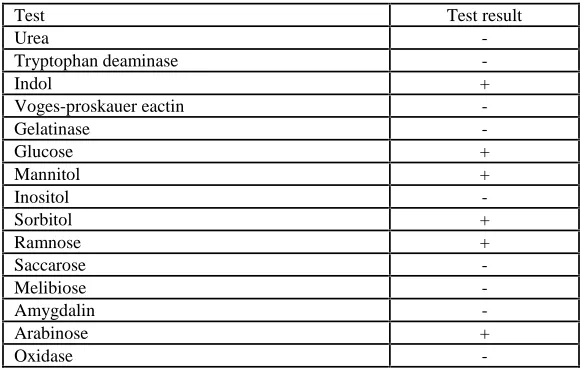
Table (2): shows the results of (API20E) technique.
Test result Test
-Urea
-Tryptophan deaminase
+ Indol
-Voges-proskauer eactin
-Gelatinase
+ Glucose
+ Mannitol
-Inositol
+ Sorbitol
+ Ramnose
-Saccarose
-Melibiose
-Amygdalin
+ Arabinose
-Oxidase
So as a result 223(33.43%) out of total number 667 samples were gotten of E. coli type (1). 5- Colonial and cultural characters:
These results were depended according to(22, 24).
- Growth on blood agar: circular colonies, white, and smooth with a fecal odor. - Growth on McCoonky agar: the growth of red colonies.
- Growth on XLD agar (xylose lysine desoxycholate agar) European pharmacopoeia: yellow colonies with wet strength, and with zone of yellow precipitation around the colonies.
- Growth on Salmonella–shigella agar: red colonies.
6- The results of Antibacterial Efficacy of plant extracts against E. coli type(1):
The petroleum ether, and water extract from studied plants were not active against E. coli type I (1) (diameters of zone of inhibition were zero).
As shown in Table (3), the ethanol extracts of various plants showed antibacterial activity against E. coli type(1), with the diameters of zone of inhibition ranging between 6 and 20 mm. Mean inhibition zones indicate that Myrtus communis leaves extracts exert a powerful effect on E.coli type(1), while the Zingiber officinale extract has the lowest influence.
Figure 2:
shows no effect of studied antibiotics against E.coli
Figure 1:
Figure 4:
Inhibition zones of Achilla extracts against E.coli type(1)
Figure 3:
Inhibition zones of myrtus extracts against E.coli type(1)
Table (3): Antibacterial activity of different extracts of studied plants
Plant
Inhibition zones of plant extracts (mm)
mean ±S.D
Percentage of sensitive bacteria %
Control/5 µm 0 0
Myrtus communis leaves 20+1,3 90.4
Achillea falcata flowers 18+0,7 84.35
Olea Europea leaves 16+1,2 68.55
Majorana syriacus leaves 8+1,08 74.55
Zingiber officinale roots 6+1,1 45.36
Figure(5): Percentage of sensitive bacteria Figure(6): Mean of inhibition diameter of plants extract and Amikacin against
E. coli type(1). DISCUSSION
In the present study, antibacterial activity in the leaf extracts of various plants against multidrug resistant pathogenic bacteria Escherichia coli type (1) was evaluated by in vitro agar disc diffusion method, E.coli was resistance to all antimicrobials assayed, where the ethanol extract exhibits maximum antibacterial activity against Escherichia coli type (1). The present study demonstrates that ethanol extract, not aqueous, or ether petroleum extracts, exhibits an inhibitory effect on E.coli type (1) growth. This may in part be due to different chemical compositions between aqueous and ethanol extracts. The results showed variation in the antimicrobial properties of plant extracts (Table 3). The ethanol extracts showed strong activity (inhibition zone 20-16 mm), and weak inhibition (zone 8-6 mm). Attending to this, we arrange plants according to their effectiveness against E.coli type(1) to find that the major effectiveness was achieved by the ethanol extracts from Myrtus communis leaves, followed by Achillea falcata flowers, and Olea Europea leaves extract. While the Majorana syriacus, and Zingiber officinale leaves has the
0 20 40 60 80 100 Figure 4:
Inhibition zones of Achilla extracts against E.coli type(1)
Figure 3:
Inhibition zones of myrtus extracts against E.coli type(1)
Table (3): Antibacterial activity of different extracts of studied plants
Plant
Inhibition zones of plant extracts (mm)
mean ±S.D
Percentage of sensitive bacteria %
Control/5 µm 0 0
Myrtus communis leaves 20+1,3 90.4
Achillea falcata flowers 18+0,7 84.35
Olea Europea leaves 16+1,2 68.55
Majorana syriacus leaves 8+1,08 74.55
Zingiber officinale roots 6+1,1 45.36
Figure(5): Percentage of sensitive bacteria Figure(6): Mean of inhibition diameter of plants extract and Amikacin against
E. coli type(1). DISCUSSION
In the present study, antibacterial activity in the leaf extracts of various plants against multidrug resistant pathogenic bacteria Escherichia coli type (1) was evaluated by in vitro agar disc diffusion method, E.coli was resistance to all antimicrobials assayed, where the ethanol extract exhibits maximum antibacterial activity against Escherichia coli type (1). The present study demonstrates that ethanol extract, not aqueous, or ether petroleum extracts, exhibits an inhibitory effect on E.coli type (1) growth. This may in part be due to different chemical compositions between aqueous and ethanol extracts. The results showed variation in the antimicrobial properties of plant extracts (Table 3). The ethanol extracts showed strong activity (inhibition zone 20-16 mm), and weak inhibition (zone 8-6 mm). Attending to this, we arrange plants according to their effectiveness against E.coli type(1) to find that the major effectiveness was achieved by the ethanol extracts from Myrtus communis leaves, followed by Achillea falcata flowers, and Olea Europea leaves extract. While the Majorana syriacus, and Zingiber officinale leaves has the
0 5 10 15 20 Figure 4:
Inhibition zones of Achilla extracts against E.coli type(1)
Figure 3:
Inhibition zones of myrtus extracts against E.coli type(1)
Table (3): Antibacterial activity of different extracts of studied plants
Plant
Inhibition zones of plant extracts (mm)
mean ±S.D
Percentage of sensitive bacteria %
Control/5 µm 0 0
Myrtus communis leaves 20+1,3 90.4
Achillea falcata flowers 18+0,7 84.35
Olea Europea leaves 16+1,2 68.55
Majorana syriacus leaves 8+1,08 74.55
Zingiber officinale roots 6+1,1 45.36
Figure(5): Percentage of sensitive bacteria Figure(6): Mean of inhibition diameter of plants extract and Amikacin against
E. coli type(1). DISCUSSION
MEDICINAL PLANTS AGAINST MULTIDRUG RESISTANCE ESCHERICHIA COLI TYPE (1)
Asian J Pharmaceut Res Health Care Volume 6 Issue 1 11-18
weakest’sinfluence. Considering the large number of different groups of chemical compounds present in plants, it is most likely that their antibacterial activity is not attributed to one specific mechanism but that there are several targets in the cell. The antimicrobial potency of plants is believed to be due to, saponins, phenolic compounds, essential oils and flavonoids(26).Most of the studies on the mechanism of phenolic compounds have focused on their effects on cellular membranes. They have been seen to attack not only cell walls and cell membranes, thereby affecting their permeability and the release of intracellular constituents, but also to interfere with membrane functions such as electron transport, enzyme activity or nutrient uptake. Thus, active phenolic compounds might have several targets which could lead to the inhibition of bacteria (27). As in khder article these compounds were found in denature proteins and block enzymes and subsequently the bacteria losses its activity(6). Myrtus communis leaves contain different polyphenol classes as flavonols and galloyl derivatives, their antimicrobial mode of action was related to the presence of phenolic compounds(27). More over Myrtucomlone A&B are considered as two new acylphloraglucinols identified in the leaves and fruits of M.communis and have shown a significant antimicrobial effect against bacteria. The inhibition effect may be regarded to present of Tannin via producing hydrogen bonds with proteins, which converted its structure and lead to block the protein synthesis, and tannins considered as a phenolic compounds of plants(6). So the inhibition effect of Myrtus communis towards E.coli type(1) isolates may refer to the polyphenolic and Tannin they contain. Information about the antimicrobial activity of Achillea extracts is limited. The study of the 13 Turkish Achillea species showed that not all of the Achillea species possess antibacterial activity. Achillea falcata showed mild to low antibacterial activity(9). Also water-insoluble parts of the methanolic extracts exhibited slight or no activity(28). In contrast at Stojanović’s study, extracts of several species of Achillea possess a broad spectrum of antimicrobial activity against tested strains Staphylococcus aureus, and Escherichia coli(29, 30), which matched our results. The composition of the extract of Achillea clavennae are alkanes, fatty acids, monoterpenes, guaiane sesquiterpenes, and flavonoids (apigenin and centaureidin)(29). The genus Achillea has been extensively studied in regard to its flavonoids and sesquiterpene lactones. Flavonoids possess antimicrobial properties and several investigations have examined the relationship between flavonoid structure and antibacterial activity. Promising evidence has clearly shown that sesquiterpene lactones derived from several different plant species have significant antimicrobial activity in vitro(9). Researchers have published numerous studies concluding that olive leafs active ingredient, oleuropein and its derivative hydroxytyrosol act as a natural antibiotic agent. Oleuropein has been shown to have strong antimicrobial activity against both Gram-negative and Gram-positive bacteria, as well as mycoplasma. Oleuropein and other phenolic compounds completely inhibit the development of Klebsiella pneumoniae, Escherichia coli and B. cereus(31).
Phenolic structures similar to oleuropein seem to produce its antibacterial effect by damaging the bacterial membrane and/or disrupting cell peptidoglycans(32). However, the exact mechanism of the antimicrobial effect of oleuropein is still not completely confirmed, although some authors have suggested proposed that it is due to the presence of the ortho-diphenolic system (catechol)(31). Other researchers concluded that oleuropeins can enhance nitric oxide production in mouse macrophages. By increasing nitric oxide production, oleuropein appears to arm the macrophages against endotoxins. Interestingly, oleuropein only increased nitric oxide production when endotoxins were present(33). Ethanol extract of Ginger inhibited E.coli showing 9 mm diameter(34), as our study. Ginger extract found to have moderate antibacterial properties against E. coli serogroups O8 and O88, while it did not show any antibacterial activity against all other serogroups of E. coli(35).In contrast, Sofia at el. Reported that the Ginger extract showed negligible antibacterial activity against Escherichia coli, staphylococcus aureus and Bacillus cereus(36),and no effect not even by hexane, ethyl acetate, water, and methanol extracts(13). Alsoaqueous extracts of Zingiber
officinale did not exhibit in vitro any inhibition on the growth ofE. coli (37), which confirmed the result of our study. The methanol extract of Origanum majorana against the E.coli has 18 mm diameter Zone of inhibition(16), while our study showed 8 mm . The methanol extract of shade dried aerial parts of O.majorana had showed variable activity against Bacillus subtilis,B. megaterium, Escherichia coli, Proteus vulgaris, Pseudomonas aeruginosa and Staphylococcus aureus(16). The antibacterial activity exhibited by Origanum majorana essential oil, and The n-hexane extract of Four sweet marjoram (Origanum majorana ) fractions have been demonstrated(38). In contrast, at Joshi’s study the most resistant bacteria to Origanum majorana extract were E.coli(39).
We believe that this is the first study on the antibacterial effect of Achillea, and majorana on this type of bacteria, Escherichia coli type(1).
CONCLUSION
The ethanol extracts of Myrtus communis, Achillea falcata, Olea Europea, Majorana syriacus, and Zingiber officinale showed variant antibacterial activity against resistant Escherichia coli Type(1), which causes mastitis. Myrtus, Achillea, and olive had beaten out all the strongest antibiotics in possession the antibacterial effect on these bacteria.
REFERENCE
1.Bachaya H, Iqbal Z, Muhammad G, Yousaf A, Ali H. Subclinical mastitis in buffaloes in Attock district of Punjab (Pakistan). Pakistan Veterinary Journal. 2005;25(3):134.
2.Martín BS, Kruze J, Morales MA, Agüero H, Iragüen D, Espinoza S, et al. Antimicrobial Resistance in Bacteria Isolated From Dairy Herds in Chile. The International Journal of Applied Research in Veterinary Medicine. 2009;4(7).
4.Brazier J, Levett P, Stannard A, Phillips K, Willis A. Antibiotic susceptibility of clinical isolates of clostridia. Journal of antimicrobial chemotherapy. 1985;15(2):181-5.
5.Naziri Z, Rajaian H, Firouzi R. Antibacterial effects of Iranian native sour and sweet pomegranate (Punica granatum) peel extracts against various pathogenic bacteria. Iranian Journal of Veterinary Research. 2012;13(4):282-8.
6.Khder AK. Effect of Allium sativum and Myrtus communis on the elimination of antibiotic resistance and swarmig of Proteus mirabilis. Jordan Journal of Biological Sciences (JJBS). 2008:3124.
7.Al-Anbori DK, Al-Nimer MS, Al-Weheb AM. Athraa M:Antibacterial activity of ethanolic extract of Myrtus communis. L leaves against salivary Mutans streptococci. Saudi Dental Journal. 2008;20(3):82-7.
8.Katzung BG, Masters SB, Trevor AJ. Basic & clinical pharmacology: Lange Medical Books/McGraw-Hill Toronto:; 2001. 9.Karaalp C, Yurtman AN, Karabay Yavasoglu NU. Evaluation of antimicrobial properties of Achillea L. flower head extracts. Pharmaceutical biology. 2009;47(1):86-91.
10.Pereira AP, Ferreira IC, Marcelino F, Valentão P, Andrade PB, Seabra R, et al. Phenolic compounds and antimicrobial activity of olive (Olea europaea L. Cv. Cobrançosa) leaves. Molecules. 2007;12(5):1153-62.
11.Bisignano G, Tomaino A, Cascio RL, Crisafi G, Uccella N, Saija A. On the in‐vitro antimicrobial activity of oleuropein and hydroxytyrosol. Journal of pharmacy and pharmacology. 1999;51(8):971-4.
12.Marks SL, Kather EJ. Antimicrobial susceptibilities of canine< i> Clostridium difficile</i> and< i> Clostridium perfringens</i> isolates to commonly utilized antimicrobial drugs. Veterinary microbiology. 2003;94(1):39-45.
13.Philip K, Malek SNA, Sani W, Shin SK, Kumar S, Lai HS, et al. Antimicrobial activity of some medicinal plants from Malaysia. American Journal of Applied Sciences. 2009;6(8):1613-7.
14.Akoachere J, Ndip R, Chenwi E, Ndip L, Njock T, Anong D. Antibacterial effects of Zingiber Officinale and Garcinia Kola on respiratory tract pathogens. East African medical journal. 2006;79(11):588-92.
15.Park M, Bae J, Lee DS. Antibacterial activity of [10]-gingerol and [12]-gingerol isolated from ginger rhizome against periodontal bacteria. Phytotherapy Research. 2008;22(11):1446-9.
16.Leeja L, Thoppil J. Antimicrobial activity of methanol extract of Origanum majorana L.(Sweet marjoram). Journal of Environmental Biology. 2007;28(1):145.
17.Abu-Lafi S, Odeh I, Dewik H, Qabajah M, Hanuš L, Dembitsky V. Thymol and carvacrol production from leaves of wild Palestinian Majorana syriaca. Bioresource technology. 2008;99(9):3914-8.
18.Evans WC. Trease and Evans Pharmacognosy. 15th ed ed: WB Saunders company Ltd; 2002.
19.Wang L, Weller CL. Recent advances in extraction of nutraceuticals from plants. Trends in Food Science & Technology. 2006;17(6):300-12.
20.Hudzicki J. Kirby-Bauer Disk Diffusion Susceptibility Test Protocol. Kirby-Bauer Disk Diffusion Susceptibility Test Protocol. 2009.
21.Wilker MA, Cockerill FR, Craig WA, Dudley MN, Eliopoulos GM, Hecht DW. M100-S17 Performance Standards for Antimicrobial Susceptibility Testing;Seventeenth Informationl Supplement. 2007;27(1).
22.Ebeid M. microbiology. 4th ed: Publications of the University of Damascus; 2000.
23.Pradeep B, Manojbabu M, Palaniswamy M. Antibacterial Activity of Punica granatum L. Against Gastro Intestinal Tract Infection Causing Organisms. Ethnobotanical Leaflets. 2008;2008(1):143.
24.Al-Rifai I, Alomar A. special Microbiology 2007:106-7.
25.Standards NCfCL. NCCLS Antimicrobial Susceptibility Testing: National Committee for Clinical Laboratory Standards; 1992.
26.Aboaba O, Efuwape B. Antibacterial properties of some Nigerian species. Bio Res Comm. 2001;13:183-8.
27.Amensour M, Bouhdid S, Fernández-López J, Idaomar M, Senhaji NS, Abrini J. Antibacterial activity of extracts of Myrtus communis against food-borne pathogenic and spoilage bacteria. International Journal of Food Properties. 2010;13(6):1215-24. 28.Candan F, Unlu M, Tepe B, Daferera D, Polissiou M, Sökmen A, et al. Antioxidant and antimicrobial activity of the essential oil and methanol extracts of Achillea millefolium subsp millefolium Afan.(Asteraceae). Journal of Ethnopharmacology. 2003;87(2):215-20.
29.Stojanović G, Radulović N, Hashimoto T, Palić R. In vitro antimicrobial activity of extracts of four Achillea species: The composition of Achillea clavennae L.(Asteraceae) extract. Journal of ethnopharmacology. 2005;101(1):185-90.
30.Tajik H, Jalali FSS, Sobhani A, Shahbazi Y, Zadeh MS. In vitro assessment of antimicrobial efficacy of alcoholic extract of Achillea millefolium in comparison with penicillin derivatives. Journal of Animal and Veterinary Advances. 2008;7(4):508-11. 31.Omar SH. Oleuropein in olive and its pharmacological effects. Scientia pharmaceutica. 2010;78(2):133.
32.Caturla N, Pérez-Fons L, Estepa A, Micol V. Differential effects of oleuropein, a biophenol from Olea europaea, on anionic and zwiterionic phospholipid model membranes. Chemistry and physics of lipids. 2005;137(1):2-17.
33.Visioli F, Bellosta S, Galli C. Oleuropein, the bitter principle of olives, enhances nitric oxide production by mouse macrophages. Life sciences. 1998;62(6):541-6.
34.Hamad M, Habra N, Kalb-Allose A. Isolated of Clostridium perfringens from intestinal bacteriotoxemia cases in the province of Hama. Al-Baath University journal. 2009;31(2).
MEDICINAL PLANTS AGAINST MULTIDRUG RESISTANCE ESCHERICHIA COLI TYPE (1)
Asian J Pharmaceut Res Health Care Volume 6 Issue 1 11-18
36.Alexander CJ, Citron DM, Brazier JS, Goldstein E. Identification and antimicrobial resistance patterns of clinical isolates of Clostridium clostridioforme, Clostridium innocuum, and Clostridium ramosum compared with those of clinical isolates of Clostridium perfringens. Journal of clinical microbiology. 1995;33(12):3209-15.
37.Rahman S, Parvez AK, Islam R, Khan MH. Antibacterial activity of natural spices on multiple drug resistant Escherichia coli isolated from drinking water, Bangladesh. Annals of clinical microbiology and antimicrobials. 2011;10(1):10.
38.Kozlowska M, Laudy A, Starosciak B, Napiorkowski A, Chomicz L, Kazimierczuk Z. Antimicrobial and antiprotozoal effect of sweet marjoram (Origanum majorana L.). order. 2010.