Proceedings of the
Ninth International Workshop on
Graph Transformation and
Visual Modeling Techniques
(GT-VMT 2010)
De-/Re-constructing Model Transformation Languages
Eugene Syriani and Hans Vangheluwe
14 pages
Guest Editors: Jochen Küster, Emilio Tuosto
Managing Editors: Tiziana Margaria, Julia Padberg, Gabriele Taentzer
De-/Re-constructing Model Transformation Languages
Eugene Syriani and Hans Vangheluwe
McGill University, School of Computer Science, Montréal, Canada {esyria,hv}@cs.mcgill.ca
Abstract: The diversity of today’s model transformation languages makes it hard
to compare their expressiveness and provide a framework for interoperability. De-constructing and then re-De-constructing model transformation languages by means of a unique set of most primitive constructs facilitates both. We thus introduceT-Core, a collection of primitives for model transformation. CombiningT-Corewith a (pro-gramming or modelling) language enables the design of model transformation for-malisms. We show how basic and more advanced features from existing model transformation languages can be re-constructed usingT-Coreprimitives.
Keywords: Transformation primitives, multi-paradigm model transformation
1
Introduction
A plethora of different rule-based model transformation languages and supporting tools exist today. They cover all (or a subset of) the well-known essential features of model transforma-tion [SV09c]: atomicity, sequencing, branching, looping, non-determinism, recursion,
paral-lelism, back-tracking, hierarchy, and time. For such languages, the semantics (and hence
imple-mentation) of a transformation rule consists of the appropriate combination of building blocks implementing primitive operations such as matching, rewriting, and often a validation of con-sistent application of the rule. The abovementioned essential features of transformation lan-guages are achieved by implicitly or explicitly specifying “rule scheduling”. Lanlan-guages such asATL[JK06],FUJABA[FNTZ00],GReAT[AKK+06], MoTif[SV09b],VIATRA[VB07], and
VMTS[LLMC06] include constructs to specify the order in which rules are applied. This often takes the form of a control flow language. Without loss of generality, we consider transformation languages where models are encoded as typed, attributed graphs.
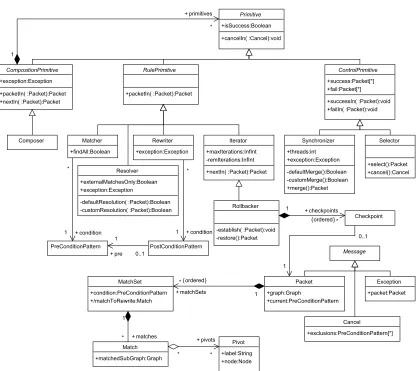
Figure 1: TheT-Coremodule
We introduce T-Core, a collection of transformation language primitives for model transfor-mation in Section 2. Section 3 motivates the choice of its primitives. Section 4 shows how transformation entities, common as well as more esoteric, can be re-constructed. Section5 de-scribes related work and Section6draws conclusions and presents directions for future work.
2
De-constructing Transformation Languages
We propose here a collection of model transformation primitives. The class diagram in Figure1 presents the moduleT-Coreencapsulating model transformation primitives. T-Coreconsists of eight primitive constructs (Primitiveobjects): aMatcher,Iterator,Rewriter,Resolver,Rollbacker,
PostCondi-tionPatterns. For example, in rule-based model transformation, the transformation unit is a rule. ThePreConditionPatterndetermines its applicability: it is usually described with a left-hand side (LHS) and optional negative application conditions (NACs). It also consists of a PostCondition-Patternwhich imposes a pattern to be found after the rule was applied: it is usually described with a right-hand side (RHS).RulePrimitivesare to be distinguished from theControlPrimitives, which are used in the design of the rule scheduling part of the transformation language. A meaningful composition of all these different constructs in aComposer object allows modular encapsulation of and communication betweenPrimitiveobjects.
Primitives exchange three different types of messages: Packet, Cancel, and Exception. A packetπ represents the host model together with sufficient information for inter- and intra-rule processing of the matches.π thus holds the current model (graph in our case)graph, the match-Set, and a reference to the current PreConditionPattern identifying a MatchSet. A MatchSet
refers to aconditionpattern and contains the actual matches as well as a reference to the match-ToRewrite. Note that each MatchSet of a packet has a unique condition, used for identifying the set of matches. AMatch consists of a sub-graph of the graphinπ where each element is bound to an element ingraph. Some elements (Nodes) of the match may be labelled aspivots, which allows certain elements of the model to be identified and passed between rules. A cancel messageϕ is meant to cancel the activity of an active primitive element (especially used in the presence of aSelector). Finally, specific exceptionsχcan be explicitly raised, carrying along the currently processed packetπ (πφ is used to represent the empty packet).
All the primitive constructs can receive packets by invoking either theirpacketIn,nextIn, suc-cessIn, orfailInmethods. The result of calling one of these methods sets the primitive in success or failure mode as recorded by theisSuccessattribute. Cancel messages are received from the
cancelInmethod. Next, we describe in detail the behaviour of the different methods supported by the primitive elements. A complete description can be found in [SV09a].
2.1 Matcher Algorithm 1Matcher.packetIn(π)
M←(all) matches ofconditionfound inπ.graph if∃ hcondition,M′i ∈π.matchSetsthen
M′←M′∪M
else
addhcondition,Mitoπ.matchSets
end if
π.current←condition
isSuccess←M6=/0
return π TheMatcherfinds all possible matches of thecondition
pattern on the graph embedded in the packet it receives from its packetIn method. The transformation mod-eller may optimize the matching by setting thefindAll
attribute to falsewhen he a priori knows that at most one match of this matcher will be processed in the
over-all transformation. The matching also considers the pivot mapping (if present) of the current match ofπ. After matching the graph, theMatcherstores the different matches in the packet as described in Algorithm1. Some implementations may, for example, parametrize theMatcherby the condition pattern or embed it directly in theMatcher. The transformation units (e.g., rules) may be compiled in pre/post-condition patterns or interpreted, but this is a tool implementation issue which we do not discuss here.
2.2 Rewriter
As described in Algorithm 2, the Rewriter applies the required transformation for itscondition
Algorithm 2Rewriter.packetIn(π)
ifπis invalid then
isSuccess←false
exception←χ(π)
return π end if
M← hcondition.pre,Mi ∈π.matchSets
apply transformation on M.matchToRewrite if transformation failed then
isSuccess←false
exception←χ(π)
return π end if
set all modified nodes in M to dirty removehcondition,Mifromπ.matchSets
isSuccess←true
return π by theRewriter: no other operation can be further applied
on it. Some validations are made in theRewriterto verify, for example, that π.current.condition = condition.pre or that no error occurred during the transformation. In our ap-proach, a modification (update or delete) of an element in
{M| hcondition.pre,Mi ∈ π.matchSets} is automatically propagated to the other matches, if applicable.
2.3 Iterator
TheIteratorchooses a match among the set of matches of thecurrentcondition of the packet it receives from its pack-etInmethod, as described in Algorithm 3. The match is chosen randomly in a Monte-Carlo sense, repeatable using
sampling from a uniform distribution to provide a reproducible, fair sampling. When itsnextIn
method is called, theIteratorchooses another match as long as the maximum number of iterations
maxIterations(possibly infinite) is not yet reached, as described in Algorithm4. In the case of multiple occurrences of aMatchSetidentified byπ.current, theIteratorselects the lastMatchSet.
Algorithm 3Iterator.packetIn(π)
ifhπ.current,Mi ∈π.matchSetsthen
choose m∈M
M.matchToRewrite←m
remIterations←maxIterations−1
isSuccess←true
returnπ else
isSuccess←false
returnπ end if
Algorithm 4Iterator.nextIn(π)
ifhπ.current,Mi ∈π.matchSetsandremIterations>0 then choose m∈M
M.matchToRewrite←m
remIterations←remIterations−1
isSuccess←true
return π else
isSuccess←false
return π end if
2.4 Resolver
Algorithm 5Resolver.packetIn(π)
for all condition c∈ {c|hc,Mi ∈π.matchSets}do
ifexternalMatchesOnlyand c=π.currentthen
continue end if
for all match m∈M do
if m has a dirty node then
ifcustomResolution(π) then
isSuccess←true
return π
else ifdefaultResolution(π)then
isSuccess←true
return π else
isSuccess←false
exception←χ(π)
return π end if end if end for end for
isSuccess←false
exception←χ(π)
return π The Resolver resolves a potential conflict between
matches and rewritings as described in Algorithm 5. For the moment, the Resolver detects conflicts in a simple conservative way: it prohibits any change to other matches in the packet (check for dirty nodes). However, it does not verify if a modified match is still valid with respect to its pre-condition pattern. The
externalMatchesOnly attribute specifies whether the conflict detection should also consider matches from its match set identified byπ.currentor not. In the case of conflict, a default resolution function is provided but the user may also override it.
2.5 Rollbacker
it is used as a recovery point that allows backward recovery of packets, e.g., by means of check-pointing. The packetInmethod establishes a checkpoint of the received packet and the nextIn
method restores the last checkpoint to roll-back the packet to its previous state. Again, a maxi-mum number of iterations can be specified.
Algorithm 6Rollbacker.packetIn(π)
establish(π)
remIterations←maxIterations−1
isSuccess←true
return π
Algorithm 7Rollbacker.nextIn(π)
ifhπ.current,Mi ∈π.matchSetsandremIterations>0 then
remIterations←remIterations−1
isSuccess←true
returnπ
else ifremIterations>0 then ˆ
π←restore()
remIterations←remIterations−1
isSuccess←true
return ˆπ else
isSuccess←false
returnπ end if
2.6 Selector
TheSelectoris used when a choice needs to be made between multiple packets processed con-currently by different constructs. It allows exactly one of them to be processed further. When its
successIn(orfailIn) method is called, the received packet is stored in itssuccess(orfail) collec-tion, respectively. Note that, unlike the previous described methods, it is only when theselect
method in Algorithm 8is called that a packet is returned, chosen fromsuccess. The selection is random in the same way as in theIterator. When thecancel method is invoked, the two col-lections are cleared and a cancel messageϕ is returned where theexclusionsset consists of the singletonπ.current(meaning that operations of the chosenconditionshould not be cancelled).
2.7 Synchronizer
Algorithm 8Selector.select() ifsuccess6=/0 then
ˆ
π←choose fromsuccess isSuccess←true
else iffail6=/0 then ˆ
π←choose fromfail isSuccess←false else
ˆ π←πφ
isSuccess←false exception←χ(πφ) end if
success← /0
fail← /0
return ˆπ
Algorithm 9Synchronizer.merge() if|success|=threadsthen
ifcustomMerge()then
ˆ
π←the merged packet insuccess isSuccess←true
success←/0
fail←/0
return ˆπ
else ifdefaultMerge()then
ˆ
π←the merged packet insuccess isSuccess←true
success←/0
fail←/0
return ˆπ else
isSuccess←false exception←χ(πφ) return πφ
end if
else if|success|+|fail|=threadsthen
ˆ
π←choose fromfail isSuccess←false return ˆπ
else
isSuccess←false exception←χ(πφ) return πφ
end if
2.8 Composer
TheComposerserves as a modular encapsulation interface of the elements in itsprimitiveslist. When one of itspacketInornextInmethods is invoked, it is up to the user to manage subsequent method invocations to its primitives. Nevertheless, when the cancelIn method is called, the
3
T-Core
: a minimal collection of transformation primitives
In the de-construction process of transformation languages into a collection of primitives, ques-tions like “up to what level?” or “what to include and what to exclude?” arise. The proposed
T-Coremodule answers these questions in the following way.
In a model transformation language, the smallest transformation unit is traditionally the rule. A rule is a complex structure with a declarative part and an operational part. The declarative part of a rule consists of the specification of the rule (e.g., LHS/RHS and optionally NAC in graph transformation rules). However, T-Coreis not restricted to any form of specification let it be rule-based, constraint-based, or function-based. In fact, some languages require units with only a pre-condition to satisfy, while other with a pre- and a post-condition. Some even allow arbitrary permutations of repetitions of the two. InT-Core, either aPreConditionPatternor both aPre- and aPostConditionPatternmust be specified. For example, a graph transformation rule can be represented inT-Coreas a couple of a pre- and a post-condition pattern, where the latter has a reference to the former to satisfy the semantics of the interface K (in the L ← K → R
algebraic graph transformation rules) and be able to perform the transformation. Transformation languages where rules are expressed bidirectionally or as functions are supported inT-Coreas long as they can be represented as pre- and post-condition patterns.
The operational part of a rule describes how it executes. This operation is often encapsu-lated in the form of an algorithm (with possibly local optimizations). Nevertheless, it always consists of a matching phase, i.e., finding instances of the model that satisfy the pre-condition and of a transformation phase, i.e., applying the rule such that the resulting model satisfies the post-condition. T-Coredistinguishes these two phases by offering aMatcherand aRewriter as primitives. Consequently, theMatcher’s condition only consists of a pre-condition pattern and the
Rewriterthen needs a post-condition pattern that can access the pre-condition pattern to perform the rewrite. Combinations ofMatchersandRewritersin sequence can then represent a sequence of simple graph transformation rules: match-rewrite-match-rewrite. Moreover, because of the separation of these two phases, more general and complex transformation units may be built, such as: match-match-match or match-match-rewrite-rewrite. The former is a query where each
Matcher filters the conditions of the query. The latter is a nesting of transformation rules. In this case, however, overlapping matches between different Matchers and then rewrites on the overlapping elements may lead to inconsistent transformations or even non-sense. This is why a
Resolvercan be used fromT-Coreto safely allow match-rewrite combinations.
The data structure exchanged between T-Core RulePrimitivesin the form of packets contains sufficient information for each primitive to process it as described in the various algorithms in Section2. TheMatchallows to refer to all model elements that satisfy a pre-condition pattern. The pivot mappings allow elements of certain matches to be bound to elements of previously matched elements. The pivot mapping is equivalent to passing parameters between rules as will be shown in the example in Section4.1. TheMatchSetallows to delay the rewriting phase instead of having to rewrite directly after matching.
fur-ther operators. Advanced features such as iteration over multiple matches or back-tracking to a previous state in the transformation are also supported inT-Core.
SinceT-Coreis a low-level collection of model transformation primitives, combining its itives to achieve relevant and useful transformations may involve a large number of these prim-itive operators. Therefore, it is necessary to provide a “grouping” mechanism. TheComposer
allows to modularly organizeT-Coreprimitives. It serves as an interface to the primitives it en-capsulates. This then enables scaling of transformations built onT-Coreto large and complex model transformations designs.
T-Coreis presented here as an open module which can be extended, through inheritance for example. One could add other primitive model transformation building blocks. For instance, a conformance check operator may be useful to verify if the resulting transformed model still conforms to its meta-model. It can be interleaved between sequences of rewrites or used at the end of the overall transformation as suggested in [KMS+09]. We believe however that such new constructs should either be part of the (programming or modelling) language or the tool in which
T-Coreis integrated, to keepT-Coreas primitive as possible.
4
Re-constructing Transformation Languages
(a) (b)
(c) (d)
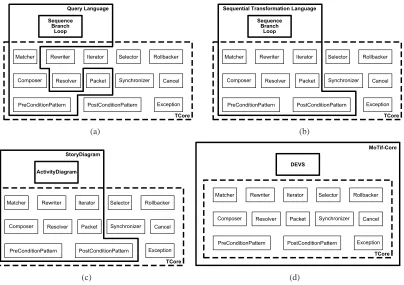
Figure 2: CombiningT-Corewith other languages allows to re-construct existing and new lan-guages
transforma-tion primitives makes it easier to reason about transformatransforma-tion languages. In fact, properly com-biningT-Coreprimitives with an existing well-formed programming or modelling language al-lows us to re-construct some already existing transformation languages and even construct new ones [SV09a]. Figure2shows some examples of combinations ofT-Corewith other languages. Figure2(a)and Figure2(b)combine a subset ofT-Corewith a simple (programming) language which offers sequencing, branching, and looping mechanisms (as proposed in Böhm-Jocapini’s
structured program theorem [BJ66]). We will refer to such a language as an SBL language. The first combination only involves theMatcherand its PreConditionPattern, Packetmessages to exchange, and theComposerto organize the primitives. TheseT-Coreprimitives integrated in an SBL language lead to a query language. Since only matching operations can be performed on the model, they represent queries where the resulting packet holds the set of all elements (sub-graph) of the model (graph) that satisfy the desired pre-conditions. Including otherT-Core
primitives such as theRewriterpromotes the query language to a transformation language. Fig-ure2(b)enumerates the necessaryT-Coreprimitives combined with an SBL language to design a complete sequential model transformation language. Replacing the SBL language by another one, such as UML Activity Diagrams in Figure2(c), allows us to re-construct Story Diagrams [FNTZ00], for example, since they are defined as a combination of UML Activity and Collab-oration Diagrams with graph transformation features. Other combinations involving the whole
T-Coremodule may lead to novel transformation language with exception handling and the no-tion of timed model transformano-tions when combined with a discrete-event modelling language [SV09a].
We now present the re-construction of two transformation features using the combination of an SBL language withT-Coreas in Figure2(b).
4.1 Re-constructing Story Diagrams
In the context of object-oriented reverse-engineering, theFUJABAtool allows the user to spec-ify the content of a class method by means of Story Diagrams. A Story Diagram organizes
Figure 3: TheFUJABA doSubDemotransformation showing a for-all Patternand twostatement activities
the behaviour of a method with activities and transi-tions. An activity can be aStory Pattern or a state-ment activity. The former consists of a graph trans-formation rule and the lat-ter is Java code. Figure3 shows such a story dia-gram taken from the
timeapplies statement 7 after each iteration of thefor-all Pattern. This activity allows the pattern to simulate random choices of levels for different people in the elevator. When all iterations have been completed, the flow proceeds with statement 8 reached by the transition labelledend. The latter activity simulates the elevator going one level up.
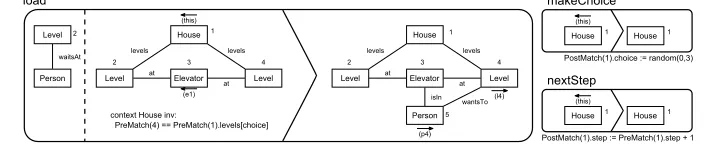
Figure 4: The threeMoTifrules for thedoSubDemotransformation
Algorithm 10makeChoiceC.packetIn(π)
π←makeChoiceM.packetIn(π)
if notmakeChoiceM.isSuccessthen
isSuccess←false
return π end if
π←makeChoiceI.packetIn(π)
if notmakeChoiceI.isSuccessthen
isSuccess←true
return π end if
π←makeChoiceW.packetIn(π)
if notmakeChoiceW.isSuccessthen
isSuccess←false
return π end if
π←makeChoiceR.packetIn(π)
if notmakeChoiceR.isSuccessthen
isSuccess←false
return π end if
isSuccess←true
returnπ We now show how to re-construct this non-trivial
story diagram transformation from an SLB language combined withT-Core. An instance of that combi-nation is called a T-Core model. First, we design
the rules needed for the conditions of rule primi-tives. Figure 4 describes the three necessary rules corresponding to the three Story Diagram activi-ties. We use the syntax of MoTif [SV09b] where the central compartment is the LHS, the compart-ment on the right of the arrow head is the RHS and the compartment(s) on the left of dashed lines are the NAC(s). The concrete syntax for represent-ing the pattern elements was chosen to be intuitively close enough to the FUJABA graphical representa-tion. Numeric labels are used to uniquely identify different elements across compartments. Elements with an alpha-numeric label between parentheses de-note pivots. A right-directed arrow on top of such a
label depicts that the model element matched for this pattern element is assigned to a pivot (e.g.,p4 and l4). If the arrow is directed to the left, then the model element matched for this pattern element is bound to the specified pivot (e.g.,thisande1).
The T-Coremodel equivalent to the originaldoSubDemo transformation consists of a Com-poser doSubDemoC. It is composed of twoComposers loadCandnextStepCeach containing a
Matcher, an Iterator, a Rewriter, and a Resolver. The packetIn method of doSubDemoC first calls the corresponding method of loadC and then feeds the returned packet to the packetIn
method of nextStepC. This ensures that the output packet of the overall transformation is the result of first loading all the Personobjects and then moving the elevator by onestep. make-ChoiceCandnextStepCbehave as simple transformation rules. TheirpacketInmethod behaves as specified in Algorithm10. First, the matcher is tried on the input packet. Note that the con-ditions of the matchers makeChoiceM and nextStepMare the LHSs of rules makeChoice and
Algorithm 11loadC.packetIn(π)
π←loadM.packetIn(π)
if notloadM.isSuccessthen
isSuccess←false
return π end if
π←loadI.packetIn(π) while true do
if notloadI.isSuccessthen
isSuccess←true
return π end if
π←loadW.packetIn(π)
if notloadW.isSuccessthen
isSuccess←false
return π end if
π←loadR.packetIn(π)
if notloadR.isSuccessthen
isSuccess←false
return π end if
π←makeChoiceC.packetIn(π)
π←loadI.nextIn(π) end while
isSuccess←true
return π Note that the conditions of the rewriters makeChoiceW
and nextStepW are the RHSs of rules makeChoice and
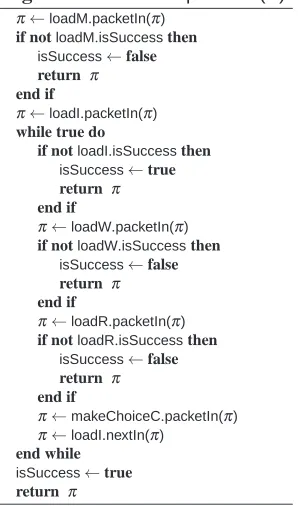
nextStep, respectively. If it fails, an exception is thrown and the transformation stops. Otherwise, the resolver verifies the application of this pattern with respect to other matches in the transformed packet. The behaviour of the resolution function will be elaborated on later. Finally, on a successful resolution, the resulting packet is output and the composer is put in success mode. loadC is the composer that emu-lates thefor-all Patternof the example. Algorithm 11 spec-ifies that behaviour. After finding all matches with loadM
(whose condition is the LHS and the NAC of ruleload), the packet is forwarded to the iteratorloadIto choose a match. The iteration is emulated by a loop with the failure mode ofloadI as the breaking condition. Inside the loop, loadW
rewrites the chosen match andloadR resolves possible con-flicts. Then, the resulting packet is sent tomakeChoiceCto fulfil theeach timetransition of the story digram. After that, thenextInmethod ofloadIis invoked with the new packet to choose a new match and proceed in the loop.
Having seen the overallT-Coretransformation model, let
us inspect how the differentResolversshould behave in order to provide a correct and complete transformation. The first rewriter called isloadR and the first time it receives a packet is when a transformation is applied on one of the matches of loadM. Therefore each match consists of the sameHouse(since it is a bound node), twoLevels, anElevator, and the associations between them. On the other hand,loadWonly adds aPersonand links it to aLevel. Therefore the default resolution function ofloadR applies successfully, since no matched element is modified nor is the NAC violated in any other match. The next resolver ismakeChoiceR which is in the same loop asloadR. There, theHouseis conflicting with all the matches in the packet according to the conservative default resolution function. Note that makeChoiceMfinds at most one match (the boundHouseelement). However,makeChoiceWdoes not really conflict with matches found in
loadM. We therefore specify a custom resolution function formakeChoiceRthat always succeeds. The same applies fornextStepR.
4.2 Re-constructing amalgamated rules
Figure 5: The transformation rules for the Repotting
Gera-niums example
In a recent paper, Rensink et al. claim that the Repotting the
Geraniums example is inexpressible in most transformation
for-malisms [RK09]. The authors propose a transformation language that uses an amalgamation scheme for nested graph transforma-tion rules. As we have seen in the previous example, nesting transformation rules is possible in T-Core and will be used to solve the problem. It consists of repotting all flowering
Algorithm 12baseC.packetIn(π)
π←baseM.packetIn(π)
if notbaseM.isSuccessthen
isSuccess←false
return π end if while true do
π←baseI.packetIn(π)
if notbaseI.isSuccessthen
isSuccess←true
return π end if
π←baseW.packetIn(π)
if notbaseW.isSuccessthen
isSuccess←false
return π end if
π←baseR.packetIn(π)
if notbaseR.isSuccessthen
isSuccess←false
return π end if
π←innerC.packetIn(π)
π←baseM.packetIn(π)
if notbaseM.isSuccessthen
isSuccess←true
return π end if end while graph transformation rules involved and Algorithm 12
demonstrates the composition of primitiveT-Coreelements encoding these rules. baseM(with, as condition, the LHS of rule base) finds all broken pots containing a flowering geranium, given the input packet containing the input graph. The set of matches resulting in the packet are the combina-tion of all flowering geraniums and their pot container. From then on starts the loop. First,baseIchooses a match. If one is chosen,baseWtransforms this match andbaseRresolves any conflicts. In this case,baseWonly creates a new unbro-ken pot and assigns pivots. Therefore, baseR’s resolution function always succeeds. In fact, the resolver is not needed here, but we include it for consistency. TheinnerCcomposer encodes theinnerrule which finds the two bound pots and moves a flourishing flower in the broken pot to the unbroken one. In order to iterate over all the flowers in the broken pot, theinnerC.packetInmethod has the exact same behaviour as
loadC.packetIn in Algorithm 11, with the exception of not calling a sub-composer (like makeChoiceC). Note that an always successful custom resolution function for innerR is required. After theResolversuccessfully outputs the packet, theinnerrule is applied. Then (and also ifbaseIhad failed)
baseM.packetInis called again with the resulting packet. The loop ends when thebaseM.packetIn
method call inside the loop fails, which entailsbaseCto return the final packet in success mode.
5
Related work
The closer work to our knowledge is [VJBB09]. In the context of global model management, the authors define a type system offering a set of primitives for model transformation. The advantage of our approach is that T-Coreis a described here as a module and is thus directly implementable. We have recently incorporated T-Corewith an asynchronous and timed mod-elling language [SV09a] which allowed us to re-implement the two examples in Section4 as well as others. Also, the approach described in [VJBB09], does not deal with exceptions at all. Nevertheless, their framework is able to achieve higher-order transformations, which we did not consider in this paper.
The GP graph transformation language [MP08] also offers transformation primitives. They however focus more on the scheduling of the rules then on the rules themselves. Their scheduling (control) language is an extension of an SBL language. Our approach is more general since much more complex scheduling languages (e.g., allowing concurrent and timed transformation execution) can be integrated withT-Core. Although it performs very efficiently, the application area ofGPis more limited, as it can not deal with arbitrary domain-specific models.
6
Conclusion
In this paper, we have motivated the need for providing a collection of primitives for model trans-formation languages. We have definedT-Corewhich precisely describes each of these primitive constructs. The de-construction process of model transformation languages enabled us to re-construct existing model transformation features by combining T-Corewith, for example, an SBL language. This allowed us to compare different model transformation languages using a common basis.
Now that these primitives are well-defined, efficiently implementing each of them might lead to more efficient model transformation languages. Also, for future work, we would like to in-vestigate howT-Corecombined with appropriate modelling languages can express further trans-formation constructs. We would also like to investigate further on the notion of exceptions and error handling in the context of model transformation.
Bibliography
[AKK+06] A. Agrawal, G. Karsai, Z. Kalmar, S. Neema, F. Shi, A. Vizhanyo. The Design of a Language for Model Transformations. SoSym 5(3):261–288, September 2006.
[BJ66] C. Böhm, G. Jacopini. Flow diagrams, turing machines and languages with only two formation rules. Communications of the ACM 9(5):366–371, May 1966.
[FNTZ00] T. Fischer, J. Niere, L. Turunski, A. Zündorf. Story diagrams: A new graph rewrite language based on the Unified Modelling Language and Java. In Ehrig et al. (eds.),
Theory and Application of Graph Transformations. LNCS 1764, pp. 296–309.
Springer-Verlag, Paderborn (Germany), November 2000.
[JK06] F. Jouault, I. Kurtev. Transforming Models with ATL. In MTiP’05. LNCS 3844, pp. 128–138. Springer-Verlag, January 2006.
[KMS+09] T. Kühne, G. Mezei, E. Syriani, H. Vangheluwe, M. Wimmer. Systematic Transfor-mation Development. In 3rd International Workshop on Multi-Paradigm Modeling
(best paper). Volume 21. October 2009.
[LLMC06] L. Lengyel, T. Levendovszky, G. Mezei, H. Charaf. Model Transformation with a Visual Control Flow Language. IJCS 1(1):45–53, 2006.
[MP08] G. Manning, D. Plump. The GP Programming System. In GT-VMT’08. ECEASST,
pp. 235–247. Budapest (Hungary), March 2008.
[RK09] A. Rensink, J.-H. Kuperus. Repotting the Geraniums: On Nested Graph Transfor-mation Rules. In Margaria et al. (eds.), GT-VMT’09. EASST. York (UK), March 2009.
[SV09b] E. Syriani, H. Vangheluwe. Discrete-Event Modeling and Simulation: Theory and
Applications. Chapter DEVS as a Semantic Domain for Programmed Graph
Trans-formation. CRC Press, Boca Raton (USA), 2009.
[SV09c] E. Syriani, H. Vangheluwe. Matters of model transformation. Technical
re-port SOCS-TR-2009.2, McGill University, School of Computer Science, March 2009.
[VB07] D. Varró, A. Balogh. The model transformation language of the VIATRA2 frame-work. Science of Computer Programming 68(3):214–234, 2007.