Available online throug
ISSN 2229 – 5046
International Journal of Mathematical Archive- 10(6), June-2019 68
THREE DIMENSIONAL CONVECTIVE SQUEEZING FLOW
IN A ROTATING CHANNEL WITH HALL EFFECT AND THERMAL RADIATION
PUDI SREENIVASA RAO*
Department of Physics, Jyothishmathi Institute of Technology & Sciences,
Karimnagar, Telangana, India.
(Received On: 13-05-19; Revised & Accepted On: 13-06-19)
ABSTRACT
W
e analyze MHD effects on the three dimensional squeezing flow of an electrically conducting in a rotating channel and its heat transfer characteristics with hall effect. The governing equations are reduced to set of ordinary differential equations and then numerically solved by employing Runge-Kutta-Fehlberg fourth-fifth order method. Effect of pertinent parameters on velocity, temperature fields is examined through the plots. Nusselt number for different variations are studied numerically.Keywords: Thermal Radiation, Squeezing flow, Hall Effect, Rotating Channel.
1. INTRODUCTION
An unsteady squeezing flow of an electrically conducting fluid occurs in many engineering and industrial applications such as lubrication, food industries, transient loading of mechanical components, power transmission, polymer processing, compression and injection modelling. The squeezing flow of a fluid was first introduces by Stefan [53], Following this work, many researchers have investigated such flow with different aspects. Numerical solution for a fluid film squeezed between two parallel plane surfaces have been reported by Hamza and Macdonald [23]. Domairry and Aziz [15] studied the squeezing flow of viscous fluid between parallel disks with suction or blowing analytically. Heat and mass transfer in the unsteady squeezing flow between parallel plates is analyzed by Mustafa et al. [36], Hamza [22] discussed the effect of suction and injection on the squeezing flow between parallel plates. It is noted that very little attention has been given to study the three-dimensional flow in a rotating channel. Munawar et al. [35] studied the three-dimensional flow in a rotating channel of lower stretching sheet in the presence of MHD effects. The mathematical equations are modelled with the help of Navier-Stokes equation and then they are solved numerically. Hayat et al. [24] have discussed an unsteady mixed convection three-dimensional squeezing flow of an incompressible Newtonian fluid between two vertical parallel planes. Mahantesh et al. [31] have discussed the heat and mass transfer effects on the mixed convective flow of chemically reacting nanofluid past a moving / stationary vertical plate. Mahanthesh et al. [31] have studied mixed MHD convection squeezing three-dimensional flow in a rotating channel filled with nanofluid.
The motion of rotation fluids enclosed with in a body or vice versa, was given by Greenspan [21], discussed these problems relating to the boundary layers and their interaction in rotating flows and gave so many examples relating to such interaction. The rotating viscous flow equation yields a layer known as Eckman boundary layer after the Swedish oceanographer Eckman who discovered it. Attempts to observe the structure of the Eckman layer in the surface layers of the sea have been successful. Eckman layers are easy to produce and observe in the laboratory. Such boundary layers or similar ones are required to connect principally geotropic flow in the interior of the fluid to the horizontal boundaries where conditions like a prescribed horizontal stress or no slip on a solid bottom are given. In a similar way other kinds of various boundaries have been studies so as to connect geotropic flow to vertical boundaries (for example a vertical well along which the depth varies) on which boundary conditions consistent with geotropic flow are given. Rao et al.
[38] made an investigation of the combined free and forced convective effects on an unsteady Hydro magnetic viscous incompressible flow in a rotating porous channel. This analysis has been extended to porous boundaries by Sarojamma and Krishna [45]. An initial value investigation of the hydro magnetic and convective flow of a viscous electrically conducting fluid through a porous medium in a rotating channel has been made by Krishna et al. [28]. In all these papers the viscous dissipative effect has not been considered. But the viscous dissipation has its importance when the
Corresponding Author: Pudi Sreenivasa Rao*,
natural convection flow fixed is of extreme size or the temperature is low or in higher gravity field. The problem of steady laminar micro polar fluid flow through porous walls of different permeability had been discussed by Agarwal and Dhanpal [5]. Steady and unsteady hydro magnetic flow of viscous incompressible electrically conducting fluid under the influence of constant and periodic pressure gradient in the presence of include magnetic field had been investigated by Ghosh [20] to study the effect of slowly rotating systems with low frequency of oscillation when the conductivity of the fluid is low and the applied magnetic field is weak. El-Mistikawy et al. [18] were discussed the rotating disk flow in the presence of strong magnetic field and weak magnetic field. Hazim Ali Attia [25] was developed the MHD flow of incompressible, viscous and electrically conducting fluid above an infinite rotating porous disk was extended to flow starting impulsively from rest. The fluid was subjected to an external uniform magnetic field perpendicular to the plane of the disk. The effects of uniform suction or injection through the disk on the unsteady MHD flow were also considered. Circar and Mukherjee [12] have analyzed the effect of mass transfer and rotation on flow past a porous plate in a porous medium with variable suction in a slip flow regime. Balasubramanyam [7] and Madhusudhana Reddy [30] have investigated convective heat and mass transfer flow in horizontal rotating fluid under different conditions. Singh and Mathew [52] have studied on oscillatory free convective MHD flow in a rotating vertical porous channel with heat sources. Madhavi et al. [29] have investigated heat and mass transfer flow of a rotating fluid in a vertical channel with stretching and stationary walls. Sukanya et al. [54] have studied the effect of non-uniform heat sources on convective heat and mass transfer flow in vertical channel bounded by Stretching walls.
The heat transfer flow of an electrically conducting fluid in the presence of transverse magnetic field also finds a variety of applications such as MHD generators, pumps, flow meters, nuclear reactors, accelerators and in metallurgical industries. Its relevance is also seen in many practical applications in geophysical and astrophysical situations. Sarpkya [46] was the first to study the effectiveness of MHD flows in fluids.
The effect of radiation on MHD flow and heat transfer problem have become more important industrially. At high operation temperature, radiation effect can be quite significant. Many processes in engineering areas occur at high temperature and a knowledge of radiation heat transfer becomes very important for the design of the pertinent equipment. Nuclear power plants, gas turbines and the various propulsion devices for aircraft, missiles, satellites and space vehicles are examples of such engineering areas. Bestman [8] examined the natural convection boundary layer with suction and mass transfer in a porous medium. His results confirmed the hypothesis that suction stabilizes the boundary layer and affords the most efficient method in boundary layer control yet known. Abdul Sattar and Hamid Kalim [2] investigated the unsteady free convection interaction with thermal radiation in a boundary layer flow past a vertical porous plate. Mankinde [32] examined the transient free convection interaction with thermal radiation of an absorbing-emitting fluid along moving vertical permeable plate. Recently Ibrahim et al. [26] have studied non classical thermal effects in Stokes second problem for micropolar fluids by used perturbation method.
© 2019, IJMA. All Rights Reserved 70
transfer for Hiemenz flow through porous media with radiation. Devikarani et al [14] have considered oscillatory mixed convection in horizontal channel with heat sources and radiation effect.
With the fuel emergency extending everywhere throughout the world, there is an awesome worry to use the gigantic power underneath the world's outside layer in the geothermal region. Fluid in the geothermal area is an electrically conducting liquid because of high temperature. Hence the study of interaction of the geomagnetic field with the fluid in the geothermal region is of awesome interest, in this way prompting enthusiasm for the investigation of MHD convection courses through permeable medium. Keeping these applications in view the MHD convective heat and mass flow of a electrically conducting fluid past a stretching sheet has been considered by a few analysts [4, 13, 27, 44].
Hall currents are essential and they have a marked effect on the magnitude and direction of the current density and subsequently on the magnetic forceterm. The issue of MHD free convection flow with Hall currents has many important engineering applications, for example, in control generators, MHD accelerators, refrigeration coils, transmission lines, electric transformers, warming components and so on., several authors [3,10,40,51,50,55] have studied hall current effects on MHD convective heat transfer in different configurations.
2. MATHEMATICAL FORMULATION
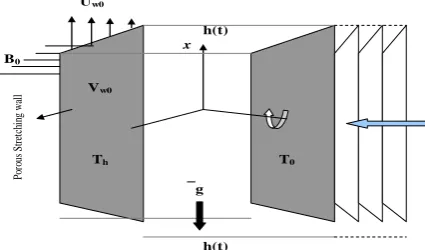
Consider an unsteady three-dimensional squeezing flow of an electrically conducting incompressible viscous fluid in a vertical rotating channel. The plane positioned at y = 0 is stretched with velocity Uwo = ax/(1 – α t) in x-direction and
maintained at the constant temperature T0. The temperature at the other plane is Th and located at a variable distance
)
1
(
)
(
t
t
h
=
ν
f−
α
. In negative y-direction, the fluid is squeezed with a time dependent velocity)
1
(
/
2
/
/
dt
t
dh
V
h=
=
−
α
ν
fα
−
α
.The fluid and the channel are rotated about y-axis with angular velocity
Ω
=
ω
ˆ
j
/(
1
−
α
t
)
. The transverse magneticfield is assumed to be variable kind
B
=
B
0/
(
1
−
α
t
)
and it is applied along y-axis. The fluid is sucked/injected from the plane located at y = 0 as shown in figure 1. The magnetic Reynolds number is assumed to be small thus induced magnetic field is negligible. In addition, effects of Hall current, viscous dissipation and Joule heating are taken into account.Under those assumptions, the governing equations for the velocity and temperature fields in the presence of internal heating source/sink are given by [Hayat et al. 24, Munawar et al 35].
,
0
=
∂
∂
+
∂
∂
y
v
x
u
(1) 2 2 2 0 0 2 21
2
(
)
(
),
1
(1
)
T
B
g
u
u
u
p
u
u
u
w
u
mw
T
T
t
x
y
t
x
x
y
t
σ
β
ω
ν
ν
α
ρ
ρ
α
ρ
∂
∂
∂
∂
∂
∂
+
+
+
= −
+
+
−
+
+
−
∂
∂
∂
−
∂
∂
∂
−
(2),
1
2 2 2 2
∂
∂
+
∂
∂
+
∂
∂
−
=
∂
∂
+
∂
∂
+
∂
∂
y
v
x
v
y
p
y
v
x
v
u
t
v
ν
ρ
ν
(3)),
(
)
1
(
1
2
2 0 2 2 2 2mu
w
t
B
y
w
x
w
u
t
y
w
x
w
u
t
w
f r−
−
−
∂
∂
+
∂
∂
=
−
−
∂
∂
+
∂
∂
+
∂
∂
α
ρ
σ
ν
α
ω
ν
(4)2 2 2
2 2
2 2 0
2 2 2
(
)
1
2
(
)
(
)
(
)
1
f R
p p
k
q
B
T
T
T
T
T
u
w
u
u
w
t
x
y
C
x
y
C
y
y
y
m
σ
ν
µ
ρ
ρ
∂
∂
+
∂
+
∂
=
∂
+
∂
−
−
∂
+
∂
+
+
∂
∂
∂
∂
∂
∂
∂
∂
+
(5)where u, v and w are velocity components along x, y and z directions respectively, p is pressure. B0 is the magnetic
field, σ is the electrical conductivity, g is the magnitude of acceleration due to gravity, α is characteristic parameter with the dimension of reciprocal of time t and αt < 1. T is temperature of the fluid, kf and (ρCp) are thermal
conductivity and heat capacity of the fluid respectively.ρf is the density of fluid, µf is the dynamic viscosity of the
fluid, The approximate boundary conditions for the present problem are;
Uw0 h(t) x B0 Vw0
Th T0
g
h(t)
Fig. 1 : Flow configuration and coordinate
0 0
0
( , , )
,
( , , )
,
( , , )
0 ,
( , , )
,
w w
u x y t
U
v x y t
V
w x y t
T x y t
T
=
=
=
=
at y = 0 (6)( , , )
0 ,
( , , )
,
( , , )
0 ,
( , , )
h
h
u x y t
v x y t
V
w x y t
T x y t
T
=
=
=
=
at y = h(t) (7)where
T
h=
T
0+
T
0/(
1
−
α
t
),
V
w0=
−
V
0/(
1
−
α
t
)
. Here V0 is constant, Vw0 < 0 corresponds injection whereas Vw0 > 0 corresponds wall suction.To reduce the governing equations into a set of similarity equations, introduce the following similarity transformations [Munawar et al 35].
),
(
),
(
1
,
),
(
1
,
)
(
),
(
1
0 0 0 0η
η
α
α
η
η
θ
α
η
η
α
α
ψ
η
f
w
U
g
t
v
v
f
U
u
t
T
T
T
t
h
y
xf
t
v
w f w f=
−
−
=
=
−
+
=
=
−
=
(8)where a suffix η denote the differentiation with respect to η and vf is the kinematic viscosity of the fluid. Using the
above transformations (8), the equation (1) is automatically satisfied, while the equation (2) – (4) are respectively reduces to the following nonlinear ordinary differential equations;
2 2
2
2 2
(1
)
2
(
)
( )
,
2
1
M
t
p
f
f f
f
f
f
Rg
f
m g
G
m
a x
x
ηηη ηη η η ηη η
η
α
β
θ
ρ
−
∂
−
−
−
−
−
+
+
=
+
∂
(9)(
)
1
,
2
η ηη ηη
ρ
α
η
β
p
a
v
t
f
f
f
f
f
f−
−
=
−
+
+
−
(10),
0
)
(
1
2
2
2 2=
−
+
−
+
−
−
+
η η η η ηηη
β
η
g
m
f
m
M
Rf
g
g
g
f
g
f
g
(11)2
2 2 2 2
2
4
Pr
1
Pr
(
) Pr
(
)
0
3
2
1
Rd
EcM
f
f
g
Ec f
g
m
ηη η η η ηη η
η
θ
β θ
θ
θ
+
+
+
+
+
+
+
+
=
+
. (12)The modified boundary conditions are;
fη = 1, f = fw, g = 0, θ = 0, at η = 0
fη = 0, f = β2 , g = 0, θ = 1, at η = 1 (13) where
β = α/α is the squeezing parameter, R = ω /α is rotation parameter,
M
2=
σ
B
02/
αρ
f is magnetic parameter,Gr = G / Re2 is mixed convection parameter,
G
=
g
β
TT
0x
3/
v
2f(
1
−
α
t
)
is Grashaf number, Re = xUw0 / vf isReynolds number, Pr = (µcp)f / kf is the Prandtl number.
It is important to mention that, β = 0 represents plates are stationary, β > 0 corresponds to the plate which is located at
y = h(t) moves towards the plate which is located at y = 0 and β <0 corresponds to the plate at y = y(t) moves apart with respect to the plate at y= 0.
Now in order to reduce the number of independent variables by cross differentiation; the set of equations (9)-(12) takes the following form;
(
)
22
3
2
(
)
(
)
0
2
1
M
f
f
f
f f
f f
Rg
f
m g
G
m
ηηη ηη ηηη η ηη ηηη η ηη η η
β
η
θ
−
+
−
+
−
+
+
=
+
(14)0
)
(
1
2
2
2 2=
−
+
−
+
+
−
−
+
η η η η ηηη
η
β
g
m
f
m
M
f
R
g
g
g
f
g
f
g
(15)2
2 2 2 2
2
4
Pr
1
Pr
(
) Pr
(
)
0
3
2
1
Rd
EcM
f
f
g
Ec f
g
m
ηη η η η ηη η
η
θ
β θ
θ
θ
+
−
+
+
+
+
+
+
=
+
(16)© 2019, IJMA. All Rights Reserved 72
,
)
(
,
)
(
0 ) ( *
) ( at 0
0 *
0 at
T
k
q
a
v
Nu
T
k
q
a
v
Nu
f t h y xy f t
h y f
y xy f y
= =
=
=
=
=
(17)where τxy is the shear stress, qxy is the heat flux, and mxy is the mass flux which are given by
∂
∂
+
∂
∂
−
=
y
T
x
T
k
q
xt ηf (18)In view of equation (18) and similarity transformations (8); equations (14)-(15) will takes the following form;
),
0
(
)
1
(
1,5 *at 00
aty=
=
−
α
t
Nu
y==
−
θ
ηNu
)
1
(
)
1
(
1,5 *at ()) (
aty=ht
=
−
α
t
Nu
y=ht=
−
θ
ηNu
(19)3. NUMERICAL METHOD AND VALIDATION
A set of non-similar equations (14)-(16) are nonlinear in nature and possess no analytical solution, thus, a numerical treatment would be more appropriate. These set of ordinary differential equations together with the boundary conditions (13) are numerically solved by employing fourth-fifth order Runge-Kutta-Fehlberg scheme with the help of Maple. This algorithm in Maple is proven to be precise and accurate and which has been successfully used to solve a wide range of nonlinear problem in transport phenomena especially for flow and heat transfer problems. In this study, we set the relative error tolerance to 10-6. Comparison results are recorded in table 1 and are found to be in excellent agreement. The effects of development of the squeezing three-dimensional flow and heat transfer in a rotating channel utilizing nanofluid are studied for different values of squeezing parameter, rotation parameter, magnetic parameter, suction/injection parameter, mixed convection parameter, radiation parameter, Prandtl number. In the following section, the results are discussed in detail with the aid of plotted graphs and tables.
We make an investigation of the three dimensional squeezing convective flow, heat transfer flow of An electrically conducting fluid in a rotating channel. In our numerical simulation the default values of the parameters are considered as,R = 0.5, β = 0.5, Pr = 0.71. In order to analyse the effects of various pertinent parameters on velocity, temperature profiles, several graphs are plotted.
Fig.2a-2d represent the effect of Hall current on f, f′, g, θ .It can be found from the profiles that the normal velocity (f), axial velocity (f′), the transverse velocity (g) enhances with increasing Hall parameter (m) (figs.2a-2c). The thickness of the thermal boundary layers reduces with increase in m which results in a fall in the temperature in the flow region (figs.2d).
The influence of rotation parameter (R) on f, f′, g, θ can be observed from the figs.3a-3d. The normal velocity (f) and transverse velocity (g) enhances with increase in R. The axial velocity (f′) enhances in the left half(0,0.5) and reduces in the right half (0.5,1.0) of the channel. The temperature distributions experience an enhancement in the entire flow region with increase in rotation parameter (R). This is due to the fact thickness of the thermal boundary layers increase with R.
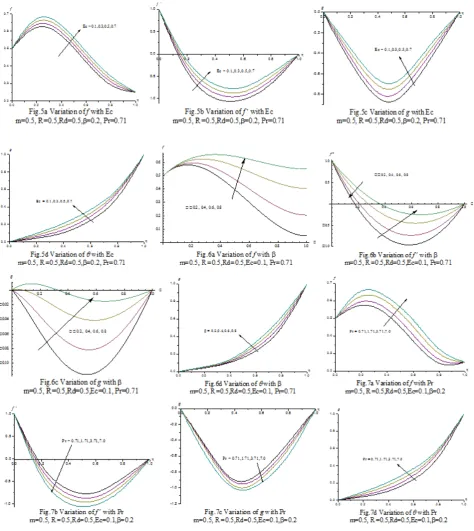
Fgs.4a-4d show the influence of thermal radiation(Rd) on f, f′, g, θ .It can be seen from the profiles(figs.4a-4d) that there is a significant depreciation in the magnitude of the velocity components f, f ′and g in the presence of thermal radiation throughout the flow region. The radiation parameter is found to reduce the hydrodynamic boundary layers along x and y-directions. The presence of the thermal radiation is very significant on the variation of temperature. It is seen that the temperature increases rapidly in the presence of thermal radiation parameter throughout the flow region. This may be attributed to the fact that as the Roseland radiative absorption parameter R*diminishes the corresponding heat flux diverges and thus rising the rate of radiative heat transfer to the fluid causing a rise in the temperature of the fluid. The thickness of the thermal boundary layer also increases with increase in Rd (fig.4d).
Figs.5a-5d represents the effect of Eckert number (Ec) on f, f′ g, θ from the velocity profile we find that the normal velocity (f) enhances while axial and transverse velocity component depreciate in magnitude in the flow region (figs.5a-5c). From fig.5d we notice an enhancement in temperature in entire flow region. It may be attributed to the fact that higher dissipation larger the thickness of the thermal boundary layer.
The effect of Prandtl number (Pr) on f, f′, g, θ can be seen from figs.7a-7d. From the profiles we find that all the velocity components experience an enhancement with increase in Pr. Also lesser the thermal diffusivity larger the thickness of the thermal boundary layer in the entire flow region (figs.7d).
The rate of heat transfer (Nu) at
η
=
0
,
1
are shown in table.1. An increase in Hall parameter (m) or R or Rd reduces Nu at the left wall and enhances at the right wall. Higher the dissipation (Ec) or squeezing parameter (β) smaller Nu atη=0 and larger at η=1. The rate of heat transfer reduces at the left wall and enhances at the right wall with increase in R or β or Pr. An increase in Prandtl number reduces Nu at η=1 and enhances at η=0.
© 2019, IJMA. All Rights Reserved 74
Table – 2: Nusselt number(Nu) at η = 0
Parameter Nu(0) Nu(1) Parameter Nu(0) Nu(1)
m 0.5 -0.999841 -1.00005 Ec 0.1 -0.999745 -1.00015
1.0 -0.998857 -1.00032 0.3 -0.998231 -1.00104
1.5 -0.99939 -1.00045 0.5 -0.99756 -1.00214
2.0 -0.998316 -1.00055 0.7 -0.996221 -1.00305
R 0.5 -0.999841 -1.00005
β
0.2 -0.999165 -1.00108
1.0 -0.998858 -1.00031 0.4 -0.998989 -1.00145
1.5 -0.999392 -1.00045 0.6 -0.998813 -1.00182
2.0 -0.998316 -1.00055 0.8 -0.998637 -1.00218
Rd 0.5 -0.999841 -1.00005 Pr 0.71 -1.00012 -0.999896
1.5 -0.997252 -1.00139 1.71 -1.00029 -0.999749
3.5 -0.996392 -1.00295 3.71 -1.00047 -0.999603
4. CONCLUSIONS
The effect of rotation, Hall currents, squeezing, thermal radiation and heat source on convective heat and mass transfer of an electrically conducting fluid in a vertical channel has been analysed .It is found that an increase in Hall parameter (m) increases f, f′ and g while squeezing parameter (β) enhances f and reduces f ′ & g. The temperature enhances with Rotation and Hall parameter, reduces with squeezing parameter (β). Higher the thermal radiation/dissipation larger the temperature in the flow region. The Nusselt number enhances at η=1 and reduces at η=0, with increase in m, R, Rd, Ec, β.
5. REFERENCES
1. Abd El-Naby M.A, Elsayed M.E, Elbarabary and Nader Y.A. Finite difference solution of radiation effects on MHD free convection flow over a vertical porous plate, Appl. Maths Comp. Vol.151 pp 327-346 (2004). 2. Abdul Sattar.M.D, Hamid Kalim.M.D: Unsteady free-convection interaction with thermal radiation in a
boundary layer flow past a vertical porous plate. J Math Phys Sci; 30:25-37 (1996).
3. Abo-Eldahab EM, Salem AM. Hall effects on MHD free convection flow of a non-Newtonian power-law fluid at a stretching surface. Int. Commun. Heat Mass Transfer, V.31, pp: 343-5 (2004).
4. Afify AA. MHD free-convective flow and mass transfer over a stretching sheet with chemical reaction, Heat Mass Transf V.40, pp:495-500(2004).
5. Agarwal, R.S and Dhanapal, C : Numerical solution to the flow of a micro polar fluid flow through porous walls of different permeability. pp. 325-336 (1987).
6. Bakier A.Y and Gorla R.S.R.: Thermal radiation effects on mixed convection from horizontal surfaces in porous media, Transport in porous media, Vol.23 pp 357-362 (1996).
7. Balasubramanyam M: Effect of radiation on convective Heat and Mass transfer flow in a horizontal rotating channel communicated to Research India Publications, India (2010).
8. Bestman. A.R: Natural convection boundary layer with suction and mass transfer in a porous medium. Int J Energy Res; 14:389-96 (1990).
9. Chamkha A.J: Solar Radiation Assisted natural convection in a uniform porous medium supported by a vertical heat plate, ASME Journal of heat transfer, V.19, pp 89-96 (1997).
10. Chamkha AJ, Mansour MA, Aly AM. Unsteady MHD Free Convective Heat and Mass Transfer from a
Vertical Porous Plate with Hall Current, Thermal Radiation and Chemical Reaction effects. International Journal for Numerical Methods in Fluids V.65, pp: 432-47(2011).
11. Chitrphiromsri.P and Kuznetsov.A.V: Porous medium model for investigating transient heat and moisture transport in firefighter protective clothing under high intensity thermal exposure, J. Porous media, Vol 8,5, pp 10-26 (2005).
12. Circar and Mukharjee: Effects of mass transfer and rotation on flow past a porous plate in a porous medium with variable suction in slip flow. Acta Cienica Indica, V.34M, No.2, pp.737-751 (2008).
13. Das,S Jana R.N and Makinde O.D: MHD boundary layer slip flow and heat transfer of nanofluid past a vertical stretching sheet with non-uniform heat generation/absorption., Int.J.Nanoscience,V.13(3), pp: 145 (2014).
14. Devikarani B, Bharathi M, Prasada Rao DRV, Journal of pure & Appl. Physics. Vol. 21, No.4, pp.767-786, (2009).
15. Domairry, G. and Aziz, A. (2009), “Approximate analysis of MHD squeeze flow between two parallel disks with suction or injection by homotopy perturbation method”, Mathametical Problems in Engineering, Vol. 2009. doi: 10.1155/2009/603916.
16. Dulal Pal and Babulal Talukdar: Perturbation analysis of unsteady magneto hydro dynamic convective heat and mass transfer in a boundary layer slip flow past a vertical permeable plate with thermal radiation and chemical reaction, Communications in Nonlinear Science and Numerical Simulation, Volume 15, Issue 7, July 2010, P.1813-1830 (2010).
17. Dulal Pal and Sewli Chatterjee: Heat and Mass transfer in MHD non-Darcian flow of a micropolar fluid over a stretching sheet embedded in a porous media with non-uniform heat source and thermal radiation, Communications in Nonlinear Science and Numerical Simulation, Volume 15, Issue 7, Pages 1843-1857 (2010).
18. El.Mistikawy, T.M.A, Attia, H.A: The rotating disk flow in the presence of Strong magnetic field. Proc. 3rd Int. Congr. of fluid mechanics. Cairo, Egypt. V.3, 2-4 January, pp 1211-1222 (1990).
19. Ganesan.P and Loganothan. P: Radiation and Mass transfer effects on flow of an incompressible viscous fluid past a moving cylinder. Int.j. H&M transfer, V-45, P.4281-4288 (1972).
20. Ghouse, S.K : A note on steady and unsteady hydro magnetic flow in rotating channel in the presence of inclined magnetic field. Int. J. Eng. Sci., V.29, No.8, pp.1013-1016(1991).
21. Greenspan,H.P:The theory of rotating fluids, Cambridge Univ.Press, UK(2013)
© 2019, IJMA. All Rights Reserved 76
23. Hamza, E.A. and Macdonald, D.A. (1981), “A fluid film squeezed between two parallel plane
surfaces”, Journal of Fluid Mechanics, Vol. 109, pp. 147-160.
24. Hayat, T., Qayyum, A. and Alsaedi, A. (2015), “Three-dimensional mixed convection squeezing flow”, Applied Mathematics and Mechanics – English Edition., Vol. 36 No. 1, pp. 47-60.
25. Hazem Ali Attia: Unsteady MHD flow near a rotating porous disk with uniform suction or injection. Fluid dynamics Research, V.23, pp.283-290.
26. Ibrahim FS, Hassanien IA, Bakr AA: Non classical thermal effects in stoke’s second problem for micro polar flulids. ASME J Appl Mech; 72-468-74 (2005).
27. Ibrahim W, Makinde OD. Double-diffusive mixed convection and MHD Stagnation point flow of nanofluid over a stretching sheet. Journal of Nanofluids, V. 4, pp: 28-37(2015).
28. Krishna, D.V, Prasada Pao, D.R.V, Ramachandra Murty,A.S: Hydromagnetic convection flow through a porous medium in a rotating channel., J.Engg. Phy. and Thermo.Phy,V.75(2),pp.281-291.
29. Madhavilatha,S and Prasada rao, D.R.V: Finite element analysis of convective heat and mass transfer flow past a vertical porous plate in a rotating fluid., Int.Jour.Emerging and development,Vol.3,pp.202-216,(2017) 30. Madhusudhan Reddy, Y, Prasada Rao, D.R.V: Effect of thermo diffusion and chemical reaction on non-darcy
convective heat & mass transfer flow in a vertical channel with radiation. IJMA, V.4, pp.1-13 (2012).
31. Mahanthesh B, Gorla R S R, Gireesha B J : “Mixed convection squeezing three-dimentional flow in a rotating channel filled with nanofluid”, International Journal of Numerical Methods for Heat & Fluid flow, Vol.26, Issue 5.
32. Makinde OD: Free convection flow with thermal radiation and mass transfer past moving vertical porous plate. Int Comm Heat Mass Transfer; 32:1411-9 (2005).
33. Mohan, M, Srivatsava, K.K: Combined convection flows through a porous channel rotating with angular velocity. Proc. Indian Acad. Sci., V.87, p.14 (1978).
34. Mosa.M.F: Radiative heat transfer in horizontal MHD channel flow with buoyancy effects and axial temp. gradient, Ph D thesis, Mathematics Dept, Bradford University, England, UK (1979).
35. Munawar, S., Mehmood, A. and Ali, A. (2012), “Three-dimensional squeezing flow in a rotating channel of lower stretching porous wall”, Computers and Mathematics with Applications, Vol. 64 No. 6, pp. 1575-1586. 36. Mustafa, M., Hayat, T. and Obaidat, S. (2012), “On heat and mass transfer in the unsteady squeezing flow
between parallel plates”, Meccanica, Vol. 47 No. 7, pp. 1581-1589.
37. Nath.O, Ojha. S.N and Takhar. H.S: A study of stellar point explosion in a radiative MHD medium Astrophysics and space science, V.183, pp 135-145 (1991).
38. Prasada Rao, D.R.V, Krishna, D.V and Debnath, L: Combined effect of free and forced convection on MHD flow in a rotating porous channel. Int. J. Math and Math. Sci., V.5, pp.165-182 (1982).
39. Rajesh. V and Varma.S.V.K: Radiation effects on MHD flow through a porous medium with variable temperature or variable mass diffusion, Int.J. of Appl.Math and Mech.6(1).p.39-57 (2010).
40. Rana MA; Siddiqui AM and Ahmed N. Hall effect on Hartmann flow and heat transfer of a Burger’s fluid. Phys. Letters A; V.37 (2), pp: 562-8(2008).
41. Raptis. A.A: Radiation and free convection flow through a porous medium, Int. commun. Heat mass transfer, Vol. 25, pp 289-295 (1998).
42. Raptis.A.A and Singh.A.K: Free convection flow past an impulsively started vertical plate in a porous medium by finite difference method, Astrophysics space science J, Vol. 112, pp 259-265 (1985).
43. Rawat.S and Bhargava.R: Finite element study of natural convection heat and mass transfer in a micropolar fluid-saturated porous regime with Soret/Dufour effects, Int.J. of Appl.Math and Mech.5(2).p.58-71 (2009).
44. Rudraswamy NG, Gireesha BJ, Chamkha AJ. Effects of Magnetic Field and Chemical Reaction on
Stagnation-Point Flow and Heat Transfer of a Nanofluid over an Inclined Stretching Sheet. Journal of Nanofluids; V.4, pp: 239-46 (2015).
45. Sarojamma, G and Krishna, D.V: Transient Hydromagnetic convection flow in a rotating channel with porous boundaries. Acta Mechanica, V. 39, p.277 (1981).
46. Sarpkaya T: Flow of non-Newtonian fluids in a magnetic field, AIChE J. V.7 pp.324–328(1961).
47. Satapathy. S, Bedford. A and Raptis. A: Radiation and free convection flow through a porous medium, Int. comm. Heat mass transfer, vol. 125, 2, pp 289-297 (1998).
48. Seddeek.M.A, Darwish.A.A, and Abdelmeguid.M.S: Effects of chemical reaction and variable viscosity on hydromagnetic mixed convection heat and mass transfer for Hiemenz flow through porous media with radiation, Communications in Nonlinear Science and Numerical Simulation, Volume 12, Issue 2, March 2007, Pages 195-213 (2007).
49. Shateyi.S: Thermal Radiation and Buoyancy Effects on Heat and Mass Transfer over a Semi-Infinite stretching surface with Suction and Blowing, journal of Applied mathematics,v.2008,Article id.414830,12 pages (2008).
50. Shateyi S, Motsa SS. Boundary Layer Flow and Double Diffusion over an Unsteady Stretching Surface with Hall Effect. Chem. Eng. Comm.V.198, pp: 1545-65(2011).
51. Shit GC. Hall effects on MHD free convective flow and mass transfer over a stretching sheet. Int. J of Applied Mathematics and Mechanics; V.5 (8), pp: 22-38(2009).
53. Stefan, M.J. (1874), “Versuch U ber die scheinbare adhesion Sitzungsberichte der Akademie der Wissens-chaften in Wien”, Mathematik-Naturwissen, Vol. 69, pp. 713-721.
54. Sukanya J.S and Leelarathnam A: “combined influence of Hall Currents and Soret effect on convective heat and mass transfer flow past vertical porous stretching plate in rotating fluid and dissipation with constant heat and mass flux and partial slip”, IJATED (2018)
Source of support: Nil, Conflict of interest: None Declared.