BIODIVERSITY OF ALGAE IN THE MITHI RIVER- A PILOT
STUDY
Shruti Handa and Rahul Jadhav
A.V College of Arts, K.M College of Commerce and E.S.A College of Science,
Vasai Road, Dist-Palghar,40202, India
ABSTRACT
Biodiversity of Algae was studied from along the stretch of Mithi River, beginning from the Vihar Lake to the Mahim
Bay. Six locations were narrowed down from the mouth of the river to the point it meets the sea. The focus has been laid on the presence of micro algae including cyanobacteria. The organisms under study were abundantly present and majorly belonged to the following divisions, Cyanophyta, Chlorophyta, Bacillariophyta, Euglenophyta and Dinoflagellata with varying numbers of their families in different seasons.Key words
:
Algae, Biodiversity, Diversity index, Mithi River1.
INTRODUCTION
The present work was carried out with an objective to understand and give a baseline data on the presence different dominant algal families that were present commonly in most of the locations, throughout the year, based on which specialized studies can be carried out.
2.
MATERIALS AND METHODS
2.1
Area Of Study
The Mithi River flows through the suburbs of Mumbai. It originates through the overflow of Vihar Lake and Powai Lake close to the Sanjay Gandhi National park. Due to heavy population and industrialization, the banks of the river has been encroached upon by people, reclaimed and modified for development by authorities and has become a source to empty the pollutants into it through point sources or non-point sources. The river has a steep flow upstream, but due to reclamation and exploitation of the river banks, it is rather flattened downstream resulting in accessibility to dump in wastes and thus accumulation of pollutants until its pushed forwards to the bay where it ends its journey. The Mithi River empties into the Arabian Sea. At its origin, it is not more than 10 Kms. from the Arabian Sea. The area is within latitude 19o 00’ to 19o 15’ and longitude 72o 45’ to 73o.00’ E is covered in the water shed of Mithi River (NEERI, 2011).
2.2
Collection Of Samples
The study was conducted for a period of one year from June 2013 to May 2014. The samples were collected from 6 stations along the river. The collection locations were narrowed down on basis of their accessibility and distance from the previous location. The water was collected using glass wares that were thoroughly cleaned and rinsed in distilled water; they were also dry sterilized at 1600 C for 2 hours in a hot air oven before use. The samples were fixed in 4% formalin and brought to the laboratory immediately for further analysis.
2.3
Enrichment
The water sample was not treated with any enrichment media. The algae were allowed to grow in the original water samples. The flasks were shaken well using a rotary shaker and incubated with temperature maintained at 29 ±1oC. Illumination was provided using cool fluorescent lamps (40 W).
2.4
Incubation And Observation Of Algae
The samples were incubated till the appearance of good growth.The algal samples was observed under high magnification using binocular microscope (Labomed LP-Plan Achro and Labomed SP-Achro). Identification of taxa was restricted to true filaments of green and blue-green algae. The algae were identified based on monographs (APHA, 2005; Prescott, 1964; Desikachary, 1959).
2.5
Occurrence Pattern
The abundance pattern of microalgae was marked in the field of view. Five fields were observed for each of the three replicates. Each time the algae was observed and noted. The frequency of occurrence of a particular division at different locations was analyzed. Mean values of the samples occurring frequently from all the stations was taken and then calculated with Simpsons Index (D) and Shannon- Weiner diversity Index (H) to check the abundance of the algal population and occurrence of the number of families of the divisions of algae in different seasons respectively.
a. Simpson Diversity Index
The diversity index was derived by Simpson in 1949. The values are between 0-1. However the final result is subtracted by 1 to correct the inverse proportion (Simpson, 1949).
It is denoted by,
D = N (N-1) ∑n (n-1)
D = Diversity index
N = Total number of organisms in the community
n = Number of individual in each species
b. Shannon Wiener Diversity Index
The index is applied to biological systems especially when diversity studies are taken up. It was derived by Shannon in 1948 from a mathematical formula. The values are between 1.5 and 4.0 (Mandavile, 2002).
It is denoted Shannon-Wiener Index denoted by H = -∑ [(pi) × ln(pi)]
H= Diversity index
pi = proportion of total sample represented by species i.
3.
RESULTS AND DISCUSSION
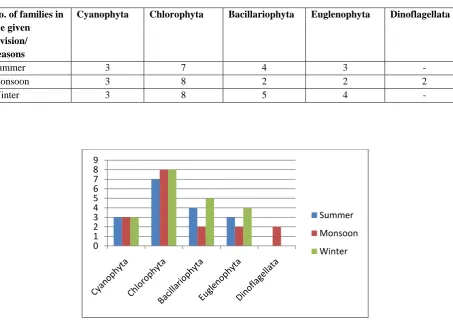
Abundance and occurrence in the diversity of algae belonging to the different divisions were observed along the Mithi River. The most abundant division was chlorophyta throughout the different seasons (Figure 1, 2 and 3). Similar observations were also noted in other water bodies (Shrivatava et.al.2014; Mahadik and Jadhav, 2014). The most frequent genera among chlorophyta were scenedesmus, microcystis and chlorella. The occurrence of the different families under their respective divisions in a comparative format is given in (Table 1).
The different small scale industries and outlets of pollutants change the physico chemical characteristics of the water making it favorable for some and unfavorable to different algal communities. Pollutants in unchecked amount are emptied into the Mithi River each day. It is loaded with pollutants and treated as an open drain (NEERI, 2011).The seasons have an impact on lotic water bodies since it changes the parameters of water during the different seasons. In any ecosystem, not a single species grows independently and indefinitely, because all the species are interlinked and has cyclic transformation of nutrients (Makandar and Bhatnagar, 2010)
The families under chlorophyta, cyanophyta, bacillariophyta and euglenophyta appear in all three seasons. Dinoflagellates have been abundant during monsoon (Table.2).The Shannon- wieners index characterizes the diversity in the algae at different seasons. The values infer higher diversity during winters, followed by monsoon and summer. The Simpson’s index shows the abundance of algal diversity throughout all the three seasons irrespective of the different types (Table.3).
2014). In the current study, the diversity amongst the algal division is high, but the overall occurrence of algae in different seasons does not show much difference.
FIGURES AND TABLES
Fig1.Algal diversity- Summer Fig 2. Algal diversity-Monsoon Fig.3 Algal diversity- Winter
Table 1. Occurrence of algal divisions in various seasons.
No. of families in the given division/ Seasons
Cyanophyta Chlorophyta Bacillariophyta Euglenophyta Dinoflagellata
Summer 3 7 4 3 -
Monsoon 3 8 2 2 2
Winter 3 8 5 4 -
Fig 4: Variations of the occurrence of algae in different seasons. Cyanophyta Chlorophyta
Bacillariophyta Euglenophyta Summer
Cyanophyta Chlorophyta Bacillariophyta Euglenophyta Dinoflagellata
Monsoon
Cyanophyta Chlorophyta Bacillariophyta Euglenophyta Winter
0 1 2 3 4 5 6 7 8 9
Summer
Monsoon
Table 2. Occurrence of algae with respect to seasons using Simpson’s diversity index and Shannon- Weiner diversity index.
4.
REFERENCES
[1] APHA, (2005), Standard Methods for Examination of Water and Wastewater, 21st Edition, American Public Health Association, Washington D. C.
[2] Borowitzka, M.A. (1988). Vitamins and fine chemicals from Microalgae. In: Borowitzka, M.A.and Borowitzka, L.J., (Eds.), Microalgal Biotechnology, pp. 153 – 196 Cambridge University Press.
[3] Desikachary T. V. (1959). “Cyanophyta,” I.C.A.R. Monograph on Algae, New Delhi, p. 686.
[4] Kannaiyan, S. (1985). Algal biofertilizers for low land rice 14 pp. Tamil Nadu Agricultural University, Coimbatore
[5] Mahadik B.B. and M. J. Jadhav (2014). A preliminary study on algal biodiversity of Ujani reservoir (MS) India, Bioscience discovery, 5(1):123 – 125.
[6] Makandar, M. B. and A. Bhatnagar (2010). Biodiversity of Microalgae and Cyanobacteria from freshwater bodies of Jodhpur, Rajasthan (India). J. Algal Biomass Utln. 1 (3): 54 – 69.
[7] Mandavile S M,(2002). Benthic Macro invertebrates in Freshwater- Taxa Tolerance values, Metrics and Protocols, Project H-1 (Nova Scotia: Soil and Water Conservation Society of Metro Halifax).
[8] National Environmental Engineering research Institute- January (2011) – A report Current status of Mithi River and possible solutions (Topsheet No. 47 A/16).
[9] Prabaharan, D. and Subramanian, G. (1995). Hydrogen photoproduction by marine cyanobacterium Dichothrixbauriana BDU 40481. Physiol. And Mol Bio of Plants 1: 45 – 57.
[10] Prescott G.W. (1964).The fresh water algae W.M.C. Brown Co, Publ. Dubuque.
[11] Priya Gopinath. T. and Ajit Kumar.K.G. (2015) Microalgal diversity of fresh water lake in Thiruvananthapuram district, Kerala. Int. Jour. of plant, animal and environ. sci. 5(1): 288-291.
MAJOR DIVISION SHOWING THE NO.OF
FAMILIES
SEASONS
SUMMER MONSOON WINTER
CYANOPHYTA 3 3 3
CHLOROPHYTA 7 8 8
BACILLARIOPHYTA 4 2 5
EUGLENOPHYTA 3 2 4
DINOFLAGELATA - 2 -
SIMPSONS DIVERSITY INDEX
0.8 0.7 0.8
SHANNON WIENER DIVERSITY INDEX
[12] Rai, L. C.; Gaur, J. P.; Kumar, H.D. (1981). Phycology and heavy-metal pollution. Biological Reviews, 56 (2): 99-151.
[13] Rajurkar B.M. and L.P. Dalal (2014). Freshwater algae from Vena River Hinganghat , Dist. Wardha ,Maharashtra,
India. Journal of Pharmacy and Biological Sciences. 9(3): 99- 104.
[14] Shankaran B. and E. Thiruneelagandan (2015). Microalgal diversity of Parthasarthy temple tank, Chennai, India. Int. J.Curr. Microbiol.App.Sci 4(4):168-173.
[15] Shrivatava A. K., M. Bharadwaj and R. Shrivastava (2014). Algal Biodiversity in fresh water reservoir of Durg, Indian J.Sci.Res. 4 (1): 121- 126.
[16] Simpson E.H. 1949. Measurement of diversity. Nature, 163: 688.
[17] Subramanian, G. and Uma, L. (1996). Cyanobacteria in pollution control. J. Sci. and Ind. Res. 55: 685 -692.
[18] Venkataraman, G.S. (1981). Blue-green algae for rice production.FAO Soil Bulletins 16:33- 42.