Cu(II) ION REMOVAL FROM AQUEOUS SOLUTION BY AN
in situ SYNTHESIZED Phragmites australis/EMERALDINE BASE
BIOCOMPOSITE
Silviya Lavrova,
[a]*Filipa Velichkova-Teneva
[a]and Bogdana Koumanova
[a]Keywords:In situ polymerization, polyaniline, Phragmites australis, copper ions adsorption.
The influence of in situ synthesized biocomposite consisted of Phragmites australis (Pha) - common reed and emeraldine base (Emb) on the removal of copper ion from aqueous media is discussed. The biocomposites were prepared with two different ratios of common reed/aniline (samples Pha/Emb1 and Pha/Emb2, respectively. Physicochemical parameters such as initial copper ion concentration, composite dosage and contact time between the composites and Cu(II) ions in aqueous solution were studied. An assessment of the equilibrium and the kinetics of sorption of copper ions has been made. Removal efficiency of 99.6 % was achieved with Pha/Emb1 and 91.9 % with Pha/Emb2, respectively. The experimental results were fitted to the isotherms of Langmuir, Freundlich, Temkin and Dubinin-Radushkevich. It was established that the Langmuir isotherm is more suitable for the case of emeraldine base and for composite Pha/Emb1, while the Dubinin-Radushkevich isotherm is more suitable for the case of Pha/Emb2 (with higher content of common reed). The influence of the plant quantity in the biocomposite is important for the mechanism of Cu2+ removal. Physical adsorption and ion exchange are
dominant in the case of Pha/Emb1, and Emb, while in the case of Pha/Emb2 the chemical interaction is predominant. The kinetics of Cu(II) adsorption onto biocomposites followed pseudo-second-order model.
* Corresponding Authors Telephone: +359 2 8163 303
E-Mail: [email protected]*, [email protected],
[a] University of Chemical Technology and Metallurgy, Postal address: 8 Kliment Ohridski Blvd., Sofia 1756, Bulgaria
Introduction
The industrial wastewaters in most cases contain metal ions which can be removed by chemical or physicochemical processes. Because of their hazard impact on the environment and the high cost of the used methods, it needs to develop new, cost-effective and efficient methods for industrial wastewater treatment. The most widely used methods for metal ions removal from aqueous medium is precipitation, adsorption and ion exchange, because of their effectiveness, low cost and possibility of metal recovery.
Increasing attention to the biosorbents such as rice hulls, raw pomegranate peel, peanut shells, sphagnum moss peat, tree fern, as well as dried activated sludge, is paid because they are widely spread, not expensive raw materials.1-6 Also,
there are various polymeric substances which can capture various ions, as a result of the complexation reactions. Such materials are chitosan,7,8 polythioamide,9 polypyrrole,10
polyaniline,11 etc. These polymers can be used either
separately or as composites - the combination of different polymers12,13,15 or combination of the polymer with some
adsorbents.14-16
One of the widely used polymeric substance is polyaniline, which conductive properties and complexing ability are well-known. The polyaniline can be found in one of three idealized oxidation states – leucoemeraldine, emeraldine,
and (per)nigraniline. The emeraldine form of polyaniline exists as emeraldine salt and emeraldine base. The deprotonated nonconducting emeraldine base has more free electron pairs in its structure in comparison with protonated conducting emeraldine salt, which contribute to its better complexation ability.17-19 The combination of these
polymeric compounds with different sorbents leads to increasing of the wastewater treatment efficiency, which is due to the enlarged surface area and the greater electron donor capacity.20,21 Recently the scientists are focused their
attention on the synthesis of biocomposites, which are consisted of residual vegetation and polymeric substances. 22-24 It is known that for the treatment of different kinds of
wastewaters constructed wetland systems are used. In them different macrophytes are growing - Phragmites australis, Typha latifolia, etc., which have the ability to extract and accumulate a variety of contaminants from the treated water.25,26 These plants are widely spread in nature, which
makes their residuals a readily available and inexpensive raw material which can be used further as a sorption material.
The aim of this study was to examine the possibility of the copper ions removal from an aqueous solution by a biocomposite of Phragmites australis and emeraldine base. The influence of the initial Cu(II) concentration, the biocomposite dose and the contact time of the removal process were studied. An assessment of the equilibrium and the kinetics of sorption of copper ions has been made.
Material and Methods
Aniline (C6H5NH2), hydrochloric acid (HCl), ammonium
persulfate ((NH4)2S2O8), sodium hydroxide (NaOH), copper
(C2H3NaO2) and acetic acid (CH3COOH) pure for analysis
were used in the experiments. Distilled water was also used. Leaves of Phragmites australis (common reed) from a comparatively clean area in this study were used. After collection, they were washed using tap water then followed with distilled water to remove the dust particles. The washed crops were dried for 2 h at 60 °C. The dried material was rinsed with acetone and then with 0.3 M NaOH and was again dried at the same temperature to constant mass. After its pre-treatment, the dried material was finely ground.
Preparation of the biocomposites
The preparation of the biocomposites was carried out at standard conditions. For the preparation of the biocomposites, two different Phragmites australis/aniline ratios were used. In the first case the ratio was 1:15 (Pha/Emb1) and in the second case it was 1:4 (Pha/Emb2). The preliminary weighed amounts of common reed (leaves) were mixed with 1938.6 mL of 1 M HCl under continuous stirring at 800 rpm for 24 h. After that 61.4 mL of aniline was added to the reaction mixture and the suspension was stirred for 24 h at room temperature. The solution of the oxidant, which was necessary for the preparation of polyaniline from aniline monomer, was prepared by dilution of ammonium persulfate ((NH4)2S2O8) with distilled water
to a volume of 800 mL. This solution was added to the reaction mixture, and the resulting suspension was stirred continuously for another 24 hours. The suspension was filtered and washed with distilled water. In order to remove the impurities and possible residual monomers, the suspension was washed several times with a mixture of water and methanol at a ratio of 80:20. At the end of the process, the polymerized aniline monomer in the biocomposites composition was under protonated form - emeraldine salt.
It is known that emeraldine salt is not particularly efficient for the removal of ions from an aqueous media and it has to be converted to more effective form - emeraldine base. The conversion of emeraldine salt into emeraldine base was carried out via washing the resulting precipitate with 1 M NaOH to pH 10.0-11.0. Thus deprotonation was achieved, consisting in the release of electron pairs at the nitrogen atoms in the amine groups of the emeraldine base polymer chain. These free electron pairs are the places where the metal ions, contained in the aqueous media, can be trapped. The washed precipitate was dried at 60 °C to a constant mass. Well-dried biocomposite was ground to a homogeneous powder.
Preparation of standard solutions of copper ions
Standard solutions with copper ions concentrations of 1.0, 2.0, 4.0, 6.0, 8.0, 10.0, 30.0, and 50.0 mg L-1 were prepared,
using CuSO4.5H2O and distilled water.
Adsorption equilibrium study
The adsorption equilibrium for the removal of copper ion was studied, using 50 mL of aqueous solutions containing Cu(II) concentrations between 1 and 50 mg L-1 contacting
with 0.1 g of the two types of biocomposites and pure emeraldine base for comparison, respectively. Shaking was carried out until equilibrium achievement.
The amount of adsorption at equilibrium27 in (mg g-1) was
computed as follows:
(1)
where
C0 and Ce are the initial and equilibrium copper ions
concentrations (mg L-1), respectively,
V is the volume of the solution (L), and
m (g) is the mass of the biocomposite.
Adsorption kinetic studies
In order to establish the influence of the contact time and the composite dosage on the adsorption of copper ions by
Phragmites australis/emeraldine base biocomposites, kinetic studies were performed. For this purpose individual samples with initial copper ions concentration of 50.0 mg L-1 (C
0)
were prepared. The volume of each sample was 50 mL, and the certain amount of the biocomposites (0.1, 0.5, 1.0 and 1.5 g) were added to each of them. The samples were poured in iodine flasks and were shaken in a plate shaker for 1, 3, 5, 7, 10, 15, 30, 60 and 360 min, respectively.
Inductively Coupled Plasma - Optical Emission Spectroscopy ("Prodigy" High dispersion ICP-OES, Telledyne Leeman Labs) was used for determination of the copper ions concentration. All experiments were conducted at 20 °C and in order to avoid Cu(II) precipitation, the pH of the aqueous solutions was adjusted to 5. 28
The Cu(II) removal efficiency was determined according to the formula:
(2)
where
C0 is the initial copper ions concentration and
Ctis their concentration at time t in mg L-1.
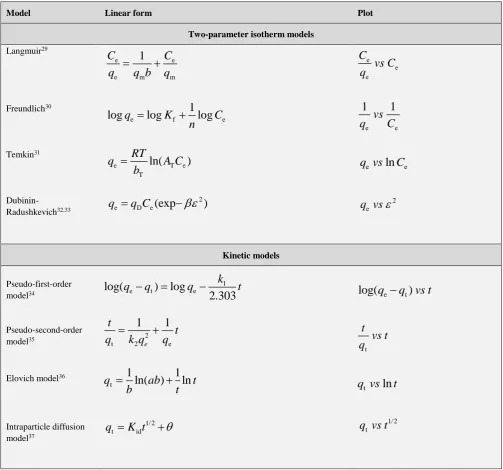
In this study the obtained results were fitted into the isotherms of Langmuir,29 Freundlich,30 Temkin31 and
Dubinin-Raduskevich32,33 and the kinetic experimental data
were analyzed by comparative estimation of the applicability of the pseudo-first-order model,34
pseudo-second-order model,35 Elovich kinetic model36 and the
intraparticle diffusion model37 (Table 1).
0 e
eC
C V
q
m
0 t
0(%)
C
C
100
RE
C
Table 1. Isotherm and kinetic models used to interpret the experimental results.
Results and Discussion
Adsorption equilibrium
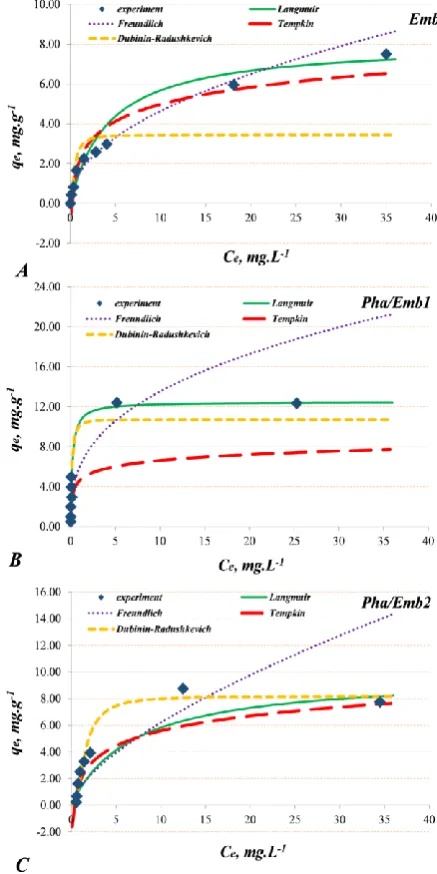
The experimental equilibrium data of copper ions adsorption on Emb, Pha/Emb1, and Pha/Emb2 were described by the Langmuir, Freundlich, Temkin and Dubinin–Radushkevich isotherm models (Figure 1). The calculated model parameters and regression coefficients (R2)
are presented in Table 2.
The RL values obtained from Langmuir isotherm model
for all adsorbents indicate that for all cases, the adsorption is favourable. This model describes well the experimental data for Emb and Pha/Emb1, confirmed by the high correlation
coefficient. The 1/n values obtained for the adsorption process according to the Freundlich isotherm model for all solids corresponds to a beneficial adsorption. Concerning the adequacy of this model to the experimental data, the correlation coefficient is lower, compared to Langmuir model.
The Temkin isotherm model describes the data for Emb and Pha/Emb1 inconveniently, compared to the other two parameter models, as low correlation coefficient observed. On the other hand, the correlation coefficient for Pha/Emb2 is the highest, compared to the two previous models. The calculated values of E from the Dubinin–Radushkevich isotherm model were 2.5 and 5 KJ mol-1 for Emb and
Pha/Emb1, respectively.
Model Linear form Plot
Two-parameter isotherm models
Langmuir29
Freundlich30
Temkin31
Dubinin-Radushkevich32,33
Kinetic models
Pseudo-first-order model34
Pseudo-second-order model35
Elovich model36
Intraparticle diffusion model37
e e
e m m
1
C
C
q
q b
q
e e e
C
vs C
q
e f e
1
log
q
log
K
log
C
n
e e
1
1
vs
q
C
e T e
T
ln(
)
RT
q
A C
b
q vs
eln
C
e2 e D e
(exp
)
q
q C
2e
q vs
1
e t e
log(
)
log
2.303
k
q
q
q
t
e t
log(
q
q vs t
)
2
t 2 e
1
1
e
t
t
q
k q
q
t
t
vs t
q
t
1
1
ln(
)
ln
q
ab
t
b
t
t
ln
q vs
t
1/ 2 t
q vs t
1/ 2Table 2. Isotherm constants of two-parameter models for Cu(II) adsorption.
Model Parameter Adsorbents
Emb Pha/Emb1 Pha/Emb2
Langmuir qm 8.0775 12.469 9.8135
b 0.2363 5.2079 0.1454
RL 0.0780 0.0038 0.1209
R² 0.9766 0.9998 0.7322
Freundlich KF 1.5185 5.9865 1.3663
1/n 0.4851 0.4350 0.6563
R² 0.9693 0.7727 0.6483
Tempkin AT 2.1328 4.6268 1.8462
bT 1161.7 535.48 1344.6
R² 0.9187 0.9682 0.9874
Dubinin-Radushkevich
qD 3.4445 10.726 8.2016
β 8.10-8 2.10-8 4.9.10-7
E 2.5 5.0 10.1
R² 0.7400 0.9034 0.9444
According to the literature, the value of E in the range of 1 - 8 KJ mol-1 indicates physical adsorption process.38 For the
second biocomposite, Pha/Emb2, the numerical value of E is equal to 10.1 KJ mol-1, which is the indicator for ion
exchange adsorption. This different behaviour is also observed when taking into account the correlation coefficient, higher for Pha/Emb2 than Emb and Pha/Emb1. As it can be seen in Figure 1, this model isotherm fits very well the experimental isotherm for Pha/Emb2 compared to the other models.
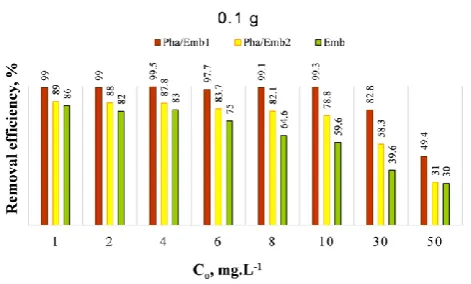
In order to estimate the effect of the initial copper ions concentration on the removal efficiency, 0.1 g of the biocomposites was used, and the initial copper ions concentration was varied from 1 and 50 mg L-1. The results
are presented in Figure 2.
From the obtained results it was observed that with increasing of the initial copper ions concentration, the removal efficiency of 0.1 g biocomposites and pure emeraldine base was reduced. The higher removal efficiency of copper ions at lower concentrations can be explained by the existence of enough free nitrogen atoms in the polymer chain, which have a higher electron density namely those involved in the complexing with copper ions. With increasing of the metal ions concentration, the possibility of their binding to the polymer structure reduces. The results show that the presence of Phragmites australis has a certain impact on the treatment efficiency, but the usage of the larger amount of it does not lead to a higher removal of copper ions.
The results show that the Pha/Emb1 is more effective in comparison with Pha/Emb2 and Emb. The copper ions removal efficiency increases up to an optimal dose above which the removal efficiency does not significantly change. It might be observed because, at fixed initial adsorbate concentration, the increasing biocomposite doses provide greater surface area, more adsorption sites and more available free electron pairs in the polymeric structure of the emeraldine base.
Figure 1. Experimental and model adsorption isotherms for Emb (A), Pha/Emb1 (B) and Pha/Emb2 (C).
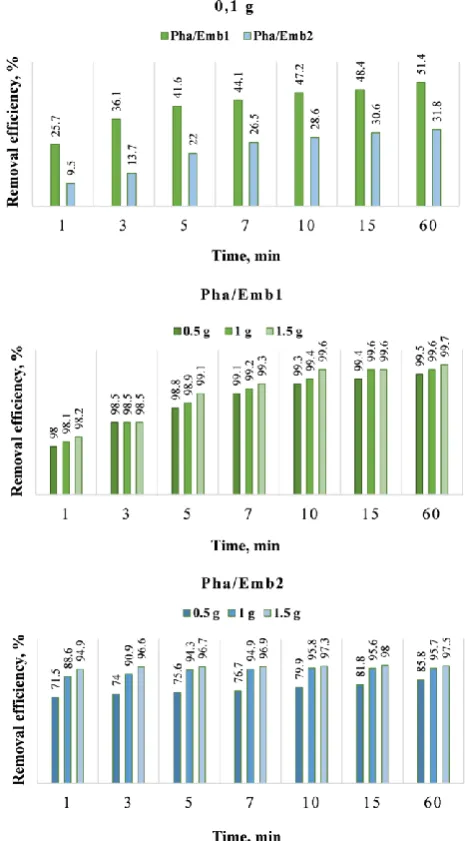
The removal efficiencies obtained for 6 hours using Pha/Emb1 and Pha/Emb2 compared with the removal efficiencies obtained at the same time using pure emeraldine base are presented in Figure 3.
Adsorption kinetics
Table 3. Adsorption kinetic model rate constants for Cu(II) adsorption onto Pha/Emb1 and Pha/Emb2.
Adsorbent Pseudo-first-order Pseudo-second-order Elovich’s equation
qexp, mg g-1 k1, min-1 qe, calc, mg g-1 R² k2, min-1 qe, calc, mg g-1 R² A, mg g-1 min-1 1/b, mg g-1 R²
Pha/Emb1 13.67 0.02902 1.7998 0.6867 0.03807 13.74 0.9999 500,7 8.1086 0.8156
Pha/Emb2 8.89 0.02671 1.7463 0.5576 0.03083 8.96 0.9998 9.413 3.3791 0.7871
Figure 2. Effect of the initial copper ions concentration on the removal efficiency using Emb, Pha/Emb1, and Pha/Emb2.
Figure 3. Removal efficiencies obtained at 360 min, using Emeraldine base, Pha/Emb1, and Pha/Emb2.
The experimental kinetic curves for Cu(II) sorption on the Pha/Emb1 and Pha/Emb2 are presented in Figures 4 and 5, respectively. The values of the calculated model's parameters and regression coefficients are presented in Table 3.
The constants k1 and qe were calculated using the slope
and intercept of plots of log(qe-qt) versus t (Table 3). The
application of Pseudo-first-order model is inappropriate as experimental observations are nonlinear. This result also in a very low correlation coefficient and subsequently a significant difference in the experimental and calculated adsorption capacities. This result suggests that the adsorption of Cu(II) onto Pha/Emb1 and Pha/Emb2 did not follow pseudo-first-order kinetics.
The constants k2 and qe were calculated using the slope
and intercept of plots of t/qt versus t (Figure 4, Table 3).
Fitted equilibrium adsorption capacities are in close agreement with those observed experimentally.
Figure 4. Application of the pseudo-second-order model.
Operating conditions: C0 = 50 mg.L-1, mads. = 0.1 g, pH = 5,
T = 20 °C.
Furthermore, the correlation coefficients (R²) for the
pseudo-second-order kinetic model are much higher than the correlation coefficients derived from pseudo-first-order model fits. The good agreement between model fit and experimentally observed equilibrium adsorption capacity in addition to the large correlation coefficient suggests that Cu(II) adsorption followed pseudo-second-order kinetics and Cu(II) ions were adsorbed onto the Pha/Emb1 and Pha/Emb2 surfaces via mechanism including chemical interaction.
If Elovich model applies, it should lead to a straight line by plotting qtas a function of ln(t) (Figure 5, Table 3).
The intraparticle diffusion rate constant ki was calculated
from the slope of the second linear section (Figure 6, Table 4). The value of the intercept C in this second section provides information related to the thickness of the boundary layer.39 Larger intercepts suggest that the surface
Figure 5. Application of the Elovich model. Operating conditions: C0 = 50 mg.L-1, mads. = 0.1 g, pH = 5, T = 20 °C.
Figure 6. Kinetics of Cu(II) adsorption according to the intraparticle diffusion model. Operating conditions: C0 = 50
mg.L-1, m
ads. = 0.1 g, pH = 5, T = 20 °C.
Table 4. Intraparticle diffusion coefficients and intercept values for Cu(II) adsorption.
The main removal of the Cu(II) becomes immediately after mixing of the biocomposites with the model solutions (Figure 7). The concentration of copper ions was decreasing up to 1 min, then only a slight change of the concentrations could be observed.
Conclusions
The possibility of the copper ions removal from aqueous solution by in situ synthesized biocomposite of Phragmites australis and emeraldine base as well the adsorption mechanism have been studied. The results indicate that the biocomposite Pha/Emb1 has a considerable potential for copper ions removal and that it is more effective in comparison with Pha/Emb2.
Figure 7. Influence of the contact time on the copper ions removal efficiency.
The results show that the presence of Phragmites australis
has an impact on the treatment efficiency, but the usage of the greater amount of it does not lead to a greater removal of copper ions. The calculated values of E from the Dubinin– Radushkevich isotherm model were 2.5 and 5 KJ mol-1 for
Emb and Pha/Emb1, respectively which indicate physical adsorption process. For the second biocomposite, Pha/Emb2, the numerical value of E is equal to 10.1 KJ mol-1, which is
the indicator for ion exchange adsorption. The experimental data were better described by the pseudo-second-order model.
References
1Jeon, Ch., J. Ind. Eng. Chem., 2011, 17, 517.
http://dx.doi.org/10.1016/j.jiec.2010.10.020.
2Ben-Ali, S., Jaouali, I., Souissi-Najar, S., Ouederni, A., J. Clean. Prod., 2017, 142, 3809.
http://dx.doi.org/10.1016/j.jclepro.2016.10.081
Composite ki, mg g−1 h-0.5 Intercept values, C R²
Pha/Emb1 1.5171 7.0122 1.0000
3Witek-Krowiak, A., Szafran, R., Modelski, S., Desalination, 2011, 265, 126. http://dx.doi.org/10.1016/j.desal.2010.07.042
4Ho, Y., McKay, G., Wat. Res., 2000, 34(3), 735.
http://dx.doi.org/10.1016/S0043-1354(99)00232-8
5Ho, Y., Biores. Technol., 2005, 96, 1292.
http://dx.doi.org/10.1016/j.biortech.2004.10.011
6Zare, H., Heydarzade, H., Rahimnejad, M., Tardast, A., Seyfi, M.,
Peyghambarzadeh, S., Arab. J. Chem., 2015, 8, 858.
http://dx.doi.org/10.1016/j.arabjc.2012.11.019
7Mende, M., Schwarz, D., Steinbach, Ch., Boldt, R., Schwarz, S., Colloids Surf., A, 2016, 510, 275.
http://dx.doi.org/10.1016/j.colsurfa.2016.08.033
8Shariful, M., Sharif, S., Lee, J., Habiba, U., Ang, B., Amalina, M., Carbohydr. Polym., 2017, 157, 57.
http://dx.doi.org/10.1016/j.carbpol.2016.09.063
9Kagaya, S., Miyazaki, H., Ito, M., Tohda, K., Kanbara, T., J. Hazard. Mater., 2010, 175, 1113.
http://dx.doi.org/10.1016/j.jhazmat.2009.10.099
10Abdi, S., Nasiri, M., Mesbahi, A., Khani, M., J. Hazard. Mater.,
2017, 332, 132.
http://dx.doi.org/10.1016/j.jhazmat.2017.01.013
11Wang, J., Zhang, K., Zhao, L., Chem. Eng. J., 2014, 239, 123.
http://dx.doi.org/10.1016/j.cej.2013.11.006
12Kumar, R., Oves, M., Almeelbi, T., Al-Makishah, N., Barakat,
M., J. Colloid Interface Sci., 2017, 490, 488.
http://dx.doi.org/10.1016/j.jcis.2016.11.082
13Li, X., Zhou, H., Wu, W., Wei, S., Xu, Y., Kuang, Y., J. Colloid Interface Sci., 2015, 448, 389.
http://dx.doi.org/10.1016/j.jcis.2015.02.039
14Mthombeni, N., Mbakop, S., Ochieng, A., Onyango, M., J. Taiwan Inst. Chem. Eng., 2016, 66, 172.
http://dx.doi.org/10.1016/j.jtice.2016.06.016
15Chen, L., Feng, S., Zhao, D., Chen, S., Li, F., Chen, C., J. Colloid Interface Sci., 2017, 490, 197.
http://dx.doi.org/10.1016/j.jcis.2016.11.050
16Ansari, R., Dezhampanah, H., Eur. Chem. Bull., 2013, 2(4), 220.
doi: 10.17628/ECB.2013.2.220
17Stejskal, J., Gilbert, R., Pure Appl. Chem., 2002, 74(5), 857. 18Mahato, N., Parveen, N., Cho, M., Mater. Lett., 2015, 161, 372.
http://dx.doi.org/10.1016/j.matlet.2015.08.138
19Borah, R., Baerjee, S., Kumar, A., Synth. Met., 2014, 197, 225.
http://dx.doi.org/10.1016/j.synthmet.2014.08.018
20Shyaa, A., Hasan, A., Abbas, M., J. Saudi Chem. Soc., 2015, 19,
101. http://dx.doi.org/10.1016/j.jscs.2012.01.001
21Kaur, B., Srivastava, R., Sens. Actuator B-Chem., 2015, 211, 476.
http://dx.doi.org/10.1016/j.snb.2015.01.081
22Phan, T., Do, N., Mai, T., Adv. Nat. Sci-Nanosci., 2010, 1, 1.
doi:10.1088/2043-6262/1/3/035006
23Kumar, P., Chakaborty, S., Ray, M., Chem. Eng. J., 2008, 141,
130. http://dx.doi.org/10.1016/j.cej.2007.11.004
24Ghorbani, M., Eisazadeh, H., Ghoreyshi, A., IJEE., 2012, 3(1),
66-71. doi: 10.5829/idosi.ijee.2012.03.01.3343
25Vymazal, J., Brězinová, T., Chem. Eng. J., 2016, 290, 232.
http://dx.doi.org/10.1016/j.cej.2015.12.108
26Kumari, M., Tripathi, B., Ecotoxicol. Environ. Saf., 2015, 112, 80.
http://dx.doi.org/10.1016/j.ecoenv.2014.10.034
27Vanderborght, M., Van Grieken, E., Anal. Chem., 1977, 49(2),
311. doi: 10.1021/ac50010a032
28Srithongkham, S., Vivitchanont, L, Krongtaew, C., J. Mater. Sci. Eng. B., 2012, 2(4), 213.
29Langmuir, I., J. Am. Chem. Soc., 1918, 40, 1361. doi:
10.1021/ja02242a004
30Freundlich, H., Phys. Chem. Soc., 1906, 40, 1361.
31Aharoni, C., Ungarish, M., J. Chem. Soc. Faraday Trans., 1977, 73, 456. doi:10.1039/F19777300456
32Dabrowski, A., Adv. Colloid Interface Sci., 2001, 93, 135-224. 33Hutson, N., Yang, R., Adsorption, 1997, 3, 189.
http://dx.doi.org/10.1007/BF01650130
34Lagergren, S., Ksver. Veterskapsakad. Handl., 1898, 24, 1. 35Farooq U., Khan M. A., Athar W., Kozinski J. A., Chem. Eng. J.,
2011, 171, 400. http://dx.doi.org/10.1016/j.cej.2011.03.094
36Zeldowitsch, J., Acta Physicochim. URSS, 1934, 1, 364.
37Crank G., The mathematics of diffusion. London, New York:
Clarendon Press, 1933.
38Helfferich, F., Ion Exchange, McGraw-Hill, New York, USA, 1962.
39Kavitha, D., Namasivayam, C., Bioresour. Technol., 2007, 98, 14.
http://dx.doi.org/10.1016/j.biortech.2005.12.008