International Journal Advances in Social Science and Humanities
Available Online at:
www.ijassh.com
RESEARCH ARTICLE
Influence Factors on China's Export Competitiveness of
International Education Service Trade
Ye Yankun
1, Xia Xinrong
2*College of Economics, Sichuan Agricultural University, Chengdu 611130, China; 2 College of Humanities, Sichuan Agricultural Universities, Ya’an 625014, China.
*Corresponding Author: Xia Xinrong
Abstract: Both developed and developing countries have attached great importance to attracting international students in the era of regarding talents as the key driving force of economic development. The growing inequality of export competitiveness of international education service trade between developing countries and developed countries leads to the flow of students mainly from developing countries rather than to developing countries. Empirical analysis of the factors affecting the international competitive advantage of international student education industry was carried out using the “diamond model”, through which it was found that the academic level and international recognition of higher education institutions, overseas tourism and the government’s educational expenditure had significant impact on the development of international student education industry in China. The key problem lies before the export of China education services in near future is how to convert the scale of international students to its national economic benefit.
Keywords: Export competitiveness;International education service trade;Influence factor.
Article Received: 28 Jan. 2020 Revised: 18 Feb. 2020 Accepted: 22 Feb. 2020
Introduction
Internationalization of higher education has become the new development trend of higher education worldwide. One of the most visible and dynamic manifestation of internationalization of higher education is Student Mobility [1, 2].
More than 5 million students across the globe are receiving education in countries other than their home countries, a 67 percent increase from a decade ago and a marked acceleration in cross-border mobility. There are many factors affecting international mobility of students, which can be explained by a combination of push–pull model as well as individual characteristics, push factors operating within the home country initiating the student’s decision to study overseas while
pull factors within the host country to make that country relatively more attractive than other potential destinations [3]. Cased studies [4, 5, 6, 7, 8, 9] show that the determinants of international mobility of students varies but usually fall into 6 categories: educational conditions, economic benefits, personal career development, language, political stability, experiencing different cultural life.
Students from developed countries go to less developed or developing countries or regions, owing to a desire to experience a different culture [11]. Studies on international students in South Africa [12] and Turkey [7] also confirm this point. The latest decade has witnessed an unprecedented increase in the number of international student mobility in China. In terms of inflow student mobility, China in 2015 is the third-ranked destination for international students with a total of 397,000 from 202 origin countries and regions [14].
China has rapidly transformed itself into an international student“ receiving ”nation [10], which was contributed by the“ pull ”from the different cultural experiences, new knowledge and technique, different educational approaches, and more job opportunities, as well as by the “push” of the shortcomings in some aspects of domestic environment, such as international cultural exchange, educational methods, and opportunities for admission. Jiani [15] and Choudaha [16] noted that supportive government policy, scholarship policy and different cultural experience played a very crucial role in China’s leap to the third-ranked education destination for international college students.
This paper gives the theoretical analysis of the factors affecting the international competitive advantage of international student education industry on the “diamond model” proposed by Michael Porter to explore the main factors that affect China's international student education industry. The findings offer significant insights for understanding how external forces directly or indirectly influence the flow of international student into China, exemplifying how developing and less developed countries develop international student education in a non-English speaking context.
Theoretical Basis
The education of international students is an important link of higher education industry and an important part of China’s higher
education services export. Studying abroad means that some students may face obstacles caused by multiple disadvantages [17]. Finance, manpower, community and cultural capital all have an impact on students' willingness to study abroad [18]. Based on Competitive Advantage of Nations Theory by Michael Porter, factors influencing the international competitive advantage of a certain industry in a country mainly include: production factors, demand factors, related and supporting industries, enterprise strategy, structure and horizontal competition, government support and opportunities.
According to Porter's diamond model, combined with the specific situation of China’s education service export, the influence factors on China's export competitiveness of education service trade can be summarized as follows. Production factors in the process of higher education internationalization are manifested as the software and hardware facilities, teaching resources and capacity, scientific research capacity, social reputation and other factors that determine the comprehensive strength of higher education.
In this paper, the total number of higher education institutions and the average scores of the world’s top 500 higher education institutions in the Academic Ranking of World issued by Shanghai Jiao Tong University were selected to reflect production factors from the perspective of quantity and quality (the total score includes the scores of six sub-items, including Alumni, Award, HiCi, N&S, PUB and PCP, the weights of which are 10%, 20%, 20%, 20%, 20% and 10% respectively).
The internationalization of higher education involves a wide range of industries and complex relations. International tourism is the front of a country’s outreach. For this reason, tourism industry for overseas tourists was selected as a consideration. In addition, overseas education agencies also affect education service export because the students sent via such agencies to study in foreign countries can help the local higher education institutions to better understand China’s higher education.
In consideration thereof, the level of development of the international flight routes approved by the Civil Aviation of China was also included into the empirical analysis as an influential factor. Corporate strategy, structure and horizontal completion are negligible since most higher education institutions in China are public and non-corporate, and only few are private and corporate but rarely accepting international students.
The fiscal educational expenditure was also included into the scope of empirical analysis as one of the influential factors because education is a quasi-public product, in which the government plays an important role. For the factor of opportunity, policy documents and social events that will have a certain impact on the scale of international students
studying in China were selected for analysis, including SARS outbreak in 2003, the 2003-2007 Action Plan for Invigorating Education promulgated in 2004, 2008-2012 global financial crisis, Notice on Notice on Improving Chinese Government Scholarship System and Funding Criteria issued in 2014, “One Belt and One Road Scholarship” established in 2015, and the Measures for the Administration of the Recruitment and Training of International Students promulgated in 2017.
Empirical Analysis and Basic Model
Table 1 shows the sample observations during the period from 2003 to 2017. The number of degree international students studying in China (A) was used as an explained variable. The total number of higher education institutions in China(B), the average scores of top 500 Chinese colleges and universities(C) included in the Academic Ranking of World issued by Shanghai Jiao Tong University, exchange rate(D), the gross enrollment ratio(E) of higher education in China, the number of overseas education agencies(F) in China, the number of overseas tourists(G) traveling to China, the total traffic turnover of international flight routes (H), and the proportion of national educational expenditure to national GDP(I) were used as explanatory variables.
Table 1: Number of international students studying in China and related factors
Production factor Demand factor Supporting industries Goverment
Year A B C D E F G H I
2015 184799 2560 13.96 6.2284 40.0% 2889 13382.04 2926107 0.051 2016 209966 2596 14.73 6.6423 42.7% 4381 13844.38 3405834 0.052 2017 214543 2631 15.05 6.7518 45.7% 6572 13948.24 3884753 0.052 Note: Data are from China Statistical Yearbook, China Education Statistical Yearbook, Concise Statistics on International Students in China, Academic Ranking of World issued by Shanghai Jiao Tong University, and www.tianyancha.com.
The opportunity link was set as dummy
variable . In 2003, 2008 and 2012, there
were social events . In the years of
2004, 2014, 2015 and 2017, important overseas study education policies were
issued , and the other years .
The data of all variables are positive and the values vary greatly, and thus in order to eliminate possible volatility, heteroscedasticity and multicollinearity, the regression equation is established after natural logarithm treatment for all variables
except dummy variable :
Where denotes the total number of degree
students in the tth year;
Denotes the total number of higher
education institutions in China in the tth year;
Denotes the average scores of colleges
and universities in China ranking among the world’s top 500 in the tth year;
Denotes the annual average exchange
rate in the tth year (RMB to 1 USD);
Denotes the gross enrolment ratio of
higher education in the tth year;
Denotes the total number of overseas
education agencies in China in the tth year;
Denotes the number of overseas tourists
traveling to China in the tth year;
Denotes the total traffic turnover of
international flight routes in the tth year;
Denotes the proportion of national
education expenditure in the tth year;
Is the regression constant, are
the respective regression coefficients, and
is the residual.
In order to better process the possible autocorrelation and heteroscedasticity to make the estimated values more valid, Eviews10 software was used to conduct generalized least square method for the sample observation data, and the regression results were as follows (Table 2):
Table 2: Regression results
Variable lnx1 lnx2 lnx3 lnx4 lnx5 lnx6 lnx7 lnx8 D C
coefficient 0.21 0.24 -1.76 0.00 0.25 1.09 0.06 -0.23 -0.04 -0.71
T value 0.64 1.81 -7.91 -0.03 3.97 6.18 0.47 -0.79 -8.87 -0.44
Prob value 0.55 0.13 0.00 0.98 0.01 0.00 0.66 0.46 0.00 0.68
VIF value 1163.81 81.18 234.61 673.96 3187.60 102.71 2237.19 170.09 5.48 NA
With given significance level α=0.05, the
critical value for n-2=13, 2.16.
variables considering the t values of various explanatory variables and the values of VIF in between, obtaining the following regression results: Therefore, the original explanatory variable was gradually regressed by
combining the t value of each explanatory variable and the VIF value of variance inflation factor, and the regression results after excluding multicollinearity were as follows (Table 3):
Table 3: Regression results
Variable lnx2 lnx6 lnx8 C
Coefficient 0.48 2.92 5.66 -0.21
T value 4.28 10.75 28.37 -0.07
Prob value 0.00 0.00 0.00 0.94
VIF value 2.35 1.51 2.88 NA
The ARCH test Obs* r-squared =2.253519, the corresponding P value =0.1333, greater than the given significance level alpha =0.05, which does not reject the null hypothesis that there is no heteroscedasticity .In terms of autocorrelation, DW value =1.38 can be used to preliminarily judge the existence of a certain degree of autocorrelation, and LM test is used to judge the Obs* r-squared =12.96464 with a lag of 1 order, and the corresponding P value =0.0015. The null hypothesis is rejected
at the significance level of 5%, that is, the disturbance term has a first-order autocorrelation. After calculating the auto-correlation coefficient p =0.312, the generalized difference transformation is carried out on the model:
The Final Model Regression Results
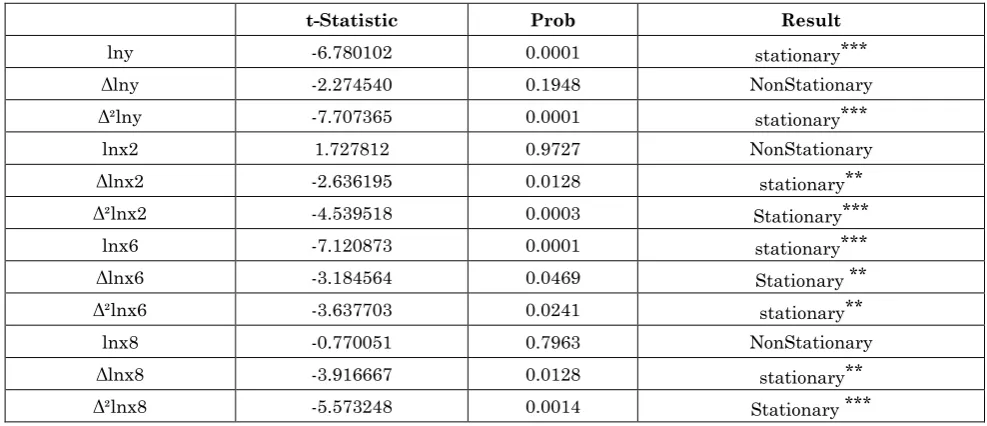
Table 4: ADF unit root test results
t-Statistic Prob Result
lny -6.780102 0.0001 stationary***
Δlny -2.274540 0.1948 NonStationary
Δ²lny -7.707365 0.0001 stationary***
lnx2 1.727812 0.9727 NonStationary
Δlnx2 -2.636195 0.0128 stationary**
Δ²lnx2 -4.539518 0.0003 Stationary***
lnx6 -7.120873 0.0001 stationary***
Δlnx6 -3.184564 0.0469 Stationary **
Δ²lnx6 -3.637703 0.0241 stationary**
lnx8 -0.770051 0.7963 NonStationary
Δlnx8 -3.916667 0.0128 stationary**
Δ²lnx8 -5.573248 0.0014 Stationary ***
Notes: * denotes “stationary” at significance level of 10%, ** “stationary” at significance level of 5%, and *** denotes “stationary” at significance level of 1%.
According to the ADF unit root test in table 4, the above variables are all second-order single integration sequences, and the co-integration test can be carried out.
engle-granger co-integration test also does not reject the null hypothesis that co-integration relations exist. Therefore, it can be concluded that the previous regression results are valid and not pseudo-regression.
Conclusions
According to the results of empirical analysis, the factors that have a significant impact on the educational development of international students in China after entering the 21st century are academic level and international recognition of universities, international tourism industry and government’s education expenditure, which show a positive impact.
It can also be seen from the regression coefficient that the country's support for education development has the most significant positive effect on improving the degree education scale of overseas students. However, the number of higher education institutions, exchange rate, the popularity of domestic higher education, the number of overseas education agencies, the development of international aviation industry and the introduction of important relevant policies and social events do not have significant impact thereon.
Previous studies have suggested that the investment and expenditure of education funds are the most important factors affecting the number of overseas students in China [19], and Jin [15] further added that the opening of Confucius institutes and the openness of service trade also have positive effects. Our results of empirical analysis not only verify the previous studies, but also find out that the improvement of universities' own level and popularity and the development of international tourism also play a crucial role in promoting the export of China's higher education.
Our empirical result is a supplement and improvement to the research on export competitiveness of international education service trade. As for the three main influencing factors in the empirical results,
our interpretation is as follows: Firstly, what is mostly needed for the higher education institutions of a country to attract international students is to be “strong enough to forge iron”.
International students would choose to study in a country only if the level of higher education in this country is sufficiently high, the international students studying in this country can achieve the academic goals, and the academic degrees obtained are sufficient to be recognized by their home countries and even by other countries in the world.
Otherwise, students are more likely to receive higher education closer to home. Secondly, the number of overseas tourists traveling to China has positive impact on the internationalization of China’s higher education, which coincides with the old saying, which goes “it is better to see once than to hear a hundred times”.
In recent years, with the development of China’s tourism industry, a large number of overseas tourists have been attracted to China, which allows more foreigners to understand China closely, and to a certain extent, decide to study in China or advise their relatives and friends to study in China. Finally, it is not to be doubted that the input of educational expenditure has positive impact on the scale of international education. Education, the pillar of a country, can flourish only when it is led and supported by the state.
Britain, Australia, France and Japan-account for nearly 80% of the trade share in education service market, among which the United States and Britain account for nearly 60%. Although China became the world’s third largest country receiving international students and accounted for 8% of the international student market [14], its education services export volume accounted for only 0.65% of the world’s total education services export volume [20].
China’s education services export volume is extremely inconsistent with its huge higher education scale. Therefore the key problem lies before the export of China education services in near future is how to convert the scale of international students to its national economic benefit, reduce and even reverse the great deficit of education services
import/export trade, and thus promote the healthy development of international education industry.
Acknowledgement
This paper is sponsored by the Project of “A Comparative Study of Higher Education Internationalization in Germany and China”(Project No.: ZDF1403), from Sichuan Agricultural University’s Germany-Focused Research Center, the Region and Nation Key Research Base of Sichuan Province; also sponsored by National and regional research projects of Ministry of Education 2017. YE Yankun (1993-), male, from Nanjing, Jiangsu Province, postgraduate, College of Economics, Sichuan Agricultural University. Research direction: International Education Industry and Economic development.
References
1. Bhandari R, Blumenthal P (2011) International Students and Global Mobility in Higher Education. Palgrave Macmillan US. 260.
2. Beine MAR, Noel R, Ragot L (2012) the determinants of international mobility of students. Social Science Electronic Publishing, 41(3):40-54.
3. González CR, Mesanza RB, Mariel P (2011) The determinants of international student mobility flows: an empirical study on the erasmus programme. Higher Education, 62(4):413-430.
4. Mazzarol T, Soutar GN (2002) “Push-pull” factors influencing international student destination choice. International Journal of Educational Management, 16(2):8290.
5. Altbach PG (2004) Can the United States remains the top destination for foreign students? Change, 36(2):18-25.
6. Li M, Bray M (2007) Cross-border flows of students for higher education: Push-pull factors and motivations of mainland Chinese students in Hong Kong and Macau.
Higher Education, 53(6):791-81
7. Kondakci Y (2011) Student mobility reviewed: Attraction and satisfaction of international students in Turkey. Higher Education, 62(5):573-592.8.
8. Wilkins S, Huisman J (2011) International student destination choice: the influence of home campus experience on the decision to consider branch campuses. Journal of Marketing for Higher Education 21(1): 65-87.
9. Forsey M, Broomhall S, Davis J (2012) Broadening the mind? Australian student reflections on the experience of overseas study. Journal of Studies in International Education 16(2): 128-139.
10.Wei H (2013) an empirical study on the determinants of international student mobility: A global perspective. Higher Education, 66(1):105-122.(Chinese journal)
12.Lee JJ, Sehoole C (2015) Regional, continental, and global mobility to an emerging economy: The case of South Africa. Higher Education, 70(5):827-843.
13. Foster M (2014) Student Destination Choices in Higher Education: Exploring Attitudes of Brazilian Students to Study in the United Kingdom. Journal of Research in International Education, 13(2):149-162.
14. Center for China, Globalization (CCG) (2016) Annual report on the development of overseas students studying in China and Chinese students studying abroad.
15. Jiani MA (2016) why and how international students choose Mainland China as a higher education study abroad destination. Higher Education, 44(5):1-17.
16. Choudaha R (2017) three waves of international student mobility (1999–2020). Studies in Higher Education,
42(5):825-832.
17.Nicolai Netz (2015) What Deters Students from Studying Abroad? Evidence from Four European Countries and Its Implications for Higher Education Policy. Higher Education Policy, 28(2).
18.Mark H, Salisbury, Paul D, Umbach, Michael B, Paulsen, Ernest T, Pascarella (2009) Going Global: Understanding the Choice Process of the Intent to Study Abroad. Research in Higher Education, 50(2).
19.Chen X (2015) Analysis on the competitiveness of China's higher education service export and its influencing factors. (Chinese journal)