KINETIC EQUATIONS OF FREE-RADICAL
NONBRANCHED-CHAIN PROCESSES OF ADDITION TO ALKENES,
FORMALDEHYDE, AND OXYGEN
Michael M. Silaev
[a]Keywords: Low-reactive radical, autoinhibitor, competing reaction, nonbranched-chain addition, thermochemical data.
The aim of this study was to devise simple kinetic equations to describe ab initio initiated nonbranched-chain processes of addition of saturated free-radical to double bonds of unsaturated molecules in binary reaction systems of saturated and unsaturated components. In these processes the formation rate of the molecular addition products (1:1 adducts) as a function of concentration of the unsaturated component reaches a limiting value. Five reaction schemes are suggested for the addition processes. The proposed schemes include the reaction competing with chain propagation reactions through a reactive free radical. The chain evolution stage in these schemes involves three or four types of free radicals. One of them is relatively low-reactive and inhibits the chain process by shortening of the kinetic chain length. Based on the suggested schemes, nine rate equations are deduced using quasi-steady-state treatment. These equations provide good fits for the non-monotonic (peaking) dependences of the formation rates of the molecular products (1:1 adducts) on the concentration of the unsaturated component in the binary systems. The unsaturated compound in these systems is both a reactant and an autoinhibitor generating low-reactive free radicals. A similar kinetic description is applicable to the nonbranched-chain process of the free-radical hydrogen oxidation, in which the oxygen with the increase of its concentration begins to act as an oxidation autoinhibitor (or an antioxidant). The energetics of the key radical-molecule reactions are considered.
* Corresponding Authors
E-Mail: [email protected]
[a] Chemistry Faculty, Lomonosov Moscow State University, Vorobievy Gory, Moscow 119991, Russia
Introduction
A free radical may be low-reactive if its unpaired p -electron is delocalized, e.g., over conjugated bonds as in the case of allyl radical CH2=CHĊH2 or along a double bond from carbon to the more electronegative oxygen as in the case of formyl radical HĊ=O. The activity of a free radical is also connected to the heat of reaction in which it participates. In nonbranched-chain processes of addition of reactive free radical (addendum) to double bonds of molecules, the formation of rather low-reactive free radicals in reactions, which are parallel to or competing with propagation via a reactive radicals, lead to chain termination, because these low-reactive radicals do not participate in further chain propagation and because they decay when colliding with each other or with chain-carrier reactive radicals thus resulting in inefficient expenditure of the latter and process inhibition.
In similar processes involving the addendum and inhibitor radicals in diffusion controlled bimolecular chain-termination reactions of three types, the dependences of the rate of molecular 1:1 adduct formation on the concentration of the unsaturated component (which is the source of low-reactive free radicals in a binary system of saturated and unsaturated components) have a maximum, usually in the region of small (optimal) concentrations. The progressive inhibition of nonbranched chain processes upon exceeding this optimal concentration may be an element of self-regulation of the natural processes returning them to a steady state condition.
Here, addition reactions of reactive free radicals to multiple bonds of alkene, formaldehyde, and oxygen molecules to give 1:1 adduct radicals are taken as examples to consider the role of low-reactive free radicals as inhibitors of the nonbranched chain processes at moderate temperatures. In the case of oxidation, there are tetraoxyl 1:2 adduct radical arising upon addition of a peroxyl 1:1 adduct radical to molecular oxygen at high enough concentrations of the latter.
The 1:1 adduct radical (which is the heaviest and the largest among the free radicals that result from the addition of one addendum radical to the double bond of the molecule) may have an increased energy owing to the energy liberated in the transformation of a double bond to an ordinary bond (30-130 kJ mol–1 for the gas phase under standard conditions1-4). Therefore, it can decompose or react with one of the surrounding molecules in the place of its formation without diffusing in the solution and, hence, without participating in radical-radical chain termination reactions. Which of the two reactions of the adduct radical, the reaction with the saturated component or the reaction with the unsaturated component, dominates the kinetics of the process will depend on the reactivity and concentration ratios of the components in the binary system.
coordinates, is convex upward, and has an asymptote parallel to the abscissa axis. Replacing the component concentrations with the corresponding mole fractions generates a peak in this irrational function and thereby makes it suitable to describe the experimental data.7 However, this circumstance cannot serve as a sufficient validation criterion for the mechanism examined, because the new property imparted to the function by the above artificial transformation does not follow from the solution of the set of algebraic equations that are set up for the reaction scheme accepted for the process in a closed system and express the equality of the steady-state formation and disappearance rates of the reactive intermediates.
This publication presents a comprehensive review of the nonbranched-chain kinetic models developed for particular types of additions of saturated free radicals to multiple bonds.8-14 It covers free radical additions to alkenes,10,11 their derivatives,8,9 formaldehyde,8,9,12 and molecular oxygen13,14 (which can add an unsaturated radical as well) yielding various 1:1 molecular adducts, whose formation rates as a function of the unsaturated compound concentration pass through a maximum (free radical chain additions to the С=N bond have not been studied adequately). In the kinetic description of these nontelomerization chain processes, the reaction between the 1:1 adduct radical and the unsaturated molecule, which is in competition with chain propagation through a reactive free radical (•PCl2, С2Н5ĊНОН, etc.), is included for the first time in the chain propagation stage. This reaction yields a low-reactive radical (such as СН2=С(СН3)ĊН2 or НĊ=О) and thus leads to chain termination because this radical does not continue the chain and thereby inhibits the chain process.8 We will consider kinetic variants for the case of comparable component concentrations with an excess of the saturated component10,11 and the case of an overwhelming excess of the saturated component over the unsaturated component.8,9,12 Based on the reaction schemes suggested for the kinetic description of the addition process, we have derived kinetic equations with one to three parameters to be determined directly.
Reducing the number of unknown parameters in a kinetic equation will allow one to decrease the narrowness of the correlation of these parameters and to avoid a sharp build-up of the statistical error in the nonlinear estimation of these parameters in the case of a limited number of experimental data points.15 The rate constant of the addition of a free radical to the double bond of the unsaturated molecule, estimated as a kinetic parameter, can be compared to its reference value if the latter is known. This provides a clear criterion to validate the mathematical description against experimental data.
The kinetic equations were set up using the quasi-steady-state treatment. This method is the most suitable for processes that include eight to ten or more reactions and four to six different free radicals and are described by curves based on no more than three to seven experimental points. In order to reduce the exponent of the 2k5[R1•]2 term in the d[R1•]/dt = 0 equation to unity,8 we used the following condition for the early stages of the process: k6 = 2k52k7 and, hence, V1 = V5 + 2V6 + V7 = ( 2k5 [
•
1
R ] + 2k7 [ R•2 ])2.16 Here, [ •
1
R ] and [ R•2 ] are the concentrations of the addendum radical and the low-reactive
(inhibitor) radical, respectively; V1 is the initiation rate; V5, 2V6, and V7 are the rates of the three types of diffusion-controlled quadratic-law chain termination reactions; 2k5 and 2k7 are the rate constants of the loss of identical free radicals via the reactions R1• + R1• and R•2 + R•2 , respectively; k6 is the rate constant of the loss of different free radicals via the R1• + R•2 reaction (Schemes 1–5). The kinetic equations thus obtained fit the peaking rate curves well throughout the range of unsaturated component concentrations in the binary systems. Our mathematical simulation was based on experimental data obtained for γ-radiation-induced addition reactions for which the initiation rate V1 is known. The analysis of stable liquid-phase products was carried out by the gas chromatographic method.
Addition to the С=С bond of alkenes and their
derivatives
When reacting with alkenes not inclined to free-radical polymerization, the free radicals originating from inefficient saturated telogens, such as alcohols17 and amines18, usually add to the least substituted carbon atom at the double bond, primarily yielding a free 1:1 adduct radical. This radical accumulates an energy of 90–130 kJ mol–1, which is released upon the transformation of the C=C bond to an ordinary bond (according to the data reported for the addition of nonbranched C1–C4 alkyl radicals to propene and of similar C1 and C2 radicals to 1-butene in the gas phase under standard conditions1-4). Such adduct radicals, which do not decompose readily for structural reasons, can abstract the most labile atom from a neighbouring molecule of the saturated or unsaturated component of the binary reaction system, thus turning into a 1:1 adduct molecule.
The consecutive and parallel reactions involved in this free-radical nonbranched-chain addition process are presented below (Scheme 1). In the case of comparable component concentrations with a non-overwhelming excess of the saturated component, extra reaction (1b) (k1b 0) is included in the initiation stage.10,11 In the case of an overwhelming excess of the saturated component reaction (1b) is ignored (k1b = 0).8,9,12
Comparable component concentrations
In this scheme, I is an initiator (e.g., a peroxide5,12,13), •
0 R is a reactive (initiating) radical, A and B are hydrogen or halogen atoms,2,5,17-24 •
1
R is •PCl2,19 •CCl3,20 alkyl,2,5 1-hydroxyalkyl,5,6,17,22-24 or a similar functionalized reactive addendum radical,5 •
2
R is an alkenyl radical (allyl or higher),2,5,17-24 1-hydroxyalkenyl,5,17,18,23,24 or a similar functionalized low-reactive radical (inhibitor),5,18 •
3
(competing) reaction pairs 3 and 4, and consecutive-parallel reaction pair 2–4.
Chain initiation
1. I⎯2⎯→⎯k1 2R•0;
1a. R0 R А 1 1a R А 0 R1
k
• •
+
⎯⎯→
+ ;1b. 1b
0 2 0 2
R• +R А
⎯⎯→
k R А + R•.Chain propagation
2. R1•+R В 2
⎯⎯→
k2 R3•;3. •+ ⎯⎯→3 3 + 1• 1
3 RA R A R
R k .
Inhibition
4. R3 R В 2 4 R В 3 R2
k
• •
+
⎯⎯→
+ .Chain termination
5. 2R1 5 Prod
2k
•
⎯⎯→
;
6. R1•+R2•
⎯⎯→
k6 Prod;7. 2R 2 7 Prod.
2⎯⎯ →⎯
• k
Scheme 1. Consecutive and parallel reactions involved in the free-radical nonbranched-chain addition processes.
The initiation reaction 1 is either the decomposition of a chemical initiator,5,17,18 a reaction induced by light5,17,18 or ionizing radiation.19-13 The overall rate of chain initiation (reactions 1, 1a, and 1b) is determined by the rate of the rate-limiting step (k1b > k1a). The reaction between the free radical R•2, which results from reactions 1b and 4, and the saturated molecule R1А is energetically unfavourable because it implies the formation of the free radical R1•, which is less stable than the initial one.
The addition reaction 2 may be accompanied by the
abstraction reaction 2a. R1•+R B 2
⎯⎯→
k2a R B1 +R•2 which yields the product R1B via a nonchain mechanism.Reaction 2a does not regenerate the addendum radical R1•
and is not necessary for a kinetic description of the process, because the rate ratio of reactions 2 and 2a, V2/V2a = k2/k2a , is independent of the concentration of the unsaturated component R2B in the system. The inhibition of the nonbranched-chain addition process is due to reaction 4, in which the adduct radical R•3 is spent in an inefficient way, since this reaction, unlike reaction 3, does not regenerate R•1. The inhibiting effect is also due to the loss of chain carriers
•
1
R through their collisions with low-reactive unsaturated radicals R•2, but to a much lesser extent.
The rates of the formation (V, mol dm–3 s–1) of the 1:1 adducts R3A (via a chain mechanism) and R3B (via a nonchain mechanism) in reactions 3 and 4 are given by the eqns. (1) and (2) where V1 is the rate of the initiation reaction 1; l = [R1A] and x = [R2B] are the molar concentrations of the initial components, with l > x; k2 is the rate constant of the addition of the R1• radical from the saturated component R1А to the unsaturated molecule R2В (reaction 2) and = k1a/k1b and = k3/k4 are the rate constant ratios for competing (parallel) reactions ( is the first chain-transfer constant for the free-radical telomerization process5). The rate ratio for the competing reactions is V3/V4 = l/x, and the chain length is v = V3/V1.
1 23 3 2
2 5 1
/ (
)
(R A)
,
(
) 2
l
l
x V lk x
V
k x
l
x
k V
+
=
+
+
(1)
21 2
4 3 2
2 5 1
/ ( )
(R B) ,
( ) 2
l l x V k x V
k x l x k V
+ =+ +
(2)
Earlier mathematical simulation [8] demonstrated that replacing the adduct radical R3 with the radical R2 [5] in the reaction between identical radicals and in the reaction involving R1 gives rise to a peak in the curve of the 1:1 adduct formation rate as a function of the concentration of the unsaturated component. Reaction 1b, which is in competition with reaction 1a, is responsible for the maximum in the curve described by eqn. (2), and reaction 4, which is in competition with reaction (3), is responsible for the maximum in the curve defined by eqn. (1).
The number of unknown kinetic parameters to be determined directly (k2,, and ) can be reduced by introducing the condition , which is suggested by the chemical analogy between the competing reactions pairs 1a-1b and 3-4. For example, the ratios of the rate constants of the reactions of •OН, СН3О•, •СН3,
•
3
NO , and H2PO•4 with methanol to the rate constants of the reactions of the same radicals with ethanol in aqueous solution at room temperature are 0.4–0.5.25,26
For the same purpose, the rate constant of reaction 2 in the kinetic equation can be replaced with its analytical
expression k2 =
lm 2k V5 1 xm2 , which is obtained by solving the quadratic equation following from the reactionrate extremum condition V3,4(1:1Adduct)/x=0, where
) Adduct 1 : 1 (
4 3, V
= V3 + V4.
better to use the quantity λV1 , where λ = l/(l + x) is the mole fraction of R1A, in place of V1 in eqns. (3) and (3a).
1 2
3, 4 2
2 5 1
(1:1 Adduct)
( ) 2
V lk x V
k x l x k V
= =
+ +
(3)
1
2 2 ,
( ) m m
V lx x l x x l
=
+ +
(3a)
The two variable concentrations in the kinetic eqn. (3), l and x, can be reduced to one variable by replacing them with the corresponding mole fractions. Substituting the
expression k2=
(
1 /m)
−1
2−1
2k V5 1(
lm+xm)
, derived from the rate extremum condition, into this transformed equation for the binary system containing comparable component concentrations, we obtain eqn. (3b) where 1 – χ = l/(l + x) and χ = x/(l + x) are the mole fractions of the components R1A and R2В (0 < χ <1), respectively, and χm is the χ value at the point of maximum.
3, 4
1
2 2
(Аdduct 1:1)
(1 )
[ (1 ) ] [(1 / ) 1] 1
,
m
V
V χ χ
χ χ χ χ
=
−
− + − −
+
(3b)
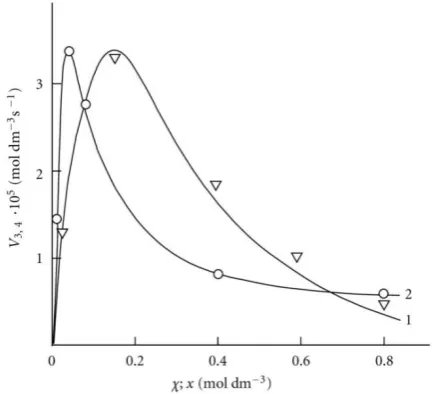
The overall formation rate of the 1:1 adducts R3A and R3B is a sophisticated function of the formation and disappearance rates of the radicals R1• and R•2 i.e., V(R3A, R3B) = (V1a + V3 – V5) – (V1b + V4 – V7). The application of the above rate equations to particular single nonbranched-chain additions is illustrated in Figure 1. Curve 1 represents the results of simulation in terms of eqn. (3b) for the observed 1:1 adduct formation rate as a function of the mole fraction of the unsaturated component in the phosphorus trichloride–methylpropene reaction system at 303 K.19 In an earlier work,10 the methylpropene concentration in this system was overvalued by a factor of 1.7 when it was derived from the mole fractions given in.19
In this simulation, the 60Co γ-radiation dose rate was set at P = 0.01 Gy s–1 and the initiation yield was taken to be G(•PCl2) = 2.8 particles per 100 eV (1.60 × 10⁻¹⁷ J) of the energy absorbed by the solution.19 The product of reaction 3 is Cl2PCH2C(Cl)(CH3)CH3 (two isomers), V1 = 4.65 × 10⁻⁹ mol dm–3 s–1 at χ = 0, and 2k5 = 3.2 × 10⁸ dm3 mol–1 s–1. This leads to α = (2.5 ± 0.4) × 103, and the rate constant of reaction 2 derived from this α value is k2 = (1.1 ± 0.2) × 104 dm3 mol–1 s–1.
Note that, if the R2–B bond dissociation energy for the unsaturated component of the binary system is approximately equal to or above, not below, the R1–A bond dissociation energy for the saturated component, then the rate of reaction 4 relative to the rate of the parallel reaction 3 (chain propagation through the reactive free radical R1•) will be sufficiently high for adequate description of R3A and R3B adduct formation in terms of eqns. (1)-(3b) only at high
temperatures.20 In the phosphorus trichloride–propene system, the difference between the R2–B (B = H) and R1–A (A = Hal) bond dissociation energies in the gas phase under standard conditions [1] is as small as 5 kJ mol–1, while in the tetrachloromethane–methylpropene (or cyclohexene) and bromoethane–2-methyl-2-butene systems, this difference is 20.9 (37.7) and ~24 kJ mol– 1, respectively.
Figure 1. Reconstruction of the functional dependences (curves) of the product formation rates V3, 4 (1, ) on the mole fraction of the unsaturated component (χ) from empirical data (symbols) using Eqn. (3b) (model optimization with respect to the parameter α) for the phosphorus trichloride–methylpropene reaction system at 303 K19 (standard deviation of S
Y = 2.58 10–6) and (2, ○) on the
concentration of the unsaturated component (x) from empirical data (symbols) using Eqn. (4a) (model optimization with respect to V1, хm, and α) for the 2-propanol–2-propen-1-ol system at 433 K [23]
(SY = 5.91 10–7).
Excess of the saturated component
If the concentration of the saturated component exceeds the concentration of the unsaturated component in the binary system, reaction 1b can be neglected. If this is the case (k1b = 0), then, in the numerators of the rate equations for reactions 3 and 4 (eqns. (1) and (2)), l/(l + x) = 1 and the overall rate equation for the formation of the 1:1 adducts R3A and R3B will appear as
1 2
3, 4 2
2 5 1
( ) (1:1 Addduct)
( ) 2
V l x k x V
k x l x k V
+
= =
+ +
(4)
1
2 2
1 m
m m
V x αl x
αl x x αl
−
=
+ +
+
(4a)where the parameters are designated in the same way as in eqns. (1)–(3a), l >> x, and
k2 =
(
) (
)
2 5 1
1 2
m m m
l x l k V
+
is determined from the condition
3, 4(1:1 Adduct) / 0.
V х
The rate equations for the chain termination reactions 5–7 (Scheme 1, k1b = 0) are identical to eqns. (12)-(14) (see below) with = 0.
If it is necessary to supplement Scheme 1 for k1b = 0 with the formation of R1B via the possible nonchain reaction 2a, the parameter k2a should be included in the denominator of eqn. (4) to obtain k x2 2+(l+x k x)( 2a + 2k V5 1). The analytical expression for k2 in the case of k2a 0 is identical to the expression for k2 for eqn. (4). The equation for the rate V2a(R1B) can be derived by replacing k2 with k2a in the numerator of eqn (4) containing k2a in its denominator.
Curve 2 in Figure 1 illustrates the good fit between eqn. (4a) and the observed 1:1 adduct formation rate as a function of the concentration of the unsaturated component in the reaction system 2-propanol–2-propen-1-ol at 433 K.8,9 In this description, we used a 60Co γ-radiation dose rate of P = 4.47 Gy s–1.23 The product of reactions 3 and 4 is СН3(СН3)С(ОН)СН2СН2СН2ОН, and 2k5 = 1.0 1010 dm3 mol–1 s–1. The following parameters were obtained: V1 = (3.18 ± 0.4) 106 mol dm–3 s–1, x
m = (3.9 ± 0.5) 10–2 mol
dm–3, and α = (6.8 ± 0.8) 10–2. The rate constant of reaction 2 derived from this α is k2 = (1.0 ± 0.14) 105 dm3 mol–1 s–1.
Addition to the C=O bond of formaldehyde
Free radicals add to the carbon atom at the double bond of the carbonyl group of dissolved free (unsolvated, monomer) formaldehyde. The concentration of free formaldehyde in the solution at room temperature is a fraction of a percent of the total formaldehyde concentration, which includes formaldehyde chemically bound to the solvent.27 The concentration of free formaldehyde exponentially increases with increasing temperature.28 The energy released as a result of this addition, when the C=O bond is converted into an ordinary bond, is 30 to 60 kJ mol–1 (according to the data on the addition of С1–С4 alkyl radicals in the gas phase under standard conditions1-4). The resulting free 1:1 adduct radicals can both abstract hydrogen atoms from the nearest-neighbour molecules of the solvent or unsolvated formaldehyde and, due to its structure, decompose by a monomolecular mechanism including isomerization.9,12
Addition of Free 1-Hydroxyalklyl Radicals with Two or More Carbon Atoms
Free 1-hydroxyalkyl radicals, which result from the abstraction of a hydrogen atom from the carbon atom bonded to the hydroxyl group in molecules of saturated aliphatic alcohols except methanol under the action of chemical initiators,29,30 light,17,31 or ionizing radiation,32,33 add at the double bond of free formaldehyde dissolved in the alcohol, forming 1,2-alkanediols,8,9,12,29-36 carbonyl compounds, and methanol8,33via the chain mechanism. The yields of the latter two products in the temperature range of 303 to 448 K are one order of magnitude lower. In these processes, the rate determining role in the reactivity of the alcohols can be due to desolvation of formaldehyde in alcohol–formaldehyde solutions, which depends both on the
temperature and on the polarity of the solvent.28,33 For the
-radiolysis of 1(or 2)-propanol–formaldehyde system at a constant temperature, the dependences of the radiation-chemical yields of 1,2-alkanediols and carbonyl compounds as a function of the formaldehyde concentration show maxima and are symbatic.8,32 For a constant total formaldehyde concentration of 1 mol dm–3, the dependence of the 1,2-alkanediol yields as a function of temperature for 303
–
473 K shows a maximum, whereas the yields of carbonyl compounds and methanol increase monotonically33 along with the concentration of free formaldehyde.28 In addition to the above products, the nonchain mechanism in the -radiolysis of the solutions of formaldehyde in ethanol and 1- and 2-propanol gives ethanediol, carbon monoxide, and hydrogen in low radiation-chemical yields, which, however, exceed the yields of the same products in the-radiolysis of individual alcohols.8,9,33 The available experimental data can be described in terms of Scheme 2.
Chain initiation
1. I ⎯⎯ →2⎯k1 2 0 R• ;
1а. R0• + ROH ⎯⎯→k⎯1a ROH + •R(–H)OH.
Chain propagation
2. •R(–H)OH + CH2O ⎯⎯→k2 R(–H)(ОH)СН2О•;
3. R(–H)(ОH)СН2О•+ROH ⎯⎯→k3 R(–H)(ОH)СН2ОH +•R(–H)OH;
3а. R(–H)(ОH)СН2О•⎯k⎯→⎯3a R(–2H)HO + •СН2ОН (or RRCO + •СН2ОН);
3b. •СН2ОН + ROH ⎯⎯→k⎯3b CH3OH + •R(–H)OH.
Inhibition
4. R(–H)(ОH)СН2О• + CH2O⎯⎯→k4 R(–H)(ОH)СН2ОH + •СНО.
Chain termination
5. 2•R(–H)OH ⎯⎯ →2⎯k5 R(–H)(OH)R(–H)OH
(or: ROH+R(–2H)HO, ROH+RRCO);
6. •R(–H)OH + •СНО ⎯⎯→k6 R(–H)(OH)CHO (or: R(–2H)HO+CH2O,
RRCO+CH2O, ROH+CO);
7. 2•СНО ⎯2⎯ →⎯k7 HC(O)CHO
(or: CH2O + CO, 2CO + H2).
In these reactions, I is an initiator, e.g., a peroxide;29,30
•
0
R a reactive radical (initiator radical); R an alkyl group; ROH, a saturated aliphatic alcohol, either primary or
secondary, beginning from ethanol; •СН2ОН, the hydroxymetyl fragment radical; •R(–H)OH, the reactive 1-hydroxyalkyl addendum radical, beginning from 1-hydroxyethyl; R(–H)(ОH)СН2О•, the reactive
hydroxyalkoxyl 1:1 adduct radical; •СНО, the low-reactive formyl radical (inhibitor radical); R0H, the molecular product; R(–H)(OH)СН2ОН, 1,2-alkanediol; R(–2H)HO, an aldehyde in the case of a primary alcohol and an R'R"CO ketone in the case of a secondary alcohol; R(–H)(ОH)R(–H)ОH, a vicinal alkanediol and R(–H)(OH)CHO, a hydroxyaldehyde. The chain evolution stage of Scheme 2 includes consecutive reaction pairs 2–3, 2–3a, and 3a–3b, parallel (competing) reaction pairs 3–3a, 3–3b, 3–4, and 3a–4 and consecutive– parallel reactions 2 and 4.
Scheme 2 does not include the same types of radical-molecule reactions as were considered for Scheme 1. In addition, it seems unlikely that free adduct radicals will add to formaldehyde at higher temperatures. An addition reaction is unlikely because this would result in an ether bond. The addition of hydroxymethyl radicals to formaldehyde, which is in competition with reaction 3b, is not included as well, because there is no chain formation of ethanediol at 303-448 K.33 At the same time, small amounts of ethanediol can form via the dimerization of a small fraction of hydroxymethyl radicals, but this cannot have any appreciable effect on the kinetics of the overall process. The addition of free formyl radicals to formaldehyde cannot proceed at a significant rate, indicated by the lack of formation of glycol aldehyde in the systems examined .33
The mechanism of the decomposition of the free adduct radical via reaction 3a, which includes the formation of an intramolecular НО bond and isomerization, can be represented as follows.8,9,12
Scheme 2. Possible mechanism of reaction 3a.
The probability of the occurrence of reaction 3a should increase with increasing temperature. This is indicated by experimental data presented above.8,9,12 The decomposition of the hydroxyalkoxyl radical. R(–H)(ОH)СН2О• (reaction 3a) is likely to be endothermic. The endothermic nature of reaction 3a is indirectly indicated by the fact that the decomposition of simple C2−C4 alkoxyl radicals RО• in the gas phase is accompanied by heat absorption2-4 (
298 Н
= 30−90 kJ mol–1). Reaction 3b, subsequent to reaction 3a, is exothermic, and its heat for C2−C3 alcohols in the gas phase is Н298 = −40 to −60 kJ mol–1.2-4 As follows from the above scheme of the process, reactions 3a and 3b, in which the formation and consumption of the highly reactive free radical hydroxymethyl take place (at equal rates under steady-state conditions), can be represented as a single
bimolecular reaction 3a, b occurring in a "cage" of solvent molecules.
The free formyl radical resulting from reaction 4, which is in competition with reactions 3 and 3a, is comparatively low-reactive because its spin density can be partially delocalized from the carbon atom via the double bond toward the oxygen atom, which possesses a higher electron affinity.1 For example, in contrast to the methyl and alkoxyl π-radicals, the formyl σ-radical can be stabilized in glassy alcohols at 77 K.37 In gas phase, the dissociation energy of the C–H bond in formyl radicals is half that for acetyl radicals and is about 5 times lower than the dissociation energy of the Сα–Н bond in saturated C1–C3 alcohols.1
As distinct from reactions 3 and 3a, b, reaction 4 leads to an inefficient consumption of hydroxyalkoxyl adduct radicals, without regenerating the initial 1-hydroxyalkyl addendum radicals. Reaction 4 together with reaction 6 (mutual annihilation of free formyl and chain-carrier 1-hydroxyalkyl radicals) causes the inhibition of the nonbranched-chain process. For the disproportionation of the free radicals, the heats of reactions 5-7 for C1−C3 alcohols in the gas phase vary in the range of Н298 =
−135 to −385 kJ mol–1.1-4
The rates of the chain formation of 1,2-alkanediols in reaction 3 (and their nonchain formation in reaction 4), carbonyl compounds in reaction 3a, and methanol in reaction 3b are given by the following equations, where V1 is the initiation rate, l is the molar concentration of the saturated alcohol at a given total concentration of formaldehyde dissolved in it, x is the molar concentration of free formaldehyde (l >> x), k2 is the rate constant of reaction 2 (addition of 1-hydroxyalkyl free radical to free formaldehyde), and α = k3/k4 and β = k3а/k4 (mol dm–3) are the ratios of the rate constants of the competing (parallel) reactions. The alcohol concentration in alcohol– formaldehyde solutions at any temperature can be estimated by the method suggested in.38,39 The data necessary for estimating the concentration of free formaldehyde using the total formaldehyde concentration in the solution are reported by Silaev et al.28,29
V3, 4(R(–H)(OH)CH2OH) =
1 2
2
2 5 1
,
(
)
(
) 2
V
l
x k x
k x
l
x
k V
+
+
+ +
(5)
V3a(R(–2H)HO) = V3b(CH3OH) =
2 1 2
2 5 1
,
(
) 2
+
+ +
V
k x
k x
l
x
k V
(6)Estimates of 2k5 were reported by Silaev et al.39,40 From the extremum condition for the reaction 3a rate function,
3a / 0
V х
= , we derived the following analytical
expression:
k
2=
(
l
m+
) 2
k V
5 1x
m2 .formation and disappearance rates of the •R(–H)OH and •СНО free radicals: V(R(–H)(OH)CH2OH, R(–2H)HO, CH3OH) = V1a + V3 + V3b – V4 – V5 + V7. The ratios of the rates of the competing reactions are V3/V4 = αl/x and V3a/V4 = β/x, and the chain length is = (V3 + V3a)/V1. The ratio of the rates of formation of 1,2-alkanediol and the carbonyl compound is a simple linear function of x:
V3,4(R(–H)(OH)CH2OH)/V3a(R(–2H)HO)=(k4/k3а)х + (k3/k3а)l.
The equations for the rates of chain-termination reactions 5
–
7 are identical to eqns. (12)-(14).Neutral formaldehyde solutions in alcohols at room temperature primarily consist of a mixture of formaldehyde polymer solvates reversibly bound to alcohols. These polymer solvates differ in molecular mass and have the general formula RO(CH2O)nH, where n = 1-4.27 The concentration of formaldehyde that occurs in solution as a free, unsolvated active species chemically unbound to the solvent (this species is capable of scavenging free radicals) at room temperature is lower than 1% of the total formaldehyde concentration.27 The concentration x of the free formaldehyde species in solutions was determined by high-temperature UV spectrophotometry in the range 335– 438 K at the total formaldehyde concentration c0 (free and bound species including the concentration of polymer solvates) of 1.08.4 mol dm–3 in water, ethanediol, methanol, ethanol, 1-propanol, 2-propanol, and 2-methyl-2-propanol28 (see Table of the Appendix). This concentration increases with temperature according to an exponential law, and it can be as high as a few percent of the total concentration in solution under the test conditions, up to 19.3 % in the case of 2-methyl-2-propanol at a total concentration of 1.0 mol dm–3 and a temperature of 398 K. The following empirical equation relating the concentration x (mol dm–3) of free formaldehyde to temperature T (K) and the total concentration c0 in the solution (measured at room temperature), was developed by the treatment of 101 data points,28,39 where the coefficients a and b were calculated as the parameters of a straight-line equation by the least-squares technique from the dependence of log x on 1/T at c0 = 1.0 mol dm–3 for various solvents, and the coefficient h was obtained as the average value of the slopes of log x as linear functions of log c0 at various series of fixed temperatures.
Table 1. Coefficients of eqn. (7) for the estimation of the concentration x of free formaldehyde in polar solvent– formaldehyde systems.
Solvent
Coefficient
a b h
Water 2.36 4.45 0.80 Ethanediol 1.83 2.60 1.28
Methanol 3.11 5.58 0.22 c0 / log c0 Ethanol 3.10 5.92 1.10 (103/T) – 1.44 1-Propanol 2.42 4.47 1.30
2-Propanol 2.42 4.64 1.05 2-Methyl-2-propanol 3.19 7.31 0.96
log x = –a (103
/
T) + b + h log c0, (7)
The coefficients for each solvent are summarized in Table 1. As regards the experimental data, the error in the calculations of the concentration x of free formaldehyde made by eqn. (7) in the specified temperature range was no higher than 25 %.
On the assumption that the dependence of the density of a given solution on the concentration of formaldehyde is similar to the analogous linear dependence found for aqueous formaldehyde solutions (0
–
14 mol dm–3, 291 K),27 the concentrations lT (mol dm–3) of alcohols in alcohol– formaldehyde solutions at a certain temperature can be estimated by eqn. (8), where c0 is the total formaldehyde concentration (mol dm–3); M is the molecular mass (g mol–1) of the solvent; d and dT are the solvent densities (g cm–3) at room and given temperatures, respectively; the coefficients 8.4 × 10⁻³ and 21.6 have the units of 103g mol–1 and g mol–1, respectively.38, ) 10 8.4 (
) 21.6 10
(
0 3
T 0 3
T
M c d
d c d
l −
+
−
= (8)
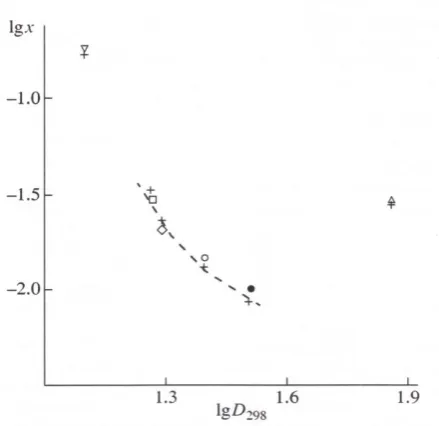
Earlier,28 it was found that the concentration x of the free formaldehyde species decreased with the solvent permittivity D298 at a constant temperature. Water is an exception. Although water is more polar than alcohols, the concentration x of free formaldehyde in an aqueous solution is anomalously high and reaches the level of its concentration in 2-propanol, all other factors being the same (Figure 2).28,39 This can be due to the specific instability of hydrated formaldehyde species and the ease of their conversion into free formaldehyde with increasing temperature.
Figure 2. Logarithmic plot of the experimental concentrations x (mol dm–3) of free formaldehyde at its total concentration c0 = 1.0 mol dm–3 and 395 ± 3 K in () water, () methanol, () ethanol, () 1-propanol, () 2-propanol, and () 2-methyl-2-propanol as functions of the permittivity D298 of these solvents (+ refers to the concentrations x in the above solvents calculated by eqn. (8)).
free formaldehyde in the 1-propanol–formaldehyde reacting system at a total formaldehyde concentration of 2.0 to 9.5 mol dm–3 and temperature of 413 K.8,9,41 The concentration dependence of the propanal formation rate was described using the estimates of kinetic parameters obtained for the same dependence of the 1,2-butanediol formation rate. We considered these data more reliable for the reason that the carbonyl compounds forming in the alcohol–formaldehyde systems can react with the alcohol and this reaction depends considerably on the temperature and acidity of the medium.27 The mathematical modelling of the process was carried out using a 137Cs γ-radiation dose rate of P = 0.8 Gy s–1,32,41 a total initiation yield8,9 of G(CH
3СН2ĊНОН) = 9.0 particles per 100 eV (V1 = 4.07 10–7 mol dm–3 s–1), and 2k5 = 4.7 109 dm3 mol–1 s–1). The following values of the parameters were obtained: α = 0.36 ± 0.07, β = 0.25 ± 0.05 mol dm–3, and k2 = (6.0 ± 1.4) 103 dm3 mol–1 s–1.
It may be noted that, as compared to the yields of 1,2-propanediol in the γ-radiolysis of the ethanol–formaldehyde system, the yields of 2,3-butanediol in the γ-radiolysis of the ethanol–acetaldehyde system are one order of magnitude lower.41 Using data from,8,9 it can be demonstrated that, at 433 K, the double bond of 2-propen-ol accepts the 1-hydroxyethyl radical 3.4 times more efficiently than the double bond of formaldehyde.42
Addition of hydroxymethyl radicals
The addition of hydroxymethyl radicals to the carbon atom at the double bond of free formaldehyde molecules in methanol, initiated by the free-radical mechanism, results in the chain formation of ethanediol.34 In this case, reaction 3a in Scheme 2 is the reverse of reaction 2, the 1-hydroxyalkyl radical •R(–H)OH is the hydroxymethyl radical •СН2ОН, so reaction 3b is eliminated (k3b = 0), and reaction 5 yields an additional amount of ethanediol via the dimerization of chain-carrier hydroxymethyl radicals (their disproportionation can practically be ignored43). The scheme of these reactions has been reported.35
The rate equation for ethanediol formation by the chain mechanism in reaction 3 and by the nonchain mechanism in reactions 4 and 5 in the methanol–formaldehyde system has a complicated form as compared to eqn. (1) for the formation rate of the other 1,2-alkanediols.12 In an earlier publication,8 this equation does not take into account reaction 3a.
V3, 4, 5(CH2OH)2 =
2
1 2 1 5
2
[ ( ) 2 (
) ]
V f
l+x k x V k+
l+
+
x
f
, (9)where f = k2x2 + (αl + β + x) 2k V5 1.
If the rate of ethanediol formation by dimerization in reaction 5 is ignored for the reason that it is small as compared to the total rate of ethanediol formation in reactions 3 and 4, eqn. (9) will be identical to eqn. (5). After the numerator and denominator on the right-hand side of eqn. (5) are divided by k–2 ≡ k3a, one can replace k2 in this equation with K2 = k2/k–2, which is the equilibrium constant for the reverse of reaction 2. Ignoring the reverse of reaction 2 (k3a = 0, β = 0) makes eqn. (5) identical to eqn. (4) for
Scheme 1 at k3b = 0. In this case, the rate constant k2 is effective.
Addition to Oxygen
The addition of a free radical or an atom to one of the two multiply bonded atoms of the oxygen molecule yields a peroxyl free radical and thus initiates oxidation, which is the basic process of chemical evolution. The peroxyl free radical then abstracts the most labile atom from a molecule of the compound being oxidized or decomposes to turn into a molecule of an oxidation product. The only reaction that can compete with these two reactions at the chain evolution stage is the addition of the peroxyl radical to the oxygen molecule (provided that the oxygen concentration is sufficiently high). This reaction yields a secondary, tetraoxyalkyl, 1:2 adduct radical, which is the heaviest and the largest among the reactants. It is less reactive than the primary, 1:1 peroxyl adduct radical and, as a consequence, does not participate in further chain propagation. At moderate temperatures, the reaction proceeds via a nonbranched-chain mechanism.
Addition of hydrocarbon free radicals
Usually, the convex curve of the hydrocarbon (RH) autooxidation rate as a function of the partial pressure of oxygen ascends up to some limit and then flattens out.6 When this is the case, the oxidation kinetics is satisfactorily describable in terms of the conventional reaction scheme,2,5,6,16,44,45 which involves two types of free radicals. These are the hydrocarbon radical R• (addendum radical) and the addition product RO2• (1:1 adduct radical). However, the existing mechanisms are inapplicable to the cases in which the rate of initiated oxidation as a function of the oxygen concentration has a maximum (Figures. 4, 5).46,47 Such dependences can be described in terms of the competition kinetics of free-radical chain addition, whose reaction scheme involves not only the above two types of free radicals, but also the RO4• radical (1:2 adduct) inhibiting the chain process.13.14
Chain initiation
1. I⎯⎯ →2⎯k1 2R•0;
1а. R RH R0Н R .
a 1 0
•
• + ⎯k⎯→⎯ +
Chain propagation
2. •+ ⎯⎯→2 •2
2 RO
O
R k ;
3. RО• +RH⎯⎯→RО2H+R•
3 2
k
(or ROH + RO•);
3a. RО 3а 2⎯⎯→⎯
• k
R(–H)HO + RO•
3b. RO•(RO•) + RH ⎯k⎯→⎯3b ROH (ROH) + R•
(or •OH + RH ⎯k⎯→⎯3b H
2O + R•). Inhibition
4. • + ⎯⎯→4 2 2 O
RО k RO . •4
Chain termination
5. 2R•⎯2⎯ →⎯k5 RR
(or R(–2H)H + RH); 6. R•+ RO•4 ⎯⎯→k6 RH + R
(–2H)HО + O3 (or: ROH + R(–2H)HO + O2, ROR + O3, RO2R + O2);
7. 2RO•4 ⎯⎯ →2⎯k7 RO
2R + 2О3.
Scheme 3. Kinetic model of oxidation.
The only difference between the kinetic model of oxidation represented by Scheme 3 and the kinetic model of the chain addition of 1-hydroxyalkyl radicals to the free (unsolvated) form of formaldehyde in nonmethanolic alcohol–formaldehyde systems8,9 (Scheme 2) is that in the former does not include the formation of the molecular 1:1 adduct via reaction 4.
The decomposition of the initiator I in reaction 1 yields a reactive R0• radical, which turns into the ultimate product R0H via reaction 1a, generating an alkyl radical R•, which participates in chain propagation. In reaction 2, the addition of the free radical R• to the oxygen molecule yields a reactive alkylperoxyl 1:1 adduct radical RO2• ,45 which possesses increased energy owing to the energy released upon the conversion of the O=O bond into the ordinary bond RО–О• (for addition in the gas phase under standard conditions, this energy is 115-130 kJ mol–1 for C1-C4 alkyl radicals1,2,4 and 73 kJ mol–1 for the allyl radical).4 Because of this, the adduct radical can decompose (reaction 3a) or react with some neighboring molecule (reaction 3 or 4) on the spot, without diffusing in the solution and, accordingly, without entering into any chain termination reaction. In reaction 3, the interaction between the radical adduct RO2•
and the hydrocarbon molecule RH yields, via a chain mechanism, the alkyl hydroperoxide RO2H (this reaction regenerates the chain carrier R• and, under certain conditions, can be viewed as being reversible2) or the alcohol ROH (this is followed by the regeneration of R• via reaction 3b). The latter (alternative) pathway of reaction 3 consists of four steps, namely, the breaking of old bonds and the formation of two new bonds in the reacting structures. In reaction 3a, the isomerization and decomposition of the alkylperoxyl radical adduct RO2• with O–O and C–O or C–H bond breaking take place,6.44 yielding the carbonyl compound R(–Н)НО or R(–2Н)НО. Reaction 3b produces the alcohol ROH or water and regenerates the free radical R• (here, R and R are radicals having a smaller number of carbon
atoms than R). As follows from the above scheme of the process, consecutive reactions 3a and 3b (whose rates are equal within the quasi-steady-state treatment), in which the highly reactive fragment, oxyl radical RО• (or •ОН) forms and then disappears, respectively, can be represented as a single, combined bimolecular reaction 3a, b occurring in a "cage" of solvent molecules. Likewise, the alternative (parenthesized) pathways of reactions 3 and 3b, which involve the alkoxyl radical RО•, can formally be treated as having equal rates. For simple alkyl C1–C4 radicals R, the pathway of reaction 3 leading to the alkyl hydroperoxide RO2H is endothermic (ΔН
˚
298 = 30-80 kJ mol–1) and thealternative pathway yielding the alcohol ROH is exothermic (ΔН
˚
298= –120 to –190 kJ mol–1), while the parallel reaction3a, which yields a carbonyl compound and the alkoxyl radical RО• or the hydroxyl radical •ОН, is exothermic in both cases (ΔН
˚
298 = –80 to –130 kJ mol–1), as also isreaction 3b (ΔН
˚
298 = –10 to –120 kJ mol–1), consecutive toreaction 3a, according to thermochemical data for the gas phase.2-4 In reaction 4, which is competing with (parallel to) reactions 3 and 3a (chain propagation through the reactive radical R•), the resulting low-reactive radical that does not participate in further chain propagation and inhibits the chain process is supposed to be the alkyltetraoxyl 1:2 radical adduct RO4•, which has the largest weight and size. This radical is possibly stabilized by a weak intramolecular H···O hydrogen bond54 shaping it into a six-membered cyclic structure (seven-membered cyclic structure in the case of aromatic and certain branched acyclic hydrocarbons.56, 57
Sheme 5. Possible mechanism of r
Scheme 3. Possible mechanism of reaction 4.
Note that the R(–H)H···O(R)O3 ring consisting of the same six atoms (C, H, and 4O), presumably with a hydrogen bond,6 also forms in the transition state of the dimerization of primary and secondary alkylperoxyl radicals RО2•via the Russell mechanism.5,55
Reaction 4 in the case of the methylperoxyl radical
3 2
CH O• , addition to the oxygen molecule to yield the methyltetraoxyl radical CH O3 4•, takes place in the gas phase, with heat absorption equal to 110.0 ± 18.6 kJ mol–1 (without the energy of the possible formation of a hydrogen bond taken into account).49 The exothermic reactions 6 and 7, in which the radical R• or RO4• undergoes disproportionation, include the isomerization and decomposition of the RO4• radical (taking into account the principle of detailed balance for the various pathways of formation of products, whose numbers in the elementary reaction should not exceed three for possible involvement in the triple collisions in the case of the reverse reaction, since the probability of simultaneous interaction of four particles is negligible). The latter process is likely accompanied by chemiluminescence typical of hydrocarbon oxidation.52 It may be noted that the alkylperoxyl radicals RО2• are effective quenchers of singlet oxygen О2(a1Δg).58 These reactions regenerate oxygen as O2 molecules, including singlet oxygen,52.59 and partially, as O
3 molecules and yield the carbonyl compound R(–2H)HO, possibly in the triplet excited state.52 Depending on the decomposition pathway, the other possible products are alcohol ROH, ether ROR, and alkyl peroxide RO2R. It is likely that the isomerization and decomposition of the RO4• radical via reactions 6 and 7 can take place through the breaking of a C–C bond to yield carbonyl compounds, alcohols, ethers, and organic peroxides containing fewer carbon atoms than the initial hydrocarbon, as in the case of the alkylperoxyl radical RO2• in reaction 3a. At later stages of oxidation and at sufficiently high temperatures, the resulting aldehydes can be further oxidized into respective carboxylic acids. They can also react with molecular oxygen so that a C–H bond in the aldehyde molecule breaks to yield two free radicals ( HO•2 and •R(–H)O or •R(–2H)O). This process, like possible ozone decomposition yielding an •O• atom or peroxide decomposition with O–O bond breaking, leads to degenerate chain branching.6
The equations describing the rates of formation of molecular products at the chain propagation and termination stages of the above reaction scheme, using the quasi-steady-state treatment, appear as follows, where V1 is the initiation rate, l = [RH] and x = [O2] are the molar concentrations of the starting components (l >> x), α = k3/k4 and β = k3a/k4 (mol dm–3) are the ratios of the rate constants of the competing (parallel) reactions, k2=(
lm+
) 2k5V1 xm2 isthe rate constant of the addition of the alkyl radical R• to the oxygen molecule (reaction 2) as determined by solving the quadratic equation following from the rate function extremum condition
V
3,3a/
=
x
0
, lm and xm are thevalues of l and x at the maximum point of the function,
f = k2x2 + (αl + β + x) 2k5V1 , and
) ( )
( 2
2+
+
+
+
= m m
m x l x x l
f :
V3(RO2H; ROH) =
V lk x f
1
2 = (10)=
V lx f
1
m, (10a)V3а(R(–H)HO; R(–2H)HO) = V3b(ROH; H2O) = =
V
1
k x f
2 = (11)=
V
1
x f
m , (11a)V5 =
(
)
2
2 2
1
2
5V
k
l
+ +
x
f
, (12)2V6 =
(
)
2 2
1 5 1 2
2
V
2
k V
l
+ +
x k
x
f
, (13)V7 =
( )
22 2
1 2
V k x
f
, (14)The ratios of the rates of the competing reactions are V3/V4 = αl/x and V3a/V4 = β/x, and the chain length is = (V3 + V3a)/V1. eqn. (11) is identical to eqn. (6). Eqns. (10a) and (10a) were obtained by replacing the rate constant k2 in eqns. (10) and (11) with its analytical expression (for reducing the number of unknown parameters to be determined directly).
For αl >> β (V3 >> V3a), when the total yield of alkyl hydroperoxides and alcohols having the same number of carbon atoms as the initial compound far exceeds the yield of carbonyl compounds, as in the case of the oxidation of some hydrocarbons, the parameter β in eqns. (10) and (10a) can be neglected (β = 0) and these equations become identical to eqns. (3) and (3a) with the corresponding analytical expression for k2.
In the alternative kinetic model of oxidation, whose chain
termination stage involves, in place of R• (Scheme 4), RO2• radicals reacting with one another and with RO4• radicals,
the dependences of the chain formation rates of the products on the oxygen concentration x derived by the same method have no maximum: V3=V1k3l (k4x+ 2k5V1) and
) 2 ( 4 5 1 a
3 1 a
3 Vk k x kV
V = + . In the kinetic model of oxidation that does not include the competing reaction 4
(k4 = 0) and involves the radicals R• and RO2
•
(the latter
Thus, of the three kinetic models of oxidation mathematically analyzed above, which involve the radicals R• and RO2• in three types of quadratic-law chain termination reactions (reactions 5-7) and are variants of the conventional model,2,5,6,16,44,45 the last two lead to an oxidation rate versus oxygen concentration curve that emanates from the origin of coordinates, is convex upward and has an asymptote parallel to the abscissa axis. Such monotonic dependences are observed when the oxygen solubility in the liquid is limited under given experimental conditions and the oxygen concentration attained is [O2]top ≤ xm. The oxygen concentration attained in the liquid may be below the thermodynamically equilibrium oxygen concentration because of diffusion limitations hampering the establishment of the gas–liquid saturated solution equilibrium under given experimental conditions (for example, when the gas is bubbled through the liquid) or because the Henry law is violated for the given gas–liquid system under real conditions.
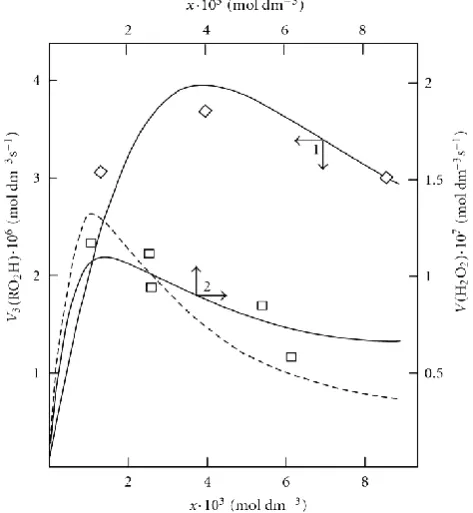
Unlike the conventional model, the above kinetic model of free-radical nonbranched-chain oxidation, which includes the pairs of competing reactions 3-4 and 3a-4 (Scheme 4), allows us to describe the nonmonotonic (peaking) dependence of the oxidation rate on the oxygen concentration (Figure 4).
Figure 4. (1, ) Reconstruction of the functional dependence of the 2-methylbenzyl hydroperoxide formation rate V3(RO2H) on the dissolved oxygen concentration x. (2,
□
) Reconstruction of the functional dependence of the total hydrogen peroxide formation rate V3, 7(Н2О2) on the dissolved oxygen concentration x from empirical data (symbols) using eqns. (3a) and (14a) with β = 0 (model optimization with respect to the parameter α) for the γ-radiolysis of water saturated with hydrogen and containing different amounts of oxygen at 296 K63 (SY = 1.1310–8). The
dashed curve described V3(H2O2) as a function of the oxygen concentration x based on eqn. (3a) (model optimization with respect to α) and the experimental data of curve 2 (SY = 1.7310–8).
In this oxidation model, as the oxygen concentration in the binary system is increased, oxygen begins to act as an oxidation autoinhibitor or an antioxidant via the further
oxidation of the alkylperoxyl 1:1 adduct radical RO2• into the low-reactive 1:2 adduct radical RO•4 (reactions 4 and 6 lead to inefficient consumption of the free radicals RO2• and R• and cause shortening of the kinetic chains).
The optimum oxygen concentration xm, at which the
oxidation rate is the highest, can be calculated using kinetic equations (10a) and (11a) and eqn. (3a) with β = 0 or the corresponding analytical expression for k2. Semenov60 has noted that raising the oxygen concentration when it is already sufficient usually slows down the oxidation process by shortening the chains. The existence of the upper (second) ignition limit in oxidation is due to chain termination in the bulk through termolecular collisions between an active species of the chain reaction and two oxygen molecules (at sufficiently high oxygen partial pressures). In the gas phase at atmospheric pressure, the number of termolecular collisions is roughly estimated to be 103 times smaller than the number of binary collisions and the probability of a reaction taking place depends on the specificity of the action of the third particle.60 In case of a gas-phase oxidation of `hydrogen at low pressures of 25-77 Pа and a temperature of 77 K47 when termolecular collisions are unlikely, the dependence of the rate of formation of hydrogen peroxide on oxygen concentration also has a pronounced maximum (see curves 3 and 4 in figure 5) that indicates a chemical mechanism providing the appearance of a maximum (see reaction 4 of Scheme 3).
Curve 1 in figure 4 illustrates the fit between eqn. (3a) at αl >> β and experimental data for the radiation-induced oxidation of o-xylene in the liquid phase at 373 K where 2-methylbenzyl hydroperoxide is formed much more rapidly than o-tolualdehyde (V3 >> V3a and αl >> β).46 The oxygen concentration limit in o-xylene is reached at an oxygen concentration of [O2]top > xm, which corresponds to the third
experimental point.46
The oxygen concentration was calculated from the oxygen solubility in liquid xylene at 373 K.61
The following quantities were used in this mathematical description, 60Co -radiation dose rate of P = 2.18 Gy s–1 and total initiation yield of G(o-СН3С6Н4ĊН2) = 2.6 particles per 100 eV of the energy absorbed by the solution;46 V
1 = 4.73 10–7 mol dm–3 s–1 and 2k5 = 1.15 1010 dm3 mol–1 s–1. The resulting value of the parameter α is (9.0 ± 1.8) 10–3; hence, k2 = (3.2 ± 0.8) 105 dm3 mol–1 s–1. From the earlier data,62 it was estimated that k
4 = k3/α = (5.2 ± 1.2) 102 dm3 mol–1 s–1.
Addition of the hydrogen atom
A number of experimental findings concerning the autoinhibiting effect of an increasing oxygen concentration at modest temperatures on the oxidation of hydrogen both in the liquid phase63 (Figure 4, curve 2) and in the gas phase47,64,65 (Figure 5), considered in our earlier work,13,56,57,66 can also be explained in terms of the competition kinetics of free radical addition.14,67 From Figure 5 it is apparent that the quantum yields of hydrogen peroxide and water (products of photochemical oxidation of hydrogen at atmospheric pressure and room temperature) are maximum in the region of small concentrations of oxygen in the hydrogen–oxygen system (curves 1 and 2, respectively).64
Nonbranched-chain oxidation of hydrogen and changes in enthalpy (ΔН
˚
298, kJ mol–1) for elementary reactions aregiven in the following reaction Scheme 4.
Chain initiation
1. Н2 ⎯h⎯ →ν⎯,γ 2Н•, ΔН
˚
298 = 436.0 0.0.Chain propagation
2. Н• + О2 ⎯⎯→k2 HO2•, ΔН
˚
298 = –205.4 1.7;3.HO•2+Н2⎯⎯→k3 Н2О +НО•, ΔН
˚
298=–215.42.9(or Н2О2 + Н•), ΔН
˚
298 = 69.4 1.7;3. НО•+Н2⎯⎯→k3' Н2О+Н•, ΔН
˚
298 = –62.8 1.2.Inhibition
4. HO2• + О2 ⎯⎯→k4 HO4
•
, ΔН
˚
298 = 110.0 15.4.Chain termination
5. 2Н•(+М)⎯2⎯ →⎯k5 Н
2(+М), ΔН
˚
298 = –436.0 0.0;6. Н•+
4
HO• ⎯⎯→k6 Н
2О2+О2, ΔН
˚
298 = –476.6 13.7(or: Н2О + О3, ΔН
˚
298 = –439.3 15.4,Н2 + 2О2), ΔН
˚
298 = –340.6 13.7;7. 2 4
HO• ⎯2⎯ →⎯k7 Н
2О2 + 2О3, ΔН
˚
298= –95.0 30.8.Scheme 4. Nonbranched-chain oxidation of hydrogen.
According to Francisco and Williams49, the enthalpy of formation (ΔНf˚298) in the gas phase of Н•, НО•, HO2
•
, HO4•
(the latter without the possible intramolecular hydrogen bond taken into account), О3, Н2О2, Н2О2, and Н2О4 is 218.0
0.0, 39.0 1.2, 12.6 1.7, 122.6 13.7, 143.1 1.7, –241.8 0.0, –136.0 0, and –26.0 9 kJ mol–1, respectively.Calculations for the HO4• radical with a helical structure were carried out using the G2(MP2) method.68 The stabilization energies of HO2• , HO4• , and HO3• were calculated in the same work to be 64.5 0.1, 69.5 0.8, and 88.5 0.8 kJ mol–1, respectively. The types of the O4 molecular dimers, their IR spectra, and higher oxygen oligomers were reported.69,70 The structure and IR spectrum of the hypothetical cyclotetraoxygen molecule O4, a species with a high- energy density, were calculated by the CCSD method, and its enthalpy of formation was estimated.71 The photochemical properties of O4 and the van der Waals nature of the О2-О2 bond have investigated.72,73 The most stable geometry of the dimer is two O2 molecules parallel to one another. The O4 molecule was identified by NR mass spectrometry.74
The hydroperoxyl free radical75-78
2
HO• , resulting from reaction 2, possesses an increased energy due to the energy released on the conversion of the О=О multiple bond into the НО–О• ordinary bond. Therefore, before its possible decomposition, it can interact with a hydrogen or oxygen molecule as the third body via parallel (competing) reactions 3 and 4, respectively. The hydroxyl radical НО• that appears and disappears in consecutive parallel reactions 3 (first variant) and 3 possesses additional energy owing to the exothermicity of the first variant of reaction 3, whose heat is distributed between the two products. As a consequence, this radical has a sufficiently high reactivity not to accumulate in the system during these reactions, whose rates are equal (V3 = V3) under quasi-steady-state conditions, according to the above scheme. Parallel reactions 3 (second, parenthesized variant) and 3 regenerate hydrogen atoms. It is assumed56.57 that the hydrotetraoxyl radical
4
HO• (first reported in Refs.79,80) resulting from endothermic reaction 4, which is responsible for the peak in the experimental rate
curve (Figure 4, curve 2), is a five-membered [ОО─Н···ОО]• cycle due to weak intramolecular hydrogen
bonding.54,81 This structure imparts additional stability to this radical and makes it least reactive.