ISSN: 2278-3369
International Journal of Advances in Management and Economics
Available online at:
www.managementjournal.info
RESEARCH ARTICLE
Profile of National Publications on Managerial Controls and
Organizational Culture
Graziela de Oliveira Padilha
1*, Carlos Eduardo Facin Lavarda
2 Department of Accounting Sciences / Federal University of Santa Catarina, Brazil.*Corresponding Author: Email:[email protected]
Abstract: The purpose of the research was to investigate aspects of the scientific production on managerial control and organizational culture in the national periodicals of the Spell database available until May 2019. In order to achieve the general objective, the following specific objectives are stipulated: a) b) identify the key words, c) observe the methodological approach, d) know the published journals, e) examine the main works cited, f) evaluate the proposals of the articles, g) verify the theoretical concepts presented, h ) identify suggestions for future research and i) examine the citations in the Spell database. As for the methodology, the research is characterized as descriptive regarding the objectives and how many to the procedures as documental analysis. It can be concluded that the organizational culture possesses is important for the control, so that new research must be carried out, so in the end some suggestions are proposed for future research.
Keyword: Control; Culture; Organization; Organizational culture.
Article Received: 08 June 2019 Revised: 18 June 2019 Accepted: 27 June 2019
Introduction
Managerial accounting plays an important role in organizations, since their role is to drive improvements in decision-making processes, as well as providing various types of information: economic, financial and
operational [1]. Management control, which
is one of the management mechanisms defined as the process by which managers make sure that resources are obtained and used effectively in accordance with the
organization's objectives [2]. In this
perspective control is the process by which the implementation of strategies and the obedience to them is decided, that is, through it, it is ensured that the plans are executed by the employees to achieve the objectives
intended [3].
Although systematic, managerial control is
not mechanical because it involves
individuals, so a management control system helps the organization around its need to direct activities and tasks of the parties
involved, in the idea of goal congruence [2].
In dealing with individuals, groups and behaviors culture presents itself as an important element of the organization, because it represents the common values and
norms of the organization in the collective, for a long time, it is understood the organizational culture as an aspect that directs the activities of the individuals in the organization [4], companies with strong culture are examples of management [5]. There is a current and pertinent discussion of the cultural and behavioral influences present in management practices, and some authors caution that management systems often carry cultural characteristics of those
who have developed them [6].
Some researchers propose to evaluate the
systems of managerial control and,
consequently, the managerial tools like the budget, from a perspective oriented to the culture in which the organization is inserted, since they trust that the characteristics of the adopted model must be compatible not only. with the internal context of the organization,
but also with its social context.
The general objective of the research is to
investigate aspects of the scientific
production on managerial control and organizational culture in the national periodicals of the Spell database, available until May 2019. In order to achieve the general objective, the following specific objectives are stipulated: a (b) identify the key concepts, (c) observe the methodological approach, (d) know the journals published, (e) examine the main works cited, (f) h) identify suggestions for future research and i) examine the citations in the Spell database. Control systems contribute to the creation of
organizational reality and are
simultaneously altered to be compatible with organizational goals, as they influence the behavior of individuals [7], in this sense [8] they are affected by the interactions of individuals in the various social contexts that are inserted, but this interaction builds the
essence of the organization. This section
introduces the subject introduction, with the objectives and research problem. The next section explores the theoretical foundation, on the managerial control and organizational culture, in the sequence, the methodology is presented. The fourth section the data is analyzed and discussed and finally concluded with future suggestions for research.
Literature Review
Management Control
A critical issue in almost every organization is obtaining and maintaining managerial control, since any loss of control can lead to damage to reputation, financial difficulties or even bankruptcy and general failure of the organization. Currently, it is possible to perform managerial control through several instruments, which include, for example, performance evaluation, budgets, corporate policies, regulations, employee selection, conduct training, among others [9].
In this sense, current business management requires flexibility, a broader focus, a greater degree of adaptation and willingness to learn Otley [1]. Due to the many different ways in which the term organizational control has been employed, it is sometimes difficult to distinguish between control, leadership, influence and power, as well as other
constructs [10]. The authors define
organizational control as organizational attempts to increase the likelihood that individuals and groups behave in ways that reach organizational goals.
They suggest that control is goal-oriented, that is, the intent is to influence people to take actions and decisions that are consistent with organizational goals. In addition, [10] the task of valuing human efforts to achieve organizational goals has been of paramount importance. In an effort to gain control over individuals' behavior, organizations use a combination of mechanisms, which include personal oversight, standard operating
procedures, positioning, descriptions,
performance measurement, and reward systems.
Together, these mechanisms constitute the system of organizational control. In the
configuration of management control
systems, the need for organizations to stipulate desired and unwanted performance dimensions, identify metrics to measure performance, and create incentives for employees [11]. Management control is located between strategy formulation and task control, being one of several types of planning and control activities that occur within an organization [12].
In this sense, Merchant and Van Der Stede [11] suggest four forms of control that can complement each other: control of results, control of actions, cultural controls and control of personnel. The authors state that "managerial control is composed of all the devices and mechanisms that managers use to ensure that actions are consistent with the
organization's goals and strategies."
Merchant and Van Der Stede [11]. In this way, the relevance of management controls in organizations is perceived, since it reverts to the decision-making process in a way that can influence in the financial and non-financial terms.
Organizational Culture
The importance of culture and its historical roots are recognized in the accounting research. The pioneering research on
nationalist cultural influences in
assumptions shared and accepted by all those involved in the group [14]. It turns out that there is no consensus on the meaning of organizational culture. However, Hofstede [8] argues that most authors agree with the
following characteristics: organizational
culture is holistic, historically determined, related to anthropological concepts, socially constructed and difficult to change.
It should be considered, [15] that all organizations have cultures or sets of values that influence how people behave in a variety of areas such as client treatment, performance standards, innovation, culture and values.
And norms that influence the thoughts and actions of individuals in organizations. Culture acts in the use of information generated by the control system, generating different behaviors, preferences and reactions in individuals. When considering that culture is not unique in each organization, the same information may be subject to several interpretations, which may lead to various types of decision making and behavior, so the control system has a behavioral component [16, 17, 3].
Methodological Approach
The research is characterized as descriptive regarding the objectives and how many to the procedures as documental analysis. The methodology followed three steps. Firstly, the consultation database was defined, which includes the national journals indexed by the Spell Portal. The choice of Portal Speel is justified by being a system of indexing, research and free availability of scientific production and that seeks to promote access, organization, dissemination and analysis of scientific production of different areas of knowledge.
In the second step the search parameters were configured. Regarding the selection of articles, the words "culture, control, performance, budget, budget practices, business budget and planning" were found in the title, abstract or keywords. In the third stage, the articles were analyzed. We excluded those who even containing the search words the topic was not according to the proposal.
The data of the research was processed. A spreadsheet was created in Excel® with the following fields: periodical, year, author (s),
title, keywords, theoretical reference,
methodology, collection, data analysis, definition, objective, research question, results, and suggestions for future research, conclusion, total references and references on the subject. In the final verification of the articles the theoretical reference of the articles was observed, in order to identify if the subjects of management controls and culture were approached, thus, the final sample of the study comprises 16 articles, which were duly analyzed.
Table 1 shows the years in which these articles were published. Finally, each item was analyzed. It was started by the journals to which the studies were published, the topics covered in the scope of the research and if they related the keywords. Subsequently, all the citations were verified in each article, with the intention of ascertaining the main works referenced. After the verification of the works, it was made the investigation of the definitions and concepts approached in the works that dealt with the research themes. Next, suggestions for future research were observed, and finally, in May 2019, the quotes in the Spell Portal of each of the sixteen articles were raised.
Table 1: Number of articles per year of publication
Years 1999 2003 2005 2006 2007 2008 2010 2011 2014 2016 2018 Total
Publication 1 1 1 1 1 1 1 4 1 3 1 16
Data Analysis
Table 2 shows the total number of articles published by journals on the subject of managerial control and organizational
culture, according to the classification according to Qualis Capes for the triennium 2013-2016.
Table 2: Journal of the final sample
Journal Qualis Capes 2013_2016 Publications
Cadernos Ebape A2 1
Pensar Contábil B2 1
Revista Capital Científico B3 1
Revista Ciências Administrativas B2 1
Revista Contabilidade Vista & Revista A2 3
Revista de Administração Contemporânea A2 1
Revista de Administração Pública A2 1
Revista de Contabilidade e Organizações A2 3
Revista Eletrônica de Administração B1 1
Revista Eletrônica de Estratégia & Negócios B2 1
Sociedade, Contabilidade e Gestão B2 1
Total 16
In order to identify if the theoretical reference was in agreement with the keywords and both covered the scope of this
research, it is presented the Fig. 1, which is possible to identify, in the words, its relation with the proposal.
Figure 1: Keywords presented in articles
One of the main content analyzes was related to their theoretical reference. At this stage, the theoretical approaches used to define the themes, own or other authors' citations were verified. When considering that the first axis
of the research refers to managerial controls and this is broad, its usability is presented as presented by the researchers about the research theme. Therefore, we selected not classic concepts, but rather those defined by the researchers.
Table 3: Management controls
Research Usability
Silva e Gomes (2011)
Managerial control helps management lead the organization towards its goals, so it focuses mainly on executing the strategy, which differentiates it from organization to
organization. Tarifa, Crozatti,
Espejo e Almeida (2011)
The purpose of the audit is to ensure adequate information for the decision-making process, as well as collaborate with managers in their efforts to achieve the effectiveness of their areas and ensure business effectiveness.
Santos, Fonseca e Sauerbronn
(2014)
The cost information system should be able to support decisions such as buying or renting, producing in-house or outsourcing a particular service or activity, and allowing comparisons between the costs of similar activities or services produced by different public entities.
Vargas-Hernández, Cardenaz e Campos (2016)
Internal control is a tool for monitoring the resources and processes of a required entity in all types of organizations.
Wrubel, Marassi, Lavarda e Lavarda (2016)
There are several types of existing management controls, control, management control, budget, cost system, and internal control. Regarding the managerial aspects,
the managerial control, is one of the administrative mechanisms that contribute to the implementation of strategies, was the most approached [18].
Table 4: Culture definitions
Research Definições de Cultura
Fonseca (1999) Culture is influenced by the society in which it finds itself, by the history of the organization and by past leaderships and external contingencies. Silva e Fonseca
(2007) Culture translates into what we call the behaviors and attitudes of the members of this organization.
Machado (2010) Culture is a set of values that are merely complementary throughout social structures, the complexity and dynamism of culture, which allows the organization of various members of the company.
Heinzmann e
Lavarda (2011) Organizational culture can be characterized by the collective and social behavior of its members.
Santos, Fonseca e
Sauerbronn (2014) Culture assimilates that it is recognized as a force of cohesion and homogeneity within the organization, which proclaim values and beliefs shared by social actors. Pereira e Terra
(2016) It relates to the way in which any activities performed by people, whether in groups or individually, as well as in organizations, are executed. Vargas-Hernández,
Cardenaz e Campos (2016)
Organizational culture is a pattern of behavior, beliefs, and values that its members share.
The authors conducted a discussion in their studies on the concept of culture and present classical authors, such as Hofstede and Schein, for example. However, only a few conceptualize the term used in the research, so we chose to bring these concepts, so as not to be repetitive in terms of authors, it is worth remembering that such meanings have support in concepts already presented, so the similarity between them. One can see that there is a consensus on the idea of what culture means within organizations. It is
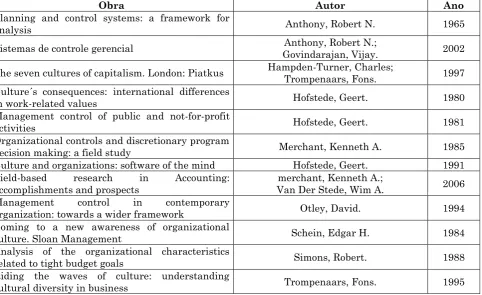
emphasized that the frequent concept in the articles refers to culture as "the collective programming of the mind that distinguishes the members of one group or category of people from another" Hofstede [8]. With the intention of observing the main works, it was verified all the references presented in the articles. All sample references of sixteen articles were copied to an Excel® table, whose total represents 490 citations. The most repeated ones were those that contained classic authors.
Table 5: Main cited works
Obra Autor Ano
Planning and control systems: a framework for
analysis Anthony, Robert N. 1965
Sistemas de controle gerencial Govindarajan, Vijay. Anthony, Robert N.; 2002
The seven cultures of capitalism. London: Piatkus Hampden-Turner, Charles; Trompenaars, Fons. 1997
Culture´s consequences: international differences
in work-related values Hofstede, Geert. 1980
Management control of public and not-for-profit
activities Hofstede, Geert. 1981
Organizational controls and discretionary program
decision making: a field study Merchant, Kenneth A. 1985
Culture and organizations: software of the mind Hofstede, Geert. 1991
Field-based research in Accounting:
accomplishments and prospects Van Der Stede, Wim A. merchant, Kenneth A.; 2006
Management control in contemporary
organization: towards a wider framework Otley, David. 1994
Coming to a new awareness of organizational
culture. Sloan Management Schein, Edgar H. 1984
Analysis of the organizational characteristics
related to tight budget goals Simons, Robert. 1988
Riding the waves of culture: understanding
The relationship between two consequences of budgetary controls: budgetary slack creation and
managerial short-term orientation Van Der Stede, Wim A. 2000
Another analysis related the proposals of the articles, which encompass the objective and conclusions. As to the question of research of the sixteen articles, only five presented the presented ones. Any research work begins by contextualizing the problem that is intended to find a solution or a response, so defining a problem is to communicate what is being worked on and what objectives of this work [19]. It was proposed to detect the impact of cultural differences in a planning and control system, so that a qualitative research was carried out in the Brazilian subsidiary of a British multinational.
The results show that some differences in aspects of the planning and control system, foreseen in Hofstede's theory as resulting from different levels of escape to uncertainty, could be observed in the analyzed company. Although the statements seem to confirm the great majority of theoretical propositions, the reasons why some of them have not been
shown may be linked to external
contingencies, other cultural dimensions, to cancel certain effects of the dimension under analysis, or to the influence of the organizational structure of culture [20].
He presented a discussion about the transformations of organizational control in contemporary organizations, their relation to culture, and their impact on the role of leadership. Thus, organizational control now
emphasizes the use of normative
mechanisms, placing great emphasis on culture and sharing a dominant worldview. Through the analysis of literature and empirical work, it has been verified that control has undergone an evolution in the last decades that made it prioritize more subtle forms, especially those whose mechanisms seek the dissemination and sharing of the same world view, of the same set of evidence [21].
The main aspects of the organizational culture of the companies surveyed were analyzed, considering the factors of planning,
budget, control and evaluation of
performance and management information system. The results of the research showed that the use of controllership tools has a close relationship with the management process, which incorporates a specific organizational
culture emanated by the institutional subsystem of the company, through its beliefs and values and its mission. Thus, it is important to parametrize the role of
controllability within companies, to
incorporate the characteristics of the organizational culture into their information system, as well as in the performance of the controller. The greater the adherence of the
company's cultural characteristics to
management instruments, the greater the possibility for the controlling company to fulfill its mission with the desired efficiency [22].
Management control systems were analyzed in two different companies, one of local scope and one of international scope, that have business units in the same city. The authors conclude that how companies use control tools, such as budgeting, is influenced by internal and external factors, and among these factors is the organizational culture. In addition, the results suggest that two units operating in the same segment and locality can use different management control systems, since the types of control adopted in the companies appear to be in agreement with the matrix culture [23].
It was described how the emphasis given to
the strengthening of the quality
organizational culture acted as a control
mechanism by a Military Service
Organization of the Brazilian Navy, from the adoption of the management contract. They concluded that the emphasis on developing an internal culture focused on excellence, where the adoption of several practices, research and quality, and a clear and effective process of information transmission, demonstrates the intention to build an environment in which there is a greater probability of occurrence of behaviors compatible with the desired [24].
knowledge of Brazilian cultural values and a strategy of input prepared and adapted to the local specificities, so that in the result of the process, culture is a success factor in accepting changes in the control system [25]. He presented a discussion of the human and cultural aspect in the management control system to offer models of managerial control.
The author concluded that there is a great
possibility to emphasize that the
understanding of managerial control
behavior in response to changes in organizational environments in relation to cultural aspects is a critical factor for the
implementation of corporate control,
administration and survival [26].
An analysis of the empirical studies that related the organizational culture and the process of budget planning and control, which sought to identify the variables of the organizational culture, the budget process and the research method, was carried out. They conclude that culture influences organizations through social structures, such as laws and political systems, and also through participants' values, attitudes, behaviors, goals, and preferences [27]. It was proposed to describe the impact of organizational culture on the use of management controls in metallurgical companies. Unlike the literature, it was identified that the cultural differences found did not influence the use of its managerial controls [28].
It was identified the characteristics of the national culture are considered in the design of control of the management of foreign companies, being understood as foreign company in which the control of shares belongs to a foreign shareholder. The results suggest that some aspects of Brazilian culture are preserved; however, there is a transfer of managerial practices developed in
countries of diverse cultures, which
consequently generate some conflicts in organizations [29].
The relationship between organizational culture and control practices in a publicly held company in the city of Londrina, state of Paraná, was analyzed. The organizational culture identified through the structures of beliefs and values that make up the characteristics of the company influences the company's practices of control and the current classifications of hierarchical culture
and ideals of the clan culture are visible, according to the model of Quinn and Cameron [30]. It was investigated how the cultural characteristics of Military Service Organizations (OMPS) approach or distance themselves from those required to adopt the variable cost method. It is concluded that there is a mismatch between the values implicit in the proposed model for the
transformation of Brazilian public
administration and the values that permeate the organizational culture of the OMPS, where concepts and bureaucratic instruments still remain being used because they are appropriate to the hierarchy and discipline of military organizations, as opposed to new managerial mechanisms, forged on the basis of the assumptions of the administration [31].
The development of barriers imposed by the organizational culture in the implementation of the Balanced Scorecards (BSC), through the study in a large food industry, was explored. As a result, the main cultural barrier identified was the failure of the knowledge transfer process [32]. Internal control strengthened by organizational culture was examined as a competitive small
business strategy in the globalized
environment. Small businesses should foster an organizational culture, with a focus on
adopting values that contribute to
compliance and internal control standards, as an essential part of achieving the corporate goals and ethical principles that an organization wants to design both within and with the environment [33].
The relationship between organizational culture and the budgeting practices of an organization is evaluated. It was verified that the agroindustry organizational culture provides strong indications of positively influencing the existence of rigid control related to the budget in this company, which was reinforced with the evidence highlighted in the interview [34]. The effect of the organization on the NYSE was analyzed.
These effects differ between the origin of the undertakings and between the type of legal system of the countries of origin of the companies [35]. It was observed the type of approach used, which showed that two articles (13%) have a quantitative approach, while the other ones (87%) are qualitative. In this same approach, it was observed that ten articles did a case study, three brought the
bibliographic research and three carried out research survey. The studies were divided into case studies (37%), interviews (25%), literature review (19%) and questionnaires (19%). As to the suggestions for future research presented in Table 6, only eight presented them, this item is important due to the research gaps of the work and the continuation of them.
Table 6: Suggestions for future research
Research Suggestions for future research
Silva (1999)
They suggest some concerns, which should be addressed in new research, namely: (i) the role played by new information technologies and technologies enabling virtual surveillance; ii) adherence to the practices and values professed by the organizations; and iii) an investigation into the institutional aspects that underpin the new organizational control settings.
Heinzmann e Lavarda (2011)
They propose to develop a research that seeks to deepen the studies on the influence of culture in the practices of budgetary control, in order to understand how the processes and the practices of the budget differ due to differences of norms shared between the individuals of a group.
Silva e Gomes (2011)
It recommends an expansion for other foreign capital companies, belonging to the other dimensions of Hofstede, using a similar methodology, so that it is possible to generate comparisons between them. Likewise, it is suggested the extension of the research in Brazilian companies, which will allow to verify if and to what extent the transfer of management practices that contemplate cultural values different from the Brazilian culture.
Tarifa, Crozatti, Espejo e Almeida
(2011)
They suggest the continuity of the research, based on their work, of specific qualitative and quantitative analyzes directed to each department that compose the company's control, as well as the collection of information distributed by other sectors related to the company, due to its representativeness in the company. National and international market.
Pereira e Terra
(2016) They understand that there are opportunities to develop new research that understands other barriers that culture creates in the implementation of BSC. Wrubel, Marassi,
Lavarda e Lavarda (2016)
They suggest that future researches may extend the case studies to other companies, as well as to study the same relation from other theoretical approaches indicated in the review of the literature.
Most polls suggest a continuation of the same or a replication in a different environment. With the exception of Silva (1999) who at the end of his study presents some concerns that were not addressed in his research. Finally, in May 2019, the quotations were collected by Postal Spell and Google academic. Canan and Fonseca (2006), "Organizational culture: analysis and impacts of the instruments in the management process" (Padoveze & Benedicto, 2006), with seven and six citations by Spell, respectively and 72 and 36 citations by Google Scholar. The others were either not mentioned or few were mentioned.
Final Considerations
The study aimed to investigate the profile of the scientific production on managerial control and organizational culture in the national periodicals of the Spell database, available until May 2019. Thus, a bibliometric study was carried out. The research data presented here allowed
demonstrating what is researched in relation to the terms of managerial and cultural controls in the organizations. Although they are traditional subjects, it is verified that they are few explored. An influence of culture is observed in the managerial field of the organizations, it has a high research scope and it must be approached in more depth. In general, it can be observed that the theme is of great importance for organizations, and some research, because a well-defined organizational culture directly impacts on the positive outcome of the organization.
values are the structure and basis for organizations, as well as managerial control, which is the set of activities developed to ensure that management plans are reached and necessary for their development, so the relationship between the themes suggests new studies. Literature and comparison are indispensable, because gaps exist in all researches, and they are indispensable for the continuity, still, quantitative researches are necessary. Thus, it is suggested that future research encompass the tools of
managerial control and non-financial
controls, in order to identify the influence of the culture in these controls. It is also suggested that research be replicated in other sectors in order to evaluate other environments or other situations. Finally, it is possible to go beyond management and analyze all the departments of the organization and add more variables to the study, such as the influence of culture in management control systems, internal control, budget practices, and other variables behavioral, focusing on the individual, his motivation, perception of justice and others.
References
1. Otley D (1999) Performance management:
a framework for management control systems research. Management accounting research, 10(4):363-382.
2. Anthony RN (1965) Planning and Control
Systems: A Framework for Analysis [by]. Division of Research, Graduate School of
Business Administration, Harvard
University,
3. Anthony RN, Govindarajan V
(2002) Sistemas de controle gerencial. São Paulo: Altas.
4. Schein EH (1990) what is
culture. Newbury Park, CA: Sage
Publicatios, 243-253.
5. Barney JB (1986) Organizational culture:
can it be a source of sustained competitive advantage? Academy of management review, 11(3):656-665.
6. Trompenaars F, Hampden-Turner C
(1994) The seven cultures of capitalism: Value systems for creating wealth in the United States, Britain, Japan, Germany,
France, Sweden, and the
Netherlands. London: Piatkus, 12.
7. Schäffer U, Strauss E, Zecher C (2015) the
role of management control systems in situations of institutional complexity. Qualitative Research in Accounting & Management, 12(4):395-424.
8. Hofstede G (1980) Culture and
organizations. International Studies of Management & Organization, 10(4):15-41.
9. Goebel S, Weißenberger BE (2017) Effects
of management control mechanisms:
Towards a more comprehensive
analysis. Journal of Business
Economics, 87(2):185-219.
10.Flamholtz EG, Das TK., Tsui AS (1985)
Toward an integrative framework of
organizational control. Accounting,
organizations and society, 10(1):35-50.
11.Merchant KA, Van der Stede WA
(2007) Management control systems:
performance measurement, evaluation and incentives. Pearson Education.
12.Lyrio MVL, Borba JA, Costa JMD (2007)
Controle gerencial: delineamento do perfil metodológico de uma amostragem de publicações acadêmicas nas áreas de administração e contabilidade de 2000 a
2004. Revista de Administração e
Contabilidade da
Unisinos-BASE, 4(2):126-136.
13.Jaques E (1952) The changing culture of a
factory.
14.Schein EH (1984) Coming to a new
awareness of organizational culture. Sloan management review, 25(2):3-16.
15.Flamholtz EG, Randle Y (2012) Corporate
culture, business models, competitive advantage, strategic assets and the bottom
line: Theoretical and measurement
issues. Journal of Human Resource
Costing & Accounting, 16(2):76-94.
16.Marciarello JA, Kirby CJ (1994)
Management Control System, Using Adaptive systems to Attain Control. Engelwood Cliffs.
17.Merchant KA (1998) Modern management
control systems: text and cases. Prentice Hall.
18.Govindarajan V (1988) a contingency
approach to strategy implementation at
the business-unit level: integrating
strategy. Academy of management Journal, 31(4):828-853.
19.Slomski VG, Pinheiro ICB, Megliorini E,
Ferreira TARC (2013) A importância da formulação da questão de pesquisa na produção científica em contabilidade: uma discussão a partir de trabalhos publicados no Congresso Brasileiro de Custos no ano de 2009. In Anais do Congresso Brasileiro de Custos-ABC.
20.Fonseca ACPD (1999) Percepções de
incerteza em um sistema de planejamento e controle: um estudo comparativo
Brasil-Inglaterra. Revista de Administração
Contemporânea, 3(3): 57-80.
21.Silva RC (2003) Controle organizacioanal,
cultura e liderança: evolução,
transformações, e perspectivas. Revista de Administração Pública, 37(4):797-816.
22.Padoveze CL, Benedicto GC (2005)
Cultura organizacional: análise e impactos
dos instrumentos no processo de
gestão. REAd-Revista Eletrônica de
Administração, 11(2).
23.I Canan, ACPD Fonseca, AC(2006)
Sistemas de controle gerencial: estudo de
caso nas empresas Bunge e
Amaggi. Revista Capital
Científico-Eletrônica (RCCҽ)-ISSN
2177-4153, 4(1):89-110.
24.Soares SA, Fonseca ACPD (2007) A
Cultura Organizacional como Mecanismo de Controle: o caso da adoção do contrato
de gestão na Marinha do
Brasil. Contabilidade Vista &
Revista, 18(3).
25.Silva RNS, Gassenferth W, da Silva F
(2009) O Impacto da Cultura sobre o Sistema de Controle Gerencial: uma análise de empresas brasileiras adquiridas
por capital estrangeiro. Contabilidade
Vista & Revista, 19(2):35-60.
26.Machado A (2010) Aspecto humano e
cultural no controle de gestão. Pensar Contábil, 12(48).
27.Heinzmann LM, Facin Lavarda CE (2011)
Cultura organizacional e o processo de
planejamento e controle
orçamentário. Revista de Contabilidade e Organizações, 5(13).
28.Klann RC, Machado DDPN (2011) Impacto
da cultura organizacional no uso dos
controles gerenciais de empresas
metalúrgicas. Revista de Contabilidade e Organizações, 5(12).
29.Silva AFS, Gomes JS (2011) Consideração
do Elemento Cultural no Desenho de Sistemas de Controle de Gestão das
Empresas Estrangeiras: Estudo de
Casos. Contabilidade Vista &
Revista, 22(1):143-176.
30.Tarifa MR, Crozatti JC, Espejo MMDSB,
de Almenida LB (2011) A Cultura organizacional influencia as práticas de controladoria? Um estudo de campo
baseado no competing value
model. Revista Ciências Administrativas
ou Journal of Administrative
Sciences, 17(2).
31.Santos MDFB, da Fonseca ACPD,
Sauerbronn FF (2014) Cultura
organizacional e avanço do management na Marinha do Brasil. Cadernos EBAPE. BR, 12(1):131-162.
32.Pereira DD, Terra LAA (2016) Barreiras
Impostas pela Cultura na Implantação de Balanced Scorecard em uma Indústria de
Alimentos. Revista Eletrônica de
Estratégia & Negócios, 9(1):3-25.
33.Vargas-Hernández JG, Cardenaz RC,
Calderón Campos P (2016) Internal control and organizational culture in small
businesses: A conjunction to
competitiveness. Revista Reuna, 21(2):05-22.
34.Wrubel F, Marassi RB, Lavarda CEF,
Lavarda RAB (2016) Cultura
Organizacional nas Práticas
Orçamentárias: Estudo em uma
Cooperativa Agroindustrial. Sociedade,
Contabilidade e Gestão, 11(3).
35.Parente PHN, De Luca MMM, De Lima
GASF, De Vasconcelos AC (2018) Cultura
organizacional e desempenho nas
empresas estrangeiras listadas na
NYSE. Revista de Contabilidade e