International Journal of Advances in Management and Economics
Available online at:
www.managementjournal.info
RESEARCH ARTICLE
Determinant of Organizational Success in Industrial Revolution
4.0: The Role of Change’s Driver in Islamic Perspective
Zainur Rahman
*Faculty of Economics, Universitas Negeri Surabaya, Indonesia.
*Corresponding Author: Email: [email protected]
Abstract: Industrial Revolution 4.0 presents its own challenges for organizations, so members of organization have to prepare them self to achieve organizational success. This study uses a qualitative approach with content analysis to analyze the literature. Islamic perspective, the drivers of change must fulfill the dimensions of spiritual needs because the essence of human beings is everything that belongs to God, second, personal dimensions in the form of skills and competencies. The last is the environmental dimension in the form of leadership and cultural factors within the organization.
Keywords:Change’s Driver, Industrial Revolution 4.0, Islamic Perspective, Organizational Success.
Article Received: 10 Feb. 2019 Revised: 20 Feb. 2019 Accepted: 27 Feb. 2019
Introduction
The history of organizational change continues to run dynamically, before the 1970s, leaders did not give massive attention to the external environment, such as competitors and customers. At the end of the 1970s the scope of change had begun to swell, because leaders had begun to focus on organizational improvement (organizational imperatives). In the 1990s, the run to customer relationship management, LEAN, connectivity through the WEB, etc.
In the mid-1990s, change had begun to focus on conditions or external factors. Nowadays, Industrial revolution 4.0 where change is unavoidable both in the realm of business
because change occurs quickly and
unpredictably. Unexpected impacts on an organization are failure and decreased organizational performance. This condition give signals that the organization needs a change. Lavanya et al. [1] stated that technological progress has tremendous potential in changing the way we live and work.
The essential factor is to achieve success, namely the effectiveness of the work system that is reflected in human resources in the organization [2]. Motives or factors that influence change can be divided into two parts, namely: external and impersonal
(environment, market place, organizations) and internal and personal (culture and mindset) [3]. Both of these factors cannot be separated because in order to achieve the expected change, dialectic is needed between them. Dialectics will have an impact on achieving trans formational change that directs organizations to achieve a sustainable and dynamic change process.
In the Islamic perspective an organizational success is not only driven by mere human needs, but rather towards the spiritual need. As explained by Sulaiman [2] stated that the main idea of an organization's success and blessing of God in the hhereafter is based on sharia. Sharia become the way of life both in society and working condition. In Islam, the importance of collective cooperation is based on Sharia to achieve organizational success [4].
Literature Review
Industrial Revolution 4.0
Characteristics of industrial revolution 4.0 are increased competitiveness through smart equipment, massive information utilization, demographic change, resources, energy efficiency, and urban production [5]. Industry 4.0 shows a significant change by utilizing latest information technology to make all industries more connected. Rublek, Mesko, & Krapez [6] states that industrial revolution 4.0 is a conceptual state related to highly
dynamic technology involving various
industries (IT, mobility, energy providers, construction, medicine, textiles, etc.).
Industry 4.0 is based on an integrated business approach, manufacturing process, and integration of all actors in the company's value chain [7]. Almada-Lobo [8] argues that Industry 4.0 has an important influence in industrial information because it represents progress on the following three points.
Digitizing, production includes information systems for management and production planning.
Automation, a system for comprehensive use of data.
Connecting, manufacturing sites in a comprehensive supply.
Iindustry 4.0 creates smart factories that are structurally modular, monitors physical processes, maps the physical world in the virtual world, and decentralizes operational decision making [9]. Iindustry 4.0 shows a direction of shifting the industrial world which was initially dominated by the
approach to physically switching to virtual. The sign of this change certainly leads to system changes in the organization, especially on the employee side.
Change’s Drivers to Reach Organizational Success
Islamic Perspective
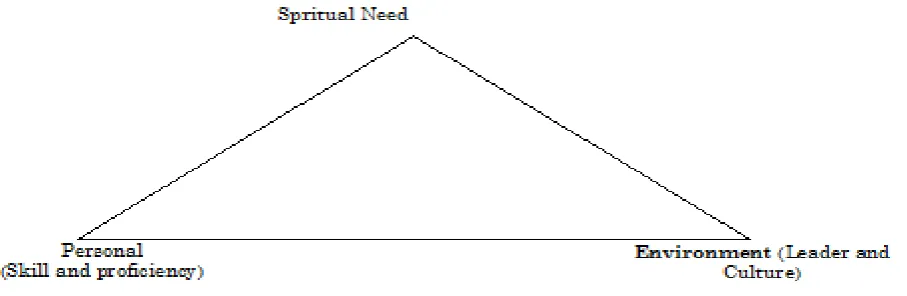
In Islam advice drivers of change are based on three aspects, namely spiritual needs, personal (skills, competencies and skills), environment (leader). Islamic scholars state that the main drivers of change are to fulfill spiritual needs [10]. Spiritual needs are shown by the basic core of Islamic community in carrying out all their activities both in relation to the social sphere and within the
organization. In addition, Islam emphasizes
the importance of the skills or competencies possessed by employees. So, in Islam we are required to continue to learn and improve ourselves that we can do everything to the fullest.
Alhabshi et al. [11] state that the ability to do things to the fullest exceeds a predetermined before. External factors that are considered to have a strong enough role, namely leaders because leaders are a reflection of an organization. Leaders are role models and their behavior is reflected in the culture and procedures of the organization [12].
The leadership model in Islam must refer to the main foothold of the Qur'an and hadith, where Abbasi et al. [13] state that leadership in Islam must refer to the principles of humility, responsibility and accountability. Three dimension of change’s driver in Islamic perspective as figure follow.
Figure 1: Change’s Driver in Islamic Perspective
Ather & Sobhani [14] asserted that
Islamic Sharia, and delegated trust. Leadership in Islam will never be separated
from sharia principles and humanitarian
principles. This balance shows that the concept of Islamic leadership is holistic. Western Perspective
The driver of change is a dynamic phase sequence and divides it into seven categories. They are divided into two main categories,
namely four categories classified as
traditional and three modern components, seven dynamic model in the organization [3]. Environment
Which is a dynamic movement that occurs in a broader context in organizations and operations people? Including: social, business and economy, government, technology, demography, natural environment, etc.
Marketplace Requirement for Success Is a set of tools required by customers that determine policies in achieving business success to bring and meet customer needs.
This fact is driven by changes in the environment and society, because the change will certainly have an impact on changes in consumption and customer demand, so the company must be able to answer these changes in order to exist and be able to retain customers.
Business Imperative
Is related to actions that must be carried out by companies as strategic to achieve success. Modern business systems are manifested in systematic thinking, such as: changes in mission, strategy, goals, business models, products, services, and branding.
Organizational Imperative
Is related to changes that occur in organizations, such as structures, systems, processes, technology, etc. to implement and achieve a strategic business system.
Culture Imperatives
Is a norm, a collection of ways or way of life for organizations to encourage and shape new organizational designs, operating systems, and organizational strategies. This is found in the work culture of the team that is built in the company to support the renewal of business processes, strategies, and improve customer response.
Leader and Employee Behavior
Which is related to changes in leaders and followers that can reflect organizational culture, because behavior is a different thing compared to over action? The alignment of behavior between leaders and followers will form organizational culture to implement new organizational designs.
Leader and Employee Mindset
Is a point of view, assumptions, beliefs, and mental models that make people believe in behavior and culture. The change’s mindset
between leaders and followers are
fundamental because a change will be achieved because it begins with a change in mindset. Changes in systems, technology, and initial strategies are built because of changes in the mindset of all elements of organization. The formation of change’s drivers models that can be observed from various perspectives, such as: 1).
Helping each individual to understand the scope of changes required and to broaden the views related to external dimensions; 2). As a tool that can help define the type of
organizational change that must be
undertaken; 3). Defines cases or reasons for changes required, and; 4). As a provider of a framework for communicating results, coverage, and changes to stakeholders.
Research Method
This study uses a qualitative approach by using descriptive techniques. Ryan & Bernard [15] states that qualitative descriptive research using the content analysis technique is used to analyze words with many categories. Various references were collected and then analyzed based on the topics of studied. Rresearch steps by using literature review, first, studying and collecting data, phrases, and sentences in the literature source. Second, describe data that has been collected using structured sentences [16].
Discussions
the Qur'an. Surely Allah will not change the state of a people before they change their own circumstances." (QS.Ar-Ra'd: 11) [17].
Organizational change certainly will never happen if there is no intention to change. Anderson & Anderson [3] Leader and employee mindset are fundamental in making a change. This is also supported by the results of research by Herscovith & Meyer [18], stating that commitment to change is a mental attitude that must be possessed by every individual in an organization. Commitment will affect behave based on their mindset. Commitment to change is a mindset that can bring each individual to act in achieving actual success from initiatives to change [18].
The spiritual needs emphasize the mindset to change must be based on the principle of seeking the pleasure of Allah because without this it will be difficult to achieve a change. As in the Qur’an follows. And those who strive for (seeking pleasure) Us, We will show them our ways. And really, God is with those who do good. "(QS.al-Ankabut: 69) [17]. In the verse it has been shown that if humans have had the mindset that their actions are in order to seek the pleasure of Allah, all their activities will be given instructions for success.
In the Industry 4.0 this principle is important because the changes that occur are so fast and unpredictable, if they are not balanced with the principle of seeking Mercy from Allah and commitment will be difficult
to achieve organizational success.
Commitment to change is a mindset that needs to be built by each individual.
Actually, the three commitment models as source of inner power. Without the power of the mindset, a change will become an expectation, without implementation. Based on the context, this study also examined the effect of three models of commitment to change the behavior of each individual. Herscovith & Meyer [18] states that with the commitment to change will be guide the individual to act, so that the actions taken repeatedly will create behavior.
The component of the commitment model to change is also built by the correlation of multifocal or purpose work relationships.
Each individual has their own multifocals in each organization. Tend to be focused or fit each individual will later reflect the commitment to change. This study show that commitment to change is also influenced by each individual's focus. Experience based on internal strength will make individuals more committed, vibrant, and organized [19]. Abbasi et al. [13] state that skills are qualities that possessed by individuals who have extensive meaning. Islam has taught that it is important to have skill because without skills it will be difficult to achieve success.
Therefore, organizational members need to have special skills in dealing with industry 4.0; the demands of these skills include various aspects, technical, conceptual, and even interactional relationships within the organization. The Qur'an also mentions the following. As for those who believe and do good works, their Lord will put them in His mercy. That is a real victory. "(Surat al-Jatsiah, 45:30) [17].
Islam guides people to pursue things well and professionally because Islam expressly states that the impact will get victory. The Hadith also stated From Aisha r.a., actually Rasulullah s. a. w. said: "Indeed Allah loves someone who when working, does it professionally". (HR. Thabrani, No: 891, Baihaqi, No: 334) [20]. The proficiency shown by members of the organization has a positive impact, both personally and for the organization. Members of the organization that show significant proficiency will improve organizational performance [13].
Therefore, it is important for a leader to be an example in the organization, as in the Qur'an. Surely there is in (the) Messenger of Allah a good example for you (that is) for those who wish (the mercy) of Allah and (the coming of) the Day of Judgment and he calls Allah a lot (QS: Al-Ahdab: 21) [17]. Islam has suggested the importance of leaders to set an example.
Leaders in organizations must be able to observe the commitment to change in each individual, because the success of the process of directing individuals also manifests because of the interpersonal relationship between the leader and the individual. Jamil [22] states that leaders must be able to compete with a group of individuals to complete certain missions and arrange followers for management success. Achieving organizational success in Industry 4.0 will never be separated from the role of a leader because leaders must be able to manage individuals with love.
Furst & Cable [23] research divides managerial tactics in two parts, namely, hard tactics and soft tactics. 1). Hard tactics consists of two components, namely sanction, the manager gives a warning and will give punishment for those who violate and give rewards for awareness and negligence;
legitimization, managers explain that
changes remain consistent with
organizational policies. 2).
Soft tactics consists of two components, namely ingratiation, managers reward and boast of every effort made by members of the organization; consultation, manager asks and gives advice to individual members of the organization to achieve change.
In Islam, prefer to soft approach, as in the Qur'an. Therefore it is from Allah's mercy that you are gentle with them. If you are hard again, rough-hearted, they will certainly distance themselves from your surroundings. Therefore forgive them, ask forgiveness for them, and deliberate with them in that matter. Then if you have made a determination, then put your trust in Allah. Surely Allah likes those who put their trust in Him (QS: Ali Imran: 159) [17].
Leadership in Islam adopts a humanist approach by inviting all members of the organization to be involved in achieving
organizational success. The Quran has stated that leaders must take a persuasive approach to make them doing change. In the era of Industry 4.0 a persuasive approach is needed because competition is getting tougher if
there is no humanist approach,
organizational members can show declining performance even out of the organization. Followers have emotional attitudes to leaders as well as leaders have an emotional impact on followers [22].
Interpersonal relations between leaders and followers are implemented massively and comprehensively because of the strength of the relationship between the two parties. The results of study by Furst & Cable [23] show that managerial tactics related to hard tactics will be associated more strongly with resistance or resistance to change when the quality of LMX relationships is low. This fact shows that managerial techniques on hard tactics will make individual resistance to change stronger, because the existence of punish will not be able to change employee’s resistance.
On the other hand, when the LMX is high, the use of predetermined punish will not
make individual resistance higher. Leaders
need to direct followers to achieve the vision and goals of the organization, besides that commitment to change cannot be avoided so that the organization still exists and can achieve its goals. Moten [24] states that leaders in Islamic perspective have vertical responsibility to God and horizontal responsibility to fellow beings for all their actions.
Thus, leaders must be able to build good relationships and positive interactions with followers. Without such a relationship it will be difficult for managers to achieve
organizational goals. The increasingly
stringent challenges in Industry 4.0 must be able to be faced with optimism with the role of a leader who is able to take a humanist approach.
Conclusion
competence so that organizational members can work professionally in accordance with the requirements. Besides that, there needs to be an environmental push manifested by the role of a leader.
In Islam, Industry 4.0 is part of a change in the business environment that must be faced because change cannot be avoided with the main goal being organizational success. The
limitation of this article is that it only sees Industry 4.0 from an internal organization perspective and Islamic perspective.
The hope for further research needs to add to the demands of the market and technology so that the results of the research will be more comprehensive. As stated by Nagy et al. [9] that Industry 4.0 cannot be separated from technology and markets.
References
1. Lavanya B, Shylaja BS, Santhosh MS (2017)
Industry 4.0 – The Fourth Industrial Revolution. International Journal of Science, Engineering and Technology Research, 6(6):2278 -7798.
2. Sulaiman M, Khaliq A, Baraa S, Naail MK
(2014).The Perspective Of Muslim Employees Towards Motivation And Career Success. Journal of Social Sciences and Humanities, 9(1):045-062.
3. Anderson D, Anderson LA (2010) Beyond Change
Management: How to Achieve Breakthrough Results through Conscious Change Leadership. San Francisco: Pfeiffer.
4. Mohiuddin MG, Gaffar OY, Afroza B (2013)
Organizing: An Islamic Perspective. Global Disclosure of Economics and Business, 2(2):60-72.
5. Heck S, Rogers M (2014) Are You Ready for the
Resource Revolution? McKinsey Quarterly, 2:32-45.
6. Roblek V, Maja M, Alojz K (2016) A Complex View
of Industry 4.0 SAGE Open. 1-11.
7. Rojko A. 2017. Industry 4.0 Concept: Background
and Overview. IJIM, 11(5).
8. Almada-Lobo F (2016) The Industry 4.0 revolution
and the future of manufacturing execution systems (MES). Journal of Innovation Management, 3:16-21.
9. Nagy J, Judit O, Edina E, Domicián M, József P
(2018) the Role and Impact of Industry 4.0 and the Internet of Things on the Business Strategy of the Value Chain—the Case of Hungary. Sustainability, 10, doi:10.3390/su10103491
10. Rahman M, Al-Buraey M (1992) An Islamic
perspective of organizational controls and
performance evaluation. The American Journal of Islamic Social Sciences, 9(4):499-514.
11. Alhabshi SO, Ghazali AH (1994) Islamic Values and
Management, Institute of Islamic Understanding Malaysia (IKMI).
12. Jabnoun N (1994) Islam and Management, Institute
Kajian Dasar (IKD).
13. Abbasi AS, Kashif UR, Amna B (2010) Islamic
Management Model. African Journal of Business Management, 4(9):1873-1882.
14. Ather SM, Sobhani FA (2007) Managerial
Leadership: An Islamic Perspective. IIUC Studies, 4:7-24.
15. Ryan GW, Bernard HR (2010) Handbook of
Qualitative Research: Second Edition. London: Sage Pblivation Inc.
16. Mason J (2002) Qualitative Researching: Second
Edition. London: Sage Publication Ltd.
17. Al Qur’an Alkareem.
18. Herscovith L, Meyer J (2002) Commitment to
Organizational Change: Extension of a Three-Component Model. Journal of Applied Psychology, 87(3):474-487.
19. Thomas, KW, Velthouse BA (1990) Cognitive
Elements of Empowerment: An" Interpretive" Model of Intrinsic Task Motivation. Academy of management review, 15(4):666-681.
20. Al-Hadith, Bukhari & Muslim Sharif.
21. Rafiki A, Khalid MA, Imam B (2014) Islamic
Human Capital and Firm Performance: An Evidence of Small and Medium Enterprises in Bahrain. International Journal of Business and Management, 9(4).
22. Jamil MY (2015) Islamic Perspective of Leadership:
A Role Model for Today’s CEOs. Journal of Islamic Thought and Civilization, 5(2).
23. Furst SA, Cable DM (2008) Employee Resistence to
Organizational Change: Managerial Influence Tactics and Leader-Member Exchange. Journal of Applied Psychology, 93(2):453-462.
24. Moten AR (2011) Leadership in the West and the