DATA SHEET
Product specification
Supersedes data of 2002 May 16
2003 Oct 22
TJA1050
FEATURES
• Fully compatible with the“ISO 11898” standard • High speed (up to 1 Mbaud)
• Very low ElectroMagnetic Emission (EME)
• Differential receiver with wide common-mode range for high ElectroMagnetic Immunity (EMI)
• An unpowered node does not disturb the bus lines • Transmit Data (TXD) dominant time-out function • Silent mode in which the transmitter is disabled • Bus pins protected against transients in an automotive
environment
• Input levels compatible with 3.3 V and 5 V devices • Thermally protected
• Short-circuit proof to battery and to ground • At least 110 nodes can be connected.
GENERAL DESCRIPTION
The TJA1050 is the interface between the Controller Area Network (CAN) protocol controller and the physical bus. The device provides differential transmit capability to the bus and differential receive capability to the CAN controller.
The TJA1050 is the third Philips high-speed CAN transceiver after the PCA82C250 and the PCA82C251. The most important differences are:
• Much lower electromagnetic emission due to optimal matching of the output signals CANH and CANL • Improved behaviour in case of an unpowered node • No standby mode.
This makes the TJA1050 eminently suitable for use in nodes that are in a power-down situation in partially powered networks.
QUICK REFERENCE DATA
ORDERING INFORMATION
SYMBOL PARAMETER CONDITIONS MIN. MAX. UNIT
VCC supply voltage 4.75 5.25 V
VCANH DC voltage at pin CANH 0 < VCC< 5.25 V; no time limit −27 +40 V
VCANL DC voltage at pin CANL 0 < VCC< 5.25 V; no time limit −27 +40 V
Vi(dif)(bus) differential bus input voltage dominant 1.5 3 V
tPD(TXD-RXD) propagation delay TXD to RXD VS= 0 V; see Fig.7 − 250 ns
Tvj virtual junction temperature −40 +150 °C
TYPE NUMBER
PACKAGE
NAME DESCRIPTION VERSION
TJA1050T SO8 plastic small outline package; 8 leads; body width 3.9 mm SOT96-1
BLOCK DIAGRAM
handbook, full pagewidth
30 µA 200 µA MGS374 TXD DOMINANT TIME-OUT TIMER 1 8 3 RECEIVER 4 REFERENCE VOLTAGE 5 DRIVER TEMPERATURE PROTECTION 2 7 6 VCC VCC VCC CANH CANL GND GND GND GND Vref RXD S TXD TJA1050 25 kΩ 25 kΩ 0.5VCC
Fig.1 Block diagram.
PINNING
SYMBOL PIN DESCRIPTION
TXD 1 transmit data input; reads in data from the CAN controller to the bus line drivers
GND 2 ground
VCC 3 supply voltage
RXD 4 receive data output; reads out data from the bus lines to the CAN controller
Vref 5 reference voltage output
CANL 6 LOW-level CAN bus line
CANH 7 HIGH-level CAN bus line
S 8 select input for high-speed mode
or silent mode handbook, halfpage 1 2 3 4 8 7 6 5 MGS375 TJA1050T S CANH GND CANL Vref RXD VCC TXD
FUNCTIONAL DESCRIPTION
The TJA1050 is the interface between the CAN protocol controller and the physical bus. It is primarily intended for high-speed automotive applications using baud rates from 60 kbaud up to 1 Mbaud. It provides differential transmit capability to the bus and differential receiver capability to the CAN protocol controller. It is fully compatible to the “ISO 11898” standard.
A current-limiting circuit protects the transmitter output stage from damage caused by accidental short-circuit to either positive or negative supply voltage, although power dissipation increases during this fault condition.
A thermal protection circuit protects the IC from damage by switching off the transmitter if the junction temperature exceeds a value of approximately 165°C. Because the transmitter dissipates most of the power, the power dissipation and temperature of the IC is reduced. All other IC functions continue to operate. The transmitter off-state resets when pin TXD goes HIGH. The thermal protection circuit is particularly needed when a bus line short-circuits. The pins CANH and CANL are protected from automotive electrical transients (according to“ISO 7637”; see Fig.4).
Control pin S allows two operating modes to be selected: high-speed mode or silent mode.
The high-speed mode is the normal operating mode and is selected by connecting pin S to ground. It is the default mode if pin S is not connected. However, to ensure EMI performance in applications using only the high-speed mode, it is recommended that pin S is connected to ground.
In the silent mode, the transmitter is disabled. All other IC functions continue to operate. The silent mode is selected by connecting pin S to VCC and can be used to
prevent network communication from being blocked, due to a CAN controller which is out of control.
A ‘TXD dominant time-out’ timer circuit prevents the bus lines being driven to a permanent dominant state (blocking all network communication) if pin TXD is forced
permanently LOW by a hardware and/or software application failure. The timer is triggered by a negative edge on pin TXD. If the duration of the LOW-level on pin TXD exceeds the internal timer value, the transmitter is disabled, driving the bus into a recessive state. The timer is reset by a positive edge on pin TXD.
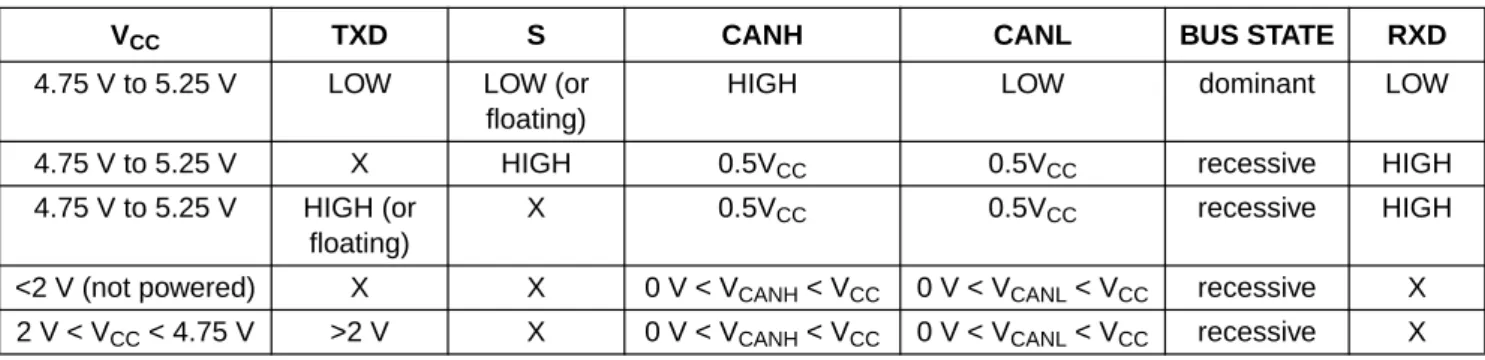
Table 1 Function table of the CAN transceiver; X = don’t care
VCC TXD S CANH CANL BUS STATE RXD
4.75 V to 5.25 V LOW LOW (or
floating)
HIGH LOW dominant LOW
4.75 V to 5.25 V X HIGH 0.5VCC 0.5VCC recessive HIGH
4.75 V to 5.25 V HIGH (or floating)
X 0.5VCC 0.5VCC recessive HIGH
<2 V (not powered) X X 0 V < VCANH< VCC 0 V < VCANL< VCC recessive X 2 V < VCC< 4.75 V >2 V X 0 V < VCANH< VCC 0 V < VCANL< VCC recessive X
LIMITING VALUES
In accordance with the Absolute Maximum Rating System (IEC 60134). All voltages are referenced to GND (pin 2). Positive currents flow into the IC.
Notes
1. The waveforms of the applied transients shall be in accordance with“ISO 7637 part 1”, test pulses 1, 2, 3a and 3b (see Fig.4).
2. Human body model: C = 100 pF and R = 1.5 kΩ. 3. Machine model: C = 200 pF, R = 10Ω and L = 0.75µH.
4. In accordance with“IEC 60747-1”. An alternative definition of Tvjis: Tvj= Tamb+ P×Rth(vj-a), where Rth(vj-a)is a fixed
value to be used for the calculation of Tvj. The rating for Tvjlimits the allowable combinations of power dissipation (P)
and ambient temperature (Tamb).
THERMAL CHARACTERISTICS According to IEC 60747-1.
QUALITY SPECIFICATION
Quality specification“SNW-FQ-611 part D” is applicable.
SYMBOL PARAMETER CONDITIONS MIN. MAX. UNIT
VCC supply voltage −0.3 +6 V
VCANH DC voltage at pin CANH 0 < VCC< 5.25 V;
no time limit
−27 +40 V
VCANL DC voltage at pin CANL 0 < VCC< 5.25 V;
no time limit
−27 +40 V
VTXD DC voltage at pin TXD −0.3 VCC+ 0.3 V
VRXD DC voltage at pin RXD −0.3 VCC+ 0.3 V
Vref DC voltage at pin Vref −0.3 VCC+ 0.3 V
VS DC voltage at pin S −0.3 VCC+ 0.3 V
Vtrt(CANH) transient voltage at pin CANH note 1 −200 +200 V
Vtrt(CANL) transient voltage at pin CANL note 1 −200 +200 V
Vesd electrostatic discharge voltage at all pins note 2 −4000 +4000 V
note 3 −200 +200 V
Tstg storage temperature −55 +150 °C
Tvj virtual junction temperature note 4 −40 +150 °C
SYMBOL PARAMETER CONDITIONS VALUE UNIT
Rth(vj-a) thermal resistance from junction to ambient in SO8 package
in free air 145 K/W
Rth(vj-s) thermal resistance from junction to
substrate of bare die
CHARACTERISTICS
VCC= 4.75 V to 5.25 V; Tvj=−40°C to +150°C; RL= 60Ω unless specified otherwise; all voltages are referenced to
GND (pin 2); positive currents flow into the IC; see notes 1 and 2.
SYMBOL PARAMETER CONDITIONS MIN. TYP. MAX. UNIT
Supply (pin VCC)
ICC supply current dominant; VTXD= 0 V 25 50 75 mA
recessive; VTXD= VCC 2.5 5 10 mA
Transmitter data input (pin TXD)
VIH HIGH-level input voltage output recessive 2.0 − VCC+ 0.3 V
VIL LOW-level input voltage output dominant −0.3 − +0.8 V
IIH HIGH-level input current VTXD= VCC −5 0 +5 µA
IIL LOW-level input current VTXD= 0 V −100 −200 −300 µA
Ci input capacitance not tested − 5 10 pF
Mode select input (pin S)
VIH HIGH-level input voltage silent mode 2.0 − VCC+ 0.3 V
VIL LOW-level input voltage high-speed mode −0.3 − +0.8 V
IIH HIGH-level input current VS= 2 V 20 30 50 µA
IIL LOW-level input current VS= 0.8 V 15 30 45 µA
Receiver data output (pin RXD)
IOH HIGH-level output current VRXD= 0.7VCC −2 −6 −15 mA
IOL LOW-level output current VRXD= 0.45 V 2 8.5 20 mA
Reference voltage output (pin Vref)
Vref reference output voltage −50µA < IVref< +50µA 0.45VCC 0.5VCC 0.55VCC V
Bus lines (pins CANH and CANL) Vo(reces)(CANH) recessive bus voltage at
pin CANH
VTXD= VCC; no load 2.0 2.5 3.0 V
Vo(reces)(CANL) recessive bus voltage at
pin CANL
VTXD= VCC; no load 2.0 2.5 3.0 V
Io(reces)(CANH) recessive output current at
pin CANH
−27 V < VCANH< +32 V;
0 V < VCC< 5.25 V
−2.0 − +2.5 mA
Io(reces)(CANL) recessive output current at
pin CANL
−27 V < VCANL< +32 V;
0 V < VCC< 5.25 V
−2.0 − +2.5 mA
Vo(dom)(CANH) dominant output voltage at pin CANH
VTXD= 0 V 3.0 3.6 4.25 V
Vo(dom)(CANL) dominant output voltage at
pin CANL
VTXD= 0 V 0.5 1.4 1.75 V
Vi(dif)(bus) differential bus input voltage
(VCANH−VCANL) VTXD= 0 V; dominant; 42.5Ω< RL< 60Ω 1.5 2.25 3.0 V VTXD= VCC; recessive; no load −50 0 +50 mV
Notes
1. All parameters are guaranteed over the virtual junction temperature range by design, but only 100 % tested at 125°C ambient temperature for dies on wafer level and in addition to this 100 % tested at 25°C ambient temperature for cased products, unless specified otherwise.
2. For bare die, all parameters are only guaranteed if the backside of the bare die is connected to ground. Io(sc)(CANH) short-circuit output current at
pin CANH
VCANH= 0 V; VTXD= 0 V −45 −70 −95 mA
Io(sc)(CANL) short-circuit output current at
pin CANL
VCANL= 36 V;
VTXD= 0 V
45 70 100 mA
Vi(dif)(th) differential receiver threshold
voltage
−12 V < VCANL< +12 V;
−12 V < VCANH< +12 V;
see Fig.5
0.5 0.7 0.9 V
Vi(dif)(hys) differential receiver input
voltage hysteresis
−12 V < VCANL< +12 V;
−12 V < VCANH< +12 V;
see Fig.5
50 70 100 mV
Ri(cm)(CANH) common mode input
resistance at pin CANH
15 25 35 kΩ
Ri(cm)(CANL) common mode input
resistance at pin CANL
15 25 35 kΩ
Ri(cm)(m) matching between pin CANH and pin CANL common mode input resistance
VCANH= VCANL −3 0 +3 %
Ri(dif) differential input resistance 25 50 75 kΩ
Ci(CANH) input capacitance at
pin CANH
VTXD= VCC; not tested − 7.5 20 pF
Ci(CANL) input capacitance at
pin CANL
VTXD= VCC; not tested − 7.5 20 pF
Ci(dif) differential input capacitance VTXD= VCC; not tested − 3.75 10 pF
ILI(CANH) input leakage current at
pin CANH
VCC= 0 V; VCANH= 5 V 100 170 250 µA
ILI(CANL) input leakage current at pin CANL VCC= 0 V; VCANL= 5 V 100 170 250 µA Thermal shutdown Tj(sd) shutdown junction temperature 155 165 180 °C
Timing characteristics (see Figs.6 and 7)
td(TXD-BUSon) delay TXD to bus active VS= 0 V 25 55 110 ns
td(TXD-BUSoff) delay TXD to bus inactive VS= 0 V 25 60 95 ns
td(BUSon-RXD) delay bus active to RXD VS= 0 V 20 50 110 ns
td(BUSoff-RXD) delay bus inactive to RXD VS= 0 V 45 95 155 ns
tdom(TXD) TXD dominant time for time-out
VTXD= 0 V 250 450 750 µs
APPLICATION AND TEST INFORMATION
handbook, full pagewidth
MGS380 VCC Vref RXD TJA1050 60 Ω 60 Ω 60 Ω 60 Ω CANH CAN BUS LINE CANL SJA1000 CAN CONTROLLER MICRO-CONTROLLER 7 6 8 2 GND S 4 5 TXD RX0 TX0 1 3 100 nF 47 nF 47 nF +5 V
Fig.3 Application information.
handbook, full pagewidth
MGS379 VCC Vref RXD TJA1050 1 nF TRANSIENT GENERATOR 1 nF CANH CANL 7 6 8 2 GND S 15 pF 4 5 TXD 1 3 100 nF +5 V
handbook, full pagewidth MGS378 VRXD HIGH LOW hysteresis 0.5 0.9 Vi(dif)(bus) (V)
Fig.5 Hysteresis of the receiver.
handbook, halfpage MGS376 VCC Vref RXD TJA1050 RL 60 Ω CL 100 pF CANH CANL 7 6 8 2 GND S 15 pF 4 5 TXD 1 3 100 nF +5 V
handbook, full pagewidth MGS377 td(TXD-BUSon) tPD(TXD-RXD) tPD(TXD-RXD) 0.3VCC 0.7VCC 0.9 V 0.5 V HIGH LOW CANH TXD RXD CANL Vi(dif)(bus)(1) HIGH recessive (BUS off) dominant (BUS on) LOW td(TXD-BUSoff) td(BUSon-RXD) td(BUSoff-RXD)
Fig.7 Timing diagram for AC characteristics.
(1) Vi(dif)(bus)= VCANH−VCANL.
handbook, full pagewidth
MGT229 6.2 kΩ 6.2 kΩ 30 Ω 30Ω 10 nF 47 nF CANH CANL test PCB GND
TX TJA1050 ACTIVE PROBE
SPECTRUM-ANALYZER
handbook, full pagewidth 50 80 0 0 10 20 30 MGT231 40 f (MHz) 20 40 60 A (dBµV)
Fig.9 Typical electromagnetic emission up to 50 MHz (peak amplitude measurement).
Data rate of 500 kbits/s.
handbook, full pagewidth
10 80 0 0 2 4 6 MGT233 8 f (MHz) 20 40 60 A (dBµV)
Fig.10 Typical electromagnetic emission up to 10 MHz (peak amplitude measurement and envelope on peak amplitudes).
handbook, full pagewidth MGT230 30 Ω 30 Ω 50 Ω 4.7 nF CANH CANL test PCB GND TX TJA1050 RF VOLTMETER AND POWER AMPLIFIER RF SIGNAL GENERATOR RX TJA1050
Fig.11 Basic test set-up for electromagnetic immunity measurement (see Fig.12).
handbook, full pagewidth
0 30 VRF(rms) (V) 103 MGT232 102 10 1 f (MHz) 10−1 10 20
max RF voltage reached with no errors
BONDING PAD LOCATIONS
Note
1. All x/y coordinates represent the position of the centre of each pad (inµm) with respect to the lefthand bottom corner of the top aluminium layer (see Fig.13).
SYMBOL PAD COORDINATES(1) x y TXD 1 103 103 GND 2 740 85 VCC 3 886.5 111 RXD 4 1371.5 111 Vref 5 1394 1094 CANL 6 998 1115 CANH 7 538.5 1115 S 8 103 1097
Fig.13 Bonding pad locations. handbook, halfpage MGS381 8 TJA1050U 7 6 5 1 2 3 4 y x 0 0 test pad
PACKAGE OUTLINE UNIT max.A A1 A2 A3 bp c D(1) E(2) e HE L Lp Q v w y Z(1) θ REFERENCES OUTLINE VERSION EUROPEAN
PROJECTION ISSUE DATE
IEC JEDEC JEITA
mm inches 1.75 0.25 0.10 1.45 1.25 0.25 0.49 0.36 0.25 0.19 5.0 4.8 4.0 3.8 1.27 6.2 5.8 1.05 0.7 0.6 0.7 0.3 8 0 o o 0.25 0.1 0.25
DIMENSIONS (inch dimensions are derived from the original mm dimensions)
Notes
1. Plastic or metal protrusions of 0.15 mm (0.006 inch) maximum per side are not included. 2. Plastic or metal protrusions of 0.25 mm (0.01 inch) maximum per side are not included.
1.0 0.4 X wM θ A A1 A2 bp D HE Lp Q detail X E Z e c L v M A (A )3 A 4 5 pin 1 index 1 8 y 0.069 0.010 0.004 0.057 0.049 0.01 0.019 0.014 0.0100 0.0075 0.20 0.19 0.16 0.15 0.05 0.244 0.228 0.028 0.024 0.028 0.012 0.01 0.01 0.041 0.039 0.004 0.016 0 2.5 5 mm scale
SOLDERING
Introduction to soldering surface mount packages This text gives a very brief insight to a complex technology. A more in-depth account of soldering ICs can be found in our“Data Handbook IC26; Integrated Circuit Packages” (document order number 9398 652 90011).
There is no soldering method that is ideal for all surface mount IC packages. Wave soldering can still be used for certain surface mount ICs, but it is not suitable for fine pitch SMDs. In these situations reflow soldering is
recommended. Reflow soldering
Reflow soldering requires solder paste (a suspension of fine solder particles, flux and binding agent) to be applied to the printed-circuit board by screen printing, stencilling or pressure-syringe dispensing before package placement. Driven by legislation and environmental forces the worldwide use of lead-free solder pastes is increasing. Several methods exist for reflowing; for example, convection or convection/infrared heating in a conveyor type oven. Throughput times (preheating, soldering and cooling) vary between 100 and 200 seconds depending on heating method.
Typical reflow peak temperatures range from
215 to 270°C depending on solder paste material. The top-surface temperature of the packages should preferably be kept:
• below 220°C (SnPb process) or below 245°C (Pb-free process)
– for all BGA and SSOP-T packages – for packages with a thickness≥2.5 mm – for packages with a thickness < 2.5 mm and a
volume≥350 mm3 so called thick/large packages.
• below 235°C (SnPb process) or below 260°C (Pb-free process) for packages with a thickness < 2.5 mm and a volume < 350 mm3 so called small/thin packages.
Moisture sensitivity precautions, as indicated on packing, must be respected at all times.
Wave soldering
Conventional single wave soldering is not recommended for surface mount devices (SMDs) or printed-circuit boards with a high component density, as solder bridging and non-wetting can present major problems.
To overcome these problems the double-wave soldering
If wave soldering is used the following conditions must be observed for optimal results:
• Use a double-wave soldering method comprising a turbulent wave with high upward pressure followed by a smooth laminar wave.
• For packages with leads on two sides and a pitch (e): – larger than or equal to 1.27 mm, the footprint
longitudinal axis is preferred to be parallel to the transport direction of the printed-circuit board; – smaller than 1.27 mm, the footprint longitudinal axis
must be parallel to the transport direction of the printed-circuit board.
The footprint must incorporate solder thieves at the downstream end.
• For packages with leads on four sides, the footprint must be placed at a 45°angle to the transport direction of the printed-circuit board. The footprint must incorporate solder thieves downstream and at the side corners. During placement and before soldering, the package must be fixed with a droplet of adhesive. The adhesive can be applied by screen printing, pin transfer or syringe dispensing. The package can be soldered after the adhesive is cured.
Typical dwell time of the leads in the wave ranges from 3 to 4 seconds at 250°C or 265°C, depending on solder material applied, SnPb or Pb-free respectively.
A mildly-activated flux will eliminate the need for removal of corrosive residues in most applications.
Manual soldering
Fix the component by first soldering two
diagonally-opposite end leads. Use a low voltage (24 V or less) soldering iron applied to the flat part of the lead. Contact time must be limited to 10 seconds at up to 300°C.
When using a dedicated tool, all other leads can be soldered in one operation within 2 to 5 seconds between 270 and 320°C.
Suitability of surface mount IC packages for wave and reflow soldering methods
Notes
1. For more detailed information on the BGA packages refer to the“(LF)BGA Application Note” (AN01026); order a copy from your Philips Semiconductors sales office.
2. All surface mount (SMD) packages are moisture sensitive. Depending upon the moisture content, the maximum temperature (with respect to time) and body size of the package, there is a risk that internal or external package cracks may occur due to vaporization of the moisture in them (the so called popcorn effect). For details, refer to the Drypack information in the“Data Handbook IC26; Integrated Circuit Packages; Section: Packing Methods”. 3. These transparent plastic packages are extremely sensitive to reflow soldering conditions and must on no account
be processed through more than one soldering cycle or subjected to infrared reflow soldering with peak temperature exceeding 217°C±10°C measured in the atmosphere of the reflow oven. The package body peak temperature must be kept as low as possible.
4. These packages are not suitable for wave soldering. On versions with the heatsink on the bottom side, the solder cannot penetrate between the printed-circuit board and the heatsink. On versions with the heatsink on the top side, the solder might be deposited on the heatsink surface.
5. If wave soldering is considered, then the package must be placed at a 45° angle to the solder wave direction. The package footprint must incorporate solder thieves downstream and at the side corners.
6. Wave soldering is suitable for LQFP, TQFP and QFP packages with a pitch (e) larger than 0.8 mm; it is definitely not suitable for packages with a pitch (e) equal to or smaller than 0.65 mm.
7. Wave soldering is suitable for SSOP, TSSOP, VSO and VSSOP packages with a pitch (e) equal to or larger than 0.65 mm; it is definitely not suitable for packages with a pitch (e) equal to or smaller than 0.5 mm.
8. Hot bar or manual soldering is suitable for PMFP packages.
REVISION HISTORY
PACKAGE(1) SOLDERING METHOD
WAVE REFLOW(2)
BGA, LBGA, LFBGA, SQFP, SSOP-T(3), TFBGA, VFBGA not suitable suitable
DHVQFN, HBCC, HBGA, HLQFP, HSQFP, HSOP, HTQFP, HTSSOP, HVQFN, HVSON, SMS
not suitable(4) suitable
PLCC(5), SO, SOJ suitable suitable
LQFP, QFP, TQFP not recommended(5)(6) suitable
SSOP, TSSOP, VSO, VSSOP not recommended(7) suitable
PMFP(8) not suitable not suitable
REV DATE CPCN DESCRIPTION
4 20031013 − Product specification (9397 750 12157)
Modification:
• Added recommendation to connect unused pin S to ground • Added Chapter REVISION HISTORY
DATA SHEET STATUS
Notes
1. Please consult the most recently issued data sheet before initiating or completing a design.
2. The product status of the device(s) described in this data sheet may have changed since this data sheet was published. The latest information is available on the Internet at URL http://www.semiconductors.philips.com. 3. For data sheets describing multiple type numbers, the highest-level product status determines the data sheet status.
LEVEL DATA SHEET
STATUS(1)
PRODUCT
STATUS(2)(3) DEFINITION
I Objective data Development This data sheet contains data from the objective specification for product development. Philips Semiconductors reserves the right to change the specification in any manner without notice.
II Preliminary data Qualification This data sheet contains data from the preliminary specification. Supplementary data will be published at a later date. Philips
Semiconductors reserves the right to change the specification without notice, in order to improve the design and supply the best possible product.
III Product data Production This data sheet contains data from the product specification. Philips Semiconductors reserves the right to make changes at any time in order to improve the design, manufacturing and supply. Relevant changes will be communicated via a Customer Product/Process Change Notification (CPCN).
DEFINITIONS
Short-form specification The data in a short-form specification is extracted from a full data sheet with the same type number and title. For detailed information see the relevant data sheet or data handbook.
Limiting values definitionLimiting values given are in accordance with the Absolute Maximum Rating System (IEC 60134). Stress above one or more of the limiting values may cause permanent damage to the device. These are stress ratings only and operation of the device at these or at any other conditions above those given in the Characteristics sections of the specification is not implied. Exposure to limiting values for extended periods may affect device reliability.
Application information Applications that are described herein for any of these products are for illustrative purposes only. Philips Semiconductors make no representation or warranty that such applications will be suitable for the specified use without further testing or modification.
DISCLAIMERS
Life support applications These products are not designed for use in life support appliances, devices, or systems where malfunction of these products can reasonably be expected to result in personal injury. Philips Semiconductors customers using or selling these products for use in such applications do so at their own risk and agree to fully indemnify Philips Semiconductors for any damages resulting from such application.
Right to make changes Philips Semiconductors reserves the right to make changes in the products including circuits, standard cells, and/or software -described or contained herein in order to improve design and/or performance. When the product is in full production (status ‘Production’), relevant changes will be
communicated via a Customer Product/Process Change Notification (CPCN). Philips Semiconductors assumes no responsibility or liability for the use of any of these products, conveys no licence or title under any patent, copyright, or mask work right to these products, and makes no representations or warranties that these products are free from patent, copyright, or mask work right infringement, unless otherwise specified.
© Koninklijke Philips Electronics N.V. 2003 SCA75 All rights are reserved. Reproduction in whole or in part is prohibited without the prior written consent of the copyright owner.
The information presented in this document does not form part of any quotation or contract, is believed to be accurate and reliable and may be changed without notice. No liability will be accepted by the publisher for any consequence of its use. Publication thereof does not convey nor imply any license under patent- or other industrial or intellectual property rights.
Contact information
For additional information please visit http://www.semiconductors.philips.com. Fax: +31 40 27 24825 For sales offices addresses send e-mail to: [email protected].