MASTERS IN COUNSELOR EDUCATION PROGRAM EVALUATION REPORT
Prepared by
Marsene Caswell Holly J. P. Kopp Research Assistant Research Associate
Center for Educational Policy, Applied Research and Evaluation College of Education & Human Development
University of Southern Maine
TABLE OF CONTENTS
Page
EXECUTIVE SUMMARY i
I. INTRODUCTION AND BACKGROUND 1
A. Purpose 1
B. Brief Program History 1
II. METHODOLOGY 2
A. Instruments 2
B. Population 3
C. Procedure 4
III. ANALYSIS 4
A. Research Question 1: Does the program content satisfy the knowledge base needed for professional competency?
4 B. Research Question 2: Does the program encourage
reflection and critical inquiry?
7 C. Research Question 3: Does the program provide
opportunities to examine the impact of diversity?
8 D. Research Question 4: Does the program provide good
opportunities for students to demonstrate content knowledge, skills, and understanding?
9
E. Research Question 5: Are students satisfied with program advising and various student services?
10
F. Additional Analyses 12
G. Research Question 6: Are students satisfied with the quality of instruction in each course? Do students feel each course is beneficial to their work? What is their overall assessment of the program and instruction?
18
IV. CONCLUSIONS AND RECOMMENDATIONS 22
A. Major conclusions 22
B. Recommendations 22
V. APPENDICES
A. Surveys
COUNSELOR EDUCATION PROGRAM EVALUATION
I. EXECUTIVE SUMMARY
In an effort to continuously improve, the College of Education and Human Development (CEHD) at the University of Southern Maine has implemented a plan to evaluate each of its degree programs on a five year schedule. The Counselor Education Program was scheduled as one of the programs to be evaluated in the 2000-2001
academic year. The Counselor Education Program is designed to provide a professional preparation program that prepares its graduates to act as facilitators of change in the lives of individuals at all developmental levels.
All graduates of the Counselor Education program for the past five years (N=141) and all current degree candidates (N=147) were sent surveys. Approximately, 35% of graduates (N=49) and 40% of current students (N=59) returned completed surveys. The survey was constructed using two types of items; a 5-point Likert scale to rate the program and courses, followed by several open-ended questions inviting participants to comment on strengths and weaknesses of the program and to make recommendations for improvements.
The purpose of the study was to assess:
1. how well the program is meeting its stated goals and objectives;
2. if the program is responding to the common themes/processes as described in the CEHD conceptual framework; and
3. student satisfaction with both the academic program and student services.
The College of Education and Human Development has adopted a conceptual framework which emphasizes: 1) connections and partnerships, 2) reflection and critical inquiry, 3) diversity, and 4) performance assessment. The computed means of the items that addressed the four areas indicated that the program was generally reflecting the framework, but that diversity was the weakest of the four areas.
Participants were asked to rate courses on a) the quality of instruction, and b) how beneficial the knowledge, skills, and attitudes learned were to their work. The rating
scale goes from 1 (poor) to 5 (excellent). Overall, means and frequencies suggest that graduates and current students are generally satisfied with the quality of instruction and agree that the courses are beneficial to their work.
The results of the survey demonstrated an overall positive response to the Counselor Education Program on the part of graduates and current students. The most frequently mentioned strengths were: (1) the faculty, particularly in the areas of availability and interest in student progress, (2) practicum and internship experiences, (3) the flexibility of the program and the focus on meeting individual students needs, and (4) strong
foundation and preparation in many practical skills provided by the program. The most frequently mentioned weaknesses were: (1) the need for more skills instruction with direct practical application throughout the program (specifically in the area of school counseling at the secondary level ), (2) the perceived lack of internship and practicum support in finding clients and sites, (3) the need for more specialty courses to be offered with more frequency, and (4) issues surrounding human development and diversity instruction.
Based on these results, five areas are recommended for future attention.
1. One recommendation is that the program continue building on its many strengths 2. Second, we recommend that the program review the balance between theory and
skills instruction and the opportunity for students to gain practical experiences throughout each stage of the program.
3. Third, we recommend that the program review the level of student support in preparation for field based experiences.
4. Fourth, we recommend that specialty course offerings with regards to frequency and variety be reviewed.
5. Finally, we recommend the program explore ways to help students develop a better understanding of diversity issues.
MASTERS IN COUNSELOR EDUCATION PROGRAM EVALUATION REPORT
Prepared By
Marsene Caswell Holly J. P. Kopp
Research Assistant Research Associate
II. INTRODUCTION AND BACKGROUND
Purpose
In an effort to continuously improve, the College of Education and Human Development (CEHD) at the University of Southern Maine has implemented a plan to evaluate each of its degree programs on a five year schedule. The Counselor Education Program was scheduled as one of the programs to be evaluated in the 2000-2001
academic year. The evaluation is designed to assess:
1. how well the program is meeting its stated goals and objectives;
2. if the program is responding to the common themes/processes as described in the CEHD conceptual framework; and,
3. levels of student satisfaction with both the academic program and student services.
Brief Program History
The Counselor Education program currently offers a variety of options for those wishing to pursue a degree in counseling. The Master of Science in Counselor Education was created to provide a professional preparation program that prepares its graduates to act as facilitators of change in the lives of individuals at all developmental levels. The program offers a Master of Science in Counseling degree (M. S.) with specialties in the areas of school counseling, mental health counseling (professional counseling and clinical counseling), rehabilitation counseling, and psychosocial rehabilitation counseling.
In 1987, the school counseling specialty of the Counselor Education Program received accreditation by the Council for Accreditation of Counseling and Related Educational Programs (CACREP). It is one of only three programs in New England to be accredited by CACREP. The mental health counseling specialty was also approved for
accreditation by CACREP in 1995. This program includes a professional counseling degree and a 60-hour clinical counseling specialty.
The rehabilitation specialty is accredited by the Council on Rehabilitation Education (CORE). Graduates from this program are eligible to sit for the Certified Rehabilitation Counselor Examination.
The University of Southern Maine and the Maine Bureau of Mental Health developed the psychosocial rehabilitation specialty in 1991. Students are awarded the Mental Health Rehabilitation Technician IV certification upon graduation from the master’s specialty in psychosocial rehabilitation. It is the only program of it’s kind in northern New England. A five-course certificate program is also available.
III. METHODOLOGY
In the fall of 2001 a survey was developed to assess the Counselor Education Program as described in the Purpose section above. In early December, the survey was mailed to 141 graduates and all current students. An analysis of the 107 returned documents was conducted in the spring of 2001.
Instruments
The graduate and current student surveys were developed by examining previous surveys designed by the faculty of the Counselor Education program. The program’s description as presented in the University of Southern Maine Graduate Catalog was also used in order to construct items which would determine if students’ perceptions of the Counselor Education program agreed with the program's stated goals and objectives. The Conceptual Framework developed by the College of Education and Human Development was reviewed, as well, to ensure that survey items assessed the effectiveness of that emphasis. Faculty and administrators were invited to submit items they would like included in the survey. The surveys were drafted and submitted to program faculty for final changes and comments.
The instruments for graduates and current students used a 5 point Likert scale to rate the program, with “1” being the lowest rating and “5” the highest. Frequency tables
instrument included several open-ended questions asking participants to comment on the program’s strengths and weaknesses, as well as to make suggestions for improvements. Graduates of the Counselor Education program from the last three years were also sent a Supervisor/Employer survey and were asked to pass that survey along to their supervisor or employer. The instrument for Supervisors/Employer was one previously developed by the counseling faculty. Copies of the student and graduate survey instruments appear in Appendix A.
Population
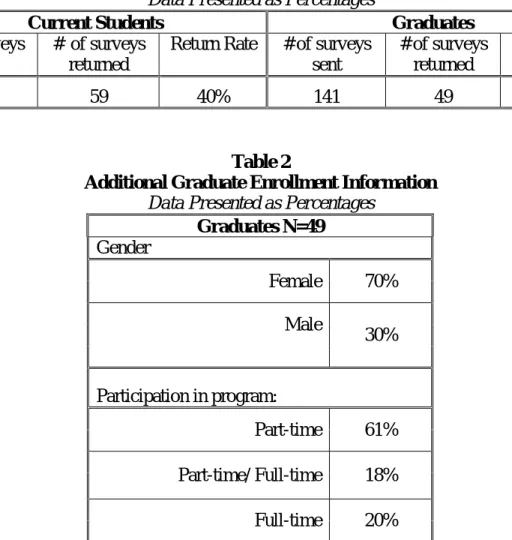
The population surveyed included all graduates from the Counselor Education program who graduated between January of 1996 and June 2000 (N=141) and all current degree candidates as of November 2000 (N=147). The return rate for graduates (N= 49) was 35%, and the return rate for current students (N= 59) was 40%. Supervisor/Employer surveys were also sent with each survey to graduates who graduated within the last three years. Since only one supervisor survey was returned, the results of this survey will not be discussed in this report.
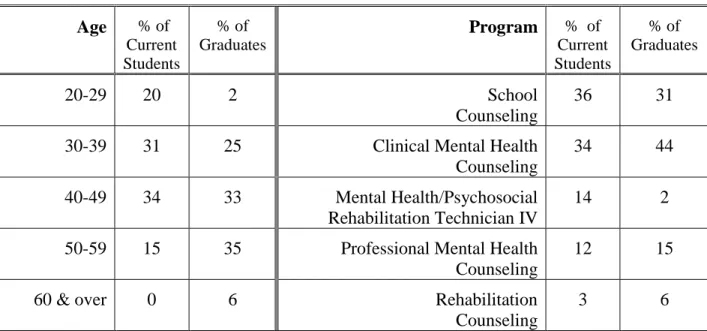
Table 1 below displays the distribution of respondents by age and by specialty
Table 1
Respondents’ Age and Specialty Area
Data Presented as Percentages
Age % of Current Students % of Graduates Program % of Current Students % of Graduates 20-29 20 2 School Counseling 36 31
30-39 31 25 Clinical Mental Health
Counseling
34 44
40-49 34 33 Mental Health/Psychosocial
Rehabilitation Technician IV
14 2
50-59 15 35 Professional Mental Health
Counseling
12 15
60 & over 0 6 Rehabilitation Counseling
area. The largest group of respondents, 44% of graduates and 34% of current students, were involved with the Clinical Mental Health Counseling Specialty. Students of the School Counseling program also accounted for a large number of survey returns, making up 36% of current students and 31% of graduates responding. Graduate respondents were slightly older than current students with 74% of graduates indicating they were 40 years or older compared with 49% of current students. For further information regarding enrollment and graduation trends, please refer to Tables 2-5 in Appendix B.
Procedure
In early December 2000, survey packets were mailed to graduates and matriculated students asking that they be completed and returned within two weeks. Each packet included:
1. a letter explaining the survey; 2. a survey; and,
3. a postage paid envelope for returning the survey.
4. Packets for recent graduates (last three years) also included a
Supervisor/Employer survey with an additional postage paid envelope. At the end of two weeks, reminder postcards were mailed to all graduates and current students.
IV. ANALYSIS
The survey information was tabulated and analyzed with respect to several evaluative research questions. In this section of the report, an analysis of survey items is presented along with the relevant data. A copy of the computed frequencies for all survey items appears throughout tables in the text of this report and / or in Appendix B.
Research Question 1: Does the program content satisfy the knowledge base needed for professional competency?
Table 2, on the next page, reports the response frequencies and means for three items dealing with student perceptions of the development of professional competency.
current students range from 4.14 to 4.40 indicating that the overwhelming majority of graduates and students agreed that the program develops professional competencies in these areas.
In regards to the first statement, The program provided a balance of theoretical and practical skills, the mean for graduates (4.27) and the mean for current students (4.14) were similar. A number of graduates praised the skill development that occurred through the program, “ Very practical skills are well taught. The program is broad in spectrum.” A few current students commented that the faculty is important in providing this balance stating, “instructor experience in the working world mixed with the theories. Very good skills classes.” However, some current students thought more emphasis on skills is necessary, stating, “not enough connections made between counseling theories and techniques and practical experience.” Several students commented that more emphasis on theory would be helpful. “Human development content and theories should be tested more thoroughly. You leave each course knowing most about the aspect you researched and having only a familiarity with the other theories or stages of
development.”
Table 2
Development of Professional Competency
Data Presented as Percentages
Graduates N = 49 Current Students N=59 Strongly Disagree Strongly Agree Strongly Disagree Strongly Agree Question 1 2 3 4 5 Mean 1 2 3 4 5 Mean
The program provided a balance of theoretical
and practical skills. 2 - 8 49 41 4.27 - 2 19 43 36 4.14
The program helped me develop expertise in
my area of interest. 4 8 16 25 47 4.02 2 2 15 34 48 4.24
The program objectives were consistent with
my professional objectives. 2 2 18 25 53 4.24 - - 9 43 48 4.40
For the second item, The program helped me develop expertise in my area of interest, the mean for graduates is 4.02 and the mean for current students is 4.24 (both indicating positive responses). Many respondents, both current students and graduates alike, indicated that a strength of the program was its flexibility in meeting the needs and
interests of all students. Comments such as the following appeared on several surveys: “(A strength of the program is) the interest and openness, and accessibility of faculty to students on a personal level. A small program allows this to happen” and “Flexibility (is a strength of the program). The small size makes the program more effective due to greater attention to the individual”. Also, “the program has the format to help
individuals develop their own counseling style” and “ Instructors are flexible with regard to meeting the needs of students with demanding schedules.”
Most students rated the program’s emphasis in developing individuals’ area of interest positively. However, some of the written suggestions discussed the need for some specialty courses to be offered more frequently. Others indicated that specialty courses in additional areas would help them further develop expertise in areas that interested them. The need for additional offerings of courses addressing the following areas were
mentioned: chemical dependence, additional diversity topics, depressive disorders and suicide, crisis intervention, specific counseling methods and theoretical orientations, contemporary healing methods, spirituality, and elder mental health.
One trend in comments written on surveys is important to note at this time. A number of school counseling graduates made comments regarding their lack of expertise and competence in areas of importance to their practice in the field. Several samples of these types of comments follow: “ (The program had) absolutely no regard for the unfortunate reality that school counselors are still viewed as schedulers and that we are pioneering a new role. Your graduates are really discouraged, where we could be charged up as if activists going against the grain ”and “For school counseling, more practical “tools” and training at the different levels (is needed). I was completely unprepared for scheduling, SAT’s, etc. in high school.”
In the case of the third statement, The program objectives were consistent with my professional objectives, both groups indicated rather high responses with current students giving slightly higher mean responses (4.40) than did graduates (4.24). Samples of related positive comments include: “ The idea of developing a professional identity instills ethical/personal standards and eases the transition into our career in counseling” and “ Faculty seemed to care about our personal and professional development, as well
practicum and internship.” One graduate mentioned that they “would like to have seen more emphasis given to ethical issues, children’s treatment, and preparation for licensure and practice.”
Research Question 2: Does the program encourage reflection and critical inquiry?
When asked to rate the statement, The program helped me refine my skills of critical inquiry, the mean graduate response was 4.02 while the mean response of current students was 4.15 indicating positive responses for both groups as seen in Table 3. For the statement, The program helped me examine the connections between theory and practice, response resulted in a graduate mean of 4.24 and a current student mean of 3.98. In regards to this question, many comments from graduates seem to agree that “
Practicum and Internship were the ultimate aspects to putting skills and theories together.” However, there were some comments by current students that there are “not enough connections made between counseling theories and techniques, and practical experience”. The lower means for the current students may, in part, be explained by the fact that they have not finished the program and/or completed the practicum and
internship courses. The following comment summarizes a suggestion proposed by several graduates. “I would like to see more practical experience earlier in the program, perhaps running through the program.”
Table 3
Reflection and Critical Inquiry in Program
Data Presented as Percentages
Graduates N=49 Current Students N=59 Strongly Disagree Strongly Agree Strongly Disagree Strongly Agree Question 1 2 3 4 5 Mean 1 2 3 4 5 Mean
The program helped me refine my skills of
critical inquiry. 4 2 20 35 39 4.02 2 2 14 46 37 4.15
The program helped me examine the connections
between theory and practice. 2 2 10 41 45 4.24 - 5 21 45 29 3.98 The program required rigorous intellectual
Respondents agreed to a slightly lesser degree with the statement, The program required rigorous intellectual discipline, with a mean graduate response of 3.76 and a 3.85 mean current student response. The most frequent response to this question from both graduates and current students was a “4” which indicates moderate agreement with this item. Several respondents made comments such as the following: “ Some classes are very “soft” and lack rigor,” “Too much accommodation for “adult learner” reduces standards and rigor ”and “Weak academic underpinning”. Another student
recommended the program be “evaluated from a purely academic perspective, to
objectively evaluate the intellectual rigor of the program and classes.” While these types of comments represent the minority, they point to a more complex opinion regarding this item.
Research Question 3: Does the program provide opportunities to examine the impact of diversity?
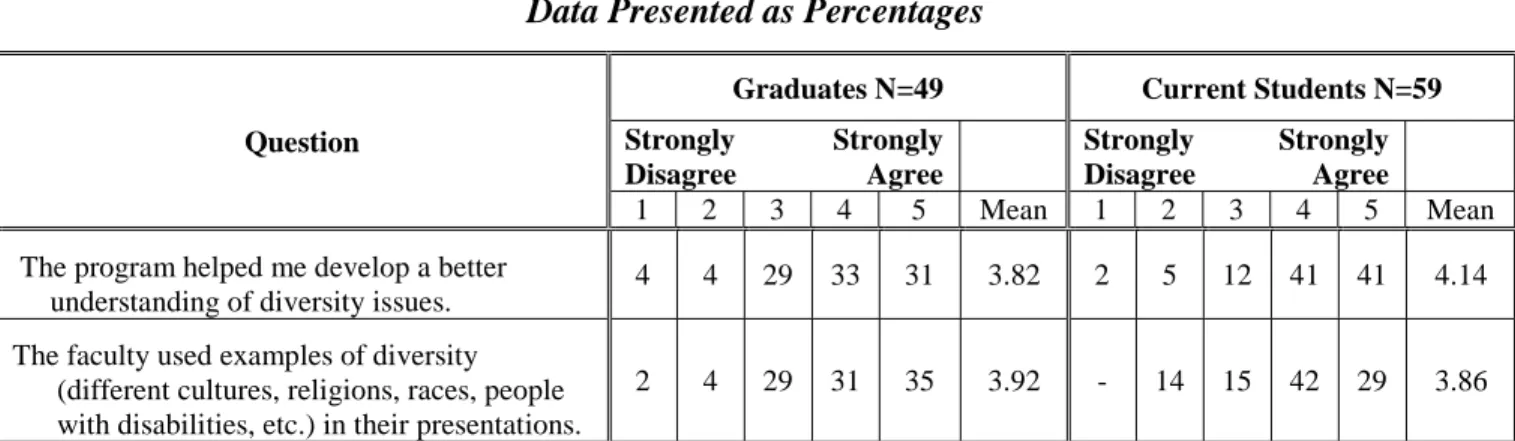
Two items on the survey addressed diversity and are listed in Table 4 below. In response to the statement, The program helped me develop a better understanding of diversity issues, the means for graduate and current student respondents were 3.82 and 4.14 respectively. When asked to rate, The faculty used examples of diversity (different cultures, religions, races, people with disabilities, etc.) in their presentations, the respective means were 3.92 and 3.86.
Table 4 Diversity Issues
Data Presented as Percentages
Graduates N=49 Current Students N=59 Strongly Disagree Strongly Agree Strongly Disagree Strongly Agree Question 1 2 3 4 5 Mean 1 2 3 4 5 Mean
The program helped me develop a better understanding of diversity issues.
4 4 29 33 31 3.82 2 5 12 41 41 4.14
The faculty used examples of diversity (different cultures, religions, races, people with disabilities, etc.) in their presentations.
The means for items related to diversity all indicate a fairly positive view on the part of program participants towards diversity training in the program; however, a number of comments discussed the need for more diversity training or improved
instruction in courses most specifically related to diversity. The following comment also seems to indicate a possible deficit in at least one area of diversity training: “MORE DIVERSITY training! Especially in sexuality. One is more likely to encounter a
homosexual in their counseling room than many other groups in Maine. The unique, yet necessary needs of this group are not understood by many of my student colleagues.” Other comments addressed the diversity training more broadly, such as the following: “Some diversity training seems to perpetuate stereotyping instead of respect for
individuals and their culture” and “Continuing lack of visibility of and discussion /info. about people from other cultural groups – this is improving but continues to be an area in need of improvement.” Others pointed out “the lack of cultural diversity among staff and student body (but then so is this country)”.
Research Question 4: Does the program provide good opportunities for students to demonstrate content knowledge, skills, and understanding?
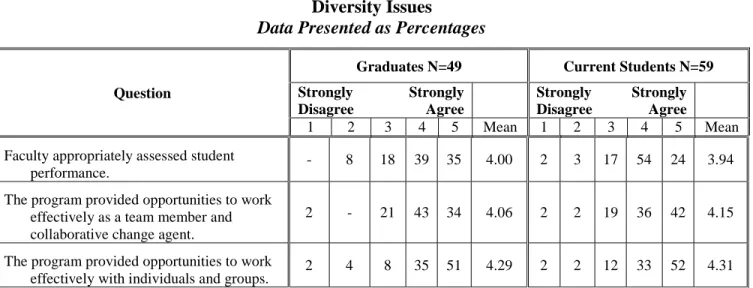
In regards to Research Question 4, students responded to questions regarding assessment, collaboration, and group work. Overall, students and graduates felt that faculty appropriately assessed performance, and that opportunities for collaboration, group work and individual work were all provided.
Bothgraduates and current students of the Counselor Education program reported moderately positive responses (means of 4.00 and 3.94 respectively) for the statement, Faculty appropriately assessed student performance as seen in Table 5 on the next page. Sample comments included: “ Most instructors care about the quality of your learning experience by encouraging discussion and critical thinking rather than grading on memorization of factual information,” and “More emphasis on classroom exams (is needed). More objective, measurable standards in definable courses with less person-centered subjective learning.”
Table 5 Diversity Issues
Data Presented as Percentages
Graduates N=49 Current Students N=59 Strongly Disagree Strongly Agree Strongly Disagree Strongly Agree Question 1 2 3 4 5 Mean 1 2 3 4 5 Mean
Faculty appropriately assessed student
performance. - 8 18 39 35 4.00 2 3 17 54 24 3.94
The program provided opportunities to work effectively as a team member and collaborative change agent.
2 - 21 43 34 4.06 2 2 19 36 42 4.15
The program provided opportunities to work
effectively with individuals and groups. 2 4 8 35 51 4.29 2 2 12 33 52 4.31
When asked to respond to the item The program provided opportunities to work effectively as a team member and collaborative change agent , graduates responded with a mean of 4.06 and current students with a mean of 4.15, indicating a strong positive response. A current student exemplified these high scores with the following comment: “Students are encouraged to think, and to work together as a team. The professors are also part of that team. Having students work in groups (is a strength).”
Graduates and currents students responded very positively to the item, The program provided opportunities to work effectively with individuals and groups, with means of 4.29 an 4.31 respectively. Several respondents commented that their fellow students were one of the strengths of the program. While the majority of respondents indicated a “5”, which shows strong agreement, one student indicated group work was overemphasized: “I would like to have one class in which group work/projects are not emphasized. Group work at the graduate level is very difficult, particularly when time is not given in class.”
Research Question 5: Are students satisfied with program advising and various student services?
Table 6 on the next page reports frequencies and means for both graduates and current students for several items dealing with advising services and the availability of
program faculty. The means for all items were above 4.00, which indicated an overall positive perception of these services.
Table 6
Satisfaction with Student Services
Data Presented as Percentages
Graduates N=49 Current Students N=59 Strongly Disagree Strongly Agree Strongly Disagree Strongly Agree Question 1 2 3 4 5 Mean 1 2 3 4 5 Mean
Program advising was
a. available when I needed it.
2 2 8 21 67 4.48 2 - 17 27 54 4.32
b. helpful. 2 - 15 17 66 4.45 3 - 14 40 43 4.19 The accessibility of Counseling Education
faculty was satisfactory.
2 2 4 14 78 4.63 3 - 14 33 50 4.26
The assistance provided by Counseling Education faculty outside of class was helpful.
2 2 10 33 53 4.33 2 5 19 31 43 4.09
Responses to the question Program advising was: a) available when I needed it; and b) helpful, indicated that most students were pleased with the availability and quality of program advising, with over 80% of respondents indicating they agreed or strongly agreed. While few comments were made directly regarding advising services, one student did make the following comment: “The green sheet that I got at the beginning of the year was pretty confusing in terms of what to take and when.”
The means for the item, The accessibility of Counseling Education faculty was satisfactory, were 4.63 for graduates and 4.23 for current students. Similar results were indicated for the related item, The assistance provided by Counseling Education faculty outside of class as helpful , with graduates indicating a mean of 4.33 and current students a mean of 4.09. When asked to list the strengths of the Counselor Education program, over one-half of all respondents indicated the faculty was strength. The most frequent comments referred to availability of faculty members and their interest in the progress and individual needs of the students. Students made many comments about faculty
members that were similar to the following: “(Strengths of the program were) personality and approachability of professors”, “Faculty – both instruction and availability. They have all shown an interest in my progress” and “the approachability of the professors,
their dedication to the profession and willingness to share their approaches and
knowledge to their students.” Another student discussed the strengths of the program as “the knowledge and skills of faculty. Commitment of faculty to their profession and continued growth. Commitment of faculty to encouraging and supporting growth and risk taking of students. Creation of a non-competitive, cooperative environment in support of building a community of learners. Acceptance of individual differences, learning styles, and areas of interest.”
Additional Analyses:
Questions that were generated by the faculty of the Counselor Education Program are examined in this section of the report. These questions involved: (1) graduates’ level of preparation regarding specific skills and knowledge areas, (2) graduates’ field-based experiences and supervision, (3) graduates’ professional credentials and current positions, and (4) graduates’ and current students’ interest in further education.
In developing surveys for the purpose of this evaluation, the Counseling Education Faculty members requested that several items from previous Counselor Education graduate surveys be included. The first question addressed the level of
preparation in a number of knowledge areas. The results are displayed in Table 7 on the next page in order of descending means. The higher the mean, the higher the level of preparedness as rated by survey respondents. It is important to note when viewing the table, that not all respondents indicated a response for each area. For example, 48 respondents indicated their level of knowledge in the area of “Theories of counseling”, but only 10 indicated responses in the area of “rehabilitation/disabilities”.
A majority of responding graduates indicated they felt prepared in most of the areas with mean scores falling between 4.45 and 3.34. Some knowledge areas in which respondents indicated the highest level of preparation with a mean above 4.00 were psychological diagnosis, theories of counseling, psychological measurement, and research and statistics. Areas in which respondents indicated the lowest level of preparedness include professional credentialing, abnormal psychology, professional organizations, family counseling, and counseling persons with special needs.
Table 7
Graduates’ Perceived Competency in Selected Knowledge Areas
In order of descending means
(Indicates # of respondents replying in each category)
Graduates (N=49)
Poor Excellent
30. KNOWLEDGE AREAS: Please indicate your preparation in each of the following knowledge areas.
1 2 3 4 5 Mean
Psychological (i.e., clinical) diagnosis - 1 3 7 18 4.45
Theories of counseling - - 3 21 24 4.44
Psychological measurement (testing) 1 - 7 12 27 4.36 Research and statistics - 3 4 15 26 4.33 Treatment planning/management - 3 6 5 19 4.21
Group counseling 1 - 12 14 21 4.13
Rehabilitation/disabilities - - 4 1 5 4.10 Crisis intervention/counseling - 2 14 10 18 4.00 Ethical and legal issues in your profession - 3 10 17 15 3.98
Consultation - 2 10 7 12 3.94
Career and lifestyle counseling (vocation/career
development) 2 2 13 13 19 3.91
Human growth and development 2 3 11 17 15 3.83
Program Planning - 2 5 6 5 3.78 Multicultural/diversity issues 1 6 8 20 12 3.77 Substance abuse 2 1 8 5 9 3.72 Program Evaluation 1 4 7 16 5 3.59 Professional credentialing 1 8 15 7 13 3.52 Abnormal psychology 1 5 8 8 7 3.51 Professional Organizations - 7 16 12 6 3.41 Family Counseling - 3 13 6 3 3.36
Counseling persons with special needs 1 4 11 10 3 3.34
A second question focused on graduates’ perceived level of competency in skill areas. Table 8 on the next page displays the results of this question in order of descending means. Overall, a majority of responding graduates indicated they felt prepared in most of the areas with mean scores falling between 4.46 and 3.16. However, only three skill areas had means above 4.00. Skill areas in which graduates felt most prepared were
individual counseling, and clinical diagnosis. Graduates felt least prepared in the areas of classroom guidance skills, career and lifestyle counseling, and counseling persons with special needs.
Table 8
Graduates’ Perceived Competency in Selected Skill Areas
In order of descending means
(Indicates # of respondents replying in each category)
Graduates (N=49)
Poor Excellent
31. SKILLS AREAS: Please indicate your personal evaluation of your preparation in each of the following skills areas in your program(s)
1 2 3 4 5 Mean
Individual counseling - - 5 16 27 4.46
Clinical (psycho) diagnosis - 1 4 12 13 4.23 Child and adolescent counseling - - 10 15 12 4.05
Treatment planning/management - 2 7 9 11 4.00 Rehabilitation processes - - 2 - 2 4.00 Assessment - 4 13 14 12 3.79 Group Counseling 1 3 15 16 13 3.77 Program planning - 1 3 6 2 3.75 Crisis intervention/counseling 1 2 14 13 10 3.73 Consultation - 3 8 8 7 3.73
Classroom guidance skills 1 4 2 8 6 3.67
Career and lifestyle counseling - 6 17 11 13 3.66 Counseling persons with special needs 1 5 11 5 3 3.16
Counseling Education faculty decided that they wanted to explore interns’ experience with supervision, and their perception of training opportunities provided during their field based experiences. Results to three questions relating to these topics are detailed in Table 9 on the next page. Means on these items ranged from 4.00 to 4.29, indicating an overall positive response. Many of the comments, particularly on graduate surveys, referred to practicum and internship experiences. Some of the graduates spoke highly of their field-based experiences, such as the following graduate who said, “ The practicum and internship are excellent and the counseling skills course makes the program.”
of comments questioned the support received prior to the experience. One student made the following comment: “Having to find practicum clients by yourself (is a weakness of the program). This is potentially dangerous and could result in inappropriate clients being paired with inexperienced counselors.” Another student made the following suggestion for improving the program: “Develop a better way for students to meet clients in practicum. Perhaps they could do so through a counseling center or other agencies. Meeting strangers inside of closets in Portland is a recipe for disaster.”
Table 9
Graduates’ Perception of Field-based Experiences and Supervision
Data Presented as Percentages
Graduates N=49
Strongly Strongly Disagree Agree
1 2 3 4 5 Mean
The sites provided for field-based experiences
offered excellent training opportunities. 2 12 10 35 41 4.00 The on-campus individual supervision for
practicum was excellent. 4 4 8 37 57 4.29
The on-campus, individual, group supervision for
field-based experiences was excellent. - 8 10 31 50 4.23
Similar comments emerged regarding the internship experience. A sample of comments includes: “Lack of support provided during internship (i.e., finding a site) – no resources available.” and “ Greater university support for developing and guiding students to varied real world internships, at least with regard to clinical counseling (is needed)”. One student suggested that the college “provide students with a list of local contacts for both practicum and internship.”
The third area queried by Counselor Education faculty concerned the professional credentials and employment of graduates of the program. As can be seen in Table 10 on the next page, a large majority of those responding hold a Licensed Clinical Professional Counselor degree (87%) and many are also National Certified Counselors (71%). Fewer, approximately one-third, have obtained certification from the Maine Department of Education. This is the majority of those graduates that find such a certificate applicable. The smallest percentage of graduates responding are Certified Rehabilitation Counselors
(7%), though over 50% of those responded they do not find the certification applicable to their work.
Table 10
Professional Credentials of Graduates
Data Presented as Percentages
Do you hold any of the following licenses?
Licensed Professional Counselor 9 Licensed Clinical Professional Counselor 87
Licensed Substance Abuse Counselor 4
Are you a National Certified Counselor (NCC)?
Yes 71
No 23
Not Applicable 6
Do you currently hold certification from the Maine Department of Education?
Yes 35
No 20
Not applicable 45
Are you a Certified Rehabilitation Counselor (CRC)?
Yes 7
No 42
Not Applicable 51
Table 11 on the next page indicates that the majority of graduates (70%) changed jobs as a result of their master’s degree. Overall, 82 % of graduates are currently
employed with 63% employed on a full-time basis. Graduates of the Counselor Education program reported employment in a variety of positions accounting for 25 different job titles. The largest group of graduates (32%) reported they were currently employed as school or guidance counselors. Other job titles reported by more than one respondent include counselor, social worker, case manager, and crisis unit clinician/worker. For a complete list of job titles, please see Appendix B, Table 7. Further data regarding clients served, salary, and location is also included in Appendix B, Tables 8-10.
The fourth area of additional analysis concerned student interest in further education. When graduates were asked about further educational study at the University of Southern Maine, 61% of those responding indicated interest in pursuing a doctoral program. Slightly fewer, 53%, were interested in pursuing a Certificate of Advanced
Table 11
Graduates’ Employment Information
Data Presented as Percentages
Graduates N = 49
Are you currently employed? Did you change jobs as a result of your master’s degree?
Full-time 63 yes 70
Part-time 19
Not Employed 19
no 30
The percentage of responding current students interested in pursuing a doctoral degree at USM was similar to the percent of graduates at 62%. The largest number of respondents (29%) indicated they would be interested in enrolling five or more years in the future, while 24 % indicated they would enroll in two to four years as indicated in Table 13.
Table 12
Graduate Interest in Further Study at USM
Data Presented as Percentages
Would you be interested in pursuing a Certificate of Advanced Study (CAS) program at USM?
Graduates N=49 Would you be interested in pursuing a doctoral (Ed.D.) program at USM? Graduates N=49 Yes 53 Yes 61 No 47 No 39 Table 13
Student Interest in Further Study at USM
Data Presented as Percentages of those responding
Would you be interested in enrolling in a doctoral (Ed.D.) program in Counselor
Education at USM?
Current Students N=59
No 39
Yes: in 0-1 years 9
Yes: in 2-4 years 24
When asked to list professional development topics for possible training
workshops or courses, a variety of topics were proposed. The most frequent response was that a course in ethics would be valuable. Topics brought up more than once in the
comments include, crisis counseling/suicide assessment, school guidance counselor issues (writing recommendation letters, course scheduling, career exploration), school violence, and alternative theories and treatments.
Research Question 6: Are students satisfied with the quality of instruction in each course? Do students feel each course is beneficial to their work? What is their overall assessment of the program and instruction?
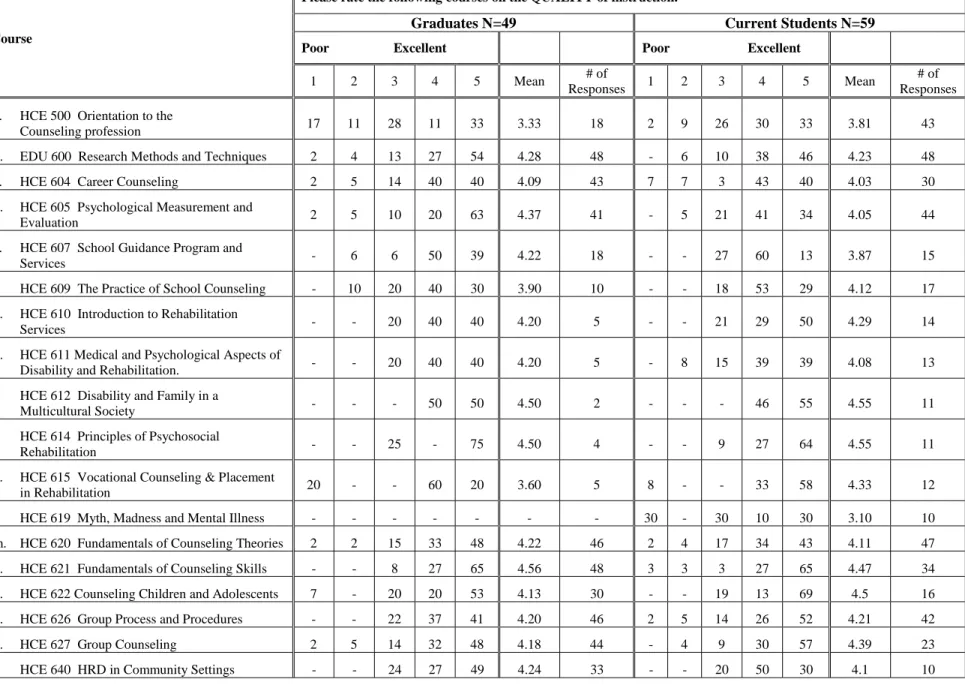
The survey asked respondents to rate each of the 33 courses in the Counselor Education Program on two levels, (1) the quality of instruction, and (2) the value of knowledge and skills gained. Thus, each course in the program yielded four means: quality of instruction for graduates and for current students, value of knowledge and skills gained for graduates and current students (please refer to Tables 13-14 in Appendix B). It should be noted that for the purpose of this discussion, if fewer than 5 respondents indicated an opinion regarding a particular class, the scores are not discussed in this section. However, they are available in Appendix B, Table 13.
For the quality of instruction, the range of means for graduates was from 3.20 to 4.68, while for current students the means ranged from 3.10 to 4.85. This indicates that both graduates and current students generally agree that course instruction is of excellent quality. When looking at response patterns, some courses received higher scores than others. A large number of courses received such favorable reviews for quality, that a majority of respondents gave the course the highest rating of a “5”. Graduates ranked 8 courses at this level while students indicated that 11 courses are at this level. Both graduates and current students gave the highest ratings for quality to the following three courses: HCE 645 – Diagnosis and treatment planning, HCE 686 – Internship in
Counselor Education, and HCE 690 – Individual Counseling Practicum.
All courses received mean scores higher than a three, which falls between poor and excellent. However, several courses were rated by the majority of students at a level
way, while current students rated HRD 664, HCE 650, and HCE 619 in this fashion. Lower scores for these courses may signify possible issues regarding student perceptions of the quality of these courses.
The quality of courses was also a common topic of responses to open-ended questions regarding the strengths and weaknesses of the program. Many comments, such as the following, discussed the quality of instruction as a strength of the program: “ The quality of instruction and support from the faculty and office personnel (are strengths)”, “faculty (is a strength) – availability, interest, flexibility, and quality of instruction.” Others found quality of instruction to be a weakness. A sample of related comments includes: “Some courses had poor, low quality instruction – some courses needed to be updated,” “The human development and diversity courses lack clear direction and inspiring leadership. There’s some great material in there that could be flushed out and presented with a bit more enthusiasm and energy.” Also, “as with all institutions, occasionally an instructor, usually adjunct, was of lessor quality.”
When rating courses based upon the value or knowledge and skills gained, means for graduates ranged from 2.69 to 4.65 and the mean for current students range from 2.83 to 4.85 as seen in frequency counts listed in Appendix B, Table 14. This indicates that, overall, both graduates and current students agree that they gained valuable knowledge and skills in most courses. When rating individual courses, there were nine courses for which the majority of graduates rate the course at the highest level. Current students also rated courses as valuable, with the majority of students rating eleven courses at the highest level. Courses rated highly by both current students and graduates include: HCE 621, HCE 622, HCE 645, HCE 686, and HCE 690. A sample of the positive comments regarding the preparation and knowledge gained through instruction includes the
following: “Very dedicated, available, qualified and knowledgeable staff members. J. S. is someone who is a wonderful asset to this program. He prepared me well for the field!” and” It seems ideas are innovative and current. I feel I would bring a lot to a job
surrounding change in field.”
While the majority of courses received very positive ratings, there were several courses that received mean scores of less than three, which indicated that a number of students felt the value of skills and knowledge gained through the course was poor.
Graduates of the program rated “HCE 500: Orientation to the Counseling Profession” at a mean score of 2.69, while current students rated “HCE 619: Myth, Madness, and Mental Illness” at a 2.83. One comment addressed another issue regarding the perceived value of instruction: “ I have had classes that were too dependent on personal experiences of students in the class with out the guided thoughts of the professor. Classes become therapy sessions for students. It was difficult to see the value and tie-in to the subject we were studying.”
In addition to questions specific to particular courses and particular skills, graduates were asked to rate how prepared they were to pursue a job in their specialty area upon graduation. The largest group of graduates (43%) indicated they felt “well prepared”, while 36% felt “very well prepared” and 21% felt “somewhat prepared”. While “marginally prepared” and “not prepared” were given as options, no graduate selected either of these options. This indicates a high level of preparedness among program graduates.
Many written comments support the fact that graduates feel well prepared for their professional roles. For example, several graduates stated that, “Staff prepared me well for licensing test and employment in field.” and ”Professors were knowledgeable and prepared me for actual job. I feel very comfortable in the field.” Students also discussed the importance the internship played in their preparation with comments such as the following: “…as I worked through my internship, all my learning seemed to come together. I felt confident and knowledgeable in my role. Thank you!” However, a few students, particularly in the area of school counseling, felt there were some roles they did not feel prepared for. “ I do not feel I was fully prepared for the “real job” of a school counselor. I feel the program has very unrealistic ideas of what a H. S. counselor really does and needs to be prepared to do when entering a new job.”
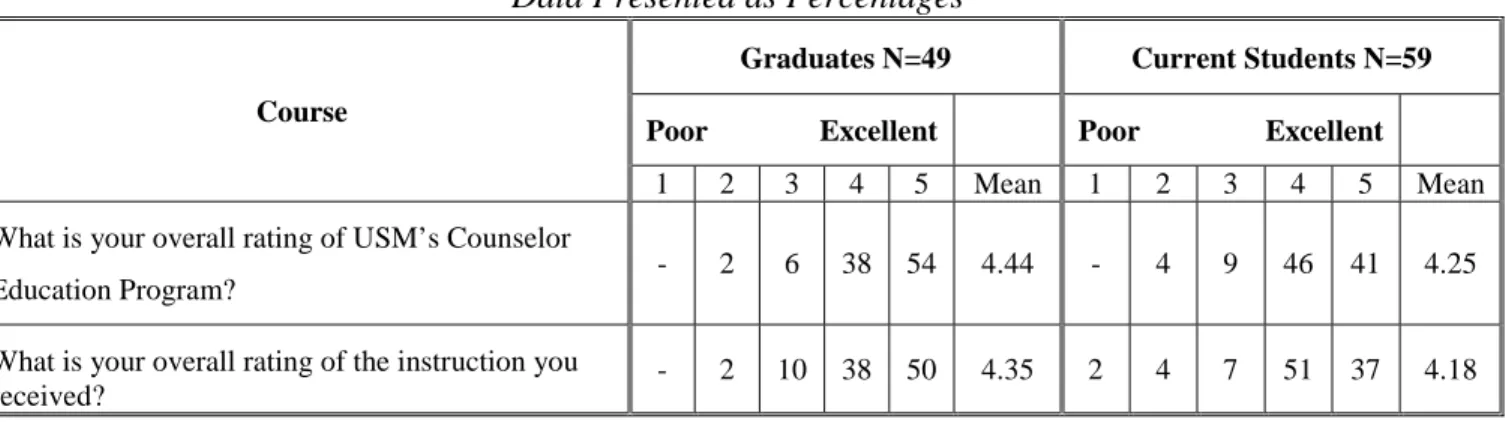
Table 14, on the next page, shows that the overall assessment mean ratings of the Counselor Education Program are 4.44 for graduates and 4.25 for current students. This data indicates that participants’ overall ratings of the program are very positive. Overall ratings for instruction received during the program also suggested a positive response, with graduates indicating a mean of 4.35 and current students a mean of 4.18.
Graduates and present students were also asked if they would recommend the Counselor Education Program to others. The overwhelming majority of both groups (n=81) indicated that they would do so, with many indicating they have already recommended the program. A small number of respondents (4) were uncertain if they would do so, and only three reported that they would not do so. The most frequently cited reasons for recommending the program were that it was a rewarding experience in
personal development and a good preparation. The following comments typify this type of response: “ The program is an exceptional personal growth vehicle and a fine preparation for professional work,” “Yes, It is a good, solid, proven program which provides excellent over-all training in a number of related disciplines all having to do with assisting individuals in their personal development,” and “It was one of the most rewarding experiences of my life. I grew academically and as a person. I was allowed to grow and take risks.” Others responded that the flexibility of the program made it
inviting. “It was flexible enough to allow one to obtain a degree while working outside of the program – classes and expectation high enough so you walk in feeling very prepared for jobs!” Other students and graduates alike mentioned that the program was in a convenient location.
Another frequent comment was that the faculty was one reason the program might be recommended. One graduate responded that she would recommend the program because “I believe the faculty make every attempt to assist students in becoming a
professional counselor no matter what “luggage” they bring.”
Table 14 Overall Assessment
Data Presented as Percentages
Graduates N=49 Current Students N=59
Poor Excellent Poor Excellent Course
1 2 3 4 5 Mean 1 2 3 4 5 Mean
What is your overall rating of USM’s Counselor
Education Program? - 2 6 38 54 4.44 - 4 9 46 41 4.25
What is your overall rating of the instruction you
Six of the graduates mentioned that reimbursement issues made it less likely that they would recommend the program and others made reference to the difficulty in getting reimbursed when working as a Licensed Clinical Professional Counselor (LCPC). When asked whether or not they would recommend the program, the typical response of this type was, “Yes and No. Yes because it’s a great preparation for counseling. No, because reimbursement for counselors after graduation is troublesome – if someone needs to make $, they would do better to consider social work because (its) more reimbursable” and “I like developing a network of professionals as I was going through school, but the lack of insurance re-imbursibility makes the degree less “practical” than an MSW or Ph.D.”
IV. CONCLUSIONS AND RECOMMENDATIONS
Conclusions
The results of the survey demonstrated an overall positive response to the Counselor Education Program on the part of graduates and current students. The most frequently mentioned strengths were: (1) the faculty, particularly in the areas of
availability and interest in student progress, (2) practicum and internship experiences, (3) the flexibility of the program and the focus on meeting individual students needs, and (4) strong foundation and preparation in many practical skills provided by the program. The most frequently mentioned weaknesses were: (1) the need for more skills instruction with direct practical application throughout the program (specifically in the area of school counseling at the secondary level ), (2) the perceived lack of internship and practicum support in finding clients and sites, (3) the need for more specialty courses to be offered with more frequency, and (4) issues surrounding human development and diversity instruction.
Recommendations
Based on the survey findings of computed means and comments offered from Counselor Education graduates and current students, it is suggested the program consider five recommendations:
2. Second, we recommend that the program review the balance between theory and skills instruction and the opportunity for students to gain practical experiences throughout each stage of the program.
3. Third, we recommend that the program review the level of student support in preparation for field based experiences.
4. Fourth, we recommend that specialty course offerings with regards to frequency and variety be reviewed.
5. Finally, we recommend the program explore ways to help students develop a better understanding of diversity issues.
In summary, the results from these surveys indicate many graduates and current students believe the Counselor Education Program offers excellent training opportunities, and is a quality program. The survey results did surface some concerns, and the
recommendations we have offered are designed to suggest areas faculty may wish to continue to review in an effort to strengthen the current program.
APPENDIX A
College of Education and Human Development Program Evaluation Counselor Education
Current Students
1. What year were you admitted to the program? 19___
2. What is your anticipated graduation date? _______ Month ________ Year 3. Age: ___ 20-29; ___30-39; ___ 40-49; ___50-59; ___60 & over 4. Current Program
___ School Counseling
___ Mental Health Counseling - Professional ___ Mental Health Counseling – Clinical
___ Mental Health/ Psychosocial Rehabilitation Technician IV ___ Rehabilitation Counseling
Please circle the number that best describes your reaction to the following statements.
Strongly Disagree
Strongly Agree
5. The program requires rigorous intellectual discipline. 1 2 3 4 5 6. The program provides a balance of theoretical and practical skills. 1 2 3 4 5 7. The program is helping me develop expertise in my area of interest. 1 2 3 4 5 8. The program objectives are consistent with my professional objectives. 1 2 3 4 5 9. The program is helping me examine the connections between theory and practice. 1 2 3 4 5 10. The program is helping me refine my skills of critical inquiry. 1 2 3 4 5 11. The program is helping me develop a better understanding of diversity issues. 1 2 3 4 5 12. The faculty uses examples of diversity (different cultures, religions, races, sexual
orientation, people with disabilities, etc.) in their presentations. 1 2 3 4 5 13. Faculty appropriately assess student performance. 1 2 3 4 5 14. The program provides opportunities to work effectively as a team member and
collaborative change agent. 1 2 3 4 5
15. The program provides opportunities to work effectively with individuals and groups. 1 2 3 4 5 16. Program advising is: a. available when I need it.
b. helpful 1 1 2 2 3 3 4 4 5 5 17. The accessibility of counselor education faculty in person is satisfactory. 1 2 3 4 5
Please circle the number that best describes your reaction to the following statements. Strongly Disagree Strongly Agree
18. The assistance provided by counselor education faculty outside of class is helpful. 1 2 3 4 5
19. The library hours are convenient. 1 2 3 4 5
20. The resources available in the library are sufficient to complete course requirements. 1 2 3 4 5 21. If the materials are not on campus, library personnel are able to get them for me in a
reasonable amount of time. 1 2 3 4 5
22. The course registration process is convenient. 1 2 3 4 5
23. The following student services are satisfactory: a. Financial Aid b. Student Billing c. Food Services d. Career Service d. Computer Labs e. Dial-up-modem access g. Student Health 1 1 1 1 1 1 1 2 2 2 2 2 2 2 3 3 3 3 3 3 3 4 4 4 4 4 4 4 5 5 5 5 5 5 5 1. the quality of instruction 2. the value of
knowledge and skills gained
24. Please rate the following courses on two dimensions:
RESPOND ONLY FOR THOSE COURSES YOU
HAVE COMPLETED. Poor Excellent Very
Little
Very Much
a. HCE 500 Orientation to the Counseling Profession 1 2 3 4 5 1 2 3 4 5 b. EDU 600 Research Methods and Techniques 1 2 3 4 5 1 2 3 4 5
c. HCE 604 Career Counseling 1 2 3 4 5 1 2 3 4 5
d. HCE 605 Psychological Measurement and Evaluation 1 2 3 4 5 1 2 3 4 5 e. HCE 607 School Guidance Programs and Services 1 2 3 4 5 1 2 3 4 5 f. HCE 609 The Practice of School Counseling 1 2 3 4 5 1 2 3 4 5 g. HCE 610 Introduction to Rehabilitation Services 1 2 3 4 5 1 2 3 4 5 h. HCE 611 Medical and Psychological Aspects of
Disability and Rehabilitation 1 2 3 4 5 1 2 3 4 5
i. HCE 612 Disability and Family in a Multicultural
Society 1 2 3 4 5 1 2 3 4 5
j. HCE 614 Principles of Psychosocial Rehabilitation 1 2 3 4 5 1 2 3 4 5 k. HCE 615 Vocational Counseling and Placement in
Rehabilitation 1 2 3 4 5 1 2 3 4 5
l. HCE 619 Myth, Madness and Mental Illness 1 2 3 4 5 1 2 3 4 5 m. HCE 620 Fundamentals of Counseling Theories 1 2 3 4 5 1 2 3 4 5
1. the quality of instruction
2. the value of
knowledge and skills gained
24. Please rate the following courses on two dimensions:
RESPOND ONLY FOR THOSE COURSES YOU
HAVE COMPLETED. Poor Excellent Very
Little
Very Much
o. HCE 622 Counseling Children and Adolescents 1 2 3 4 5 1 2 3 4 5
p. HCE 626 Group Process and Procedures 1 2 3 4 5 1 2 3 4 5
q. HCE 627 Group Counseling 1 2 3 4 5 1 2 3 4 5
r. HCE 640 HRD in Community Settings 1 2 3 4 5 1 2 3 4 5
s. HCE 642 Perspectives in Chemical Dependency 1 2 3 4 5 1 2 3 4 5 t. HCE 643 Psychopharmacology and Substance-Related
Disorders 1 2 3 4 5 1 2 3 4 5
u. HCE 644 Crisis Intervention 1 2 3 4 5 1 2 3 4 5
v. HCE 645 Diagnosis and Treatment Planning 1 2 3 4 5 1 2 3 4 5 w. HCE 650 Basic Concepts of Systems Theory and
Family Therapy 1 2 3 4 5 1 2 3 4 5
x. HRD 664 Culture, Tradition and Diversity 1 2 3 4 5 1 2 3 4 5
y. HRD 668 Human Development 1 2 3 4 5 1 2 3 4 5
z. HCE 686 Internship in Counselor Education 1 2 3 4 5 1 2 3 4 5 aa. HCE 690 Individual Counseling Practicum 1 2 3 4 5 1 2 3 4 5
bb. EDU 660 CAS Seminar 1 2 3 4 5 1 2 3 4 5
cc. HCE 651 Systemic Assessment in Couple and Family
Therapy 1 2 3 4 5 1 2 3 4 5
dd. HCE 652 Classic Models of Family Therapy 1 2 3 4 5 1 2 3 4 5 ee. HCE 653 Postmodern Methods of Family Therapy 1 2 3 4 5 1 2 3 4 5 ff. HCE 656 Fundamentals of Couple and Family Therapy
Skills 1 2 3 4 5 1 2 3 4 5
gg. HCE 693 Practicum in Couple and Family Therapy 1 2 3 4 5 1 2 3 4 5
Overall Assessment Poor Excellent
25. What is your overall rating of USM’s Counselor Education Program? 1 2 3 4 5 26. What is your overall rating of the instruction you are receiving? 1 2 3 4 5
27. Would you be interested in enrolling in a doctoral program (Ed.D) in counselor education at USM?____ Yes ____ No
If yes, when might you seek admittance into the program?
Please provide brief answers to questions 28-31
28. What would you identify as the strengths of the Counselor Education program?
29.What would you identify as the weaknesses of the Counselor Education program?
30.What recommendations would you make to improve the Counselor Education program?
31.Would you recommend the Counselor Education program to others? Why or why not?
Additional Comments:
University of Southern Maine - College of Education and Human Development Program Evaluation: Counseling Education
Graduates Survey 1. Age:___20-29 ___30-39 ___40-49 ___ 50-59 ___60 & over 2. Gender:___M ___F
3. Specialty Area:
___ School counseling ___ Rehabilitation counseling ___ Clinical mental health counseling ___ Professional mental health counseling
___ Mental Health/Psychosocial Rehabilitation Technician IV 4. Enrollment Information:
a. Did you participate in your graduate program: __ part-time __ part-time/full-time__ full-time b. Date of enrollment: Spring / Summer / Fall year: _____
c. Date of graduation: January / May / August year: _____
d. Time required to complete program: _____years ____months 5. Credentialing:
a. Do you currently hold certification from the Maine Department of Education for school counseling? ___ Yes ___ No ___Not Applicable
b. Are you a Certified Rehabilitation Counselor (CRC)? ___ Yes ___ No ___Not Applicable
c. Are you a National Certified Counselor (NCC)? ___ Yes ___ No ___Not Applicable d. Do you hold any of the following licenses?
___Licensed Professional Counselor
___Licensed Clinical Professional Counselor ___Licensed Marriage and Family Counselor ___Licensed Pastoral Counselor
___Licensed Substance Abuse Counselor
e. How well did your coursework prepare you for any certification/licensure examination you took? ___ very well ___ somewhat well ___ not at all ___ not applicable
6. Current Work Status:
a. Are you currently employed?
___ full-time ___ part-time ___ not employed
b. Job Title:_____________________________________________________ c. How long have you been in this position?___ years ___ months
d. Did you change jobs as a result of obtaining your master’s degree? ___Yes___ No
f. Average annual salary:
___less than $10,000 ___ $30,000-39,999
___ $10,000-19,999 ___ $40,000-49,999
___ $20,000-29,999 ___ $50,000+
g. What are your job functions: h. In which state do you work? i. If employed in Maine, do you intend to stay in Maine?__yes ___no ___unsure
Please circle the number that best describes your reaction to the following statements.
Strongly Disagree
Strongly Agree
7. The program required rigorous intellectual discipline. 1 2 3 4 5 8. The program provided a balance of theoretical and practical skills. 1 2 3 4 5 9. The program helped me develop expertise in my area of interest. 1 2 3 4 5 10. The program objectives were consistent with my professional objectives. 1 2 3 4 5 11. The program helped me examine the connections between theory and practice. 1 2 3 4 5 12. The program helped me refine my skills of critical inquiry. 1 2 3 4 5 13. The program helped me develop a better understanding of diversity issues. 1 2 3 4 5 14. The faculty used examples of diversity (different cultures, religions, races, sexual
orientations, people with disabilities, etc.) in their presentations. 1 2 3 4 5 15. Faculty appropriately assessed student performance. 1 2 3 4 5 16. The program provides opportunities to work effectively as a team member and
collaborative change agent. 1 2 3 4 5
17. The program provided opportunities to work effectively with individuals and
groups. 1 2 3 4 5
18. Program advising was: a. available when I needed it. b. helpful 1 1 2 2 3 3 4 4 5 5 19. The accessibility of counseling education faculty in person was satisfactory. 1 2 3 4 5 20. The assistance provided by counseling education faculty outside of class was
helpful. 1 2 3 4 5
21. The library hours were convenient. 1 2 3 4 5
22. The resources available in the library were sufficient to complete course requirements.
1 2 3 4 5
23. If the materials were not on campus, library personnel were able to get them for me in a reasonable amount of time.
1 2 3 4 5
24. The course registration process was convenient. 1 2 3 4 5 25. The in-program student evaluation procedures were adequate. 1 2 3 4 5
Please circle the number that best describes your reaction to the following statements. Strongly Disagree Strongly Agree
26. The following student services were satisfactory: a. Financial Aid b. Student Billing c. Food Services d. Career Service e. Computer Labs f. Dial-up-modem access g. Student Health 1 1 1 1 1 1 1 2 2 2 2 2 2 2 3 3 3 3 3 3 3 4 4 4 4 4 4 4 5 5 5 5 5 5 5 27. The sites provided for field-based experiences offered excellent training
opportunities.
1 2 3 4 5
28. The on-campus, individual supervision for practicum was excellent. 1 2 3 4 5 29. The on-campus, individual, group supervision for field-based experiences was
excellent.
1 2 3 4 5
30. KNOWLEDGE AREAS IN THE PROGRAM: Please indicate your preparation in each of the following knowledge areas. Please place (n/a) whenever you come to aspect of a program in which you did not receive training.
Poor Excellent N/A
a. Ethical and legal issues in your profession. 1 2 3 4 5 N/A
b. Theories of counseling. 1 2 3 4 5 N/A
c. Group counseling 1 2 3 4 5 N/A
d. Multicultural/diversity issues 1 2 3 4 5 N/A
e. Career and lifestyle counseling (vocation/career development) 1 2 3 4 5 N/A
f. Human growth and development 1 2 3 4 5 N/A
g. Professional credentialing 1 2 3 4 5 N/A
h. Psychological measurement (testing) 1 2 3 4 5 N/A
i. Consultation 1 2 3 4 5 N/A
j. Crisis intervention/counseling 1 2 3 4 5 N/A
k. Abnormal psychology 1 2 3 4 5 N/A
l. Professional organizations 1 2 3 4 5 N/A
m. Program evaluation 1 2 3 4 5 N/A
n. Counseling persons with special needs 1 2 3 4 5 N/A
o. Substance abuse 1 2 3 4 5 N/A
p. Rehabilitation/disabilities 1 2 3 4 5 N/A
q. Program planning 1 2 3 4 5 N/A
r. Treatment planning/management 1 2 3 4 5 N/A
s. Family counseling 1 2 3 4 5 N/A
t. Research and statistics 1 2 3 4 5 N/A
31. SKILLS DEVELOPMENT IN THE PROGRAM: Please indicate your personal evaluation of your preparation in each of the following skill areas in your program(s). Please place (n/a) whenever you come to aspect of a program in which you did not receive training.
Poor Excellent N/A
a. Individual counseling 1 2 3 4 5 N/A
b. Group counseling 1 2 3 4 5 N/A
c. Career and lifestyle counseling 1 2 3 4 5 N/A
d. Classroom guidance skills 1 2 3 4 5 N/A
e. Crisis intervention/counseling 1 2 3 4 5 N/A
f. Assessment 1 2 3 4 5 N/A
g. Child and adolescent counseling 1 2 3 4 5 N/A
h. Consultation 1 2 3 4 5 N/A
i. Clinical (psycho) diagnosis 1 2 3 4 5 N/A
j. Treatment planning/management 1 2 3 4 5 N/A
k. Counseling persons with special needs 1 2 3 4 5 N/A
l. Rehabilitation processes 1 2 3 4 5 N/A
m. Program Planning 1 2 3 4 5 N/A
32. Upon successful completion of your program, how well prepared were you to pursue a job in your specialty area?
Use the following scale, please rate : _____
1 not prepared; 2 marginally prepared; 3 somewhat prepared; 4 well prepared; 5 very well prepared
1. the quality of instruction
2. the value of knowledge and skills gained 33. Please rate the following courses on two dimensions:
RESPOND ONLY FOR THOSE COURSES YOU HAVE COMPLETED.
Poor Excellent Very Little
Very Much
aa. HCE 500 Orientation to the Counseling Profession 1 2 3 4 5 1 2 3 4 5 bb. EDU 600 Research Methods and Techniques 1 2 3 4 5 1 2 3 4 5
cc. HCE 604 Career Counseling 1 2 3 4 5 1 2 3 4 5
dd. HCE 605 Psychological Measurement and Evaluation 1 2 3 4 5 1 2 3 4 5 ee. HCE 607 School Guidance Programs and Services 1 2 3 4 5 1 2 3 4 5 ff. HCE 609 The Practice of School Counseling 1 2 3 4 5 1 2 3 4 5 gg. HCE 610 Introduction to Rehabilitation Services 1 2 3 4 5 1 2 3 4 5 hh. HCE 611 Medical and Psychological Aspects of
Disability and Rehabilitation 1 2 3 4 5 1 2 3 4 5
ii. HCE 612 Disability and Family in a Multicultural Society 1 2 3 4 5 1 2 3 4 5 jj. HCE 614 Principles of Psychosocial Rehabilitation 1 2 3 4 5 1 2 3 4 5 kk. HCE 615 Vocational Counseling & Placement in
1. the quality of instruction
2. the value of knowledge and skills gained 33. Please rate the following courses on two dimensions:
RESPOND ONLY FOR THOSE COURSES YOU HAVE COMPLETED.
Poor Excellent Very Little
Very Much
mm. HCE 620 Fundamentals of Counseling Theories 1 2 3 4 5 1 2 3 4 5 nn. HCE 621 Fundamentals of Counseling Skills 1 2 3 4 5 1 2 3 4 5 oo. HCE 622 Counseling Children and Adolescents 1 2 3 4 5 1 2 3 4 5
pp. HCE 626 Group Process and Procedures 1 2 3 4 5 1 2 3 4 5
qq. HCE 627 Group Counseling 1 2 3 4 5 1 2 3 4 5
rr. HCE 640 HRD in Community Settings 1 2 3 4 5 1 2 3 4 5
ss. HCE 642 Perspectives in Chemical Dependency 1 2 3 4 5 1 2 3 4 5 tt. HCE 643 Psychopharmacology and Substance-Related
Disorders 1 2 3 4 5 1 2 3 4 5
uu. HCE 644 Crisis Intervention 1 2 3 4 5 1 2 3 4 5
vv. HCE 645 Diagnosis and Treatment Planning 1 2 3 4 5 1 2 3 4 5 ww. HCE 650 Basic Concepts of Systems Theory and Family
Therapy 1 2 3 4 5 1 2 3 4 5
xx. HRD 664 Culture, Tradition and Diversity 1 2 3 4 5 1 2 3 4 5
yy. HRD 668 Human Development 1 2 3 4 5 1 2 3 4 5
zz. HCE 686 Internship in Counselor Education 1 2 3 4 5 1 2 3 4 5 aaa. HCE 690 Individual Counseling Practicum 1 2 3 4 5 1 2 3 4 5
bbb. EDU 660 CAS Seminar 1 2 3 4 5 1 2 3 4 5
ccc. HCE 651 Systemic Assessment in Couple and Family
Therapy 1 2 3 4 5 1 2 3 4 5
ddd. HCE 652 Classic Models of Family Therapy 1 2 3 4 5 1 2 3 4 5 eee. HCE 653 Postmodern Methods of Family Therapy 1 2 3 4 5 1 2 3 4 5 fff. HCE 656 Fundamentals of Couple and Family Therapy
Skills 1 2 3 4 5 1 2 3 4 5
ggg. HCE 693 Practicum in Couple and Family Therapy 1 2 3 4 5 1 2 3 4 5
Overall Assessment Poor Excellent
34. What is your overall rating of USM’s Counseling Education Program? 1 2 3 4 5 35. What is your overall rating of the instruction you received? 1 2 3 4 5
Please provide brief answers to questions 36-41
37. What would you identify as the weaknesses of the Counseling Education program?
38. What recommendations would you make to improve the Counseling Education program?
39. Would you recommend the Counseling Education program to others? Why or why not?
40. Please list some professional development topics for possible training workshops, summer courses, or institutes sponsored by USM.
41. Are you currently a member of the Counselor Ed Student/Alumni Association? ___yes ___no 42. Would you be interested in pursuing a Certificate of Advanced Study (CAS) program at USM?
___yes ___no
Note: We now have a CAS program in counseling and a CAS program in Couple and Family Therapy. Call (207) 780 – 5306 for more information.
43. Would you be interested in pursuing a doctoral (Ed.D.) program at USM? ___yes ___no Other comments:
APPENDIX B
Counselor Education Program - Additional Frequency Tables
Note: Numbers listed in the tables below show the percent of those responding who indicated each response.
Table 1 Response Rates
Data Presented as Percentages
Current Students Graduates
# of surveys sent
# of surveys returned
Return Rate # of surveys sent # of surveys returned Return Rate 147 59 40% 141 49 35% Table 2
Additional Graduate Enrollment Information
Data Presented as Percentages
Graduates N=49 Gender Female 70% Male 30% Participation in program: Part-time 61% Part-time/ Full-time 18% Full-time 20%