Towards Multi-Paradigm
Software Development
Valentino Vrani´c
Department of Computer Science and Engineering, Faculty of Electrical Engineering and Information Technology, Slovak University of Technology in Bratislava, Slovakia
Multi-paradigm software development is a possible an-swer to attempts of finding the best paradigm. It was present in software development at the level of intuition and practiced as the “implementation detail” without a real support in design. Recently it is making a twofold breakthrough: several recent programming paradigms are encouraging it, while explicit multi-paradigm ap-proaches aim at its full-scale support. In order to demonstrate this, a survey of selected recent software development(programming)paradigms(aspect-oriented
approaches and generative programming) and
multi-paradigm approaches (multi-paradigm programming in
Leda, multi-paradigm design in C++, and intentional
programming)is presented.
The survey is preceded and underpinned by the analysis of the concept ofparadigmin computer science in the context of software development, since there is no com-mon agreement about the meaning of this term, despite its wide use. The analysis has showed that there are two meanings of paradigm: large-scale and small-scale.
Keywords: software development, programming, large-scale, small-scale paradigm; commonality, variability analysis; multi-paradigm, aspect-oriented, generative, Leda, intentional programming; metaparadigm.
1. Introduction
The way software is developed is changing. En-forced by the need for mass production of qual-ity software and enabled by the grown experi-ence of the field, software development is mov-ing towards industrialization. The question is no longer which single tool is the best one, but how to select the right tools for each task to be accomplished.
This article maps the state of the art in the field of post-object-oriented software development. Most notably, it is devoted to the promising
concepts of aspect-oriented programming, gen-erative programming and, particularly, to multi-paradigm software development.
The move towards multi-paradigm software de-velopment can be felt not only in new soft-ware development paradigms — e.g. aspect-oriented programming, which is bound to other paradigms from the first principles — it is present already in object-oriented programming. It is even more notable at the language level. It is hard to find a language that is pure in the sense of prohibiting any other than its pro-claimed paradigm to be used in it.
What has been described is the implicit form of multi-paradigm software development. There are several approaches which make this idea ex-plicit by enabling a developer not only to com-bine multiple paradigms, but also to choose the most appropriate one for the given feature of a system or family of systems.
2. The Concept of Paradigm in Software Development
Paradigmis a very often used — and even more often abused — word in computer science in the context of software development. Its impor-tance arose significantly with the appearance of so-called multi-paradigm approaches. Be-fore discussing them, the concept of paradigm in software development requires a deeper ex-amination. We must consider both the well-established meaning of paradigm in science and the actual meaning of the word in order to find out when its use in computer science is justi-fied, and also to gain a better understanding of the concept of paradigm itself.
The term paradigm in science is strongly re-lated to Thomas Kuhn and his essay Kuh70], where it is used to denote a consistent collec-tion of methods and techniques accepted by the relevant scientific community as a prevailing methodology of the specific field.
In computer science, the term paradigm denotes the essence of a software development process
(often referred to as programming, see Sec-tion 2.1). Unfortunately, this is not the only purpose this term is used for. Probably no sci-ence has accepted this term with such an enthu-siasm as computer science has; there are a lot of methods whose authors could not resist the temptation to raise them to the level of paradigm
(just try a keyword “paradigm” in some citing index or digital library, e.g. NEC]). Although not contradictory to the original meaning of the word paradigm, such an overuse causes confu-sion.
The basic meaning of paradigm isexample, es-pecially a typical one, or pattern, which is in a direct connection to its etymology(Greek “to show side by side”) Mer]. The meaning and et-ymology pose no restriction to the extent of the example or pattern it refers to. This is reflected in the common use of the word paradigm today: on the one hand, it has the meaning of a whole philosophical and theoretical framework of sci-entific school (akin to Kuhn’s interpretation), while on the other hand, it is simply an example as in linguistics where it has the meaning of an example of conjugation or declension showing a word in all its inflectional forms Mer]. Computer science, being asciencewhose great part is devoted to a special kind of languages
intended for programming, hosts well both of these two interpretations of paradigm covered in more detail in the following text.
2.1. Large-Scale Paradigms
The notion of paradigm in the context of soft-ware development is used at two levels of gran-ularity. Let us first discuss the large-scale meaning of paradigm, which, as it has already been mentioned, denotes the essence of a soft-ware development process. Coplien used the term large-scale paradigm to denote program-ming paradigms in, as he said, a “popular” sense Cop99a].
Besides software development paradigm and software engineering paradigm, at least two more terms are used to refer to large-scale paradigm of software development: program-ming paradigmor, simply, programming. Al-though in common use(for historical reasons), one must be carful with these terms because of possible misunderstanding: programming sometimes stands for implementation only, as other phases of a software development process can also be referred to explicitly (e.g., object-orientedanalysis,object-orienteddesign, etc.). The name of a paradigm reveals its most signif-icant characteristic Vra00]. Sometimes it is de-rived from the central abstraction the paradigm deals with, as it is a function to functional paradigm, an object to object-oriented paradigm
(according to Mey97]it is notobjectbutclass that is the central abstraction in object-oriented paradigm), etc.
Lack of a general agreement on which name denotes which paradigm is a potential source of confusion. For example, although the term functional paradigmis usually used to denote a kind of application paradigm, as opposed to procedural paradigm, in Mey97] it is used to denote exactly the procedural paradigm. It is hard to blame the author for misuse of the term knowing that the procedure is often being de-noted asfunction.
speak about the visual paradigm(as in Bud95]). Making a complete classification and compar-ison of the software development paradigms is beyond the scope of this text; see N´av96] for the comparison of selected programming paradigms regarding the concepts of abstraction and generalization.
A software development paradigm is constantly changing, improving, or better to say, refining. The basic principles it lays on must be pre-served; otherwise it would evolve into another paradigm. Consider, for example, the simpli-fied view on the evolution of object-oriented paradigm. First, there were commands ( im-perative programming). Then named groups of commands appeared, known as procedures
(procedural programming). Finally, procedures were incorporated into the data it operated on yielding objects/classes(object-oriented para-digm).
However, according to Kuhn, paradigms do not evolve, although it could seem so; it is the sci-entific revolutionthat ends the old and starts a new paradigm Kuh70]. A paradigm is
domi-nant by definition and thus there can be only one at a time in a given field of science unless the field is in an unstable state. According to this, simultaneous existence of several software development paradigms indicates that the field of software development is either in an unstable state, or all these paradigms are parts of the one not yet fully recognized nor explicitly named paradigm. That paradigm is beyond the com-monly recognized paradigms and it is about the
(right)use and combination of those paradigms. Therefore it can be denoted asmetaparadigm.
2.2. Small-Scale Paradigms
The notion of paradigm in computer science can also be considered at the small-scale level based on the programming language perspec-tive. This perception of paradigm is appar-ent in James O. Coplien’s multi-paradigm de-sign Cop99b] (covered in more detail in Sec-tion 4.2). According to Coplien et al. CHW98], we can factor out paradigms such as procedures, inheritance and class templates. We can iden-tify the common and variable part which to-gether constitute a paradigm. A paradigm is then aconfiguration of commonality and vari-ability Cop99b]. This is analogous to conjuga-tion or declension in natural languages, where
the common is the root of a word and variability is expressed through the suffixes or prefixes(or even infixes)added to the root in order to obtain different forms of the word.
Scope, commonality and variability (SCV) ana-lysis CHW98] can be used to describe these language level paradigms. Here are the defi-nitions of the three cornerstone terms in SCV analysis (instead of entities the word objects was used in CHW98], but this could lead to a confusion with objects in the sense of object-oriented paradigm):
Scope (S): a set of entities;
Commonality (C): an assumption held uniformly across a given set of entitiesS;
Variability (V): an assumption true for only some elements ofS.
SCV analysis of procedures paradigm illus-trates the definition(based on an example from
CHW98]):
S: a collection of similar code fragments, each to be replaced by a call to some new pro-cedureP;
C: the code common to all fragments inS; V: the “uncommon” code inS; variabilities are
handled by parameters toPor custom code before or after each call toP.
Having an expressive programming language that supports multiple paradigms introduces an-other issue: a method is needed for selecting the right paradigms for the features that are to be im-plemented. Such a method is ametaparadigm with respect to the small-scale paradigms. The small-scale paradigms metaparadigm is there-fore a less elusive concept than the large-scale paradigms metaparadigm. One such small-scale metaparadigm, multi-paradigm design for C++, is described in Section 4.2.
One can understand small-scale paradigms as a programming language issue exclusively, while large-scale programming paradigms seem to have a broader meaning as they are affecting all the phases of software development. Actually, small-scale paradigms have an impact on all the phases of software development as well; either with or without an explicit support in analysis and design.
3. Recent Software Development Paradigms
Among the recent software development para-digms there is a significant group of those that appeared as a reaction to the issues tackled but not satisfactorily solved by object-oriented paradigm. Many of these paradigms actually build upon object-oriented paradigm. Despite some of them are claimed not to be bound to object-oriented paradigm(and, indeed, they are more generally applicable), they are still widely applied in connection with it.
3.1. Beyond Object-Oriented Programming
Human perception of the world is to the great ex-tent based on objects. Object-oriented program-ming, well-known under the acronym OOP, is based precisely on this perception of the world natural to humans. But what is OOP exactly? This question seems to be an answered one. Ac-tually, there are plenty of answers to this ques-tion, but the trouble is that they are all different. OOP has passed a very long way of changes to reach the form in which it is known today. Yet, there is no general agreement about what its essential properties are(to some, even inher-itance is not an essential property of OOP, or it is
being denoted as a minor feature Bud95]). Per-haps Bertrand Meyer’s viewpoint that “‘object-oriented’ is not a boolean condition” Mey97]is the best characterization of this issue.
OOP is not always the best choice among all the paradigms. This is recognized even in the OOP literature. Thus Booch points out that there is no single paradigm best for all kinds of appli-cations. But, according to Booch, OOP has an-other important feature: it can serve as “the ar-chitectural framework in which other paradigms are employed” Boo94]. Although this state-ment is probably overestimated in its applica-bility to all the paradigms, the truth is that some multi-paradigm languages(like Leda, see Sec-tion 4.1)are designed in this fashion. This re-veals that OOP is multi-paradigmatic in its very nature and leaves not much space for the object-oriented purism.
The object-oriented purism comes from the dogma that everything should be modeled by objects. But not everything is an object; neither in the real world, nor in programming. Con-sider synchronization as a well-known example of a non-object concept; in natural language, we would probably refer to it asaspect. The aspects crosscut the structure of objects (or functional components, in general) making the code tan-gled. The pieces of code are either repeated throughout different objects or unnatural inher-itance must be involved. Among other inconve-niences, this “code scattering” has a bad impact on reuse.
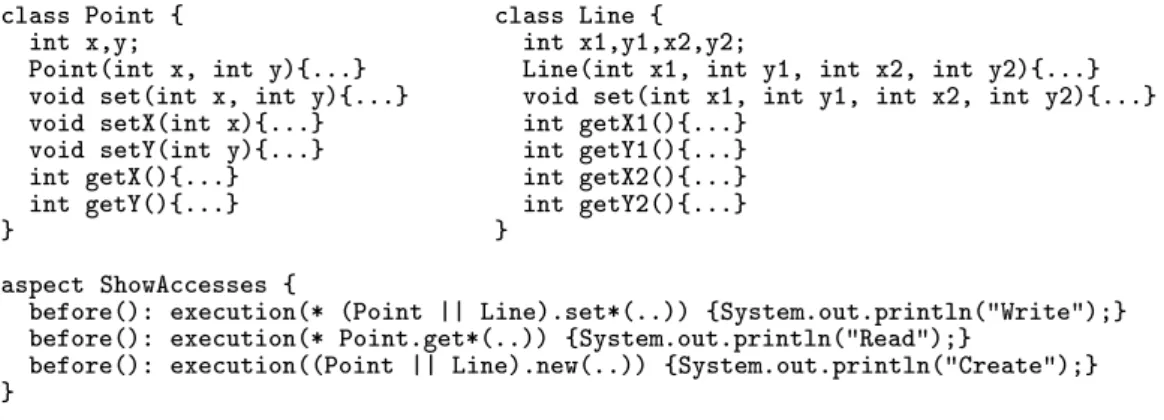
class Point { class Line {
int x,y int x1,y1,x2,y2
Point(int x, int y){...} Line(int x1, int y1, int x2, int y2){...} void set(int x, int y){...} void set(int x1, int y1, int x2, int y2){...}
void setX(int x){...} int getX1(){...}
void setY(int y){...} int getY1(){...}
int getX(){...} int getX2(){...}
int getY(){...} int getY2(){...}
} }
aspect ShowAccesses {
before(): execution(* (Point || Line).set*(..)) {System.out.println("Write")} before(): execution(* Point.get*(..)) {System.out.println("Read")}
before(): execution((Point || Line).new(..)) {System.out.println("Create")} }
Fig. 1.Tracking access in AspectJ.
3.2. Aspect-Oriented Programming and Related Approaches
According to one of those who stood upon the birth of the aspect-oriented programming, Gregor Kiczales, aspect-oriented programming
(AOP) is a new programming paradigm that enables the modularization of crosscutting con-cerns KLM+97
]. We’ll take a closer look at four main AOP approaches.
Xerox PARC Aspect-Oriented Programming
Most of the AOP terminology (as well as its name) later adopted by others was coined by Xerox PARC AOP group. Their research effort is concentration mainly on AspectJ Xera], a general purpose AOP extension to Java LK98]. AOP appeared as a reaction to the problem known from thegeneralized procedure langua-ges KLM+
97], i.e. languages that use the con-cept of procedure to capture functionality( be-sides procedural languages, this includes func-tional and object-oriented languages as well). In such languages some program code frag-ments that implement a clearly separableaspect of a system(such as synchronization)are scat-tered and repeated throughout the program code that becomes tangled. AOP aims at factoring out such aspects into separate units. Aspects crosscut the base code in join points. These must be specified so aspects could be woven into the base code by aweaver.
A simple example written in AspectJ v1.0.0
(similar to the example in LK98]) in Fig. 1 illustrates the idea. Two classes are presented there, Point and Line, whose methods are of
three kinds: creating, writing and reading( im-plementation of the methods is omitted). Sup-pose we want to be informed what kind of access to these classes has been performed. In ordinary Java we would have to modify each method of bothPointandLine. Moreover, this would re-sult in a tangled code. In AspectJ both problems can be avoided using aspects. In our example it is the aspect ShowAccesses that solves the problem. Note that the original code remains unchanged.
The solution with aspects is undoubtedly more elegant than the tangled one would be. How-ever, the information where an aspect is to be woven (i.e., join points) is included in the as-pect itself. This complicates the asas-pect reuse. AspectJ addresses this problem with abstract aspects and named sets of join points, so-called pointcuts.
Adaptive Programming
Fig. 2.Traversal strategies(fromLie97], c 1997 Northeastern University).
The traversal strategies are partial graph speci-fications through mentioning a few isolated cor-nerstone nodes and edges, and thus they cross-cut the graphs they are intended for.
An example of AP is presented in Fig. 2. The left part of the figure presents a UML class diagram of a system. Assume we would like to count the people waiting at the bus sta-tions along the bus route. In ordinary OOP this would require either the implementation of small methods in all of the affected classes( de-picted shaded)or rough breaking of the encap-sulation by exposing some of the classes’ private data.
If we use a traversal strategy, as it is proposed in AP, there is no need for a change in the existing classes. In this case, the traversal strategy:
from BusRoute through BusStop to Person
solves the problem of getting to objects of the classPersonalong the bus route, which is suf-ficient to count them. The right part of Fig. 2 demonstrates the robustness of this technique: the traversal strategy mentioned above applies in this case as well although the class diagram it was constructed for has changed.
Composition Filters
Composition filters (CF) is an aspect-oriented programming approach in which different as-pects are expressed as declarative and orthogo-nal message transformation specifications called filters AT98].
A message sent to an object is evaluated and manipulated by the filters of that object, which are defined in an ordered set, until it is dis-carded or dispatched (i.e., activated or dele-gated to another object). A filter behavior is simple: each filter can either accept or reject the received message, but the semantics of the operations depends on the filter type. For ex-ample, if an Error filter accepts the received message, it is forwarded to the next filter, but if it was aDispatchfilter, the message would be executed. A detailed description of CF can be found in AWB+93, Koo95
].
In Fig. 3 two sets of filters(written in Sina lan-guage Koo95], which directly adopts the CF model AT98, AWB+93
]), are shown. These
Point
acc: ShowAccess inputfilters
WriteAccess: Dispatch = {set, acc.WriteAccess, inner.*} ReadAccess: Dispatch = {getX, getY, acc.ReadAccess, inner.*} CreateAccess: Dispatch = {Point, acc.CreateAccess, inner.*} Execute: Dispatch = {true => inner.*}
Line
acc: ShowAccess inputfilters
WriteAccess: Dispatch = {set, acc.WriteAccess, inner.*}
ReadAccess: Dispatch = {getX, getY, getX1, getY1, acc.ReadAccess, inner.*} CreateAccess: Dispatch = {Line, acc.CreateAccess, inner.*}
Execute: Dispatch = {true => inner.*}
filters are attached to thePointandLineclasses from Fig. 1. The existence of the class
ShowAccessis presumed. ShowAccessprovides three methods — WriteAccess, ReadAccess andCreateAccess)— that simply write out the type of the access. They are called by the three correspondingDispatchfilters, in case the mes-sage was accepted. Afterwards, the method of the inner object, which has actually been called, is executed(inner.*).
From the perspective of AOP, the class
ShowAccess implements the aspect, while the filters represent the join points. Thus, the join points in this case are separated from the aspect, which is better regarding the aspect reuse.
Subject-Oriented Programming
A concept can be defined by naming its prop-erties. This is sufficient to precisely define and identify mathematical concepts, but the same does not apply to natural concepts. Their def-initions aresubjectiveand thus never complete (more details about conceptual modeling can be found in CE00]).
Subject-oriented programming (SOP), devel-oped at IBM as an extension to OOP IBM], is based on subjective views, so-calledsubjects. A subject is a collection of classes or class frag-ments whose hierarchy models its domain in its own, subjective way. A complete software sys-tem is then composed out of subjects by writing thecomposition rules, which specify correspon-dence of the subjects(i.e., namespaces), classes and members to be composed and how to com-bine them.
As a result of the research effort in SOP, the Wat-son Subject Compiler was developed KOHK96],
which allows partial(subjective)definitions of C++program elements and automates the com-position required to produce a running program. There are also other platforms SOP support was built for, such as IBM VisualAge for C++ Ver-sion 4, HyperJ and Smalltalk.
The example from Fig. 1 reimplemented in Wat-son Subject Compiler-like syntax (the actual syntax could by slightly different)is presented in Fig. 4. We assume that the classShowAccess is implemented in Accessnamespace and that the classes Point and Line are implemented in the Graphics namespace. The join-points, represented by composition rules, are separated from the aspect and represented by a separate class (as in CF approach). The composition rules for the methodsgetY,getX1, getY1 and
getX2 are omitted in Fig. 4 (indicated by el-lipsis)since they are analogous to the rules for
getXorgetY2.
This is not a characteristic case of the applica-tion of SOP (such can be found in OHBS94, KOHK96, IBM]); it is presented here in order to show how a well-known AOP example can be easily transformed into its SOP version. Never-theless, there is no general agreement whether SOP is AOP. In CE00]SOP is viewed as a spe-cial case of AOP where the aspects according to which the system is being decomposed are chosen in such a manner that they represent dif-ferent, subjective views of the system. On the other hand, Kiczales et al. reject the very idea that SOP(which they call subjective
program-ming)could be AOP, arguing that the methods from different subjects, which are being auto-matically composed in SOP, are components in the AOP sense, since they can be well localized in a generalized procedure(routine) KLM
+97 ].
namespace GraphicsWithAccess{ class Point
class Line}
GraphicsWithAccess.Point.Point := MergeGraphics.Point.Point, Access.ShowAccess.CreateAccess] GraphicsWithAccess.Line.Line := MergeGraphics.Point.Line, Access.ShowAccess.CreateAccess]
GraphicsWithAccess.Point.set := MergeGraphics.Point.set, Access.ShowAccess.WriteAccess] GraphicsWithAccess.Line.set := MergeGraphics.Line.set, Access.ShowAccess.WriteAccess]
GraphicsWithAccess.Point.getX := MergeGraphics.Point.getX, Access.ShowAccess.ReadAccess] . . .
GraphicsWithAccess.Line.getY2 := MergeGraphics.Line.getY2, Access.ShowAccess.ReadAccess]
But this seems to be a more general issue, since it applies to AspectJ, too, where it has been identified asaspectual paradoxby Liebrherr et al. LLM99]:
An aspect described in AspectJ, the Xerox PARC’s AOP language, which has a construct for specifying aspects, is by definition no longer an aspect, as it has just been captured in a(new kind of)generalized routine.
As observed in Cza98], SOP is close to Gen-Voca BG97], a successful approach to software reuse. In GenVoca, systems are composed out of layers according to design rules: GenVoca layers can be easily simulated by subjects.
3.3. Generative Programming
Krysztof Czarnecki and Ulrich Eisenecker pro-pose a comprehensive software development paradigm which brings together the object-ori-ented analysis and design methods with domain engineering methods that enable development of the families of systems: generative program-ming CE00]:
Generative programming (GP) is a software engineering paradigm based
on modeling software systems fami-lies such that, given a particular re-quirements specification, a highly cus-tomized and optimized intermediate or end-product can be automatically manufactured on demand from ele-mentary, reusable implementation components by means of configura-tion knowledge.
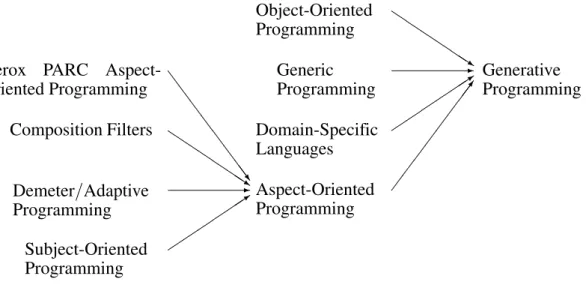
GP is a unifying paradigm — it is closely related to four other paradigms(see Figure 5):
object-oriented programming, providing ef-fective system modeling techniques,
generic programming, enabling reuse through parameterization,
domain-specific languages, increasing the abstraction level for a particular domain, and aspect-oriented programming, used to achi-eve the separation of concerns.
In order to be used, GP first has to be tailored to a particular domain. This process will yield a methodology for the families of systems to be developed, which can be viewed as a paradigm in its own right. This gives a certain meta-paradigm flavor to GP.
In the solution domain, GP requires metapro-gramming for weaving and automatic config-uration. To support domain-specific notations, syntactic extensions are needed.Active libraries
Xerox PARC Aspect-Oriented Programming
Composition Filters
Demeter/Adaptive Programming
Subject-Oriented Programming
S S
S S
S S
S S w Q
Q Q
Q Q
Q s
3
Object-Oriented Programming
Generic Programming
Domain-Specific Languages
Aspect-Oriented Programming
Q Q
Q Q
Q Q s
3
7
Generative Programming
are proposed in CE00], which can be viewed as knowledgeable agentsinteracting with each other to produce concrete components, as ap-propriate to cover this requirement.
4. Multi-Paradigm Approaches
In the survey of recent post-object-oriented soft-ware development paradigms presented in the previous section a spontaneous move towards the integration of paradigms became apparent. This section proceeds with explicit multi-para-digm approaches.
4.1. Multi-Paradigm Programming in Leda
The question how to support multi-paradigm programming at the language level can be an-swered simply: create a multi-paradigm lan-guage. Timothy Budd took this route by cre-ating a multi-paradigm programming language called Leda.
According to Budd, Leda supports four pro-gramming paradigms Bud95]: imperative( pro-cedural, to be more precise) logic, functional, and object-oriented. The term paradigm, as used by Budd, denotes a large-scale paradigm
(with respect to the classification of paradigms introduced in Section 2). This means that Leda actually supports more than four small-scale paradigms. This is clear having in mind that, for example, object-oriented paradigm breaks down into six or more small-scale paradigms, as has been shown in Section 4.2. Nevertheless, in order not to digress from the intent of this approach, just the mechanisms by which each of the four proclaimed paradigms is supported in the language will be discussed.
Leda has a Pascal-like(i.e., Algol-like)syntax and, moreover, in Leda the mechanism upon which all the four supported paradigms realiza-tion is based on are funcrealiza-tions(procedures that return values). This makes a good background for procedural paradigm, denoted by Budd as imperative.
Logic paradigm is supported by a special type of function that returns relation data type and by a special assignment operator<-. These in-dicate when the inference mechanism, inherent to logic programming, is to be activated.
Functional paradigmrequires no special mech-anism other than those provided by functions, because Leda permits a function to be an argu-ment of another function and to return a func-tion. Thus, functional paradigm is achieved by using functions in the recursive fashion while refraining from assignments.
In addition to the basic mechanisms of object-oriented paradigm, such as classes, inheritance, encapsulation etc., Leda also supports parame-terized types(considered by some authors a part of object-oriented paradigm Mey97]).
Despite Leda is not widely used, it is worth con-sideration because it demonstrates the combina-tion of paradigms. For example, the inference mechanism of logic programming can be used inside of a procedure.
Of course, creating a language that supports multiple paradigms and expecting it to be the best language for programming is similar to a search for the best programming paradigm. No matter how many paradigms are supported in a programming language, the number is fi-nite and, obviously, it does not embrace future paradigms. One can argue that it is possible to extend the language with new programming mechanisms in order to support new paradigms. This is not only possible, but often practiced. Unfortunately, due to limitations set by parsing methods, programming languages cannot be ex-tended indefinitely.
Leda is an example of a languagecreated(from scratch)in order to support multiple paradigms. We can study existing interconnecting languages that support different paradigms through an in-terface instead of making a completely new lan-guage(a sort of language reuse). There is also a possibility of implementing one language on top of the other, but this leads to a certain degra-dation of performance. An example of intercon-necting object-oriented and logic programming
(Loops and Xerox Quintus Prolog)can be found in KE88].
two paradigms traditionally used in this field, logic and functional programming, both with each other and together with OOP.
Different paradigms are expressed using differ-ent syntax. BETA language Mad00] is sup-posed to overcome this inconvenience through aunified syntaxachieved by introducing the so-calledpatternas an abstraction of all other pro-gramming language constructs appearing in the paradigms it supports. The approach is there-fore denoted as unified paradigm, but it is not fundamentally different from other “created to be multi-paradigm” languages.
4.2. Multi-Paradigm Design for C++
Multi-paradigm design for C++(MPD), as pro-posed by Coplien Cop99b, Cop00], has its roots in the multi-paradigm features of C++. De-spite these multi-paradigm features, C++is of-ten considered to be just an object-oriented lan-guage. As such, C++is used to implement the systems designed according to object-oriented paradigm. However, non-object-oriented fea-tures of C++ are widely used, but without a support in the(object-oriented)design.
MPD is a metaparadigm intended for develop-ing families of systems, therefore akin to do-main engineering approaches. It deals with choosing the appropriate paradigm for a fea-ture being designed and implemented. MPD is based on SCV analysis (discussed in Sec-tion 2.2)or, to be more precise, SCVR analysis, where R stands for the relationship between the domains Cop00], which are covered by vari-ability dependency graphs(explained further in this section). On the other hand, neither SCV, nor SCVR analysis is mentioned in Cop99b]; the term commonality and variability analysis is used instead to denote the same thing. Com-monality analysis concentrates on common at-tributes while the aim of variability analysis is to parameterize the variation.
The major steps in MPD are: commonality and variability analysis of the application domain, commonality and variability analysis of the so-lution domain, transformational analysis and translation from the transformational analysis to the code. These steps need not to be performed sequentially. They can be performed in par-allel (to some extent)and revisited as needed.
Before starting the actual MPD, it is recom-mended to evaluate the possibility to reuse an existing (similar) design. If the commonali-ties and variabilicommonali-ties of the application domain do not fit any existing solution domain struc-tures, creation of a new application-oriented
(i.e., domain-specific)language should be con-sidered.
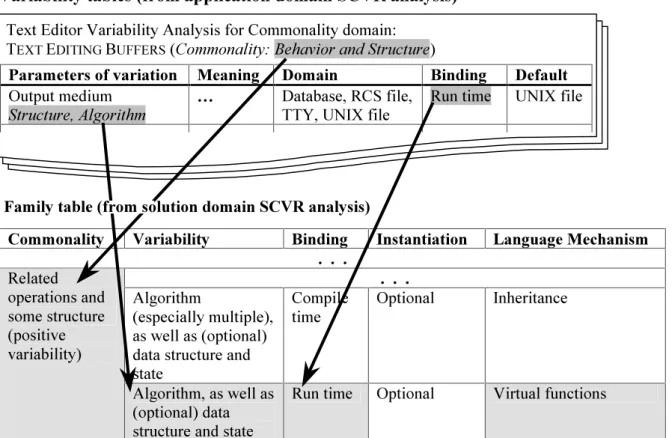
Application domain analysis. Commonality analysis of the application domain(usually de-noted as problem domain) starts with finding commonality domains and creating domain dic-tionary. It then proceeds in parallel with vari-ability analysis, whose results — the parame-ters of variationof a given commonality domain and their characteristics — are being summa-rized in variability tables (one per each com-monality domain), as depicted in the upper part of Fig. 6.
As already mentioned, variability dependency graphs (denoted also as domain dependency graphs or diagrams)are used to capture the rela-tionship between domains and their parameters of variation, which are also domains. Variability dependency graphs are directed graphs whose nodes represent domains and the edges repre-sent “depends on” relationship(in the direction indicated by an arrow)between the domains and their parameters of variation. Despite the sim-ple notation, variability dependency graphs are quite useful in identifyingoverlappingdomains (such domains can be merged) and
codepen-dent domains, i.e. the domains with circular dependencies(which must be resolved).
9DULDELOLW\WDEOHVIURPDSSOLFDWLRQGRPDLQ6&95DQDO\VLV
&RPPRQDOLW\ 9DULDELOLW\ %LQGLQJ ,QVWDQWLDWLRQ /DQJXDJH0HFKDQLVP
$OJRULWKP
HVSHFLDOO\PXOWLSOH DVZHOODVRSWLRQDO GDWDVWUXFWXUHDQG VWDWH
&RPSLOH
WLPH 2SWLRQDO ,QKHULWDQFH 5HODWHG
RSHUDWLRQVDQG VRPHVWUXFWXUH SRVLWLYH YDULDELOLW\
$OJRULWKPDVZHOODV RSWLRQDOGDWD VWUXFWXUHDQGVWDWH
5XQWLPH 2SWLRQDO 9LUWXDOIXQFWLRQV
3DUDPHWHUVRIYDULDWLRQ 0HDQLQJ 'RPDLQ %LQGLQJ 'HIDXOW
2XWSXWPHGLXP
6WUXFWXUH$OJRULWKP « 'DWDEDVH5&6ILOH77<81,;ILOH 5XQWLPH 81,;ILOH
7H[W(GLWRU9DULDELOLW\$QDO\VLVIRU&RPPRQDOLW\GRPDLQ 7(;7(',7,1*%8))(56&RPPRQDOLW\%HKDYLRUDQG6WUXFWXUH
)DPLO\WDEOHIURPVROXWLRQGRPDLQ6&95DQDO\VLV
Fig. 6. Transformational analysis in MPD(according to an example fromCop99b] ).
should be refactored to reverse the commonality and variability.
The results of the solution domain commona-lity and variabicommona-lity analysis are summarized in the family table, as shown in the lower part of Fig. 6, and in the table used to expressfeatures for negative variability, where for each combi-nation of the kind of commonality and the kind of variability the language feature for positive variability and the one for the corresponding negative variability are introduced.
Transformational analysis. The tables ob-tained in the preceding analyses are used in transformational analysis, which is, roughly speaking, a matching of application domain structures described in variability tables, with solution domain structures, i.e. paradigms, de-scribed in family tables. Figure 6 shows how this matching is performed. Prior to the match-ing, the commonality domain has to be genera-lized(e.g., TEXTEDITINGBUFFERS: behavior,
structure), as well as the parameters of variation (e.g., output medium: structure, algorithm).
MPD emphasizes the solution domain analysis whose underestimation in contemporary soft-ware development methodologies results in a gap between design and implementation.
To a certain extent, MPD enforces thereuse of design: both application and solution domain analysis can be reused independently; however, transformational analysis is not reusable. This brings MPD close to design patterns, as dis-cussed in Cop99b]. On the very cover of the de-sign patterns cornerstone book GHJV95]Steve Vinoski points out that a reusable design is “the real key to software reuse”. This claim is being justified in the ongoing research on reuse with design patterns SN00].
Although the design patterns from GHJV95] are inspired by Alexandrian patterns Ale79], not all of them are the patterns in the Alexan-drian sense: some of them can be formalized as configurations of commonality and variability
(unlike Alexandrian patterns). As such they can be incorporated directly into MPD (by adding them to the family table), as anything else that can be formalized as a configuration of com-monality and variability (i.e., other paradigms and solution domain tools that are not sup-ported by the main programming language, like databases or parser generators) Cop99b]. One of the problems with MPD is the unsui-tability of the notation used: only a few types of tables and variability diagrams with a lot of relevant details expressed as informal text. With a better notation, like feature modeling Vra01], transformational analysis could become more transparent. A better notation could also ease the transition to the actual program code (the program skeleton).
4.3. Intentional Programming
Programming languages with fixed syntax are limiting otherwise unlimited number of pro-gramming abstractions. Intentional program-ming group at Microsoft Research offered a so-lution to this problem as a new software deve-lopment paradigm called intentional program-ming(IP) Sim99, Sim96](the project is on hold from Spring 2001 Roe]). The idea behind IP is that programming abstractions, which are in IP denoted asintentions, could live better without their hosts, (fixed-syntax) programming lan-guages, because of their limits in the accepted notations(due to underlying grammars). A program in IP is represented by a so-called intentional tree, whose nodes represent inten-tion instances. Each inteninten-tion instance points to the corresponding intention declaration node providing a method which specifies the process of transforming the subtree headed by the in-tention instance. The executable program is obtained in a process calledreductionin which the intentional tree is traversed and transformed according to the rules indicated by intention declarations until it consists only of executable nodes. Such areducedtree is represented in an intermediate language. The executable code is generated from this representation.
It would be inconvenient for a human to directly maintain the intentional tree. This is being per-formed in a programming environment with a special graphic editor instead of the usual text editor. It enables each intention to have its own graphic representation. Of course, entering a program in such an environment is quite differ-ent from differ-entering it in a classic text editor. A program text, as we are used to it, is a complete and an unambiguous representation of the pro-gram. In IP environment this is not so. What is presented in IP editor is only a view of the actual program. To illustrate this, consider one peculiarity: two distinct variables can have the same name(even if they reside the same scope). This is possible because the intentional tree does not rely on the names to identify intentions; the names are provided only for developers’ conve-nience.
Although it can seem so, IP is not intended to push out the existing programming languages from the scene. It can import any program in any programming language if a parser for that language — in the form of a library — is added to IP environment.
4.4. Multi-Paradigm Approaches Compared
The three multi-paradigm approaches presented in this section are compared in Table 1 ac-cording to the selected criteria: the concept of paradigm the approach enforces, a program-ming language the approach is bound to, and whether the approach supports thelanguage ex-tension.
Paradigm Language Language extension
MP in Leda large-scale Leda no
MPD small-scale any not applicable
IP small-scale none yes
Table 1.The three multi-paradigm approaches compared.
5. Conclusions and Further Work
The concept of paradigm in computer science in the context of software development has been analyzed in this article. Two distinct meanings of paradigm in software development have been identified and discussed: large-scale and small-scale.
A survey of selected post-object-oriented para-digms, namely aspect-oriented approaches and generative programming, has been presented. A growing multi-paradigm tendency has been identified in these approaches. This tendency has materialized into explicit multi-paradigm approaches. Three such approaches have been discussed and compared: multi-paradigm pro-gramming in Leda, multi-paradigm design for C++, and intentional programming.
Multi-paradigm approach to software develop-ment makes the question which paradigm is the best(and therefore should replace all other paradigms)a meaningless one. It has a poten-tial of incorporating all the paradigms at dis-posal of the solution domain. It is a paradigm of paradigms: a metaparadigm.
However, multi-paradigm software development must be further improved and refined if it is to be used in its full strength. Among the paradigm approaches considered, multi-paradigm design(for C++), described in Sec-tion 4.2, seems to be the most appropriate as the basis for the future form of multi-paradigm software development.
Multi-paradigm design can be tailored to any programming language by applying common-ality and variability analysis to it. It would be particularly interesting to establish multi-paradigm design for AspectJ(see Section 3.2) since it could help to understand better the re-lationship between multi-paradigm design and aspect-oriented programming(although, of co-urse, AspectJ is not the same as aspect-oriented
programming in general), which Coplien de-noted as “the most fully general implementation of multi-paradigm design possible” Cop00]. An initial work towards establishing multi-para-digm design for AspectJ has been reported in
Vra01].
The notation used in multi-paradigm design, which besides informal description embraces only two types of tables and a kind of sim-ple graphs, is not appropriate. This is appa-rent especially during transformational analysis. Similarly to commonality and variability analy-sis of multi-paradigm design,feature modeling also expresses commonalities and variabilities explicitly, but using a more sophisticated no-tation (see CE00] for more details on feature modeling and feature diagrams). Both solu-tion and applicasolu-tion domains can be represented as feature models, as has been demonstrated in Vra01]. This eases transformational analysis and brings multi-paradigm design and genera-tive programming closer to each other.
Acknowledgments
This work was partially supported by Slovak Science Grant Agency, grant No. G1/7611/20. I would like to thank Pavol N´avrat for his valu-able suggestions.
References
Ale79] C. ALEXANDER.The Timeless Way of Building.
Oxford University Press, 1979. Cited inCop99b].
AT98] M. AKSIT ANDB. TEKINERDOGAN. Solving the
modeling problems of object-oriented languages by composing multiple aspects using composition fil-ters. InProc. of the Aspect-Oriented Programming Workshop at ECOOP’98, 1998. Available atTwe].
AWB +93
] M. AKSIT, K. WAKITA, J. BOSCH,
L. BERGMANS, AND A. YONEZAWA. Abstracting
Proc. of 7thEuropean Conference on Object-Oriented Programming (ECOPP’93) Workshop, LNCS 791, pages 152–184, Kaiserslautern, Ger-many, 1993. Springer. Available atTwe].
BG97] D. BATORY ANDB. J. GERACI. Composition
vali-dation and subjectivity in GenVoca generators.IEEE Transactions on Software Engineering (special is-sue on Software Reuse), pages 67–82, February 1997. Available atPro].
Boo94] G. BOOCH.Object-Oriented Analysis and
De-sign with Applications. Addison-Wesley Publishing Company, second edition, 1994.
Bud95] T. A. BUDD. Multiparadigm Programming in
Leda. Addison-Wesley, 1995.
CE00] K. CZARNECKI ANDU. EISENECKER.Generative
Programing: Principles, Techniques, and Tools. Addison-Wesley, 2000.
CHW98] J. COPLIEN, D. HOFFMAN, AND D. WEISS.
Commonality and variability in software engi-neering. IEEE Software, 15(6), November 1998.
Available atCop].
Cop] J. O. COPLIEN. Home page.
http://www.bell-labs.com/people/cope. Accessed on Novem-ber 15, 2001.
Cop99a] J. O. COPLIEN. Multi-paradigm design and
im-plementation in C++. Slides and notes of the
tutorial given at 1st International Conference on Generative and Component-Based Software Engi-neering (GCSE’99), Erfurt, Germany, September 1999. Available atCop].
Cop99b] J. O. COPLIEN. Multi-Paradigm Design for
C++. Addison-Wesley, 1999.
Cop00] J. O. COPLIEN. Multi-Paradigm Design. PhD
thesis, Vrije Universiteit Brussel, Belgium, 2000. Available atCop].
Cza] K. CZARNECKI. Home page.
http://www.prakinf.tu;ilmenau.de/czarn.
Accessed on November 15, 2001.
Cza98] K. CZARNECKI. Generative Programming:
Principles and Techniques of Software Engineering Based on Automated Configuration and Fragment-Based Component Models. PhD thesis, Technical University of Ilmenau, Germany, 1998. Partially available atCza].
Dem] Demeter group. Home page.
http://www.ccs.neu.edu/research/demeter. Accessed on October 30, 2001.
GHJV95] E. GAMMA, R. HELM, R. JOHNSON, AND
J. VLISSIDES. Design Patterns: Elements of
Reusable Object-Oriented Software. Addison-Wesley, 1995.
IBM] IBM Research. Subject-Oriented Programming
home page.
http://www.research.ibm.com/sop. Accessed on August 15, 2000.
KE88] T. KOSCHMANN ANDM. W. EVENS. Bridging the
gap between object-oriented and logic program-ming.IEEE Software, 60:36–42, July 1988.
KLM +97
] G. KICZALES, J. LAMPING, A. MENDHEKAR,
C. MAEDA, C. V. LOPES, J.-M. LOINGTIER, AND
J. IRWIN. Aspect-oriented programming. In M.
Ak-sit and S. Matsuoka, editors, Proc. of 11th Euro-pean Conference on Object-Oriented Programming (ECOOP’97), LNCS 1241, Jyv¨askyl¨a, Finland, June 1997. Springer. Available atXerb].
KOHK96] M. KAPLAN, H. OSSHER, W. HARRISON,AND
V. KRUSKAL. Subject-oriented design and the
wat-son subject compiler. In 11th Annual ACM Con-ference on Object-Oriented Programming Systems, Languages and Applications (OOPSLA’96), 1996. Available atIBM].
Koo95] P. S. KOOPMANS. On the definition and
imple-mentation of the Sina/st language. Master’s thesis,
Dept. of Computer Science, University of Twente, The Netherlands, August 1995. Available atTwe].
Kuh70] T. S. KUHN.The Structure of Scientific
Revolu-tions. University of Chicago Press, Chicago, 1970. Czech translation, OIKYMENH, 1997.
Lie] K. J. LIEBERHERR. Connections between
Deme-ter/adaptive programming and aspect-oriented
pro-gramming. Web document, College of Computer Science, Northeastern University, Boston, USA. Available atDem].
Lie97] K. J. LIEBERHERR. Demeter and aspect-oriented
programming: Why are programs hard to evolve? Presentation slides, 3rd Conference Smalltalk und Java in Industrie und Ausbildung (STJA 97), Erfurt, Germany, 1997. Available atDem].
LK98] C. V. LOPES AND G. KICZALES. Recent
de-velopments in AspectJ. In Proc. of 12th Eu-ropean Conference on Object-Oriented Program-ming (ECOPP’98) Workshops, Demos, and Posters, LNCS 1543, Brussels, Belgium, July 1998. Springer. Available atXerb].
LLM99] K. J. LIEBERHERR, D. LORENZ, AND
M. MEZINI. Programming with aspectual
com-ponents. Technical Report NU-CCS-99-01, Col-lege of Computer Science, Northeastern University, Boston, MA, March 1999. Available atDem].
Mad00] O. L. MADSEN. Towards a unified
program-ming language. In J. L. Knudsen, editor, Proc. of 14th European Conference on Object-Oriented Programming(ECOOP 2000), Sophia Antipolis and Cannes, France, June 2000. Springer LNCS 1850.
Mer] Merriam-Webster OnLine. Merriam-Webster’s
Collegiate Dictionary.http://www.m-w.com. Ac-cessed on November 15, 2001.
Mey97] B. MEYER.Object-Oriented Analysis Software
Construction. Prentice Hall, second edition, 1997.
NEC] NEC Research Institute. ResearchIndex: The
NECI Scientific Digital Research Library.
N´av96] P. N ´AVRAT. A closer look at programming
exper-tise: Critical survey of some methodological issues.
Information and Software Technology,38(1):37–46,
1996.
OHBS94] H. OSSHER, W. HARRISON, F. BUDINSKY,AND
I. SIMMONDS. Subject-oriented programming:
Sup-porting decentralized development of objects. In
Proc. of 7th IBM Conference on Object-Oriented Technology, July 1994. Available atIBM].
Pro] Product-Line Architecture Research group. Home
page.http://www.cs.utexas.edu/users/ schwartz. Accessed on November 15, 2001.
Roe] L. ROEDER. Home page.
http://www.aisto.com/roeder. Accessed on November 21, 2001.
Sim96] C. SIMONYI. Intentional programming —
inno-vation in the legacy age, June 1996. Presented at IFIP WG 2.1 meeting, available atRoe].
Sim99] C. SIMONYI. The future is intentional. IEEE
Computer, 32(5):56–57, May 1999.
SN97] M. SMOLAROV´ A AND´ P. N´AVRAT. Software reuse:
Principles, patterns, prospects.Journal of Comput-ing and Information Technology, 5(1):33–48, 1997.
SN00] M. SMOLAROV´ A AND´ P. N´AVRAT. Reuse with
de-sign patterns: Towards pattern-based dede-sign. In Y. Feng, D. Notkin, and M. Gaudel, editors,Proc. Software: Theory and Practice, pages 232–235, Beijing, China, 2000. PHEI - Publishing House of Electronics Industry.
SNB98] M. SMOLAROV´ A´, P. N ´AVRAT, AND M. BE -LIKOVA´. Abstracting and generalising with design
patterns. In A. G. U. G¨ud¨ukbay, T Dayar and E. Gelenbe, editors, Proc. of 13th International Symposium on Computer and Information Sciences (ISCIS’98), pages 551–558, Belek-Antalya, Turkey, 1998. IOS Press.
Twe] Twente Research and Education on
Soft-ware Engineering (TRESE) group. Home page.
http://trese.cs.utwente.nl. Accessed on November 15, 2001.
Vra00] V. VRANIC´. Multiple software development
paradigms and multi-paradigm software develop-ment. In J. Zendulka, editor, Proc. of 3rd Inter-national Conference on Information Systems Mod-elling (ISM 2000), pages 191–196, Roznov podˇ
Radhoˇstem, Czech Republic, May 2000. MARQ.ˇ
Vra01] V. VRANIC´. AspectJ paradigm model: A basis
for multi-paradigm design for AspectJ. In J. Bosch, editor, Proc. of 3rd International Conference on Generative and Component-Based Software Engi-neering (GCSE 2001), LNCS 2186, pages 48–57, Erfurt, Germany, September 2001. Springer.
VS95] S. VRANES ANDˇ M. STANOJEVIC´. Integrating
multiple paradigms within the blackboard frame-work.IEEE Transactions on Software Engineering, 21(3):244–262, 1995.
Xera] Xerox PARC. AspectJ home page.
http://aspectj.org. Accessed on November 15, 2001.
Xerb] Xerox PARC. Software Design Area home page.
http://www.parc.xerox.com/sda. Accessed on November 15, 2001.
Received:February, 2001 Revised:November, 2001 Accepted:December, 2001
Contact address: Valentino Vrani´c Department of Computer Science and Engineering, Faculty of Electrical Engineering and Information Technology Slovak University of Technology in Bratislava, Slovakia Ilkovicova 3ˇ 812 19 Bratislava Slovakia Phone:+421(2)602 91 548 Fax:+421(2)654 20 587 e-mail:[email protected] WWW:http://www.dcs.elf.stub a.sk / vra nic