doi: 10.17700/jai.2019.1.1.498 21 Attila Sándor Debrenti, Adrián Csordás, Miklós Herdon: Management support systems in the Hungarian food-manufacturing sector
Hungarian Association of Agricultural Informatics European Federation for Information Technology in Agriculture, Food and the Environment
Journal of Agricultural Informatics. Vol. 10, No. 1 journal.magisz.org
Management support systems in the Hungarian food manufacturing sector
Attila Sándor Debrenti1, Adrián Csordás2, Miklós Herdon3
I N F O
Received 02 Jun 2019 Accepted 10 Jun 2019 Available on-line 30 Sep 2019 Responsible Editor: L.Várallyai
Keywords:
Digitalisation, Business Intelligence, DSS, ERP, Food sector, Hungary, IT, Industry 4.0
A B S T R A C T
Today businesses in the food sector face many problems: decreasing profitability, increasing competition, and rapidly changing consumer demands, resulting from the global crisis. Decision support systems have recently proved themselves to be helpful tools and are becoming essential to stay competitive within most sectors of the food industry. The development of the digitalization of Hungarian enterprises is essential to increase competitiveness and efficiency. That is why the initiative of the strategic task for the food sector digitalization is vital. For the development of the strategy, it is advisable to know the position and opinion of the players in the sector. In this research, set out to create a pre-study work. In the article, the research examined the conditions of decision support and management support that are necessary for the company to operate more efficiently to make better decisions. So focus was on integrated enterprise information systems, management support systems, business intelligence systems, industry 4.0 technologies, and issues related to their application. An analysis based on a questionnaire survey covered the Hungarian food processing sector. According to the survey, the sector needs significant improvement and creating a digitalization strategy.
1.
Introduction
In terms of production value, the food industry is the third largest in Hungary, the first in Hungary in terms of the number of employees, and the first in Europe in the processing industry, as well as a significant user of resources. Agri-food enterprises operate in a complex and dynamic environment (Wolfert et al. 2010) and facing different challenges, such as financial issues, lack of technical skills and investment in the business etc. (Sing et al. 2019, Zhang 2012). In this sense, several key factors can help food SMEs. Therefore, increasing productivity and efficiency in the food industry is extremely important, and the application of Industry 4.0 and digitization offers many new opportunities. In this way, new products, new services, new solutions, and approaches can be developed to use resources better, improve quality parameters, create new skills, and competencies.
According to Shirazi (2018), distributed enterprise resources planning (ERP) can be customized to the specific requirements of each segment in networked structures for upgrading the small & medium enterprises' (SMEs) value chain. The implementation and control processes of distributed ERP systems are challenging in enterprises having limited resources. His study proposed a multi-criteria optimization method on ERP systems assessment in food industry networked enterprises. The remarkable points of the method capabilities are the multi-criteria optimization of food ERP and SMEs collaboration in the value chain's distributed platform.
1 Attila Sándor Debrenti
University of Debrecen (PhD student) [email protected]
2 Adrián Csordás
University of Debrecen (PhD student) [email protected]
3 Miklós Herdon
University of Debrecen
doi: 10.17700/jai.2019.1.1.498 22 Attila Sándor Debrenti, Adrián Csordás, Miklós Herdon: Management support systems in the Hungarian food-manufacturing sector
There are many methods to make a decision, and there is a vast range of domains in which decisions are made. The concept of DSS is vast. DSS is an IT system, which supports our decision making. When we make a decision, we choose between alternatives. DSS supports the estimation, the evaluation, and/or the comparison of alternatives, that is how it helps us to make the right choice (Alter 1980). There are five generic DSS types, which are determined based upon the dominant technology component. These are Communications-driven, Data-driven, Document-driven, Knowledge-driven, and Model-driven Decision Support Systems (Power 2004).
Communication-driven: Group Decision Support Systems (GDSS) were developed in the early 1980s, which benefits from expanded communications capabilities that became available in the computing architecture. It was the first wide category of DSS. The development of networking technologies in the last 30 years made this type of multi-participant decision support much more powerful and more ordinary. Groupware supports electronic communication, scheduling, and other group productivity and decision-support-enhancing activities. For example, the two-way interactive video, chat tools, email, and electronic whiteboard are included in this category.
Data-driven: Executive Information Systems (EIS) and data-driven spatial Decision Support Systems, management reporting and file drawer systems, data warehousing system, and Online Analytical Processing (OLAP) are included in this group. These systems emphasize access to and treatment of a great database of structured data, particularly a static time-series of internal company data and in some systems, external data. The simple file systems make available the most basic level of functionality by query and retrieval tools (Power 2004). Dhar and Stein said that the highest level of functionality and decision support are provided, what is linked to the analysis of large collections of historical data by OLAP with the Data-driven DSS (Dhar et al. 1997).
Document-driven: Swanson and Culnan called it a Document-based system. These are formation to help managers handle and regain the unstructured web sites and documents. There are different kinds of storage and processing technologies integrated into it, to provide complete document retrieval and analysis (Sasvári 2011). The access is provided by the web to huge databases, for example, a database of videos, images, pictures (Fedorowicz 1993).
Knowledge-driven: To the decision maker, these DSS can suggest or recommend actions, because they have a specialized problem-solving „expertise”. This means, these DSS knows the extraordinary domain, the DSS understands the problem with it and has proficiency at solving some of the difficulties. They operate with heuristic models, which are called inference engines (Power 2004).
Model-driven: Simple analytical and statistical tools provide the most elementary level of functionality. These are rare data intensive. However, the decision maker himself or herself should provide the data, which will be analyzed to help the user. To the decision maker, these systems should provide a simplified representation of a situation, which is understandable for him (Power et al. 2007) Accounting, financial, optimization and representation models are used by the system (Power 2000).
Wu says Business Intelligence (BI) is the successor of DSS. He writes in his article that the new generation of DSS applications evolved into BI systems (Wu 2000). According to Loshin (2012), BI includes data warehouses, business analytics tools, and knowledge management. In this wording, the author views Business Intelligence as a process, where it will generate information from data, and from information will be knowledge (Loshin 2012).
We should talk about big data as well. With the fast development of information technology tools and the need for handling, analysis and interpretation of huge interrelated datasets resulted in a new scientific field. It is called big data, according to Baranyi et al. 2013. This application can be useful for companies, so it has also appeared in DSS.
doi: 10.17700/jai.2019.1.1.498 23 Attila Sándor Debrenti, Adrián Csordás, Miklós Herdon: Management support systems in the Hungarian food-manufacturing sector
agricultural sector do not look for cloud services or big data, because the enterprise management system is not used either (Botos et al. 2015).
In order to carry out an economic activity, a functioning business association is needed (in most cases). There are the next categories of companies in Hungary: General partnership (kkt), Limited partnership (bt), Joint enterprise (kv), Limited liability company (Kft.) and Company limited by shares (Rt.) (Flanders Investment & Trade Market Survey). Categories and numbers of food, beverage, and tobacco companies in Hungary in 2016 are the following Kft: 5396, Rt: 176, kkt: 51, bt: 768.
In this article, we examined, what DSS technologies are used and how widespread is the use of the different technical solutions by food companies. We also tried to determine the factors that influenced the success or failure of DSS from the incoming questionnaires.
Hampel’s (2010) research focused on the sources of information, which was used in various areas of the operation and on decisions of a different subject. Also, it focuses on the main features and capabilities of information systems, which are used in businesses. He tried to involve 250 food companies in his research, but only 27 of them took part in it. Totally of 59 people participated in this survey. Almost half of the executives belonged to the top managers (47%), while 53% were among the middle managers. The proportion of the limited liability company (47%) and the company limited by shares (51%) was close to the same. The remaining questionnaires were returned from cooperative leaders (Hampel 2010).
Sasvári (2013) investigated how widespread are the information systems in Poland. One hundred fifty-five companies completed the anonymous questionnaire. 26% of respondents were micro-enterprises, 34% were small micro-enterprises, 25% were medium-sized micro-enterprises, and 15% were large companies (Sasvári 2013). Sasvári also studied single indicators, to get to know what existing information and communication technology is used by enterprises. He used the available Hungarian related reports issued by KSH, and international data (Statistical Office of the European Communities) as well. The author also worked with more than 6.000 items from secondary information sources (KSH 2017).
Botos et al. (2015) research focused on rural micro and small to medium enterprises about their significant economic role. With their survey, they wanted to get an answer to how firms use the internet, which are the relevant ICT for them and what it depends on. They asked several SMEs from a settlement – which is typical in the North Hungarian region, and its main profile is agriculture – to fill their survey. 106 SMEs were interviewed. Their sample represents well the enterprises of this settlement. In most cases, these were service and commercial businesses and firms related to agriculture. Füzesi et al. (2016) analysed the ICT support in the Hungarian meat sector. They explored, systemized and analyzed the applicable identification technologies applicable for meat industrial product chains. The result was that the bar code technique is currently the absolute leader in the sector, although modern solutions provide numerous advantages. Botos et. al (2018) determined the main question groups which focus mainly on ICT solutions supporting the quality of communication and relationship between partners. As the basic IT tools are available in the major part even in the SMEs besides large companies, the two main issues will be the usage of advanced online services and the usage of high quality ICT solutions. Nagy et al. (2018) made an investigation of the era of industrial digitalization in Hungary. This research compared the sectors including food industry. The automotive industry and electronics companies operating in Hungary have already started Industry 4.0 developments but the food industry is behind these sectors.
doi: 10.17700/jai.2019.1.1.498 24 Attila Sándor Debrenti, Adrián Csordás, Miklós Herdon: Management support systems in the Hungarian food-manufacturing sector
as a great opportunity of progress for the sector. It is expected that, along with others, the food and beverage industry will be pioneer in the adoption of flexible and individualized manufacturing processes.
The overall goal in the study of Demartini et al. (2018) was to help food companies toward digitalization, with a particular focus on the design and manufacturing processes. From the methodological point of view, Case Study has been used as research method. Furthermore, a questionnaire characterized by the different elements of the Manufacturing Value Modelling Methodology (MVMM) has been developed and used to gather information from companies.
The planned Hungarian digitalization strategy focuses on the entire food economy from the chain of raw material production to the final consumer, to the issues of industrial food processing. At present, this is the area of the Hungarian food processing industry where a solution should be found as soon as possible to the problems of increasing productivity, resource efficiency, labour shortages, skills shortages and which can bring tangible benefits the fastest.
Today, a wide range of management support systems and tools are available for the efficient operation of the company. The prerequisite for the application of these systems is the appropriate digitization of enterprises and their digital readiness. However, in order to develop the digitization of the food industry, it is necessary to get a picture of the situation. At what level are businesses, what tasks, what decisions, what functional areas are the current tools used, how do they judge the applicability of systems and tools and what plans do they have for developing digitization?
In this article, the most important functions, features, and aspects of these technologies for managerial decision support were examined: network infrastructure and Internet usage; use of integrated enterprise information systems (ERP); management information systems (MIS); opinions on some of the most important information technologies in business intelligence tools (BI) and Industry 4.0.
2.
Material & Methods
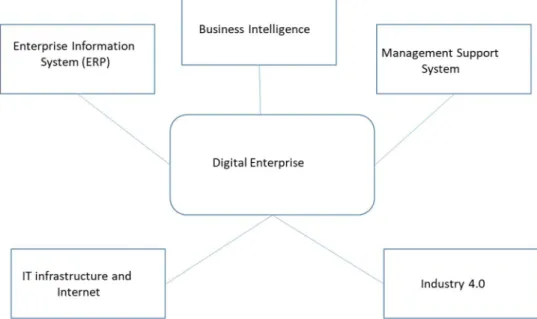
The research goal defined the research method. The use of information and decision support tools to support management was at the heart of the assessment of the situation of the digitalization of food business enterprises.The research (in 2019) examined the role and relationship of integrated enterprise information systems (ERP) or decision support, business analysis tools (BI), which are used independently of one another in the Food Industry 4.0 technology change (Figure 1).
doi: 10.17700/jai.2019.1.1.498 25 Attila Sándor Debrenti, Adrián Csordás, Miklós Herdon: Management support systems in the Hungarian food-manufacturing sector
The study was carried out with the cooperation of the Agricultural Research Institute (AKI) and the National Chamber of Agricultural Economics (NAK). The anonymous online questionnaire was filled by Hungarian food industry companies, which contain 6 question groups with 44 questions. The question groups focused on the main IT topics in the digitalization transformation.
The survey was only possible with a questionnaire survey. The preparation and implementation phases of the questionnaire were as follows.
• Phase I: Preparing survey
o Studying literature
o Mapping of related statistical databases and surveys
o Content design
o Professional review of the questionnaire • Phase II: Developing the online survey
o Selecting an online survey system (LimeSurvey on a cloud service in Germany)
o Creating an online questionnaire
o Testing survey professionals
o Modifications of the questionnaire • Phase II: Carrying out (between April-May, 2019)
o Create a mailing list server
o Send invitations by e-mail (For 4500 food-processing companies) and publish the call on NAK, AKI website
o Controlling the progress
o Statistical evaluation of the survey after the deadline Questions groups were:
• I. General enterprise information (geographical location, industry branch, ownership form, size, legal form, net sales)
• II. IT infrastructure and Internet usage (ICT tools and computer network, Internet access, website usage, cloud-based services)
• III. Enterprise information systems (ERP) (operating form, implementation, use, supported activities, satisfaction)
• IV. Using Management Information Systems (CIS) (implementation of application; needs, expectations, benefits; who uses it and what are they used for?)
• V. Using Business Analytics (BI) Tools (business analysis technologies; applied areas; advantages; future use)
doi: 10.17700/jai.2019.1.1.498 26 Attila Sándor Debrenti, Adrián Csordás, Miklós Herdon: Management support systems in the Hungarian food-manufacturing sector
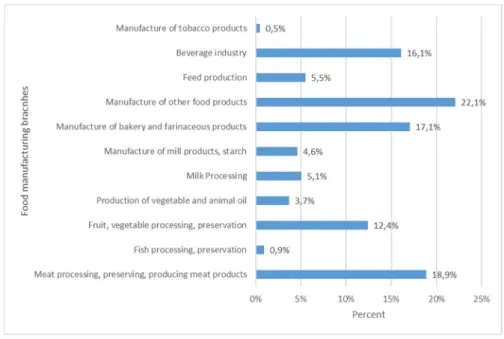
Figure 2. Number of answers by industry branches (N=232)
3.
Results
3.1.ERP in the management support
Of the 184 respondents, 60 companies (33%) have an integrated business management information system. 35% of these systems operate exclusively with internal operations and 53% with partly internal and partly external operations. Where ERP does not work, respondents have indicated the reasons which can be seen on Figure 3. From the results, it can be concluded that the proportion of small enterprises is high, where 81% of enterprises were designated as the reason. It is also not a negligible aspect that the limited financial capacity of the companies was set at 23%.
Figure 3. Reasons for why not using ERP (N=128)
doi: 10.17700/jai.2019.1.1.498 27 Attila Sándor Debrenti, Adrián Csordás, Miklós Herdon: Management support systems in the Hungarian food-manufacturing sector
justification of certain management decisions in case of larger companies. In our survey, we asked the reasons and motivations for the introduction of the system that we considered to be more important. According to Figure 4, the organizational reasons were 81% and business consideration were 65% respectively.
Figure 4. The reasons why companies implemented ERP (N=61)
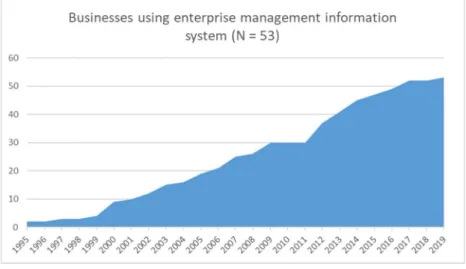
Organizations carrying out economic activities generate large amounts of information and data through their activities. Effective and fast processing of these can mean the difference between success or failure. One of the tools for managing these is integrated enterprise management systems that map enterprise business processes and have, in addition to their core functions, expanded functions that integrate their business relationships with customers (CRM) and vendors (SRM) into their information systems. Figure 5 shows the trend of using ERP in the asked food manufacturing company.
Figure 5. The increase of applying ERP system
doi: 10.17700/jai.2019.1.1.498 28 Attila Sándor Debrenti, Adrián Csordás, Miklós Herdon: Management support systems in the Hungarian food-manufacturing sector
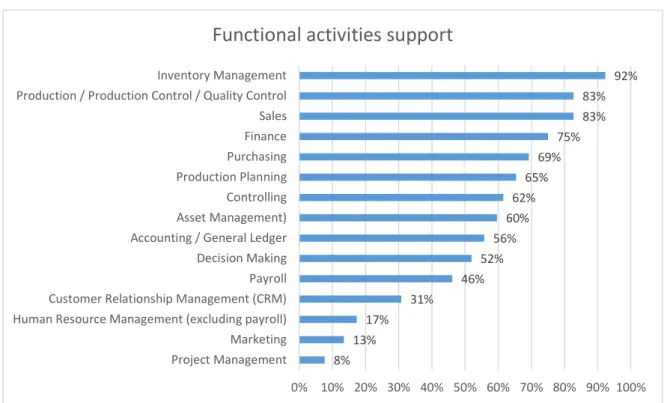
management, production support, sales, and finance. The controlling and decision-making function are evaluated to a medium level.
Figure 6. The rate and rank of supported functional activities in the enterprises (N=61)
It is very interesting to examine the effects of the introduction of ERP systems. The most prominent effects are the improved information provision (89%) required for decision support, the improvement of internal communication (76%) and the improvement of corporate cost efficiency (76%) (Figure 7).
Figure 7 Main effects of ERP implementation (N=61)
8% 13%
17% 31%
46% 52%
56% 60%
62% 65%
69% 75%
83% 83%
92%
0% 10% 20% 30% 40% 50% 60% 70% 80% 90% 100% Project Management
Marketing Human Resource Management (excluding payroll) Customer Relationship Management (CRM) Payroll Decision Making Accounting / General Ledger Asset Management) Controlling Production Planning Purchasing Finance Sales Production / Production Control / Quality Control Inventory Management
doi: 10.17700/jai.2019.1.1.498 29 Attila Sándor Debrenti, Adrián Csordás, Miklós Herdon: Management support systems in the Hungarian food-manufacturing sector
3.2.Management support system
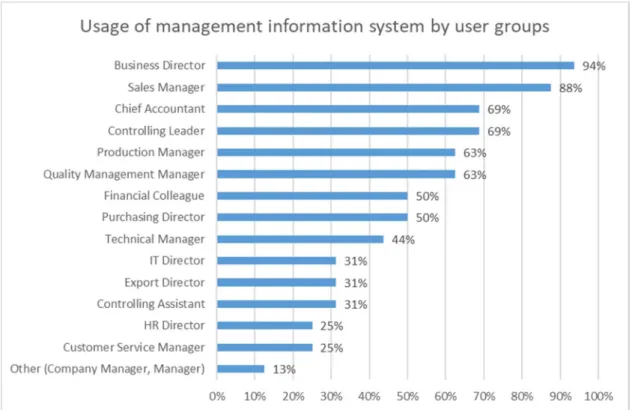
88.46% of ERP users agree that the use of information management by the corporate governance information system has improved and 51.92% use it regularly during the decision-making process and only 30.77% use customer relationship management (CRM) support. The rates and orders can be seen on Figure 8 according to by functionals.
Figure 8. The rate of usage of MIS in different jobs (N=20)
3.3.Decision support technologies and business intelligence (BI)
In 2018, 70.58% of businesses with business intelligence applications used BI tools in middle management decision support, compared to 82.35% in senior management decision support. The most relevant analytical technology is the preparation of reports, monitoring and controlling, and analysis.
Figure 9. The relevant rate of decision support technologies (N=20) 15%
8% 8% 8% 8%
8% 15% 0% 0% 0%
15% 23% 8%
8% 8%
31% 15% 23%
31% 8%
31% 38% 62%
54% 77%
0% 10% 20% 30% 40% 50% 60% 70% 80% 90% 100% Graphic, Visual Dashboards
Forecasts Monitoring, controlling Making analyzes Creating reports (ad hoc, interactive, rankings, etc.)
Relevant business analysis technologies
doi: 10.17700/jai.2019.1.1.498 30 Attila Sándor Debrenti, Adrián Csordás, Miklós Herdon: Management support systems in the Hungarian food-manufacturing sector
3.4. Food industry 4.0 technologies
The next industrial revolution is poised to change the food and beverage industry forever. However, embracing the technology required for it will require sacrifices in several areas. While becoming an Industry 4.0 facility ultimately improves efficiency, technology may not be ready for this change.
Industry 4.0 is a framework for addressing the digitalization of complex value chains and the efficient collaboration of businesses, IoT, technology providers, and consumers. Industry 4.0 extends beyond the digitization of physical assets with the vision of a digitally enabled industrial economy integrating business processes and data across multiple supply chains and value chain participants.
Integrating Manufacturing Execution System (MES) with other business systems is key to real digital transformation and efficiency on the factory floor. Food and beverage manufacturers can achieve a more holistic view by taking advantage of an integrated suite, including Enterprise Resource Planning (ERP) and Enterprise Asset Management (EAM). ERP dictates, MES executes, and EAM ensures reliability and uptime.
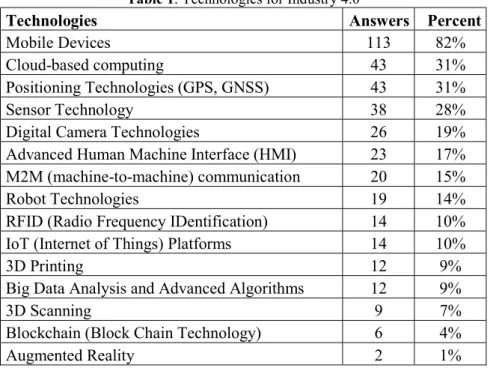
The companies were asked the most critical technologies in development, going towards Industry 4.0. Of course, these technologies mostly belong to MES, but some of them can be used in ERP, EAM, and another system to increase the complexity. In the Hungarian food-processing sector, the companies who filled the questionnaire signed the following technologies (Table 1).
Table 1. Technologies for Industry 4.0
Technologies Answers Percent
Mobile Devices 113 82%
Cloud-based computing 43 31%
Positioning Technologies (GPS, GNSS) 43 31%
Sensor Technology 38 28%
Digital Camera Technologies 26 19%
Advanced Human Machine Interface (HMI) 23 17%
M2M (machine-to-machine) communication 20 15%
Robot Technologies 19 14%
RFID (Radio Frequency IDentification) 14 10%
IoT (Internet of Things) Platforms 14 10%
3D Printing 12 9%
Big Data Analysis and Advanced Algorithms 12 9%
3D Scanning 9 7%
Blockchain (Block Chain Technology) 6 4%
Augmented Reality 2 1%
4.
Conclusions
doi: 10.17700/jai.2019.1.1.498 31 Attila Sándor Debrenti, Adrián Csordás, Miklós Herdon: Management support systems in the Hungarian food-manufacturing sector
systems are not widely spread in the food manufacturing sector. It is essential to point out that in the research, the small and the micro-enterprises represented themselves in more significant numbers.
Acknowledgements
The authors would like to thank two anonymous reviewers for their helpful and constructive comments that greatly contributed to improving the manuscript.
In particular, we thank the Leaders and Employees of the Hungarian Research Institute of Agriculture Economics, the Hungarian Chamber of Agriculture and the Hungarian Federation of Food Manufacturers for supporting the research work.
References
Alter S. L. (1980): Decision support systems: current practice and continuing challenges. Reading, Mass., Addison-Wesley Pub. 1980.
Baranyi J., Jóźwiak A., Varga L., Mézes M., Beczner J., Farkas J. (2013): Application Potentials of Network Science, Bioinformatics and Systems Biology to Food Science. In: Hungarian Science 174(9): 2013. pp. 1094– 1102.
Botos Sz., Herdon M., Várallyai L. (2015): Readiness for future internet services in rural areas. In. Procedia Economics and Finance 19. 2015. pp. 383-390. https://doi.org/10.1016/S2212-5671(15)00039-8
Demartini M., Pinna C., Tonelli F., Terzi S., Sansone C., Testa C. (2018): Food industry digitalization: from challenges and trends to opportunities and solutions. IFAC-PapersOnLine. 51(11). pp. 1371-1378.
https://doi.org/10.1016/j.ifacol.2018.08.337
Dhar V. V., Stein R. (1997): Intelligent Decision Support Methods: The Science of Knowledge, Upper Saddle River, NJ: Prentice-Hall.
Fedorowicz J. (1993): A Technology Infrastructure for Document-Based Decision Support Systems, In: Sprague, R. and H. J. Watson, Decision Support Systems: Putting Theory into Practice (3), Englewood Cliffs, NJ:
Prentice-Hall, 1993. pp. 125-136.
Flanders Investment & Trade Market Survey URL:
https://www.flandersinvestmentandtrade.com/export/sites/trade/files/market_studies/572150824152714/5721508 24152714_3.pdf
Füzesi I., Lengyel P., Csobán K., Szilágyi R. (2016): Development of ICT Support in Hungarian Meat Sector. Agrárinformatika / Journal of Agricultural Informatics, Vol. 72 pp. 60-69.
https://doi.org/10.17700/jai.2016.7.2.306
Hampel Gy. (2010): Információforrások használatának gyakorisága és információs rendszerek az élelmiszeripari társas vállalkozásban – felmérés a Dél-Alföld régió élelmiszeripari társas vállalkozásainak vezetői körébe. (Frequency of use of information sources and information systems for food companies - a survey of leaders of food companies in the Southern Great Plain region) In: Journal of Agricultural Informatics / Agrárinformatika Folyóirat. 2010. 1. (1). https://doi.org/10.17700/jai.2010.1.1.7
KPMG LLP. (2013): 2013 Food and Beverage Industry Outlook Survey, 2013,
URL: http://www.kpmg.com/US/en/IssuesAndInsights/ArticlesPublications/Documents/food-beverage-outlook-survey-2013.pdf
KSH Statisztikai tükör (Statistical Mirror). 2017.
Loshin D. (2012): Business Intelligence: The Savvy Manager’s Guide. Morgan Kaufmann. https://doi.org/10.1016/B978-0-12-385889-4.00002-8
doi: 10.17700/jai.2019.1.1.498 32 Attila Sándor Debrenti, Adrián Csordás, Miklós Herdon: Management support systems in the Hungarian food-manufacturing sector
Nagy J., Oláh J., Erdei E., Máté D., Popp J. (2018): The Role and Impact of Industry 4.0 and the Internet of Things on the Business Strategy of the Value Chain—The Case of Hungary. Sustainability. 2018; 10(10):3491. https://doi.org/10.3390/su10103491
Power D. J. (2000): Web-Based and Model-Driven Decision Support Systems: Concepts and Issues, Proceedings of the 2000 Americas Conference on Information Systems, Long Beach, California, August 10th - 13th, 2000 Power D. J. (2004): Specifying an Expanded Framework for Classifying and Describing Decision Support Systems. 2004. https://doi.org/10.17705/1CAIS.01313
Power D. J., Sharda R. (2007): Model-driven decision support systems: Concepts and research directions. In: Decision Support Systems: vol. 43(3), 2007. p. 1044-1061. https://doi.org/10.1016/j.dss.2005.05.030
Rossit D. A., Tohmé F., Frutos M. (2019): A data-driven scheduling approach to smart manufacturing, Journal of Industrial Information Integration. https://doi.org/10.1016/j.jii.2019.04.003
Sasvári P. (2011): The Economic Impacts of Information and Communication Technology In The Hungarian Economy. In: Journal of Applied and Practical Information Technology, 1(1), 2011.
Sasvári P. (2013): Az információs rendszerek kisvállalati alkalmazásának vizsgálata, lengyel- és magyarországi összehasonlító elemzés. (Investigation of small enterprise application of information systems, comparative analysis in Poland and Hungary) In: The Publications of the XXVII. microCAD International Scientific Conference. 2013. pp. 1-6. URL: http://real.mtak.hu/5736/
Shirazi B. (2018): Towards a sustainable interoperability in food industry small & medium networked enterprises: Distributed service-oriented enterprise resources planning, Journal of Cleaner Production, Vol. 181,2018, pp. 109-122. https://doi.org/10.1016/j.jclepro.2018.01.118
Singh R. Kr., Luthra S., Mangla S. K., Uniyal S. (2019): Applications of information and communication technology for sustainable growth of SMEs in India food industry. Resources, Conservation and Recycling, Vol. 147, 2019, pp. 10-18. https://doi.org/10.1016/j.resconrec.2019.04.014
Swanson E. B., Culnan M. J.. (1978): Document-Based Systems for Management Planning and Control: A Classification, Survey, and Assessment, In: MIS Quarterly, (2)4, December, 1978 pp. 31-46.
https://doi.org/10.2307/248903
Wolfert S., Verdouw C.N., Verloop C.M., Beulens A.J.M. (2010): Organizing information integration in agri-food – A method based on a service-oriented architecture and living lab approach. Computers and Electronics in Agriculture, Vol. 70. pp. 389-405. https://doi.org/10.1016/j.compag.2009.07.015
Wu J. (2000): Business Intelligence: What is Business Intelligence? 2000. URL: http://www.dmreview.com/article_sub.cfm?articleId=1924