GXQuery: Extending XQuery for
Querying Graph-structured
XML Data
Hongzhi Wang and Jianzhong Li
Department of Computer Science and Technology, Harbin Institute of Technology, Harbin, China
XML data can be naturally modeled as a graph. Existing query languages to XML can only express queries of matching XML document with a tree-structured schema with structural and value constraints without the con-sideration of graph features. The ability of such query languages cannot satisfy various requirements of query-ing graph-structured XML data. In this paper, GXQuery is presented as an extension of XQuery, an XML query language recommended by W3C, to express more flexible query on graph-structured XML. GXQuery expressions can match XML document with graph-structured schema with not only structural and value constraints, but also topological constraints.
Keywords: XML, XQuery, query language, topological
1. Introduction
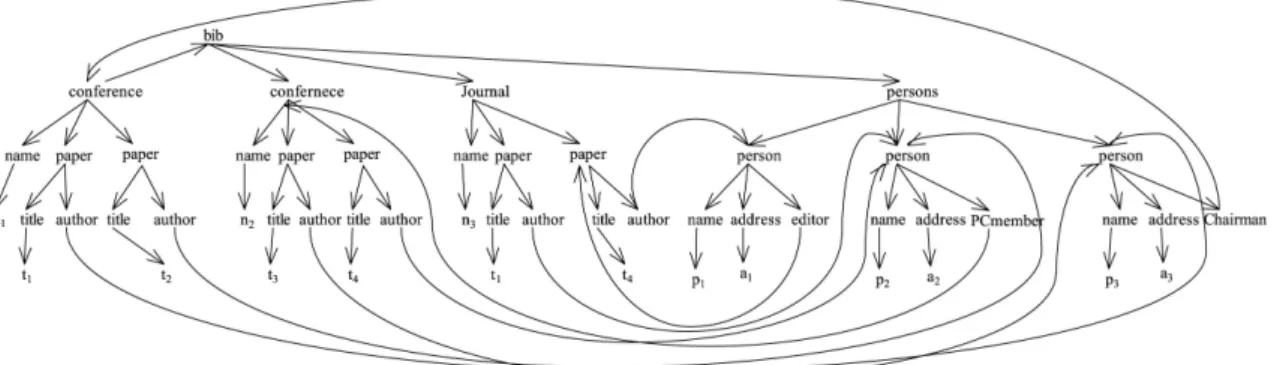
In some applications, XML data can be natu-rally modeled as graph structure. For an exam-ple, Figure 1 shows a graph structure of an XML document in Figure 2. This is a document about the relationship between authors and publica-tions. Such document adapts to graph structure
since one paper may have more than one author and one author may have more than one paper.
Figure 2.bib.xml.
Query processing on graph-structured XML data brings new challenges. One of them is that cur-rent query language can not satisfy all require-ments of query description of graph-structured XML documents.
Current query languages [2] for XML do not support the following features for graph-structu-red XML document.
• Current query languages for XML are de-signed for tree-structured XML data and do not support the matching of schema in form of general graph. Even though XPath can express a node with multiple parents by mul-tiple constraints with axis “parent”, it cannot express a graph with cycles.
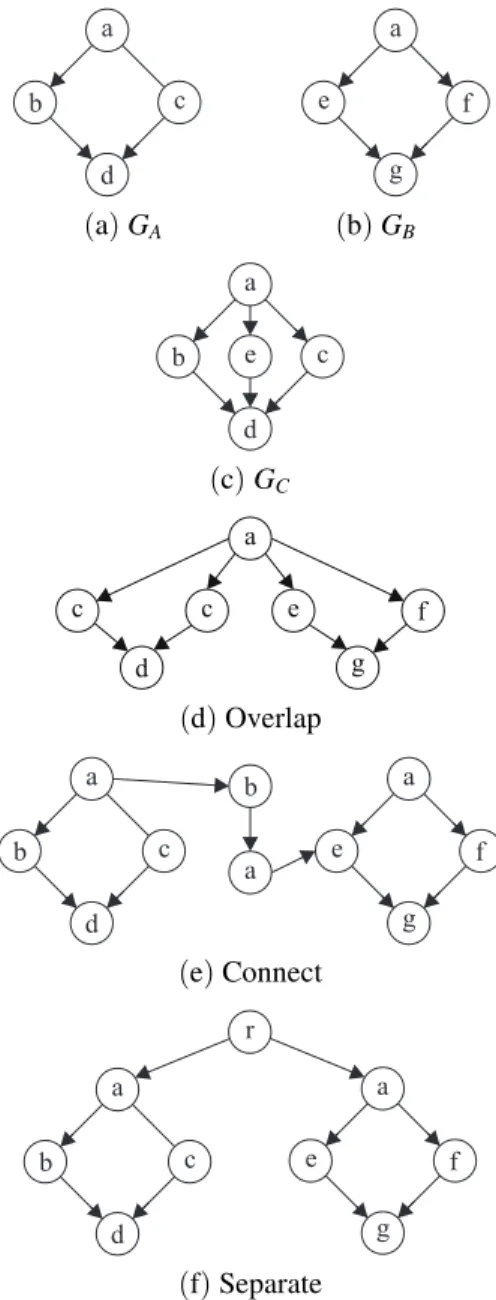
• Current query languages for XML do not support topological constraints. Topologi-cal constraint in the query to a graph means that the required graph must have some topo-logical constraint with a given graph. For example, in Figure 5(d), subgraph GA in Figure 5(b)and subgraphGBin Figure 5(b) are overlapping. Topological relationships between two graphs include connect, over-lapping, contain and disjoint.
In real applications, these two features for query-ing graph-structured XML data have their appli-cations. Two applications are shown in follow-ing examples.
• Retrieve the person who has published paper in the conference with himself as a PCmem-ber. Performing such query in the graph in Figure 1 is to retrieve person element in a cir-cle “person→ Pcmember→conf erence→
paper → author → person”. Note that the last person and first one should be the same element.
• Retrieve the conference which shares at least one paper with same title and authors as a journal. Such query uses a topological rela-tionship “overlapping” as a constraint. Per-forming such query in the graph in Figure 1 is to find subgraphs containing conference and sharing common parts of author information with some subgraph containing information about journal.
In this paper, in order to describe queries on graph-structured XML data effectively, we ex-tend XQuery [3], a query language for XML recommended by W3C by adding these fea-tures of graph representation and topological constraints to XQuery. We define a new data type XGraph as an extension of XPath to ex-press structural constraints as a general graph,
which may contain some circles. We also de-fine topological constraints to make XQuery ex-pressions support topological queries. These two new features can be embedded in current XQuery expression seamlessly.
The contributions of this paper includes: • XPath is extended to be XGraph to support
the description of general directed graph. XGraph can express a kind of graphs in a flexible and concise way. The extension re-serves original features of XPath. Addition-ally, XGraph can be embedded in original XPath expression as structural constraint. • With the support of XGraph, topological
constraint is added to XPath and XQuery. With such extension, queries such as “re-trieve graphs overlapping with graph B” can be expressed. As far as we know, this is the first paper that considers this problem. • A labelling-scheme-based processing
strat-egy of GXQuery is presented in this paper. This paper is organized as follows. In Section 2, some background knowledge is presented. In Section 3, we give the description of XGraph and topological constraints. Some use cases about extended XQuery are presented in Sec-tion 4. We design preliminary implementaSec-tion of GXQuery in Section 5. In Section 6, we give an overview of work related to this paper. We draw the conclusions in Section 7.
2. Preliminaries
In this section, we briefly introduce graph-structured XML model and some terms used in this paper.
2.1. Data model
mapped into edges in the graph. An XML frag-ment is shown in Figure 2, which can be mod-eled as the graph shown in Figure 1. Note that the graph in Figure 1 is not a DAG.
2.2. XPath and XQuery
XPath [5]is a path description language pre-sented by W3C. The unit of XPath is called a step. A step generates a sequence of items and then filters the sequence by zero or more predicates. The result of the step consists of items that satisfy the predicates. Such a step has two parts: an axis, which defines the “di-rection of movement” for the step, and a node test, which specifies the node kind and/or name of the nodes to be selected by the step. For ex-ample, to retrieve the title of the paper published in a conference “n1”, the XPath expression is bib/conf erence[name = “n1”]/paper/title. The results of performing this query on XML document in Figure 2 ist1 andt2.
XQuery [3]is a query language recommended by W3C. It uses XPath to express complex path and supports flexible query semantics. XQuery has “For-Let-Where-Return”(FLWR for brief) structure. For example, query
for$i=document(“bib.xml”)//
person[PCmember]
let$j=$i/addres where$j=“a2”
return<name>$i/name< /name>
is to retrieve the name of a person with address “a2” who has been a PCmember of some con-ference. The result of this query is an XML fragment “<name>p2< /name>”.
2.3. Labelling schemes
The labelling scheme for a graph-structured XML document is to judge the structural re-lationship between any two nodes in a graph. In XML document without accessing other in-formation. Such that subgraph queries can be processed efficiently. The labelling scheme used in this paper is an extension of that in[9]. The reachability labelling scheme can be gen-erated in the following steps:
• Each strongly connected component inGis contracted to one node to convertGto a DAG
D.
• An optimum tree coveringTof the DAGDis found. A depth-first traversal from the root ofT accesses all nodes to generate the post-order of each node. Note that during the traversal, when a node nC generated from a strongly connected component C ⊂ G is accessed, if the post order of last accessed node ispc, thenpc+1,pc+2, . . . ,pc+|Vc|
are assigned tonC (whereVC is the number of nodes in C). Then, each node n ∈ T is assigned a number id and an interval [x,y], whereidandyare both the post order ofn;x
is the smallest post order of descendants of
ninT.
• All the nodes in D are traversed in the re-versed topological order. When a node n
is met, the interval sets of n’s children in
D are copied to that ofn. Then intersected intervals in the interval set ofnare merged. • For each node inC, its interval set is that of
nC; itsid is one of theids ofnC. Note that each node inChas a differentid.
When such steps are finished, each node n in
Gis assigned a numbern.id and a set of inter-valsIn. A node areaches a nodeb (no matter whethera and bare in the same strongly con-nected component) if and only if b.id belongs to some interval ofIa. With slight modification of attaching the interval[i,i]of each node with idito its parent, the adjacent labelling scheme is generated and the judgement condition is the same as that of reachability labelling schemes.
3. Description of GXQuery
In this section, we describe how to extend XQue-ry to support queXQue-rying graph flexibly. A basic idea of the enhancement is to describe the query to a graph flexibly. By extending XPath, we present XGraph. Similar to XPath expression describing matching rules of a path, XGraph describes matching rules of a graph.
3.1. The definition of XGraph
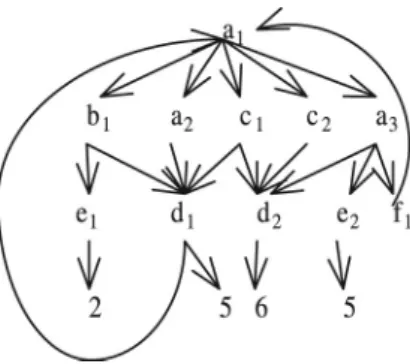
In this subsection, we will present the definition of XGraph. XGraph is an expression language to describe a special class of graph matching some patterns. An example of graph structure of an XML document is shown in Figure 3.
Figure 3.Example graph.
In XGraph, we use XPath as the backbone to describe general graph. Each XGraph expres-sion can be represented as a graph, as is called
query graph. There are two kinds of nodes in query graph, nodes as result and nodes as struc-tural constraint. Similar to XPath, we use “[]” to represent “existing” a branch or subgraph in query expression. We use “<>” to represent a schema to be matched and exist in the result of this XGraph expression. If a tag is not in any bracket, it represents structural constraint. In a simple example query with query graph in Figure 4(a), sinceaat the top of the figure has more than one child/descendant in the query, all its children/descendants are in brackets. It is different from XPath. An XPath expression can only represent the query requiring a spe-cial kind of nodes, while an XGraph expres-sion can represent the query requiring a special kind of subgraphs. For example, an XPath ex-pression a/b/c will retrieve nodes with tag c
and incoming path a/b. An XGraph expres-sion<a/b/c>will retrieve all subgraphs with schemaa/b/c. XGraph has the same semantics as XPath when nodes in XML document match-ing only one node in query should be returned as results. For example, XGraph expression
a/b/c has the same meaning as XPath expres-siona/b/c.
In order to describe circle or node with multiple parents/ancestors, we add variables binding to XGraph expression. “%” is used as the suffix of variable in XGraph expression. The variable in
brackets “()” following a nodenis the variable binding ton.
We use an example to illustrate XGraph. The structure of a graph query is shown in Fig-ure 4(a). Solid lines and circles in the query graph represent the nodes and relationships to be matched as result in the graph. Dotted lines and circles represent that the nodes and rela-tionships are constraints. Single line represents parent-child relationship. Double lines repre-sents ancestor-descendant relationship. The ex-pression of the query graph in Figure 4(a)is as follows.
Query 1 a(%a)[a/%d] < //c//%d > / < b[e=2]/d(%d)%a>
where %aand %dare variables binding to query nodes with tag a and d, respectively. ‘/’ and ‘//’ in Query 1 represent parent-child relation-ship and ancestor-descendant relationrelation-ship, re-spectively. The result of processing Query 1 in Figure 3 is shown in Figure 4(b).
Another case is that in the graph, it is required
(a)Query 1 (b)Result 1
(c)Result 2 (d)Result 3
(e)Query 4
(f)Result 4 (g)Query 5
that multiple nodes match one node in the query while other nodes in the query only match just one node in the document graph. We use “*” to represent multiple-matching part of the query. For example, a query
Query 2<a/ <c>∗>
will return result shown in Figure 4(c). As a comparison, a query
Query 3<a/c>
will return results as is shown in Figure 4(d). The result of XGraph expression is a graph. Note that in the result, both ancestor-descendent and parent-child relationships between two match-ing nodes are both represented as parent-child relationship.
XGraph reserves all the features of XPath, such as axis, structural, value and position constraints. For example, query
Query 4<a(%a)/c[position() =2]/
d[::ancestor%a[//e=5]]>
represents the query within form of graph in Figure 4(e). The result of Query 4 is shown in Figure 4(f).
XGraph expression can be embedded in an XPath expression as structural constraint. For an example, query
Query 5a/c/d[a(%a)/a/f/%a]
represents the query graph in Figure 4(g). The result isd1.
3.2. Topological constraints of XGraph
In this subsection, we present the constraints among XGraph objects. Besides traditional constraints of value, structure and position, we present a novel constraint, topological constraint
of XGraph object. There are five kinds of topo-logical relationship between two XGraph ob-ject. Their semantics, expressions and exam-ples are shown in Table 1. The topological re-lationships are illustrated by an example. Three subgraphs GA, GB and GC are shown in Fig-ure 5(a), Figure 5(b)and Figure 5(c),
respec-(a)GA (b)GB
(c)GC
(d)Overlap
(e)Connect
(f)Separate
Figure 5.Example of constraints.
relationship semantics expression example
connect two graphs connected with some edge GACONNECTEDGBWITH a/b Figure 5(e)
overlap two graphs have some common part GACONNECTEDGBWITH<a> Figure 5(d)
contain one graph contains another graph GCCONTAINGB Figure 5(c)
be contained one graph is contained by another graph GBINGC Figure 5(c) disjoint there is no path between any nodes ofthese two graphs GADISJOINTGB Figure 5(f)
tively.
The “example” column in Table 1 means if sub-graphs are in such relationship, then expression in “expression” column is true.
Topological constraint can be embedded in XGraph expression as a filter. The usage of such expression is the same as position and value constraints in XPath expression. For example, query
Query 6 < a/c/d > [graph()SEPARATE <
//a/e>]
represents subgraphs with schemaa/c/dwhich have no common node with any subgraph with schema //a/ein the same graph.The result of performing this query on the graph in Figure 3 is only noded2. d1is not the result because that
it is connected with a subgraph a1/e1 with a common nodea1.
XPath can express connection relationship be-tween two nodes but not graphs. This is differ-ent from the connection relationship in XGraph. In XGraph, the constraint “A CONNECT B WITH a/b” is true if there is a path “a/b” be-tween any node inAand any node inB.
3.3. Embedding XGraph and topological constraints into XQuery
XGraph expressions and topological constraints can be embedded XQuery seamlessly. In this subsection, we will show how to embed XGraph expressions and topological constraints into XQuery expression. We define XQuery ex-tended by these two features of XGraph expres-sion and topological constraint asGXQuery. An XGraph object can be used in the similar way as an element described by XPath. A variable with suffix “#” is used to represent an XGraph object. Note that XGraph is different from XPath because a variable binding to an XGraph object represents a subgraph while in an XPath expression, a binding variable repre-sents just one node. In order to distinguish the difference of such semantics, we add a keyword “AS” to define the schema to matching. The keyword “IN” is used to describe whose sub-graph this XGraph object is. The expression afterASshould be an XGraph expression. The expression afterinshould be an XGraph object or variable. A document is treated as an XGraph object.
When there is only one matching node in an XGraph expression, a variable with suffix “$” can also bind to such expression. The semantics of such binding is the same as that of XPath. For example, we suppose the XML document corresponding to the graph in Figure 3 is “text.xml”, query
Query 7 FOR#G AS < a < //b > //c/d >
IN document(“test.xml”)
FOR#SG AS<a//c/d > IN#G FOR$d ASa//c/d IN #SG
RETURN <result >$d< /result >
returns result
<result><d>5</d></result> <result><d>6</d></result> <result><d>6</d></result>
Since an XGraph variable represents a graph in-stead of a node, if it exists in a “return” clause, there is an XGraph variable, the graph should be represented in the form of an XML fragment with “ID” and “IDREF”. The number of id is the same as that in original XML document. Note that it is different from variables binding to XPath expression, the variable binding to an XGraph expression in “return” clause returns only the elements in XML documents match-ing nodes in “<>” in the XGraph expression with value as the result. If a complex node is required to be represented with all its context in the XML document, it should be bound to an XPath expression instead of an XGraph expres-sion. The reason is that since XGraph should describe the structure of the subgraph explicitly, if the result is required to contain the context of each node in an XGraph object, the expres-sion of this XGraph object must include all the nodes as the context of this XGraph object in the schema and be too complex.
For example, query
Query 8FOR#G AS<a(%a)< /b/d(%d)>
/c/%d/%a>IN document(text.xml)
RETURN #G
will return the result <a id=“a1”> <b id=“b1”>
<d id=”d1” a=“a”>5</d> </b>
<c id=“c1” d=“d1”> </a>
or XGraph expression or in WHERE clause. For example, query
Query 9 FOR #G AS < a < //e > /c/d >
IN document(“text.xml”)
LET#SG AS< //b/d > IN document(“test.xml”)
WHERE#G OVERLAPPING#SG WITH<d>
RETURN #G
returns the result <a id=“a1”> <c id=“c1”> <d id=”d1”>5</d> </c>
<e id=“e1”> </a>
<a id=“a1”> <c id=“c2”> <d id=”d1”>5</d> </c>
<e id=“e1”> </a>
4. Use Cases of GXQuery
In this section, we will present some use cases of GXQuery in order to explain GXQuery further-more. The data as example is shown in Figure 2. Corresponding graph structure is shown in Figure 1.
1. Retrieves the names of persons who have published papers in both conference and journal
Solution in GXQuery
for $n as bib[journal/paper/author/ person(%p)]
/conference/paper/author/%p/name in document(“bib.xml”)
return $n Expected result:
<name>p2</name>
2. Retrieve the names of persons who published paper in the conference with himself as one of PCmembers.
Solution in GXQuery:
for $i as bib//person(%p)/PCmember
/conference/paper/author/%p/name in document(“bib.xml”)
return $i
Expected result: <name>p2</name>
3. Retrieve the names of conferences which share at least one paper with same title and author in a journal.
Solution in GXQuery
for #G as bib/<conference<name>/
<paper<title>/author>*> in document
(“bib.xml”)
for #SG as bib/<journal/<paper<title>/ author>*>
in document(“bib.xml”)
let $i as conference/name in #G where #G overlap #SG with <paper< title>/author>
return $i Expected result:
<name>n1</name>
4. Retrieve the names of persons who have not published papers in the conference with some paper whose author has namen1.
Solution in GXQuery
for #G as bib//<paper/author/person/ name> in document(“bib.xml”)
for #SG as bib/<conference/ [paper/
author/person[name=“n1”]]/paper
/author/<person>*> in document(“bib.xml”)
let $i as paper/author/person/
name in #G
where #G DISJOINT #SG return $i
Expected result: <name>p3</name>
5. Retrieve persons who have been PCmem-bers of some conference, the result should contain the name and address of each person and the name of the conference where he has been the PCmember.
Solution in GXQuery
for #G as bib//<person<name> <address>/PCmember/<conference/
name>*> in document(“bib.xml”)
Expected result: <person>
<name>p2</name> <address>a1</address>
<PCmember><conference><name>n2 </name></conference></PCmember> </person>
6. Retrieve the conferences with their names and papers. Each paper has title, names and addresses of the authors.
Solution in GXQuery for #G as bib/<conference
<name[value()=“n1”]>/paper<title>/
<author<name>/address>*> return #G
Expected result: <conference> <name>n1</name> <paper>
<title>t1</title> <author>
<name>p3</name> <address>a3<name> </author>
</paper> <title>t2</title> <author>
<name>p2</name> <address>a2<name> </author>
</paper> </conference>
5. Preliminary Techniques for GXQuery Evaluation
In this section, the implementation issues are proposed. At first the framework of the GX-Query evaluation is presented. Then, the oper-ators related to GXQuery are introduced with their implementation.
5.1. The framework of GXQuery evaluation
The basic framework of GXQuery evaluation is to split the query into XGraph expressions. Each XGraph expression is processed sepa-rately. Then, the topological constraint is judged. As the last step, the final results are constructed.
For example, Query 9 in Section 3 contains two XGraph expressions. To process Query 9 on the graph shown in Figure 3, as the first step, these two XGraph expressions of <a<//e>/c/d>
and<//b/d>are processed respectively. The results of the former XGraph expression is
S1={(a1,e1,c1,d1), (a1,e1,c2,d2), (a1,e1,c1,
d2), (a1,e2,c1,d1), (a1,e2,c2,d2), (a1,e1,c1,
d2)}. The result of the later XGraph
expres-sion is (b1,d1). Then the graphs in S1 are
filtered with the graph (b1,d1) with the
con-straint “overlapping with <d>”. The results are(a1,e1,c1,d1)and(a1,e2,c1,d1). The last
step is to construct the graphs with values and tags with the ids for these tuples.
5.2. Implementation of operators
From Section 5.1, two major operators aregraph pattern matching for XGraph subquery pro-cessing and the topological constraint judge-ment. They can be processed with the algo-rithms based on the labelling scheme introduced in Section 2. The algorithms for graph pattern matching and topological constraint judgement are presented in[13]and[12], respectively. The basic idea of the former one is to split a graph pattern into bipartite graphs and process each pattern by bipartite graphs in a hash-based method.
The latter is to process topological constraint judgement with existing graph pattern match-ing algorithms. This algorithm is to build a structure to store the labelling schemes of the nodes in the graph of topological constraints and then use such structure to filter the results as the results.
6. Related Work
Existing query languages for XML[2]are only based on tree structure without considering graph features. Even though Lorel[1]considers IDREF, it considered path as basic unit instead of graph. The disadvantage of using path as the basic unit is that circle and topological relationships are difficult to be represented.
related to RDF[8]can be used to represent query in the form of graph. But current query lan-guages do not consider topological restrictions. Currently, existing work of querying graph-structured XML mainly focus on structural query of subgraph/subtree matching in a[14, 4]. None of them considers the problem of topological query.
7. Conclusions
In this paper, GXQuery, an extension of XQuery is presented to support represent queries in form of general graph and queries with topological constraints. We present XGraph as an exten-sion of XPath language to express graph match-ing in flexible forms. GXQuery is compatible with XQuery and XGraph expression can be embedded in XPath and XQuery expressions. GXQuery can represent five topological rela-tionships between XGraph objects. As far as we know, this is the first paper that considers topological query on XML data.
In this paper, only the description of GXQuery is presented. Efficient implementation of GX-Query is a challenging work and it is left for further research.
References
[1] S. ABITEBOUL, D. QUASS, J. MCHUGH, J. WIDOM, J. L. WIENER, The lorel query language for semistruc-tured data. Int. J. on Digital Libraries, 1(1) (1997), pp. 68–88.
[2] A. BONIFATI, S. CERI, Comparative analysis of five xml query languages. SIGMOD Record, 29(1) (2000), pp. 68–79.
[3] D. D. CHAMBERLIN, D. FLORESCU, J. ROBIE, Query: A Query language for XML. InW3C Working Draft, http://www.w3.org/TR/xquery, 2001.
[4] L. CHEN, A. GUPTA, M. E. KURUL, Stackbased al-gorithms for pattern matching on dags. InVLDB, (2005), pp. 493–504.
[5] J. CLARK, S. DEROSE, XML path language(XPath). InW3C Recommendation, 16 November 1999, http://www.w3.org/TR/xpath, 1999.
[6] I. F. CRUZ, A. O. MENDELZON, P. T. WOOD, A graphical query language supporting recursion. In
SIGMOD Conference,(1987), pp. 323–330.
[7] R. H. G ¨UTING, Graphdb: Modeling and querying graphs in databases. In J. B. Bocca, M. Jarke, C. Zaniolo, editors,VLDB’94, Proceedings of 20th In-ternational Conference on Very Large Data Bases, September 12-15, 1994, Santiago de Chile, Chile, (1994), pp. 297–308. Morgan Kaufmann.
[8] P. HAASE, J. BROEKSTRA, A. EBERHART, R. VOLZ, A comparison of rdf query languages. InInternational Semantic Web Conference,(2004), pp. 502–517. [9] H. V. J. RAKESHAGRAWAL, A. BORGIDA, Efficient
management of transitive relationships in large data and knowledge bases. InProceedings of the 1989 ACM SIGMOD International Conference on Man-agement of Data (SIGMOD 1989),(May 1989), pp. 253–262, Portland, Oregon.
[10] L. SHENG, Z. M. ¨OZSOYOGLU, G. ¨OZSOYOGLU, A graph query language and its query processing. In
Proceedings of the 15th International Conference on Data Engineering, 23-26 March 1999, Sydney, Australia, IEEE Computer Society, (1999), pp. 572–581.
[11] J. P. TIM BRAY, C. M. SPERBERG-MCQUEEN, F. YERGEAU, Extensible markup language (xml)1.0 (third edition). InW3C Recommendation 04 Febru-ary 2004, http://www.w3.org/TR/REC-xml/, 2004.
[12] H. WANG, J. LI, J. LUO, Topological queries on graph-structured xml data: Models and imple-mentations. International Journal of Information Technology, 4(4) (2008), pp. 213–220.
[13] H. WANG, J. LI, J. LUO, H. GAO, Hash-base sub-graph query processing method for sub-graph-structured xml documents.PVLDB, 1(1) (2008), pp. 478–489. [14] V. J. T. ZOGRAFOULAVAGENA, M. M. MORO, Twig query processing over graph-structured xml data. In
Proceedings of the Seventh International Workshop on the Web and Databases (WebDB 2004),(2004), pp. 43–48.
Received:February, 2007 Revised:April, 2009 Accepted:March, 2011
Contact addresses: Hongzhi Wang Department of Computer Science and Technology Harbin Institute of Technology, Harbin Institute of Technology Harbin, China e-mail:[email protected]
Jianzhong Li Department of Computer Science and Technology Harbin Institute of Technology, Harbin Institute of Technology Harbin, China
HONGZHIWANGis an Associate Professor at Department of Computer Science and Technology, Harbin Institute of Technology, China. His areas of interest include XML and information integration.