International Journal of Research in Engineering and Applied Sciences(IJREAS) Available online at http://euroasiapub.org/journals.php
Vol. 7 Issue 3, March-2017, pp. 77~87
ISSN (O): 2249-3905, ISSN(P): 2349-6525 | Impact Factor: 7.196 | Thomson Reuters Researcher ID: L-5236-2015
AUTHENTICATING AND SECURING USER CREDENTIALS USING HYBRID CRYPTOGRAPHIC PRIMITIVES
Dinesh Kumar1,
Research Scholar, Asra College of Engineering and Technology Bhawaniagarh
ER. Rajnish Kansal2
Assistant Professor, Asra College of Engineering and Technology Bhawanigarh
Abstract:
The tremendous increase in the use of mobile and wireless devices with limitations on power and bandwidth postulates a new generation of Public Key Cryptography (PKC) schemes. These PKC schemes should overcome the limitations of the mobile and wireless devices and help in achieving efficiency. At the same time, the new PKC schemes should be capable enough to provide an adequate level of security for such devices. This paper brings a hybrid cryptographic encryption scheme on both client and server machines to allow encrypted password protection. This paper examines the use of hybrid cryptographic in such a constrained environment along with the other two aspects, namely its security and efficiency. This is a one-way encryption scheme: the password is never transmitted or stored as clear text on the client or server, and thus cannot be recovered. This ensures a more robust and lightweight encryption algorithm that provides integrity, authentication, confidentiality and reliability.The performance of hybrid is compared with the other PKC applications which should prove that hybrid performs better and is more suitable for constrained environments.1. Introduction
The digital age we are currently living in is a password-driven world, where between 4 and 20 characters make the difference in communicating with friends, accessing of data and information or making online transactions. This information is a potential goldmine for those intending to use it for the wrong purpose.
The crux of the paper is in strengthening the strength of passwords in a twofold manner. The paper is aimed at implementing a new security algorithm, on both client and server end, and one that uses a hybrid cryptographic architecture. The existing system is prone to collision attacks and can be compromised by attackers. In order to strengthen the system, hybrid architecture is proposed that is more resistant to attack and hence can provide a secure form of information exchange between connected computers. This new security algorithm is designed
using a combination of both symmetric and asymmetric cryptographic techniques.
1.2 AREA OF COMPUTER SCIENCE 1.2.1 Computer and Network Security:
With the advent of computers, the need for the computer automation tool for protecting files and store additional information becomes apparent. For generic name is designed to protect data and thwart hacking tool set is computer security.
Using the data network similar to the introduction of distributed systems and portable terminal users and computers or between computers and computer measurement has led to the need to protect the data that the security of the network.
1.2.2 Services, Mechanism and Attacks:
International Journal of Research in Engineering and Applied Sciences(IJREAS) Vol. 7 Issue 3, March-2017, pp. 71~76
ISSN (O): 2249-3905, ISSN(P): 2349-6525 | Impact Factor: 7.196
Security Mechanism: A mechanism that is designed to detect, prevent or recover from a security attack.
Security Service: A service that enhances the security of the data processing systems and the information transfers of an organization. The services are intended to counter security attacks, and they make use of one or more security mechanism to provide the service.
1.2.3 Cryptography:
Cryptography is the science which uses mathematics to encrypt and decrypt data. This science enables you to store sensitive information or transmit it across insecure networks so that it cannot be intercepted and be read by anyone except the intended recipient. Cryptanalysis is the science of analyzing and breaking secure communication. It involves a combination of analytical reasoning, application of mathematical tools, pattern finding and determination. They are also called “Attackers”.
1.2.3.1 Types of cryptography algorithm
Cryptography is the science of secret writing is an ancient art; the first documented use of cryptography in writing dates back to circa 1900 B.C. when an Egyptian scribe used non-standard hieroglyphs in an inscription. Some experts argue that cryptography appeared spontaneously sometime after writing was invented, with applications ranging from diplomatic missives to war-time battle plans.
In cryptography, we start with the unencrypted data, referred to as plaintext. Plaintext is encrypted into cipher text, which will in turn (usually) be decrypted into usable plaintext. The encryption and decryption is based upon the type of cryptography scheme being employed and some form of key.
In most common usage, cryptography is most closely associated with the development and creation of the
mathematical algorithms used to encrypt and decrypt messages, whereas cryptanalysis is the science of analyzing and breaking encryption schemes. Cryptology is the term referring to the broad study of secret writing, and encompasses both cryptography and cryptanalysis
Secret Key Cryptography (SKC): Uses a single key for both encryption and decryption; also called symmetric encryption. Primarily used for privacy and confidentiality.
Public Key Cryptography (PKC): Uses one key for encryption and another for decryption; also called asymmetric encryption. Primarily used for authentication, non-repudiation, and key exchange.
Hash Functions: Uses a mathematical transformation to irreversibly "encrypt" information, providing a digital fingerprint. Primarily used for message integrity.
1.3 Client Side Encryption:
International Journal of Research in Engineering and Applied Sciences(IJREAS) Vol. 7 Issue 3, March-2017, pp. 71~76
ISSN (O): 2249-3905, ISSN(P): 2349-6525 | Impact Factor: 7.196
clear text, it is easy to find out such information to those attacks or interception. Usually sent via the network server as the authentication information from the client, an attacker can monitor the use of special tools and abstract user name, password, and other authentication information through the analysis of these data.
2. Methodology
Step1. Client Side Encryption:
The technique to combat the existing system is to ensure an encryption scheme on both client and server machines. Since all server-side only schemes are open to attacks, encryption of user information on the client-side will help achieve cryptographic primitives such as integrity, confidentiality and authentication. The new suggestion is to ensure all forms of communication between the client and server is encrypted. Instead of sending the user credentials and sensitive information as plaintext across the transmission medium, encrypt it with a suitable algorithm and transmit the encrypted text across the transmission channel.
Step2. HYBRID CRYPTOGRAPHY ENCRYPTION ALGORITHM:
This can be achieved by using a combinatorial effect of coupling Elliptical Curve Cryptography (ECC) implemented by ECDH & RSA. This new algorithm has been designed for better security using a combination of both symmetric and asymmetric cryptography techniques. The proposed hybrid is robust and a lightweight protocol that has a smaller key size, thereby reducing processing overload. The benefits of this higher strength per-bit include higher speeds, lower power consumption, bandwidth saving, storage efficiency and smaller certificates.
key and the plaintext is fed into the modified RSA Algorithm where it is encrypted to generate a crypt
text.. Since the password is now encrypted it is less prone to be attacked by illicit users and attackers.
On the server side, the hash is recomputed for the crypt text compared with the sent hash. Any change in the password during transmission will result in the hash's not complying with each other. This ensures authentication of the password login. Once it has been authenticated, the password is decrypted using the RSA algorithm and the plain text is retrieved. In order to avoid passwords being stored in the server database in plaintext, the concept involved is storing the hashes of the plaintext in the server database. To compare, the plaintext is hashed and checked with the database to see if there is a match. Based on the result, the user is redirected to a Login Success or Login Failure Page.the hashes of the plaintext in the server database. To compare, the plaintext is hashed and checked with the database to see if there is a match. Based on the result, the user is redirected to a Login Success or Login Failure Page.
Step3. Hybrid Algorithm Architecture:
International Journal of Research in Engineering and Applied Sciences(IJREAS) Vol. 7 Issue 3, March-2017, pp. 71~76
ISSN (O): 2249-3905, ISSN(P): 2349-6525 | Impact Factor: 7.196
Figure .1: Hybrid Algorithm Architecture
On the Encryption side, the given plaintext (user password) is encrypted with the help of a key generated by the Elliptic Curve Cryptography i.e. ECDH. The key generated forms the Private and Public Key & the password forms the Plain Text. The next step is where the plain text and the key are taken by the RSA and generates a cipher text. Now the generated
cipher text and the signature can be communicated to the destination through any secured channel. On the Decryption side, the hash value is first evaluated from the cipher text and integrated. This is compared with the signature, for the verification of the digital signature appended at the end of message. Thereafter, the decryption of cipher text is done by RSA.
Step4. Elliptical Curve Cryptography : Introduction and History of ECC:
The main problem of traditional public key cryptography system is critical dimensions must meet the requirements of a high level of security is large enough. This results in lower speed and greater bandwidth consumption. Solution to this problem comes in the form of elliptic curve cryptosystems. In
1985, Neal Koblitz and Victor Miller independently to design elliptic curve public key encryption system proposed. In the late 1990`s, ECC is standardized by a number of organizations, and start accepting commercial acceptance. Today, it is mainly used in resource-limited settings, such as ad-hoc wireless networks and mobile networks. _ Have a tendency to traditional public key encryption system gradually replaced by the ECC system. The key dimensions such as the development of computing power, the traditional system needs to be increased significantly.
Assuming that the data m is already in the integer or any ASCII format, we have a curve
E : y2 = x3+ ax + b (mod p).
This will work only if m3 + am + bis a square modulo p. Since only half of the square modulus p, we are only half the chance of this happening is. Therefore, we embed information into M is the value of a square. We assume that some of the values K, so that the 1 / 2K is embedded information to an acceptable failure rate for the point on the curve.Also, we make sure that : For the value of K, (m + 1) K < p.
Now, let xj = mK + j for j = 0, 1, 2, . . . ,K – 1, we compute x3j + axj + b.
(a) Curve cryptosystem parameters: In order to turn all these mathematical basics into a cryptosystem, some parameters have to be defined that are sufficient to do meaningful operations. There are 6 distinct values for the Fp case and they comprise the so-called "domain parameters":
1. p: The prime number which defines the field
in which the curve operates, Fp. All point operations are taken modulo p.
International Journal of Research in Engineering and Applied Sciences(IJREAS) Vol. 7 Issue 3, March-2017, pp. 71~76
ISSN (O): 2249-3905, ISSN(P): 2349-6525 | Impact Factor: 7.196
3. G: The generator or base point. A distinct point of the curve which resembles the "start" of the curve. This is either given in point form G or as two separate integers gx and gy
4. n: The order of the curve generator point G.
This is, in layman's terms, the number of different points on the curve which can be gained by multiplying a scalar with G. For most operations this value is not needed, but for digital signing using ECDSA the operations are congruent modulo n, not p. 5. h: The cofactor of the curve. It is the quotient
of the number of curve-points, or #E(Fp), divided by n.
(b) Generating a keypair: Generating a keypair for ECC is trivial. To get the private key, choose a random integer dA, so that
O < dA < n
Then getting the accompanying public key QA is
equally trivial, you just have to use scalar point multiplication of the private key with the generator point G:
QA = dA . G
Note that the public and private key are not equally exchangeable (like in RSA, where both are integers): the private key dA is a integer, but the public key QA is a point on the curve.
(c) Encrypting using ECIES
Encryption: Performing encryption using ECIES is then relatively easy. Let's assume we want to encrypt data with the public key QA that we just generated. Again, first choose a random number r so that
Then, calculate the appropriate point R by multiplying r with the generator point of the curve:
R = r .G
Also multiply the secret random number r with the public key point of the recipient of the message:
S = r.QA
Now, R is publicly transmitted with the message and from the point S a symmetric key is derived with which the message is encrypted. A HMAC will also be appended, but we'll skip that part here and just show the basic functionality.
Decryption: Now assume that you receive a message, which is encrypted with a symmetric key. Together with that message you receive a value of R in plain text. How can you -- with the aid of your private key, of course -- recover the symmetric key? Well, that's also easy:
S = dA . R
By just multiplying your private key with the publicly transmitted point R, you will receive the shared secret point S, from which you can then derive the symmetric key (with the same mechanism that the sender did generate it, of course).
To see why this works so beautifully, you just have to take a look at the equations and substitute:
S = dA . R = dA . r . G = r . ( dA> G ) r . QA
(d) Signing using ECDSA
Signing: Generating and verifying signatures
via ECDSA is a little bit more complicated that
International Journal of Research in Engineering and Applied Sciences(IJREAS) Vol. 7 Issue 3, March-2017, pp. 71~76
ISSN (O): 2249-3905, ISSN(P): 2349-6525 | Impact Factor: 7.196
Then, as with ECIES, a random number has to be generated (here it's called k, not r). This random number must under all circumstances be different for each generated signature, or the private key pair can be regenerated with some tricks (you'll see later on why):
0 < k < n
This number k is then multiplied with the generator point
G of the curve and the x coordinate is taken modulo n:
Note that this is the exact same process as key generation, with a new private key k. In fact, the values (k, R) are also in some documents referred to as "ephemeral" or temporary keypairs.
If r is 0, a new random number has to be chosen. If a r not equal to 0 has been found, s can be calculated:
If s is 0, a new random number has to be chosen. If it is not equal to zero, the resulting pair of two integers (r, s) is then the final signature.
Step5. Signature Verification
Now for the opposite direction: You received a message m, a signature (r, s) and have the public key
QA of the supposed sender. Now is the message legit?
Let's check it by first verifying that the values or (r, s) are plausible. If they're not, the signature is invalid:
0 < r < n0 < s < n
Now that these values are okay, generate the hash value of the message:
e = HASH(m)
Then invert s (modulo n):
W = S-1 modn
And calculate two integers u1 and u2:
u1 = e .w mod nu2 = r.w modn
Then calculate the point P using the results of these computations:
And take px modulo n. The signature is valid if px is equal to the received r (modulo n):
Step6. ECC in Public Key Cryptography System:
Elliptic curves used to construct a public key cryptosystem. Like a conventional cryptographic system, once a key pair (D, Q) is generated, various encryption systems, such as signing, encryption / decryption, key management system can be established. DP computing represents scalar multiplication. It is not only used to calculate the public key, but also for the signing, encryption, and key agreement in the ECC system.
Private Key :dis randomly selected from [1,n-1], where n is integer.
Public Key :Qis computed by dP, where P,Q are points on the elliptic curve.
Step7. Elliptical Curve Diffie-Hellman(ECDH) : Elliptic Curve Diffie-Hellman (ECDH) is an anonymous key agreement that allows the two sides, each with an elliptic curve public-private key pairs, establish a shared secret over insecure channels. This can be directly used as a shared secret key, or better yet, to get another key can then be used to encrypt a
symmetric key encryption subsequent
communications.
International Journal of Research in Engineering and Applied Sciences(IJREAS) Vol. 7 Issue 3, March-2017, pp. 71~76
ISSN (O): 2249-3905, ISSN(P): 2349-6525 | Impact Factor: 7.196
two parties, suchthat, it can be used for the private key algorithms. Both ends have a key pair consisting: Private Key :d which is less than a random number n, and
Public Key :Q = d * G, where G is the Generator point of the elliptic curve.
Here, (dA, QA) is the Private Key - Public Key pair of A and
(dB, QB) be the Private Key - Public Key pair of B. The computation goes as :
1. The end A computes K = (xK, yK) = dA * QB 2. The end B computes L = (xL, yL) = dB * QA 3. Since dAQB = dAdBG = dBdAG = dBQA. 4. Hence the shared secret is xK
The security in encrypting the key is that is practically impossible to find the private key dA or dB from the public key K or L.
NIST Recommended Key Sizes:
Table 1 : NIST Recommended Key Sizes Symmetric
Algorithm (bit) RSA and DH (bit) ECC (bit)
56 512 112
80 1024 160
112 2048 224
128 3072 256
192 7680 384
256 15360 521
Step8. Introduction to RSA :
RSA is one of the earliest practicable public-key cryptography and is widely used for secure data transmission. In the cryptosystem, the encryption key is public and differs from the decryption key which is kept a secret. RSA was designed by Ron Rivest, Adi Shamir and Leonard Adleman in 1977.
Operation of RSA :
The RSA algorithm involves 3 key steps : 1) Key Generation
2) Encryption 3) Decryption Key Generation :
RSA involves a public key and a private key. The public key is that everyone knows, and is used to encrypt messages. Message encrypted with the public key can only be in a reasonable amount of time using the private key to decrypt. The keys for the RSA:
of the modulus n and the public (or encryption)
exponent e. The private key consists of the
modulus n and the private (or decryption)
exponent d, which must be kept secret. p, q, and φ(n)
must also be kept secret because they can be used to
calculate d.
Encryption :
Alice transmits her public key (n, e) to Bob and keeps
the private key secret. Bob then wishes to send
message M to Alice. He first turns M into an
integer m, such that 0 ≤ m < n by using an
agreed-upon reversible protocol known as a padding
scheme. He then computes the ciphertext c
corresponding to
C≡me (mod n)
This can be done quickly using the method
of exponentiation by squaring. Bob then
transmits c to Alice.
Decryption :
Alice can recover m from c by using her private key
exponent d via computing
m ≡ cd (mod n)
Given m, she can recover the original message M by
reversing the padding scheme. Factorization Problem :
International Journal of Research in Engineering and Applied Sciences(IJREAS) Vol. 7 Issue 3, March-2017, pp. 71~76
ISSN (O): 2249-3905, ISSN(P): 2349-6525 | Impact Factor: 7.196
Step9. Hybrid Authentication Encryption Scheme (HAES)
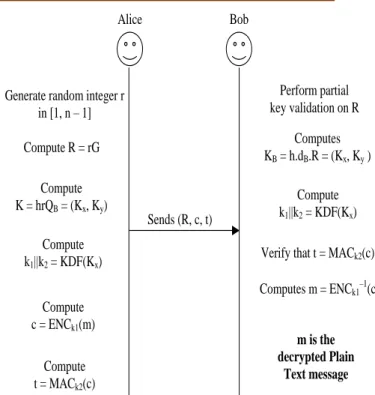
Alice has the domain parameters D = (q, FR, a, b, G, n, h) and public key Q. Bob has the domain parameters D. Bob’s public key is QB and private key is dB. The
HAES mechanism is as follows.
Alice performs the following stepsA does the following
Step 1: Selects a random integer r in [1, n – 1]
Step 2: Computes R = rG
Step 3: Computes K = hrQB = (Kx, Ky),
checks that K O
Step 4: Computes keys k1||k2 = KDF(Kx)
where KDF is a key derivation function, which derives cryptographic keys from a shared secret
Step 5: Computes c = ENCk1(m) where m is
the message to be sent and ENC a symmetric encryption algorithm Step 6: Compute t = MACk2(c) where MAC
is message authentication code Step 7: Sends (R, c, t) to Bob
To decrypt a cipher text, Bob performs the following steps
Step 1: Perform a partial key validation on R (check if R O, check if the coordinates of R are properly represented elements in Fq and
check if R lies on the elliptic curve defined by a and b)
Step 2: Computes KB = h.dB.R = (Kx, Ky ) ,
check K O
Step 3: Compute k1, k2 = KDF (Kx)
Step 4: Verify that t = MACk2(c)
Step 5: Computes m =
ENC
1(c)
1
K
We can see that K = KB, since K = h.r.QB = h.r.dB.G =
h.dB.r.G = h.dB.R = KB
Alice Bob
Generate random integer r in [1, n – 1]
Perform partial key validation on R
Sends (R, c, t) Compute R = rG
Compute K = hrQB = (Kx, Ky)
Compute k1||k2 = KDF(Kx)
Computes KB = h.dB.R = (Kx, Ky )
Verify that t = MACk2(c)
Computes m = ENCk1–1(c)
m is the decrypted Plain
Text message
Compute c = ENCk1(m)
Compute t = MACk2(c)
Compute k1||k2 = KDF(Kx)
Figure 2 :Illustration of Hybrid Authentication Encryption Scheme
3. Results And Discussion
3.1 Run-time Comparisons
To test and compare the performance characteristics of the RSA and ECDSA signature algorithms, we independently tested each of the three main components: key generation, signature generation and signature verification.
Since ECC offers security equivalent to RSA using much smaller key sizes, the performances were tested according to the following table, suggested from [4].
Table 2 : Comparable key sizes (in bits)
Symmetric ECC RSA
80 163 1024
112 233 2240
128 283 3072
192 409 7680
International Journal of Research in Engineering and Applied Sciences(IJREAS) Vol. 7 Issue 3, March-2017, pp. 71~76
ISSN (O): 2249-3905, ISSN(P): 2349-6525 | Impact Factor: 7.196
Tests were performed on an Intel P4 2.0 GHz machine with 512MB of RAM. The message used for signing is a 100 KB text file.
3.2 Computation required performing a signature and verification over a message
Table 3 : Performance of signature and verification
Figure 3 Performance of signature and verification
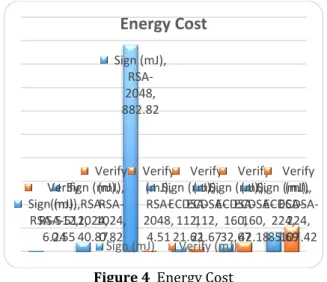
3.3 Energy Cost
Table 4 : Energy Cost
Sign(9mj) Verify (mj)
RSA-512 6.24 0.55
RSA-1024 40.87 0.82
RSA-2048 882.82 4.51
ECDSA-112 21.62 21.67
ECDSA-160 32.67 42.18
ECDSA-224 85.69 107.42
Figure 4 Energy Cost
3.4 Performance Comparison(MB/s)
Table 5 Performance Comparison
Sign Verify
∆ MB/ s (file s 1 K) MB/ s (file s 1
M) Δ
MB/s (files 1 K) MB /s (fil es 1 M) RSA-512 1.33 · 10− 2 1.50 · 10−
1 13.73 1.38 · 10−2 5.33 · 10−1 14.67
RSA102 4 1.08 · 10− 2 4.05 · 10−
2 11.06 1.38 · 10−2 3.51 · 10−1 14.47
RSA-2048 5.79 · 10− 3 9.56 · 10−
3 5.94 1.35 · 10−2 1.84 · 10−1 13.96
ECDSA-112 1.07 · 10− 2 3.90 · 10−
2 10.94 1.06 · 10−2 3.87 · 10−2 10.92
ECDSA-160 9.89 · 10− 3 3.03 · 10−
2 10.14 9.52 · 10−3 2.71 · 10−2 9.76
ECDSA-224 9.32 · 10− 3 2.55 · 10−
2 9.56 8.47 · 10−3 2.00 · 10−2 8.69 Sign Δ (x10-2) ms, RSA-512, 1.05 Sign Δ (x10-2) ms, RSA-1024, 0.882 Sign Δ (x10-2) ms, RSA-2048, 0.556 Sign Δ (x10-2) ms, ECDSA-112, 0.865 Sign Δ (x10-2) ms, ECDSA-160, 0.832 Sign Δ (x10-2) ms, ECDSA-224, 0.814 Verify Δ (x10-2) ms, RSA-512, 1.09 Verify Δ (x10-2) ms, RSA-1024, 1.09 Verify Δ (x10-2) ms, RSA-2048, 1.08 Verify Δ (x10-2) ms, ECDSA-112, 0.866 Verify Δ (x10-2) ms, ECDSA-160, 0.79 Verify Δ (x10-2) ms, ECDSA-224, 0.769 Sign Δ (x10-2) ms, RSA-512, 1.05 Sign Δ (x10-2) ms, RSA-1024, 0.882 Sign Δ (x10-2) ms, RSA-2048, 0.556 Sign Δ (x10-2) ms, ECDSA-112, 0.865 Sign Δ (x10-2) ms, ECDSA-160, 0.832 Sign Δ (x10-2) ms, ECDSA-224, 0.814 Verify Δ (x10-2) ms, RSA-512, 1.09 Verify Δ (x10-2) ms, RSA-1024, 1.09 Verify Δ (x10-2) ms, RSA-2048, 1.08 Verify Δ (x10-2) ms, ECDSA-112, 0.866 Verify Δ (x10-2) ms, ECDSA-160, 0.79 Verify Δ (x10-2) ms, ECDSA-224, 0.769
Signature and verification message
Sign Δ (x10-2) ms Verify Δ (x10-2) ms
Sign Δ (x10-2) ms Verify Δ (x10-2) ms
Sign (mJ), RSA-512, 6.24 Sign (mJ), RSA-1024, 40.87 Sign (mJ), RSA-2048, 882.82 Sign (mJ), ECDSA-112, 21.62 Sign (mJ), ECDSA-160, 32.67 Sign (mJ), ECDSA-224, 85.69 Verify (mJ), RSA-512, 0.55 Verify (mJ), RSA-1024, 0.82 Verify (mJ), RSA-2048, 4.51 Verify (mJ), ECDSA-112, 21.67 Verify (mJ), ECDSA-160, 42.18 Verify (mJ), ECDSA-224, 107.42
Energy Cost
Sign (mJ) Verify (mJ)
Sign Verify
Δ (x10-2) ms Δ (x10-2) ms
RSA-512 1.05 1.09
RSA-1024 0.882 1.09
RSA-2048 0.556 1.08
ECDSA-112 0.865 0.866
ECDSA-160 0.832 0.79
International Journal of Research in Engineering and Applied Sciences(IJREAS) Vol. 7 Issue 3, March-2017, pp. 71~76
ISSN (O): 2249-3905, ISSN(P): 2349-6525 | Impact Factor: 7.196
Figure 5 Performance Comparison
CONCLUSION
This paper is intended to perform the dual security measures. First, to ensure that the client is encrypted to prevent passwords are transmitted in clear text to the server. This ensures that an attacker cannot intercept the password to monitor the transmission medium and use it for malicious purposes. The concept of hybrid encryption algorithm is a more powerful and robust, and less prone to attack. Our findings suggest that Public key generation - RSA is significantly slower than Hybrid key generation for RSA key of sizes 1024 bits and greater. . RSA is comparable to Hybrid for digital signature creation in terms of time, and is faster. Thus, for applications requiring message verification more often than signature generation, RSA may be the better choice. The smaller key sizes of hybrid potentially allow for less computationally able devices such as smart cards and embedded systems to use cryptography for secure data transmissions, message verification and other means.
REFERENCES
[1] Atta ur Rehman Khan, Mazliza Othman ,Feng Xia ,Abdul Nasir Khan, “Context-Aware Mobile Cloud Computing and Its Challenges”, In Proceedings of IEEE International conference on Cloud Computing, vol. 2(3),pp. 42-49,2015
[2] Laiphrakpam Dolendro Singh and Khumanthem Manglem Singh. “Image Encryption using Elliptic Curve Cryptography”, Procedia Computer Science, vol 54,pp. 472-481,2015
[3] Mehdi Bahrami. “Cloud Computing for Emerging Mobile Cloud Apps” In proceedings of IEEE
International conference, pp. 4-5,2015
guero, N. Koenig, I. Chen, H. Boyer, S. Peters, J. Hsu, B. Gerkey, S. Paepcke, J. Rivero,J. Manzo, E. Krotkov, and G. Pratt. “Inside the Virtual Robotics Challenge: Simulating Real-time Robotic Disaster Response”, In Proceedings of IEEE International conference on Automation Science and Engineering ,vol. 12(2), 2015.
[5] Fathima Nizar, Fathima Latheef, Alfina Jama. “RSA Based Encrypted Data Embedding Using APPM”, In Proceedings of IJETT, vol. 9, 2014
[6] Mohammad Anagreh, AzmanSamsudin and MohdAdib Omar. “ Parallel Method for Computing Elliptic Curve Scalar Multiplication Based on MOF”, The International Arab Journal of Information Technology, vol. 11, pp. 521- 525, 2014
[7] Hong Liu and Yanbing Liu. “Cryptanalyzing an Image Encryption Scheme based on Hybrid Chaotic System and Cyclic Elliptic Curve,In Optics and Laser Technology” , Elsevier, vol. 56, pp. 15–19,2014
[8] A. Ahmed, Abd El-Latif and XiamuNiu.“A Hybrid Chaotic System and Cyclic Elliptic Curve for Image Encryption”, International Journal of Electronics and Communications, Elsevier, vol. 67, pp. 136–143, 2013
[9] Rajan S., Jamgekar.“File Encryption and
Decryption Using Secure RSA”, international Journal of Emerging Science and Engineering (IJESE), vol. 1, Februray 2013
[10] Arshad R, Ikram N.“Elliptic curve cryptography based mutual authentication scheme for session initiation protocol”, Multimedia Tools and applications, vol. 66(2), pp. 165–178,2013
[11] Lekha Bhandari, AvinashWadhe ."Speeding up Video Encryption using Elliptic Curve Cryptography
Sign Δ, RSA-512, 0 Sign Δ, RSA-1024, 0 Sign Δ, RSA-2048, 0 Sign Δ, ECDSA-112, 0 Sign Δ, ECDSA-160, 0 Sign Δ, ECDSA-224, 0 Sign MB/s
(files 1 K), RSA-512,
0
Sign MB/s (files 1 K), RSA-1024,
0
Sign MB/s (files 1 K), RSA-2048,
0
Sign MB/s (files 1 K),
ECDSA-112, 0
Sign MB/s (files 1 K),
ECDSA-160, 0
Sign MB/s (files 1 K), ECDSA-224, 0 Sign MB/s (files 1 M), RSA-512, 13.73 Sign MB/s (files 1 M), RSA-1024, 11.06 Sign MB/s (files 1 M), RSA-2048, 5.94 Sign MB/s (files 1 M), ECDSA-112, 10.94 Sign MB/s (files 1 M), ECDSA-160, 10.14 Sign MB/s (files 1 M), ECDSA-224, 9.56 Verify Δ, RSA-512, 0 Verify Δ, RSA-1024, 0 Verify Δ, RSA-2048, 0 Verify Δ, ECDSA-112, 0 Verify Δ, ECDSA-160, 0 Verify Δ, ECDSA-224, 0 Verify MB/s (files 1 K),
RSA-512, 0
Verify MB/s (files 1 K), RSA-1024,
0
Verify MB/s (files 1 K), RSA-2048,
0
Verify MB/s (files 1 K),
ECDSA-112, 0
Verify MB/s (files 1 K),
ECDSA-160, 0
Verify MB/s (files 1 K),
ECDSA-224, 0 Verify MB/s (files 1 M), RSA-512, 14.67 Verify MB/s (files 1 M), RSA-1024, 14.47 Verify MB/s (files 1 M), RSA-2048, 13.96 Verify MB/s (files 1 M), ECDSA-112, 10.92 Verify MB/s (files 1 M), ECDSA-160, 9.76 Verify MB/s (files 1 M), ECDSA-224, 8.69
Comparison
Sign ΔSign MB/s (files 1 K)
Sign MB/s (files 1 M)
Verify Δ
Verify MB/s (files 1 K)
International Journal of Research in Engineering and Applied Sciences(IJREAS) Vol. 7 Issue 3, March-2017, pp. 71~76
ISSN (O): 2249-3905, ISSN(P): 2349-6525 | Impact Factor: 7.196
(ECC)", International Journal of Emerging Research in Management & Technology, Vol. r, March 2013
[12] D. Sravana Kumar, CH.Suneetha, A.
Chandrasekhar. “Encryption Of Data Using Elliptic Curve Over Finite Fields”, International Journal of Distributed and Parallel Systems (IJDPS),Vol.3, January 2012
[13] ] Vivek Katiyar, Kamlesh Dutta, Syona Gupta . “ Elliptic Curve Cryptography Ubiquitous Computing In Today's Subiquitous Computing Era”,
International Journal of Computer Application, Vol. 11, 2010
International Journal of Research in Engineering and Applied Sciences(IJREAS) Vol. 7 Issue 3, March-2017, pp. 71~76