Published online April 20, 2014 (http://www.sciencepublishinggroup.com/j/cbb) doi: 10.11648/j.cbb.20140202.11
On the investigation of biological phenomena through
computational intelligence
Jyotsana Pandey
1, B. K. Tripathi
21
Dept. of Computer Science, Singhania University, Rajasthan, India
2
Dept. of Computer Science & Engineering, HBTI, Kanpur, India
Email address:
[email protected] (J. Pandey), [email protected] (B. K. Tripathi)
To cite this article:
Jyotsana Pandey, B. K. Tripathi. On the Investigation of Biological Phenomena through Computational Intelligence. Computational Biology and Bioinformatics. Vol. 2, No. 2, 2014, pp. 19-24. doi: 10.11648/j.cbb.20140202.11
Abstract:
This paper presents the approach towards understanding and building integrative system to explain biological phenomena like splicing, promoter gene identification, disease and disorder identification through artificial neural network based computational intelligence technique. Bioinformatics and computational intelligence are new research area which integrates many core subjects such as chemistry, biology, medical science, mathematics, computer and information science. Since most of the problems in biological information processing are inherently hard, ill defined and possesses overlapping boundaries. Neural networks have proved to be effective in solving those problems where conventional computation tools failed to provide solution.Having a computational tool to predict genes and other meaningful information is therefore of great value, and can save a lot of expensive and time consuming experiments for biologists. This paper will focus on issues related to design methodology comprising neural network to analyze biological information and investigate them for powerful applications. This paper also presents an empirical evaluation on wide spectrum of complex problems to infer and analyze biological information. Our experiments demonstrate the endeavor of biological phenomena as an effective description for many intelligent applications.Keywords: Splicing, Promoter Gene, Bioinformatics, Biological Disorder, Artificial Neural Networks
1. Introduction
Human level intelligence is manifested through rapid growth in biological information understanding that is coming in the form of genomes, protein sequences, gene expression, biological disorders data and many other medical diagnosis problems. There is the absolute need of effective and efficient computational tools to store, analyze and interpret the multifaceted data. The conventional techniques [1] of computational biology [2, XX] involve the use of applied mathematics, informatics and biochemistry to solve biological problems usually on the molecular level. Major research efforts in the field include sequence alignment, gene finding, genome assembly, protein structure alignment, protein structure prediction, and prediction of gene expression, protein-protein interactions and modeling of evolution. All these problems need to deal with a huge amount of multifaceted data. For example, they are approximately 26 billion base pairs (bp) representing the various genomes available on the server of the National Center for Biotechnology Information (NCBI).
The computational biology [2, XX] is concerned with the use of computation to understand biological phenomena and to acquire and exploit biological data, increasingly large-scale data [9]. Methods from computational biology are increasingly used to augment or leverage traditional laboratory and observation-based biology. These methods have become critical in biology due to recent changes in our ability and determination to acquire massive biological data sets, and due to the ubiquitous, successful biological insights that have come from the exploitation of those data. This transformation from a data-poor to a data-rich field began with DNA sequence data, but is now occurring in many other areas of biology. The bioinformatics involve the creation and advancement of algorithms using techniques including modern computer science and engineering. In other words, it can be described as the application of computational tools to make biological discoveries [6].
are evolving new theories with a sound biological understanding in solving problems of molecular and computational biology [9]. They are able to perform a variety of tasks that are difficult or impossible to do with conventional mathematics and informatics [12]. To name a few, Tasoulis et al. [10] introduced the application of neural networks, evolutionary algorithms and clustering algorithms to DNA microarray experimental data analysis; Liang and Kelemen [11] propose a time lagged recurrent neural network with trajectory learning for identifying and classifying gene functional patterns from the heterogeneous nonlinear time series microarray experiments.
In this paper, we investigate the technique of machine learning through artificial neural networks [ZZ] which demonstrate to be more suitable for genomic and other biological data analysis. The performance of the gene prediction approaches [4] mostly depends on the effectiveness of detecting the splice sites. This paper proposes a system with artificial neural network (ANN) [6] to addresses the problem of splice site detection. ANN takes up it as a two-class problem and classifies a given sequence whether it will be a donor or an acceptor site. Further it predicts the splice form for a given sequence using the scores provided by the single site detectors for every appearing AG and GT dimer. The challenge is to find a splice form that consistently combines all predictions. The empirical analysis has further revealed that the results come out more refined if data analyzed in binary format as compared to other format. In the neural network structure, a standard three layer feed forward network of neurons is considered for analysis in which there are two neurons in output corresponding to the donor and acceptor splice sites, 128 neurons in hidden layer and 240 units at input end. The 240 input units were used since the orthogonal input scheme uses four inputs each nucleotide in the window.
To provide useful insights for neural network applications in biological information analysis, we structure the rest of the paper as follows: section 2 elaborates the recent trends in biological information coming in the form of genomes [4], protein sequences, gene expression, biological disorders data and medical diagnosis problems. Artificial neural network technique involved in classification and recognition process is presented in section 3. Section 4 presents the empirical evaluation of different biological data analysis and experimental outcome. Finally, section 5 summarizes the paper with the inferences and discussions.
2. Recent Trends in Biological
Information
Gene prediction [4] is a very powerful and important task for many ongoing researches in the field of bioinformatics [5]. A gene is a set of instruction which governs the assembly and function of all organisms. We know that a gene is a region of DNA that control a certain basic characteristic and ultimately lead to protein synthesis. In the
1990s genomic data started becoming available. Since conventional mathematical models [8] proved to be unworkable in analysis of biological information, bioinformaticians turned to computational intelligence [[9] models for help in tasks such as gene finding and protein structure prediction. The feature selection and class prediction, two learning tasks that are strictly paired in the search of molecular profiles from microarray data, were performed with ANN. The models with ANN have been shown to present a good choice, thus providing analysis and clues for biological information samples. Recently, proteomic data considered potentially rich, but arguably unexploited, for genome annotation using ANNs which shows favorable performances as compared to conventional mathematical models. The idea of using manifold learning for feature reduction combined with an ANN classifier was successful applied in biomedical diagnosis and protein identification.
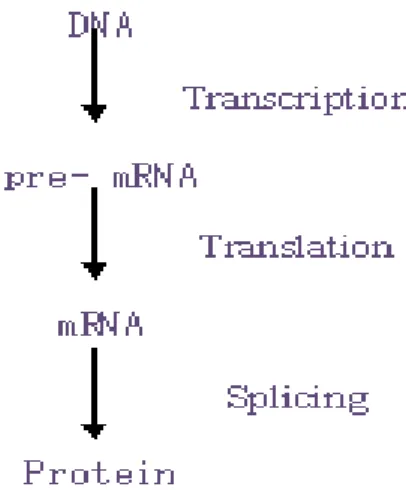
Figure 1. It shows the importance of splicing which ultimate cause for making of protein.
In this fig DNA expresses the gene product that it encodes. Figure demonstrates that certain region of the DNA is transcribed into RNA in the form of pre-mRNA. Further, the introns of the pre-mRNA are excised, leaving only exon intact to become the mature mRNA by translation. The ribosome then translates the mRNA into a polypeptide chain of amino acids that eventually becomes a protein by splicing [1]. In splice site prediction in E. coli gene DNA sequences one need to identify the boundaries between exon (the part of DNA sequence retained after splicing) and introns (the part of DNA sequence that are spliced out) in given DNA gene sequence. Thus, this problem contains three classes. First is intron–exon (IE) boundary (donors), second is exon-intron (EI) (acceptors) and third class belongs to neither donors nor acceptors (Neither).
in eukaryotic organisms than that of prokaryotic organisms [3]. A typical example of exon shuffling is the generation of antibodies against foreign antigens that may invade the host system. The dinucleotide AG are splice sites that borders the transition from intron to exon (Intron/Exon border) going from 5’ to 3’, while GT are associated with the transition from exon to intron (Exon/Intron border). The GT dinucleotide is usually referred to as “donor” whereas the AG dinucleotide is known as “acceptor” [4].
Figure 2. Schematic representation of the splice site.
3. Neural Network for Biological
Information Analysis
Neural networks have several unique characteristics and advantages as tools for the molecular sequence analysis problem [ZZ]. A very important feature of these networks is their adaptive nature, where “learning by example” replaces conventional mathematical techniques which are time-consuming, computation extensive, and weak to noise. A small complexity, robust performance, and quick convergence of ANN are vital for its wide applicability. This feature makes such computational models [10] very appealing in application domains where one has little or incomplete understanding of the problem to be solved, but where training data are readily available. Owing to the large number of interconnections between their basic processing units, neural networks are error-tolerant, and can deal with noisy data. Neural network [12] architecture encodes information in a distributed fashion. This inherent parallelism makes it easy to optimize the network to deal with a large volume of data and to analyze numerous input parameters. Flexible encoding schemes can be used to combine heterogeneous sequence features for network input. Finally, a multilayer network is capable of capturing and discovering high-order correlations and relationships in input data. The artificial neural networks [13] are “neural” in the sense that they may have been inspired by neuroscience but not necessarily because they are faithful models of biological neural or cognitive phenomena.
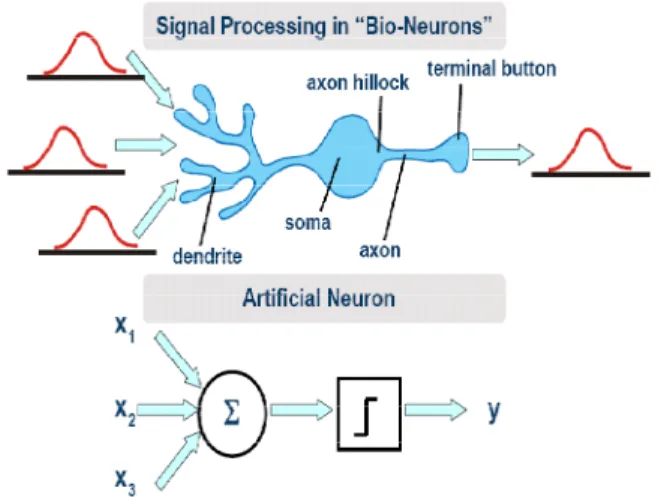
To enable understanding of neural networks, we start from a theoretical model of a single neuron and then briefly introduce a neural network to reveal their structure, training mechanism, operation, and functions. The basic structure of a biological neuron and corresponding artificial neuron is
shown in Fig 3 and can be theoretically modeled as (1)
Y = f (∑i=1 n wi xi + b) (1)
Where X {xi, i=1, 2, . . ., n} represent the inputs to the neuron and Y represents the output. Each input is multiplied by its weight wi, a bias b is associated with each neuron and their sum goes through a activation function f. A neural network is characterized by (1) its pattern of connections between the neurons (its architecture), (2) its method of determining the weights on the connections (training or learning, algorithm), and (3) its activation function.
Figure 3. Real biological neuron to artificial neuron.
In summary, the applications of ANNs in biological information processing have to be analyzed individually. ANN has been applied to biological data to deal with the issues that cannot be addressed by traditional algorithms or by other classification techniques. By introducing artificial neural networks, algorithms developed for processing and analysis often become more intelligent than conventional techniques. While neural networks are undoubtedly powerful tools for classification, clustering and pattern recognition; analysis of the internal weight and bias values for neurons in a network is possible, and a network itself can be represented formulaically, they are sometimes too large to be explained in a way that a human can easily understand. Despite this, they are still widely used in situations where a black-box solution is acceptable, and where empirical evidence of their accuracy is sufficient for testing and validation.
4. Design of Learning Machine
well supported in different programming languages and software suites. Through manual modification of weights prior to training, and through imposing custom limitations on their modification during training, existing expert knowledge can be incorporated into their design and construction. Additionally, neural networks based learning machine are usually computationally inexpensive to use after they have been trained, making them ideal for real-time applications where immediate output is desirable.
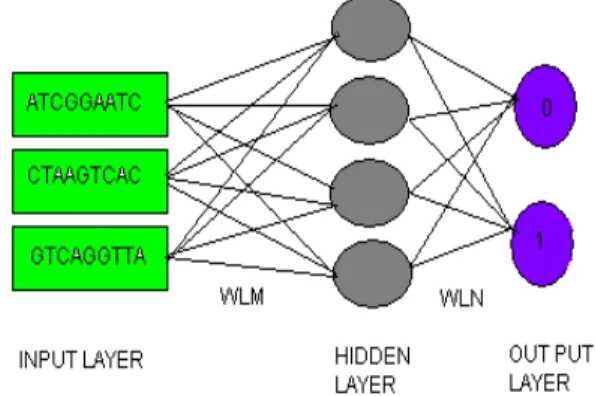
The neural networks used in this study (Fig. 3) are of the multi-layer neural network containing neurons of summation aggregation function [13]. They are feed-forward connected and have three layers: an input layer, one hidden layer and an output layer. In case of gene prediction problems, the network input is a segment of nucleotides from the nucleotide sequence. The output consists of one unit, giving a real valued output between 0.9 and 0.1. Using a threshold this number is interpreted as a category assignment for the nucleotide in the input window. The networks were trained by standard error back propagation learning algorithm on two different tasks: (i) detection of coding nucleotides (versus non-coding nucleotides), and (ii) the prediction of splice sites (defined as the first and last Intron, nucleotide respectively). Thus neural network unarguably possess strong potential for output prediction as can be seen by their widespread use in designing learning machine involving modeling and prediction.
Figure 4. Learning machine design with artificial neural network.
5. Empirical Evaluation of Biological
Data Analysis
In order to estimate the strength and effectiveness of biological information from wide spectrum of problems, one needs to analyze them with standard computational intelligence technique. I have considered the artificial neural network to prove the motivation and to establish the significance of work done. Benchmark problems are standard enough to associate the tasks like classification and pattern recognition. They also incorporate the tasks from different fields of importance; few of them are biological engineering, medical and bioinformatics. In this section, I have thoroughly evaluated kinds of problem to present the
importance of neural network in characterizing and analyzing the medical and biological information. In the present investigation, we use 5 datasets. Dataset containing primate splice-junction gene sequences and promoter gene sequences were used in both normalized and binary forms. We observed better error convergence in binary form than the normalized form of dataset. The other datasets Heart Spectf, Bupa Liver Disorder and Protein Localization sites [15] are in numeric forms only, therefore sets normalized in preprocessing.
In all the experiments, I have divided whole dataset into two parts: one is training set and second is testing set. Performance is analyzed in terms of parameters which are briefly defined as follows:
( )
Training Accuracy %
Number of correct matches 100
Total number of samples in training set
=
×
( )
Testing Accuracy %Number of correct matches 100
Total number of samples in test set
=
×
5.1. Datasets and Significance
In this paper we have used two genomic datasets and three biological disorders data sets. All these data sets are benchmark and available online for research and academic purposes.
1 E. coli promoter gene sequences (DNA) [11] is acquired to predict the member/non-member of class of sequences with biological promoter activity. The dataset contains non-numeric domain of attributes. The attributes are one of the ‘a’, ‘g’,‘t’ and ‘c’ (a=Adenine, b=Guanine, t=Thymine and c=Cytosine). This dataset have been also used by Harley, C. and Reynolds, R. 1987 in "Analysis of E. Coli Promoter Sequences" Nucleic Acids Research.
2 Primate splice-junctions are the points on DNA sequence at which superfluous DNA is removed during the process of protein creation in higher organisms. The splice-junction gene problem is to identify the boundaries between exons and introns in given DNA gene sequence.
3 Heart SPECTF Data set [14] is based on cardiac single proton emission computed tomography (SPECT) images. Each patient is classified in normal or abnormal categories. Database was used in automated Cardiac SPECT Diagnosis.
5 Protein localization sites dataset [15] can be achieve from "Expert System for Predicting Protein Localization Sites in Gram-Negative Bacteria", Kenta Nakai & Minoru Kanehisa, PROTEINS: Structure, Function, and Genetics 11:95-110, 1991.
5.2. Learning Machine with Benchmark Datasets
5.2.1. Splice Site Prediction in E. Coli Gene DNA Sequences
In E. coli promoter gene sequences (DNA) dataset from University of Wisconsin Biochemistry Department, there are 106 instances with 59 attributes. In these 59 attribute One of {+/-}, indicating the class ("+" = promoter) and second 2-60 remaining 59 fields are the sequence, starting at position filled by one of {a, g, t, c} base pairs. There is no missing attribute Values. In Class attribute there are 53 positive instances and 53 negative instances.
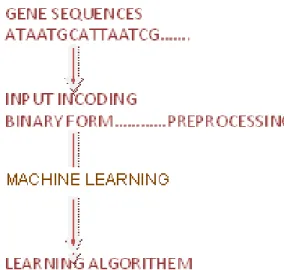
Figure 5. Processing of biological dataset (binary form) through ANN.
First we get DNA sequences to analyze splice sites, second we used sparse encoding to encode these sequences that is : A as (1000), C as (0100), G as (0010) and T as (0001) for preprocessing. It is used to avoid algebraic dependencies between nucleotides in the encoding also called BIN4 encoding in which each letter coded by four digits with the combination of 0 and 1 to input data. The learning in ANN is done with error back propagation method and result is presented in Table 1 with discussion in section 6.
5.2.2. Primate Splice-Junction Gene Sequences
In this dataset all examples taken from Gen bank 64.1 (ftp site: genbank.bio.net), there are three categories "ei", "ie" and “n” for splice sites recognition. Dataset contains 3190 instances including three classes. Class ‘EI’ as donor consists of 767 instances, class ‘IE’ as accepter consists of 768 instances and rest of as ‘N’ neither belongs to any class consists of 1655 instances. In this dataset containing primate splice junction gene sequences (DNA), the standard result was 85% and we achieved the accuracy of 81% using binary form of the dataset and 79% of accuracy was achieved when we used the normalized form of dataset.
Result is presented in Table 1 with discussion in section 6 for back propagation neural network.
5.2.3. Heart Spectf Dataset
This dataset describes diagnosing of cardiac Single Proton Emission Computed Tomography (SPECT) images. This can be achieved from University of Colorado at Denver, Denver, CO 80217, [email protected].. Database used by Kurgan, L.A., Cios, K.J., Tadeusiewicz, R., Ogiela, M. & Goodenday, L.S. "Knowledge Discovery Approach to Automated Cardiac SPECT Diagnosis" Artificial Intelligence in Medicine, vol. 23:2, pp 149-169, Oct 2001. There are 267 instances as SPECT image sets for patients. Each of the patients is classified into two categories: normal (0) and abnormal (1). Database contains 23attributes in which 22 spectf image + 1 class. All dataset is divided into training data with 80 instances and testing data with 187 instances. Class 0 consists of 55 instances and class 1 consists of 212 instances. In dataset containing SPECTF heart data the standard result was an accuracy of 87% and we achieve an accuracy of 84% as shown in Table 1.
5.2.4. BUPA Liver Disorders Data Set
This dataset achieved from "Expert Sytem for Predicting Protein Localization Sites in Gram-Negative Bacteria", Kenta Nakai & Minoru Kanehisa, PROTEINS: Structure, Function, and Genetics 11:95-110, 1991. There are 336 instances each with 8 attributes one of them is name and other are predictive. In this 8 classes are according to the protein location in bacteria. In protein localization dataset containing the standard result was an accuracy of 84% with ad hoc structured probability model; but, we found an accuracy of 81% with the artificial neural network.
6. Inferences and Discussion
Research in bioinformatics is driven by the experimental data. Current biological databases are populated by vast amounts of experimental data. Machine learning has been widely applied to bioinformatics and has gained a lot of success in this research area. At present, with various learning algorithms available in the literature [16], researchers are facing difficulties in choosing the best method that can apply to their data. We performed an empirical study and observed that single learning networks are perfectly usable in splice site prediction, gene prediction, liver disorders and localization site in the same manner. The performance of the learning technique is highly dependent on the nature of the training data or on the basis of dataset design. We conclude that, if dataset is in normalized form as well as in binary, then the best results can be achieved.
variables A-T-G-C are converted into orthogonal vectors. The dataset containing primate splice junction gene sequences (DNA), we achieved the accuracy of 81% using binary form of the dataset and 79% of accuracy was achieved when we used the normalized form of dataset. In the past usage as results of study indicate that machine learning techniques (neural networks, nearest neighbor, contributors' KBANN system) have performed as well/ better than classification based on canonical pattern matching. In dataset containing SPECTF heart data we achieve an accuracy of 84%. In protein
localization dataset we found an accuracy of 81% with the artificial neural network. In dataset containing BUPA Liver disorders we found a mediocre accuracy of 77%. We conclude that we achieved the said accuracies with most straight forward and convenient technique which does not possess the complicated computing operations. There may be techniques which may yield little more accuracy for corresponding dataset but our technique is computationally efficient.
We can see the overall analysis at a glance in the Table 1:
Table 1. Analysis of all datasets with accuracy using back propagation.
SNo. Name of database No of instances No of attribute Training accuracy Testing accuracy
1 Promoter gene 106 59 85% 83%
2 Primate splice-junction gene sequence 3190 1595 81% 85%
3 SPECTF-heart data 267 23 87% 84%
4 BUPA-liver disorders 345 7 77% 80%
5 Protein Localization Sites. 336 8 81% 84%
Acknowledgements
I want to pay my sincere thanks to those who are directly and indirectly related with my work and reviewed & encouraged all the time.
References
[1] Krogh A, Brown M, Mian IS, K Sjölander of molecular biology, – Elsevier 1994 Computational systems biology, H Kitano - Nature, 2002
[2] Pertea M, Lin X, Salzberg S: Gene Splicer: a new computational method for splice site prediction. Nucleic Acids Res 2001, 29(5):1185-90.
[3] JSR Jang, CT Sun, E Mizutani, -“Neuro-fuzzy and soft computing-a computational approach to learning and machine intelligence Automatic Control”, IEEE …, ieeexplore.ieee.org 1997.
[4] David Reby, Sovan Lek, I Dimopoulos, “Artificial neural networks as a classification method in the behavioural sciences”, Behavioural Processes 40 (1997) 35–43, Elsevier.
[5] Pati, NN Ivanova, N Mikhailova, G Ovchinnikova GenePRIMP:” A gene prediction improvement pipeline for prokaryotic genomes” Nature …, 2010
[6] Pierre Baldi, Sren Brunak Bioinformatics: “The Machine Learning Approach”, Second Edition (Adaptive Computation and Machine Learning) on Amazon.com. 2002
[7] Zoheir Ezziane, “Applications of artificial intelligence in bioinformatics” 2006
[8] Mitra S and Hayashi Y, “Bioinformatics with soft computing”, IEEE Transactions on Systems, Man, and Cybernetics, Part C: Applications and Reviews, Vol. 36, pp. 616-635 2006
[9] Tasoulis D.K., Plagianakos V. P., and Vrahatis M. N. Computational Intelligence Algorithms and DNA Microarrays, Studies in Computational Intelligence(SCI) 94, pp. 1-31. 2008
[10] Tasoulis D.K., Plagianakos V. P., and Vrahatis M. N. Computational Intelligence Algorithms and DNA Microarrays, Studies in Computational Intelligence(SCI) 94, pp. 1-31. 2008
[11] Arpad Kelemen Ajith Abraham Yuehui Chen (Eds.) “Computational Intelligence in Bioinformatics. Studies in Computational Intelligence”, Springer- Verlag Berlin Heidelberg, 2008
[12] C. and Reynolds, R. "Analysis of E. Coli Promoter Sequences" Nucleic Acids Research, 15:2343-2361, 1987
[13] Wu CH, McLarty JW. “Neural Networks and Genome Informatics”. Methods in computational Biology and Biochemistry, 1 ed. Vol. 1. Elsevier; 2000.
[14] Reese MG, Eeckman FH. “Novel Neural Network Prediction. Systems For Human Promoters And. Splice Sites”. 1995
[15] Mariofanna G. Milanova3, Tomasz G. Smolinski4,20. Ogiela, M. & Goodenday, L.S. "Knowledge Discovery Approach to Automated Cardiac SPECT Diagnosis" Artificial Intelligence in Medicine, vol. 23:2, pp 149-169, Oct 2001.
[16] Kenta Nakai & Minoru Kanehisa, "Expert Sytem for Predicting Protein Localization Sites in Gram-Negative Bacteria", PROTEINS: Structure, Function, and Genetics 11:95-110, 1991