VOLUME 16 ISSUE 4 (2018), Page 34 – 39
THE IMPACT OF LYNAS ADVANCED MATERIAL PLANT (LAMP) TOWARDS SURROUNDING HOUSING
MARKET PRICE
Muhammad Ikmal Ariff Azmee1 & Atasya Osmadi2
1&2School of Housing, Building and Planning
UNIVERSITI SAINS MALAYSIA
Abstract
Lynas Advanced Materials Plant (LAMP) is situated in Gebeng industrial estate in Kuantan, Malaysia. Lynas plant processes rare earth elements that was trucked from Mt Weld Western Australia’s mine site to Fremantle Port and then brought to Malaysia. Rare elements are important in greenhouse emission reduction especially for their distinctive use in wind turbines, hybrid vehicles, automotive chemical action converters and others technologies. However, the construction and the opening of Lynas plant may have caused pollution to the environment and health risk towards surrounding area. Few case studies highlighted the negative impacts of radioactive element towards the surrounding housing market price. Using before-and-after analysis and sensitivity analysis, this research seeks to evaluate the impact from Lynas plant on the price of housing (single storey terrace) in its surrounding area. The findings show that Lynas plant could be one of the factors that have affected the housing market price in the area. This research concludes that, in general, there is an increase of house price after the opening of Lynas plant, however it is evident that there is a trend of increasing house price when the house is farther away from the plant. It is hoped that the findings of this research helps in answering some of the public speculations regarding the impact of the plant.
INTRODUCTION
Previous research have studied the impact of pollution or radioactive to the surrounding housing market price. Nelson (1981) observed the impact of residential property values, which resulted from the Three Mile Island (TMI) nuclear tragedy. According to him, although there are two government reports stated that the nuclear tragedy have caused losses in property values, more so residential properties closest to the plant, neither report utilised elementary statistical inference methods. Nelson’s objective was to find out whether the nuclear tragedy caused a statistically decline in house price, which located inside a five miles radius from the plant. Nelson used an indulgent value model called hedonic model to look at the impact of TMI on sale costs of homes in two communities within the radius. Analysis on property values close to the TMI nuclear energy facility indicated that once the accident occurred, there was a brief term call on the quantity of sales of residences within ten miles from the plant. However, sales returned to normal within four to eight weeks. Hence, this proves that nuclear plant does bring impact to surrounding property market.
In the 1980s, the Asian Rare Earth (ARE) company, owned by the Mitsubishi Chemical Company, did not safely remove its industrial waste containing radioactive thorium hydroxide. Employees and also the neighbouring community were exposed to ionising radiation, leading to birth defects and cancer, especially leukaemia cases, among the 11,000 individuals living in Bukit Merah and Papan, Perak. Seven of the eight cases of cancer were fatal. Public protests eventually forced Mitsubishi Chemical to shut its operations in 1992. The clean-up had cost the company about US$100 million (McCoy, 2013). Although the ARE case was not focussed on the impact of the rare earth plant on property value, it does show that such plant poses negative impact on the surrounding community. In the case of ARE, the area turned hazardous and not suitable for people to be living in.
Nevertheless, some quarters objected to the statements that Lynas plant does not negatively affect surrounding property values (Muda, 2012). They contested that the statements have not been based on real facts and quite confusing. Thus, this study intends to analyse the impact of Lynas plant on the surrounding property values.
METHODOLOGY
This study employed the before and after analysis and sensitivity analysis to measure the pattern of average of percentage changes of property prices in the study area before and after the construction of Lynas Advanced Material Plant (LAMP). Secondary house price data for year 2004 until 2015 for four residential areas in Kuantan were obtained from the National Property Information Centre (NAPIC), Kuantan. The residential areas involved were Perumahan Bandar Baru Gebeng, Taman Idaman Bayu, Balok Jaya II and Balok Jaya. These four residential areas are made up of single storey terrace houses and are located near the Lynas plant.
RESULT
s
Table 1 shows the percentage change of price of houses in Perumahan Bandar Baru Gebeng from 2004 to 2014. It can be seen that the prices were increasing from RM79,888 in 2004 to RM145,000 in 2014. The average of percentage change in house prices almost doubled after LAMP came into operation (8.18%) compared to before (4.68%).
Table 1:Average percentage change of single storey terrace house price in Perumahan Bandar Baru Gebengbefore and after LAMP operation
No. Lot No. Date of Valuation
Price (RM)
Percentage of Change (%)
Average of Change (%)
1 9396 23/10/2004 79,888
4.68% (before) 2 9390 31/10/2005 79,888 0.00
3 9539 31/01/2006 85,000 6.40 4 9368 11/07/2007 95,000 11.76 5 9534 05/04/2008 95,000 0.00 6 11096 05/05/2009 100,000 5.26
7 11192 14/06/2010 110,000 10.00 LAMP Opening 8 11250 06/06/2011 115,000 4.55
8.18% (after) 9 11170 25/01/2012 125,000 8.70
10 11180 18/11/2013 145,000 16.00 11 11181 13/12/2014 150,000 3.45
Table 2 shows the data for the transacted price of single storey terrace house in Taman Idaman Bayu from year 2004 to 2014. The lowest price recorded was RM94,000 in 2004, while the highest price was RM150,000 in 2014. This resulted in average percentage change of more than double after LAMP came into operation (6.94%) compared to before (3.22%).
Table 2: Average percentage change of single storey terrace house price in Taman Idaman Bayu before and after LAMP operation
No. Lot No. Date of Valuation
Price (RM)
Percentage of Change (%)
Average of Change (%)
1 8785 07/07/2004 94,000
3.22% (before) 2 8786 08/04/2005 94,000 0.00
3 8818 23/07/2006 99,900 6.28 4 8731 20/03/2007 100,000 0.10 5 8778 09/04/2008 105,000 5.00 6 8781 04/07/2009 110,000 4.76
7 10295 28/12/2010 115,000 4.55 LAMP Opening 8 10295 28/12/2011 120,000 4.35
6.94% (after) 9 10285 13/04/2012 125,000 4.17
10 8795 09/12/2013 142,000 13.60 11 10305 30/10/2014 150,000 5.63
Source: NAPIC Kuantan, 2017
Table 3 shows the data for the transacted price of single storey terrace house in Balok Jaya II from year 2005 to 2015. The lowest price recorded was RM100,000 in 2005, while the highest price was RM200,000 in 2015. The average of percentage change in house prices almost doubled after LAMP came into operation (9.40%) compared to before (4.73%).
Table 3: Average percentage change of single storey terrace house price in Balok Jaya II before and after LAMP operation.
No. Lot No. Date of Valuation
Price (RM)
Percentage of Change (%)
Average of Change (%)
1 5841 05/08/2005 100,000
4.73% (before) 2 6138 03/01/2006 110,000 10.00
3 6955 10/12/2007 110,000 0.00 4 6646 09/07/2008 117,000 6.36 5 6956 20/11/2009 120,000 2.56
6 7041 26/07/2010 128,000 6.67 LAMP Opening 7 5780 28/03/2011 135,000 5.47
9.40% (after) 8 6718 20/04/2012 145,000 7.41
Table 4 shows the data for the transacted price of single storey terrace house in Balok Jaya from year 2005 to 2014. The lowest price recorded was RM95,000 in 2005, while the highest price was RM200,000 in 2014. This resulted in average percentage change of 12.98% after LAMP came into operation compared to 8.42% before LAMP.
Table 4:Average percentage change of single storey terrace house price in Balok Jaya before and after LAMP operation
No. Lot No. Date of Valuation
Price (RM)
Percentage of Change (%)
Average of Change (%)
1 4065 05/11/2005 95,000
8.42% (before) 2 4058 16/03/2006 98,000 3.16
3 4064 13/12/2007 96,000 -2.04 4 4074 12/08/2008 115,000 19.79 5 4096 26/04/2009 125,000 8.70
6 4035 13/05/2010 125,000 0.00 LAMP Opening 7 4056 19/12/2011 125,000 0.00
12.98% (after) 8 4092 19/11/2012 160,000 28.00
9 4054 07/01/2013 170,000 6.25 10 4040 05/09/2014 200,000 17.65
Source: NAPIC Kuantan, 2017
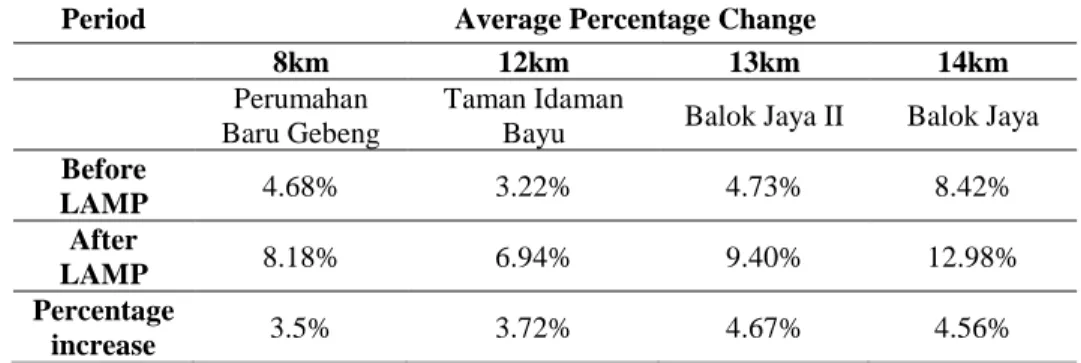
Meanwhile, Table 5 compares the average percentage change of house prices in the four residential areas based on their distance from LAMP. In terms of distance, among the four selected residential areas, the nearest to LAMP is Perumahan Baru Gebeng, which is located only 8km from the plant. The farthest is Balok Jay, which is 14km away from the plant.
Table 5: The Average percentage Change of House Price Based on Distance from LAMP
Period Average Percentage Change
8km 12km 13km 14km
Perumahan Baru Gebeng
Taman Idaman
Bayu Balok Jaya II Balok Jaya
Before
LAMP 4.68% 3.22% 4.73% 8.42%
After
LAMP 8.18% 6.94% 9.40% 12.98%
Percentage
From Table 5, it can be seen that the residential areas farther from LAMP experienced higher percentage increase in their housing prices compared to those located closer to LAMP.
CONCLUSION
The findings from this research indicate that the construction and operation of LAMP do not negatively affect the house prices in its surrounding area. Despite mixed speculations on the impacts of LAMP, the housing prices in its surrounding have been increasing steadily even after LAMP came into operation. This could partly be due to the economic benefits the plant brought to the area. Previous research on impacts of nuclear facilities on property values by Bezdek and Wendling (2006) found that establishment of nuclear facilities has led to increase in property values and that the facilities also provided job opportunities to surrounding communities.
However, there is a strong pattern shown in Table 5 where, although all four residential areas continue to experience house price increase after LAMP came into operation, the biggest increase happened in residential areas farther from the plant.
REFERENCES
Bernama (2016, July 28). Lynas operation safe, generates only low-level radiation, says
minister. Retrieved from https://www.malaysiakini.com/news/350292
Bezdek, R. H., & Wendling, R. M. (2006). The impacts of nuclear facilities on property values and other factors in surrounding communities. International Journal of
Nuclear Governance,Economy and Ecology, 1(1), 122-145.
Husin, N. N. (2012, March 27). Lynas project has not affected Kuantan market. Retrieved from https://www.thestar.com.my/news/nation/2012/03/27/lynas-project-has-not-affected-kuantan-market/#ZImpzkegS6fLrvPg.99.
Lynas tidak jejas nilai hartanah. (2012). Retrieved from
http://ww1.kosmo.com.my/kosmo/content.asp?y=2012&dt=0327&pub=Kosm o&sec=Negara&pg=ne_07.htm
McCoy, R. (2013, March 9). Launch of report on the description and critical environmental evaluation of the Lynas Advanced Materials Plant in Gebeng,
Pahang. Retrieved from
http://mpsr.org/wp/2013/03/09/report-on-lynas-environmental-hazard/
Muda, M. N. (2012).PKR tuntut MB beri fakta nilai hartanah melonjak kerana Lynas.
Retrieved from http://www.freemalaysiatoday.com
National Property Information Center, Kuantan (2017). Property Reports.
Nelson, J. P. (1981). Three Mile Island and residential property values: Empirical analysis and policy implications. Land Economics, 57(3), 363-372