VOLUME 18 ISSUE 2 (2020), Page 109 – 120
ANALYSIS ON THE SOCIO-CULTURAL VALUES OF THE TRADITIONAL MALAY HOUSES COMPOUND
Illyani Ibrahim 1, Noranisa Roslee2, Alias Abdullah3, Mansor Ibrahim4,
Fatin Farhana N Murtaza5
1,2,3,4,5Department of Urban and Regional Planning,
Kulliyyah of Architecture and Environmental Design, INTERNATIONAL ISLAMIC UNIVERSITY MALAYSIA
Abstract
The Malay traditional environment is the interaction between human, natural environment, and culture, which is then translated into the spatial design of houses and their surroundings. However, rapid urbanisation has transformed many traditional villages by incorporating urban elements into the villages. This study focuses on understanding the existence of the socio-cultural values of a traditional Malay house compound in Kampung Paya Rumput Jaya, Melaka. The objective of this study is to identify the Malay socio-cultural values and the spatial arrangement of the traditional Malay house compound. Data were collected by means of a questionnaire survey, semi-structured interviews, a mapping analysis (site inventory), and a thematic/content analysis (interviews). The findings indicate that the community in the villages are still upholding the Malay traditional socio-cultural values. Future design of a house compound should incorporate the characterisation of a traditional Malay houses compound for maintaining at least part of the Malay traditional socio-cultural values.
INTRODUCTION
Malaysia is experiencing a rapid development of the urban and suburban areas. However, there is an increasing concern that such progress might have negatively affected the existing traditional Malay houses, which are considered as the cultural assets of the Malay community. Yuan (1991) defined kampong or village as a rural settlement sustained traditionally by subsistence activities like paddy-growing, fishing, and other agricultural practices. Villages are randomly distributed with an access road leading to the village and with trees that blend with the environment.
Socio-culture is considered as the law that lies within a society that dictates and forms the society’s characters and way of living, either collectively or individually. An interrelation between socio-culture and the built environment can be seen when a change in a component brings a change to the other
components. People’s lives can be generally defined as social, while culture holds
the meaning of creating the behaviour of the society (Muhammad, 2012). Therefore, an understanding of culture allows a society’s action in the future to
be predicted, particular their adoption of a particular culture in their life. The study of a Malay house’s socio-cultural values on a spatial organisation can explain the potential benefit of the implementation of urban form, which is influenced by the Malays on the society in the field of spatial planning. Thus, this paper will focus on the socio-cultural values of the spatial organisation of traditional Malay house, a case study of Kampung Paya Rumput Jaya, Melaka.
Traditional Malay House Compound
Ani et al. (2012) noted warm hospitality as one of the Malay socio-cultural values. The Malays enjoy entertaining guests during social or religious events, in which the segregation of male and female is apparent. This value can be understood as the compassionate treatment of strangers and the openness and generosity of Muslims families to others, as discussed in Othman, Aird, and Buys (2015). Hashim, Mohamad Ali, and Asnarulkhadi (2009) even elaborate about the communal intimacy of the Malay society as the Malay house is always considered as a unit of a larger community in a village. Spaces in a Malay house are designed to signify the warm hospitality of the Malays in maintaining amicable social interaction in their activities.
to indicate that a minimal use of visually and physically obstructive barriers is prevalent in the village areas.
According to the World Intellectual Property Organization (2016), customary law is defined as the belief or the way of conduct accepted as the rules of obligatory by indigenous groups as well as by the local communities. The customary law also dictates the socio-economic systems and the way of living of these people. Mohd Sahabuddin (2002) states that besides language and vernacular architecture, the customary laws as part of the original culture of the Malays had been expanded due to the migration of the community to a new area, which instigated the opening of a new traditional Malay settlement or kampung. Mokhtar Ismail (1992) mentioned that the customary laws practised by the Malays have become a part of their social-cultural values, yet these laws are not being documented or written. The Malays have inherited and are accustomed to these laws and therefore have incorporated them in their way of living.
Therefore, the arrangement of spaces in a traditional Malay house in Melaka serves to fulfil the socio-cultural needs of the society. One of the examples of a customary law practised by the Malays is the positioning of a house; it cannot be in front of the house belonging to an older relative. It is allowable for the house to be at the back or in line with the house of the elders. According to Raja Bahrin (1988), traditional Malay houses commonly face a transportation route, such as a river (mode of travelling).
The cultural analysis conducted by Talib et al. (2012) and Mokhtar Ismail (1992) found the functional spatial characteristics located outside a traditional Malay house; the compound of a typical Malay settlement is generally a fenceless open area. A fenceless compound allows constant interaction between the communities. The Malay community emphasises togetherness and community living. Another element is trees, which Mohd Sahabuddin (2002) denotes as having the functions of providing fruits for the residents and protecting pedestrians from the sun. In regard to housing orientation, the east-west direction facing Mecca is commonly found in traditional Malay houses, noted to be for religious reasons besides reducing exposed areas towards the solar radiation during the day. The boundary between one house and another is indicated by a drain or stream (Samsudin & Idid, 2016).
conducted, such as wedding feasts or any celebration that involves community participation.
STUDY AREA
Kampung Paya Rumput Jaya was located in the district of Melaka Tengah covering the area of 1160 acres (Fig. 1). The overall population living in the village is 1557, which consists of 1527 Malay residents (98%) and 30 Chinese residents (2%). The village is one of the traditional villages in Melaka whose settlement began in 1705. The village was established by four friends from Kerinchi, Sumatera, known as Malim Panjang, Malim Sigai, Tuan Fakeh Ali and another one whose name is unknown. During their arrival, they encountered a Kelinting tree at a swamp forest. The size of the tree was four metres in circumference, and it was coated with wild grasses from top to bottom. Thus, the
four friends named the village “Paya Rumput” after the name of the grass.
Figure 1: Boundary of Kampung Paya Rumput Jaya, Sungai Udang, Melaka Source: Google Map, 2019
METHODOLOGY
traditional Malay facade. The study involved the collection of primary and secondary data. The primary data were collected from a questionnaire survey, semi-structured interviews, a mapping analysis (site inventory). The interviews queried the experiences of the villagers living in the village and the hardscape observable at the site. A sequential explanatory method was adopted, and the reliability analysis rendered a value of 0.8, a value considered sufficient for the analysis. An aerial survey was also carried out using a fixed-wings drone to capture a high-resolution photograph of the study area. Permission to fly the drone over the village was given by the chief of the village. Five assistants were recruited to carry out the survey from 2nd June until 6th June 2019.
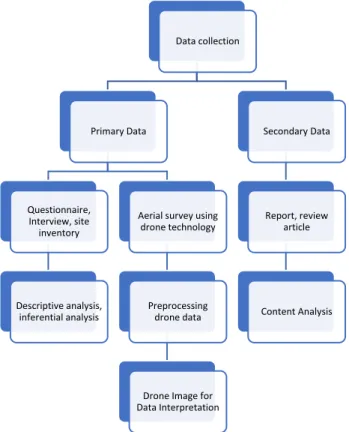
The secondary data derived from an analytical review of relevant literature and case studies. The conceptual framework of the study is illustrated in Figure 2. For each case study, two diagrams were prepared: (i) drone mapping, and (ii) diagram of features on each parcel.
Figure 2: Conceptual framework of the study
Data collection
Primary Data
Questionnaire, Interview, site
inventory
Descriptive analysis, inferential analysis
Aerial survey using drone technology
Preprocessing drone data
Drone Image for Data Interpretation
Secondary Data
Report, review article
ANALYSIS AND DISCUSSION
The analysis was performed to answer the first objective, which is to identify the existence of Malay socio-cultural values in the traditional Malay settlement. The descriptive analysis served to provide in-depth understanding of the study area. The subsequent spatial analysis focused on the respective parcels to understand the socio-cultural values of the Malay traditional houses’ exterior.
Descriptive Analysis
This analysis concentrated on the existing relationship of the respondents with the original owner and to the man-made and natural features at the compound of their traditional Malay housing in the study area.
Table 1: Frequency analysis on family relationship
The descriptive analysis (Table 1) shows that 95% of the home owners do have a family relationship with the original owner, and 85% of the home owners have inherited their houses from family members. The rest of the respondents (5%) are renters, thus having no relationship with the original owner. According to the chief of the village, usually the youngest child will inherit the house from their parents.
Table 2: Frequency analysis on own courtyards
The above analysis (Table 2) shows that 80% of the respondents own their courtyards and 20% share their courtyards. The courtyards contain several man-made and natural elements, such as an outdoor toilet, a well, a garage, a well, trees, plants, and flowers. The relationship between these inhabitants is close as they share their courtyards, thus indicating the close relationship among the relatives.
Table 3: Frequency analysis on plant flowers and herbs Frequency Percentage Family relationship
with original owner 38 95%
No relationship 2 5%
Frequency Percentage
Own courtyards 32 80%
Shared courtyard 8 20%
Frequency Percentage Planted flower and herb 26 65%
Table 3 indicates that 65% of the respondents have planted flowers at their compound, which serves as a multifunctional transitional space. According
to the researchers’ inventory, the flowers are arranged at the side of the house and
along the fence. The flower arrangement is also seen as the boundary demarcation value practised by the community in the village.
Table 4: Frequency analysis on plant fruit trees
Table 4 shows that 57.5% of the respondents have planted fruit trees. Fruit trees also provides a boundary demarcation value in the village.
Table 5: Frequency analysis on fence
Seventy-seven percent of the respondents do have a fence and the rest of the respondents (23%) do not have a fence. The analysis also shows that the most preferred material for fencing is wire (50%), probably due to the material’s
durability and safety. This finding also indicates that the villagers are aware of the safety of their dwelling.
Table 6: Frequency analysis on seating
Table 6 shows that 85% of the seatings are available at the exterior area
of the housing. This finding implies the villagers’ socio-cultural value of being
fond of having a meeting at a compound to enjoy the breeze from the surrounding areas. Many of them use trees to locate a seating in the compound to enjoy the ventilation of the windy air.
Malay Socio-Cultural Values in The Compound of Malay Traditional Housing
This study was conducted to answer the second objective, which is to analyse the spatial distribution of the compound of a traditional Malay house. The socio-cultural value is interpreted as a symbolic meaning of the house’s compound.
Several parcels were identified from the sketched plan and drone mapping. The Frequency Percentage
Planted fruit trees 23 57.5%
None 17 42.5%
Frequency Percentage
Fence 31 77%
No fence 9 23%
Frequency Percentage
Seating 34 85%
parcels identified enabled the researcher to understand the relationship among the residents in each parcel.
Fig. 3 shows the illustrations for Case Study 1. One of the respondents’
houses is located in front of her relatives’ houses, which are located within the same lot of the land. The kinsfolks prefer to stay close to each other to assist each other in daily activities if necessary, thus indicating a socio-culture value of a strong relationship, cooperation, and consensus. They are also comfortable living with a family. Such value also reflects the respect among the family members.
Figure 3: Case study 1
Figure 4: Case study 2
Fig. 4 shows one parcel within the village in Case Study 2. The sketched plan of the house shows a parcel of the respondents’ houses. The houses are all located within the same lot of land. The houses are orientated to the main road and just nearby to the relatives’ houses. One respondent’s family runs a stall in front of their house, which is strategically located by the main road. This finding also shows the value of a strong family relationship in the respective parcel. Many trees can be identified around the compound, particularly those at the back of the house. The material of the courtyard is asphalt. A shared courtyard can be used for collective activities of the family members. At the middle and side of the compound are palm trees, which provide a shaded and cool environment, hence a resting area for the villagers.
Figure 5: Case study 3
relationship. The relative’s house is located just next to his house within the same
lot of land. Both houses share a driveway and a courtyard, and both have their own garage. The outdoor toilet is located just next to the house, and both clothes lines are located at the back of the house. The houses are orientated towards the main road. A drone image of the parcel shows clear trees and greenery at the compound. A dense of several matured trees contribute to a windy airflow hence improving the ventilation of the houses and cool the surrounding area. The observation shows that the arrangement of the houses in Melaka is organic in the respective parcel; however, all of them are orientated towards the road. The road appears to be the most efficient method of transporting both people and goods. Al-Ahmadi (2000) explained that orientation is the key element in considering the placement of things in the Malay environment, as referred to Tajul Muluk, whose findings were translated into the built environment perspectives.
Analysis of the interviews showed that 80% of the respondents share a parcel with their relatives. Twenty-percent of the respondents have one house in each parcel—a pattern that can be identified from the exterior spatial organisation of a traditional Malay house. Staying near relatives implies the socio-cultural values of a strong family relationship, cooperation, and consensus. Such socio-cultural values are mostly reflected through the positioning of the houses close to those of family members within the same lot of land. The findings indicate that the Malays tend to form a housing cluster that consists of family members.
A high percentage of fencing shows that the villagers are aware of the safety of their dwellings. However, all of the houses appear to have a fence at the parcel, an observation that contradicts the notion that the compound of a typical Malay settlement is generally a fenceless open area (Talib et al., 2012; and Mokhtar Ismail, 1992). Maliki et al. (2015) explain that women can have more freedom of spatial use by having family members as neighbours in their village setting. The open compound serves as a playground for children and as a venue for feast and gathering. The functions of the spaces in the courtyard can be
depended on the inhabitants’ needs. Cultural events can also be supported by the
community, which includes relatives (Sufari, 2017).
Thus, the socio-cultural values of a strong family relationship and the practice with customary law have been demonstrated in the study area, similar to the observations by Raja Bahrin (1988), Mokhtar Ismail (1992) and Mohd Sahabuddin (2002). These elements can be adopted in a terrace-house settlement, but doing so in high-rise apartments requires a detailed design to preserve the socio-cultural values of the community. An apartment is characterised by privacy issue; the kitchen is located opposite to the walkway, and the people from the other buildings are able to see those in a different building. Another privacy issue
of an apartment is the door, which is also located opposite to a neighbour’s door.
implies several elements that can be considered, such as the sharing of courtyard between the houses and the variety of softscape elements at the courtyard areas. Privacy can also be well-taken care if a house’s entrance is not opposite to another
house. The corridors should include small trees or plants with benches to maintain the green areas as the after-work areas. Any land or spaces on a high-rise housing should be turned to a garden so that those who are passionate in gardening can contribute to beautifying the spaces.
CONCLUSION
Preserving the social-cultural values of the Malay traditional houses compound is crucial for future implementation by practitioners and national authorities. The characterisation of traditional Malay houses compound can be used for developing cultural heritage area. Thus, the functional space design for preserving culture values can be used as an influence on occupants’ quality of life. The courtyard is the place (1) where the Malays prefer to have a feast, particularly by gotong-royong among family members, and (2) for children’s
activities. Landscaping with wide spaces and lined flowers and herbs are the setting for having a conversation with family members and neighbours on a pangkin (seating). The compound of a traditional Malay house has to fulfil the socio-cultural values mentioned. The design of the houses in an urban area needs to adopt the values mentioned. The arrangement of a private courtyard and landscaping is one of the design strategies that need to be incorporated in future design.
ACKNOWLEDGEMENTS
Thank you for the support of TRGS research grant “Trans-Disciplinary Research
Grant Scheme” (TRGS16-03-002-00002). Special thanks go to International
Islamic University of Malaysia and the Ministry of Higher Education (MOHE) for the research grant. Thank you also to Integrated Geoplanning Sdn. Bhd for the assistance in conducting drone data collection. The same also goes to all of the referees for the instructive comments to improve the manuscript.
REFERENCES
Al-Ahmadi, A.R. (2000). Petua Membina Rumah Malaysia. Kuala Lumpur: Perpustakaan Negara Malaysia.
Ani, A., Mohamed, N., & Abdul Rahman, N. (2012). Socio-cultural influences in the composition of traditional Malay house compounds in rural Melaka. Alam Cipta, 5(1), 63–78.
Hashim, A. H., Mohamad Ali, H., & Asnarulkhadi, A. S. (2009). Urban Malays’ User-
Behaviour and Perspective on Privacy and Spatial Organization of Housing. International Journal of Architectural Research, 3(1), 197–208.
170, 605–612. https://doi.org/10.1016/j.sbspro.2015.01.062.
Mohd Sahabuddin, M. F. (2002). Chapter 2: Malaysian Vernacular Architecture and Its Relationship to Climate 2.1 Vernacular Architecture of Traditional Malay House, 5–24.
Mokhtar Ismail (1992). Rumah Tradisional Melayu Melaka. Kuala Lumpur: Persatuan Muzium Malaysia, Muzium Negara.
Muhammad, S. A. (2012). The relationship between the royal socio-culture and the residence palaces in Kedah.
Othman, Z., Aird, R., & Buys, L. (2015). Privacy, modesty, hospitality, and the design of Muslim homes: A literature review. Frontiers of Architectural Research, 4(1), 12– 23. https://doi.org/10.1016/j.foar.2014.12.001.
Raja Bahrin, R. A. S., (1988). The Terengganu Timber Malay House. Kuala Lumpur: Badan Warisan Malaysia.
Samsudin, N. A., & Idid, S. Z. A. (2016). Influences of housing settings and designs in
fulfilling the Malay residents’ social cultures. Planning Malaysia, 4 (4),
109–120. https://doi.org/10.21837/pmjournal.v14.i4.152
Sufari, N. (2017). Women’s Baraan in Parit Bugis, Johor The Malaysian Insight. Batu Pahat, Johor: The Malaysian Insight. Retrieved from https://www.themalaysianinsight.com/g/6345/?utm_source=dlvr.it&utm_mediu m=facebook&utm_campaign=the+malaysian+insight
Talib, R., & Sulieman, M. (2012). Surveying on the Cultural Approaches for the Melaka Malay Houses. Procedia - Social and Behavioral Sciences, 65(ICIBSoS), 511– 516. https://doi.org/10.1016/j.sbspro.2012.11.157.
World Intellectual Property Organization. (2016). Customary law and traditional. knowledge. Customary Law, 7(7), 1–4. https://doi.org/10.1016/j.ecolecon.2003. Yuan, L. J. (1991). “The Malay house: Rediscovering Malaysia’s indigenous shelter
system, Malaysia: Institute Masyarakat.” Phoenix press.