The
Tropos
Metamodel and its Use
Angelo Susi, Anna Perini and John Mylopoulos
ITC-irst, Via Sommarive, 18, I-38050 Trento-Povo, Italy E-mail: [email protected], [email protected], [email protected]
Paolo Giorgini
Department of Information and Communication Technology University of Trento, via Sommarive 14, I-38050 Trento-Povo, Italy E-mail: [email protected]
Keywords:Agent Oriented Software Engineering Methodology, Metamodel
Received:May 9, 2005
Troposis a software development methodology founded on the key concepts of agent-oriented software development. Specifically,Troposemphasizes concepts for modelling and analysis during the early re-quirements phase. This phase precedes the prescriptive rere-quirements specification of the system-to-be. In this paper, we present theTroposmetamodel starting from the basic concepts of actor, goal, plan, resource and social dependency and then we illustrate its use by introducing an extension intended to introduce concepts for modelling security concerns. We also sketch theTroposmodelling environment and compare with the metamodels of other software development methodologies.
Povzetek: Podana je programska metodologija Tropos, temeljeˇca na agentnih pristopih.
1 Introduction
Software development paradigms have exploited a wealth of models to capture requirements and design information about a software system (the “system-to-be”) throughout its development process. Structured software development used SADT and Data Flow Diagrams. Object-oriented software development has used a range of modelling lan-guages which have been integrated into UML. Not surpris-ingly, agent-oriented software development is following on the same footsteps.
To formally analyze software models, we need a means
to define their syntax and semantics. Metamodels have
been used for the former task. Metamodels define a set of possible instantiations, which are all and only the syntacti-cally correct models in some modelling language. As such, metamodels have been used for more than two decades as a basis for defining the syntax of (usually graph-theoretic)
modelling languages, such as UML as well asTropos.
The objective of this paper is to introduce the Tropos
metamodel, discuss some of its uses, and compare it to other metamodels of agent/goal-oriented software develop-ment methodologies. Section 4 of the paper sketches the
Tropos methodology, while Section 3 presents the meta-model and explains its features. Section 4 presents one extension of the metamodel to include security-related
con-cepts. In Section 5 we sketch theTroposdevelopment
envi-ronment, which uses the metamodel in its basic core. Sec-tion 6 relates the proposed metamodel to others in the same family of modelling languages, while Section 7 concludes
the paper.
2 Models and Methodology
Troposis founded on the idea of using the agent paradigm and related mentalistic notions during all phases of the de-velopment software process. The methodology [6] adopts
thei*[26] modelling framework, which proposes the
con-cepts of (social)actor,goal,task,resourceand social
de-pendencyto model both the system-to-be and its
organiza-tional operating environment. Thei*framework includes
the strategic dependency model (actor diagrams inTropos)
for describing the network of inter-dependencies among ac-tors, as well as the strategic rationale model (goal diagrams in Tropos) for describing and supporting the means-ends analysis conducted by each actor as it attempts to ensure that – through delegations to other actors – its goals will eventually be fulfilled.
Anactor diagramis a graph whose nodes represent
ac-tors (agents, positions, or roles), while edges represent
dependencies among them. A dependency represents an agreement between two actors where one actor (the depen-der) depends on another (the dependee) to fulfill a goal, per-form a task or deliver a resource (the dependum). Depen-dencies may also involve softgoals (such as “having a good quality meeting”) which represent vaguely-defined goals, with no clear-cut criteria for their fulfillment.
goals or plans1, while edges represent goal/plan relation-ships, such as AND/OR-decomposition (i.e., a goal/plan can be decomposed into a set of other goals/plans. Goals/plans can also be related to softgoals through quali-tative relationships (labelled “+” or “-”) to indicate that the goal/plan contributes positively or negatively to the fulfill-ment of the softgoal. Goal diagrams appear inside a bal-loon associated with a single actor. This is the actor whose goals/plans are being analyzed to determine how they can be fulfilled/executed.
The Troposmethodology supports four phases of soft-ware development: Early Requirements Analysis, Late Re-quirements Analysis, Architectural Design, and Detailed
Design. Early requirementsis concerned with
understand-ing the organizational context within which the system-to-be will eventually function. During early requirements analysis, the requirements engineer identifies the domain stakeholders (who have a stake in the system-to-be) and models them as social actors, who have goals and depend on each other for goals to be fulfilled, plans to be
per-formed, and resources to be furnished. Late requirements,
on the other hand, is concerned with a definition of the functional and non- functional requirements of the system-to-be. This is accomplished by treating the system as an-other actor (or a small number of actors) who are depen-ders/dependees in dependencies that relate them to exter-nal actors. The shift from early to late requirements occurs when the system actor is introduced and it participates in delegations from/to other actors.
Architectural designis concerned with the global struc-ture of the system-to-be. Unsurprisingly, subsystems and system components are represented as actors too, and their dependencies to other system components are social, rather than procedural/structural. This means that system compo-nents need to have the ability to monitor dependencies to other actors to make sure they will be fulfilled. As well, system components need to be able to cancel dependen-cies that seem ineffective and replace them with new ones through planning, negotiation, etc. As with conventional software architectures, architectural styles constitute crit-ical support for the software developer. Since the funda-mental concepts of Tropos architectures are intentional and social, we have turned to theories which study social struc-tures to define architectural styles: namely Organization Theory and Strategic Alliances.
Detailed design focuses on the specification of actor
communication and behavior. To support this phase,
we have adopted existing agent communication languages such as FIPA-ACL [20] or KQML [11]; also message trans-portation mechanisms and other related concepts and tools. We have also proposed and defined a set of stereotypes,
tagged values, and constraints to accommodateTropos
con-cepts within UML [5].
Through the models constructed during these phases, one can answer “why” questions, in addition to “what” and “how” ones, regarding system functionality. For example,
1Plans inTroposcorrespond to tasks ini*.
one can ask “Why does this component of the system need to notify library users when a book becomes available”. Answers to why questions ultimately link system function-ality to stakeholder needs, preferences and objectives. Such answers serve as ultimate justifications for all elements of a proposed design.
3 The Metamodel
review papers
Reviewer PC
Chair
review form
PC Member
review the papers assigned
papers
actor goal
resource KEY
dependum
depender dependee
be fair in reviews assignment papers
conflicts conflicts
softgoal
review form
plan
Figure 2: TheTroposactor diagram describing a sketch of
the conference review process.
Figure 1 shows the portion of the Tropos metamodel,
where agent, role and position are specialization of the
con-cept of actor. A position cancover 1. . . nroles, whereas
an agent canplay0. . . nroles and canoccupy0. . . n
posi-tions. An actor can have0. . . ngoals, which can be both
hard and softgoals and are wanted by1actor.
An actor dependency is a quaternary relationship and
relates respectively a depender, dependee, and dependum (i.e. goal, plan, resource). It is possible to specify also a
reason for the dependency (labeled aswhy).
A model is an instance of the metamodel and can have a graphical representation in terms of actor and goal dia-grams.
Figure 2 depicts an example of an actor diagram for the domain of the Conference Review Process and repre-sents a model that can be obtained instantiating the meta-model discussed so far. Three actors are involved: the
Pro-gram Committee Chair (PC Chair), the Program
Com-mittee Member (PC Member) and theReviewer.
De-pendencies take place between them; in particular the goal review papers is delegated by the PC Chair
to the PC Member, moreover the PC Chair also
ex-pects to have the information of the possibleconflicts
(a resource dependency) between the PC Member and
the authors of the papers. On the other hand, the
PC Member depends on the PC Chair to obtain the
papersto distribute and thereview form. Many crit-ical goal and resource dependencies occur between the
Actor Dependency
Goal
Plan
Resource SoftGoal HardGoal
depender
dependee 1
0..n 0..n
wants 0..n wantedBy
1
dependum
dependum
dependum 1
1
1
0..1 0..1 0..1 1
executedBy
execute 0..n
why
why
why 0..1
0..1
0..1
0..n 1
{XOR}
0..n
0..n
{XOR}
Role Agent
Position
play occupy
1..n
cover
0..n 0..n 0..n 0..n
Figure 1: The UML class diagram specifying the actor concept and the dependency relationship in theTroposmetamodel.
UML notation is compliant with the OMG MOF 1.4.
Member depends on the Reviewer for review the papersand to obtain the information about the possible
conflictsonassigned papers. TheReviewer
depends on the PC Member in order to obtain a set
of assigned papers as well as the review form.
Finally, the PC Member wants to be fair in the
review assignment, and this is represented as a
soft-goal wanted by thePC Member.
review papers
collect the reviews PC Member
assign papers to reviewers
AND decomposition contribution (positive)
+
KEY
+ +
be fair in reviews assignment
Reviewer
conflicts review
the papers
select reviewers send
the papers
verify conflicts verify
competences send
papers by e-mail
Means-end analysis
Figure 4: TheTroposgoal diagram related to the actorPC
Member.
The concepts related to theTroposgoal diagram are
de-picted in Figure 3. The central concept of goal is
repre-sented by the classGoal. Goals can be analyzed, from the
point of view of an actor, by Means-end analysis,
Con-tribution analysis and Boolean decomposition. Means-end Analysis is a ternary relationship defined among an
Actor, whose point of view is represented in the
analy-sis, a goal (the end), and a Plan, Resource or Goal (the
means).Contribution Analysisis a ternary relationship
be-tween an actor, whose point of view is represented, and
two goals. Contribution analysis strives to identify goals that can contribute positively or negatively towards the ful-fillment of other goals (see association relationship labeled
contribute in Figure 3). A contribution can be annotated with a qualitative metric, as proposed in [8], denoted by
+,++,−,−−. In particular, if the goalg1contributes
pos-itively to the goalg2, with metric++then ifg1is satisfied,
so isg2. Analogously, if the planpcontributes positively
to the goalg, with metric++, this says thatpfulfillsg. A
+label for a goal or plan contribution represents a partial,
positive contribution to the goal being analyzed. With
la-bels−−, and−we have the dual situation representing a
sufficient or partial negative contribution towards the
ful-fillment of a goal. Decomposition, whose metamodel is
described in Figure 3, is also a ternary relationship which defines a generic boolean decomposition of a root goal
into subgoals, that can be in particular anAND-or an
OR-decompositionspecified via the attribute Type in the class
Boolean Decompositionspecialization of the class Decom-position.
The concept of plan in Troposis specified in Figure 2
and 3. Means-end analysisandAND/OR decomposition,
defined above for goals, can be applied to plans also. In
particular, AND/OR decomposition allows for modelling
the plan structure.
Figure 4 gives a sketchy view of goal diagram
for the actor PC Member and for the goal review
papers and for the softgoal be fair in the review assignment.
The goal review papers has been
AND-decomposed in two sub goals: assign papers
to reviewersandcollect the reviews. This
Actor Decomposition
Goal
Plan
Resource
Boolean Decomposition
+Type: String
Contribution
+Metric: String
Means-End Analysis 0..n
1 1 1
pointOfView
pointOfView
pointOfView 1
1 1
contributeTo
contributeTo
contributeTo
contributedBy 1
0..n
0..n 0..n
0..n 0..n
1
0..n end
means
0..n 1 1
end 1
0..n means 0..n 1
1 root
root
0..n 0..n
0..n 0..n
{XOR}
{XOR}
Figure 3: The UML class diagram specifying the concepts related to the goal diagram in theTroposmetamodel.
the papers between PC Member and Reviewer,
as shown in Figure 1. The goal assign papers
to reviewers is decomposed in two subgoals:
send the papers, that is operationalized as send papers by e-mail, and select reviewers
decomposed in verify the competences and
verify conflicts. This latter represents the “Why”
for the resource dependencyconflictsbetween thePC
Member and the reviewer. Moreover, the fulfillment of these two sub-goals can contribute positively to the
fulfillment of the softgoal be fair in the review
assignment as described by the positive contribution relationships in the diagram.
4 Metamodel Extension
SecureTroposhas been proposed in [16] as a formal
frame-work for modelling and analyzing security. It enhances
Tropos introducing four new concepts and relationships
behind Tropos dependency: trust, delegation,
provision-ing, and ownership. The basic idea of ownership is that
the owner of a resource (goal or plan) has full authority concerning access and disposition of his resource (goal or plan). The distinction between owning a resource makes it clear how to model situations in which, for example, a client is the legitimate owner of his/her personal data and a Web Service provider that stores customers’ personal data, provides the access to her/his data. We use the relation for delegation when in the domain of analysis there is a formal passage of authority (e.g. a signed piece of paper, a dig-ital credential is sent, etc.). The trust relations have their intuitive meaning among agents, namely the believe of an agent that the actor does not misuse some resources.
Figure 5 shows the the new part of theTroposmetamodel
concerning trust and ownership. An actor (the truster)
trusts another actor (the trustee) about the achievement
of a goal, the fulfillment of a plan or the delivering of a resource. The content of the trust relationship is called
trustum. An actor can be the owner of a resource, a plan and goal and he/she has authority concerning the use of the resource, the execution of the plan and achievement of the goal, respectively.
Actor Trust
Goal Plan Resource
truster
trustee 1
0..n 0..n
trustum
0..1 0..1 0..1 1
{XOR}
trustum
1 1 1 trustum
0..n 0..n 0..n
1 ownedBy
owns owns owns
Figure 5: TheTroposmetamodel related to the concept of
Trust.
The metamodel describing delegation relationships is basically identical to the metamodel for the dependency
re-lationship as presented in Figure 1. Thedelegaterdelegates
thedelegateefor the achievement of a goal, the execution of a plan or the delivering of a resource. As for the depen-dency relationship, it is also possible here to specify the
reason (why) of a delegation.
We have shown in [17] how the original concept of
Tro-posdependency can be expressed in terms of trust and
del-egation. Roughly, when an actor depends on another actor to achieve a goal (to fulfill a task or to deliver a resource), it is implicitly intended that the actor trusts the other actor and delegates it for such activities. A precise formalization of dependency refinement in terms of trust and delegation has been presented in [17].
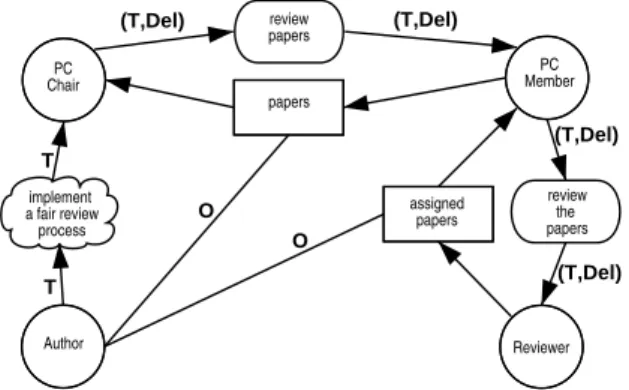
ex-tended metamodel. TheAuthortrusts thePC Chairto
implement a fair review process and he/she
is the owner of the paper sent to the PC Member and
reviewed by the Reviewer. ThePC Chairtrusts and
delegatesPC Memberto review a certain number of
pa-pers, and in turn the PC Member trusts and delegates
the Reviewer to review the papers. ThePC member
(Reviewer) depends on thePC Chair(PC Member) to receive the paper to review.
review papers
Reviewer PC
Chair
PC Member
review the papers assigned
papers papers
Author implement a fair review process
T
T
(T,Del) (T,Del)
O O
(T,Del)
(T,Del)
Figure 6: TheTroposactor diagram with the trust concepts.
5 A Modelling Environment
In order to support the specific analysis techniques adopted in Tropos, different tools have been developed, such as a tool for the verification of requirements specification through model-checking technique (T-Tool) [13], a tool which supports forward and backward reasoning on the goal analysis structures (GR-Tool) [15]. In this section, we will give details of a modelling environment, called TAOM4e (Tool for Agent-Oriented Modelling for Eclipse), which is based on an implementation of the metamodel described in the previous sections. The metamodel has been specified following the OMG’s MDA [21] standard for metamodel interoperability, that is the Meta Object
Fa-cility (MOF)2which offers a mechanism for automatically
deriving a concrete syntax based on XML DTDs and/or schemas known as XML Model Interchange (XMI). This is a preliminary step towards the adoption of the model-to-model transformation approach proposed by MDA.
Among the main requirements we considered in devel-oping this tool are the following [23]:
– Visual Modelling. The modelling environment should support the user during the specification of an AO
model (e.g., according to theTroposvisual notation).
Moreover, the environment should allow us to
repre-sent new entities that will be included in theTropos
metamodel, language variants, such as those presented in Section 4, as well as to restrict its use to a subset of entities of the modelling language.
2http://www.omg.org/technology/documents/
modeling_spec_catalog.htm#MOF
– Specification of model entities properties. The mod-elling environment should allow us to easily annotate the visual model with model properties like invari-ants, creation or fulfillment conditions that are
typi-cally used in FormalTroposspecification.
– Automatic Model Translation. The modelling envi-ronment should allow us to save a model in a standard format (e.g., XML and XMI), and provide automatic transformation into a different specification language. The model-to-model transformation approach should be also compliant with Query/View/Transformation (QVT) requirements [14], as discussed in [24].
– Extensibility. The modelling environment should be extensible and allow for different configurations by easily integrating other tools at will.
ECLIPSE
EMF GEF
TAOM4e
TAOM4e model
TAOM4e platform
Figure 7: The architecture of TAOM4e.
An effective solution to the requirement of a flexible ar-chitecture and to the component integration issue is offered by the Eclipse Platform.
New tools are integrated into the platform through plug-ins that provide the environment with new functionalities. A plug-in is the smallest unit of function in Eclipse and the Eclipse Platform itself is organized as a set of subsystems, implemented in one or more plug-ins, built on the top of a small runtime engine. The TAOM4e architecture is de-picted in Figure 7. It follows the Model View Controller pattern and has been devised as an extension of two
exist-ing plug-ins. First, the EMF plug-in3 offers a modelling
framework and code generation facilities for building tools and other applications based on a structured data model. Given an XMI model specification, EMF provides func-tions and runtime support to produce a set of Java classes for the model. Most importantly, EMF provides the foun-dation for interoperability with other EMF-based tools and
applications. The resulting plug-in, calledTAOM4e model
implements theTroposmetamodel. It represents the Model
component of the MVC architecture. Second, the
Graph-ical Editing Framework (GEF) plug-in4 allows developers
to create a rich graphical editor around an existing meta-model. The functionality of the GEF plug-in helps to cover the essential requirement of the tool, that is supporting a
visual development of Troposmodels by providing some
standard functions like drag & drop, undo-redo, copy &
paste and others. The resulting plug-in, called TAOM4e
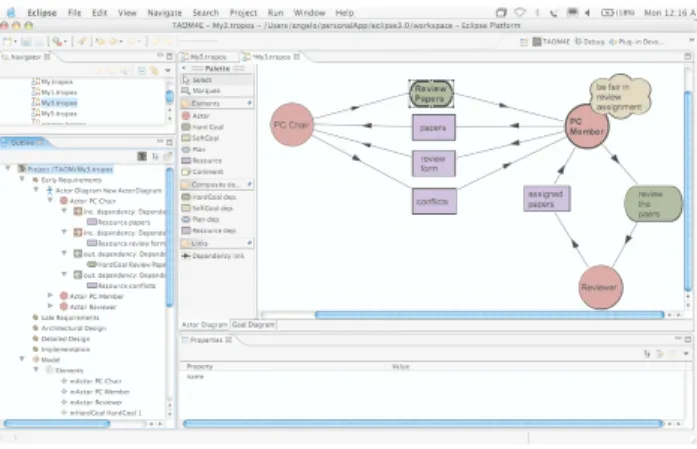
platform represents both the Controller and the Viewer components of the tool. In Figure 8 a snapshot of the
mod-Figure 8: The Graphic User Interface of TAOM4e.
eler: the diagram editor window on the right, the project and model browsers on the left, the entity properties win-dow at the bottom.
6 Related Work
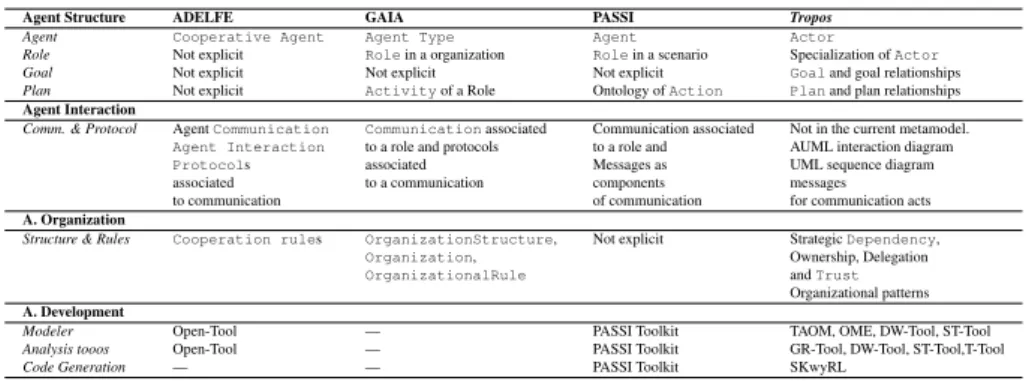
Many Agent-Oriented Software Engineering methodolo-gies have been proposed and compared over the last few years [18, 25]. An analysis of the metamodels of three methodologies, ADELFE [4], GAIA [27] and PASSI [7] has been presented in [3]. The aim of this work was to face interoperability issues between different methodologies.
In this section we extend this analysis includingTropos.
We will focus on four dimensions: Agent Structure, Agent Interaction, Agent Organization and Agent Development (e.g., CASE tools at support of the development process). Table 1 summarizes the comparison. In ADELFE the
con-cept of agent (Cooperative Agent) is defined as the
composition of aptitudes, skills, characteristic, communi-cation and representation. Not explicit concept of role is given, the concept of goal is implicitly used to identify agent skills, but it is not representable as well as the con-cept of plan, since a plan is an entity that will be built at run time and which is not representable at design time. In
GAIA, an agent (Agent Type) is specified as a
compo-sition of roles. Each role is responsible of a specific set of activities associated with the role. Goals cannot be explic-itly modeled, but they are implicexplic-itly used to characterize a
role. In PASSI, an agent (Agent) is defined as the
compo-sition of roles and each role is defined as the manifestation of the agent activity in some scenario. Goals are implicitly considered when specifying non-functional requirements
attached to agent duties. InTropos, the concept ofActor
generalizes the concepts of agent and role (or set of roles), an actor can have individual goals and it can be able to
ex-ecute plans to satisfy goals. Goal analysis inTroposdrives
the modelling process, as discussed in Section 4 and allows
us to represent goal decomposition, means to satisfy a goal or contribution towards goal satisfaction through different goal relationships.
The concepts used to specify the interactions of an agent with another agent or with the environment are similar in ADELFE, GAIA and PASSI. Basically, they use the
con-cept of communication, role, and protocols.Troposadopts
the Agent Unified modelling Language (AUML) Agent In-teraction Diagram, described in [2, 22] (proposed by the FIPA –Foundation for Physical Intelligent Agents– [12] and the OMG Agent Work group) where agent communica-tive acts are represented as messages in a UML sequence diagram.
In GAIA, the concept of organization is a primary con-cept, organization rules specify constraints that the orga-nization should observe. In PASSI, agent orgaorga-nization as-pects are modeled implicitly in terms of services that can be accessed by agents in a given scenario. In ADELFE, agent organization and society emerges from the evolving interactions between the agents which are compliant with cooperation rules.
In Troposthe strategic dependencies between actors in a domain makes explicit the organizational dimension and provide basic entities to model organizational patterns [19].
Moreover, theTroposmetamodel has been extended to
in-clude concepts of business processes and security.
Both ADELFE and PASSI provide CASE tools at support of modelling and for ad-hoc analysis on part
of the resulting specification. Tropos provides
mod-elling and analysis tools (details can be found in http://www.troposproject.org) as well as code generation tools [10].
This comparison shows that different metamodels (methodologies) may allow us to model different proper-ties of a system (e.g., organizational aspects, communica-tions and protocols). On the other hand, it shows that even if metamodels share a comparable set of concepts, they can be used in a different way by the different methodologies. This can be found also considering requirements engineer-ing methodologies based on metamodels. For instance, in KAOS [9], the concept of agent is used to assign leaf goals resulting from goal analysis.
Finally, other related work oni*andTropos
metamod-els are worth to be mentioned. The i* metamodel [26]
represents the basis for theTroposmetamodel. Other
ex-tensions of thei*metamodel have been proposed. For
in-stance, in [1] where a methodology for COTS selection is proposed.
7 Conclusion
We have presented an overview of theTroposmetamodel.
Like other software development methodologies, Tropos
Agent Structure ADELFE GAIA PASSI Tropos
Agent Cooperative Agent Agent Type Agent Actor
Role Not explicit Rolein a organization Rolein a scenario Specialization ofActor Goal Not explicit Not explicit Not explicit Goaland goal relationships Plan Not explicit Activityof a Role Ontology ofAction Planand plan relationships Agent Interaction
Comm. & Protocol AgentCommunication Communicationassociated Communication associated Not in the current metamodel. Agent Interaction to a role and protocols to a role and AUML interaction diagram
Protocols associated Messages as UML sequence diagram
associated to a communication components messages to communication of communication for communication acts A. Organization
Structure & Rules Cooperation rules OrganizationStructure, Not explicit StrategicDependency,
Organization, Ownership, Delegation
OrganizationalRule andTrust
Organizational patterns A. Development
Modeler Open-Tool — PASSI Toolkit TAOM, OME, DW-Tool, ST-Tool
Analysis tooos Open-Tool — PASSI Toolkit GR-Tool, DW-Tool, ST-Tool,T-Tool
Code Generation — — PASSI Toolkit SKwyRL
Table 1: Comparison of the meta-models of four Agent-Oriented methodologies.
it richer, could also help in supporting some forms of se-mantic consistency currently conducted through a series of
tools offered within theTropossoftware development
envi-ronment.
References
[1] C. Ayala, C. Cares, J. P. Carvallo, G. Grau, M. Haya, X. Franch G. Salazar, E. Mayol, and C. Quer. A
Com-parative Analysis ofi*-Based Agent-Oriented
Model-ing Language. InProceedings of 17th International
Conference on Software Engineering and Knowledge Engineering (SEKE’05), pages 43–50, Taipei, Tai-wan, 2005. KSI Press.
[2] B. Bauer, J.P. Muller, and J. Odell. Agent UML: A formalism for specifying multiagent interaction. In
P. Ciancarini and M. Wooldridge, editors,Proc. of the
1st Int. Workshop on Agent-Oriented Software Engi-neering (AOSE’00), volume 1957 ofLNCS, pages 91– 104, Limerick, Ireland, 2001. Springer.
[3] C. Bernon, M. Cossentino, M. P. Gleizes, P. Turci, and F. Zambonelli. A Study of Some Multi-agent Meta-models. In J. P. Muller J. Odell, P. Giorgini, editor,
Agent-Oriented Software Engineering V: 5th Interna-tional Workshop, AOSE 2004, volume 3382 ofLNCS, pages 62–77, New York, USA, NY, 2004. Springer.
[4] C. Bernon, M.P. Gleizes, S. Peyruqueou, and G. Pi-card. ADELFE, a Methodology for Adaptive Multi-Agent Systems Engineering. In P. Petta, R. Tolksdorf,
and F. Zambonelli, editors,Third International
Work-shop on Engineering Societies in the Agents World (ESAW-2002), volume 2577 ofLNCS, pages 156–169, Madrid, Spain, 2003. Springer.
[5] G. Booch, J. Rumbaugh, and I. Jacobson.The Unified
Modeling Language: User Guide. Addison-Wesley, 1999.
[6] P. Bresciani, P. Giorgini, F. Giunchiglia, J.
My-lopoulos, and A. Perini. Tropos: An
Agent-Oriented Software Development Methodology.
Au-tonomous Agents and Multi-Agent Systems, 8(3):203– 236, 2004. Kluwer Academic Publishers.
[7] A. Chella, M. Cossentino, and L. Sabatucci. Tools and patterns in designing multi-agent systems with
PASSI. WSEAS Transactions on Communications,
3(1):352–358, 2004.
[8] L.K. Chung, B. Nixon, E. Yu, and J. Mylopoulos.
Non-Functional Requirements in Software
Engineer-ing. Kluwer Publishing, 2000.
[9] A. Dardenne, A. van Lamsweerde, and S. Fickas.
Goal-directed requirements acquisition. Science of
Computer Programming, 20(1–2):3–50, 1993. Else-vier.
[10] T. T. Do, M. Kolp, and S. Faulkner. Agent Oriented
Design Patterns: The SKwyRL Perspective. InProc.
of the 6th International Conference on Enterprise In-formation Systems (ICEIS 2004), pages 48–53, Porto, Portugal, 2004.
[11] T. Finin, Y. Labrou, and J. Mayfield. KQML as an agent communication language. In J.M. Bradshaw,
editor,Software Agents, pages 291–316. MIT Press,
Menlo Park, CA, 1997.
[12] FIPA. The Foundation for Intelligent Physical
Agents. At http://www.fipa.org, 2001.
[13] A. Fuxman, M. Pistore, J. Mylopoulos, and P. Traverso. Model checking early requirements
spec-ifications in Tropos. InInt. Symposium on
Require-ments Engineering, pages 174–181, Toronto, CA, 2001. IEEE Computer Society.
[14] T. Gardner, C. Griffin, J. Koehler, and R. Hauser. A review of omg mof 2.0 query / views / transforma-tions submissions and recommendatransforma-tions towards the
final standard. InMetaModelling for MDA Workshop,
pages 178–197, York, UK, England, 2003.
[15] P. Giorgini, J. Mylopoulous, and R. Sebastiani. Goal-Oriented Requirements Analysis and Reasoning in
the Tropos Methodology. Engineering Applications
[16] P. Giorgini, F. Massacci, J. Mylopoulous, and N. Zan-none. Requirements Engineering meets Trust Man-agement: Model, Methodology, and Reasoning. In
Proc. of iTrust’04, volume 2995 ofLNCS, pages 176– 190. Springer-Verlag, 2004.
[17] P. Giorgini, F. Massacci, J. Mylopoulous, and N.
Zan-none. Modeling Security Requirements Through
Ownership, Permission and Delegation. InProc. of
the The 13th IEEE Requirements Engineering Con-ference (RE’05), Paris, France, 2005. IEEE Computer Society.
[18] B. Henderson-Sellers and P. Giorgini, editors.
Agent-Oriented Methodologies. Idea Group Inc., Hershey, PA, USA, 2005.
[19] M. Kolp, P. Giorgini, and J. Mylopoulos. A goal-based organizational perspective on multi-agents
ar-chitectures. InProc. of the 8th Int. Workshop on
In-telligent Agents: Agent Theories, Architectures, and Languages, ATAL’01, volume 2333 ofLNCS, pages 128–140, Seattle, USA, 2002. Springer.
[20] Y. Labrou, T. Finin, and Y. Peng. Agent
communica-tion languages: The current landscape. IEEE
Intelli-gent Systems, 14(2):45–52, 1999. IEEE.
[21] Stephen J. Mellor, Kendall Scott, Axel Uhl, and Dirk
Weise.MDA Distilled. Addison-Wesley, 2004.
[22] J. Odell, H. Van Dyke Parunak, and B. Bauer.
Ex-tending UML for agents. InProc. of the 2nd Int.
Bi-Conference Workshop on Agent-Oriented Information Systems, AOIS’00, pages 3–17, Austin, USA, 2000.
[23] A. Perini and A. Susi. Developing Tools for Agent-Oriented Visual Modeling. In G. Lindemann, J.
Den-zinger, I.J. Timm, and R. Unland, editors,Multiagent
System Technologies, Proc. of the Second German Conference, MATES 2004, volume 3187 of LNAI, pages 169–182, Erfurt, Germany, 2004. Springer.
[24] A. Perini and A. Susi. Automating Model
Trans-formations in Agent-Oriented modelling. In
Agent-Oriented Software Engineering VI: AOSE 2005, LNCS, Utrecht, The Netherlands, 2005. Springer.
[25] A. Sturm and O. Shehory. A Framework for Evaluat-ing Agent-Oriented Methodologies. In M. Winikoff
P. Giorgini, B. Henderson-Sellers, editor, Proc. of
the Int. Bi-Conference Workshop on Agent-Oriented Information Systems, AOIS 2003, volume 3030 of
LNCS, pages 94–109. Springer, 2003.
[26] E. Yu. Modelling Strategic Relationships for Process
Reengineering. PhD thesis, University of Toronto, Department of Computer Science, 1995.
[27] F. Zambonelli, N. R. Jennings, and M. Wooldridge. Developing Multiagent Systems: The Gaia
Method-ology. ACM Transactions on Software Engineering