Beyond Data
fl
ow
Borut Robi
c
ˇ
1, Jurij
Silc
ˇ
2and Theo Ungerer
31Faculty of Computer and Information Science, University of Ljubljana, Slovenia 2Computer Systems Department, Jozef Stefan Institute, Ljubljana, Sloveniaˇ
3Department of Computer Design and Fault Tolerance, University of Karlsruhe, Germany
This paper presents some recent advanced dataflow architectures. While the dataflow concept offers the potential of high performance, the performance of an actual dataflow implementation can be restricted by a limited number of functional units, limited memory bandwidth, and the need to associatively match pending operations with available functional units. Since the early 1970s, there have been significant developments in both fundamental research and practical realizations of dataflow models of computation. In particular, there has been active research and development in multi-threaded architectures that evolved from the dataflow model. Also some other techniques for combining control-flow and dataflow emerged, such as coarse-grain dataflow, dataflow with complex machine operations, RISC dataflow, and micro dataflow. These developments have also had certain impact on the conception of high-performance superscalar processors in the “post-RISC” era.
Keywords: Coarse-grain dataflow, computer architec-ture, hybrid von Neumann/dataflow, micro dataflow,
RISC dataflow, superscalar microprocessor, survey, threaded dataflow.
1. Introduction
The most common computing model (i.e., a
description of how a program is to be evalu-ated)is the von Neumann control-flow
comput-ing model. This model assumes that a program is a series of addressable instructions, each of which either specifies an operation along with memory locations of the operands or it specifies
(un)conditional transfer of control to some other
instruction. A control-flow computing model essentially specifies the next instruction to be executed depending on what happened during the execution of the current instruction. The next instruction to be executed is pointed to and
triggered by the program counter. This instruc-tion is executed even if some of its operands are not available yet(e.g., uninitialized).
The dataflow model represents a radical alter-native to the von Neumann computing model since the execution is driven only by the avail-ability of operands. It has no program counter and global updatable store, i.e., the two fea-tures of the von Neumann model that become bottlenecks in exploiting parallelism. The seri-alization of the von Neumann computing model is a serious limitation for exploiting more paral-lelism in today’s microprocessors – e.g., super-scalars. In dataflow computing parallelism is limited only by the actual data dependences be-tween instructions in the application program. Since program execution is driven only by the availability of the operands(at the inputs to the
functional units), dataflow computers have the
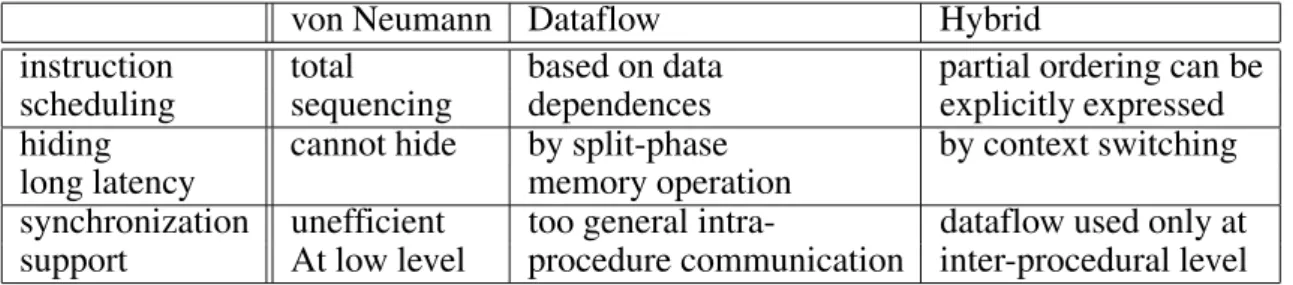
von Neumann Dataflow Hybrid
instruction total based on data partial ordering can be
scheduling sequencing dependences explicitly expressed
hiding cannot hide by split-phase by context switching
long latency memory operation
synchronization unefficient too general intra- dataflow used only at support At low level procedure communication inter-procedural level
Table 1.Von Neumman, dataflow and hybrid approach.
tagged-token(dynamic)approach or explicit
to-ken store approach have circular pipelined orga-nization, and usually perform quite poorly with sequential code (Arvind et al., 1991). This
is because an instruction of the same execu-tion thread can only be issued to the dataflow pipeline after the completion of its predeces-sor instruction. In case of an 8-stage dataflow pipeline, for example, instructions of the same thread can be issued at the most every eight cy-cles. If the computation load is low, for instance for a single sequential thread, the utilization of the dataflow processor drops to one eighth of its maximum performance.
Another disadvantage of the fine-grain dataflow is the overhead associated with token matching. For example, before a dyadic instruction is is-sued to the execution stage, two operands(each
packed in the so-called token)must be present.
The first arrived token is stored in the waiting-matching store and only when the second to-ken arrives the instruction can be issued (i.e.,
fired). This introduces a bubblein the
execu-tion stage(s)of the dataflow processor pipeline,
i.e., a sequence of idle pipeline stages. Clearly, this may affect the system’s performance, so bubbles should not be neglected. For exam-ple, the pipeline bubbles summed up to 28.75 % of the total execution time when solving the Traveling Salesman problem on the Monsoon dataflow machine (Papadopoulos and Culler,
1990). Since a context switch occurs in such
fine-grain dataflow after each instruction exe-cution, no use of registers is possible for opti-mizing the access time to data in order to avoid pipeline bubbles caused by dyadic instructions, and for reducing the total number of tokens dur-ing program execution.
A solution to these problems is to combine dataflow with control-flow mechanisms.
Ac-tually, the symbiosis between dataflow and von Neumann architectures was tried to find by a number of research projects developing von Neumann/dataflow hybrids.
In this paper, several techniques(as well as
ma-chines based on them) for combining
control-flow and datacontrol-flow will be described. In Section 2 we describe basics of hybrid dataflow com-puting. Selected hybrid architectures are given in Section 3. In Section 4 we describe the so-called micro dataflow which is nowadays used in state-of-the-art microprocessors. Finally, in Section 5 we compare the hybrid dataflow ap-proaches and discusse some possible research directions.
2. Hybrid Dataflow
Key features of von Neumann/dataflow hybrids
are given in Table 1.
The spectrum of such hybrids is quite broad, ranging from simple extensions of a von Neu-mann processor with a few additional instruc-tions to specialized dataflow systems which at-tempt to reduce overhead by increasing the exe-cution grain size and employing various schedul-ing, allocation, and resource management tech-niques developed for von Neumann computers. The results of these projects show that dataflow and von Neumann computers do not necessar-ily represent two entirely disjoint worlds but rather two extreme ends of a spectrum of pos-sible computer systems(Beck et al., 1993 and
ˇ
Silc et al., 1998).
2.1. Threaded Dataflow
By the termthreaded dataflowwe understand a technique where the dataflow principle is mod-ified so that instructions of certain instruction streams are processed in succeeding machine cycles. In particular, given a dataflow graph
(program), each subgraph that exhibits a low
de-gree of parallelism is identified and transformed into a sequential thread of instructions. Such a thread is issued consecutively by the matching unit without matching further tokens except for the first instruction of the thread.
Threaded dataflow covers the repeat-on-input technique used in Epsilon-1 and Epsilon-2 pro-cessors, the strongly connected arc model of EM-4, and the direct recycling of tokens in Monsoon. Data passed between instructions of the same thread is stored in registers instead of written back to memory. These registers may be referenced by any succeeding instruction in the thread. This improves single-thread per-formance because the total number of tokens needed to schedule program instructions is re-duced which in turn saves hardware resources. In addition, pipeline bubbles are avoided for dyadic instructions within a thread.
Two threaded dataflow execution techniques can be distinguished – direct token recycling
andconsecutive executionof the instructions of
a single thread. The first technique, direct to-ken recycling, is used in the Monsoon dataflow computer. It allows a particular thread to oc-cupy only a pipeline frame slot in the 8-stage pipeline. This implies that at least 8 threads must be active for a full pipeline utilization to be achieved. This cycle-by-cycle instruction in-terleaving of threads is used in a similar fashion by some multithreaded von Neumann comput-ers. The second technique, consecutive execu-tion, is used in Epsilon-2 and EM-4 which con-secutively execute instructions from a thread. The circular pipelined machine organization of fine-grain dataflow is retained. However, the matching unit has to be enhanced with a mech-anism that, after firing the first instruction of a thread, delays matching of further tokens in favor of consecutive issuing of all instructions of the started thread. For example, in strongly
connected arcmodel, each arc of the dataflow
graph is classified as either a normal arc or a strongly connected arc. The set of nodes that are
connected by strongly connected arcs is called
strongly connected block. While the standard
instruction firing rule is that a node(instruction)
is fired when all input arcs have matching to-kens(operands), the enhancement for strongly
connected blocks is that such a block is fired if its source nodes are enabled and the execution of the whole block is conducted as a unit, i.e., without applying the standard dataflow firing rule for other nodes in that block.
In all threaded dataflow machines, the cen-tral design problem is the implementation of an efficient synchronization mechanism(Sakai,
1995). Direct matching is a synchronization
mechanism that needs no associative mecha-nisms. As in explicit token store, a match-ing area in operand memory is exclusively re-served for a single function instance. This area is called operand segment. The code block in instruction memory corresponding to operand segment is called a template segment. Its top address is called template segment num-ber. Operand segment number points to the top of the operand segment. A token comprises an operand, operand segment number, a displace-ment, and a synchronization flag. Displace-ment serves both as a displaceDisplace-ment of the des-tination instruction in the instruction memory and as a displacement of the matching operand in operand memory. Sinchronization flag indi-cates the type of synchronization which can be either monadic, left dyadic, right dyadic, and immediate. The matching address is produced by concatenating operand segment number and displacement. Instruction address is derived by concatenating template segment number and the displacement. Each slot in an operand segment also has a presence bit. A dyadic matching is performed by a test-and-set of the presence bit. If the presence bit has already been set, the part-ner data will be read, the bit will be cleared, and the instruction will be executed. Otherwise, the arriving data will be stored there and the pres-ence bit will be set.
2.2. Coarse-Grain Dataflow
Coarse-grain dataflow is a technique for
Neu-mann style. Coarse-grain dataflow machines typically decouple the matching stage (
some-times called signal stage, synchronization stage, etc.) from the execution stage by use of
FIFO-buffers. Pipeline bubbles are avoided by the decoupling. Off-the-shelf microprocessors can be used to support the execution stage. Most of the more recent dataflow architectures fall in this category and are listed below. Note, that they are often calledmultithreaded machinesby their authors.
2.3. Complex Dataflow
Another technique to reduce the overhead of the instruction-level synchronization is the use
of complex machine instructions, for instance
vector instructions. These instructions can be implemented by pipeline techniques as in vec-tor computers. Structured data is referenced in block rather than element-wise fashion, and can be supplied in a burst mode. This deviates from the I-structure scheme where each data element within a complex data structure is fetched indi-vidually from a structure store.
An advantage of complex machine operations is the ability to exploit parallelism at the subin-struction level. Therefore, such a machine has to partition a complex machine operation into suboperations that can be executed in parallel. The use of a complex machine operation may spare several nested loops. The use of FIFO-buffers allows the machine to decouple the fir-ing stage and the execution stage to bridge the different execution times within a mixed stream of simple and complex instructions issued to the execution stage. As a major difference to con-ventional dataflow architectures, tokens do not carry data(except for the valuestrueorfalse).
Data is only moved and transformed within the execution stage. This technique is used in the Decoupled Graph/Computation Architecture,
the Stollmann Dataflow Machine, and the AS-TOR architecture. These architectures combine complex machine instructions with coarse-grain dataflow, described above. The structure-flow technique proposed for the SIGMA-1 enhances these fine-grain dataflow computer by structure load/store instructions that can move, for
in-stance, whole vectors to/from structure store.
Arithmetic operations are executed by the cyclic pipeline within a PE.
2.4. RISC Dataflow
The development ofRISC dataflowwas an addi-tional stimulus for dataflow/von Neumann
hy-brids. RISC dataflow architectures support the execution of existing software written for con-ventional processors. Using such a machine as a bridge between existing systems and new dataflow supercomputers should have made the transition from imperative von Neumann lan-guages to dataflow lanlan-guages easier to the pro-grammer. The basic philosophy underlying the development of the RISC dataflow architecture was to use a RISC-like instruction set, to change the architecture to support multithreaded com-putation, to add fork and join instructions in order to manage multiple threads, to implement all global storage as I-structure storage, and to implement load/store instructions to execute in
split-phase mode.
3. Selected Representatives
Next, we briefly describe some highly influen-tial hybrid dataflow projects.
3.1. Threaded Dataflow
3.1.1. EM-4 and EM-X
In the EM-4 project (Sakai et al., 1989) the
essential elements of a dynamic dataflow archi-tecture using frame storage for local variables are incorporated into a single chip processor. In this design eachstrongly connectedsubgraph of a function body is implemented as a thread that uses registers for intermediate results. The EM-4 was designed for 102EM-4 PEs. Since May 1990, the EM-4 prototype with 80 PEs is operational. Each PE consists of a processor(EMC-R) and
a data repository obeying the single-assignment rule, called I-structure memory.
The processor and its memory (containing
operand segments and template segments) are
of the off-chip memory is used as secondary buffer. The fetch/matching unit is used for
matching tokens and fetching instructions. It performs direct matching for packets and in-struction sequencing for a strongly connected block(thread). The heart of the EMC-R is the
execution unit, which fetches instructions un-til the end of the thread(if the next instruction
is strongly connected with the current instruc-tion, instruction fetch and data load of the next instruction are overlapped with the execution).
Instructions with matching tokens are executed. Instructions can emit tokens or write to register file.
In 1993, an upgrade to EM-4, called EM-X, was developed (Kodama et al., 1995). It was
designed to support latency reduction by fus-ing the communication pipeline with the exe-cution pipeline, latency hiding via multithread-ing, and run-time latency minimization for re-mote memory access. EM-4 can access rere-mote memory by invoking packet system handlers on the destination PE. Clearly, when the des-tination PE is busy, remote memory requests are blocked by the current thread execution. To remedy this, EM-X supports direct remote memory read/write mechanism, which can
ac-cess the memory independently of thread execu-tion. For these reasons, the EMC-Y single-chip processor was used in EM-X(instead of
EMC-R that was used in EM-4).
3.1.2. Monsoon
The Monsoon dataflow multiprocessor (
Papa-dopoulus and Culler, 1990) was built jointly
by MIT and Motorola. In Monsoon, dataflow PEs are coupled with each other and with I-structure storage units by a multistage packet-switching network. Each PE is using an eight-stage pipeline. The first eight-stage is the instruction fetch stage which precedes token matching(in
contrast to dynamic dataflow processors with associative matching units). Such a new
ar-rangement is necessary since the operand fields in an instruction denote the offset in the mem-ory frame that itself is addressed by the tag of a token. The explicit token address is com-puted from the frame address and operand off-set. This is done in the second stage, called effective address generation, which is the first of three pipeline stages that perform the token
matching. In the third stage, called presence bit operation, a presence bit is accessed to find out if the first operand of a dyadic operation has al-ready arrived. If not, the presence bit is set and the current token is stored into the frame slot of the frame memory. Otherwise, the presence bit is reset and the operand is retrieved from the slot. Operand storing or retrieving is the task of the fourth pipeline stage – frame opera-tion stage. The next three stages are execuopera-tion stages in which, besides other things, the next tag is computed concurrently. The eighth stage, also called form-token stage, forms one or two new tokens that are sent to the network, stored in a user token queue, a system token queue, or directly recirculated to the instruction fetch stage of the pipeline.
The Monsoon dataflow processor(
Papadopou-los and Traub, 1991)can be viewed as a
cycle-by-cycle interleaving multithreaded computer due to its ability of direct token recycling. Us-ing this technique, a successor token is directly fed back in the eight-stage pipeline bypassing the token store. Another instruction of the same thread is executed every eighth processor cy-cle. Monsoon allows the use of registers(eight
register sets are provided)to store intermediate
results within a thread, thereby digressing from the fine-grain dataflow execution model. Since September 1990, 1 PE 1 I-structure memory configuration (also referred to as the
two-node system)is operational while the first
8 8 configuration(16-node system)was
de-livered in the fall of 1991. In total, sixteen two-node Monsoon systems were constructed and delivered to universities across the USA and two 16-node systems were delivered to MIT and Los Alamos National Laboratories.
3.1.3. Epsilon-2
Epsilon-2 machine(Grafe and Hoch, 1990)
sup-ports a fully dynamic memory model, allowing single cycle context switches and dynamic par-allelization. The system is built around a mod-ule consisting of a processor and a structure unit, connected via a 4 4 crossbar to each other, an I/O port, and the global interconnection
The Epsilon-2 processor retains the high perfor-mance features of the Epsilon-1 prototype, in-cluding direct matching, pipelined processing, and a local feedback path. The ability to execute sequential code as a grain provides RISC-like execution efficiency.
3.1.4. RWC-1
The massively parallel computer RWC-1(Sakai
et al., 1993) is a descendant of EM-4 (as it is
EM-X). Amultidimensional directed cycles
en-semblenetwork connects up to 1 024 PEs. Two
small-scale systems, Testbed-I with 64 PEs and Testbed-II with 128 PEs are used for testing and software development. The PE is based on re-duced interprocessor-communication architec-turewhich employs 2-issue superscalar execu-tion, a floating-point multiplier/adder module,
and offers fast and simple message handling mechanism, hard-wired queuing and scheduling mechanism, a hard-wired micro-synchronization mechanism, integration of communication, scheduling and execution, and simplification of the integrated structure(Matsuoka et al., 1998).
3.2. Coarse-Grain Dataflow
3.2.1. StarT
The StarT project was launched by MIT and Motorola in mid-1991. The StarT, sometimes also written as *T (Nikhil et al., 1992), is a
direct descendant of dataflow architectures, es-pecially of the Monsoon, and unifies them with von Neumann architectures. StarT has a scal-able computer architecture designed to support a broad variety of parallel programming styles including those which use multithreading based on non-blocking threads. A StarT node con-sists of thedata processor(dP), which executes
threads, thesynchronization coprocessor (sP),
which handles returning load responses and join operations, and theremote-memory request
pro-cessor(RMem)for incoming remote load/store
requests. The three components share local
node memory. The node is coupled with a high
performance network having a fat-tree topology with high cross-section bandwidth.
Due to its on-chip special-function unit, the 2-issue superscalar RISC microprocessor Mo-torola 88110 was chosen as the basis for the
node implementation. However, in order to keep the communication latency to a minimum, a number of logic modules were added to the 88110 chip to make it acting as a tightly-coupled network interface. The resulting chip was called 88110MP(MP for multiprocessor)with 10 - 20
machine cycles overhead for sending and re-ceiving data between the node and the network. Two 88110MP microprocessors were used to implement the StarT node. The first one oper-ated as dP, with its special-function unit serv-ing as sP. dP and sP were optimized for long and short threads, respectively. The second 88110MP was tailored to act as RMem to han-dle remote memory requests from other nodes to the local node memory(64 MB).
The fat-tree network was based on the MIT Arc-tic packed routing chip(Boughton, 1994) that
was twice as fast as Monsoon’s PaRC and was expected to drive the interconnection network at 1.6 Gbyte/s/link in each direction with packet
sizes ranging from 16 to 96 bytes. Sixteen nodes were packaged into a “brick” with 3.2 GFLOPS and 3 200 MIPS peak performance. Sixteen bricks can be interconnected into 256-node ma-chine with the potential to achieve 50 GFLOPS and 50 000 MIPS.
As reported in(Arvind et al., 1997), MIT
de-cided to go back to the drawing board and to start afresh on PowerPC-based StarT machines after Motorola and IBM started manufactur-ing PowerPC family of RISC microprocessors. Thus, PowerPC 620 was planned in StarT-ng machine(Ang et al., 1995)but the architecture
was redesigned once again – this time around a 32-bit PowerPC 604 – and was called StarT-Voyager machine(Ang et al., 1996). This
ma-chine, however, bears little resemblance to the original StarT architecture and no similarity to Monsoon.
3.2.2. TAM
The Threaded Abstract Machine(TAM)(Culler
et al., 1991) is an execution model for
3.2.3. ADARC
In the Associative Dataflow Architecture
(ADARC) the processing units are connected
via an associative communication network
(Strohschneider et al., 1994). The processors
are equipped with private memories that con-tain instruction sequences generated at compile-time. The retrieval of executable instructions is replaced by the retrieval of input operands for the current instructions from the network. The structure of the associative switching network enables full parallel access to all previously gen-erated results by all processors. A processor ex-ecutes its current instruction(or instruction
se-quence)as soon as all requested input operands
have been received.
3.2.4. Pebbles
The Pebbles architecture(Roh and Najjar, 1995)
is a coarse-grain dataflow architecture with a decoupling of the synchronization unit and the execution unit within the PEs. The PEs are coupled via a high-speed network. The local memory of each node consists of an instruction memory, which is read by the execution unit, and a data memory (or frame store), which is
accessed by the synchronization unit. A ready queue contains the continuations representing those threads that are ready to execute. The frame store is designed as a storage hierarchy where a frame cache holds the frames of threads that will be executed soon. The execution unit is a 4-issue superscalar microprocessor.
3.2.5. MTA and EARTH
The Efficient Architecture of Running Threads
(EARTH) (Hum et al., 1994 and Maquelin,
1995) is based on the MTA (Multithreaded
Architecture) and dates back to the Argument
Fetch Dataflow Processor. An MTA node con-sists of an execution unit that may be an off-the-shelf RISC microprocessor and a synchroniza-tion unit to support dataflow-like thread syn-chronization. The synchronization unit deter-mines which threads are ready to be executed. Execution unit and synchronization unit share the processor’s local memory, which is cached. Accessing data in a remote processor requires
explicit request and sends messages. The syn-chronization unit and execution unit communi-cate via FIFO queues: A ready queue containing ready thread identifiers links the synchroniza-tion unit with the execusynchroniza-tion unit, and an event queue holding local and remote synchronization signals connects the execution unit with the syn-chronization unit, but also receives signals from the network. A register use cache keeps track of which register set is assigned to which func-tion activafunc-tion. MTA or EARTH rely on non-blocking threads. The EARTH architecture is implemented on top of the experimental (but
rather conventional)MANNA multiprocessor.
3.3. Complex Dataflow
3.3.1. ASTOR
The Augsburg Structure-Oriented Architecture
(ASTOR)(Zehendner and Ungerer, 1987)can
be viewed as a dataflow architecture that utilizes task level parallelism by the architectural struc-ture of a distributed memory multiprocessor, instruction-level parallelism by a token-passing computation scheme, and subinstruction-level parallelism by SIMD evaluation of complex ma-chine instructions. Sequential threads of data instructions are compiled to dataflowmacro ac-torsand executed consecutively using registers. A dependence construct describes the partial or-der in the execution of instructions. It can be visualized by a dependence graph. The nodes in a dependence graph represent control
con-structs or data instructions; the directed arcs
denote control dependences between the nodes. Tokens are propagated along the arcs of the de-pendence graph. To distinguish different activa-tions of a dependence graph, a tag is assigned to each token. The firing rule of dynamic dataflow is applied but tokens do not carry data.
The ASTOR architecture consists of PEs con-nected by an instruction communication net-workto transfer procedure calls anddata
com-munication networkfor parameter passing. No
global storage is used. Due to the separation of code and data objects, each PE consists of two loosely coupled parts: First, the program
flow control part consists of a static and
dy-namic code storage, the static and the dydy-namic code access manager, the I/O managers, and the
call, loop, choice and dependency manager).
Second, the data object processing part con-sists of a data storage, several data access man-agers, an I/O manager, some data
transforma-tion units, and the computatransforma-tional structure man-ager. All managers in a PE work in parallel to each other. Asynchronous processing and de-coupling of the managers is achieved by buffer-ing the links between them.
3.3.2. Stollman Dataflow Machine
The Stollman dataflow machine(Gl¨uck-Hiltrop
et al., 1989) is a coarse-grain dataflow
archi-tecture directed towards database applications. The dataflow mechanism is emulated on a shared-memory multiprocessor. The query tree of a relational query language(such as SQL)is
viewed as a dataflow graph. Complex database query instructions are implemented as coarse-grain dataflow instruction and(micro-)coded as
a traditional sequential program running on the emulator hardware.
3.3.3. DGC
In Decoupled Graph/Computation (DGC)
ar-chitecture (Evripidou and Gaudiot, 1991) the
token matching and token formatting and rout-ing are reduced to a srout-ingle graph operation called determine executability. The decoupled graph/computation model separates the graph
portion of the program from the computational portion. The two basic units of the decoupled model(computationalunit andgraphunit)
op-erate in an asynchronous manner. The graph unit is responsible for determining executability by updating the dataflow graph, while the com-putation unit performs all the comcom-putational op-erations(fetch and execute).
3.4. RISC Dataflow
3.4.1. P-RISC Architecture
The Parallel RISC(P-RISC)architecture(
Nik-hil and Arvind, 1989)based on the above
prin-ciples and consists of a collection of PEs(with
local memory)and aglobal memory,
intercon-nected through a packed-switching communi-cation network.
Following the principles underlying all RISC architectures, the ALU of P-RISC PEs distin-guishes betweenload/storeinstructions, which are the only instructions accessing global mem-ory (implemented as I-structure storage), and
arithmetic/logical instructions, which operate
on local memory(registers). Fixed instruction
length and one-cycle instruction execution(
ex-cept for load/store instructions)are the
charac-teristics of this processor. In addition, P-RISC lacks any explicit matching unit. Instead, all operands associated with a sequential thread of computation are kept in a frame in local pro-gram memory. Each execution step makes use of an h IP, FP i pair, where IP serves to fetch
the next instruction while FP serves as the base for fetching and storing operands. The pair is called continuation and corresponds to the tagged part of a token in a tagged-token dataflow machine. To make P-RISC multithreaded, the stack of frames must be changed to a tree of frames, and a separate continuation must be as-sociated with each thread. The frame tree al-lows different threads of instructions accessing different branches of the tree concurrently while the separate continuation extents the concept of a single PC and a single operand base register to multiple instances. Continuations of all active threads are held in the continuation queue. At each clock cycle, a continuation(also called
to-ken)is dequeued and inserted into the pipeline.
It is first processed by the instruction fetch unit, which fetches from instruction memory the in-struction pointed to by IP. Next, operands are fetched from program memory by the operand fetch unit. This uses operand offsets(specified
in the instruction)relative to the FP. The
exe-cutable token is passed to the ALU or, in case of a load/store instruction, to the global
mem-ory. To solve the memory latency problem, the load/store instructions are implemented to
op-erate in a split-phase manner. The execution of an ALU instruction produces result tokens and new continuations. Result tokens are stored in the appropriate frame in(local)frame memory
by the operand store unit. Continuations are new h FP, IP i-pairs, generated by
4. Micro Dataflow
In addition, the latest generation of micropro-cessors – as exemplified by the Intel PentiumIII, MIPS R12000, Hewlett-Packard PA-8500, DEC Alpha 21264, etc. – absorbed some ideas from the dataflow approach.
In particular, state-of-the-art processors usu-ally display an out-of-order dynamic execution whereby the processor dynamically issues an instruction as soon as all its operands are avail-able and the required execution unit is not busy. This technique is referred to as local dataflow or
micro dataflow by microprocessor researchers
(
ˇ
Silc et al., 1999).
In the first paper on the Pentium Pro the in-struction pipeline is decribed as follows(
Col-well and Steck, 1995): “The flow of the Intel
Architecture instructions is predicted and these instructions are decoded into micro-operations
(µops), or series of ops, and these ops are
register-renamed, placed into an out-of-order speculative pool of pending operations,
exe-cuted in dataflow order (when operands are
ready), and retired to permanent machine state in source program order.” That is, after a branch prediction(to remove control dependences)and
register renaming (to remove antidependences
and output dependences) the instructions (or
ops) are placed in the instruction window of
pending instructions, where ops are executed in the dataflow fashion, and then in a reorder buffer that restores the program order and ex-ecution states of the instructions. Instruction window and reorder buffer may coincide. State-of-the-art microprocessors typically provide 32
(in MIPS R10000), 40 (in Intel Pentium Pro)
or 56(in HP PA-8000) instruction slots in the
instruction window or reorder buffer. Each in-struction is ready to be executed as soon as all operands are available. A 4-issue superscalar processor issues up to 4 executable instructions per cycle to the execution units, provided that resource conflicts do not occur. Issue and ex-ecution determine the out-of-order section of a microprocessor. After execution, instructions are retired in program order.
Comparing advanced dataflow computers with such superscalar microprocessors reveals sev-eral similarities as well as differences which are briefly discussed below. While a single
thread of control in modern microprocessors often does not incorporate enough fine-grained parallelism to feed the multiple functional units of today’s microprocessors, dataflow approach resolves any threads of control into separate in-structions that are ready to execute as soon as all required operands become available. Thus, thefine-grained parallelism potentially utilized
by a dataflow computer is far larger than the parallelism available for microprocessors. Data and control dependences potentially cause pipeline hazards in microprocessors that are handled by complex forwarding logic. In fine-grain dataflow computers pipeline hazards are avoided due to the continuous context switches
(with the disadvantage of a poor single thread
performance). In microprocessors,
antidepend-ences and output dependantidepend-ences are removed by register renaming that maps the architectural registers to the physical registers of the micro-processor. Thereby the microprocessor inter-nally generates an instruction stream that sat-isfies the single assignment rule of dataflow. Modern microprocessors remove antidepend-ences and output dependantidepend-ences on-the-fly and avoid the high memory requirements, the often awkward solutions for data structure storage and manipulation, and for loop control caused by the single assignment rule in dataflow computers. The main difference between the dependence graphs of dataflow and the code sequence in an instruction window of a superscalar micro-processor isbranch prediction and speculative
execution. In microrocessors, the accuracy of
the branch prediction is surprisingly high – more than 95 % are reported in(Chang et al., 1994)
for single SPEC benchmark programs. How-ever, rerolling execution in case of a wrongly predicted path is costly in terms of processor cycles, especially in deeply pipelined micropro-cessors. In the dataflow environment, however, the idea of branch prediction and speculative execution hasnever been evaluated. The rea-son for this may be that dataflow was consid-ered to produce an abundance of parallelism while speculation leads to speculative paral-lelism which is – because of instruction dis-carding when branch is mispredicted – inferior to “real” parallelism.
locality allows to employ a storage hierarchy
that stores the instructions and data potentially executed in the next cycles close to the execut-ing processor. Due to the lack of locality in a dataflow graph, a storage hierarchy is difficult to apply in dataflow computers.
The operand matching of executable instruc-tions in the instruction window of micropro-cessors is restricted to a part of the instruction sequence. Because of the serial program order, the instructions in this window are likely to be-come executable soon. Therefore, the matching hardware can be restricted to a small number of instruction slots. In dataflow computers the number of tokens waiting for a match can be very high. A large waiting-matching store is re-quired. Due to the lack of locality the likelihood of the arrival of a matching token is difficult to estimate so caching of tokens to be matched soon is difficult in dataflow.
A large instruction window is crucial for to-day’s and future superscalar microprocessors to find enough instructions for parallel execution. However, the control logic for very large in-struction windows gets so complex that it hders higher cycle rates. Therefore alternative in-struction window organizations are needed. In
(Palacharla et al., 1997)a multiple FIFO-based
organization is proposed. Only the instructions at the heads of a number of FIFO buffers can be issued to the execution units in the next cy-cle. The total parallelism in the instruction win-dow is restricted in favor of a less costly issue that does not slow down processor cycle rate. Thereby the potential fine-grained parallelism is limited – a technique somewhat similar to the threaded dataflow approaches described above.
It might be interesting to look, with respect to alternative instruction window organizations, at dataflow matching store implementations and dataflow solutions like threaded dataflow as exemplified by the repeat-on-input technique in the Epsilon-2 and strongly-connected arcs model of EM-4, or the associative switching network in the ADARC, etc. For example, the repeat-on-input strategy issues very small compiler-generated code sequences serially(in
an otherwise fine-grained dataflow computer).
Transferred to the local dataflow in an instruc-tion window, an issue string might be used where a series of data dependent instructions are generated by a compiler and issued serially after the issue of the leading instruction. How-ever, the high number of speculative instructions in the instruction window remains.
5. Comparison and Discussion
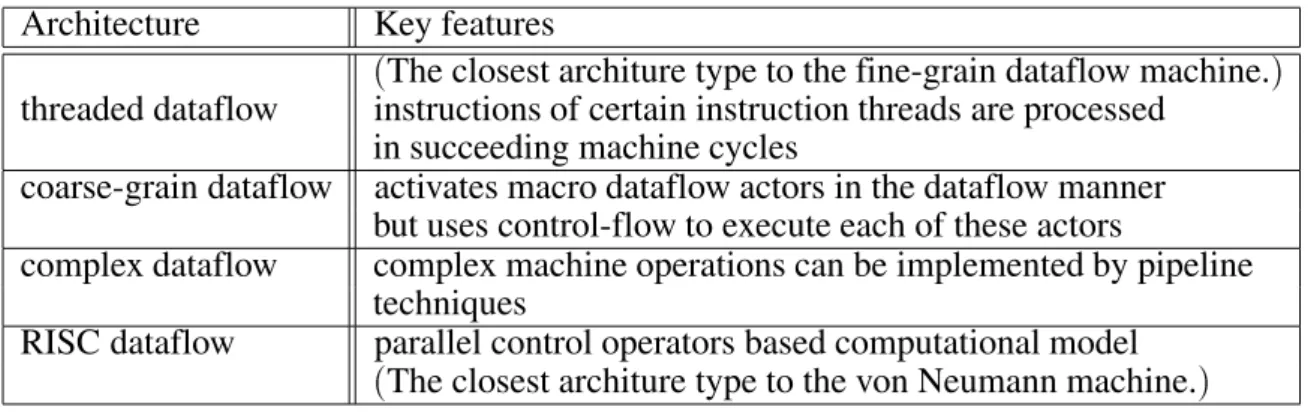
The architectures that were described in this pa-per are only a part of a broader spectrum of architectures, with von Neumann approach at one end and fine-grain dataflow approach on the other end(Table 2).
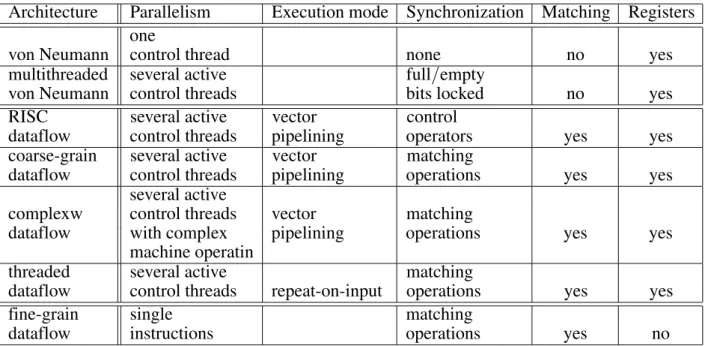
Table 3 compares these architectures accord-ing to several attributes, such as the type of instruction execution parallelism, and the type of synchronization mechanism.
As already stated by Maurice V. Wilkes in his
book Computing Perspectives, if any practical
machine based on dataflow ideas and offering real power emerges, it will be very different from what the originators of the concept had
Architecture Key features
(The closest architure type to the fine-grain dataflow machine.)
threaded dataflow instructions of certain instruction threads are processed in succeeding machine cycles
coarse-grain dataflow activates macro dataflow actors in the dataflow manner but uses control-flow to execute each of these actors
complex dataflow complex machine operations can be implemented by pipeline techniques
RISC dataflow parallel control operators based computational model
(The closest architure type to the von Neumann machine.)
Architecture Parallelism Execution mode Synchronization Matching Registers one
von Neumann control thread none no yes
multithreaded several active full/empty
von Neumann control threads bits locked no yes
RISC several active vector control
dataflow control threads pipelining operators yes yes
coarse-grain several active vector matching
dataflow control threads pipelining operations yes yes
several active
complexw control threads vector matching
dataflow with complex pipelining operations yes yes
machine operatin
threaded several active matching
dataflow control threads repeat-on-input operations yes yes
fine-grain single matching
dataflow instructions operations yes no
Table 3.Augmenting dataflow with control-flow.
in might. We have shown in this paper that due to implementation problems fine-grain dataflow remains to be a simple and elegant theoretical model.
Dataflow machines, and especially fine-grain dataflow machines, are no longer considered to be a viable option for general purpose com-putations. For DSP algorithms however, the dataflow model of architecture is a natural fit. Especially the coarse-grain dataflow machines overcome many of the problems encountered in fine-grain dataflow architectures. The coarse-grain dataflow architectures enable efficient im-plementations for high performance digital sig-nal processing.
It seems that, in order to build real dataflow ma-chines, dataflow has to borrow some concepts from the von Neumann model of computation. On the other hand, the research in modern mi-croprocessor architecture revealed the fruitful-ness of dataflow conceps in the use of instruc-tion level parallelism.
As a result, the dataflow and control-flow re-search communities now study many of the same questions. In principle, an algorithm de-fines a partial ordering of instructions due to control and data dependences. The total order-ing in an instruction stream for today’s
micro-processors stems from von Neumann languages. But why should
aprogrammer
– design apartiallyordered algorithm, – and then code the algorithm in total
ordering because of the use of a se-quential von Neumann language,
thecompiler
– regenerate the partial order in a de-pendence graph,
– and then generate a reordered “opti-mized” sequential machine code,
themicroprocessor
– dynamically regenerate the partial or-der in its out-of-oror-der section, execute due to amicro dataflowprinciple, – and then re-establish the unnatural
se-rial program order for in-order com-mitment in the retire stage ?
Ideally, an algorithm should be coded in an ap-propriate higher-order language(e.g.,
dataflow-like languages might be appropriate). Next, the
as machine language might show the right di-rection. A parallelizing compiler may generate this kind of machine code even from a program written in a sequential von Neumann language. The compiler could use compiler optimization and coding to simplify the dynamic analysis and issue out of the instruction window. The processor dismisses the serial reordering in the completion stage in favor of only a partial re-ordering. The retire unit retires instructions not in a single serial order but in two or more series
(as in the simultaneous multithreaded
proces-sors). Clogging of the reorder buffer is avoided
since clogging of one thread does not restrict retirement of instructions of another thread.
References
1] B.S. ANG, ARVIND, D. CHIOU, StarT the next
gener-ation: Integrating global caches and dataflow archi-tecture. InAdvanced Topics in Dataflow Computing and Multithreading(G.R. GAO, L. BIC, J.-L. GAU
-DIOT, Eds.) (1995) pp. 19–54. IEEE Computer
Society Press, Los Alamitos.
2] B.S. ANG, D. CHIOU, L. RUDOLPH, ARVIND,
Mes-sage passing support on StarT-Voyager. Technical Report MIT/CSG Memo 387, Laboratory for
Com-puter Science, MIT, Cambridge, 1996.
3] ARVIND, L. BIC, T. UNGERER, Evolution of dataflow
computers. InAdvanced Topics in Data-Flow Com-puting (J.-L. GAUDIOT, L. BIC, Eds.) (1991) pp.
3–33. Prentice Hall, Engelewood Cliffs.
4] ARVIND, A.T. DAHBURA, A. CARO (1997),
Com-puter architecture research and the real world. Tech-nical Report MIT/CSG Memo 397, Laboratory for
Computer Science, MIT, Cambridge, 1997.
5] M. BECK, T. UNGERER, E. ZEHENDER, Classification
and performance evaluation of hybrid dataflow tech-niques with respect to matrix multiplication. Pre-sented at theProceedings of the GI/ITG Workshop PARS,(1993)pp. 118–126, Dresden, Germany.
6] G.A. BOUGHTON, Arctic routing chip.Lect. Notes
Comput. Sc.,853(1994),310–317.
7] P.-Y. CHANG, E. HAO, T.-Y. YEH, Y.N. PATT, Branch
classification: A new mechanism for improving branch predictor performance. Presented at the Pro-ceedings of the 27th International Symposium on Microarchitecture,(1994)pp. 22–31, San Jose, CA.
8] R.P. COLWELL, R.L. STECK, A 0.6 m BiCMOS
processor with dynamic execution. Presented at the
Proceedings of the International Solid State Circuits Conference,(1995)pp. 176–177.
9] D.E. CULLER, A. SAH, K.E. SCHAUSER, T. VON
EICKEN, J. WAWRZYNEK, Fine-grain parallelism
with minimal hardware support: A compiler-controlled threaded abstract machine. Presented at the Proceedings of the 4th International Con-ference on Architectural Support for Programming Languages and Operating Systems,(1991)pp. 164–
175, Santa Clara, CA.
10] P. EVRIPIDOU, J.-L. GAUDIOT, The USC decoupled
multilevel data-flow execution model. InAdvanced Topics in Data-Flow Computing (J.-L. GAUDIOT,
L. BIC, Eds.) (1991) pp. 347–379. Prentice Hall,
Englewood Cliffs.
11] E. GLUCK¨ -HILTROP, M. RAMLOW, U. SCHURFELD¨ ,
The Stollman dataflow machine.Lect. Notes Com-put. Sc.,365(1989),433–457.
12] V.G. GRAFE, J.E. HOCH, The Epsilon-2
multi-processor system. J. Parall. Distr. Comput., 10
(1990),309–318.
13] H.H.J. HUM, K.B. THEOBALD, G.R. GAO (1994),
Building multithreaded architectures with off-the-shelf microprocessor. Presented at theProceedings of the 8th International Parallel Processing Sympo-sium,(1994)pp. 288–294, Canc ´un, Mexico.
14] Y. KODAMA, H. SAKANE, M. SATO, H. YAMANA,
S. SAKAI, Y. YAMAGUCHI Y, The EM-X parallel
computer: Architecture and basic performance. Presented at theProceedings of the 22nd Annual In-ternational Symposium on Computer Architecture,
(1995)pp. 14–23, Santa Margherita Ligure, Italy.
15] O.C. MAQUELIN, H.H.J. HUM, G.R. GAO, Costs and
benefits of multithreading with off-the-shelf proces-sors.Lect. Notes Comput. Sc.,966(1995),117–128.
16] H. MATSUOKA, K. OKAMOTO, H. HIRONO, M. SATO,
T. YOKOTA, S. SAKAI, Pipeline design and
enhance-ment for fast network message handling in RWC-1 multiprocessor. Presented at theProceedings of the Workshop on Multithreaded Execution, Architecture and Compilation,(1998), Las Vegas, NE.
17] R.S. NIKHIL, ARVIND, Can dataflow subsume von
Neumann computing? Presented at the Proceed-ings of the 16th Annual Symposium on Computer Architecture,(1989)pp. 262–272, Jerusalem, Israel.
18] R.S. NIKHIL, G.M. PAPADOPOULOS, ARVIND, *T:
A multithreaded massively parallel architecture. Presented at the Proceedings of the 19th Annual Symposium on Computer Architecture,(1992)pp.
156–167, Golden Coast, Australia.
19] S. PALACHARLA, N.P. JOUPPI, J.E. SMITH,
Complexity-effective superscalar processors. Pre-sented at the Proceedings of the 24th Annual In-ternational Symposium on Computer Architecture,
(1997)pp.
206–218, Denver, CO.
20] G.M. PAPADOPOULOS, D.E. CULLER, Monsoon: An
explicit token-store architecture. Presented at the
Proceedings of the 17th Annual Symposium on Computer Architecture,(1990)pp. 82–91, Seattle,
21] G.M. PAPADOPOULOS, K.R. TRAUB,
Multithread-ing: A revisionist view of dataflow architectures. Presented at the Proceedings of the 18th Annual Symposium on Computer Architecture,(1991)pp.
342–351, Toronto, Canada.
22] L. ROH, W.A. NAJJAR, Design of storage hierarchy
in multithreaded architectures. Presented at the Pro-ceedings of the 28th International Symposium on Microarchitecture,(1995)pp. 271–278, Ann Arbo,
MI.
23] S. SAKAI, Synchronization and pipeline design for
a multithreaded massively parallel computer. In
Advanced Topics in Dataflow Computing and Mul-tithreading(G.R. GAO, L. BIC, J.-L. GAUDIOT, Eds.) (1995)pp. 55–74. IEEE Computer Society Press,
Los Alamitos.
24] S. SAKAI, K. OKAMOTO, K. MATSUOKA, H. HIRONO,
Y. KODAMA, M. SATO, T. YOKOTA, Basic features
of a massively parallel computer RWC-1. Presented at theProceedings of the 1993 Joint Symposium on Parallel Processing,(1993), Tokyo, Japan.
25] S. SAKAI, Y. YAMAGUCHI, K. HIRAKI, Y. KODAMA,
T. YUBA, An architecture of a dataflow single
chip processor. Presented at theProceedings of the 16th Annual Symposium on Computer Architecture,
(1989)pp. 46–53, Jerusalem, Israel.
26] J.SˇILC, B. ROBICˇ, T. UNGERER, Asynchrony in
par-allel computing: From dataflow to multithreading.
Parall. Distr. Comput. Practices,1(1998),57–83.
27] J.SˇILC, B. ROBICˇ, T. UNGERER,Processor
Architec-ture – From Dataflow to Superscalar and Beyond. Springer-Verlag, Heidelberg, Berlin, New York 1999.
28] J. STROHSCHNEIDER, B. KLAUER, S. ZICKENHEIMER,
K. WALDSCHMIDT, Adarc: A fine grain dataflow
ar-chitecture with associative communication network. Presented at theProceedings of the 20th Euromicro Conference: System Architecture and Integration,
(1994)pp.445–450, Liverpool, England.
29] E. ZEHENDNER, T. UNGERER, The ASTOR
archi-tecture. Presented at the Proceedings of the 7th International Conference on Distributed Comput-ing Systems,(1987)pp. 424–430, Berlin, Germany.
Received:February, 1999
Revised:February, 2000
Accepted:March, 2000
Contact address:
Borut Robicˇ Faculty of Computer and Information Science
University of Ljubljana Trˇzaˇska 25 1001 Ljubljana, Slovenia phone:+386-61-176 8256
e-mail:[email protected] i
JurijSilcˇ Computer Systems Department Jozef Stefan Instituteˇ Jamova 39 1001 Ljubljana, Slovenia phone:+386-61-177 3268
e-mail:[email protected]
Theo Ungerer Department of Computer Design and Fault Tolerance University of Karlsruhe 76 128 Karlsruhe, Germany phone:+49-721-608 6048
e-mail:[email protected]
BORUTROBICˇis an associate professor of Computer Science at the Uni-versity of Ljubljana, Slovenia. From 1984 to 1993 he has been assistant researcher at the Department of Computer Science and Informatics, Jozef Stefan Institute, Ljubljana. From 1994 to 2000 he has been a re-ˇ searcher at the Computer Systems Department at the same institute, and also an assistant professor at the Faculty of Computer and Information Science, University of Ljubljana. Robic received the Ph.D. degree inˇ computer science from University of Ljubljana, Slovenia, 1993. His present research interests include parallel computating, computational and complexity theory, and algorithm design.
JURIJSˇILCis a researcher at the Joˇzeef Stefan Institute in Ljubljana, Slovenia. From 1980 to 1986 he has been assistant researcher at the Department for Computer Science and Informatics. From 1987 to 1993 he has been the Head of the Laboratory for Computer Architecture at the same department. Since 1994 he has been Deputy Head of the Com-puter Systems Department at the Jozef Stefan Institute.ˇ Silc receivedˇ his Ph.D. degree in Electrical Engineering from University of Ljubljana, Slovenia, in 1992. His research interests include parallel computation, computer architecture and high-level synthesis.
THEOUNGERERis a professor of Computer Science at the University of Karlsruhe, Germany. Previously, he was scientific assistant at the Uni-versity of Augsburg(1982-89 and 1990-92), visiting assistant professor
at the University of California, Irvine(1998-90), professor of computer
architecture at the University of Jena, Germany(1992-1993). Since
1993 he is with the Department of Computer Design and Fault Toler-ance, University of Karlsruhe. Ungerer received a Doctoral Degree at the University of Augsburg in 1986, and a second Doctoral Degree(
Ha-bilitation)at the University of Augsburg in 1992. His current research