An Effective Model for Teaching Developmental
Mathematics
Lipika Deka, Ph.D. Joanne Lieberman, Ph.D.
Abstract
This paper describes a highly effective model for teaching developmental mathematics courses at California State University, Monterey Bay. The model’s success has been demonstrated with a high percentage of students passing for the past five years and has been contributing to a higher retention rate of first year students at CSUMB. The paper describes the model’s theoretical basis and attributes as well as its implementation and resource issues.
Introduction
Developmental mathematics courses are often gatekeeper courses that prevent many students from succeeding in college (CSU, 2008). For this reason, there has been significant interest across the nation in improving these courses (Arendale, D., 2002; Heber & Selingo, 2009; Parker, Bustillos, & Behringer, 2010). On average 45-65 percent of the freshmen entering any California State University (CSU) campus require mathematics remediation (CSU, 2008). In other words, about half of the students enter college even though they are not academically ready. Students who are required to take developmental math courses at the CSU system are those who do not pass the Entry Level Mathematics (ELM) test and do not meet any of the ELM exemptions (EO 665). The university’s task is then to ensure that they are ready for college level math courses by the end of their first year. At the larger CSU campuses, approximately 20 percent of students needing developmental math do not pass it within their first year (CSU, 2008). The question of how to best meet the needs of this particular student population is, thus, critical for implementing a successful developmental program. This paper describes one successful program.
For the past five years, approximately 55 percent of freshmen at CSUMB have needed to take developmental courses. This percentage has remained fairly constant. Improving the success rate for the developmental math courses is a very important factor in the overall retention and success of these students. Over the past five years, CSUMB’s pass rate in developmental math courses has been 82-99 percent, and in recent years over 90 percent each semester. In addition, overall university retention has been higher for those students passing these courses compared with those students who were more prepared and did not take developmental math. This paper provides evidence of CSUMB’s success and describes how CSUMB enhanced its developmental
program to increase pass rates and improve overall retention rates at the university.
Theoretical Framework for CSUMB’s Model
Research on developmental education programs has shown that successful programs have included a range of characteristics. Some found that mandatory assessment, mandatory placement, and trained tutors have led to success (Boylan, Bliss, and Bonham, 1997; McCabe & Day, 1998; Roueche & Baker, 1986). Others have shown that having attendance and study skills taught was an integral part of the program (Arendale, 2000). Several studies have shown that having supplemental instruction improves student performance in developmental courses and contributes to student retention (Blanc et al, 1983; Rettinger & Palmer, 1996; Ramirez, 1997, Peterfreund, A., K. Rath, S. Xenos, and F. Bayliss, 2008). Others have described how student-centered learning environments through cooperative learning have been successful (Cohen, D. (Ed.), 1995; Armington, 2003). In addition, early start programs (Howell, Kurlaender, & Grodsky, 2009) and coordinated sections that are highly organized (Sperling, 2009) have been effective. McClory (2000) has described benefits of a mastery learning model where students must master one topic before moving to another. Finally, many have written about the advantages of using technology such as online diagnostic and tutoring software or the use of classroom respond systems (MacDonald, Vasquez & Caverly, 2002; Epper & Baker, 2009).
Many of these characteristics address the psychological and environmental barriers that the developmental students face, which are often major obstacles for their learning of mathematics. Several researchers have attempted to understand this aspect of math learning (Tobias, 1987, 1994; CSU, 2008), but it is not clear that any single model has put this at the core of their pedagogy and design. In redesigning the CSUMB model, the focus of the new approach was to support students as individuals both personally and academically.
While this paper focuses on college mathematics courses, research related to student success in high schools is relevant. Developmental courses are the first courses students take; therefore they are the transitional courses for students leaving high school and entering college. Lessons learned about how to reach high school students can inform practices in these courses. Literature shows that the stronger relationship formed between students and adults in small high schools increases student engagement and better enables teachers to identify and respond to students’ academic and social needs (Finn and Voelkl, 1993; Lee and Loeb, 2000; Wasley et al., 2000; Klem and Connell, 2004). Some studies about small schools suggest that these relationships can result in higher student achievement and lower dropout rates (Howley, 1989; Howley and Huang, 1991; Lee and Smith, 1997; Pittman and Haughwout, 1987), and that these effects are even stronger for disadvantaged students (Lee and Smith, 1993;
Lee and Smith, 1995; Lee and Smith, 1997). Phelan et al. (1992) found that students very much sensed teachers’ caring and responded academically much more for those teachers who they believed cared about them. This finding was, again, the most profound for less advantaged students, who tend to be the students in developmental courses. CSUMB’s revised developmental courses extend these theories to the college level. Students are not anonymous; they receive many messages from instructors that the instructor is aware of their presence in class and cares about the student’s achievement and overall well-being.
Evidence of CSUMB’s Developmental Mathematics Success
California State University, Monterey Bay (CSUMB) was established on September 14, 1994 as the 21st member of the California State University system. Located near Monterey Bay on California’s Central Coast, CSUMB serves 5,609 students, of which 5,183 are undergraduates. CSUMB is dedicated to educating underserved and low-income populations, including many first generation students to graduate from college. In fact, over half of the students (52 percent) are first generation, and 36 percent are low-income. This diversity is well represented among the students needing developmental math.
To complete the developmental mathematics requirement at CSUMB a student must pass the two courses called Math 98 and Math 99 with a C or above within the first year of enrollment. Failure to complete remediation by the end of a student's first year will result in administrative disqualification and disenrollment from CSUMB and also from the whole CSU system (EO 665). If a student is dis-enrolled due to not completing remediation requirement at the end of the freshman year, the student must attend a community college to complete this requirement and then return as a freshman again.
Math 98 and Math 99 are each 4 unit courses that review pre-college mathematics concepts and skills. These courses are designed to prepare students for college-level mathematics by focusing on basic concepts from Algebra I, Algebra II and Trigonometry. In these courses students learn how to use these basic concepts and skills for effective communication of quantitative information and concepts.
CSUMB’s revised developmental math model has been in place since Fall 2007. The successes in the last five years have been significant and very encouraging. Over 2300 students who need developmental math courses have participated in the program, and the success rate has risen from 75% to 90%. As shown in Figure 1, the pass rate for all the sections have been between 85% and 94% in the most recent two years.
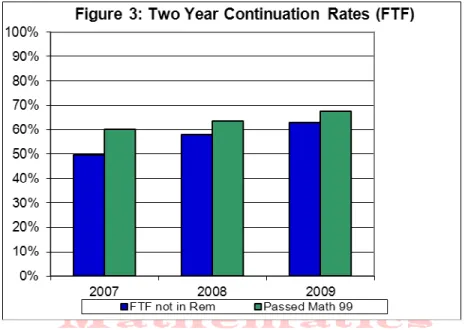
As shown in Figures 2 and 3, the courses have also been effective in improving overall retention of first year students. A significant outcome of the program is that more students are staying at CSUMB. Compared with freshmen
who entered CSUMB better prepared (without needing to take developmental courses), those who passed Math 98 and 99 were more likely to stay at CSUMB. Figures 2 and 3 show that while the overall retention rates for CSUMB have been steadily improving, those students who took and passed Math 98/99 courses were even more likely to stay at CSUMB than students who did not take those courses. The most recent data show that 86 percent of freshmen who took and passed Math 99 in the Fall of 2009 stayed at CSUMB for at least one more year, while only 77 percent of other freshmen did so. Similar percentages for 2-year retentions were 67 and 63 percent, respectively. While this study does not determine why, one hypothesis is that having initial successes in college gives students confidence in their academics. In addition, through the personalized approach in these courses, students may feel more connected to instructors and to the university. Further research is needed to better understand the connection between developmental success and retention.
Basic structure of the courses
The basic structure of Math 98 and Math 99 do not differ greatly from many lower division college courses. CSUMB offers several sections of each course each semester. Each section meets twice per week for 110 minutes. There is one instructor and two Instructional Student Assistants (ISAs) assigned to each section, which typically enrolls between 45-75 students. All the sections are coordinated and every section uses the same course material, common homework assignments and common exams. A coordinator is specifically assigned to this role to support the instructors and ensure that students’ experiences are similar and do not differ depending on which instructor they happen to have. The coordinator finalizes exams and course materials with feedback from each of the instructors.
Course Components and Classroom Structure
The courses are comprised of the following components: mini-lectures, class activities, quizzes, exams, and homework. A typical class session either begins or ends with a quiz, depending on the instructor. The rest of the session is a combination of mini-lectures to develop a concept, then going over some practice problems, and finally, students working on exercises. Each class session has several iterations of this lecture, practice, and exercise cycle. The daily activity document that is comprised of these components is used by all sections and is projected on two or three large screens in the classroom. At times students work individually and at other times in groups.
Course Materials
Instead of using a textbook, the courses use materials that were developed by several CSUMB Mathematics faculty members and put together in binders for students. The binder contains an in-class activity for each class session that includes material on the concepts they are going to learn that day
along with worked out and practice problems. These activities are used for instruction in class. In addition, students receive a homework sheet each day at the end of class that was written by Mathematics faculty.
Assessment and Grading
The following grading scale is used by all instructors for both courses: In-class work (attendance and class activity): 15%
Homework: 15%
Quiz: 20%
Midterm 1: 15%
Midterm 2: 15%
Final Exam: 20%
Students must receive 70 percent or higher to pass the class.
Additional Elements of the Model to Increase Student Success
While Math 98 and 99 have a traditional mathematics course structure consisting of lectures, activities, quizzes, homework, and exams, their effectiveness lies in the personal approach students experience despite the relatively large class size. During the summer of 2007 a group of instructors teaching Math 98 and Math 99 and a couple of tenure track professors held a discussion about how to improve the teaching of developmental math courses so that students would be more successful in completing the developmental math requirement at the end of one year. The group listed the challenges they were facing with the current model. After a discussion it was clear that the single most significant challenge was to keep students coming to class regularly and having them do their work for the class on a regular basis. All agreed to design a new model. Essential components of the new model are described below. Creating a collaborative learning environment.
The objective was to provide an encouraging learning environment for students, in which they feel comfortable asking questions and work with peers to learn the material. Class sessions include mini-lectures that are followed by students working collaboratively on activities. The instructor and ISA’s walk around the room, answering students’ questions as they are working. When students complete their class work, they bring them to an ISA, who checks it and gives them their homework handouts.
Providing a personal approach that does not allow anonymity and demonstrates caring.
To this end, instructors give individual attention to every student during class and outside class. One instructor and two Instructional Student Assistants
(ISAs) in class provide the individual attention that is needed for each student at their level. This is mostly done during the class activity time when the instructor and two ISAs walk around helping students. At times the instructor assigns a particular ISA to help particular students who are at risk of failing.
In addition, instructors use an early alert system to track each student’s performance on a weekly basis. An on-line grade book is updated weekly and provides feedback directly to students to help them improve before it is too late. This is done in many steps. ISAs take attendance at the beginning of each class and record it into the class grade-book on the course’s Learning Management System (iLearn) website. In addition, the class grade book is kept up-to-date on iLearn every week so that the instructor and student know how the student is doing. This means the daily quizzes and homework are graded and entered into the grade-book right away. The instructor looks at the grade-book at the end of each week and sends a friendly e-mail to students who have missed one class or homework assignment. A sample e-mail might say, “We missed you in class today. Is everything okay?” The instructor then follows up with the student in class by asking them to stay after class to talk or by saying something like, “Oh, are you feeling better?” This personalization sends the message to students that the instructor notices when they are absent and cares about them.
Finally, instructors mentor students at risk of failing both in class and outside of class, emphasizing the importance of the class for their college education. This message is conveyed personally to students, not just to the class as a whole. Instructors talk with students and provide extra support for them during class, office hours and sometimes during open lab, which is a departmental drop-in support program that is offered for many mathematics classes most evenings. In this way, the instructor is both a teacher and a mentor to help students succeed in college.
Providing more outside classroom support and following through with students to see that they utilize it.
In addition to giving students individual attention during class, students have several different options to receive help outside of classroom. First, they can receive group tutoring or one on one tutoring at the CSUMB free tutoring center. Second, they can receive drop in help at the Mathematics Department open lab, which is held most evenings. Third, just before each midterm and final multiple extra review sessions are held, for which several of the instructors are present. Fourth, students can attend instructors’ office hours. Receiving outside support is strongly encouraged. A log is kept of all students attending the various tutoring services and the instructor monitors this attendance. Students feel more pressure to attend because they are aware that instructors look at these logs and instructors discuss students’ attendance with them. Figure 4 shows the various types of outside support offered to students.
Another element of the developmental program that increases student success is offering second chances for those who fail Math 98 or Math 99. The options that have been developed stay within the CSU guidelines to have students complete developmental mathematics before they enter their second year. If a student failed Math 98 at the end of their first semester, that student would have likely been dis-enrolled from the system. For this reason, the Mathematics Department decided to offer students a second chance by designing two pathways to possibly continue their college education.
Intensive workshops. The first pathway is to offer a five-day winter workshop for the students that failed Math 98 at the end of their first semester. If they complete this workshop and pass the assessment at the end of the workshop they receive credit for Math 98 and are allowed to take Math 99 in the Spring semester. This intensive workshop is designed as a rigorous review of all the material covered in Math 98. The workshop runs for four days for eight hours a day. During this time one instructor and two tutors work with a group of 25-35 students. Each day is divided into two sessions: morning session is similar to the regular Math 98 class where the instructor helps the class review concepts and solve problems. In the afternoon session students mostly work on their own on problem sets, with the instructor and tutors providing individual help as needed by each student. On the fifth day students take the assessment. The main focus of the workshop is to keep the students engaged on problem solving for four days for eight hours a day through a lot of positive encouragement and community building.
CSUMB also offers a summer five-day intensive workshop for incoming freshmen who would like to complete their developmental requirement before the semester begins. This workshop is offered for both Math 98 and Math 99 one week prior to the start of Fall semester. Students who received a close to passing ELM score are put into the Math 99 workshop. All others are placed in the Math 98 workshop. The summer workshops have the same format as the winter workshops. Students who take and pass the Math 99 summer workshop have completed their developmental requirement and are ready to take college level mathematics courses. The summer workshop allows students more time to complete their Math 99 course. An additional advantage of the workshop is that it helps reduce class sizes for the regular developmental courses.
6 unit Spring course. The other pathway to give another chance to students who fail Math 98 is a 6-unit one semester long Spring Math 99 class that combines both Math 98 and 99 into one semester. This course meets three times per week for a total of 6 hours, instead of the regular 4-unit Math 99 course, which meets twice per week for a total of 4 hours. The students who fail Math 98 in their first semester and who did not pass the winter workshop have the opportunity to take this class. It has the same structure and pedagogy as the regular Math 98 and Math 99 courses, just a different set of class activities. The passing rate for this course is very similar to the regular courses. Students who pass this 6-unit
course have completed their developmental requirement by the end of their first year.
Implementation and Resource Considerations
While the model’s success has been quite encouraging and can be replicated, its implementation has faced challenges. The first challenge was to convince all instructors teaching the developmental sequence to agree to teach the coordinated course. This means everyone had to use the same weekly schedule, the same activities in class, and the same homework assignments and common exams. Instructors were concerned about their academic freedom. To assist in overcoming this concern, each of the instructors was involved with writing the course materials for the two courses. Each instructor wrote either class activities, contributed to the homework assignments, or contributed to selecting the topics for the courses. At the end of the first semester of piloting the course materials each instructor provided feedback and the activities and homework assignments were edited to better meet their needs. The instructors saw the benefit of having all the course material ready ahead of time. Another major benefit has been that when new instructors teach the course they receive a binder and electronic files, and are then ready to teach.
A similar challenge was writing a common exam for several different instructors. Again, the course coordinator received feedback from each instructor before creating the exam and then again after distributing the first draft. After teaching this sequence a couple of times the instructors have become comfortable with the process and appreciate having someone else create and copy the exam.
To achieve its success, the developmental sequence requires some additional resources, but also reduces some. The use of ISAs and multiple screen projections enables these classes to be larger, and thus, reduces the cost of instruction even when factoring these additional costs. The model depends on having student assistants help during class and outside of class. To train and support the ISAs the Mathematics Department has created a 2- unit course, which also requires financial support.
The developmental program at CSUMB has received a lot of support (financial and others) from campus leaders including the President, provost, dean and the department chair, all of whom understand the importance of the success of this program. In addition, the Mathematics Department received grants from the HP and Lumina foundations for redesigning developmental courses at CSUMB and working with local community colleges to better align developmental courses across institutions. The HP grant provided instructors with tablets that are used to display class activities. Instructors write solutions on the document that is projected on three screens during class, then they often post the notes on-line for student reference.
With increasing budget cuts, adequate resources for the model could be an issue. While the model allows for large class sizes, there is a limit. Since the core value of the model depends on providing individual attention to students, growing class sizes could jeopardize these crucial aspects of the model.
Sufficient resources are also necessary to update activities and homework assignments every year to meet the needs of every instructor. The coordinator collects the feedback from each instructor and then works with one of the tenure track faculty who is responsible for the editing of the course material. As the workload of faculty is increasing this could potentially be an issue.
Conclusion
The current CSUMB model has been in place for the past five years. It uses several approaches that others have found successful for teaching developmental math. These include: providing supplemental instruction, tracking attendance at class and tutoring sessions, using cooperative learning, and coordinating all sections. The core philosophy is aligned with small schools theory, that students do better when they are in a more personalized setting and when they sense that instructors care about them. The main methods to do this are tracking students’ progress on a weekly basis and providing personal contact and immediate support so that students see results right away. The students learn that they and the instructor share a common goal for the success of each individual student. To support this, the model incorporates highly coordinated sections with a group of instructors and tutors that provide a cooperative learning environment in class and a variety of outside class tutoring opportunities to meet individual students’ needs.
The program has expanded to reach secondary school students in order to reduce the number of students needing developmental math. CSUMB faculty have been collaborating with local teachers to offer programs during school breaks for middle or high school students. One such program is supported by Graniterock Company and targets 8th grade students to accelerate their understanding of algebra in order to prepare them for high school and college.
The success of the CSUMB developmental model has also influenced developmental programs elsewhere and other courses at CSUMB. It has been recognized as highly effective, with professors from other campuses and community colleges visiting to learn how to replicate it at their institution. Within the CSUMB Mathematics Department instructors have been implementing similar models to courses like Precalculus and Calculus. In particular, other classes are using the class activity and early alert system to help students succeed in college level courses. This personalized approach helps students succeed in the courses and in their college life, generally. At the heart of the model is the fact that instructors sincerely care about the students’ success
and demonstrate it through tracking their progress and personally communicating with them in and out of class.
Figure 4: Outside Resources Available for Student Support
Lipika Deka, Ph.D., California State University, Monterey Bay Joanne Lieberman, Ph.D., California State University, Monterey Bay
References
Arendale, D. (2000). Review of Successful Practices in Teaching and Learning. University of Missouri-Kansas City, MO.
Arendale, D. (2002). A Memory Sometimes Ignored: The History of Developmental Education. Learning Assistance Review, 7(1), 5-13. Armington, T.C.(2003). Best Practices in Developmental Mathematics, NADE
Mathematics Special Professional Interest Network.
Bailey, T. (2009), Challenge and opportunity: Rethinking the role and function of developmental education in community college, New Directions for Community Colleges, 2009(145), 11-30.
Blanc, R., Debuhr, L., & Martin, D. (1983). Breaking the attrition cycle: The effect of Supplemental Instruction on undergraduate performance and attrition, Journal of Higher Education, 54, 80-90.
Boylan, H. R., Bliss, L. B., & Bonham, B. S. (1997). Program components and their relationship to student performance. Journal of Developmental Education, 20 (3), 4.
Cohen, D. (Ed.). (1995). Crossroads in mathematics: Standards for introductory college mathematics before calculus. Memphis, TN: American
Mathematical Association of Two-Year Colleges.
CSU (2008). CSU Transforming Course Design for Developmental
Mathematics, http://www.calstate.edu/ats/transforming_course_design/. EO 665. California State University Executive Order 665.
Epper, R.M., Baker, E.D. (2009). Technology Solutions for Developmental Math: An Overview of Current and Emerging Practices,
http://creativecommons.org/licenses/by-nd/3.0/us/, funded by the William and Flora Hewlett Foundation and the Bill & Melinda Gates Foundation.
Finn, J. and Voelkl, K. (1993). School Characteristics Related to Student Engagement, Journal of Negro Education 62, 3: 249-268. Heber, S., & Selingo, J.J. (2009). “Obama's Higher-Education Goal Is
Education. Retrieved April 5, 2010 from
http://chronicle.com/article/Obamas-Higher- Education-Goal/1551/ Howell, J.S., Kurlaender, M., & Grodsky, E. (2009). Postsecondary Preparation
and Remediation: Examining the Effect of the Early Assessment Program at California State University. Sacramento, CA: CSUS. Howley, C. (1989). Synthesis of the Effects of School and District Size: What
Research Says About Achievement in Small Schools and School Districts. Journal of Rural and Small Schools 4, 1: 2-12. Howley, C. and Huang, G. (1991). Extracurricular Participation and
Achievement: School Size as a Possible Mediator of SES Influence Among Individual Students. ERIC Document No. ED336247. Charleston, WV: Appalachia Educational Laboratory.
Klem, Adena M., and James P. Connell. (2004). Relationships Matter: Linking Teacher Support to Student Engagement and Achievement. Journal of School Health 74, 7: 262-273.
Lee, V., Bryk, A., and Smith, J. (1993). The Organization of Effective
Secondary Schools. Review of Research in Education 19, 1 (January): 171-267.
Lee, V. and Loeb, S. (2000). School Size in Chicago Elementary Schools: Effects on Teachers’ Attitudes and Students’ Achievement. American Education Research Journal 31, 1:3-31.
Lee, V. and Smith, J. (1995). Effects of High School Restructuring and Size on Early Gains in Achievement and Engagement. Sociology of Education 68, 4: 241-270.
Lee, V. and Smith, J. (1997). High School Size: Which Works Best and for Whom? Educational Evaluation and Policy Analysis 19, 3: 205-227. MacDonald, L., Vasquez, S., & Caverly, D. (Winter 2002), Techtalk: Effective
Technology Use in Developmental Mathematics. Journal of Developmental Education V. 26, n. 2.
McCabe, R. H. & Day, P. R. Jr. (1998). Developmental education: A twenty-first century social and economic imperative, Mission Viejo, CA: League for Innovation in the Community College and The College Board.
McClory, S(2000). Mathematics remediation in the California State University System-One campus’ approach. Amatyc Conference, Chicago. Parker,T., Bustillos, L.T., Behringer, L.B. (2010). Remedial and Developmental
Education Policy at a Crossroads. Prepare Policy Research on preparation Access and Remedial Education, Boston.
Peterfreund, A., Rath, K., Xenos, S. and Bayliss, F. (2008). The Impact of Supplemental Instruction on Students in STEM Courses: Results from San Francisco State University. Journal of College Student Retention, Volume 9, Issue 4, pp.487 – 503.
Phelan, P., Locke, A., and Hanh, T. (1992). Speaking Up: Students' Perspectives on School. Phi Delta Kappan May 1992. Volume 73, no. 9.
Pittman, R. and Haughwout, P. (1987). Influence of High School Size on Dropout Rate. Education Evaluation and Policy Analysis 9, 4: 337-343. Ramirez, G. (1997). Supplemental Instruction: The long-term effect. Journal of
Developmental Education, 21 (1), 61-70.
Rettinger, D. & Palmer, T. (1996). Lessons learned from using Supplemental Instruction: Adapting instructional methods for practical applications. Research & Teaching in Developmental Education, 13 (1), 57-68. Roueche, J. E. & Baker, G. (1986). College Responses to Low Achieving
Students. Washington, DC: The Community College Press. Sperling, B. (2009). Massachusetts Community Colleges Developmental
Education Best Policy and Practice Audit.
Success (2007). Basic Skills as a Foundation for Success in California Community Colleges. Center for Student Success, USA Funds. Tobias, S. (1987). Succeed with math: Every student’s guide to conquering math anxiety. New York: College Board.
Tobias, S. (1994). Overcoming Math Anxiety. New York, NY: W. W. Norton & Company.
Wasley, P., Fine, M., Gladden, M., Holland, N., King, S., Mosak, E. and Powell, L. (2000). Small Schools: Great Strides. New York: Bank Street College of Education.