Proceedings of the 2020 Conference on Empirical Methods in Natural Language Processing, pages 6310–6320, 6310
BERT-enhanced Relational Sentence Ordering Network
Baiyun Cui1, Yingming Li1∗, and Zhongfei Zhang2
1College of Information Science and Electronic Engineering, Zhejiang University, China
2Computer Science Department, Binghamton University, Binghamton, NY, USA
[email protected], [email protected], [email protected]
Abstract
In this paper, we introduce a novel BERT-enhanced Relational Sentence Ordering Net-work (referred to as BERSON) by leverag-ing BERT for capturleverag-ing a better dependency relationship among sentences to enhance the coherence modeling for the entire paragraph. In particular, we develop a new Relational Pointer Decoder (referred as RPD) by in-corporating the relative ordering information into the pointer network with a Deep Rela-tional Module (referred as DRM), which uti-lizes BERT to exploit the deep semantic con-nection and relative ordering between sen-tences. This enables us to strengthen both lo-cal and global dependencies among sentences. Extensive evaluations are conducted on six public datasets. The experimental results demonstrate the effectiveness and promise of BERSON, showing a significant improvement over the state-of-the-art by a wide margin.
1 Introduction
Coherence modeling is one of the essential aspects of natural language processing (Xu et al., 2019; Mesgar et al.,2019;Moon et al.,2019;Farag and Yannakoudakis, 2019). A coherent text can fa-cilitate understanding and avoid the confusion for reading comprehension. The Sentence Ordering task (Barzilay and Lapata,2008) aims to recon-struct a coherent paragraph from an unordered set of sentences and has shown to be beneficial to im-prove the coherence in many NLP tasks includ-ing multi-document summarization (Barzilay and Elhadad, 2002; Nallapati et al., 2017), conversa-tional analysis (Zeng et al.,2018), and text gener-ation (Konstas and Lapata,2013;Holtzman et al., 2018). Table1shows an example of this task.
In recent years, several approaches based on ranking or sorting frameworks have been
devel-∗Corresponding author
An unordered set of sentences Coherent paragraph 1 Dan was walking during the night. 1 Dan was walking during the night. 3 They tried to steal his book bag. 2 A group of thieves surrounded him. 4 A bystander noticed them. 3 They tried to steal his book bag. 2 A group of thieves surrounded him. 4 A bystander noticed them. 5 But she continued to walk away. 5 But she continued to walk away. Table 1: Illustration of the sentence ordering task. It aims to reorganize an unordered set of sentences into a coherent paragraph.
oped to deal with this task. RankTxNet ( Ku-mar et al., 2020) computes a score for each sen-tence and sorts these scores with ranking based loss functions. Pairwise Model (Chen et al., 2016) adopts a pairwise ranking algorithm to learn the relative order of each sentence pair. B-TSort (Prabhumoye et al.,2020) predicts the constraint between two sentences and uses the topological sort technique to find the ordering.
On the other hand, to better capture the global coherence, pointer network (Vinyals et al.,2015) has been gradually used for the decoder of the or-dering model. It is able to capture the paragraph-level contextual information for generating an or-dered sequence with the highest coherence prob-ability (Gong et al., 2016; Logeswaran et al., 2018;Cui et al.,2018;Yin et al., 2019). Further,
HAN (Wang and Wan, 2019) and TGCM (Oh
et al., 2019) introduce the attention mechanism (Vaswani et al.,2017), and FUDecoder (Yin et al., 2020) proposes pairwise ordering prediction mod-ules to enhance the traditional pointer network.
Despite having achieved great successes, pair-wise ranking and pointer network-based ordering approaches have a few problems. The former fo-cuses on learning the local relationship between sentence pairs, but may have trouble in capturing the global interactions among all the sentences. The latter overlooks the importance of learning relative order between sentence pairs through the encoder-decoder, and lacks enough local
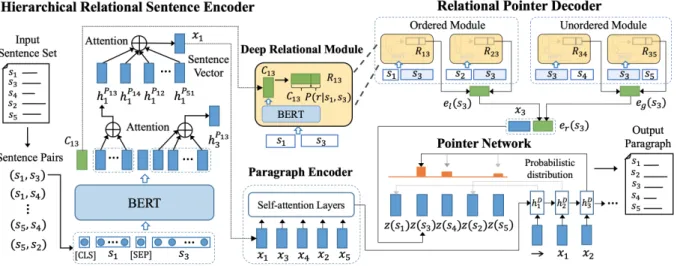
interac-Figure 1: The architecture of the proposed BERSON. Given an unordered set of sentences, our BERT-based Hierarchical Relational Sentence Encoder first builds the high-level representation for each input sentence. Then, a self-attention based paragraph encoder is employed for paragraph encoding. Finally, the proposed Relational Pointer Decoder generates an ordered out sequence. For the sentence generation at the 3rd timestep in the decoder,
s1 ands2 are the previous sorted sentences, ands3,s4, ands5 are the unsorted ones. Here, we use the candidate sentences3as an example to illustrate how to encode the relative ordering information for it in the pointer network based on Deep Relational Module. Please refer to Section2.4for more details of the decoder.
tions among sentences.
To address the above limitations, in this pa-per, we propose a novel BERT-enhanced Rela-tional Sentence Ordering Network (referred to as BERSON) by integrating BERT (Devlin et al., 2019) with the pointer network to fully exploit the pairwise relationships between sentences for a better coherence modeling. Specifically, we first introduce a BERT-based Hierarchical Relational Sentence Encoder, which uses sentence pairs as the input to the model and learns the high-level representation for each sentence. Next, a Self-Attention based Paragraph Encoder is adopted for paragraph encoding.
Building upon the above pairwise sentence and paragraph encoding, a novel Relational Pointer Decoder (referred to as RPD) is developed by corporating the informative relative ordering in-formation into the pointer network with a Deep Relational Module (referred to as DRM). This module leverages the Next Sentence Prediction objective of BERT to learn the relative ordering between sentences and constructs a pairwise re-lationship representation for each sentence pair, which helps RPD not only exploit the global ori-entation information among unordered sentences but also consider the local coherence between the candidate sentence and the previously sorted ones. Thus, RPD is able to generate a more coherent or-der assignment for the input sentences. In addi-tion, the pairwise ordering prediction loss is also
added as the auxiliary objective to guide the co-herence modeling in the training procedure. The overall architecture of our model is presented in Figure1.
Extensive experiments are conducted on six public datasets in different domains to evaluate the performances of BERSON. The results show that BERSON significantly outperforms the exist-ing approaches by a wide margin and achieves a state-of-the-art performance on all the datasets and under all the evaluation measurements.
2 Relational Sentence Ordering Network
In this section, we start by formulating the sen-tence ordering problem and then present the pro-posed model BERSON, which is compro-posed of a BERT-based Hierarchical Relational Sentence En-coder, a Self-Attention based Paragraph EnEn-coder, and a Relational Pointer Decoder enhanced by a new Deep Relational Module to model the text co-herence in a more effective way.
2.1 Problem Definition
Given an out-of-order version set of N sentences s = [s1,s2,· · ·,sN], and si = [wi1,wi2,· · ·,wili],
where li is the number of words in sentence si. The model aims to recover the correct order o = [o1,o2,· · ·,oN]for these sentences.
2.2 Hierarchical Relational Sentence Encoder
The sentence encoder is designed based on BERT with sentence pairs in the set as input, and further adopts two-level attention layers to encode the hi-erarchical semantic concepts and contextual infor-mation of the sentence.
Formally, for the given N sentences in the set, all the pair of sentences can be denoted as:
P=Pi j|i ∈ [1,N],j∈ [1,N],i, j (1)
wherePi jrepresents the sentence pair si,sj . The total number of sentence pairs is|P|= A2N. These sentence pairs are sent into BERT to not only learn the sentence representation but also capture the pairwise relationship between sentences.
As shown in the left part of Figure 1, given a sentence pair Pi j = si,sj, the input sequence of this pair to the BERT model consists of a[CLS] token, the first sentence si in the pair, a separa-tor token[SEP], and the second sentence sj. The BERT model encodes the representation for this pair as: n Ci j,h Pi j i1 ,· · ·,h Pi j ili ,Si j,h Pi j j1 ,· · ·,h Pi j jlj o (2) whereCi j andSi jare the final hidden states of the [CLS]and[SEP]tokens, and
n hi1Pi j,· · ·,hilPi j i o and n hPj1i j,· · ·,hPjli j j o
are the output word representa-tions of sentencesi andsjin this pair with the se-quence lengthliandljrespectively.
After the BERT encoder, we compose a fixed-dimensional representation for each sentence.
For sentence si in pair Pi j, the representations n
hi1Pi j,· · ·,hilPi j i
o
of each word are combined to-gether with an attention mechanism to obtain its sentence representationhiPi j: uik =tanh Wwh Pi j ik , αik = exp(vwuik) Íli k=1exp(vwuik) hiPi j =Õli k=1αikh Pi j ik (3)
whereWw and vw are learnable parameters. At-tention allows the model to concentrate on the in-formative words for coherence and helps build a better semantic representation. Similarly, we also compute the representationhPji j forsjin pairPi j. Further, all the sentence pairs related to
sentence si can be described as: Pi =
Pi j|j ∈ [1,N],j,i ∪ {Pki|k ∈ [1,N],k ,i}.
The number of pairs is 2N − 2. The
cor-responding sentence representations of si ob-tained from these pairs are given as: hi =
n hiPi j|j ∈ [1,N],j ,i o ∪ n hPk i i |k ∈ [1,N],k,i o . We denotehi= h1i,· · ·,h2Ni −2 for simplification. Since the sentence embeddings ofsiin different pairs capture different context features, to reward the most salient features that contribute highly to the overall contextual meaning of the sentence, a high-level attention mechanism is adopted to es-tablish the final representationxifor sentencesi:
uit =tanh Wshti , αt i = exp(vsuit) Í2N−2 t=1 exp(vsuti) xi = Õ2N−2 t=1 α t ihit (4) whereWs and vs are also trainable weights. Es-sentially, as all the related sentence pairs are fairly considered, it is ensured that this representation being invariant to the input sentence order and be-ing logically reliable to be used in our model.
2.3 Paragraph Encoder
After the sentence encoder, a self-attention based paragraph encoder is employed to capture the global dependency for all the sentences.
Specifically, the sentence representations ob-tained from the sentence encoder are packed to-gether into a paragraph matrix X = [x1,· · ·,xN] asX(1), which is then sent toL self-attention lay-ers (Vaswani et al.,2017). For the l-th layer, the output matrixX(l)is computed as:
e X(l) =LN(X(l−1)+MultiHead(X(l−1))) (5) X(l)=LN(Xe (l)+ FFN(eX (l) )) (6)
where MultiHead(·) is multi-head attention func-tion, FFN(·) denotes the fully-connected feed-forward network, and LN(·) is the layer normal-ization operation (Ba et al.,2016).
The final paragraph vectormis generated by av-eraging the output matrix X(L)from the last self-attention layer: m = N1 ÍNn=1Xn(L), where Xn(L) is then-th row inX(L). This vector will then be used as the initial state of our decoder.
2.4 Relational Pointer Decoder
In this section, we propose a Relational Pointer Decoder (RPD), which utilizes the useful relative ordering information to enhance pointer network with a Deep Relational Module (DRM). In the fol-lowing, we first describe the new module DRM
and then incorporate it into the pointer network to strengthen the coherence modeling in the decoder.
2.4.1 Deep Relational Module
Our Deep Relational Module is based on BERT model, which aims to capture a better dependency relationship between sentences. The architecture of this module is shown in the middle part of Fig-ure1.
In particular, as illustrated in Section2.2, given the sentence pairPi j, the embedding of the[CLS] symbol from the top layer of BERT is denoted as
Ci j. Owing to the Next Sentence Prediction pre-training objective of BERT, this vectorCi j is able to aggregate the semantic relations for the input sentence pair and is capable of identifying the rel-ative order between two sentences. Therefore, we take full advantages of this vector to exploit the latent dependency for sentences.
Further, a probability distribution P(r|si,sj) is generated,r ∈ {before,after}, which measures the probability ofsi occuring before or aftersj:
P(r|si,sj)=softmax(WcCi j) (7) whereWcdenotes the learnable weights.
In order to obtain the richer pairwise relation information for the sentence pair, we combine the above semantic featureCi jand the probability dis-tribution together: Ri j = Ci j;P(r|si,sj) (8) This new vectorRi j is considered as the relational representation for this sentence pair(si,sj), which is then leveraged to provide the relative order in-formation for the pointer network. We compute such pairwise relational representation for all the sentence pairs in the paragraph, and utilize the subset of them at each step of the decoder.
Different from the previous method of using the learned sentence vectors to calculate the pair-wise relationship between sentences (Yin et al., 2020), DRM employs the whole sequence of the sentence pair as the input to BERT. It allows us to directly relate words from different sentences together, which is more straightforward to exploit the intrinsic relations and coherence between sen-tences. Further, instead of relying on the modules trained from scratch to control the pairwise order-ing predictions (Yin et al., 2020), DRM adopts BERT as the main building block to obtain a pair-wise relationship representation for the sentence
pair. Intuitively, being pre-trained on the large cor-pus in BERT, this representation encodes more re-liable and accurate relative ordering information, and thus is more effective to help determine the pairwise ordering predictions in the decoder.
2.4.2 Integrating DRM with Pointer Network
As illustrated in the right part of Figure 1, Rela-tional Pointer Decoder (RPD) incorporates Deep Relational Module into the pointer network to pro-mote the coherence modeling among sentences.
Formally, the conditional coherence probability of a predicted orderbo for the given out-of-order sentence setscan be computed as:
P(bo|s)=ÖN
i=1P(boi|bo<i,s) (9) A higher probability indicates a more coherent
sentences assignment. We employ an
LSTM-based pointer network as the basis of our decoder, and the mathematical formulation for thei-th step in the decoder is:
hDi =LSTM(hiD−1,x b oi−1) (10) P(boi|bo<i,s)=softmax(g Ttanh(W qhiD+WkZi)) where g, Wq, and Wk are all learnable parame-ters, hDi is the hidden state in the decoder with size d, hD0 = m, and x
b
oi−1 is the embedding of
the previous predicted sentences
b
oi−1at stepi−1.
The softmax function produces an output distribu-tion over all unordered sentences (candidate sen-tences). The one that yields the highest probability from the distribution will be selected at positioni. The matrix Zi encodes the relationship repre-sentation information of the candidate sentence with the other sentences in the set. For one candi-date sentence, the other sentences can be divided into two groups: previously sorted subset and un-sorted subset. The relative ordering information between the candidate sentence and the two group sentences are captured by the proposed DRM with its two versions: Ordered ModuleandUnordered Module, respectively. On the one hand, such mod-eling helps evaluate the local coherence between the previously sorted sentences and the candidate sentence for investigating the rationality of each candidate choice. On the other hand, the global relative orientation information of other unsorted sentences with respect to the candidate one also provides further clues for the current prediction. Thus, both the local dependency information and the global orientation are fully exploited in RPD.
For the Ordered Module, the pairwise relation-ships between the predicted sentences
b
oi−1 at step i − 1 and the candidate sentence sc can be ef-fectively measured by our deep relational module with the following relational representation:
R b oi−1c = C b oi−1c;P(r|sobi−1,sc) (11) which not only encodes the semantic relations be-tween two sentences, but also includes the prob-ability of whether sentence sc truly appears af-ter s
b
oi−1 or not. In similar ways, the relational
embedding generated with the previous ordered sentences can be described asR
b
o1c,· · ·,Robi−1c .
Then, we compose a high-level local coherence representationel(sc)for this candidate sentence by integrating these relational embeddings to summa-rize the overall local dependency forsc.
For the Unordered Module, the relative orienta-tion of another unordered sentencesgwith respect to the candidate sentencesc can also be captured by our relational embedding as:
Rcg=
Ccg;P(r|sc,sg)
(12) Considering all the other unsorted sentences, a hi-erarchical global orientation representationeg(sc) forsc can be obtained, which is formulated as:
eg(sc)= 1 |Sc| Õ sg∈Sc Rcg (13)
whereSc is the unordered sentence set exceptsc. Subsequently, to leverage the relative ordering information encoded by Ordered and Unordered Modules simultaneously, the representationel(sc) andeg(sc)are integrated together, which allows us to build a more informative relational vectorer(sc) for sentence sc. Finally, a new representation for this candidate sentencescis obtained by combin-ing its sentence embeddcombin-ing and relational vector
er(sc)together:
z(sc)=[xc;er(sc)] (14) Such representation is generated for all unsorted sentences, which are then packed into matrix Zi for order predictions. During inference, we use beam search to select sentences sequentially.
2.5 Model Training
Assume that there areQparagraphs in the training setQ = {(s,o)}. Following the existing ordering networks (Gong et al.,2016;Oh et al.,2019), the model is trained to maximize the coherence prob-ability by minimizing the loss function as follows:
Dataset Length statistics Data split Vocabulary mean max train valid test
NIPS abstract 6 15 2427 408 377 11505 AAN abstract 5 20 8569 962 2626 34485 NSF abstract 8.9 40 96070 10185 21580 334090 arXiv abstract 5.38 35 884912 110614 110615 64557 SIND 5 5 40155 4990 5055 30861 ROCStory 5 5 78529 9816 9817 33903 Table 2: Summary of datasets used in our experiments.
Lc =− 1 |Q| Õ (s,o)∈QlogP(o|s;θ)+ λ 2 kθk 2 2 (15) whereθdenotes all the trainable parameters.
To further exploit the correct relative order in-formation, we add the Pairwise Ordering Predic-tion Loss (Ploss) as an auxiliary objective Lp. It is defined as the cross-entropy loss function opti-mized by minimizing the negative log-likelihood of each pair’s ground-truth relative ordering label
yi j ∈ [0,1], given the networks predictionbyi j:
Lp =− 1 |Q| 1 |P| Õ (s,o)∈Q Õ Pi j∈P (−yi jlogP(byi j|Pi j) −(1−yi j)P(1−byi j|Pi j)) The final training objective of our model can be formulated as:
L= LC+αLp (16)
whereαis the coefficient that makes a balance be-tween the influences of the two loss functions. 3 Experiments
In this section, we empirically evaluate the effec-tiveness of BERSON in the sentence ordering task.
3.1 Datasets
The experiments are conducted on six public datasets in different domains:
NIPS abstract, AAN abstract, NSF abstract,
arXiv abstract: These datasets contain
ab-stracts of research papers. NIPS abstract1 is from conference papers in NIPS, where pa-pers in years 2005-2013/2014/2015 for train-ing/validation/testing (Logeswaran et al., 2018). AAN abstract (Logeswaran et al., 2018) is col-lected from ACL Anthology Network corpus. ACL papers published up to year 2010 for train-ing, year 2011 for validation and 2012-2013 for testing. NSF abstract (Logeswaran et al.,2018) is from NSF Research Award abstract dataset, where abstracts in years 1990-1999/2000/2001-2003 for
Dataset learning rate batch size epochs coefficientα
NIPS abstract 5e-5 8 20 0.2
AAN abstract 5e-5 32 10 0.4
NSF abstract 2e-5 16 10 0.4
arXiv abstract 2e-5 32 10 0.8
SIND 2e-5 8 10 1.0
ROCStory 2e-5 16 10 0.6
Table 3: Hyper-parameter settings of our model on each dataset.
training/validation/testing. ArXiv abstract (Gong et al.,2016;Chen et al.,2016) is from arXiv web-site2. The validation and test sets of this dataset are the first and last 10% abstracts from the shuf-fled data, and the remaining data are for training.
SIND, ROCStory: SIND is a visual storytelling
dataset3 (Huang et al., 2016), which is
re-leased as training/validation/testing following the 8:1:1 split. ROCStory is a commonsense story dataset4 (Wang and Wan, 2019; Mostafazadeh
et al.,2016). It is randomly split by 8:1:1 for the training/validation/test sets. Both of two datasets consist of 5 sentences in each story text.
Table2shows the details of all the datasets.
3.2 Evaluation Metrics
Following the existing work (Oh et al.,2019), we employ the three most commonly used metrics5in this task to assess the model performance:
Accuracy (Acc): This metric calculates the
ra-tio of sentences whose absolute posira-tions are cor-rectly predicted (Logeswaran et al.,2018).
Perfect Match Ratio (PMR): It measures the
per-centage of the exactly matching orders across all the paragraphs: PMR=Q1 ÍQi=11(boi = oi), where bo
iandoiare the predicted and correct order of the
i-th paragraph respectively (Chen et al.,2016).
Kendall’s tau (τ): For a paragraph containingN
sentences,τis defined as:τ=1−2×(#inversions
)/ N2
, where#inversions denotes the number of pairs in the predicted sequence with the incorrect relative order (Lapata, 2003). The score ranges from -1 (the worst) to 1 (the best).
A higher score indicates a better performance for all the metrics.
3.3 Experimental Setup
We adopt the BERTBASE in the experiment and
fine-tune it on each dataset. The paragraph en-2https://github.com/FudanNLP/NeuralSentenceOrdering 3http://visionandlanguage.net/VIST/dataset.html 4https://github.com/sodawater/SentenceOrdering
5Code for metrics: https://github.com/DeepLearnXMU/NSEG
coder has 2 self-attention layers with 8 heads. The hidden size is 768 and beam size is 16. Adam is employed as the optimizer. To search for the op-timal hyper-parameters, we adopt the grid search strategy for learning rate from{2e-5, 5e-5}, batch size from{8,16,32}, the number of epochs from {5,10,20}, and the coefficientαin the loss func-tion from{0.2,0.4,0.6,0.8,1.0}. The model with the best performance on the validation set is se-lected for each setting. The recommended hyper-parameter configuration of the model on each dataset are presented in Table3. To diminish the effects of randomness in training, the results of our model are averaged with 5 random initializa-tions. For data preprocessing, we use the tok-enizer6 from BERT to preprocess the sentences. The experiments are conducted on GeForce GTX 1080Ti GPU with PyTorch framework .
3.4 Baselines
To demonstrate that BERSON truly improves the sentence ordering performance, we compare it with the state-of-the-art methods in this task, which can be categorized into two classes: (1) Ranking or Sorting frameworks: Pairwise Model (Chen et al.,2016); RankTxNet (Kumar et al.,2020); B-TSort (Prabhumoye et al.,2020). (2) Pointer network based models: HAN (Wang and Wan, 2019); LSTM+PtrNet (Gong et al., 2016); V-LSTM+PtrNet (Logeswaran et al., 2018); ATTOrderNet (Cui et al.,2018); SE-Graph (Yin et al.,2019); FUDecoder (Yin et al.,2020); TGCM (Oh et al.,2019).
In addition to the above existing approaches, we also investigate three variants of BERSON.
BertSenPD: This model replaces the ranking
module in RankTxNet with the traditional pointer network decoder (PD). Please note that it uses the single sentence rather than sentence pair as the in-put to BERT to obtain the sentence vector.
BertPairPD, HRSEPD: These two models
em-ploy the sentence pair encoding strategy with BERT and utilize PD instead of our RPD as the de-coder. HRSEPD adopts the proposed Hierarchical Relational Sentence Encoder (HRSE), while Bert-PairPD does not have two-level attention layers in the encoder. They aim to investigate the impact of both the Hierarchical Relational Sentence Encoder and the Relational Pointer Decoder.
Models NIPS abstract AAN abstract NSF abstract arXiv abstract SIND ROCStory
Acc PMR τ Acc PMR τ Acc PMR τ Acc PMR τ Acc PMR τ Acc PMR τ
Pairwise Model - - - 33.43 0.66 - - - -LSTM+PtrNet 50.87 - 0.67 58.20 - 0.69 32.45 - 0.52 - 40.44 0.72 - 12.34 0.48 - - -V-LSTM+PtrNet 51.55 - 0.72 58.06 - 0.73 28.33 - 0.51 - - - -ATTOrderNet 56.09 - 0.72 63.24 - 0.73 37.72 - 0.55 - 42.19 0.73 - 14.01 0.49 - - -HAN - - - 44.55 0.75 - 15.01 0.50 - 39.62 0.73 SE-Graph 57.27 - 0.75 64.64 - 0.78 - - - - 44.33 0.75 - 16.22 0.52 - - -FUDecoder - - - 46.58 0.77 - 17.37 0.53 - 46.00 0.77 TGCM 59.43 31.44 0.75 65.16 36.69 0.75 42.67 22.35 0.55 58.31 44.28 0.75 38.71 15.18 0.53 - - -RankTxNet - 24.13 0.75 - 39.18 0.77 - 9.78 0.58 - 43.44 0.77 - 15.48 0.57 - 38.02 0.76 B-TSort 61.48 32.59 0.81 69.22 50.76 0.83 35.21 10.44 0.66 - - - 52.23 20.32 0.60 - - -BertSenPD 64.36 31.30 0.79 70.34 45.45 0.80 45.76 17.41 0.64 69.72 46.26 0.78 52.12 19.19 0.58 75.05 52.56 0.81 BertPairPD 67.65 32.89 0.81 73.99 50.53 0.83 46.88 18.76 0.65 71.03 48.98 0.79 54.36 23.86 0.60 78.01 60.39 0.83 HRSEPD 67.99 35.54 0.83 75.45 53.27 0.84 47.01 19.02 0.65 71.65 49.91 0.80 56.22 25.22 0.63 79.81 61.93 0.84 BERSON 73.87 48.01 0.85 78.03 59.79 0.85 50.02 23.07 0.67 75.08 56.06 0.83 58.91 31.69 0.65 82.86 68.23 0.88 Table 4: Comparison results for different models on sentence ordering task. The best and second-best results are in bold and underlined respectively.
3.5 Main Results
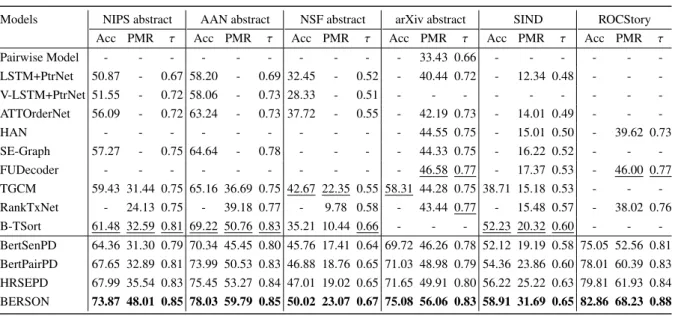
The experimental results7 are reported in Table4.
As we see, BERSON achieves the state-of-the-art-performance on all the datasets and under all the evaluation metrics.
The results show that BERSON significantly outperforms all the existing methods by a large
margin. BERSON shows remarkable
improve-ments over the existing best systems of 12.39% and 16.77% accuracy score on NIPS and arXiv datasets, and with 15.42%, 11.37%, and even 22.23% gains in PMR score on NIPS, SIND, and ROCStory datasets respectively, which strongly demonstrates the effectiveness of our model8.
Compared with the existing ranking ap-proaches, our BertSenPD baseline performs much better than RankTxNet with stable improvements, which confirms the superiority of the traditional pointer network to the ranking module used in their model. This could be due to that RankTxNet only computes a score for each sentence in paral-lel, which overlooks the coherence of the whole predicted sequence and may have trouble in gen-erating a more coherent order assignment. Be-sides, although B-TSort outperforms RankTxNet with clear improvements, it only considers the sentence-pair interactions and does not take the entire paragraph into account. Therefore, B-TSort is limited by the lack of a global structure and 7The validation results, average runtime, and the number
of parameters are reported in Appendix.
8Ordering prediction examples from BERSON and
sev-eral baselines are also shown in Appendix.
falls behind other baselines for Acc and PMR scores on the large dataset NSF abstract. In con-trast, BERSON not only captures the local coher-ence between every two sentcoher-ences but also obtains the paragraph-level contextual information for the global dependency, hence being more competitive in the sentence ordering.
In addition, among the pointer network based ordering models, FUDecoder exhibits a better per-formance. However, the ordering prediction mod-ules of FUDecoder are built based on two non-linear layers trained from scratch and with the learned sentence vectors as the input, which is still difficult to fully explore the latent dependency among sentences. Once these modules are not sufficiently trained especially on small datasets, they may mislead the decoder with the wrong relative orientation information. Our BERSON overcomes the limitation of FUDecoder by utiliz-ing BERT model as the main buildutiliz-ing block of our DRM to improve the pairwise ordering strat-egy. As shown in Table 4, BERSON achieves to outperform FUDecoder with significant improve-ments of about 14.32% and 22.23% PMR score on SIND and ROCStory respectively, which proves the promise of incorporating more reliable order-ing module into the decoder to ensure the more accurate relative ordering information.
Moreover, for the variants of our model, PairPD and HRSEPD perform better than Bert-SenPD on all the datasets. This shows that with the sentence pair instead of single sentence as the input to BERT, the model directly builds the
inter-Models arXiv abstract ROCStory Acc PMR τ Acc PMR τ BertPairPD 71.03 48.98 0.79 78.01 60.39 0.83 HRSEPD 71.65 49.91 0.80 79.81 61.93 0.84 BERSON 75.08 56.06 0.83 82.86 68.23 0.88 - Ordered Module 73.62 54.51 0.82 81.14 66.61 0.86 - Unordered Module 72.57 50.49 0.80 80.35 62.47 0.85 - Ploss 73.99 54.89 0.82 81.63 66.92 0.87 Table 5: Ablation studies on arXiv and ROCStory datasets. We remove various modules and explore their influences to our model.
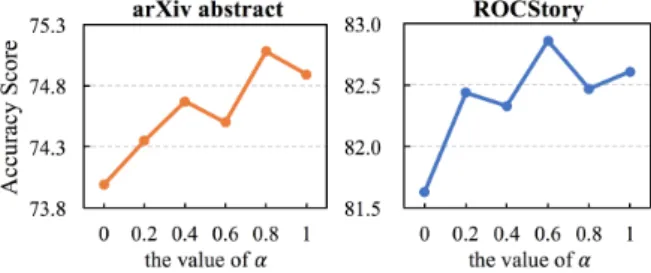
Figure 2: Results of varying the coefficientαfor Pair-wise Ordering Prediction Loss in our model.
actions between words from different sentences, which is capable of capturing the rich contextual information for each sentence and is more bene-ficial to modeling the relations among sentences. Besides, HRSEPD outperforms BertPairPD with stable improvements, which reflects the strength of our Hierarchical Relational Sentence Encoder. Furthermore, by adopting our Relational Pointer Decoder to replace the traditional pointer network, BERSON achieves further improvements across the datasets, which demonstrates the advantage of enhancing the pointer network with DRM to reach a superior performance.
3.6 Ablation Study
Further, to better understand the contributions of different components in our Relational Pointer De-coder, we conduct ablation study on arXiv and ROCStory datasets, which are both the largest datasets in the two domains for providing more re-liable analysis. The results are reported in Table5.
Effect of Ordered and Unordered Modules:It is
observed that the removal of two modules hurts the model performance dramatically though they still outperform our baseline models BertPairPD and HRSEPD. Compared with Ordered Module, the lack of Unordered Module leads noticeable drops, which indicates that the relative orientations be-tween unsorted sentences are more important for
Models arXiv abstract SIND
head tail head tail
Pairwise Model 84.85 62.37 - -LSTM+PtrNet 90.47 66.49 74.66 53.30 ATTOrderNet 91.00 68.08 76.00 54.42 SE-Graph 92.28 70.45 78.12 56.68 FUDecoder 92.76 71.49 78.08 57.32 TGCM 92.46 69.45 78.98 56.24 RankTxNet 92.97 69.13 80.32 59.68 BertSenPD 93.38 72.57 81.46 61.02 BertPairPD 94.01 73.99 82.37 62.24 BERSON 94.75 76.69 84.95 64.87
Table 6: Accuracy of predicting the first and the last sentences on arXiv and SIND datasets.
order predictions. The superior performance of BERSON over these two variants shows the neces-sity of having both modules in RPD to leverage the global orientation and local dependency informa-tion simultaneously for a better coherence model.
Effect of Pairwise Ordering Prediction Loss:
As shown in Table5, removing the Pairwise Or-dering Prediction Loss (Ploss) in the training pro-cedure causes a performance degradation on both datasets. This proves the benefit of encouraging the accurate relative ordering information through the loss function. As the coefficientαin Equation 16 directly controls the impact of Ploss, we fur-ther study how the value of this coefficient affects the performance of BERSON. Figure 3 shows the results of accuracy score on arXiv and ROCStory datasets. It is shown thatα = 0.8, 0.6 is superior to other settings for arXiv and ROCStory respec-tively. Thus, it is essential to have an appropriate value to balance the importance of Ploss and the original training objective for BERSON.
3.7 Analysis
In this section, we delve into further analysis to in-vestigate the stability and adaptability of the pro-posed model.
3.7.1 Prediction of First and Last Sentences
Previous studies (Oh et al.,2019;Yin et al.,2019) have mentioned that both the first and last sen-tences play crucial roles in a paragraph due to their special positions. Thus, we also report the per-formances of our models in correctly predicting these two sentences on arXiv and SIND datasets. As summarized in Table6, both of the two vari-ants BertSenPD and BertPairPD outperform the existing state-of-the-arts. BERSON achieves
fur-Models Win=1 Win=2 Win=3 Win=1 Win=2 Win=3
NIPS abstract SIND
B-TSort 87.59 95.59 98.11 82.67 95.01 99.09 BERSON 91.98 96.84 99.29 84.01 95.11 99.10
NSF abstract AAN abstract B-TSort 61.41 75.52 83.87 90.56 96.78 98.71 BERSON 70.08 80.29 86.46 93.31 97.57 99.09
Table 7: Analysis of the displacement of sentences on four datasets. Win denotes the Window size.
Models Acc PMR τ LCS Rouge-S
NIPS abstract B-TSort 39.43 0.00 0.74 71.68 83.26 BertPairPD 43.75 6.67 0.75 72.59 87.44 BERSON 50.89 13.33 0.76 74.96 87.94 AAN abstract B-TSort 36.86 0.00 0.69 72.01 78.52 BertPairPD 40.75 3.45 0.71 73.87 85.77 BERSON 47.38 6.90 0.73 76.53 86.48
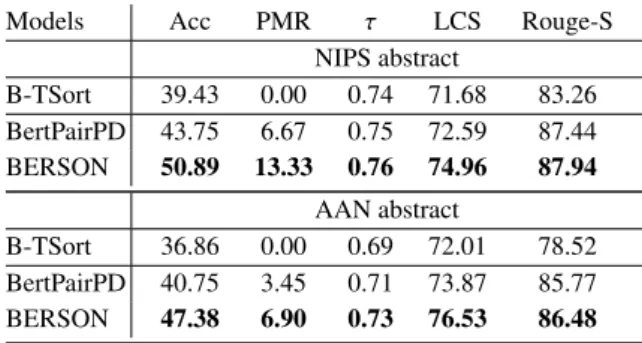
Table 8: Performance for paragraphs containing more than 10 sentences in NIPS and AAN datasets.
ther boosts and reaches the best performances on both datasets. For identifying the last sentence, BERSON obtains significant improvements over RankTxNet of 7.56% and 5.19% gain on arXiv and SIND datasets respectively, which also indi-cates the benefits of the proposed model.
3.7.2 Sentence Displacement Analysis
Additionally, we analyze the displacement of sen-tences in the predicted orders by calculating the percentage of sentences whose predicted location is within one, two or three positions from their original location (Prabhumoye et al.,2020). The higher score is better, which denotes less displace-ment of sentences. As summarized in Table 7, BERSON also achieves a better performance than B-TSort across the datasets and on all the window sizes especially for the smaller ones. BERSON even reaches 99% percent when the window size is 3 on NIPS, AAN, and SIND datasets, which clearly demonstrates the promise of BERSON.
3.7.3 Performance on Longer Paragraphs
Following the prior approach (Prabhumoye et al., 2020), we also evaluate the model performance on paragraphs longer than 10 sentences, which are much challenging for the order prediction. In ad-dition to the three metrics adopted in the previous sections, here we also utilize two other metrics:
Longest Common Subsequence (LCS) and Rouge-S for a more comprehensive comparison9. Table 8 reports the results on NIPS and AAN datasets. BERSON significantly outperforms B-TSort with all the metrics, showing more than 10% gain in accuracy score on both datasets. Besides, the re-sults of PMR score indicate that it is difficult for B-TSort to exactly match orders for all the sentences, while our BERSON consistently shows a good po-tential on these longer paragraphs, which proves the stronger ability of BERSON in modeling the long-range dependency across the sentences. 4 Conclusion
In this work, we develop a new
BERT-enhanced Relational Sentence Ordering Network (BERSON) by integrating BERT with the pointer network for a better coherence modeling. In par-ticular, a novel Relational Pointer Decoder is de-veloped to incorporate the relative ordering infor-mation into the pointer network with a Deep Rela-tional Module, which leverages BERT to fully ex-ploit the pairwise relationships between sentences helping generate an ordered sequence. The exper-iments on six datasets demonstrate the superiority of BERSON to the baselines, which achieves the state-of-the-art performance across the datasets. Acknowledgments
This work is supported in part by Science and Technology Innovation 2030-”New Gen-eration Artificial Intelligenc” Major Project
No.(2018AAA0100904), National Key R&D
Program of China (No. 2018YFB1403600),
NSFC (No. 61672456, 61702448, U19B2043), Artificial Intelligence Research Foundation of Baidu Inc., the funding from HIKVision and Horizon Robotics, and ZJU Converging Media Computing Lab. We thank all reviewers for their valuable comments.
References
Jimmy Lei Ba, Jamie Ryan Kiros, and Geoffrey E Hin-ton. 2016. Layer normalization. arXiv preprint arXiv:1607.06450.
Regina Barzilay and Noemie Elhadad. 2002. Infer-ring strategies for sentence ordeInfer-ring in multidocu-ment news summarization. Journal of Artificial In-telligence Research, 17:35–55.
9The explanation of two metrics are illustrated in the
Regina Barzilay and Mirella Lapata. 2008. Modeling local coherence: An entity-based approach. Compu-tational Linguistics, 34(1):1–34.
Xinchi Chen, Xipeng Qiu, and Xuanjing Huang. 2016. Neural sentence ordering. arXiv preprint arXiv:1607.06952.
Baiyun Cui, Yingming Li, Ming Chen, and Zhongfei Zhang. 2018. Deep attentive sentence ordering net-work. InEMNLP, pages 4340–4349.
Jacob Devlin, Ming-Wei Chang, Kenton Lee, and Kristina Toutanova. 2019. Bert: Pre-training of deep bidirectional transformers for language understand-ing. InNAACL, pages 4171–4186.
Youmna Farag and Helen Yannakoudakis. 2019. Multi-task learning for coherence modeling. In
ACL, pages 629–639.
Jingjing Gong, Xinchi Chen, Xipeng Qiu, and Xu-anjing Huang. 2016. End-to-end neural sentence ordering using pointer network. arXiv preprint arXiv:1611.04953.
Ari Holtzman, Jan Buys, Maxwell Forbes, Antoine Bosselut, David Golub, and Yejin Choi. 2018. Learning to write with cooperative discriminators. InACL, pages 1638–1649.
Ting-Hao Kenneth Huang, Francis Ferraro, Nasrin Mostafazadeh, Ishan Misra, Aishwarya Agrawal, Ja-cob Devlin, Ross Girshick, Xiaodong He, Pushmeet Kohli, Dhruv Batra, et al. 2016. Visual storytelling. InNAACL, pages 1233–1239.
Ioannis Konstas and Mirella Lapata. 2013. Inducing document plans for concept-to-text generation. In
EMNLP, pages 1503–1514.
Pawan Kumar, Dhanajit Brahma, Harish Karnick, and Piyush Rai. 2020. Deep attentive ranking networks for learning to order sentences. In AAAI, pages 8115–8122.
Mirella Lapata. 2003. Probabilistic text structuring: Experiments with sentence ordering. InACL, pages 545–552. Association for Computational Linguis-tics.
Lajanugen Logeswaran, Honglak Lee, and Dragomir Radev. 2018. Sentence ordering and coherence modeling using recurrent neural networks. InAAAI. Mohsen Mesgar, Sebastian B¨ucker, and Iryna Gurevych. 2019. A neural model for dia-logue coherence assessment. arXiv preprint arXiv:1908.08486.
Han Cheol Moon, Muhammad Tasnim Mohiuddin, Shafiq Joty, and Chi Xu. 2019. A unified neural co-herence model. In EMNLP-IJCNLP, pages 2262– 2272.
Nasrin Mostafazadeh, Nathanael Chambers, Xiaodong He, Devi Parikh, Dhruv Batra, Lucy Vanderwende, Pushmeet Kohli, and James Allen. 2016. A cor-pus and cloze evaluation for deeper understanding of commonsense stories. InNAACL, pages 839–849. Ramesh Nallapati, Feifei Zhai, and Bowen Zhou. 2017.
Summarunner: A recurrent neural network based se-quence model for extractive summarization of docu-ments. InAAAI, pages 3075–3081.
Byungkook Oh, Seungmin Seo, Cheolheon Shin, Eu-nju Jo, and Kyong-Ho Lee. 2019. Topic-guided coherence modeling for sentence ordering by pre-serving global and local information. In EMNLP-IJCNLP, pages 2273–2283.
Shrimai Prabhumoye, Ruslan Salakhutdinov, and Alan W Black. 2020. Topological sort for sentence ordering. InACL, pages 2783–2792, Online. Asso-ciation for Computational Linguistics.
Ashish Vaswani, Noam Shazeer, Niki Parmar, Jakob Uszkoreit, Llion Jones, Aidan N Gomez, Łukasz Kaiser, and Illia Polosukhin. 2017. Attention is all you need. InNIPS, pages 6000–6010.
Oriol Vinyals, Samy Bengio, and Manjunath Kudlur. 2015. Order matters: Sequence to sequence for sets.
arXiv preprint arXiv:1511.06391.
Tianming Wang and Xiaojun Wan. 2019. Hierarchical attention networks for sentence ordering. InAAAI, volume 33, pages 7184–7191.
Peng Xu, Hamidreza Saghir, Jin Sung Kang, Teng Long, Avishek Joey Bose, Yanshuai Cao, and Jackie Chi Kit Cheung. 2019. A cross-domain transferable neural coherence model. InACL, pages 678–687. Yongjing Yin, Fandong Meng, Jinsong Su, Yubin Ge,
Linfeng Song, Jie Zhou, and Jiebo Luo. 2020. Enhancing pointer network for sentence ordering with pairwise ordering predictions. InAAAI, pages 9482–9489.
Yongjing Yin, Linfeng Song, Jinsong Su, Jiali Zeng, Chulun Zhou, and Jiebo Luo. 2019. Graph-based neural sentence ordering. In IJCAI, pages 5387– 5393.
Xingshan Zeng, Jing Li, Lu Wang, Nicholas Beauchamp, Sarah Shugars, and Kam-Fai Wong. 2018. Microblog conversation recommendation via joint modeling of topics and discourse. InNAACL, pages 375–385.
A Appendix
A.1 Case Study
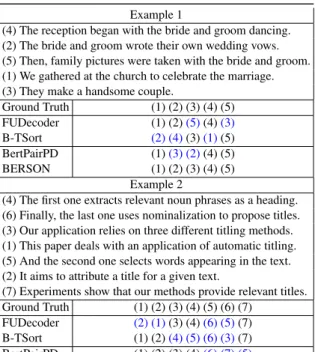
Table 9 reports the sentence ordering results for two examples produced by different models. For the baseline FUDecoder and B-TSort, we ran the public code provided by the authors to generate
the order predictions. As we see, in the first ex-ample, BERSON achieves to exact match orders for all the sentences while all the baseline meth-ods have some incorrect order predictions. For the second input paragraph, BERSON is able to cor-rectly predict the order for the most of sentences which also shows a better performance than the competing models.
A.2 Two other metrics used in the Analysis
Longest Common Subsequence (LCS): It
cal-culates the percentage of longest correct sub-sequence between the predicted order and the gold order (Gong et al.,2016). The consecutiveness is not necessary for it10.
Rouge-S: This metric (Chen et al., 2016; Gong
et al.,2016) measures the fraction of pairs of sen-tences whose predicted relative order is the same as the ground truth order11. It allows for any arbi-trary gaps between two sentences as long as their relative order is correctly identified.
A higher score is better for both metrics.
A.3 Discussion of Topic Shift Problem
BERSON captures both global and local coher-ence among sentcoher-ences, which is effective in re-organizing texts with multiple topics. In par-ticular, the paragraph encoder is able to model the global topic information for all the sentences, which helps guide the order prediction process for the decoder. In addition, building upon the Next Sentence Prediction pre-training objective of BERT, the Deep Relational Module captures the local dependency relationship between each pair of sentences and identifies the tight seman-tic connections for sentence ordering, especially identifying the sentences containing topic shift clues of the whole text and acting as a link be-tween the preceding and the following topics. Further, the Relational Pointer Decoder leverages both the topical context flows from the previously predicted sequences and from the unsorted sen-tences to generate an accurate order prediction for these topic-linking sentences and their neighbor-ing ones. Therefore, BERSON is capable of gen-erating a logically consistent output sequence for texts including texts with topic shift.
10Codes for metric:
https://github.com/shrimai/Topological-Sort-for-Sentence-Ordering
11Code for metric: https://github.com/DeepLearnXMU/NSEG
Example 1
(4) The reception began with the bride and groom dancing. (2) The bride and groom wrote their own wedding vows. (5) Then, family pictures were taken with the bride and groom. (1) We gathered at the church to celebrate the marriage. (3) They make a handsome couple.
Ground Truth (1) (2) (3) (4) (5) FUDecoder (1) (2)(5)(4)(3) B-TSort (2) (4)(3)(1)(5) BertPairPD (1)(3) (2)(4) (5) BERSON (1) (2) (3) (4) (5) Example 2
(4) The first one extracts relevant noun phrases as a heading. (6) Finally, the last one uses nominalization to propose titles. (3) Our application relies on three different titling methods. (1) This paper deals with an application of automatic titling. (5) And the second one selects words appearing in the text. (2) It aims to attribute a title for a given text.
(7) Experiments show that our methods provide relevant titles. Ground Truth (1) (2) (3) (4) (5) (6) (7)
FUDecoder (2) (1)(3) (4)(6) (5)(7) B-TSort (1) (2)(4) (5) (6) (3)(7) BertPairPD (1) (2) (3) (4)(6) (7) (5) BERSON (1) (2) (3) (4) (5)(7) (6)
Table 9: Ordering prediction examples generated by different approaches. The prediction in blue indicates the wrong order assignment.
Dataset BERSON BertPairPD
Runtime #Params Runtime #Params
NIPS abstract 58s 129M 47s 127M
AAN abstract 1min26s 129M 1min15s 127M NSF abstract 57min59s 129M 48min40s 127M arXiv abstract 2h44min23s 129M 2h31min10s 127M
SIND 3min33s 129M 2min58s 127M
ROCStory 6min31s 129M 5min28s 127M Table 10: The runtime on the validation set and the total number of parameters for BERSON and baseline model BertPairPD.
A.4 Further Experimental Results
For the more detailed experimental results, Table 10 summarizes the runtime on the validation set and the number of parameters for BERSON and BertPairPD. The validation results of BERSON on all the datasets are reported in Table11.
Dataset Validation Results
Acc PMR τ NIPS abstract 68.65 39.46 0.82 AAN abstract 76.75 58.84 0.85 NSF abstract 51.71 23.39 0.68 arXiv abstract 74.84 55.75 0.82 SIND 58.84 31.70 0.65 ROCStory 82.55 67.63 0.87