Chapter 6
Weather
• Weather is a local area’s short-term physical conditions Hours or days
• Troposphere
Variables of Weather
• Atmospheric pressure • Precipitation
• Temperature • Wind speed
Fronts: boundaries between 2 air masses with different temps and densities
Pressure systems
• High
Cool, dense air that descends toward earth’s surface, becomes warmer Fair weather
• Low
Less dense warm air that rises, expands and cools.
Tornadoes
• US most prone: March - Aug • Australia
Tropical Cyclone
• Atlantic – hurricanes • Pacific – Typhoons • Saffir-Simpson scale
• Immediate damage – loss of life and damage to property/agricultural production
• Long term damage in ecology/economy Erosion of physical features of land
Change population distribution of plants/animals Convey waterborne/airborne contaminants
Hurricanes are beneficial?
• Can flush excess nutrients from land runoff.
Hurricane Brett 1999 • Reduced brown tides
• Increased growth of sea grass/ served as nurseries for shrimp, crabs, fish
Factors Determining Climate
How is climate determined?
Global Air Circulation
a. Uneven heating: stronger at equator than poles (sun’s rays more at angle)
b. Seasonal changes in temp due to tilt of Earth c. Rotation in eastward direction prevents winds
from equator from moving N & S
Winds move to R in northern hemisphere, L in southern hemisphere. Coriolis Effect
• Polar Easterlies
d. Long-term variations in amount of solar energy striking the Earth
e. Properties of air and water
• Evaporation and heat transfer from oceans to atmosphere creates convection cells
that transport heat and water from one area to another.
Animation: Air Circulation and
Climate
PLAY ANIMATIO
Cell 3 North
Moist air rises — rain
Cell 2 North Cool, dry air falls
Cell 1 North
Moist air rises, cools, and releases Moisture as rain
Cell 1 South Cool, dry
air falls
Cell 2 South
Moist air rises — rain Cell 3 South
Cold, dry air falls Polar cap Temperate deciduous forest and grassland Desert Tropical deciduous forest Tropical rain forest Equator Tropical deciduous forest Cold, dry air falls Polar cap Arctic tundra Evergreen coniferous forest Temperate deciduous forest and grassland
2.
Ocean Currents: global air circulation + differences in water density create warmand cold ocean currents
a. Redistribute solar energy
Gyres
• Large ocean currents - North Atlantic Gyre
- Gulf Stream
Currents mix ocean waters and distribute nutrients and DO.
Upwellings
• Movement of nutrient rich bottom water to the ocean’s surface
Animation: Upwelling Along
Western Coasts
El Nino Southern Oscillation
ENSO
1. Prevailing westerlies weaken
2. Surface water along the South and North American (west) coasts becomes
warmer
3. Normal upwellings are suppressed
reduces primary productivity, causes sharp decline in pops of some fish
Animation: El Nino Southern
Oscillation
Typical Climate Changes with El Nino
• Torrential rains and mudslides along Ca coast. • Peruvian floods and mudslides
• Drought in Brazil, Indonesia, Australia, India, parts of Africa
La Nina
• Cooling episode that sometimes follows El Nino.
• More Atlantic Ocean Hurricanes
• Colder winters in Canada and Northeast • Warmer, drier winters in SE and SW US • Torrential rains in SE Asia
Chemical Makeup of Atmosphere and the Greenhouse Effect
• Certain gases play key role in determining temp and climate of Earth
• Greenhouse gases:
Water vapor, CO2, CH4 (methane), N2O (nitrous oxide)
Greenhouse Effect
• Visible light, IR, UV pass through troposphere • Earth’s surface absorbs much energy and
transforms to IR (2nd law of thermodynamics)
which rises back into troposphere.
• Some heat escapes to space, some is absorbed by greenhouse gases and emitted into
troposphere as longer IR rays which warms the atmosphere
Greenhouse Effect & Global
Warming
• Human activities increase greenhouse gases
increased greenhouse effect.
• May lead to global warming causing 1. Altered precip patterns
2. Altered areas for crop growth
3. Rise in sea level – thermal expansion and melting ice caps
Anthropogenic Activities Leading to
Increased Greenhouse Gases
• Increase in CO2 emissions – burning of fossil fuels
Animation: Increasing
Greenhouse Gases
Animation: Greenhouse Effect
Chemical Makeup of Atmosphere
• 3O2 + UV 2O3
• Stratospheric Ozone prevents 95% of UV rays from reaching Earth
• Prevents tropospheric gases from entering stratosphere
• Acts as thermal cap to determine average temp of troposphere
Topography/Earth Surface Features Effect on Climate
• Topographic features can produce microclimates • Mountains can interrupt flow of winds and
movement of storms. windward slope
leeward slope
Fig. 5-8, p. 105
Prevailing winds pick up moisture from an ocean.
Dry habitats Moist
habitats
On the leeward side of the mountain range, air descends, warms, and Releases little moisture. On the windward
side of a mountain range, air rises, cools, and
Microclimates in Cities
• Pavement, building materials absorb and hold heat
• Buildings block wind flow
• Motor vehicle emissions release heat & pollutants
Land/Ocean Breeze Interactions
Animation: Coastal Breezes
BIOMES:
CLIMATE AND LIFE ON LAND
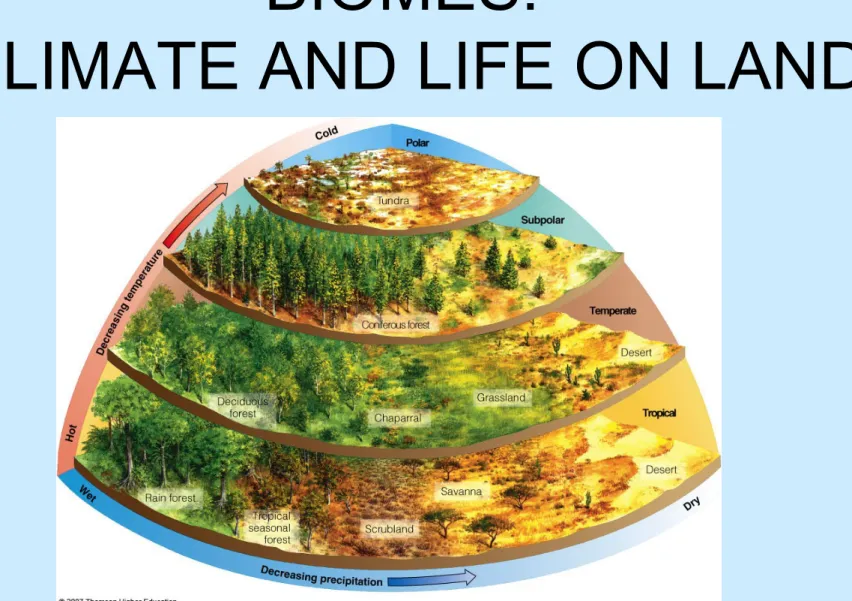
• Different climates lead to different
communities of organisms, especially vegetation.
– Biomes – large terrestrial regions characterized by similar climate, soil, plants, and animals.
– Each biome contains many ecosystems whose communities have adapted to differences in
Fig. 5-9, p. 106 Polar ice Equator Tropic of Capricorn Tropic of Cancer High mountains
Polar grassland (arctic tundra) Temperate grassland Tropical grassland (savanna) Chaparral Coniferous forest
Temperate deciduous forest Tropical forest
BIOMES:
CLIMATE AND LIFE ON LAND
• Biome type is determined by precipitation, temperature and soil type
Figure 5-10
BIOMES:
CLIMATE AND LIFE ON LAND
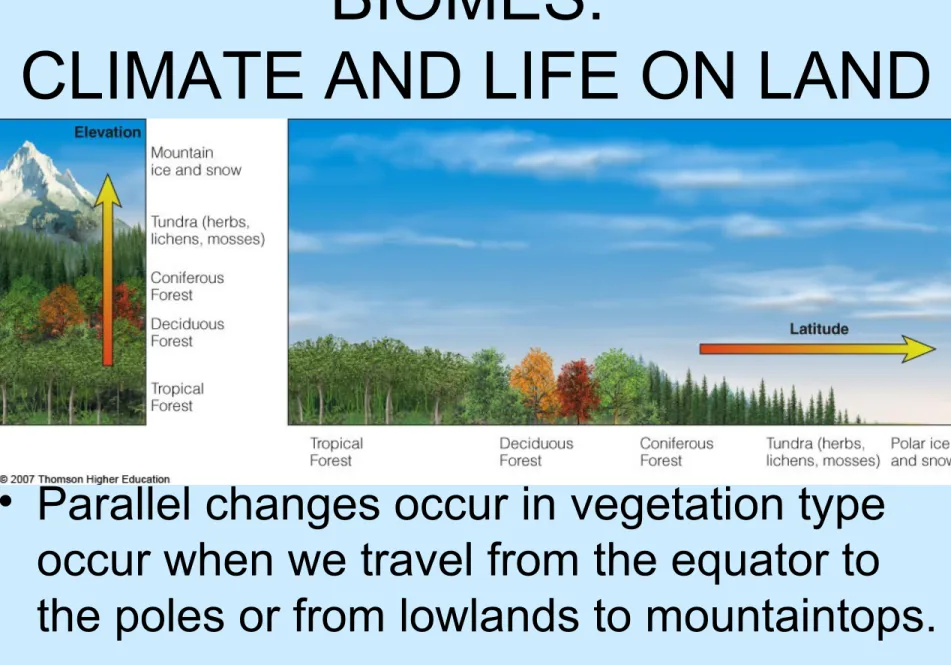
• Parallel changes occur in vegetation type occur when we travel from the equator to the poles or from lowlands to mountaintops.
Figure 6-22
Plant Survival Strategies
• Desert – succulent plants, no leaves (no water loss), store water in fleshy tissue, open stomata for CO2 only at night
• Tropical rainforest – broadleaf evergreens allow for collection of sunlight and radiation of heat
• Cold/dry winters – broadleaf deciduous survive drought and cold by shedding leaves and
becoming dormant