Programme Title and Cohort: BA (Hon.) Business and
Management
Module Code and Title: NX0320
Forename: Dilini Chavindi
Surname: Meemaduma
Student ID number: w11040837
University email address:
Student Number: w11040837
Word Limit: 10 % + /- 10000
Word count: 10980
Submission date: 06 September 2013
NAME Dilini Meemaduma
DEGREE BA (Hons) Business and
Management
SUPERVISOR Dr. Guy Brown
Title Assess the most effective attribute
of celebrity endorsed advertising on attracting
customers; Survey on cosmetic industry, Colombo
District, Sri Lanka
TITLE The Ethics of Advertising
DATE August 2009
Table of Contents
Executive summery ... 9
Acknowledgement ... 12
Chapter 01 - Introduction ... 13
1.0 Introduction ... 13
1.1Project Rationale ... 13
1.1.1 Significance of the study ... 14
1.2 Current situation ... 15
1.2.1 Company profile ... 16
1.2.1.1 Oriflame ... 16
1.2.1.2 Nature’s Secrets ... 16
1.3 Overview of literature review ... 16
1.4 Objectives ... 18
1.5 Scope of the research ... 18
1.5.1 Companies Chosen ... 18
1.5.2 Geographic area ... 18
1.5.3 Demographics ... 18
1.5.4 Product specific ... 18
1.6 Outlines of methodology ... 19
Chapter 2 – Literature Review ... 20
2.1 Introduction ... 20
2.2 Advertising defined ... 20
2.3 Types of advertising ... 24
2.4 Celebrity endorsement and importance of it ... 26
2.6 Celebrity endorsement theories ... 31
2.7 Celebrity attributes that influence endorsement effectiveness ... 33
2.7.1 Celebrity performance ... 34
2.7.2 Negative information ... 34
2.7.3 Celebrity credibility ... 35
2.7.4 Celebrity expertise ... 35
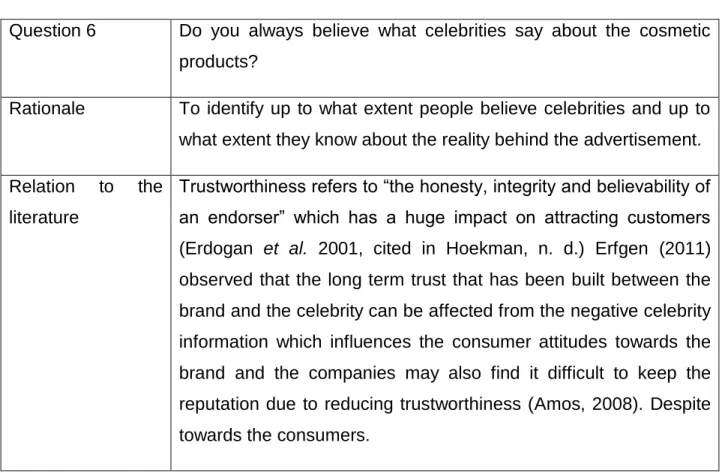
2.7.5 Celebrity trustworthiness ... 36
2.7.6 Celebrity attractiveness ... 36
2.7.8 Celebrity product - fit ... 37
2.8 Conclusion ... 38
Chapter 3 – Methodology ... 39
3.0 Introduction ... 39
3.1 Defining a marketing research ... 39
3.2 Research strategy ... 39
3.3 Research approach ... 41
3.4 Research methods ... 42
3.5 Sampling approach ... 43
3.6 Data collection ... 43
3.7 Pilot Test ... 44
3.8 Data Analysis ... 44
3.9 Approaches to ethical research ... 45
3.10 Limitations of the research ... 46
Chapter 4 – Finding and analysis ... 47
4.0 Introduction ... 47
4.1 - Question 1 ... 48
4.2 - Question 2, 3 and 4 ... 49
4.3 – Question 5, 6 and 17 ... 53
4.4 Question 7 and 8 ... 57
4.5 – Question 9, 10 and 11 ... 60
4.5 – Question 12 and 13 ... 64
4.6 – Question 15 and 16 ... 68
4.7 – Question 18 and 19 ... 72
4.8 - Discussions of finding and analysis ... 76
Chapter 5 – Conclusion ... 82
5.1 Review of the research objectives ... 82
5.2 Key themes ... 83
5.2.2 Impact of advertising towards consumer buying behaviour ... 83
5.3 Key views from the finding and analysis ... 85
5.4Limitations of the research ... 86
5.5 Further developments for future research ... 86
6.0 – Introduction ... 88
List of Reference ... 91
Bibliography ... 105
Appendix 1 – Reflective statement ... 107
Appendix 2 – Brand Loyalty towards the cosmetic industry ... 122
Appendix 3 - Consumer buying behavior ... 123
Appendix 4 – Types of advertising ... 125
Table of Figures
Figure 1. 1 - Relation between the advertising expenditure and purchasing intention in Health &
beauty industry (International Analysis of 349 consumers) ... 15
Figure 2. 1 - Impact of advertising in buying decision ... 23
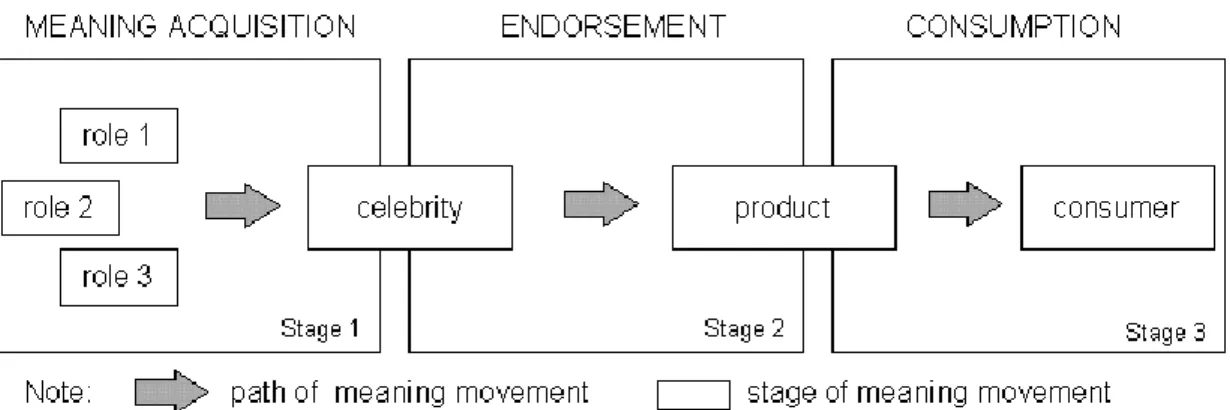
Figure 2.2 - Meaning movement and the endorsement process adopted by McCracken ... 32
Figure 4. 1 - Do celebrity interest to you ... 48
Figure 4. 2 - Which brand name comes to your mind first ... 50
Figure 4.3 - Celebrity or the product that comes to your mind first ... 51
Figure 4.4 - Has any celebrity endorsed advertisement influenced you ... 52
Figure 4.5 - Have you felt that you have been miss-lead from advertisements ... 54
Figure 4.6 - Do you believe celebrities ... 55
Figure 4.7 - Loyalty towards the celebrity ... 56
Figure 4.8 - Celebrities as an information source ... 58
Figure 4.9 - Comparison of celebrities ... 59
Figure 4.10 - Celebrity likability ... 61
Figure 4.11 - Impact of advertising on recalling the brand ... 62
Figure 4.12 - Reflection of celebrity appearance ... 63
Figure 4.13 - Positive performance of celebrities ... 65
Figure 4.14 - Negative information of celebrities... 66
Figure 4.15 - Credible sources have high impact on purchasing decision... 67
Figure 4.16 - Influence of celebrity’s experience about the product ... 69
Figure 4.17 - It makes people buy when celebrities are qualified ... 71
Figure 4.18 - Celebrity attraction on buying decision ... 73
Table of tables
Table 2.1 - Usage of advertising ... 22
Table 2.2 - Different types of advertisement ... 24
Table 2.3 - Defining Celebrity ... 26
Table 2.4 - Match up theory Vs Source theory ... 31
Table 3.1 - Quantitative Vs qualitative study ... 40
Table 3.2 - Benefits and limitations of Descriptive study ... 41
Table 3.3 - Benefits and limitations of using close ended questionnaire ... 42
Table 4.4.1 - Question 1 ... 48
Table 4.4.2 - Question 2 ... 49
Table 4.4.3 - Question 3 ... 50
Table 4.4.4 - Question 4 ... 52
Table 4.4.5 - Question 5 ... 53
Table 4.4.6 - Question 6 ... 54
Table 4.4.7 - Question 17 ... 55
Table 4.4.8 - Question 7 ... 57
Table 4.4.9 - Question 8 ... 58
Table 4.4.10 - Question 9 ... 60
Table 4.4.11 - Question 10 ... 61
Table 4.4.12 - Question 11 ... 62
Table 4.4.13 - Question12 ... 64
Table 4.4.14 - Question 13 ... 65
Table 4.4.15 - Question 14 ... 67
Table 4.4.16 - Question 15 ... 68
Table 4.4.17 - Question 16 ... 70
Table 4.4.18 - Question 18 ... 72
Table 4.4.19 - Question 19 ... 74
Table 4.4. 20 - Summarizing the effectiveness of different celebrity attributes ... 75
Table 4.4.21 - Cross tabulation ... 76
Table 4.4.22 - Cross tabulation ... 77
Table 4.4.23 - Cross tabulation ... 79
Table 5. 1 - Multi Attribute Attitude Model adopted by Belch and Belch (2009) ... 87
DECLARATIONS
I declare the following:-
(1) that the material contained in this dissertation is the end result of my own work and that due acknowledgement has been given in the bibliography and references to ALL sources be they printed, electronic or personal.
(2) the W ord Count of this Dissertation is ...10980...
(3) that unless this dissertation has been confirmed as confidential, I agree to an entire electronic copy or sections of the dissertation to being placed on Blackboard, if deemed appropriate, to allow future students the opportunity to see examples of past dissertations. I understand that if displayed on Blackboard it would be made available for no longer than five years and that students would be able to print off copies or download. The authorship would remain anonymous.
(4) I agree to my dissertation being submitted to a plagiarism detection service, where it will be stored in a database and compared against work submitted from this or any other School or from other institutions using the service.
In the event of the service detecting a high degree of similarity between content within the service this will be reported back to my supervisor and second marker, who may decide to undertake further investigation which may ultimately lead to disciplinary actions, should instances of plagiarism be detected.
(5) I have read the University Policy Statement on Ethics in Research and Consultancy and the Policy for Informed Consent in Research and Consultancy and I declare that ethical issues have been considered and taken into account in this research.
SIGNED: ...Dilini Meemaduma……
Executive summery
Celebrity endorsement advertising has become a ubiquitous feature of modern marketing.
Most of the time celebrities are not the same individuals that people see in the
advertisement as well as in their real life and the most important query is why firms use
celebrities. Obviously the answer would be they do not just sell the products,they touch
your heart. On the other hand, for some of the European countries they would say neither
skinny models nor celebrities make me buy, but in Asian countries such as India people
worship celebrities and treat them as gods (Rawtani, n. d). However in the meantime Sri
Lankan celebrities still have a significant impact on customers and obtain special
salutation from them (Lalanananda, 2007). Consequently it is not the celebrity but the
advertiser who makes people buy and this study intends to find the most effective attribute
in selecting celebrities in the context of attracting customers with providing a quantitative
summery.
Also analysis of industry advertising data discovered that there is a significant increase in
billions for advertising expenditure in Sri Lanka and that is why it is important to find out
whether the firms generate sales for the huge amount of money they spend on advertising
(Lalanananda, 2007). However nowadays the cosmetic industry is struggling with lot of
competing challenges and there is a wide availability to fail local marketers against the
foreign cosmetic companies and their celebrity endorsed advertising (Wijesekara, 1996).
Therefore this research will help to improve the advertising firms with referring to why local
celebrities fail in attracting customers compared to international level celebrities. This also
aims to provide other competitors who are excluded in this research to find the ways to
close the gaps and use the research results to create effective celebrity endorsed advertising. In addition, to the customer’s perspective they will be able to stop
unnecessary spending due to miscommunications in celebrity endorsed marketing
communication.
Further according to the past surveys, advertising messages delivered by celebrities
provide a higher degree of attention and possibly provide a message than those delivered
by non-celebrities (Menon, 2001). However, there is also a significant usage of celebrity
most effective celebrity endorser source effects (attributes) in advertising effectiveness in
Sri Lanka (Wijesekara, 1996). Therefore this research is carried out for companies to
understand the most effective celebrity attribute and develop their advertising strategies
choosing the best effective and attractive source of endorsement to customer to recall the
brand. As prior survey done by Amos (2008) determined several attributes that have
significant impact on celebrity endorsed advertisements and associated brands towards
the customer attitudes that are considered in this research specifically celebrity
performance, negative information, celebrity credibility, celebrity expertise, celebrity
trustworthiness, celebrity attractiveness, celebrity familiarity and likeability and celebrity
product fit.
For the purpose of gathering data close ended questionnaires were distributed using
random sampling within focused sample size 100 out of “2,323,826 population” of
Colombo District (Census of population and housing, 2012, n. p). Further, the survey was
carried out as a descriptive study as a top-down approach which help to describe the link
between attributes of the celebrity and advertising effectiveness through its positive
impact on customer buying behavior which generates sales for the huge amount of money
they spend on advertising.
The survey focused on the main two local and foreign cosmetic companies which
captured 60 percent of market share in Sri Lanka. Oriflame which is the international branded company use only foreign celebrities and Nature’s Secrets uses local actresses
as celebrities (Ceylon Today, 2013; Nature’s Secrets, 2013; Oriflame, 2013). Further McCracken’s (1989) meaning transfer model describes that it is celebrities who represent
the brand name or company and consumer attempts to consume a brand which has the
greatest fit with their individual personality/image. It is the advertisers who are responsible
for transfer of the image of the product closer to the expectation of the consumer, by using
best fit celebrity attribute to reside in theimage to the product (Rawtani, n. d). Therefore in brief Oriflame Vs Nature’s Secrets clearly reflect the effectiveness of foreign celebrities Vs
local celebrities. Consequently the research analyses the result discovered that Oriflame
advertisements have more significant effectiveness with foreign celebrities compared to the Nature’s Secrets which uses the local celebrities. Moreover, the result described that
the most influential factors that affect the advertising effectiveness and foreign celebrities
have earned trustworthiness, attractiveness and expertise due to the unawareness of
them of local customers. Further Belch and Belch (2009) explained that their negative information never gets air to Sri Lanka and that this is why most of the ‘A’ grade European
celebrities do not appear in advertisements in their homeland but get paid in billions from
foreign countries since there is a great tendency for Asians to believe that they actually
have the experience in that particular product.
However, it is important for firms to keep the long term strong relationship with the
celebrity without switching to new celebrities and that would increase reliability and confident in the consumer’s mind and reduce the risk of challenge from foreign celebrities
(Amos, 2008; Erfgen, 2011). Also in selecting new celebrities in future for new products,
advertisers should be critical and need to give significant priority for the integrity,
believability of celebrity other than the attractiveness in order to have a reliable and
favorable brand image on consumer (Amos, 2008). Further, they need to stick to one
expert celebrity who does not appear for multiple brands since multiple celebrity
endorsement is ineffective for the image of celebrity .Thus, using a celebrity who is an
expert and who endorses only that brand earns more reliability, expertise and celebrity’s
loyalty towards the brand which may result in greater positive impact on consumer loyalty
(Johansson and Sparredal, 2002). Using well a reputed person is also recommended with
strong autobiographical advertising with use of traditional celebrities to promote local
brand align with heritage image which would also give positive results for local marketers
Acknowledgement
Firstly, I wish to convey my sincere thanks and appreciation to my family for being with
me and accepting my moods under extreme level pressure and their encouragement
was the key driver that constantly motivated me to complete the research successfully.
I also wish to convey my sincere thanks and appreciation to my second family team
BMS from Mr. Nizam, for offering me such a nice family background to balance my
study and work life and the motivation though the degree programme.
Secondly, I am grateful to my dissertation supervisors who guide me through the
dissertation Dr. Guy Brown from Northumbria University, Miss Dunali Perera and Miss
Rabiya Awthard from BMS for giving me such an appreciative backup with high tolerant.
Their valuable feedback and quick responses for my mails even at the last moment was
really helpful for me to finish my work as I expected.
I also wish to extend my appreciation and thanks to Mr. Dineth Smaragunarathne who
was extremely patient in teaching me to improve my academic writing from the degree
year one and guided me through the data analysis of the dissertation using SPSS soft
ware.
Finally I am thankful to my friends and colleagues who offered me with first hand help in
Chapter 01 - Introduction
1.0 Introduction
Chapter one aims to give an overall introduction to the research including the rationale
behind the research, scope of the research which identify and limit the research area,
methods that are expecting to carry out to data collection and analysis and main
objectives of the study which demonstrate the outcomes of the study. Finally all these
frame works will help to compare with the results and recommendations achieved by
conducting research.
1.1Project Rationale
This research is carried out to assess “the most effective attribute of celebrity endorsed advertising on attracting customers; Survey on cosmetic industry, Colombo District, Sri Lanka”.
Specifically it aims to identify the link between attributes of the celebrity and advertising
effectiveness trough its positive impact on customer buying behavior which generates
sales for the huge amount of money they spend on advertising. According to Wijesekara
(1996) there is a significant usage of celebrity endorsed advertising to promote cosmetics
in Sri Lanka. However, he also states that there is no significant evident to realize the
most effective celebrity endorser source effects in advertising effectiveness Additionally
there is no proper measurement to find out to what extents customers have been affected
from celebrity endorse advertisements. Therefore this topic has been argued by expert in
advertising and it is evidently presented in chapter two of this report.
Moreover, studies and researches of Amos (2008) have determined that due different
reasons, purpose and effectiveness of the celebrity endorsed advertising would be
changed. One main reason is the negative interaction with the public relations and
advertising placement (Michaelson and Stacks, 2007, p.9). However, nowadays the
cosmetic industry is struggling with a lot of competing challenges and there is a wide
availability to fail local marketers against the foreign cosmetic companies and their
also facing the same problems and it is hard to find a study on this topic even though
there are lots of researches on celebrity endorsement.
However, it will be interesting to find out as to how to overcome all those challenges face
by marketers in relation to celebrity endorsed advertising. Moreover, Richards and Curran
(2002) also put a forward view on this by stating that advertising also has a huge impact
on keep customer loyalty other than the product quality. Thus this situation is interesting to
find out how and what have done by advertisers to keep customer loyalty by recalling and
reinforcing the products in cosmetic industry. Consequently through several surveys and
studies Belch and Belch (2009) found that cosmetic industry has a high tendency to keep
customer loyalty at a highest level since always people tend to stick to one particular
cosmetic brand and this is demonstrated in Figure 1.0 (Please refer the Appendix 2).
1.1.1 Significance of the study
For companies and advertisers to understand the most effective celebrity attribute that should be used in advertising in order to have positive customer attraction. Allows marketers and companies to identify developing challenges and strategies
in advertising with referring to why local firms and celebrities fail in attracting
customers compare to international level celebrities.
Enhances advertiser’s knowledge in choosing celebrities and to create innovative celebrity endorsed advertisements and to enhance customer’s knowledge in
selecting best suitable product.
Other competitors who excluded in this research may also find the ways to close the gaps and use the research results to create effective celebrity endorsed
advertising.
Other competitors who excluded in this research may also find the ways to close the gaps and use the research results to create effective celebrity endorsed
1.2 Current situation
Most of the studies indicate that cosmetics manufactures and clothing manufactures are
the most common users of celebrity endorsed advertising in worldwide (Business
dictionary, 2012). Further global wise celebrity advertising is in a period of significant
growth and the global cosmetic market is annually growing at a rate of 4.6 percent since
the year 2004 (Datamonitor, 2012; Erfgen, 2011). However, Kotler et al. (2009) mentioned that, advertisers, marketers should carful since the South Asian Gross Domestic Product
(GDP) rates are not yet placed well, compare to the world standard. Although with the
current economic growth, GDP rate of Sri Lanka is 8.3 percent and current expenditure
rates, investments in whole sale and retail trading indicate a significant growth in
economic states in compare to the past years (Central Bank of Sri Lanka, 2012, p. 25).
Indeed as Kotler et al. (2009) believed that economic situation of a country has a huge impact on purchasing power of customer. In addition LMD (2001, cited in Lalanananda,
2007, p. 1) analysis of industry advertising data discovered a significant increase in “advertising expenditure, from Rs.1.5 billion in 1997, to Rs.2.0 billion in 2000” in Sri Lanka. Further, Lalanananda, (2007) and Belch and Belch (2009) support Wijesekara’s (1996, p. 1) argument which is “advertising expenditure will result in an increasing brand’s market share” which is showed in Figure 1.1.
Source: Nielsen (2011, n. p.)
1.2.1 Company profile
1.2.1.1 Oriflame
Oriflame is Swedish company which owns 17 percent market share in Sri Lankan market
and famous for Swedish natural innovative beauty products over 61 countries including Sri
Lanka (Oriflame, 2013). Normally oriflamme uses international celebrities only through
their magazines, bill boards and leaflets. These are unique products which are expensive
and not affordable for everyone and no any outlets except the main three branches in Sri
Lanka and 1.3 billon annual sales are done by 3.3 million consultants over the world
(Oriflame, 2013).
1.2.1.2 Nature’s Secrets
The largest herbal cosmetic manufacturer in Sri Lanka which is Nature’s Secrets has owned “38 percent” of market growth and local exports the products over 50 countries in
the world (Ceylon Today, 2013; Nature’s Secrets, 2013). Nature’s Secrets uses local
actresses as celebrities in there television advertisements and bill boards. Company
enjoying the wide range of market which categorized expensive to normal and company
has expanded from every supper market to small grocery shop through great distribution channels (Nature’s Secrets, 2013).
1.3 Overview of literature review
Advertising is one of the major concerns of sales promotion which is defined as a tool that
use to compete within the industry to ensure strong and rapid customer response in terms of “boosting sagging sales” (Kotler et al. 2009, p.476). Belch and Belch (2009), Tom and Eves (1999) and Kazmi and Batra (2009) explain usually advertising as an information
source and unusually for persuasive perspective and also it is a stimuli to customer. As a
response to this Amos (2008) argue that both advantages and disadvantages may
associate with the use of advertising since advertiser always has a risk of success.
According to the past surveys, advertising messages delivered by celebrities provide a
higher degree of attention and possibly message than those delivered by non-celebrities
(Menon, 2001). Although Agrawal and Kamakura (1995) and Erfgen (2011) noticed the
purpose of using celebrity endorsement strategy is to assess the profitability from their
fame. Tom and Eves (1999) state that celebrity endorsed advertising is effective when it touches the consumer’s heart. At the same time Petty, Cacioppo and Schumann (1983)
stated that it is common that advertising effectiveness is depend on attractiveness of
celebrity and most of the people tend to neglect the message contains. Opposing this
Amos (2008) argues that celebrity attractiveness has no impact on advertising
effectiveness since non attractive people has gain more effective results also.
However McCracken’s (1989, cited in Choi and Rifon, 2007, p. 307) model describes
celebrities as representatives who transfer their symbolic or meaning to the public, through products or brands they endorse in advertising while Till & Busler’s (1998) match
up hypothesis model describes celebrity product fit and its impact on attracting
consumers. This is supported by Brandchannel (2013) and Schlecht’s (2003, p.3) views
which is celebrities are people who enjoy public recognition on behalf of the product or
brand they endorsed. However, celebrity endorsement is a common advertising tool,
which is said to have significant impact on the customer decision-making process (Kotler
and Armstrong, 2008). Amos (2008) and Martin et al (2002) summarized, key predictors towards advertising effectiveness include celebrity performance, negative information,
credibility, celebrity expertise, celebrity trustworthiness, attractiveness, familiarity,
likeability, and celebrity- product fit. In offering a summary, Menon (2001) suggested that
the mix of celebrity appearance, celebrity knowledge and many other celebrity attributes
1.4 Objectives
To critically review literature on advertising, celebrity endorsed advertising as a marketing communication method and defines different celebrity endorser
attributes.
To ascertain the impact of different attributes of celebrity endorsed advertisements on attracting customers through a survey in regards to Colombo District, Sri Lanka. To find out the most effective attribute of celebrity endorsed advertisements based
on identified factors from the literature search.
To, establish a sufficient conclusion and to make recommendations to companies in order to overcome the challenges faced in choosing celebrities.
1.5 Scope of the research
1.5.1 Companies Chosen
The total number of cosmetic companies of beauty and cosmetic industry in Sri Lanka is 195 of which Oriflame and Nature’s Secrets are the market leaders capturing a significant
market share of the industry (Yellow Pages Directory, 2009).
1.5.2 Geographic area
The Colombo District is taken to carry out the research since the usage of the cosmetic
products high in Colombo district compare to the other cities.
1.5.3 Demographics
According to the surveys of different authors Calvert (2008) insists that age’s between13–
19 (teenagers) is the people who influenced from the advertisements most. Further, most
frequently, age within 20-39 age groups is the majority usage of all cosmetics products.
(Hitay, 2013; Persaud, n. d.). Therefore the demographics would scope up to male and
female in the age group, between the ages of 13-40.
1.5.4 Product specific
Cosmetics products are the main concern including all toilette products, skin care, hair
1.6 Outlines of methodology
Research Approach will be a survey as design as to carry out a descriptive study based
on quantitative data which is more weighted to the social, behavioral researches (Cohen,
1980, cited in Sukamolson, n. d.; Newman and Benz, 1998). The sampling technique that
will be used in this research will be probability sampling, as Sekaran and Bougie (2011)
noted that this where usually the probability is known and equal for every person being
selected within the population. The population of this research can be considered as all
the people who use the cosmetics and who live in Colombo District, Sri Lanka. The sample size is 100 people out of “2,323,826 population” of Colombo district (Census of
population and housing, 2012, n.p). Also, data will be collected through a simple random
sampling. However the research objectives that mentioned above will be achieved by next
Chapter 2 – Literature Review
2.1 Introduction
This chapter seeks to focus on the theories, models and views of different academic
sources such as books, peer viewed journal articles, research reports, theses and fact
sheets. A critical literature review should include the evaluation of key information from
main source that discuss and illustrate with different views on the same subject area
(Denscombe, 2009). Hence applying a critical review this chapter will demonstrate what is
advertising, celebrity endorsed advertising as a form of advertising, role of celebrity
endorsement in marketing communication and different celebrity attributes which affects
the effectiveness of advertising in related to the topic area of research.
2.2 Advertising defined
There are different definitions for the word advertising due to different segments of
individual perspectives such as customers, business people, journalists, sociologists and
economists (Kazmi & Batra, 2009). Kazmi & Batra (2009) further mentioned that,
advertising is a marketing process for business people, it is a communication, public
relation to the journalists, economists and sociologists to see the ethical or the societal
significance of it. Due to the above ambiguity towards the meaning of advertising, it is
important to seek how it affects on consumer buying behavior
Most of the definitions indicate advertising as one of marketing communication methods
which is also known as a ‘marcomm’ (Pringle & Binet, 2005). Belch and Belch (2009, p.18) describe advertising as “any paid form of non personal communication about an organization, product, services, or idea by an identified sponsor”. Furthermore, Weron and
Weron (2008, p. 1) put forward a view on this by stating that, advertising is a means of providing “information” about product characteristics and prices to consumers in order to make an “efficient decision”. Moreover Clow (2007) describes advertising as a tool of
strategic marketing communication where promotional activities achieve the tangible
results in terms of attracting customers. Richards and Curran (2002, n. p.) also support
Supporting to above communication perspective, Ibid’s (n.d. cited in Tahtinen, 2006, p.
156) point of view indicates advertising is a paid, mediate form of communication that “designed to persuade” and the receiver to take some action. This is further described by Tom and Eves (1999, p.39) who conceive that, “the purpose of advertisements is not only to inform but also to persuade”. Martin et al. (2002) argued affirming that advertising effectiveness can differently perused towards the diverse factors of consumers such as
demographical factors. Nevertheless supporting above authors Braun et al (2002, p. 1) state that advertisers use celebrities in “autobiographical advertising” as a mediate to create “nostalgia” and loyalty for their products and brands. Baumgartner et al (1992) intended to explain autobiographical advertising where advertisers induce customers with
remarkable advertisements reminding the positive similar situations and memories in
order to force them to buy the product.
Equally opposing to both the communication and persuasive perspectives, some of the
studies evidenced that advertising is significantly related to impulsive behavior considering
advertising as a major promotional activity refer to external stimulus of impulse resulting in
a direct increase in sales (Dittmar, Beattie and Friese, 1996). In the purchasing intention
Agrawal and Kamakura (1995) also believe the purpose of advertising strategy as to
assess the profitability. In addition Lavidge and Steiner (1961) and Richards and Curran
(2002) acknowledge enterprise and sales based view of advertising affirming it as a
function to produce or boost sales and mentioned about the importance of channel regard
to the number of sales. Moreover, Tahtinen (2006) put a forward view on this by stating
that, advertising will result significant increase of sales immediately or afterward. Lavidge
and Steiner (1961, p.137) totally agree with above statement about the concept of
Richards and Curran (2002) have mentioned that effective marketing communication
methods should based on the advertising channels, purpose or time and the audience. At
the same time Michaelson and Stacks (2007) noticed the interaction with the public
relations placements and advertising placement based on several experimental studies they carried out. Weron and Weron’s (2008) argue that, advertising is frequently used for
the purpose of introducing new products and therefore the place and other relevant
information are vital in order to compete with existing products. On the contrary Lavidge
and Steiner (1961) noted a series of activities which advertising can be used as influential
factors as viewed in Table 2.1.
Table 2.1 - Usage of advertising
The process of activities that advertising can be used
Totally unaware of the existence of a product or service, Merely aware of the existence of a product or service, As a up step to people who know the existence well
As a closer for purchasers who have favorable attitude towards the product or service and preference over all other options,
As an actual purchase attitude
(Adopted by Lavidge and Steiner, 1961)
Thus advertising is naturally intended to reflect as a communication method where
delivering the message with the any form of content or the purpose mentioned above
(Clow, 2007; Richards and Curran, 2002). However, considering this ambiguity towards
the usage of advertising Richards and Curran (2002) conclude that purpose could be
persuasiveness or entertainment, increase of sales, introducing new product or any other
2.2.1 Impact of advertising on consumer buying behavior
Weckman (2009) believes aggressive advertising has a positive impact on consumer
buying behavior which always complimentarily rises. Nevertheless advertising is one of
the influencing factors to consumer buying behavior that comes under marketing stimuli in
a huge psychological process (Kotler et al, 2009). However advertising effectiveness which is varying with the advertisement placement and the purpose will demonstrate by
below Figure 2. 1 and it also shows the significant impact of advertisement on different
demographic factors.
Figure 2. 1 - Impact of advertising in buying decision
What is important All
Adults
‘Influen
tials’ Have childre n ages 0-17 PC in home Access web at home or office Home owners
Past experience with brand 83% 88% 82% 83% 83% 84%
How quality compare to the other brands
63% 85% 63% 68% 69% 64%
Reasonably priced 56% 69% 55% 58% 57% 58%
Personal recommendation of others 48% 57% 47% 49% 50% 49%
Manufacturers reputation for quality 46% 54% 42% 53% 53% 49%
Well known/well advertised 21% 18% 21% 20% 21% 20%
How rated in consumer reports 15% 31% 14% 18% 18% 17%
Manufacture’s effect t cut pollution 8% 21% 8% 10% 11% 9%
Manufacture’s trade ‘policies’ 5% 9% 2% 6% 6% 6%
How manufacturer deals with union labor
5% 23% 5% 6% 6% 5%
(Adapted by Roper, 2006, cited in Belch and Belch, 2009, p. 119)
The figure describes the term ‘influentials’ and ‘Policies’ refer to meanings mentioned
bellow.
Consumers identified as ‘influentials’ 1 in 10 people who strongly influence the other nine.
Manufacturer trades with countries that consumer disapproves of (Roper, 2006, cited in Belch and Belch, 2009, p. 119).
Consequently Belch and Belch (2009, p. 111) defined consumer behavior as a process that people involve in when “searching for selecting, purchasing, evaluating, and disposing of products” and advertising type should match up with the consumer
requirements. (Refer the Appendix 3).
2.3 Types of advertising
Economists have identified different types of advertising that use for different types of
purposes and Figure 4 describes the four types of advertising according to Kotler et al
(2009). (Refer the Appendix 4).
Table 2.2 - Different types of advertisement
Type of
advertising
Description
Informative
advertisements
Ideal for the search of goods which are tested in terms of fit, color,
quality and lot more features by consumers before they purchase
(Dukes, 2009). Freeborn and Hulbert (2009) encourage competition among two or more similar products and it contrast the “relative quality or much value of each good” according to the given
information.
Persuasive
advertisements
Persuasive advertising focuses on “creating liking, preference, conviction” and is a way of comparative marketing in order to gain
competitive advantages (Kotler et al, 2009, p. 487). Dukes (2009) compare that informative messages are just to update the knowledge
create preference, liking towards product.
Reminder
advertisements
These are intended to remind people again and again to buy their
product and stimulate repeat purchasing (Dukes, 2009). Therefore
these advertisements should be remarkable and sometimes people
may hate the advertisement though they remember the brand, name
or the product (Kotler et al, 2009). Reinforce
advertisements
‘Reinforce’ advertising demands greater detailed information since it aims for convenience goods which “consumer cannot be sure of the quality until they consume it” (Dukes, 2009, p. 5). The task is to be stimuli to the switching customers such as ‘verity seeking’ people who
are trying new things where the product rage is wide and aggressive
advertisements may need to compete with the competitors (Barnard
and Ehrenberg, 1997; Kotler et al, 2009). Thus reinforce advertising depends on a supporting third party (celebrities) reaction, where
consumer tend to believe that as their own experience (Freeborn and
Hulbert, 2009).
(Author developed, 2013)
However, Fitzerpatrik (2005, cited in Rehman and Ibrahim, 2011) stated that as marketing
communication, all types of advertising methods are effective when, it is the right message, in the right place, with using right ‘source’ targeting right customer segments. The word ‘source’ refers to celebrities where celebrity endorsed advertising was intended
as a method of effective communication on attracting customers (Rehman and Ibrahim,
2.4 Celebrity endorsement and importance of it
Celebrity endorsed advertisements has become a “ubiquitous feature of modern marketing” (McCracken, 1989, cited in Hsu, McDonald and Danielle, 2002, p.19). Hence it
is important to define the role of celebrity in modern advertising with the identified
importance, limitations of using of celebrities. The table 2.3 will demonstrate the different
definitions on celebrities by multiple authors.
Table 2.3 - Defining Celebrity
Author Definition
Schlecht (2003, p. n.
3)
“Celebrities are people who enjoy public recognition by a large share of a certain group of people”
McCracken (1989,
cited in Choi and
Rifon, 2007)
Celebrities are individuals who behave as representatives and
transfer their symbolic or reflective meaning to the public,
through products or brands they endorse in advertising.
Business dictionary,
(2012, n.d.)
Celebrity endorsement refers a “form of brand or advertising
campaign that involves a well known person using their fame to help promote a product or service”
Friedman &
Friedman, 1979 cited
in Hoekman, n. d.)
A celebrity endorser who endorse a brand or a product to a
group of people using his/ her performance, achievements in
particular field.
Feinman, 2011, p.
100)
Celebrities are kind of “brand communication” mediates in which
line up with a particular brand or product into his/herself and certifying that product or “brand‘s claim” through the endorser’s
widen fame, performance, credibility, tallness and expertise
Gabler (2001) Celebrity is an art or a very processed person who entertains
human beings.
(Author developed, 2013)
McCracken (1989, cited in Choi and Rifon, 2007), Schlecht’s (2003) and Canning and
West (n. d.) believe that celebrities are using their fame to promote products or brands
where companies also gain public recognition. Further McCracken (1989, cited in Choi
and Rifon, 2007) notes the main concern is celebrity image that best fits the product image and culture of the consumer in the perspective of transferring celebrity’s symbolic
meaning to the products they appear in. Further, celebrities have been identified as a form of entertainment or it is an art of gaining advantage of a person’s performance, credibility,
tallness and expertise (Feinman, 2011; Gabler, 2001). Contrary to above two authors Till
(1998, cited in Sivesan, 2013) insists that it is not the celebrity who always endorsed the product but company or the brand also has a significant effect on celebrity’s image since
celebrity endorsement is an interactive process. However, Kotler et al (2009) concludes that, celebrities are influenced by both the companies and advertisers and from the audience also. Supporting that Belch and Belch (2009) noted that most of the time ‘A’
grade celebrities do not appear in advertisements since they do not like fans to think that
they have been sold out. However, they have been paid in billions from foreign countries
such as Japan for the advertisement which never airs those advertisements to their local
fans and this is indicating the impact of the celebrity on brand image as well as influence
of the audience (Belch and Belch, 2009).
Amos (2008) and Schlecht (2003) also further supported this by stating that most of the
firms spend billions of dollars per year on celebrity endorsement contracts and as an example Venus Wliams, had a “five year $40 million contract” (Schlecht, 2003, p. 3) with sport wear manufacturer “Reebok International”. Nevertheless, it has been proved by
Friedman & Friedman (1979, cited in Hoekman) and past surveys of Menon (2001) have
found that advertising messages delivered by celebrities provide a higher degree of
typical customers or corporate leaders. Opposing to this Belch and Belch (2009) believed
appearing corporate leaders for their own company advertisements is one of the best
ways to enhance the credibility which is the most important aspect in endorsement. Kotler
et al (2009) also argues that the most credible source would depend on three main factors which are expertise, trustworthiness, and likeability.
Likewise no matter which attribute of celebrity is used but the requirement which is
attracting consumer remains the same (Canning and West, n. d.). Further Feinman (2011)
and Friedman & Friedman (1979, cited in Hoekman) and Kotler et al (2009) compare all the suggestions and arguments of above authors’ and concluded that the choice of
celebrity is critical and depend on the requirement of the situation. In supporting to this
Belch and Belch (2009) argue that using celebrities in advertising is always very an
expensive and risky strategy since all their personal life, characteristics, attitudes, physical
finesses affect the endorsement image. Similarly, the studies of Canning and West (n. d.)
show that high credibility source does not always positively impact on brand image either
produce sales.
In conclusion celebrity endorsement has become an adequate influential factor in
consumer mind and specially used in autobiographical advertising (Braun et al, 2002). However celebrities are famous people who play a significant role as an entertainers
(Gabler, 2001), also gain public recognition by transferring their meaning to the products
(McCracken, 1989 cited in Choi and Rifon, 2007; Schlecht’s, 2003), and who has a
significant impact on consumer buying behavior due to different celebrity attributes
2.5 Celebrity endorsed advertising as a marketing communication method
Marketing communication is direct or indirect influence in method of inform, persuade or to
remind consumer to buy the products (Kotler et al, 2009). As views of Fitzerpatrik (2005, cited in Rehman and Ibrahim, 2011, p. 188) marketing communication is an approach towards efficiency by synergy and defined as the “merging of distinct communication functions in a way that allows an organization to speak with one voice, one look”. Further
Schultz states (2003, cited in Rehman and Ibrahim, 2011) adds that marketing communication is more than “advertising, sales promotions and direct marketing”.
Moreover Khatri (2006, p. 25) suggests that advertising plays a major role in marketing communication “coordinating consumer purchases”, across the psychological process. At
the same time, Dukes (2008) argues the reliability of that major role including signals or
the information which is passing through the advertising messages are dependable in the
context of competitive marketing. Equally, Belch and Belch (2009) put forward a view on
this by stating that celebrities result in greater attention to gain competitive advantages
especially for new introducing products through their unique attributes, talents and fame.
Moreover, Rawtani (n. d.) insists another advantage of marketing communication is that
its celebrity in use may be a hit upon on consumer in the situations which requires greater
practicality and urgency. Supporting this Arvidsson (2005, p. 236 ) describes the link between “public communication and economic value” of goods has become an unprecedented level today due to the perception of celebrity “truth”, “beauty” and “utility”
which has been constructed by public. In addition Rehman and Ibrahim (2011) noted in the customer’s perspective, integrated marketing communication helps consumer to
compare the products in terms of their purpose, brand identity, benefits, availability and
experiences. Although the disadvantage is that it is a too common strategy, multiple
endorsers may give negative results and advertisements can be copied by another
advertiser easily (Marshall, 1997). Further Kotler et al, (2009) supporting Dukes (2008) and opposing to both Khatri (2006) and Rehman and Ibrahim (2011) suggest that using
celebrities as a marketing communication method always does not ensure higher
Additionally advertising professionals are expecting innovation in communicating and that
is normally aligned with the celebrity characteristics that are associated with trends or
behaviors of customers (Erfgen, 2011; Rehman and Ibrahim, 2011). Feinman (2011)
conceives miss-using celebrity endorsement in communication cannot be accepted as an
innovative advertising today even though it grabs the attraction as still the lack of ethical
consideration is there. Belch and Belch (2009) further noted the importance of being
ethical since most of the children in the age bellow 18 are the most affected segment
especially from television commercials and addicted to drugs and cigarettes as result of
misuse of celebrities in marketing communication. However, appearing as ethical
advertisers would result positive attitude towards the consumers since ethical
consideration has a big impact to recall the brand (Brown et al, 2003).
McGrath (2005, cited in Rehman and Ibrahim, 2011) describes importance of a positive
relationship between customer behavior and integrated marketing communication since
lack of unison and reciprocal behavior will lead to negative impact on customer relationships. Describing the tagline of “who says what in which channel to whom”, Erfgen (2011) states that ‘who’ refers message source or celebrity and it is effective to match the celebrity’s personal attribute towards the favorable brand image. ‘what’ and ‘in which channel’ obviously states message content which is associated with the celebrity strength
and marketing decision and channel should be decided according to the market segment and mostly celebrity advertising focuses on mass media (Erfgen, 2011). The word ‘whom’
refers to the end consumer and both Arvidsson (2005) and Erfgen (2011) suggests that a
consumer characteristic which has highest influence on favorable brand image is vital with
regard to target audience in the advertising communication process.
Finally Rawtani (n.d., p. 6). put forward a view supporting above arguments by stating
today, using celebrities as part of marketing communication strategy is comparatively common process of practice for major companies in supporting “corporate or brand imagery” However, advertisements are one of the sources of information that people gain
knowledge and marketers believe using celebrities as a strategy is an efficient way to
without spelling. This is supported by Marshall (1997) who argued celebrities transfer sustain class relations that associated with their own states or social classes. Hence, it is
important to study about different theories and models on celebrity selection and
application.
2.6 Celebrity endorsement theories
As Canning and West (n. d.) conclude the main three theories on celebrity endorsement
are known as meaning transfer theory, source theory and product match-up theory.
Meaning transfer theory is ideal in regard to selecting spokesperson to reflect the product
or brand image and was adopted by McCracken who is the farther of celebrity
endorsement (Canning and West, n. d.). In addition source theory and product match-up
theory are defining the better way to choose a spokesperson in persuasiveness
advertising mainly based on the credibility and the attractiveness as discussed in table 2.4
(Till & Busler,1998).
Table 2.4 - Match up theory Vs Source theory
Theory Explanation
Match up hypothesis theory
Match up hypothesis model
describes celebrity product fit and
its impact on attracting
consumers (Till & Busler, 1998).
Only positive effects of the spokesperson match up
with the product (Koernig & Page, 2002). Physical
attraction of the celebrity is the major concern and
mostly use in make-up and perfume advertisements
(Kamins, 1990; Till & Busler, 1998). Mainly
application of this theory focuses on beauty or the
appearance of the celebrity (Solomon et al, 1992). Source theory
Source model mainly determined
by credibility and the
attractiveness and associated
other characteristics with the
source used (Canning and West,
n. d.).
According to the theory persuasiveness of the
advertisements can be assessed by applied
particular source attribute and to what degree the
consumer perceives the assertions celebrity made
(Mehta, 1994). The product should match up with
different attributes that associated with source
credibility and attractiveness such as expertise,
(Canning and West, n. d., Pett & Cacioppo, 1984).
(Author developed, 2013)
In contrast to above match up theory Amos (2008) explained that limitation was celebrity
appearance has no effect on increasing sales since non attractive celebrities also gain
much effective results. McCracken (1989, cited in Belch and Belch, 2009, p.186) argues
celebrity credibility and attractiveness that refers source model does not sufficiently explain “how and why celebrity endorsement works” and that was the influence to emerge
this meaning transfer model. This model meaning transfer model describes (Figure 2.2)
how endorsement works on attracting consumer and the importance of celebrity
characteristics that should matchup with the product (Belch and Belch, 2009).
Figure 2.2 - Meaning movement and the endorsement process adopted by McCracken
Source: McCracken (1989, cited in Schlecht, 2003, p.8)
In addition Gwinner (1997, p. 147) believes that McCracken referred the term ‘meaning’ as the consumer’s overall consideration of “what a celebrity represents” in terms of their
individual characteristics such as “regal, trashy, maleness, strong, caring, sexual, irreverent, wise”. However, the meaning transfer model includes three subsequent
(McCracken, 1989, cited in Schlecht, 2003). Further Gwinner (1997), Schlecht (2003)
and Belch and Belch (2009) agreed to each other by focusing on consumer perspective
and believed that all these celebrity attributes should be considered based on consumer’s social, cultural and demographical life style too. As specific attributed
celebrity associated with the meaning of the brand or product is important in the first
stage and secondly that meaning becomes familiar to the customer and finally the
meaning attributed to the “celebrity becomes associated with the brand in the consumer’s mind” (McCracken, 1989, cited in Schlecht, 2003, p.7). Thus at the end of
the process customer acquires the product.
Belch and Belch (2009) and Gwinner (1997) consist that, in this theory the most
important task is selecting celebrity who has the relevant attribute which is associated
with the meaning of the brand or product that enhance the attraction of product. Another
advantage of this model is it is easy to use and understand and once the product or the brand becomes a hit it assists improvements of the celebrity’s positive performance
(Gwinner, 1997; Schlecht, 2003). Similarly it is determined that there is a possibility to
have negative results with the negative characteristics and low performance and
McCracken has not explained how the media affects and why and how celebrity fails as
an endorser and how it affects the brand if the celebrity is endorsing two or three
different products despite those are reciprocal (Schlecht, 2003).
2.7 Celebrity attributes that influence endorsement effectiveness
As mentioned above according to McCracken’s (1989) model the importance of choosing
a celebrity as a spokesperson and in the marketing communication perspective
advertisers should consider many factors which influence the effective endorsement of the
2.7.1 Celebrity performance
Most of the empirical studies have determined that celebrity endorser’s performance
entitles a significant impact on the consumer trends, tastes and preference which affects the consumer’s purchasing perception (Busler, 2002). Belch and Belch (2009) and Kotler
et al, (2009) suggested that celebrity’s positive performance such as athletic winnings,
musical success etc. will enhance the product or brand’s performance as well. In addition according to the McCracken’s (1989, cited in Schlecht, 2003) meaning transfer model, the endorser’s performance can be transferred to the product. However advertiser also has a
significant risk in this transferring process since there is no guarantee that the celebrity
can keep the performance at the same hit level for long time (Erfgen, 2011). Further
Agrawal and Kamakura (1995) suggest that when a celebrity fails to perform tolerably,
according to views and expectations of the consumers, then it is likely to decline the
effectiveness celebrity endorser used to have. Supporting to this, Hoekman (n. d.)
conceives that when consumers have negative attitude towards the product then powerful
arguments and influences are needed to resist and to create positive attitude towards the
brand.
2.7.2 Negative information
Amos (2008) and Erfgen (2011) observed that the long term strong link that has been built
between the brand and the celebrity can be affected from the negative celebrity
information which influences the consumer attitudes towards the brand. Obviously this is a
critical situation to the companies and they may find it difficult to keep the reputation due to reducing trustworthiness (Amos, 2008). “Mike Tyson”, “Micheal Jackson” and “Kobe Bryant” are few celebrity endorsers who failed the firms due to issues of their personal life
(Belch and Belch, 2009, p. 185). Despite Hoekman (n. d.) put forward a view on this by
stating that companies may also tend to terminate the contract with the celebrity and gain
the trust from the consumer again with proving their honesty or they may also use consumer’s empathy towards the celebrity to promote the product further. Belch and
Belch (2009) explains the negative impact of the negative information stating that there is
product, will be most influenced by the celebrity advertisements. Therefore those people
especially in schooling are more aware about the celebrities and they quickly grab
negative information of celebrity in seconds which influenced them to stop buying the
product anymore (Hoekman, n. d.).
2.7.3 Celebrity credibility
Celebrities are generally viewed by consumers as credible sources of information about the product or brand they endorse (Lafferty and Goldsmith, 1999). Equally “source credibility” can be defined as degree the consumer perceives the assertions celebrity made due to endorser’s positive characteristics (Mehta, 1994; Ohanian, 1990 cited in
Amos, 2008, p. 2214). In addition Seno and Lukas (2007), Amos (2008) and Erfgen
(2011) and most of the empirical studies have determined that celebrity credibility is the
most effective functional attribute of celebrity that has a positive impact on brand and
purchasing perspective and highly associated with the celebrity trustworthiness and
expertise. However Lafferty and Goldsmith (1999) argue that advertising potential
effectiveness not only depends on the celebrity credibility but also with the credibility of
the brand or the firm. Hence, according to the source model above discussed, the risk
of using celebrity credibility is advertising effectiveness can be affected by several other
celebrity characteristics such as negative information that are associated with credibility
(Belch and Belch, 2009; Ohanian, 1990).
2.7.4 Celebrity expertise
Amos (2008) and (Erfgen, 2011) define celebrity expertise as to the degree that celebrity is able to make valid choices in the consumer’s mind. Kelman (1961, cited in
Johansson and Sparredal, 2002) insists that there is a high possibility to have more
favorable effect on brand from consumers if celebrities are knowledgeable, experienced
and qualified to talk about the product they endorse confirming expertise is more
effective source than the attractiveness and trustworthiness. In a contrary Ohanian
in advertising could be able to create positive attitudes towards consumers but expertise
may not be able to have significant result along since it should be associated with the
other attributes like attraction. However, with reference to several studies Hoekman (n.
d.) has found out that the expertise can be negatively affected from the credibility and
believability towards customers but negative information will not be able to affect on
celebrity expertise since the experience that they gain will remain (Hoekman, n. d.). Thus this helps above Kelman’s (1961) idea which is expertise still has a significant
favorable effect on attracting customers.
2.7.5 Celebrity trustworthiness
While expertise is important celebrity trustworthiness also has a positive impact on
consumer attitudes since with the new technologies and globalization people have
become more knowledgeable and concerned about the products they use (Belch and
Belch, 2009). Trustworthiness refers to “the honesty, integrity and believability of an endorser” (Erdogan et al. 2001, cited in Hoekman, n. d.). Further Hoekman (n. d.) argues that trustworthiness has a favorable relationship with believability and also if consumer
likes someone they will obviously believe in him/ her. With the supporting literature Amos
(2008) believes trustworthiness is a source that can be used in competing with the
non-trusted sources in order to gain a competitive advantage. However Erfgen (2011, p. 9)
argues that with the support of Belch and Belch (2009) statement that it is hard to find
out a perfectly trustful character “to be honest, ethical and believable” and hidden
cameras are also used to prove that it is not a paid spokesperson.
2.7.6 Celebrity attractiveness
As Belch and Belch (2009) describes attractiveness is the most preferable and most
frequent source effect in celebrity endorsed advertising. McCracken (1989, cited in
Schlecht, 2003, p.5) believes attractiveness is always important to create effective celebrity advertising and source “refers to the endorser’s appearance, personality, likeability, and similarity”. Further Cohen and Golden (1972, cited in Kanten, 2010) and
attractive endorsers because people inspire and entail various qualities such as
personality, aesthetics skills, lifestyles or athletic ability. In addition Belch and Belch
(2009) and Johansson and Sparredal (2002) believe that people prefer the attractive
endorsers because they find them likeable or similar to them and maintain their behaviors according to that of the endorser’s. As an example David Beckham who represent Armani
brand is an attractive and effective endorser Hoekman (n. d.). On the other hand,
Hoekman (n. d.) argues that it is not compulsory to promote the products through the
attractive celebrities and there are less attractive people who gained the effective impacts
on brands.
2.7.7 Celebrity familiarity and likability
Amos (2008) and most of the studies indicate that Familiarity and likability both are
include in attractiveness that associated with celebrity. Johansson and Sparredal, (2002,
p. 4) also mentioned that familiarity, likability and similarity include in attractiveness of celebrity and physically attractive sources are more effective “at changing beliefs” of
consumer. Further Hoekman (n. d.) and Belch and Belch (2009) believe a person who is
familiar to the customer and a person who is admired by the customer will be more
effective since it has a positive impact to grab the attention of consumer. On the other hand the familiarity will be depend on the celebrity’s exposure with the declining exposure
the company also get affected from that bad image (Johansson and Sparredal, 2002, p.
4). The studies of Kahle and Homer (1985, cited in Hoekman, n. d.) clearly determined that dislike celebrity will have negative impact on the company’s vision and despite the
companies may use the celebrity to get maximum publicity with that wrong exposure.
Because people can remember the things as much as they hate or dislike it Belch and
Belch (2009).
2.7.8 Celebrity product - fit
Till & Busler (2000, Cited in Amos, 2008, p. 216) define celebrity/product fit as the match-up hypothesis, which “refers to the harmony of the match between the celebrity endorser and the product being endorsed”. This has been proven and determined from different
effectiveness (Belch and Belch, 2009; Friedman & Friedman, 1979, cited in Hoekman).
Johansson and Sparredal (2002) put a forward view on this by stating that, this attribute of
celebrity will differ with the product type and target market type and it is important to test
the celebrity before use in endorsements since it is critical decision. Till and Busler (2000,
cited in Amos, 2008) insisted that celebrity product fit is not that effective on purchasing
intention of the consumer since it is the advertiser who create the positive celebrity
product fit according to the company requirements.
2.8 Conclusion
In conclusion, celebrity endorsement has started in 19th centuary and grown up to an ubiquitous feature today. Gabler (2001) argues celebrity taps some of the deepest
contradictions about who we are and who we would like to be. However, advantages of
the celebrity endorsement are not just to gain the publicity, reinforcement, recalls and
ensure the purchases but also they can enhance the marketers with design, positioning
and about commodities too (Kotler et al, 2009). Through several researches Choi, Lee & Kim (2005, p. 167) have found the greatest effect of celebrity endorsement is recall the