Politics, Emotion, and the Wallace Vote Author(s): Michael Rogin
Source: The British Journal of Sociology, Vol. 20, No. 1 (Mar., 1969), pp. 27-49
Published by: Blackwell Publishing on behalf of The London School of Economics and Political Science
Stable URL: http://www.jstor.org/stable/588997 . Accessed: 29/03/2011 11:19
Your use of the JSTOR archive indicates your acceptance of JSTOR's Terms and Conditions of Use, available at .
http://www.jstor.org/page/info/about/policies/terms.jsp. JSTOR's Terms and Conditions of Use provides, in part, that unless you have obtained prior permission, you may not download an entire issue of a journal or multiple copies of articles, and you may use content in the JSTOR archive only for your personal, non-commercial use.
Please contact the publisher regarding any further use of this work. Publisher contact information may be obtained at .
http://www.jstor.org/action/showPublisher?publisherCode=black. .
Each copy of any part of a JSTOR transmission must contain the same copyright notice that appears on the screen or printed page of such transmission.
JSTOR is a not-for-profit service that helps scholars, researchers, and students discover, use, and build upon a wide range of content in a trusted digital archive. We use information technology and tools to increase productivity and facilitate new forms of scholarship. For more information about JSTOR, please contact [email protected].
Blackwell Publishing and The London School of Economics and Political Science are collaborating with
JSTOR to digitize, preserve and extend access to The British Journal of Sociology.
Politics, emotion, and the Wallace votet
I
George Wallace's campaign for the Presidency of the United States began not in 1968 but in 1964. That spring Governor George Wal- lace, nationally prominent for his role defending school segregation in Alabama, ran in the presidential primaries of three northern states. Before the April Wisconsin primary few expected Wallace to get a significant vote;1 yet he garnered 34 per cent of the Democratic primary total in Wisconsin, 31 per cent in Indiana, and 42-7 per cent in Maryland, including a majority of the white vote.
Wallace's strength in the industrial centres of the three states was even more impressive. Wisconsin, Maryland, and Indiana contain large metropolitan areas, heavily populated by Negroes and by workers of Southern- and East-European stock. The Negro ghettoes have grown substantially since the 1960 census, and no exact measure
of their size is available. Estimates placed Negroes at 10-15 per cent
of the Milwaukee population, and approximately 35 per cent of the Baltimore population; in Gary, Indiana, Negroes outnumbered non- Spanish-speaking whites. Wallace ran better in Milwaukee than in Wisconsin as a whole, carried virtually every white precinct in Gary -most by more than two-thirds of the Democratic vote-and carried most of the non-Jewish, white Baltimore precincts.
Much of the impact of the Wallace showings was shattered by the Johnson landslide a few months later. But Johnson's authoritative victories in the cities and states where Wallace had done so well simply added to the host of unanswered questions. Four of these questions provide the focus for the present discussion:
1. What were the specific sources of support and opposition to
Wallace?
*Michael Rogin, A.B. M.A. PH.D. Assistant Professor of Political Science, University of California, Berkeley. Visiting Fulbright Lecturer, University of Sussex, 1967-68
tMy thanks to Sheila Stern and Michael Parker for help in the preparation of the quantitative sections of this article, and to the Chancellor's office, University of California at Berkeley, for a summer research fellowship which made the interviewing possible
Rogin The Wallace vote
2. What was the relationship between the support for Wallace and the support for Goldwater in the subsequent presidential contest? 3. What do these campaigns indicate about the nature and extent of racism at the mass political level?
4. How did pragmatic, urban politicians respond to extremist racist appeals?
To determine the sources of support for Wallace and Goldwater, I analysed county, township, and precinct voting returns in Mary- land, Wisconsin, and Indiana. In addition, I interviewed politicians, newspapermen, and union officials in Baltimore, Milwaukee, Gary, and East Chicago, and read the local newspaper reports of the Wal- lace campaigns. Here I will discuss the vote in Wisconsin and In- diana only, and then analyse the campaigns for and against Wallace in all three states.2
WISCONSIN: THE WALLACE VOTE
What social groups most favoured WVallace? Many social scientists
distinguish between the sources of support for economic and non- economic liberalism. These theorists hold that economic liberalism (support for the welfare state) is strongest among working class and ethnic minority elements. They find support for civil rights, civil liberties, political tolerance, a moderate foreign policy, and the other elements of 'non-economic' liberalism greater among middle class and better educated people, who are more sophisticated in under- standing democracy, more tolerant and less authoritarian in personal outlook.3
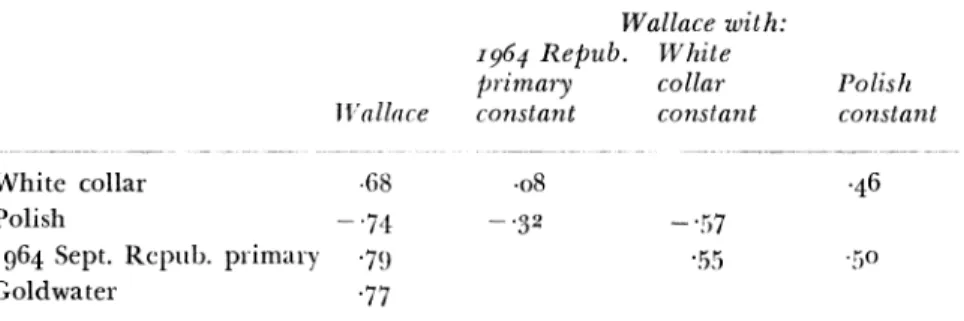
This view is not confined to social scientists. Explaining Wallace's strong showing inside Milwaukee, politically knowledgeable residents invariably reported the anti-Negro feeling on the heavily Polish, working class, south side of the city. A veteran newspaperman, a prominent union leader, and a Democratic politician all believed Wallace had run best on the south side. However, the working class, Polish precincts gave Wallace a smaller percentage of their votes than any other white precincts in the city. Of thirty-one neighbourhoods, the five more than 18 per cent Polish4 gave Wallace an average of 31 per cent of the vote. The sixteen neighbourhoods less than 5 per cent Polish averaged 38 per cent for Wallace. Similarly, the eight neigh- bourhoods with more than 45 per cent of their employed population engaged in white collar occupations averaged 41 per cent for Wallace. The eight neighbourhoods less than 25 per cent white collar averaged 33 per cent for the Alabama governor. (For the over-all correlations,
see Table 1.)
Republican neighbourhoods also voted consistently more for Wal- lace than Democratic ones. Because of reapportionment, we have only
a September 1964 gubernatorial primary as a measure of the normal party vote, and there are difficulties with its use. Nevertheless, the Republican percentage of total turnout in that primary is probably a broadly valid indicator of regular Republican strength,5 and its correlation with the Wallace vote is striking (see Table i).
TABLE 1 The Wallace vote in Milwaukee
Wallace with: 1964 Repub. White
primary collar Polish WIVallace constant constant constant
White collar .68 .08 .46
Polish - -74 - -32 -
"57
1964 Sept. Repub. primary -79! 55 .50
Goldwater .77
In the Milwaukee suburbs the principal support for Wallace also came not from workers but from middle class Republicans; Wallace was stronger in middle class suburbs than anywhere else in Wiscon- sin.6 In Gary, Indiana, however, the pattern was much different.
GARY: WORKING CLASS AUTHORITARIANISM?
Whites in Gary and the other working class towns of Lake County voted overwhelmingly for Wallace. He received his strongest support in Gary from two groups: Southern, white, working class home- owners; and homeowners of Southern- and East-European stock. A relatively homogeneous census tract of Southern, white, working class homeowners voted 77 per cent for Wallace.7 The large section of Gary south of the Little Calumet River, heavily populated by South- ern- and East-European homeowners, was 76 per cent for Wallace.8 This part of Gary is predominantly working class. However, the more white collar precincts in south Gary supported Wallace just as strongly as the most blue collar neighbourhoods.9
The area of Gary north of the Negro ghetto contains far fewer homeowners, and fewer of the residents are of Southern- and East- European stock. Both working and lower middle class north Gary precincts voted less for Wallace than comparable precincts in south Gary. Six north Gary lower middle class precincts averaged 69 per cent for Wallace, as did ten adjoining working class precincts. The wealthiest Gary neighbourhood gave least support to Wallace, 'only' 57 per cent. Perhaps class was a factor here, but a significant minority of the residents are Jewish.10 The Jewish precinct in downtown Gary
Rogin The JVallace vote
was also substantially less for Wallace than surrounding precincts, and the Milwaukee suburbs with Jewish residents voted less for Wallace than other middle class Milwaukee suburbs.
Thus ethnicity and home ownership seem more important than class in revealing who would support the Alabama governor and who oppose him. The fact remains that Gary is predominantly blue col- lar, and workers voted overwhelmingly for Wallace. But given the contrasting behaviour of Milwaukee workers, abstract 'working class authoritarianism' explanations divorced from concrete political re- alities hardly provide an adequate explanation of the Gary vote. The size and visibility of the Gary Negro ghetto is more relevant.
INDIANA: THE 'BLACK BELT' EFFECT
In the south, racist voting has been strongest where the race issue is most salient, i.e. in the counties with the heaviest Negro concentra- tion.l1 Black belt patterns now entered northern politics as well. Half the Gary population is Negro, more than three times the Milwaukee proportions. And while one-third of Milwaukee's whites voted for Wallace, more than two-thirds of Gary's did.
Black belt voting extended within Lake County itself. The Negro ghetto fills the centre of Gary, and proximity to it did not affect voting within the city. However, the closer suburban whites lived to the ghetto, the more likely they were to vote for Wallace. Hobart, Ross, and Calumet, which surround south Gary on three sides, gave Wallace 69 per cent, 73 per cent, and 65 per cent of their vote, respectively. (Calumet is 7 per cent Negro, so the white vote there was more than 65 per cent.) Residents of these townships are prob- ably more likely to work in and travel to Gary. In the other white cities and villages of Lake County Wallace received 50-60 per cent of the Democratic vote, his lowest total recorded at the south end of Lake County, furthest from the Gary Negro ghetto.
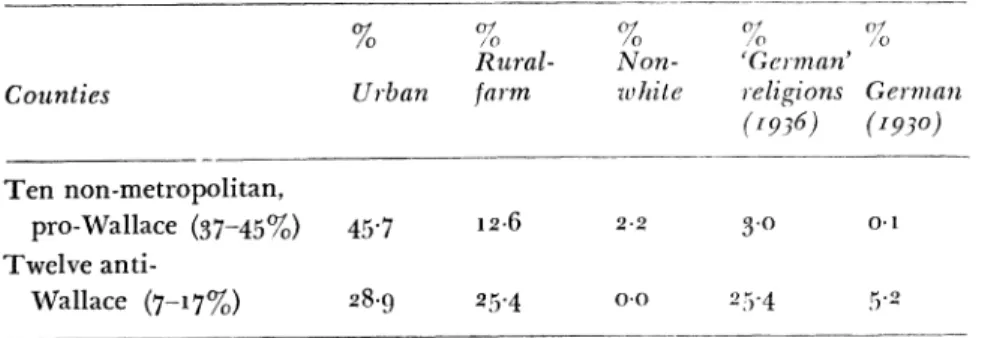
Outside of Lake and suburban Porter counties, the Wallace vote fell off precipitously, duplicating the pattern in outstate Wisconsin.'2 Omitting Lake County, Wallace averaged only 28 per cent of the Indiana vote. None of the twelve counties which gave Wallace the smallest percentage of their vote was as much as 2 per cent non-white; four of the twelve most pro-Wallace counties, in addition to the Lake -
Porter metropolitan area, had small but visible Negro ghettos.13
INDIANA: THE BIBLE BELT
Wallace's strength in outstate Indiana was in part explained by Negro proximity. But many counties with virtually no Negroes voted 30-45 per cent for Wallace. Much of southern Indiana was settled by
OElkhart
?._EG..-:
LAGRANGE
STEUBEN
Hammon M u n s t e rFT.?U NT E BHighlan ATE
0
No0LE
DEKALB
(Y-HAM
OND-E.CHCG
(GARY-HMM
.CIii%/r
Np-T
l
IMARSHAL
L
(FORT
...?.
WAYN
?J?i?i
?r?
'WHIT~g
PULASKI
FULTON
WABASH
HUTn
Lo rankS- ar HUTINTO
wHITEo
uWabashADAms
BENTON
AKKU
-West L
W
Laffawtt1e0Laf
WARREN
1 TIPPECANOE MUC
I
CLINTON
ront
naFran
fo
u I
FOUNTAIN
l
MONTGOMhERY
dn
Crawfords ville1
chmond
HERR
1HAl r'"V"-
...?;;;
??=
ll
...;. . .
,J-FRANKU
oomin-c
ooolo,0bus
N
ROE
JEFFERSON
Vincennes
nDAVIES
UTT
S.eI.•...
Top
quarle0,000-25,000
'iiiA; ii~~;;;i•ii:i:•••:.,10 P 0 10 20 30 Miles
.. and.ard Meropolian
D CMFR 5oislte 3rd.quatl reasl
V1
:-::
LHARi
M
N
4th. quarbjle:~~:
~ERRtY
.Te iRidge Park Ovr
1000PPl~o
NCEYCR 0 ve, 0000 oplao
fieSttion * 501000-100,000
0
;i~
edr'o~
5000 '0000(EIILRSOY ~ii:I~o 11000-25,000
10 0 10 20 30 Miles
,~::~::?.??.;?.???.??.?..?.
mnrr--- ?CI- ?~
.":'..???
Simrita dard Metropokian: Statistical Areas
Rogin The Wallace vote
southerners, and Civil War traditions continue to influence party patterns in the state. But perhaps these traditions have become div- orced, as so often happens, from the live issues which created them;
'southern' counties did not disproportionately support Wallace.14
Instead more recent Indiana political history may have been rele-
vant. The Ku Klux Klan dominated Indiana politics in the 192o's,
and was stronger in that state than anywhere else in the country. Wallace ran best in a wide belt of counties across central Indiana, many with middle size Anglo-Saxon cities, and most dominated by
fundamentalist Protestant sects. (See Figure i, which clearly de-
lineates both the black belt and the bible belt.) He ran worst in rural counties originally settled by German Catholics and Protestants, who
had felt the lash of nativist sentiment in the 1920's (see Table 2).15
Thus nativism augmented the black belt effect; the Wallace vote had 'ideological' as well as 'pragmatic' roots. This was also true in Wisconsin, where Republicans in counties with few Negroes, who generally vote for conservative candidates, voted for the southern segregationist.16
TABLE 2 The Wallace vote in Indiana
%
/%
%
Rural- Non- 'German'
Counties Urban farm white religions German
('936) (I930)
Ten non-metropolitan,
pro-Wallace (37-45%) 45-7 12.6 2-2 3.0 0.1
Twelve anti-
Wallace (7-17%) 28-9 25-4 0.0 2594
5"2
THE SUPPORT FOR WALLACE: CONCLUSION
In outlying Wisconsin and Indiana, general right-wing sentiments apparently contributed votes for Wallace. But he received most of his
support from anti-Negro prejudice activated by proximity to Negroes.
This explains why the ethnic working class supported Wallace in Gary and opposed him in Milwaukee.17 Negroes are a majority of the English-speaking population in Gary, less than 15 per cent in Mil- waukee. To add to the visibility of the Gary Negro ghetto, at the time of the Wallace campaign the president and two other members of the Gary city council were Negroes. Gary's large and active civil
rights movement had staged a io,ooo-man housing march and a
successful school boycott in the months before the primary. No com-
parable events had yet occurred in Milwaukee. Moreover, the civil
rights activity in neighbouring Chicago must have had some impact on Gary residents, many of whom read Chicago newspapers (particu-
larly the Chicago Tribune).18
I have speculated elsewhere'9 that educated members of the middle class do not require immediate and concrete realities to unleash anti- democratic predispositions. Abstract fears and distant threats can be more salient to them. Workers, on the other hand, lead a more con- crete and present-oriented existence. This can be a protection against the political expression of emotions like racism; caught up in their immediate daily concerns, workers-whatever their abstract attitudes -are less easily mobilized. Traditional party loyalty kept many in Milwaukee from voting for Wallace. But where a reality that seems unpleasant is immediate and visible, workers can react intensely. Active working class racism may depend more than middle class racism on a large and visible Negro ghetto.20
II
If Wallace's strength was the first act of the 1964 racial drama, Gold- water's weakness was the second. Whatever other forces caused the Republican Party to depart from tradition and nominate an out- spoken conservative, Wallace's showing among Democrats was surely a factor. Here was concrete evidence-and such evidence was scarce -of potential electoral support more likely to go to a conservative than to a moderate Republican. Many observers argued that Gold- water's nomination would realign American political parties. The racial issue would benefit Goldwater by shifting the Republican base of support toward ethnic minorities and lower class whites, allegedly more vulnerable to racial appeals. What in fact was the impact of the racism reflected in the Wallace vote on Goldwater's strength?
Rogin The IWallace vote
WVISCONSIN: THE GOLDWATER O\)'TE
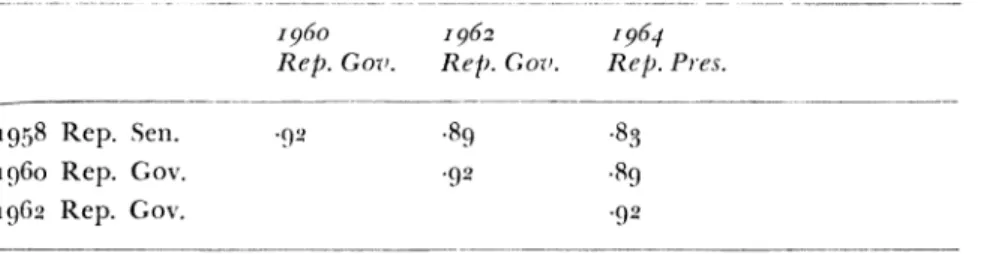
Goldwater ran consistently beneath normal Republican strength in Wisconsin, but he tended to be strong and weak in the same areas as previous Republican candidates. Within Milwaukee, among the suburbs, and among the counties, the relationship between Gold- water's support and previous Republican strength was extremely high. In the city Goldwater's vote correlated -97 with the Republican vote in the September primary. In the suburbs the correlations be- tween Goldwater's vote and other Republican elections were all
-95 +.22 In the counties Goldwater's vote was as close to normal Re-
publican elections as these were to each other (see Table 3).23 The Goldwater election did not radically alter the sources of support for the Republican Party.
TABLE 3 The Republican vote in Wisconsin
196o 1962 1964
Rep. Gov. Rep. Gov. Rep. Pres.
1958 Rep. Sen. .92 .89 .83
196o Rep. Gov. .92 .89
1962 Rep. Gov. .92
However, those shifts that did occur were strongly related to the Wallace vote. Three shifts stand out. First, Goldwater's strength fell off much less in the city of Milwaukee, the working class suburbs, and the middle class suburbs than in the counties of Wisconsin as a whole (see Table 4). Second. Goldwater's strength held up better in
Table 4 Percentage drop in Republican vote, 1962-1964
Milwaukee Working class Middle class Wisconsin
city suburbs suburbs counties
17.8 18-4 17-1 29-1
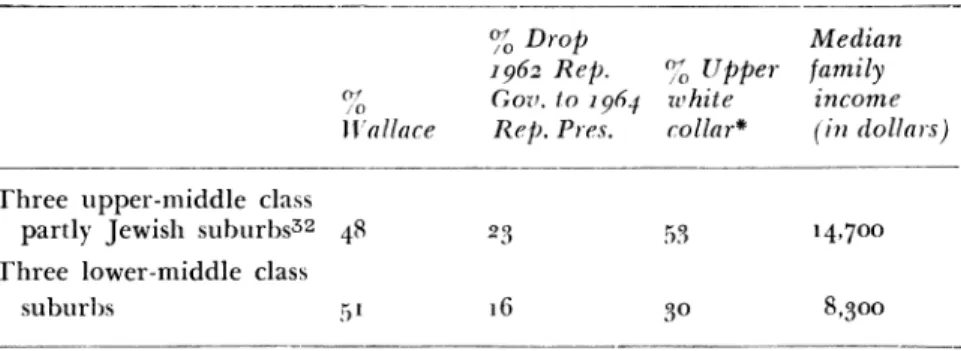
the lower middle class Milwaukee suburbs than in the upper middle class, Jewish suburbs (see Table 5).24 Third, Goldwater ran behind
the 1962 Republican gubernatorial candidate in every county in the state. But he was deserted more in the poorer, rural counties of Wis- consin which had opposed Wallace than in the wealthier urban ones which had supported him (see Table 6).25
In the folklore of American politics, Goldwater represented the nineteenth-century rural American, out of touch with modern prob-
TABLE 5 Goldwater and the Wisconsin suburban middle class
% Drop Median
1962 Rep. % Upper family
/o Gov. to 1964 white income
IVallace Rep. Pres. collar* (in dollars)
Three upper-middle class
partly Jewish suburbs32 48 23 53 14,700
Three lower-middle class
suburbs 51 16 30 8,300
*Percentage employed as professionals, managers, proprietors, and officials.
TArBLE 6 Support and opposition to Goldwater in Wisconsin
% For 0• Rural Median income
Counties Wallace 0• Urban farm (dollars) Seven pro-Goldwater,
Republican
39"7 46.6 14.4 5,564 Six anti-Goldwater,
Republican 2-7.8 28.3 349 4,409
Eight pro-Goldwater,
Democratic 31-3 41.6 23.1 5,348
Nine anti-Goldwater,
Democratic 24.7 27-8 29.6 4.884
lems and cosmopolitan developments. But Goldwater's candidacy, tied to the backlash, hurt the Wisconsin Republican Party more in the countryside than in urban areas.
LAKE COUNTY: RACE AND REALIGNMENT
Unlike Milwaukee, the white backlash in Lake County had a pro- nounced effect on the presidential contest. In spite of the Johnson landslide elsewhere in Indiana, Goldwater actually improved on the normal Republican vote in south Gary, and ran as well as Republi- cans normally do in the suburbs. The effect of the white backlash on traditional party lines was greater in Lake County than anywhere else in Indiana or Wisconsin.
Rogin The Wallace vote
the two elections was -85, which seemed relatively low, indicating a greater Goldwater departure from the normal party pattern than was true in Milwaukee.26 Two main groups of precincts deviated from the normal party pattern (see Figure 2).
Several north Gary working class precincts disproportionately op- posed Goldwater, but most of these probably had substantial Latin minorities. A cluster of precincts, all from south Gary, dispropor- tionately supported Goldwater, actually voting more for him than for the Republican senatorial candidate in 1962. Indeed, of the twenty-six south Gary precincts, all but three were above the regres- sion line, and all but four were more Republican than two years previous. In south Gary as a whole Republican strength rose from 41 per cent in 1962 to 46 per cent in 1964. This, of course, flies in the face of the Johnson landslide; only three other Gary precincts voted more Republican in 1964 than in 1962.
Goldwater's success was not restricted to south Gary alone. The total Republican vote in Lake County outside of Gary and East Chicago dropped less than 1 per cent between 1962 and 1964. As in Wisconsin, the metropolitan centre, where Wallace had been strong- est, failed to oppose Goldwater in the proportions found in the out- lying areas.
INDIANA: REALIGNMENT AND RELIGION
Outside of Lake County the Goldwater election did not noticeably disrupt party lines. But the religious split, important in the Wallace vote, was equally significant in November. This split cannot be ex- plained by proximity to Negroes. It rather lends support to specula- tion about the fundamentalist Protestant underpinnings of the con- temporary American right.27
As in Wisconsin, the Goldwater election was as close to recent Re- publican elections as these were to each other (see Table 7). How- ever, a substantial number of counties deviated somewhat from party tradition. Almost invariably, those counties disproportionately for
TABLE 7 The party vote in Indiana
1958 1960 1962 1964
Rep. Sen. Rep. Pres. Rep. Sen. Rep. Pres.
1956 Rep. Pres. .80 .80 .85 .75
1958 Rep. Sen. -80 .86 -75
196o Rep. Pres. .90 .84
1962 Rep. Sen. .91
'j3 ii
*50
s p i
3
0 *
30 -0
y-y
.
I
Goldwatr
I
x
030
40
50
60
70
FIGURE 2 Gary: Goldwater and the Republican vote
0
or
Rogin The Wallace vote
Goldwater had strongly supported Wallace, those disproportionately against Goldwater had strongly opposed the Alabama governor.28 The anti-Goldwater counties averaged 18 per cent for Wallace; the pro-Goldwater counties averaged 37 per cent. The religious compo- nent of the Wallace vote also remained important. Those adhering to the 'German' religions were more than 15 per cent of the popula- tion in six of the eight anti-Goldwater counties, and in none of the ten non-metropolitan pro-Goldwater counties. Goldwater ran best in the Protestant bible belt; yet even here he could not match normal Republican strength. Race helped Goldwater more than religion in Indiana.
GOLDWATER AND WALLACE: CONCLUSION
Goldwater clearly benefited from pro-Wallace sentiment. Lake County aside, shifts of normally Democratic voters into the Republican camp were too small either to realign substantially the sources of support for the parties, or to counteract the Democratic landslide. In 1964 racism was still less important than traditional party loyalty, eco- nomic issues, and foreign policy; these factors all hurt Goldwater. Nevertheless, the more salient race-in metropolitan as opposed to rural areas, in Lake County, in south Gary-the greater his support. The white backlash was a marginal factor in November 1964, but it had entered a northern, Presidential general election for the first time.
III
Wallace's strength had ethnic and economic correlates. But even where these were clear-cut-class in Milwaukee, ethnicity in Gary- the differences they produced in voting behaviour were only a few percentage points.29 Wallace sentiment was diffused throughout the urban population, falling off sharply only in rural counties far from Negro ghettoes. To account for Wallace's remarkable metropolitan showing, we must investigate features of urban life and politics shared across class and ethnic lines.
Wallace mobilized his remarkable support without the public backing of a single, established political leader or political faction in Gary, Milwaukee, or Baltimore. All the symbols of public authority -newspapers, church leaders, state and national politicians-issued strong public statements against the Alabama governor. Support for Wallace, moreover, violated obvious public norms about tolerance and equal rights. Wallace had few physical resources to overcome his failure to win any public legitimacy. He lacked a political organiza- tion, did not even campaign in Lake County, and virtually no pre- cinct work was done in his behalf.
To vote for Wallace under these circumstances was to reject the ordinary bearers and standards of public authority. The Wallace campaign permitted the expression of feelings that had heretofore lacked a political outlet.30 As a woman said after a rally in Madison, Wisconsin, 'Wallace is saying things that many of us are thinking. but are afraid to say.'3' One local observer of the Gary campaign echoed the views of many others when he remarked, 'People were not going to be told what to do by politicians.' Wallace pitched his cam- paign to these same feelings of popular rebelliousness, presenting himself as an underdog fighting the politicians.
In their attempt to minimize the Wallace threat, politicians fed the underdog image. In part this was wishful thinking, as they sought to deny a reality that they must have felt they could not con- trol. But there were also considerations of strategy involved. Minimi- zing Wallace's strength was part of a general effort to deny him legitimacy; he was consistently attacked as a southern 'carpetbagger' and an extremist. Similar efforts to isolate and undermine Goldwater were to succeed; these simply backfired.
WXhy did popular rebelliousness -work for Wallace but not for Goldwater--or against Eisenhower for that matter? Here one must point not only to grassroots racial resentments, but also to the condi- tions under which they could be safely expressed.
There is little doubt but that the Wallace vote was racially moti- vated. Wallace chose to run against state administrations which had enacted unpopular tax measures, and many politicians and union leaders sought to blame the size of his showing on the tax increases. As a negative factor taxes may have been important; Wallace wisely did not pit himself against any highly popular state administrations. But why should tax increases have made the governors so much more unpopular in the industrial centres of their states, with substantial Negro ghettoes, than in the outlying areas? When politicians and union leaders stressed the sales tax, they seemed mainly anxious to disguise (from themselves as well as from others) the depth of racial feeling among their constituents. They wanted to insist on the norm- ality of the politics involved in the Wallace campaigns. A Gary news- paperman with strong local ties remarked, 'Politicians will tell you it was the sales tax; but I didn't hear one person mention the sales tax during the entire campaign.'
Rogin The Wallace vote
most voters cross over to vote for the candidate they favour. And the middle class Wallace support, like the working class support, came near areas of Negro concentration.
The Wallace vote was first and foremost an anti-Negro vote. A lifelong Gary resident with obvious sympathy for Wallace explained,
People voted for Wallace because they don't like open occupancy laws shoved down their throats ... because Dick Gregory and Al Raby (Chicago civil rights leaders) lead these marches and demon- strations, tie up traffic, lie down in the streets ... because a nine- teen year old stewardess gets raped on an el [rapid transit] plat- form ... People are afraid of Negroes ... This had been building up for years . . . Negro housing projects ten years old have to be condemned; white projects twice as old are in fine condition. ...
Without discoursing on the reasons for prejudice, anti-Negro feelings are almost a reflex on the part of American urban whites. When race becomes salient in American politics, one need not wonder that a Wallace will run so well.
Public opinion polls, however, show that three-quarters of northern whites favour integrated schools and neighbourhoods. Two-thirds of the American people supported the Civil Rights Act up before Con- gress that Wallace attacked in his campaigns. How reconcile Wal- lace's vote with the 1964 California public opinion poll in which two- thirds of the sample believed civil rights to be the most important issue in the presidential campaign, and two-thirds of these thought Johnson better able to deal with it than Goldwater?32
Those who take the polls at face value must deny the racism in white America and blame the Wallace vote on deus ex machina like the sales tax or Negro 'extremism'. But it would be equally mistaken to ignore the commitment to civil rights. How, we must ask, did voters adjust these abstract norms to their concrete fears; what made it safe to express racist emotion? And here most observers had the same explanation. One could vote for Wallace without having to live with the consequences. The Wallace voter was free to express his anger; it cost him nothing. As a veteran Baltimore newspaperman put it, 'People knew Wallace wasn't going anywhere. For the average voter this was an emotional thing; there wasn't a bit of politics in it.' Again we encounter the anti-political character of the Wallace vote, this time expressed not as a revolt against the politicians, but as a rejection of the need to be practical. Many of those who voted for Wallace would probably not have wanted him to be governor of their state, or president of the United States. This would violate their abstract commitment to civil rights, as well as their need for order; it would make them feel too guilty. But in voting for Wallace
one could express pent up feelings without having to live with their consequences. In much the same way many whites opposed to civil rights demonstrations probably voted for Johnson rather than Gold- water, just because Goldwater was an 'extremist' and would not keep things under control.33 Wallace provided the opportunity, rare in politics, to express anger without needing to fear its disordering con- sequences, to violate social values without having to feel guilt.
The vote for Wallace was thus double-edged. It suggested on the one hand that racist emotion was strongest when it was politically least meaningful. But future years might bring ways of making pre- judice safe that would move racism closer to the centre of American politics. The Wallace vote was a reminder that the possibility of a mass-based racist movement was not completely remote.
At the same time, the sources of support for Wallace make irrelevant theories which rely on urban middle class, 'non-economic' liberalism as a counter-weight to 'working class authoritarianism'. The size of the non-Jewish middle class Wallace vote-even the upper middle class vote-is telling. Perhaps there are upper middle class, highly educated groups whose non-economic liberalism can be relied upon, but they make up a small percentage of the voting population.
IV
Instead the Wallace vote seems to lend credibility to a different theory of non-economic liberalism-one which locates the sources of support for racial and political tolerance among political and com- munity leaders, and urges that political issues be kept within the 'political stratum' and away from the population at large.34 Does not the Wallace vote, a rebellion of the population against its political leadership, give sustenance to this theory? Let us look more closely at the behaviour of politicians during the Wallace campaigns.
'For the average voter,' said the Baltimore reporter, 'this was an emotional thing. There wasn't a bit of politics in it.' For the average politician, he might have added, this was a political thing; there wasn't a bit of emotion in it. A young Baltimore ward heeler was more wrong than right about the uniqueness of his own city when he said, 'In other cities people play politics at election time; here we play it all year round.' For what he called attention to was the impact of private political intrigue upon public issues. And the gulf between public stance and private performance in all three cities was as signi- ficant as the gulf between political leaders and private citizens dis- cussed above.
Rogin The Wallace vote
candidates, ethnic bosses, and ward heelers. In Baltimore, with ex- tremely well-developed, grassroots politics, many precincts contain competing precinct organizations. In Milwaukee the party organiza- tion hardly exists at all at the precinct level, but individual incum- bents have their own workers, and the major city politicians are allied with different factions in the state Democratic party. The fight for political control of Gary in 1964 was between a faction led by John Krupa, head of the Lake County Democratic Central Com- mittee, and a faction which included the ex-mayor of Gary, convicted of criminal charges arising from political corruption. A powerful faction in each of the cities was in conflict with the state Democratic administration.
For ordinary citizens the Wallace campaign was about race. For the professional politicians it was just another chapter in an unending competitive struggle for political power. For many the most impor- tant candidate in the primary was not Wallace but his opponent. The mayor of Milwaukee, for example, at political loggerheads with Governor Reynolds, did not officially endorse Reynolds, or take part in the primary fight. The mayor is officially non-partisan, and, a member of his staff explained, does not get involved in primaries. Mayor Maier had four years earlier been elected thanks to his strength on the Polish south side. Voters here had a reputation for being anti-Negro, and the political calculation was simple. Why mobilize votes for the head of an opposing political faction against a candidate of undetermined but probably powerful political appeal? Voters and readers of the nation-wide press might have thought the most important contest in the 1964 Indiana primary was that between Wallace and Governor Welsh. For Gary politicians there were more pressing matters of practical significance. More than one hundred candidates were running for the ten Lake County seats in the state assembly, and each faction had its own slate. One precinct worker, asked what he would say when he knocked on the door, ex- plained he would start with the 'top of ticket', by which he meant the top of his state slate. Asked if he would eventually talk about Wallace, he replied, 'Usually', but that if there was any resentment he would not push matters. To do so might jeopardize the chances of the candidates about whom he cared.
Moreover, neither the steel union in Gary nor the leaders of the political faction currently controlling the county had any fondness for Governor Welsh. Many did not want Welsh to look too good in the primary fight (although none expected that Wallace would run as well as he did). The situation in Baltimore-strife between city and state politicians, disassociation of candidates for other offices from the Wallace campaign-duplicated that in the other cities.35 Did Democratic Party politicians fail to mobilize against Wallace
simply because of indifference and fear? Was no more involved than calculations of political costs and benefits? Certainly the pervasive instrumentalism of these politicians was important. A local Baltimore politico explained that no established precinct worker or organiza- tion could support Wallace, since they depended for patronage jobs and advancement on the political higher-ups who opposed him. But a few young precinct workers, he said, had campaigned for Wallace, just so they could say they had won their precincts with him. If he were twenty-one, said the politico nostalgically, he might have done the same thing. For such a man love of the political game and its stakes ('here we play politics all year round') pre-empts any ideo- logical consideration. Others, particularly further advanced in the political hierarchy, were sincerely opposed to Wallace, but they were more concerned with their continuing political rivalries and con- stituency relationships than with political issues like race. These politicians were adaptable, fearful of risks, anxious not to back a loser, pre-occupied with their political battles. They fit, in short, the traditional picture of the pragmatic, non-ideological American poli- tician. How they would have responded to a local racist who actually challenged their power, or to a candidate with a chance for a concrete victory, it is impossible to say. But a Wallace success could not hurt them; like the ordinary voters, they had nothing political at stake.
For other politicians and local activists, indifference to the Wallace campaign masked covert sympathy for the Alabama governor. Often those who insisted that the sales tax rather than race had caused the Wallace vote were disguising their own racial feelings. Not wanting to face their own prejudice, such community activists could not admit the existence of prejudice anywhere.36 Many politicians and union leaders withdrew from the Wallace campaign because of their own conflicted feelings.
Finally, in all three cities there was widespread sympathy for Wallace among grassroots political activists, even many who went through the motions of campaigning against him. Many precinct workers would wait until the first anti-Negro, pro-Wallace remark by their neigh- bour permitted them to express their own real feelings. To an impor- tant extent Wallace mobilized a community underground, divorced from the official sentiments of city and national leaders. This under- ground consisted not simply of precinct workers, but of other people respected in their neighbourhoods. A Gary reporter, whose father had been on the police force for twenty-one years, and who spent much of his own time at the police station, reported that all the policemen he talked to had voted for Wallace.37
Rogin The Wallace vote
Polish second ward, a well-manned precinct split fifty-fifty for Wal- lace; another in the same ward where the machine lay down sup- ported Wallace two to one.38 In the Italian section of Baltimore, a precinct of elderly, immigrant, homeowners is run by a short, barrel- chested Italian in his middle sixties. He has the (local) reputation of being the best precinct worker in the country. His is generally the most Democratic white precinct in the city, and he was given an award by the then Vice-President Johnson at a Baltimore Democratic dinner a few years ago. His precinct voted two to one for Wallace. Surely such a precinct leader could have produced more votes for Brewster had he so desired.
It would be perverse to blame the political organizations for a Wallace vote so clearly produced by grassroots sentiment. That perversity is not intended. But it seems equally perverse to argue that pragmatic, non-ideological politicians in America insulate our politics from the consequences of ideology and extremism. Pragmat- ism, cross-pressures, and the related virtues of political moderation increased the Wallace vote. Perhaps the American style of urban politics only works against weakly felt ideologies-precisely the sort not themselves dangerous.
To blame the attitudes of ordinary citizens when racism, McCarthy- ism, and similar 'ideologies' gain political importance, and thank political activists when they do not, hardly seems sufficient. The real forces keeping ideological extremism out of American politics have been, I would argue, pre-political. Pragmatic politics have not kept racism, jingoism, and anti-Communism out of the political arena when these 'ideologies' have become salient. Whatever has made extremism politically relevant, ordinary politicians adapt to it, pre- tending that nothing out of the ordinary has happened. This politics of avoidance is not necessarily the best way either to solve the prob- lems which produced the hysteria or to meet anti-democratic threats.39
There is a gulf between expressed public sentiments of political leaders and their willingness actively to engage the population on the basis of those sentiments. Political pragmatism replaces political edu- cation.40 In this situation the gulf between the expressed public sentiments of political leaders and the actual feelings of ordinary citizens becomes truly enormous. Since political leaders lack the authority of communicated conviction, no one really believes them. When citizens feel strongly enough about an issue to rebel against the politicians, there is only the authority of hollow men standing in their way. And since the politicians hide from the issues which pro- mote the rebellion, and insist on politics as usual, the rebellion meets
only a hollow response.
Ought our aim to be, then, to keep issues like race out of the political realm, or at least to restrict attention to such issues to the
political stratum itself? The difficulty is that race was kept out of the political arena only at the expense of Negroes; once race enters poli- tics, how, and at what price, does one restrict interest in it to a few groups and individuals? For example, would reducing the scope of Negro demands or mass demonstrations (if one had this power) placate white racism? It is equally plausible to argue that public Negro demands and demonstrations push further the frontiers of legitimacy for Negro aspirations-even if they also produce such defensive reactions as the Wallace vote.
There is no running away from racism in white America through political formulas and mechanics. Perhaps that racism will ultimately be less important than economic issues, real feelings of toleration, in- difference to Negroes, etc. Then the Wallace vote will appear in retrospect as a kind of political therapy for white Americans in the process of resisting change and changing themselves. Alternatively, white racism may culminate in a mass anti-Negro political move- ment. Perhaps both these things will happen. But given the conscious- ness now in the Negro community, and given the economic and po- litical obstacles that inhibit the realization of Negro demands, race will disappear neither from American politics nor from mass atten- tion. And the race issue is not like traditional American ethnic and economic political controversies. Because Negro-white relations in- volve serious conflict and deep feelings, Madisonian politics has not been successful in dealing with race. It has succeeded neither in preventing violence nor in incorporating the Negroes into the Madi- sonian system. And it has failed because it is not a system which saves us from ideological extremism, but one that works in its absence. The Wallace vote should serve as a reminder both of racist emotion in America and of the consequent failure of a pragmatic politics of race.
Notes
i. Governor Reynolds, Wallace's Wisconsin opponent, conceded him ioo,ooo votes two weeks before the primary (Milwaukee Sentinel, 4 April 1964), far more than he had been ex- pected to receive when the campaign started, and far fewer than the 26o,ooo votes he actually obtained. Predicting that Wallace would be 'slaughtered' in Maryland, Governor Tawes remarked, 'Governor Wallace won't get a vote of any significance.' (Baltimore Sun, 23 March 1964.)
2. Changes in precinct boundaries
in Gary and Milwaukee, and difficul-
ties in aligning ward and precinct lines with census tracts, place obstacles in the way of statistical analysis. The Milwaukee findings are based on a sample of 31 white neighbourhoods- groups of precincts whose boundaries coincided closely (although often not exactly) with census tract lines. In Gary the paucity of white census tracts compounds the boundary problem, and there were too few white units to permit correlations. Instead I have simply compared all the white neigh- bourhoods for which demographic data is available.
Rogin The Wallace vote
Baltimore precinct boundaries were constant for several years, and ward lines corresponded to census tract divisions. A statistical analysis of Bal- timore and Maryland data will be re- ported on in a subsequent publication.
3. Cf. the more extended discussion in my 'Wallace and the Middle Class: The White Backlash in Wisconsin', Public Opinion Quart., vol. 30 (Spring 1966), pp. 98-9, and the references there cited.
4. i.e., those born in Poland, or with at least one parent born there. Cf. Bureau of the Census, U.S. Census of Population and Housing: ig60, Census Tracts PHC (1)-92, Washing- ton, D.C., G.P.O., 1961, pp. 15-29.
5. Space precludes an extended dis- cussion of the validity of this primary as a measure of party strength. Suffice it to say that where the primary re- sults can be compared to the party vote in the previous general elections-in the eighteen Milwaukee suburbs-cor- relations are extremely high (*95+).
6. Rogin, pp. 100-5.
7. This neighbourhood is known in Gary as a southern white working class community. Only 19% of the residents are of foreign stock; only 5% come from southern or eastern Europe. 65% of the labour force is blue collar; 89% of the homes are owner-occupied. 8. 65% of the employed population of south Gary is blue collar, 77% of
the homes are owner-occupied, and
19% of the residents are immigrants
or the children of immigrants from southern and eastern Europe. Poles make up the largest single ethnic group, but there are significantly more Italians, Czechs, and Hungarians in south Gary than in south Milwaukee. 9. Within south Gary there is no exact correspondence of census tracts and precincts, and I have compared precincts lying wholly within the most white collar and the most blue collar tract.
Moreover, the Republican (pre- sumably more white collar) precincts supported Wallace as much as the Democratic precincts; the correlation
between Wallace and the 1962 Demo- cratic senatorial vote was --16. (On the relationship between ethnicity, class, and party affiliation in Gary, cf. Phillip Cutright and Peter H. Rossi, 'Grass Roots Politicians and the Vote', Amer. Sociol. Rev., vol. 23 (April 1958), pp. 172-3.)
lo. Gary residents report the Jewish concentration here. It is also suggested by the fact that this census tract has the highest percentage of Russians (usually indicating Jewishness, al- though not all Jews will be Russian) in Gary. 43% of the employed popu- lation is in upper status white collar jobs; only 30% is blue collar.
1i. Cf. V. O. Key, Jr., Southern Politics in State and Nation, New York, Knopf, 1949, PP- 5-12, 42-3,
215-16, 344, 531, 666-7.
12. Cf. Rogin, pp. 10o4-6.
13. These were all counties contain- ing middle-size cities; approximately 8% of the population in each city was non-white.
14. Cf. V. O. Key, Jr., and Frank Munger, 'Social Determinism and Electoral Decision: The Case of In- diana', in Eugene Burdick and Arthur J. Brodbeck (eds.), American Voting Behavior, Glencoe, Ill.: The Free Press, 1955. I compared the map of Wallace's strength with their map of party voting in 1868.
15. For the suggestion that the re- ligious split between Germans and fundamentalist Anglo-Saxon Protes- tants played a part in the Wallace vote, I am indebted to the American Jewish Committee Jewish Information Service, 'The Politics of Prejudice: Wallace in the Presidential Primaries in Wisconsin, Indiana, and Maryland' (July 1964), pp. 17-19. The major fun- damentalist-leaning Protestant sects in Indiana are the Methodists, the Dis- ciples, the United Brethren, and the Baptists. Two of these (mainly the first two) were the two leading relig- ions in each of the outstate pro- Wallace counties, and in less than half of the anti-Wallace counties. The 'German' religions are the Catholics,
Lutherans, Evangelicals, and Mennon- ites.
Rural German-Americans often live in tight-knit, church-oriented com- munities. The A.J.C. reports that in at least one county voters were in- fluenced against Wallace by a local priest. (The religious figures are from the 1936 religious census, the most re- cent. I have used the 1930 census for the percentage of Germans and their children, because Germans, as fourth and fifth generation Americans by 1960, would not show up in more re- cent censuses. There has been little movement into the rural Indiana counties in recent times.)
In spite of the urban character of the Wallace vote, the Wallace counties were no more working class than the anti-Wallace counties.
16. Rogin, pp. 105-7.
17. The contrast is particularly striking since the comparable neigh- bourhoods are each on the south side, across a river from the Negro ghetto. The ghetto has been able to expand across the river in neither city.
18. On Gary, cf. Victor Hoffman and John Strietelmeimer, 'Gary's Rank- and-file Reaction', Reporter, vol. 31 (9 September 1964), pp. 28-9. Whites in East Chicago, where the Negro ghetto is much smaller and the civil rights movement more quiescent, gave Wallace substantially less support than those in Gary.
19. Rogin, pp. 106-7.
20o. Other factors may also have
affected the Gary/Milwaukee contrast. First, more voters had probably heard of Wallace by the Indiana campaign. Second, Milwaukee Republicans voted for Wallace in the Democratic primary (cf. Rogin, pp. 102-4). Cross-over is not a general feature of Indiana poli- tics, and potentially pro-Wallace Re- publicans were supporting Goldwater against Stassen in their own primary. Abundant survey evidence shows that middle-class Democrats are more liberal on non-economic issues than middle-class Republicans; had the latter crossed over, middle-class Gary
areas might have been even more for Wallace than working-class areas.
Third, Gary is a city of working-class homeowners; Milwaukee is not. There was some evidence in Gary and in the Milwaukee suburbs that working-class homeowners felt more threatened by Negroes, who could, by entering their neighbourhoods, upset their aspirations for a middle-class life-style. Finally, Milwaukee had had a strong Socialist tradition, based partly on the fact, un- usual in America, that its Polish im- migrants had been skilled workers rather than peasants.
21. Since 1958 was a big Democratic year, 1960 was distorted by the re- ligious issue, and 1962 was the most recent, it seemed the best choice. Cor- relations of the county vote in Indiana and Wisconsin (Tables 2 and 7) fur- ther support its use.
22. Goldwater's vote was correlated .98 with the 1960 gubernatorial vote, .99 with the 1962 senatorial vote, .99 with the 1962 gubernatorial vote, and .96 with the 1964 September primary vote.
23. In this table the 1960 guberna-
torial vote is used instead of the 1960 presidential vote because religion clearly distorted normal party strength in the presidential election. Cf. An- drew R. Baggeley, 'Religious Influence on Wisconsin Voting 1928-1960', Amer. Polit. Sci. Rev., vol. 56 (March 1962), pp. 66-70.
24. It is impossible to determine, with confidence, whether the non- Jewish upper middle class also deser- ted Goldwater disproportionately.
25. The regression equation for the scattergram of Goldwater and the 1962 Republican vote is y= 354+.81x. Those counties furthest above the re- gression line had deserted Goldwater least; those furthest below the line had deserted him the most. These de- viant counties make up Table 6. They were further subdivided into Repub- lican and Democratic counties; all counties more than 55% Republican in 1962 were called Republican. This figure was chosen because it divided
Rogin The Wallace vote
Wisconsin's seventy-one counties ap- proximately in half.
26. The equation for the regression line in Figure 2 is y=9.o1+.77x. A wholesale reapportionment in 1961 prevents us from correlating the party vote in two non-Goldwater years. However, there is indirect evidence that party stability in Gary is norm- ally very high. Cf. Cutright and Rossi, Amer. Sociol. Rev., vol. 23, pp. 172-3.
27. Cf. David Danzig, 'The Radical Right and the Rise of the Fundamen- talist Minority', Commentary, vol. 33 (April 1962), pp. 291-8; Raymond E. Wolfinger et al., 'America's Radical Right; Politics and Ideology', in David E. Apter (ed.), Ideology and Discon- tent, New York, The Free Press, 1964, pp. 262-93.
28. Among Indiana's eight most strongly Democratic counties, this re- lationship was not consistent. The calculations that follow report only on the eighty-four counties more than 42% Republican in 1962. (The rele- vant scattergram has not been re- produced; its regression equation is Y= 3-25+.93x.)
29. Research on the backlash in Baltimore reveals the same pattern.
30. My interviews indicated that support for Wallace at the grass roots was open and enthusiastic. Thus a Gary civil rights leader, wife of a steel worker, reported widespread talk for Wallace in the steel mills, virtually no open opposition to him. Among com- munity and political leaders support for Wallace was illegitimate; in the discourse of ordinary people, almost the reverse seemed true. Cf. also Balti- more Sun, 15 May 1964.
31. Milwaukee Journal, 3 April 1964.
32. Cf. Herbert Hyman and Paul B. Sheatsley, 'Attitudes Toward Desegre- gation', Scientific American, vol. 111 (July 1964), pp. 18-21; San Francisco Chronicle, 'California Poll: The Rights Issue', 15 September 1964, p. 1. There
may be an analogy between abstract commitment to civil rights and ab- stract commitment to free speech,
which also often fails to apply in con- crete cases. Cf. Herbert McClosky, 'Consensus and Ideology in American Politics', Amer. Polit. Sci. Rev., vol. 58 (June 1964), pp. 364-6.
33. To anyone watching the 1964 Democratic convention, particularly the unofficial interviews with poli- ticians, the lesson was clear: civil rights was a good thing, but civil rights demonstrations were equated with race riots, Ku Klux activity, and right- wing extremism.
34. For one version of this currently popular notion, cf. Robert Dahl, Who Governs, New Haven, Yale Univ. Press, 1961, pp. 80-94, 318-25. Cf. also Samuel Stouffer, Communism, Con- formity, and Civil Liberties, Garden City, N.Y., Doubleday, 1955, pp. 26-57- 35. Evidence from interviews, and Baltimore Sun, 5 May 1964.
36. Steel union leaders in East Chicago, for example, stressed the im- portance of anti-Negro feeling in the Wallace vote, and were forthright in their own pro-civil rights sentiments. Gary union leaders, much more am- bivalent on civil rights themselves. insisted that the sales tax alone ex- plained the Wallace vote.
37. Negro Richard Hatcher, cam- paigning against municipal corrup- tion, defeated the Democratic incum- bent in the 1967 Gary mayorality pri- mary. The entire Gary Democratic organization moved into the Republi- can Party in the general election. John Krupa, still chairman of the Lake County Democratic Central Committee, denounced Hatcher as a 'subversive', and denied him all party financial support. The weak Republican can- didate in this overwhelmingly Demo- cratic city received more than 8o% of the white vote, but Hatcher was nar- rowly elected. Krupa, assuming an un- precedented posture of moral outrage, announced widespread evidence of il- legal voting.
38. Cf. Charles Whiteford, 'Negroes Show Vote Power, The Key to Wal- lace Defeat', Baltimore Sun, 21 May 1964.
39. These ideas are more fully de- veloped in my The Intellectuals and McCarthy: The Radical Specter, Cam- bridge, Mass., M.I.T. Press, 1967, chs. 8-9.