Compiler Construction
using Flex and Bison
Anthony A. Aaby
Walla Walla College
cs.wwc.edu
[email protected]
Copyright 2003 Anthony A. Aaby Walla Walla College
204 S. College Ave. College Place, WA 99324 E-mail: [email protected]
LaTeX sources available by request.
This material may be distributed only subject to the terms and conditions set forth in the Open Publication License, v1.0 or later (the latest version is presently available athttp://www.opencontent.org/openpub
This book is distributed in the hope it will be useful, but without any war-ranty; without even the implied warranty of merchantability or fitness for a particular purpose.
The author encourages wide distribution of this book for personal and com-mercial use, provided the above copyright notice remains intact and the method adheres to the provisions of the Open Publication Liscense located at
http://www.opencontent.org/openpub
In summary, you may copy and distribute this book free of charge or for a profit. No explicit permission is required from the author for reproduction of this book in any medium, physical or electronic.
Contents
1 Introduction 1
2 The Parser 5
3 The Scanner 9
4 The Context 13
5 Optimization 19
6 Virtual Machines 21
7 Code Generation 27
8 Peephole Optimization 37
9 Further Reading 39
10 Exercises 41
A Simple - The complete implementation 47
A.1 The parser: Simple.y . . . 47
A.2 Directions . . . 51
A.3 The scanner: Simple.lex . . . 52
A.4 The symbol table: ST.h . . . 53
A.5 The code generator: CG.h . . . 54
A.6 The stack machine: SM.h . . . 55
A.7 Sample program: test simple . . . 57
B Lex/Flex 59 B.1 Lex/Flex Examples . . . 59
B.2 The Lex/Flex Input File . . . 61
B.3 The Generated Scanner . . . 66
C Yacc/Bison 69
C.1 An Overview . . . 69
C.2 A Yacc/Bison Example . . . 71
C.3 The Yacc/Bison Input File . . . 72
C.4 Yacc/Bison Output: the Parser File . . . 86
C.5 Parser C-Language Interface . . . 87
C.6 Debugging Your Parser . . . 90
Chapter 1
Introduction
A language translator is a program which translates programs written in a source language into an equivalent program in an object language. The source language is usually a high-level programming language and the object language is usually the machine language of an actual computer. From the pragmatic point of view, the translator defines the semantics of the programming language, it transforms operations specified by the syntax into operations of the computational model to some real or virtual machine. This chapter shows how context-free grammars are used in the construction of language translators. Since the translation is guided by the syntax of the source language, the translation is said to besyntax-directed.
Acompileris a translator whose source language is a high-level language and whose object language is close to the machine language of an actual computer. The typical compiler consists of several phases each of which passes its output to the next phase
• Thelexical phase(scanner) groups characters into lexical units or tokens. The input to the lexical phase is a character stream. The output is a stream of tokens. Regular expressions are used to define the tokens recog-nized by a scanner (or lexical analyzer). The scanner is implemented as a finite state machine.
Lex and Flex are tools for generating scanners: programs which recognize lexical patterns in text. Flex is a faster version of Lex. In this chapter Lex/Flex refers to either of the tools. The appendix on Lex/Flex is a condensation of the manual page “flexdoc” by Vern Paxon.
Yacc and Bison are tools for generating parsers: programs which recognize the structure grammatical structure of programs. Bison is a faster version of Yacc. In this chapter, Yacc/Bison refers to either of these tools. The sections on Yacc/Bison are a condensation and extension of the document “BISON the Yacc-compatible Parser Generator” by Charles Donnelly and Richard Stallman.
• Thesemantic analysis phase analyzes the parse tree for context-sensitive information often called thestatic semantics. The output of the semantic analysis phase is an annotated parse tree. Attribute grammars are used to describe the static semantics of a program.
This phase is often combined with the parser. During the parse, infor-mation concerning variables and other objects is stored in asymbol table. The information is utilized to perform the context-sensitive checking.
• The optimizerapplies semantics preserving transformations to the anno-tated parse tree to simplify the structure of the tree and to facilitate the generation of more efficient code.
• The code generator transforms the simplified annotated parse tree into object code using rules which denote the semantics of the source language. The code generator may be integrated with the parser.
• Thepeep-holeoptimizer examines the object code, a few instructions at a time, and attempts to do machine dependent code improvements.
In contrast with compilers aninterpreter is a program which simulates the execution of programs written in a source language. Interpreters may be used either at the source program level or an interpreter may be used it interpret an object code for an idealized machine. This is the case when a compiler generates code for an idealized machine whose architecture more closely resembles the source code.
There are several other types of translators that are often used in conjunction with a compiler to facilitate the execution of programs. An assembler is a translator whose source language (an assembly language) represents a one-to-one transliteration of the object machine code. Some compilers generate assembly code which is then assembled into machine code by an assembler. A loader
is a translator whose source and object languages are machine language. The source language programs contain tables of data specifying points in the program which must be modified if the program is to be executed. Alink editor takes collections of executable programs and links them together for actual execution. A preprocessor is a translator whose source language is an extended form of some high-level language and whose object language is the standard form of the high-level language.
program ::= LET [ declarations ] IN command sequence END
declarations ::= INTEGER [ id seq ] IDENTIFIER .
id seq ::= id seq... IDENTIFIER ,
command sequence ::= command... command
command ::= SKIP ;
|IDENTIFIER := expression ;
|IF exp THEN command sequence ELSE command sequence FI ;
|WHILE exp DO command sequence END ;
|READ IDENTIFIER ;
|WRITE expression ;
expression ::= NUMBER|IDENTIFIER|’(’ expression ’)’
|expression+expression|expression−expression
|expression∗expression|expression/expression
|expression ˆ expression
|expression=expression
|expression<expression
|expression>expression
Figure 1.1: Simple
given in Figure 1.1 where the non-terminal symbols are given in all lower case, the terminal symbols are given in all caps or as literal symbols and, where the literal symbols conflict with the meta symbols of the EBNF, they are enclosed with single quotes. The start symbol is program. While the grammar uses upper-case to high-light terminal symbols, they are to be implemented in lower case.
Chapter 2
The Parser
A parser is a program which determines if its input is syntactically valid and determines its structure. Parsers may be hand written or may be automatically generated by a parser generator from descriptions of valid syntactical structures. The descriptions are in the form of a context-free grammar. Parser generators may be used to develop a wide range of language parsers, from those used in simple desk calculators to complex programming languages.
Yacc is a program which given a context-free grammar, constructs a C pro-gram which will parse input according to the pro-grammar rules. Yacc was developed by S. C. Johnson an others at AT&T Bell Laboratories. Yacc provides for se-mantic stack manipulation and the specification of sese-mantic routines. A input file for Yacc is of the form:
C and parser declarations %%
Grammar rules and actions %%
C subroutines
The first section of the Yacc file consists of a list of tokens (other than single characters) that are expected by the parser and the specification of the start symbol of the grammar. This section of the Yacc file may contain specification of the precedence and associativity of operators. This permits greater flexibility in the choice of a context-free grammar. Addition and subtraction are declared to be left associative and of lowest precedence while exponentiation is declared to be right associative and to have the highest precedence.
%start program
%token LET INTEGER IN
%token NUMBER %token IDENTIFIER %left ’-’ ’+’ %left ’*’ ’/’ %right ’ˆ ’ %%
Grammar rules and actions %%
C subroutines
The second section of the Yacc file consists of the context-free grammar for the language. Productions are separated by semicolons, the ’::=’ symbol of the BNF is replaced with ’:’, the empty production is left empty, non-terminals are written in all lower case, and the multicharacter terminal symbols in all upper case. Notice the simplification of the expression grammar due to the separation of precedence from the grammar.
C and parser declarations %%
program : LET declarations IN commands END ; declarations : /* empty */
|INTEGER id seq IDENTIFIER ’.’ ;
id seq : /* empty */
|id seq IDENTIFIER ’,’ ;
commands : /* empty */
|commands command ’;’ ;
command : SKIP
|READ IDENTIFIER
|WRITE exp
|IDENTIFIER ASSGNOP exp
|IF exp THEN commands ELSE commands FI
|WHILE exp DO commands END ;
exp : NUMBER
|IDENTIFIER
|exp ’<’ exp
|exp ’=’ exp
|exp ’>’ exp
|exp ’+’ exp
|exp ’−’ exp
|exp ’∗’ exp
|exp ’/’ exp
|exp ’ˆ ’ exp
|’(’ exp ’)’ ;
%%
C subroutines
the driver routine for the parser. There must also be the function yyerror() which is used to report on errors during the parse. Simple examples of the functionmain()andyyerror()are:
C and parser declarations %%
Grammar rules and actions %%
main( int argc, char *argv[] )
{extern FILE *yyin;
++argv;−−argc;
yyin = fopen( argv[0], ”r” ); yydebug = 1;
errors = 0; yyparse ();
}
yyerror (char *s) /* Called by yyparse on error */
{
printf (”%s\n”, s);
}
The parser, as written, has no output however, the parse tree is implicitly constructed during the parse. As the parser executes, it builds an internal representation of the the structure of the program. The internal representation is based on the right hand side of the production rules. When a right hand side is recognized, it is reduced to the corresponding left hand side. Parsing is complete when the entire program has been reduced to the start symbol of the grammar.
Compiling the Yacc file with the command yacc -vdfile.y (bison -vd file.y) causes the generation of two files file.tab.handfile.tab.c. The file.tab.hcontains the list of tokens is included in the file which defines the scanner. The file file.tab.cdefines the C functionyyparse()which is the parser.
Yacc is distributed with the Unix operating system while Bison is a product of the Free Software Foundation, Inc.
Chapter 3
The Scanner
A scanner (lexical analyzer) is a program which recognizes patterns in text. Scanners may be hand written or may be automatically generated by a lexical analyzer generator from descriptions of the patterns to be recognized. The descripions are in the form of regular expressions.
Lex is a lexical analyzer generator developed by M. E. Lesk and E. Schmidt of AT&T Bell Laboratories. The input to Lex is a file containing tokens defined using regular expressions. Lex produces an entire scanner module that can be compiled and linked to other compiler modules. A input file for Lex is of the form:
Lex generates a file containing the functionyylex()which returns an integer denoting the token recognized.
C and scanner declarations %%
Token definitions and actions %%
C subroutines
The first section of the Lex file contains the C declaration to include the file (simple.tab.h) produced by Yacc/Bison which contains the definitions of the the multi-character tokens. The first section also contains Lex definitions used in the regular expressions. In this case,DIGITis defined to be one of the symbols 0through9andIDis defined to be a lower case letter followed by zero or more letters or digits.
%{
DIGIT [0-9] ID [a-z][a-z0-9]* %%
Token definitions and actions %%
C subroutines
The second section of the Lex file gives the regular expressions for each token to be recognized and a corresponding action. Strings of one or more digits are recognized as an integer and thus the valueINTis returned to the parser. The reserved words of the language are strings of lower case letters (upper-case may be used but must be treated differently). Blanks, tabs and newlines are ignored. All other single character symbols are returned as themselves (the scanner places all input in the stringyytext).
C and scanner declarations %%
”:=” {return(ASSGNOP); } {DIGIT}+ {return(NUMBER); }
do {return(DO); }
else {return(ELSE); }
end {return(END); }
fi {return(FI); }
if {return(IF); }
in {return(IN); }
integer {return(INTEGER); }
let {return(LET); }
read {return(READ); }
skip {return(SKIP); }
then {return(THEN); }
while {return(WHILE); }
write {return(WRITE); } {ID} {return(IDENTIFIER); }
[ \t\n]+/* blank, tab, new line: eat up whitespace */ . {return(yytext[0]); }
%%
C subroutines
The values associated with the tokens are the integer values that the scanner returns to the parser upon recognizing the token.
Figure 3.1 gives the format of some of the regular expressions that may be used to define the tokens. There is a global variable yylval is accessible by both the scanner and the parser and is used to store additional information about the token.
The third section of the file is empty in this example but may contain C code associated with the actions.
. any character except newline
x match the character ‘x’
rs the regular expression r followed by the regular expression s; called “concatenation”
r|s either an r or an s
(r) match an r; parentheses are used to provide grouping.
r* zero or more r’s, where r is any regular expression
r+ one or more r’s
[xyz] a “character class”; in this case, the pattern matches either an ’x’, a ’y’, or a ‘z’.
[abj-oZ] a “character class” with a range in it; matches an ‘a’, a ‘b’, any letter from ‘j’ through ‘o’, or a ‘Z’.
{name} the expansion of the “name” definition.
\X if X is an ‘a’, ‘b’, ‘f’, ‘n’, ‘r’, ‘t’, or ‘v’, then the ANSI-C inter-pretation of\x.
"[+xyz]+\"+foo” the literal string: [xyz]"foo
Lex is distributed with the Unix operating system while Flex is a product of the Free Software Foundation, Inc.
For more information on using Lex/Flex consult the manual pageslex,flex
Chapter 4
The Context
Lex and Yacc files can be extended to handle the context sensitive information. For example, suppose we want to require that, in Simple, we require that vari-ables be declared before they are referenced. Therefore the parser must be able to compare variable references with the variable declarations.
One way to accomplish this is to construct a list of the variables during the parse of the declaration section and then check variable references against the those on the list. Such a list is called a symbol table. Symbol tables may be implemented using lists, trees, and hash-tables.
We modify the Lex file to assign the global variableyylval to the identifier string since the information will be needed by the attribute grammar.
The Symbol Table Module
To hold the information required by the attribute grammar we construct a sym-bol table. A symsym-bol table contains the environmental information concerning the attributes of various programming language constructs. In particular, the type and scope information for each variable.
The symbol table will be developed as a module to be included in the yacc/bison file.
The symbol table for Simple consists of a linked list of identifiers, initially empty. Here is the declaration of a node, initialization of the list to empty and
struct symrec
{
struct symrec *next; /* link field */
};
typedef struct symrec symrec; symrec *sym table = (symrec *)0; symrec *putsym ();
symrec *getsym ();
and two operations: putsymto put an identifier into the table,
symrec *
putsym ( char *sym name )
{
symrec *ptr;
ptr = (symrec *) malloc (sizeof(symrec));
ptr−>name = (char *) malloc (strlen(sym name)+1); strcpy (ptr−>name,sym name);
ptr−>next = (struct symrec *)sym table; sym table = ptr;
return ptr;
}
andgetsymwhich returns a pointer to the symbol table entry corresponding to an identifier.
symrec *
getsym ( char *sym name )
{
symrec *ptr;
for (ptr = sym table; ptr != (symrec *) 0; ptr = (symrec *)ptr−>next)
if (strcmp (ptr−>name,sym name) == 0) return ptr;
return 0;
}
The Parser Modifications
The Yacc/Bison file is modified to include the symbol table and with routines to perform the installation of an indentifier in the symbol table and to perform context checking.
%{
#include<stdlib.h>/* For malloc in symbol table */ #include<string.h>/* For strcmp in symbol table */ #include<stdio.h>/* For error messages */ #include ”ST.h” /* The Symbol Table Module */ #define YYDEBUG 1 /* For debugging */ install ( char *sym name )
{symrec *s;
if (s == 0)
s = putsym (sym name); else{errors++;
printf( ”%s is already defined\n”, sym name );
} }
context check( char *sym name )
{if ( getsym( sym name ) == 0 )
printf( ”%s is an undeclared identifier\n”, sym name );
}
%}
Parser declarations %%
Grammar rules and actions %%
C subroutines
Since the scanner (the Lex file) will be returning identifiers, a semantic record (static semantics) is required to hold the value and IDENT is associated with that semantic record.
C declarations
%union{/* SEMANTIC RECORD */ char *id; /* For returning identifiers */
}
%token INT SKIP IF THEN ELSE FI WHILE DO END %token<id>IDENT /* Simple identifier */
%left ’-’ ’+’ %left ’*’ ’/’ %right ’ˆ’ %%
Grammar rules and actions %%
C subroutines
The context free-grammar is modified to include calls to the install and context checking functions. $n is a variable internal to Yacc which refers to the semantic record corresponding the the nthsymbol on the right hand side of a production.
C and parser declarations %%
...
declarations : /* empty */
|INTEGER id seq IDENTIFIER ’.’{install( $3 );}
;
id seq : /* empty */
|id seq IDENTIFIER ’,’{install( $2 );}
;
command : SKIP
|READ IDENTIFIER{context check( $2 );} |IDENT ASSGNOP exp{context check( $2 );}
|IDENT{context check( $2 );}
... %%
C subroutines
In this implementation the parse tree is implicitly annotated with the infor-mation concerning whether a variable is assigned to a value before it is referenced in an expression. The annotations to the parse tree are collected into the symbol table.
The Scanner Modifications
The scanner must be modified to return the literal string associated each iden-tifier (the semantic value of the token). The semantic value is returned in the global variable yylval. yylval’s type is a union made from the %union dec-laration in the parser file. The semantic value must be stored in the proper member of the union. Since the union declaration is:
%union { char *id; }
the semantic value is copied from the global variableyytext(which contains the input text) toyylval.id. Since the functionstrdup is used (from the library string.h) the library must be included. The resulting scanner file is:
%{
#include <string.h> /* for strdup */
#include "Simple.tab.h" /* for token definitions and yylval */ %}
DIGIT [0-9]
ID [a-z][a-z0-9]*
%%
":=" { return(ASSGNOP); } {DIGIT}+ { return(NUMBER); }
do { return(DO); }
else { return(ELSE); }
end { return(END); }
fi { return(FI); }
if { return(IF); }
in { return(IN); }
integer { return(INTEGER); }
let { return(LET); }
read { return(READ); }
skip { return(SKIP); }
then { return(THEN); }
while { return(WHILE); }
write { return(WRITE); }
[ \t\n]+ /* eat up whitespace */
. { return(yytext[0]);}
%%
Intermediate Representation
Chapter 5
Optimization
It may be possible to restructure the parse tree to reduce its size or to present a parse to the code generator from which the code generator is able to produce more efficient code. Some optimizations that can be applied to the parse tree are illustrated using source code rather than the parse tree.
Constant folding:
I := 4 + J - 5; --> I := J - 1; or
I := 3; J := I + 2; --> I := 3; J := 5
Loop-Constant code motion:
From:
while (count < limit) do INPUT SALES;
VALUE := SALES * ( MARK_UP + TAX ); OUTPUT := VALUE;
COUNT := COUNT + 1; end; -->
to:
TEMP := MARK_UP + TAX; while (COUNT < LIMIT) do
INPUT SALES;
Induction variable elimination: Most program time is spent in the body of loops so loop optimization can result in significant performance im-provement. Often the induction variable of a for loop is used only within the loop. In this case, the induction variable may be stored in a register rather than in memory. And when the induction variable of a for loop is referenced only as an array subscript, it may be initialized to the initial address of the array and incremented by only used for address calculation. In such cases, its initial value may be set
From:
For I := 1 to 10 do A[I] := A[I] + E to:
For I := address of first element in A to address of last element in A
increment by size of an element of A do A[I] := A[I] + E
Common subexpression elimination:
From:
A := 6 * (B+C); D := 3 + 7 * (B+C); E := A * (B+C); to:
TEMP := B + C;
A := 6 * TEMP;
D := 3 * 7 * TEMP;
E := A * TEMP;
Strength reduction:
2*x --> x + x
2*x --> shift left x
Mathematical identities:
a*b + a*c --> a*(b+c) a - b --> a + ( - b )
Chapter 6
Virtual Machines
A computerconstructed from actual physical devices is termed anactual com-puter or hardware computer. From the programming point of view, it is the instruction set of the hardware that defines a machine. An operating system is built on top of a machine to manage access to the machine and to provide additional services. The services provided by the operating system constitute another machine, avirtual machine.
A programming language provides a set of operations. Thus, for exam-ple, it is possible to speak of a Pascal computer or a Scheme computer. For the programmer, the programming language is the computer; the programming language defines a virtual computer. The virtual machine for Simple consists of a data area which contains the association between variables and values and the program which manipulates the data area.
Between the programmer’s view of the program and the virtual machine pro-vided by the operating system is another virtual machine. It consists of the data structures and algorithms necessary to support the execution of the program. This virtual machine is the run time system of the language. Its complexity may range in size from virtually nothing, as in the case of FORTRAN, to an extremely sophisticated system supporting memory management and inter pro-cess communication as in the case of a concurrent programming language like SR. The run time system for Simple as includes the processing unit capable of executing the code and a data area in which the values assigned to variables are accessed through an offset into the data area.
A Stack Machine
The S-machine 1 is a stack machine organized to simplify the implementation
of block structured languages. It provides dynamic storage allocation through a stack of activation records. The activation records are linked to provide sup-port for static scoping and they contain the context information to supsup-port procedures.
Machine Organization: The S-machine consists of two stores, a program store,C(organized as an array and is read only), and a data store,S(organized as a stack). There are four registers, an instruction register, IR, which contains the instruction which is being interpreted, the stack top register,
T, which contains the address of the top element of the stack, the program address register, PC, which contains the address of the next instruction to be fetched for interpretation, and the current activation record register,
AR, which contains the base address of the activation record of the proce-dure which is being interpreted. Each location of Cis capable of holding an instruction. Each location ofSis capable of holding an address or an integer. Each instruction consists of three fields, an operation code and two parameters.
Instruction Set: S-codes are the machine language of the S-machine. S-codes occupy four bytes each. The first byte is the operation code (op-code). There are nine basic S-code instructions, each with a different op-code. The second byte of the S-code instruction contains either 0 or a lexical level offset, or a condition code for the conditional jump instruction. The last two bytes taken as a 16-bit integer form an operand which is a literal value, or a variable offset from a base in the stack, or a S-code instruction location, or an operation number, or a special routine number, depending on the op-code.
The action of each instruction is described using a mixture of English lan-guage description and mathematical formalism. The mathematical for-malism is used to note changes in values that occur to the registers and the stack of the S-machine. Data access and storage instructions require an offset within the activation record and the level difference between the referencing level and the definition level. Procedure calls require a code address and the level difference between the referencing level and the def-inition level.
Instruction Operands Comments
READ 0,N Input integer in to location N:S(N) := Input
WRITE Output top of stack: Output := S(T); T:= T-1
OPR Arithmetic and logical operations
0,0 process and function, return operation
1This is an adaptation of: Niklaus Wirth, Algorithms + Data Structures = Programs
T:= AR-1; AR:= S(T+2); P:= S(T+3)
ADD ADD: S(T-1) := S(T-1) + S(T); T := T-1
SUB SUBTRACT: S(T-1) := S(T-1) - S(T); T := T-1
MULT MULTIPLY: S(T-1) := S(T-1) * S(T); T := T-1
DIV DIVIDE: S(T-1) := S(T-1) / S(T); T := T-1
MOD MOD: S(T-1) := S(T-1) mod S(T); T := T-1
EQ TEST EQUAL:
S(T-1) := if S(T-1) = S(T) then 1 else 0; T:= T-1
LT TEST LESS THAN:
S(T-1) := if S(T-1) < S(T) then 1 else 0; T:= T-1
GT TEST GREATER THAN:
S(T-1) := if S(T-1) > S(T) then 1 else 0; T:= T-1
LD INT 0,N LOAD literal value onto stack:T:= T+1; S(T):= N
LD VAR L,N LOAD value of variable at level offset L, base
offset N in stack onto top of stack T:= T + 1; S(T):= S(f(L,AR)+N)+3
STORE L,N store value on top of stack into variable location
at level offset L, base offset N in stack S(f(ld,AR)+os+3):= S(T); T:= T - 1
CAL L,N call PROC or FUNC at S-code location N declared
at level offset L
S(T+1):= f(ld,AR);{Static Link}
S(T+2):= AR;{Dynamic Link}
S(T+3):= P;{Return Address}
AR:= T+1;{Activation Record}
P:= cos;{Program Counter}
T:= T+3{Stack Top}
CAL 255,0 call procedure address in memory: POP address, PUSH return
address, JUMP to address
DATA 0,NN ADD NN to stack pointerT := T+NN
GOTO 0,N JUMP:P := N
JMP FALSE C,N JUMP:if S(T) = C then P:= N; T:= T-1
Where the static level difference between the current procedure and the called procedure is ld. os is the offset within the activation record, ld is the static level difference between the current activation record and the activation record in which the value is to be stored and
f(ld,a) = if i=0 then a else f(i-1,S(a))
Operation: The registers and the stack of the S-machine are initialized as follows:
P = 0. {Program Counter}
AR = 0; {Activation Record}
T = 2; {Stack Top}
S[0] := 0; {Static Link}
S[1] := 0; {Static Dynamic Link}
S[2] := 0; {Return Address}
execution-loop : I:= C(P); P:= P+1; interpret(I); if { P ≤ 0 -> halt
& P > 0 -> execution-loop }
The Stack Machine Module
The implementation of the stack machine is straight forward.
The instruction set and the structure of an instruction are defined as follows:
/* OPERATIONS: Internal Representation */
enum code_ops { HALT, STORE, JMP_FALSE, GOTO, DATA, LD_INT, LD_VAR,
READ_INT, WRITE_INT,
LT, EQ, GT, ADD, SUB, MULT, DIV, PWR };
/* OPERATIONS: External Representation */
char *op_name[] = {"halt", "store", "jmp_false", "goto", "data", "ld_int", "ld_var",
"in_int", "out_int",
"lt", "eq", "gt", "add", "sub", "mult", "div", "pwr" };
struct instruction {
enum code_ops op; int arg;
};
Memory is separtated into two segments, a code segment and a run-time data and expression stack.
struct instruction code[999]; int stack[999];
The definitions of the registers, the program counterpc, the instruction register ir, the activation record pointerar(which points to be begining of the current activation record), and the pointer to the top of the stack top, are straight forward.
int pc = 0;
struct instruction ir;
int ar = 0;
int top = 0;
void fetch_execute_cycle()
{ do { /* Fetch */
ir = code[pc++];
/* Execute */
switch (ir.op) {
case HALT : printf( "halt\n" ); break;
case READ_INT : printf( "Input: " );
scanf( "%ld", &stack[ar+ir.arg] ); break; case WRITE_INT : printf( "Output: %d\n", stack[top--] ); break;
case STORE : stack[ir.arg] = stack[top--]; break;
case JMP_FALSE : if ( stack[top--] == 0 ) pc = ir.arg;
break;
case GOTO : pc = ir.arg; break;
case DATA : top = top + ir.arg; break;
case LD_INT : stack[++top] = ir.arg; break;
case LD_VAR : stack[++top] = stack[ar+ir.arg]; break; case LT : if ( stack[top-1] < stack[top] )
stack[--top] = 1; else stack[--top] = 0;
break;
case EQ : if ( stack[top-1] == stack[top] )
stack[--top] = 1; else stack[--top] = 0;
break; case GT : if ( stack[top-1] > stack[top] )
stack[--top] = 1; else stack[--top] = 0; top--;
break;
case ADD : stack[top-1] = stack[top-1] + stack[top];
top--; break;
case SUB : stack[top-1] = stack[top-1] - stack[top];
top--; break;
case MULT : stack[top-1] = stack[top-1] * stack[top]; top--;
break;
case DIV : stack[top-1] = stack[top-1] / stack[top];
top--; break;
case PWR : stack[top-1] = stack[top-1] * stack[top];
top--; break;
default : printf( "%sInternal Error: Memory Dump\n" ); break;
} }
Chapter 7
Code Generation
As the source program is processed, it is converted to an internal form. The internal representation in the example is that of an implicit parse tree. Other internal forms may be used which resemble assembly code. The internal form is translated by the code generator into object code. Typically, the object code is a program for a virtual machine. The virtual machine chosen for Simple consists of three segments. A data segment, a code segment and an expression stack.
The data segment contains the values associated with the variables. Each variable is assigned to a location which holds the associated value. Thus, part of the activity of code generation is to associate an address with each variable. The code segment consists of a sequence of operations. Program constants are incorporated in the code segment since their values do not change. The expression stack is a stack which is used to hold intermediate values in the evaluation of expressions. The presence of the expression stack indicates that the virtual machine for Simple is a “stack machine”.
Declaration translation
Declarations define an environment. To reserve space for the data values, the DATA instruction is used.
Statement translation
The assignment, if, while, read and write statements are translated as follows:
x := expr code for expr
STORE X
if cond then code for cond
S1 BR_FALSE L1
else code for S1
S2 BR L2
end L1: code for S2
L2:
while cond do L1: code for cond
S BR_FALSE L2
end code for S
BR L1 L2:
read X IN_INT X
write expr code for expr
OUT_INT
If the code is placed in an array, then the label addresses must beback-patched
into the code when they become available.
Expression translation
Expressions are evaluated on an expression stack. Expressions are translated as follows:
constant LD_INT constant
variable LD variable
e1 op e2 code for e1
The Code Generator Module
The data segment begins with an offset of zero and space is reserved, in the data segment, by calling the functiondata locationwhich returns the address of the reserved location.
int data_offset = 0;
int data_location() { return data_offset++; }
The code segment begins with an offset of zero. Space is reserved, in the code segment, by calling the function reserve loc which returns the address of the reserved location. The function gen labelreturns the value of the code offset.
int code_offset = 0; int reserve_loc() {
return code_offset++; }
int gen_label() {
return code_offset; }
The functionsreserve loc andgen labelare used for backpatching code.
The functionsgen codeandback patchare used to generate code. gen code generates code at the current offset while back patchis used to generate code at some previously reserved address.
void gen_code( enum code_ops operation, int arg ) { code[code_offset].op = operation;
code[code_offset++].arg = arg; }
void back_patch( int addr, enum code_ops operation, int arg ) {
code[addr].op = operation; code[addr].arg = arg; }
The Symbol Table Modifications
struct symrec {
char *name; /* name of symbol */
int offset; /* data offset */
struct symrec *next; /* link field */
}; ...
symrec * putsym (char *sym_name) {
symrec *ptr;
ptr = (symrec *) malloc (sizeof(symrec));
ptr->name = (char *) malloc (strlen(sym_name)+1); strcpy (ptr->name,sym_name);
ptr->offset = data_location();
ptr->next = (struct symrec *)sym_table; sym_table = ptr;
return ptr; }
...
The Parser Modifications
As an example of code generation, we extend our Lex and Yacc files for Simple to generate code for a stack machine. First, we must extend the Yacc and Lex files to pass the values of constants from the scanner to the parser. The definition of the semantic record in the Yacc file is modified that the constant may be returned as part of the semantic record. and to hold two label identifiers since two labels will be required for the if and while commands. The token type of IFandWHILEis<lbls>to provide label storage for backpatching. The function newlblrecgenerates the space to hold the labels used in generating code for theIf andWhilestatements. The context check routine is extended to generate code.
%{#include <stdio.h> /* For I/O */
#include <stdlib.h> /* For malloc here and in symbol table */
#include <string.h> /* For strcmp in symbol table */
#include "ST.h" /* Symbol Table */
#include "SM.h" /* Stack Machine */
#include "CG.h" /* Code Generator */
#define YYDEBUG 1 /* For Debugging */
int errors; /* Error Count-incremented in CG, ckd here */
struct lbs /* For labels: if and while */
{
int for_goto; int for_jmp_false; };
struct lbs * newlblrec() /* Allocate space for the labels */
{
return (struct lbs *) malloc(sizeof(struct lbs)); }
symrec *s;
s = getsym (sym_name); if (s == 0)
s = putsym (sym_name); else { errors++;
printf( "%s is already defined\n", sym_name ); }
}
context_check( enum code_ops operation, char *sym_name ) { symrec *identifier;
identifier = getsym( sym_name ); if ( identifier == 0 )
{ errors++;
printf( "%s", sym_name );
printf( "%s\n", " is an undeclared identifier" ); }
else gen_code( operation, identifier->offset ); }
%}
%union semrec /* The Semantic Records */
{
int intval; /* Integer values */
char *id; /* Identifiers */
struct lbs *lbls /* For backpatching */
}
%start program
%token <intval> NUMBER /* Simple integer */
%token <id> IDENTIFIER /* Simple identifier */
%token <lbls> IF WHILE /* For backpatching labels */
%token SKIP THEN ELSE FI DO END %token INTEGER READ WRITE LET IN %token ASSGNOP
%left ’-’ ’+’ %left ’*’ ’/’ %right ’^’ %%
/* Grammar Rules and Actions */ %%
/* C subroutines */
The parser is extended to generate and assembly code. The code imple-menting the if and while commands must contain the correct jump addresses. In this example, the jump destinations are labels. Since the destinations are not known until the entire command is processed, back-patchingof the destination information is required. In this example, the label identifier is generated when it is known that an address is required. The label is placed into the code when its position is known. An alternative solution is to store the code in an array and back-patch actual addresses.
The actions associated with code generation for a stack-machine based ar-chitecture are added to the grammar section. The code generated for the dec-laration section must reserve space for the variables.
%%
program : LET
declarations
IN { gen_code( DATA, sym_table->offset ); }
commands
END { gen_code( HALT, 0 ); YYACCEPT; }
;
declarations : /* empty */
| INTEGER id_seq IDENTIFIER ’.’ { install( $3 ); }
;
id_seq : /* empty */
| id_seq IDENTIFIER ’,’ { install( $2 ); }
;
TheIFandWHILEcommands require backpatching.
commands : /* empty */ | commands command ’;’ ;
command : SKIP
| READ IDENTIFIER { context_check( READ_INT, $2 ); }
| WRITE exp { gen_code( WRITE_INT, 0 ); }
| IDENTIFIER ASSGNOP exp { context_check( STORE, $1 ); }
| IF exp { $1 = (struct lbs *) newlblrec();
$1->for_jmp_false = reserve_loc(); }
THEN commands { $1->for_goto = reserve_loc(); }
ELSE { back_patch( $1->for_jmp_false,
JMP_FALSE,
gen_label() ); }
commands
FI { back_patch( $1->for_goto, GOTO, gen_label() ); }
| WHILE { $1 = (struct lbs *) newlblrec();
$1->for_goto = gen_label(); }
exp { $1->for_jmp_false = reserve_loc(); }
DO
commands
END { gen_code( GOTO, $1->for_goto );
back_patch( $1->for_jmp_false, JMP_FALSE,
gen_label() ); }
;
The code generated for expressions is straight forward.
exp : NUMBER { gen_code( LD_INT, $1 ); }
| IDENTIFIER { context_check( LD_VAR, $1 ); }
| exp ’<’ exp { gen_code( LT, 0 ); }
| exp ’=’ exp { gen_code( EQ, 0 ); }
| exp ’>’ exp { gen_code( GT, 0 ); }
| exp ’+’ exp { gen_code( ADD, 0 ); }
| exp ’-’ exp { gen_code( SUB, 0 ); }
| exp ’/’ exp { gen_code( DIV, 0 ); }
| exp ’^’ exp { gen_code( PWR, 0 ); }
| ’(’ exp ’)’ ;
%%
/* C subroutines */
The Scanner Modifications
Then the Lex file is extended to place the value of the constant into the semantic record.
%{
#include <string.h> /* for strdup */
#include "simple.tab.h" /* for token definitions and yylval */ %}
DIGIT [0-9]
ID [a-z][a-z0-9]*
%%
{DIGIT}+ { yylval.intval = atoi( yytext );
return(INT); }
...
{ID} { yylval.id = (char *) strdup(yytext);
return(IDENT); }
[ \t\n]+ /* eat up whitespace */
. { return(yytext[0]);}
%%
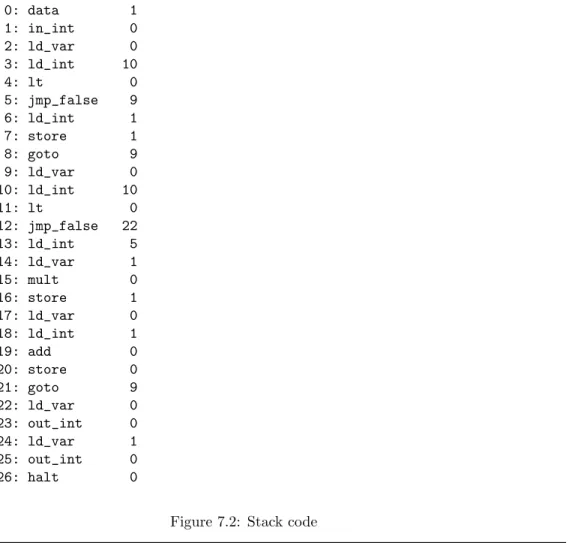
An Example
let
integer n,x,n. in
read n;
if n < 10 then x := 1; else skip; fi; while n < 10 do x := 5*x; n := n+1; end; skip;
write n; write x; end
0: data 1
1: in_int 0
2: ld_var 0
3: ld_int 10
4: lt 0
5: jmp_false 9
6: ld_int 1
7: store 1
8: goto 9
9: ld_var 0
10: ld_int 10
11: lt 0
12: jmp_false 22
13: ld_int 5
14: ld_var 1
15: mult 0
16: store 1
17: ld_var 0
18: ld_int 1
19: add 0
20: store 0
21: goto 9
22: ld_var 0
23: out_int 0
24: ld_var 1
25: out_int 0
26: halt 0
Chapter 8
Peephole Optimization
Following code generation there are further optimizations that are possible. The code is scanned a few instructions at a time (the peephole) looking for combinations of instructions that may be replaced by more efficient combina-tions. Typical optimizations performed by a peephole optimizer include copy propagation across register loads and stores, strength reduction in arithmetic operators and memory access, and branch chaining.
We do not illustrate a peephole optimizer for Simp.
x := x + 1 ld x ld x
inc inc
store x dup
y := x + 3 ld x
ld 3 ld 3
add add
store y store y
x := x + z ld x
ld z ld z
add add
Chapter 9
Further Reading
Chapter 10
Exercises
The exercises which follow vary in difficulty. In each case, determine what modifications must be made to the grammar, the symbol table and to the stack machine code.
1. Re-implement the symbol table as a binary search tree. 2. Re-implement the symbol table as a hash table.
3. Re-implement the symbol table, the code generator and the stack machine as C++ classes.
4. Extend the Micro Compiler with the extensions listed below. The exten-sions require the modification of the scanner to handle the new tokens and modifications to the parser to handle the extended grammar.
(a) Declarations: Change the semantic processing of identifier references to require previous declaration.
(b) Real literals and variables: Extend the symbol-table routines to store a type attribute with each identifier. Extend the semantic routines that generate code to consider the types of literals and variables they receive as parameters.
(c) Multiplication and division: Make appropriate changes to the seman-tic routines to handle code generation based on the new tokens. (d) ifandwhilestatements: Semantic routines must generate the proper
tests and jumps.
Optional additions include:
(a) An interpreter for the code produced by the compiler
(b) Substitution of a table-driven parser for the recursive descent parser in the Micro compiler.
5. Extend the Micro-II compiler. A self-contained description of Macro is included in the cs360/compiler tools directory. In brief, the following ex-tensions are required.
(a) Scanner extensions to handle the new tokens, use of parser generator to produce new tables(20 points).
(b) Declarations of integer and real variables(10 points).
(c) Integer literals, expressions involving integers, I/O for integers, and output for strings(10 points).
(d) The loop and exit statements and addition of the else and elsif
parts to the ifstatement(20 points).
(e) Recursive procedures with parameters(8 points for simple procedures, 8 points for recursion, 12 points for parameters).
(f) Record declarations and field references(8 points). (g) Array declarations and element references(12 points).
(h) Package declarations and qualified name references(12 points).
The total number of points is 120.
6. The compiler is to be completely written from scratch. The list below assigns points to each of the features of the language, with a basic sub-set required of all students identified first. All of the other features are optional.
Basic Subset (130 points) (a) (100 points)
i. Integer, Real, Boolean types (5 points)
ii. Basic expressions involving Integer, Real and Boolean types (+,−,∗, /, not, and or, abs, mod, **, <, <=, >, >=,=
, /=) (30 points). iii. Input/Output
A. Input of Integer, Real, Boolean scalars(5 points).
B. Output of String literals and Integer, Real and Boolean expressions(excluding formatting)(5 points).
iv. Block structure (including declaration of local variables and constants) (20 points).
v. Assignment statement (10 points).
(b) (30 points) Procedures and scalar-valued functions of no argu-ments (including nesting and non-local variables).
Optional Features (336 points possible) (a) loopstatements (15 points total)
i. inandin reverseforms (10 points) ii. whileform (5 points)
(b) Arrays (30 points total)
i. One-dimensional, compile-time bounds, including First and Last attributes (10 points)
ii. Multi-dimensional, compile-time bounds, including First and Last attributes (5-points)
iii. Elaboration-time bounds (9 points) iv. Subscript checking (3 points)
v. Record base type (3 points)
(c) Boolean short-circuit operators (and then, or else) (12 points) (d) Strings (23 points total)
i. Basic string operations (string variables, string assigns, all string operators (&, Substr, etc), I/O of strings) (10 points) ii. Unbounded-length strings (5 points)
iii. Full garbage collection of unbounded-length strings (8 points) (e) Records (15 points total)
i. Basic features (10 points)
ii. Fields that are compile-time bounded arrays (2 points) iii. Fields that are elaboration-time sized (both arrays and records)
(3 points)
(f) Procedures and functions(53 points total) i. Scalar parameters (15 points)
ii. Array arguments and array-valued functions (compiler-time bounds) (7 points )
iii. Array arguments and array-valued functions (elaboration-time bounds) (5 points)
iv. Record arguments and record-value functions (4 points) v. Conformant array parameters (i.e. array declarations of the
formtype array (T range <>) of T2) (8 points)
vi. Array-valued functions (elaboration-sized bounds) (3 points) vii. Array-valued functions (conformant bounds) (4 points) viii. Forward definition of procedures and functions (3 points)
ix. String arguments and string-valued functions (4 points) (g) casestatement (20 points total)
ii. If-then-else code (4 points) iii. Search-table code (6 points)
(h) Constrainedsubtypes(including First and Last attributes) (10 points total)
i. Run-time range checks (7 points) ii. Compile-time range checks (3 points) (i) Folding of scalar constant expressions (8 points) (j) Initialized variables (10 points total).
i. Compile-time values, global (without run-time code) (3 points) ii. Compile-time values, local (2 points)
iii. Elaboration-time values (2 points) iv. Record fields (3 points)
(k) Formatted writes (3 points). (l) Enumerations (18 points total).
i. Declaration of enumeration types; variables, assignment, and comparison operations (9 points)
ii. Input and Output of enumeration values (5 points) iii. Succ, Pred, Char, and Val attributes (4 points) (m) Arithmetic type conversion (3 points).
(n) Qualified names (from blocks and subprograms) (3 points). (o) Pragmata (2 points).
(p) Overloading (25 points total)
i. Subprogram identifier (18 points) ii. Operators (7 points)
(q) Packages (55 points total).
i. Combined packages (containing both declaration and body parts); qualified access to visible part (20 points)
ii. Split packages (with distinct declaration and body parts) (5 points)
iii. Private types (10 points)
iv. Separate compilation of package bodies (20 points) (r) Use statements (11 points)
(s) Exceptions (includingexceptiondeclarations,raisestatements, exception handlers, predefined exceptions) (20 points).
Extra credit project extensions:
• Language extensions – array I/O, external procedures, sets, pro-cedures as arguments, extended data types.
Appendix A
Simple - The complete
implementation
A.1
The parser: Simple.y
%{/*************************************************************************
Compiler for the Simple language
***************************************************************************/ /*=========================================================================
C Libraries, Symbol Table, Code Generator & other C code
=========================================================================*/
#include <stdio.h> /* For I/O */
#include <stdlib.h> /* For malloc here and in symbol table */
#include <string.h> /* For strcmp in symbol table */
#include "ST.h" /* Symbol Table */
#include "SM.h" /* Stack Machine */
#include "CG.h" /* Code Generator */
#define YYDEBUG 1 /* For Debugging */
int errors; /* Error Count */
/*---The following support backpatching
---*/
struct lbs /* Labels for data, if and while */
{
};
struct lbs * newlblrec() /* Allocate space for the labels */
{
return (struct lbs *) malloc(sizeof(struct lbs)); }
/*---Install identifier & check if previously defined.
---*/ install ( char *sym_name )
{
symrec *s;
s = getsym (sym_name); if (s == 0)
s = putsym (sym_name); else { errors++;
printf( "%s is already defined\n", sym_name ); }
}
/*---If identifier is defined, generate code
---*/ context_check( enum code_ops operation, char *sym_name )
{ symrec *identifier;
identifier = getsym( sym_name ); if ( identifier == 0 )
{ errors++;
printf( "%s", sym_name );
printf( "%s\n", " is an undeclared identifier" ); }
else gen_code( operation, identifier->offset ); }
/*========================================================================= SEMANTIC RECORDS
=========================================================================*/ %}
%union semrec /* The Semantic Records */
{
int intval; /* Integer values */
char *id; /* Identifiers */
struct lbs *lbls; /* For backpatching */
}
/*========================================================================= TOKENS
=========================================================================*/ %start program
%token <id> IDENTIFIER /* Simple identifier */
%token <lbls> IF WHILE /* For backpatching labels */
%token SKIP THEN ELSE FI DO END %token INTEGER READ WRITE LET IN %token ASSGNOP
/*========================================================================= OPERATOR PRECEDENCE
=========================================================================*/ %left ’-’ ’+’
%left ’*’ ’/’ %right ’^’
/*========================================================================= GRAMMAR RULES for the Simple language
=========================================================================*/ %%
program : LET
declarations
IN { gen_code( DATA, data_location() - 1 ); }
commands
END { gen_code( HALT, 0 ); YYACCEPT; }
;
declarations : /* empty */
| INTEGER id_seq IDENTIFIER ’.’ { install( $3 ); }
;
id_seq : /* empty */
| id_seq IDENTIFIER ’,’ { install( $2 ); }
;
commands : /* empty */ | commands command ’;’ ;
command : SKIP
| READ IDENTIFIER { context_check( READ_INT, $2 ); }
| WRITE exp { gen_code( WRITE_INT, 0 ); }
| IDENTIFIER ASSGNOP exp { context_check( STORE, $1 ); }
| IF exp { $1 = (struct lbs *) newlblrec();
$1->for_jmp_false = reserve_loc(); }
THEN commands { $1->for_goto = reserve_loc(); }
ELSE { back_patch( $1->for_jmp_false,
JMP_FALSE,
gen_label() ); }
commands
FI { back_patch( $1->for_goto, GOTO, gen_label() ); }
| WHILE { $1 = (struct lbs *) newlblrec();
exp { $1->for_jmp_false = reserve_loc(); } DO
commands
END { gen_code( GOTO, $1->for_goto );
back_patch( $1->for_jmp_false, JMP_FALSE,
gen_label() ); }
;
exp : NUMBER { gen_code( LD_INT, $1 ); }
| IDENTIFIER { context_check( LD_VAR, $1 ); }
| exp ’<’ exp { gen_code( LT, 0 ); }
| exp ’=’ exp { gen_code( EQ, 0 ); }
| exp ’>’ exp { gen_code( GT, 0 ); }
| exp ’+’ exp { gen_code( ADD, 0 ); }
| exp ’-’ exp { gen_code( SUB, 0 ); }
| exp ’*’ exp { gen_code( MULT, 0 ); }
| exp ’/’ exp { gen_code( DIV, 0 ); }
| exp ’^’ exp { gen_code( PWR, 0 ); }
| ’(’ exp ’)’ ;
%%
/*========================================================================= MAIN
=========================================================================*/ main( int argc, char *argv[] )
{ extern FILE *yyin; ++argv; --argc;
yyin = fopen( argv[0], "r" ); /*yydebug = 1;*/
errors = 0; yyparse ();
printf ( "Parse Completed\n" ); if ( errors == 0 )
{ print_code ();
fetch_execute_cycle(); } } /*========================================================================= YYERROR =========================================================================*/ yyerror ( char *s ) /* Called by yyparse on error */
{
errors++;
printf ("%s\n", s); }
A.2
Directions
Directions: this file contains a sample terminal session.
> bison -d Simple.y or
> bison -dv Simple.y
Simple.y contains 39 shift/reduce conflicts. > gcc -c Simple.tab.c
> flex Simple.lex > gcc -c lex.yy.c
> gcc -o Simple Simple.tab.o lex.yy.o -lm > Simple test_simple
Parse Completed
0: data 1
1: in_int 0
2: ld_var 0
3: ld_int 10
4: lt 0
5: jmp_false 9
6: ld_int 1
7: store 1
8: goto 9
9: ld_var 0
10: ld_int 10
11: lt 0
12: jmp_false 22
13: ld_int 5
14: ld_var 1
15: mult 0
16: store 1
17: ld_var 0
18: ld_int 1
19: add 0
20: store 0
21: goto 9
22: ld_var 0
23: out_int 0
24: ld_var 1
25: out_int 0
26: halt 0
A.3
The scanner: Simple.lex
/***************************************************************************
Scanner for the Simple language
***************************************************************************/ %{
/*========================================================================= C-libraries and Token definitions
=========================================================================*/
#include <string.h> /* for strdup */
/*#include <stdlib.h> */ /* for atoi */
#include "Simple.tab.h" /* for token definitions and yylval */ %}
/*========================================================================= TOKEN Definitions
=========================================================================*/
DIGIT [0-9]
ID [a-z][a-z0-9]*
/*========================================================================= REGULAR EXPRESSIONS defining the tokens for the Simple language =========================================================================*/ %%
":=" { return(ASSGNOP); }
{DIGIT}+ { yylval.intval = atoi( yytext ); return(NUMBER); }
do { return(DO); }
else { return(ELSE); }
end { return(END); }
fi { return(FI); }
if { return(IF); }
in { return(IN); }
integer { return(INTEGER); }
let { return(LET); }
read { return(READ); }
skip { return(SKIP); }
then { return(THEN); }
while { return(WHILE); }
write { return(WRITE); }
{ID} { yylval.id = (char *) strdup(yytext); return(IDENTIFIER); }
[ \t\n]+ /* eat up whitespace */
. { return(yytext[0]);}
int yywrap(void){}
/************************** End Scanner File *****************************/
A.4
The symbol table: ST.h
/*************************************************************************** Symbol Table Module
***************************************************************************/ /*=========================================================================
DECLARATIONS
=========================================================================*/
/*---SYMBOL TABLE RECORD
---*/ struct symrec
{
char *name; /* name of symbol */
int offset; /* data offset */
struct symrec *next; /* link field */
};
typedef struct symrec symrec;
/*---SYMBOL TABLE ENTRY
---*/ symrec *identifier;
/*---SYMBOL TABLE
Implementation: a chain of records.
---*/ symrec *sym_table = (symrec *)0; /* The pointer to the Symbol Table */ /*========================================================================
Operations: Putsym, Getsym
========================================================================*/ symrec * putsym (char *sym_name)
{
symrec *ptr;
ptr = (symrec *) malloc (sizeof(symrec));
ptr->name = (char *) malloc (strlen(sym_name)+1); strcpy (ptr->name,sym_name);
ptr->offset = data_location();
ptr->next = (struct symrec *)sym_table; sym_table = ptr;
}
symrec * getsym (char *sym_name) {
symrec *ptr;
for ( ptr = sym_table; ptr != (symrec *) 0;
ptr = (symrec *)ptr->next ) if (strcmp (ptr->name,sym_name) == 0)
return ptr; return 0; }
/************************** End Symbol Table **************************/
A.5
The code generator: CG.h
/*************************************************************************** Code Generator
***************************************************************************/
/*---Data Segment
---*/
int data_offset = 0; /* Initial offset */
int data_location() /* Reserves a data location */
{
return data_offset++; }
/*---Code Segment
---*/
int code_offset = 0; /* Initial offset */
int gen_label() /* Returns current offset */
{
return code_offset; }
int reserve_loc() /* Reserves a code location */
{
return code_offset++; }
{ code[code_offset].op = operation; code[code_offset++].arg = arg; }
/* Generates code at a reserved location */ void back_patch( int addr, enum code_ops operation, int arg )
{
code[addr].op = operation; code[addr].arg = arg; }
/*---Print Code to stdio
---*/ void print_code()
{
int i = 0;
while (i < code_offset) {
printf("%3ld: %-10s%4ld\n",i,op_name[(int) code[i].op], code[i].arg ); i++;
} }
/************************** End Code Generator **************************/
A.6
The stack machine: SM.h
/*************************************************************************** Stack Machine
***************************************************************************/ /*=========================================================================
DECLARATIONS
=========================================================================*/
/* OPERATIONS: Internal Representation */
enum code_ops { HALT, STORE, JMP_FALSE, GOTO, DATA, LD_INT, LD_VAR,
READ_INT, WRITE_INT,
LT, EQ, GT, ADD, SUB, MULT, DIV, PWR };
/* OPERATIONS: External Representation */
"data", "ld_int", "ld_var", "in_int", "out_int",
"lt", "eq", "gt", "add", "sub", "mult", "div", "pwr" };
struct instruction {
enum code_ops op; int arg;
};
/* CODE Array */
struct instruction code[999];
/* RUN-TIME Stack */
int stack[999];
/*---Registers
---*/
int pc = 0;
struct instruction ir;
int ar = 0;
int top = 0;
char ch;
/*========================================================================= Fetch Execute Cycle
=========================================================================*/ void fetch_execute_cycle()
{ do { /*printf( "PC = %3d IR.arg = %8d AR = %3d Top = %3d,%8d\n", pc, ir.arg, ar, top, stack[top]); */
/* Fetch */
ir = code[pc++];
/* Execute */
switch (ir.op) {
case HALT : printf( "halt\n" ); break;
case READ_INT : printf( "Input: " );
scanf( "%ld", &stack[ar+ir.arg] ); break; case WRITE_INT : printf( "Output: %d\n", stack[top--] ); break; case STORE : stack[ir.arg] = stack[top--]; break;
case JMP_FALSE : if ( stack[top--] == 0 ) pc = ir.arg;
break;
case GOTO : pc = ir.arg; break;
case LD_INT : stack[++top] = ir.arg; break; case LD_VAR : stack[++top] = stack[ar+ir.arg]; break; case LT : if ( stack[top-1] < stack[top] )
stack[--top] = 1; else stack[--top] = 0;
break; case EQ : if ( stack[top-1] == stack[top] )
stack[--top] = 1; else stack[--top] = 0;
break; case GT : if ( stack[top-1] > stack[top] )
stack[--top] = 1; else stack[--top] = 0;
break; case ADD : stack[top-1] = stack[top-1] + stack[top];
top--; break;
case SUB : stack[top-1] = stack[top-1] - stack[top]; top--;
break;
case MULT : stack[top-1] = stack[top-1] * stack[top]; top--;
break;
case DIV : stack[top-1] = stack[top-1] / stack[top]; top--;
break;
case PWR : stack[top-1] = stack[top-1] * stack[top]; top--;
break;
default : printf( "%sInternal Error: Memory Dump\n" ); break;
} }
while (ir.op != HALT); }
/*************************** End Stack Machine **************************/
A.7
Sample program: test simple
let
read n;
if n < 10 then x := 1; else skip; fi; while n < 10 do x := 5*x; n := n+1; end; skip;
Appendix B
Lex/Flex
In order for Lex/Flex to recognize patterns in text, the pattern must be de-scribed by a regular expression. The input to Lex/Flex is a machine readable set of regular expressions. The input is in the form of pairs of regular expres-sions and C code, called rules. Lex/Flex generates as output a C source file, lex.yy.c, which defines a routine yylex(). This file is compiled and linked with the-lfllibrary to produce an executable. When the executable is run, it analyzes its input for occurrences of the regular expressions. Whenever it finds one, it executes the corresponding C code.
B.1
Lex/Flex Examples
The following Lex/Flex input specifies a scanner which whenever it encounters the string “username” will replace it with the user’s login name:
%%
username printf( "%s", getlogin() );
By default, any text not matched by a Lex/Flex scanner is copied to the output, so the net effect of this scanner is to copy its input file to its output with each occurrence of “username” expanded. In this input, there is just one rule. “username” is thepatternand the “printf” is theaction. The “%%” marks the beginning of the rules.
Here’s another simple example:
%%
\n ++num_lines; ++num_chars;
. ++num_chars;
%% main()
{
yylex();
printf( "# of lines = %d, # of chars = %d\n", num_lines, num_chars );
}
This scanner counts the number of characters and the number of lines in its input (it produces no output other than the final report on the counts). The first line declares two globals, num lines and num chars, which are accessible both insideyylex()and in themain()routine declared after the second ”%%”. There are two rules, one which matches a newline (“\n”) and increments both the line count and the character count, and one which matches any character other than a newline (indicated by the “.” regular expression).
A somewhat more complicated example:
/* scanner for a toy Pascal-like language */
%{
/* need this for the call to atof() below */ #include <math.h>
%}
DIGIT [0-9]
ID [a-z][a-z0-9]*
%%
{DIGIT}+ {
printf( "An integer: %s (%d)\n", yytext, atoi( yytext ) );
}
{DIGIT}+"."{DIGIT}* {
printf( "A float: %s (%g)\n", yytext, atof( yytext ) );
}
printf( "A keyword: %s\n", yytext ); }
{ID} printf( "An identifier: %s\n", yytext );
"+"|"-"|"*"|"/" printf( "An operator: %s\n", yytext );
"{"[\^{$\;$}}\n]*"}" /* eat up one-line comments */
[ \t\n]+ /* eat up whitespace */
. printf( "Unrecognized character: %s\n", yytext );
%%
main( argc, argv ) int argc;
char **argv; {
++argv, --argc; /* skip over program name */ if ( argc > 0 )
yyin = fopen( argv[0], "r" ); else
yyin = stdin;
yylex(); }
This is the beginnings of a simple scanner for a language like Pascal. It identifies different types oftokensand reports on what it has seen.
The details of this example will be explained in the following sections.
B.2
The Lex/Flex Input File
The Lex/Flex input file consists of three sections, separated by a line with just %% in it:
definitions
%%
rules
%%
B.2.1
The Declarations Section
Thedefinitionssection contains declarations of simplenamedefinitions to sim-plify the scanner specification.
Name definitions have the form:
name definition
The “name” is a word beginning with a letter or an underscore (‘ ’) followed by zero or more letters, digits, ‘ ’, or ‘-’ (dash). The definition is taken to begin at the first non-white-space character following the name and continuing to the end of the line. The definition can subsequently be referred to using “name”, which will expand to “(definition)”. For example,
DIGIT [0-9]
ID [a-z][a-z0-9]*
defines “DIGIT” to be a regular expression which matches a single digit, and “ID” to be a regular expression which matches a letter followed by zero-or-more letters-or-digits. A subsequent reference to
{DIGIT}+"."{DIGIT}*
is identical to
([0-9])+"."([0-9])*
and matches one-or-more digits followed by a ‘.’ followed by zero-or-more digits.
B.2.2
The Rules Section
Therulessection of the Lex/Flex input contains a series of rules of the form:
pattern action
where the pattern must be unindented and the action must begin on the same line.