DOI: 10.1142/S0218301319500563
Investigation of the synthesis of the unknown superheavy nuclei 309,312126
T. V. Nhan Hao
Faculty of Physics, University of Education, Hue University,
34Le Loi Street, Hue 530000, Vietnam
NTT Hi-Tech Insitute, Nguyen Tat Thanh University, Ho Chi Minh City, 700000, Vietnam
N. N. Duy∗
Institute of Research and Development, Duy Tan University, Da Nang 550000, Vietnam
Department of Physics, Sungkyunkwan University, Suwon 16419, South Korea
K. Y. Chae
Department of Physics, Sungkyunkwan University, Suwon 16419, South Korea
N. Quang Hung
Institute of Fundamental and Applied Sciences, Duy Tan University, Ho Chi Minh City 700000, Vietnam
N. Nhu Le
Faculty of Physics, University of Education, Hue University,
34Le Loi Street, Hue 530000, Vietnam [email protected]
Received 29 March 2019 Revised 21 July 2019 Accepted 8 August 2019 Published 9 September 2019
In this paper, we applied the method developed by Santhosh and Safoora in [Phys. Rev. C 94(2016) 024623;95(2017) 064611] to theoretically investigate the fusion, evaporation-residue (ER) and fission cross-sections of the synthesis of the unknown superheavy
∗Corresponding author.
Int. J. Mod. Phys. E Downloaded from www.worldscientific.com
309,312126 nuclei produced by using the58Ni +251Cf and64Zn +248Cm combinations. The charge asymmetry, mass asymmetry and fissility of the DiNuclear System (DNS) in the synthesis of the mentioned combinations are also estimated. The calculated results show that the ER cross-sections for the synthesis of the309−317126 nuclei are predicted to be much less than 1.0 fb. In particular, it has been found that there may exist a valley of the ER cross-sections in the synthesis of a superheavyZ= 126 element, which produces the313126 isotope. Subsequently, a model for the mass dependence of the ER cross-section in the synthesis of the307−320126 isotopes has been proposed for the first time. On the other hand, the quasi-fission process strongly dominates over the fusion in the two concerned interacting systems. The present results, together with those reported in the previous studies, indicate that the investigated projectile–target combinations are not capable for the synthesis of the309,312126 isotopes due to tiny fusion cross-sections (about 2–3 zb), which go beyond the limitations of available facilities. Further studies are thus recommended to search for alternative interacting systems. In conclusion, this work provides useful information for the synthesis of the gap isotopes308−317126, which have not been well studied up to date.
Keywords: Fusion; cross-section; fission; superheavy nuclei; evaporation-residue; com-pound nucleus; synthesis.
PACS Number(s): 24.10.i, 25.60.Pj, 25.70.Jj, 27.90.+b
1. Introduction
The synthesis of heavy and superheavy nuclei (SHN) in the Universe is one of the most unsolved mysteries in this century. The mechanism of the SHN production has not been well understood so far. Up to date, it has been known that the reactions of heavy nuclei are often proceeded through different stages including the Coulomb barrier penetration, competition between the formation of compound nucleus (CN) and quasi-fission, and survival probability of the CN de-excited by the evaporation of a light particle against the fission. There is a competition between the fusion and quasi-fission processes in the interaction of heavy nuclei. Hence, the cross-section corresponding to the probability of each stage becomes a significant quantity to explore the mechanism of the SHN synthesis. As a result, measurements of the fusion reactions caused by the colliding systems of heavy nuclei are important to reveal the presence of the SHN production. In this scenario, practically, the feasibility of the measurements is strongly required to be investigated for a successful synthesis. Superheavy elements with atomic numbers up toZ= 118 have been discovered in laboratories with very small cross-sections (about few pb) so far.1–6 The accel-erator technologies have supported the experimentalists to approach the northern island of stability of transfermium elements,7 initiating further studies searching for the new SHN, especially for those with the atomic numbers of Z = 120 and 126. The latter with the neutron shell-closureN = 184 is also expected to be the double magic isotope as predicted by the shell model.8–10Consequently, many the-oretical studies for the synthesis of new SHN have been extended up to Z = 126 (see Refs. 11–19), in which the studies ofZ= 120 and 126 elements are paid more attention because their data are useful to reveal the possible existence of new magic numbers. Indeed, the synthesis of Z = 120 nucleus has been examined via more
Int. J. Mod. Phys. E Downloaded from www.worldscientific.com
than 48 projectile-target combinations in Ref. 20, where the formation and sur-vival probabilities, the fusion, evaporation and fission cross-sections of the CN have been carefully studied since these parameters are very important to propose the synthesis experiments for the SHN. For Z = 126 element, only six isotopes have been investigated. For example, the 307,318−320126 nuclei have been studied via a series of projectile–target combinations in Ref. 19, whereas the310126 nucleus with the magic neutron number ofN = 184 has been examined in Ref. 21. In addition, an interacting system of the 64Ni +249Cf combination has been proposed for the synthesis of the 313126 isotope in Ref. 22. However, the investigation for the syn-thesis cross-sections of 308−317126 isotopes has not yet been considered in Ref. 19 because of their short half-lives as predicted in Ref. 23. In addition, the half-lives of the above 308−317126 isotopes predicted by various calculations in Refs. 9, 10 and 24–27 are still different by several orders of magnitude. Indeed, despite having the short half-lives, the observation of these nuclei is still possible if their synthesis cross-section is large enough. Hence, the production yield is highly demanded to be investigated for the feasibility of the synthesis.
According to Refs. 19, 21 and 22, the interactions of Ni–Cf and Zn–Cm are most probable for the production of the Z = 126 element. Moreover, the fusion–fission data of these interactions are useful to explain the high abundance of nonmagic number isotopes in the oxygen, iron, barium and lead groups, which are believed to be produced by the fission.28–32Therefore, the systems of58Ni +251Cf and64Zn +
248Cm are chosen as the good candidates to discover the unknown 309,312126
iso-topes. The goal of this work is to investigate the fusion, survival and fission cross-sections, which are necessary for the future synthesis experiments of the unknown
309,312126 SHN. The pre-synthesis parameters needed for investigating the
produc-tion of these isotopes are also predicted in this study. Note that we applied the previous models, which were well described in Refs. 19–23, to the investigation in this work.
The present paper is organized as follows. The theoretical framework for the calculations of the pre-synthesis parameters and the cross-sections is presented in Sec. 2. The results of the numerical calculations are analyzed and discussed in Sec. 3. The paper is summarized in the last Sec. 4.
2. Method
The SHN production processes through three main stages: (i) the Coulomb barrier penetration of the projectile to be fully captured by the target, (ii) the competition of the CN formation and quasi-fission and (iii) the survival probability of the CN de-excited by the particle evaporation against the fission. For a projectile completely captured by the target, its captured cross-section,σCap., can be calculated by using the following expression33
σCap.= λ
2
4π
lmax
l=0
(2l+ 1)Tl(E) (1)
Int. J. Mod. Phys. E Downloaded from www.worldscientific.com
whereas its fusion cross-section reads
σFus.= λ
2
4π
lmax
l=0
(2l+ 1)Tl(E)PCN(E, l), (2)
where 2λπ, l, E, Tl(E) andPCN(E, l) are the reduced wavelength of the projectile in the entrance channel, angular momentum of the interaction system, energy of the interacting system in the center-of-mass frame (or Ecm.), transmission coefficient and probability of the CN formation, respectively. Subsequently, the evaporation-residue (ER) cross-section of the CN produced in the heavy-nuclei fusion reaction is expressed by
σER= λ
2
4π
lmax
l=0
(2l+ 1)Tl(E)PCN(E, l)PSurv.(E, l), (3)
where PSurv.(E, l) is the survival probability of the CN de-excited to the ground state via the light-particle evaporation (neutrons, protons or alphas) against the fragment fission. In Eqs. (1)–(3), lmax corresponds to the largest partial wave of the peripheral collision. The fusion probability,PCN(E, l), in Eqs. (2) and (3) is an important factor for describing the fusion of the SHN synthesis. This factor implies that after reaching the capture configuration, the projectile–target system will over-come the saddle point and start to fuse, avoiding its re-separation. For very heavy and less asymmetric systems, PCN(E, l) is much smaller than 1.0, indicating the dramatically small cross-sections of the SHN production. There have been several models for the most unclear parameters ofPCN(E, l). Within this work, we employ the method reported in Ref. 20, that is
PCN(E, l) =exp[−c(χeff −χthr)]
1 + exp
E∗
B−E∗
∆
, (4)
where c, χthr and ∆ (4 MeV) are the adjustable factors; χeff, EB∗ and E∗ are the effective entrance-channel fissility, the excitation energy when energy of the colliding system is equal to the proximity potential and the excitation energy of the CN, respectively. The values of the adjustable parameters were suggested in Refs. 20 and 34 as
c= 136.5 and χthr= 0.79 for cold fusion, (5)
c= 104 and χthr= 0.69 for hot fusion withχeff ≤0.8, (6)
c= 82 and χthr= 0.69 for hot fusion withχeff ≥0.8. (7) The survival probability was well described by20
PSurv.(E, l) =Pxn(E∗)
n
i=1
Γn Γn+ Γf
i,E∗,
(8)
whereiandndenote the index and maximum numbers of emitted neutrons, respec-tively; Pxn(E∗) is the probability of emitting n neutrons, which can be deduced
Int. J. Mod. Phys. E Downloaded from www.worldscientific.com
from the study by Jackson35; Γn and Γf are the widths of the neutron emission and fission, respectively. The ratio of Γn/Γf is expressed as36
Γn Γf =
4A2/3af(E∗−Bn)
K0an[2af(E∗−Bf)−1]×e
2[√an(E∗−Bn)−√af(E∗−Bf)], (9)
whereA,E∗andBnare the mass number of the interest nucleus, excitation energy and neutron separation energy of the CN, respectively. According to the study by Vandenbosh and Huizenga,36the constantK0is chosen to be 10.0 MeV and the level density parameters of the residual nucleus at the ground state and of the fissioning nucleus at the saddle configuration are an = A/10 and af = 1.1an, respectively. The fission barrier,Bf, which denotes the competition between fission and neutron evaporation processes, is given as37
Bf(E∗) =BfLD+δexp (E∗/ED), (10) where the liquid-drop fission barrierBfLD ≈0 for elements withZ >10938,39; the shell correction,δ, is taken from Molleret al.40; and the shell damping energy,ED, can be determined based on the mass number, A, of the concerned nucleus as37
ED= 5.48
A1/3
1 + 1.3A−1/3
. (11)
The cross-section subtended by a deBroglie wavelength in Eqs. (1)–(3) can be determined by41
λ2
4π = 0.656
µE (b), (12)
where µ denotes the reduced mass of the system. The transmission coefficient,
Tl(E), which characterizes the penetration probability at the lth partial wave, is often approximated by using the Hill–Wheeler formula42,43 as
Tl(E) ={1 + exp[2π(El−E)/ωl]}−1, (13) whereωlis the curvature of the harmonic–oscillator interaction potentials of height
El and frequency ωl. The potential of the projectile–target colliding system is
given by
V =VC(r) +VP(z) +
2l(l+ 1)
2µr2 . (14)
Here,randzare the distance between the centers of the projectile and target and the distance between the near surfaces of the projectile and target, respectively. The Coulomb potential,VC(r), expressed in terms of the Coulomb radiusRC and atomic numbers of the projectileZ1and the targetZ2 reads18,19
VC(r) = Z1Z2e
2
r if r≥RC (15)
= Z1Z2e
2
2RC
3− r
2
R2C
ifr < RC. (16)
Int. J. Mod. Phys. E Downloaded from www.worldscientific.com
The proximity potential,VP, is given as44
VP(z) = 4πγb C1C2
C1+C2φ
z
b , (17)
where γ, b and Ci (i = 1 (projectile), 2 (target)) are the nuclear surface tension coefficient, the width of the nuclear surface and the Siissmann central radii, respec-tively. These parameters can be calculated by using the following formulae20:
γ= 0.9517
1−1.7826(N−Z)
2
A2
, (18)
φ(ξ) =−4.41 exp
−ξ
0.7176
forξ≥1.9475, (19)
φ(ξ) =−1.1817 + 0.9270ξ+ 0.01696ξ2+ 0.05148ξ3 for 0≤ξ≤1.9475, (20)
φ(ξ) =−1.1817 + 0.9270ξ+ 0.0143ξ2+ 0.09ξ3 forξ≤0, (21) with ξ= (z/b). According to Ref. 20, the Siissmann radii are expressed in terms of the sharp radiiRi as Ci =Ri−b2/Ri, whereRi can be calculated by using a semi-empirical formula of the form as
Ri = 1.28A1i/3−0.76 + 0.8A−i 1/3 (22)
withAibeing the mass numbers of the projectile (i= 1) and the target (i= 2). In principle, the radiiRishould depend also on the nuclear deformation as those given in, e.g., Refs. 18 and 19. However, here, we employed the empirical formula (22), which was proposed in Ref. 44. This empirical formula, which was obtained via the refined analyses of the experimental nuclear sizes,45has been widely used in Refs. 20 and 37 and the obtained results are in good agreement with the experimental data for the synthesis systems of SHN withZ = 114–118.37Therefore, in order to have a precise prediction for the uninvestigated systems, this paper, which employed the method proposed in Refs. 20 and 37, does not treat the deformation effect explicitly. The barrier radius Rl for the angular momentum l is determined from the following condition
dV(r)
dr
Rl
= 0. (23)
The curvature parameter can be deduced based on the potential as
ωl= √
µ
d2V(r)
dr2
Rl
. (24)
The CN may be destroyed via the fission, whose cross-section is calculated by using the following relation
σFiss.=σFus.−σER. (25)
It is known that there is a competition between the CN formation and the quasi-fission in the projectile–target interaction. To decide a combination for the SHN
Int. J. Mod. Phys. E Downloaded from www.worldscientific.com
synthesis, additional parameters related to the quasi-fission process should also be taken into account. The CN fissility (χCN) reflecting the stability of the CN with respect to the fission is calculated by
χCN =
Z2 A Z2 A −1
cr..
(26)
The effective entrance-channel fissility (χeff) corresponding to the repulsive and attractive forces is estimated by46
χeff = 4zas
(A1A2)1/3
Z2
A
−1
cr..
(27)
Here, (Z, A) and (Zi, Ai) with (i= 1,2) are atomic and mass numbers of the CN and the interacting particles, respectively. The charge asymmetry, zas, in Eq. (27) is defined as
zas= Z1Z2
(A11/3+A12/3)
(28)
whereas the critical ratioZ2/Ais evaluated by46
Z2
A
cr.
= 50.883
1−1.7826
A−2Z
A
2
. (29)
The mean fissility (χm) is often defined as the feasibility of the quasi-fission appear-ance, namely46
χm= 0.25χCN+ 0.75χeff. (30)
References 47 and 48 have shown that the quasi-fission becomes dominant atχm> 0.765 whereas its feasibility depends on the mass asymmetry of the entrance chan-nel,17,49that is
α=|A1−A2|
A1+A2 . (31)
It should be noted here that the quasi-fission process occurs only when the mass asymmetry is smaller than its critical value, αcr., namely46,47
αcr.=
0 ifχCN<0.396, 1.12
χCN−0.396
χCN−0.156 ifχCN>0.396.
All the quantities including the capture, fusion and surviving cross-sections, the fissility and mass asymmetry should be taken care before giving any decisions to perform the synthesis experiments for the SHN production.
Int. J. Mod. Phys. E Downloaded from www.worldscientific.com
3. Results and Discussions
The feasibility for the synthesis of the SHN 309,312126 via the 58Ni +251Cf and
64Zn +248Cm combinations (the so-called Ni–Cf and Zn–Cm systems) was
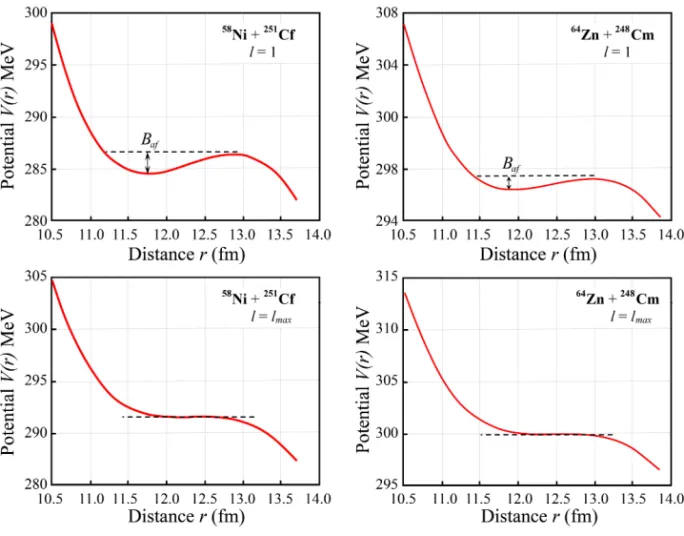
investi-gated by using the method introduced in Sec. 2. The CN can be formed when at least the projectiles penetrate the total interaction potentials calculated by using Eq. (14). The potential forms of the colliding systems are almost similar to each other but the potentials of the64Zn + 248Cm interaction are higher than those of the 58Ni + 251Cf system as shown in Fig. 1. The difference is mainly caused by their Coulomb potentials which are 286.4 MeV and 298.0 MeV, respectively. Hence, the Coulomb barrier takes an important role in the total scattering potential. Obvi-ously, the quasi-fission barriers (Bqf) of the systems, which is defined as the depth of the well in the nucleus–nucleus interaction potentialV(r), are reduced by the angular momentum. They approach zero when l increases up tolmax. Therefore, the DiNuclear System (DNS) of the projectile–targets may have a high possibility to decay into fragments rather than the CN formation or light-particle evaporation with the higherlth wave of the projectiles.
Fig. 1. The interaction potentials of the colliding systems of58Ni +251Cf (left panel) and64Zn +248Cm (right panel) for the synthesis of the new superheavyZ= 126 nuclei obtained atl= 1 andl=lmax.
Int. J. Mod. Phys. E Downloaded from www.worldscientific.com
Fig. 2. The transmission coefficientsT(E, l) of the projectiles as a function of the angular momen-tumlcalculated at the fusion energiesEcm.=VCfor the synthesis of the309,312126.
The transmission coefficients at thelth partial wave are calculated by Eq. (13). These coefficients strongly depend on the angular momentumland energyE. The values corresponding to thes-,p- andd-waves are higher than those associated with other waves. Figure 2 shows the transmissions of the projectiles corresponding to the angular momentum at the energy ofEcm.=VC. This figure illustrates that the transmission coefficients are approximately equal to 1.0 at l ≤30 and l ≤ 35 for the synthesis of 309126 and312126 isotopes, respectively.
The CN formation probabilities PCN(E, l) of the 58Ni + 251Cf and 64Zn +
248Cm interacting systems are expected to increase with increasing the incident
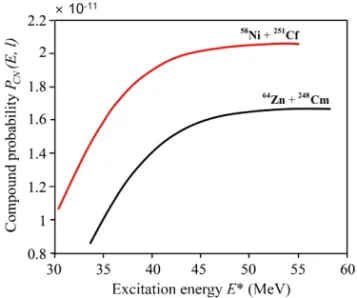
energy of the projectiles in the range of Ecm. ≤ VC. Figure 3 shows the depen-dence of PCN(E, l) upon the excited energy of the CN E∗ =Ecm.+Qval.−Erot.,
Fig. 3. The CN formation probabilitiesPCN(E, l) for the309,312126 isotopes obtained via the 58Ni +251Cf and64Zn +248Cm combinations at different excitation energiesE∗.
Int. J. Mod. Phys. E Downloaded from www.worldscientific.com
where Erot. is the rotational energy.18 The maximum PCN(E, l) values of 309126 and 312126 nuclei are 2.1×10⁻¹¹ and 1.7×10⁻¹¹, respectively. These values are almost similar to those obtained from the previous calculations for the combina-tions of58,64,66,66Ni +249,254,253,254Cf and72Zn +247Cm.19These results together with those reported in Refs. 19 and 22 clearly indicate that the CN probability strongly depends on the Coulomb factor (Z1Z2) regardless of their mass numbers. In other words, the CN probability of the same projectile–target elements but with different mass numbers is almost unchanged. This phenomenon is also confirmed by the previous report in Ref. 50 where the CN formation probability is unity with the angular momentuml < lmax for a given interacting combination with a certain value of the Coulomb factor. In addition, since the maximum probabilities can be achieved when the fusion energy exceeds the energy Ecm. = VC, the role of the Coulomb barrier in the total scattering potential of the projectile–target systems is again confirmed.
The capture and fusion cross-sections are estimated by using Eqs. (1) and (2) at various fusion energies as shown in Fig. 4. The concerned energies are assumed to be up to around the Coulomb barriers. The capture rapidly increases with increasing
Ecm. ≤1.02VC and slightly decreases after that. The strongest capture occurs at
E∗= 40 MeV where the values of the cross-sections are around 160 mb and 134 mb for the synthesis of the309126 and312126 nuclei, respectively. The cross-section for the synthesis of309126 nucleus is larger than that of 313126 isotope produced via the64Ni +249Cf scattering in Ref. 22. These results indicate that for the synthesis of a certain element (e.g.,Z= 126) with the same Coulomb factor of the projectile– target interactions, the capture cross-section for heavier isotopes should be smaller than that for the lighter ones. Since the CN probability is very small, the fusion cross-sectionsσFus. are in the order of pb. For instance, σFus. have the maximum values of 3.4 pb and 2.2 pb for the syntheses of 309126 and 312126 nuclei via the
58Ni +251Cf and64Zn +248Cm systems, respectively.
The survival probabilities of the CN for the 2n-, 3n- and 4n-neutron evapora-tions, PSurv.(E, l), are calculated by using Eq. (8). The maximum values for the
Fig. 4. The captureσCap. and fusionσFus.cross-sections for the synthesis of the new SHN with Z= 126,A= 309, 312.
Int. J. Mod. Phys. E Downloaded from www.worldscientific.com
production of the309126 (312126) nucleus are 2.8×10⁻⁹ (2.1×10⁻⁹), 2.9×10⁻¹⁷ (2.2×10⁻¹⁷) and 2.6×10⁻²⁶(3.0×10⁻²⁶) for the 2n-, 3n- and 4n-neutron separa-tions, respectively. The probability for the 2n-evaporation is slightly reduced with the increase of energy whereas it rapidly increases whenEcm.≤1.02VC for the 3n and 4n-separations. The maximum values ofPSurv.(E, l) for the309126 and312126 syntheses are almost similar to each other, which are different from the CN prob-ability shown in Fig. 3. By comparing with the results obtained for other Ni–Cf and Zn–Cm systems in Ref. 19, the PSurv.(E, l) values found within this work are about 6.0 times lower than those obtained from the production of the307,318−320126 isotopes. It can be also confirmed here that this survival probability is closely asso-ciated with the mass numbers of the projectiles and targets in the scatterings.
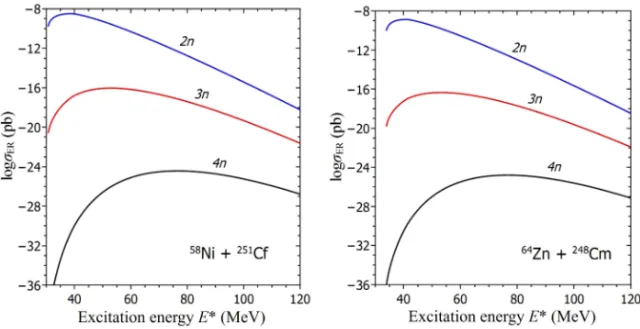
By taking into account the transmission, the CN and survival probabilities as well as the ER cross-sections for the 2n-, 3n- and 4n-separations are calculated by using Eq. (3) and the results are shown in Fig. 5. It can be seen from this figure that the largest cross-sections are obtained atEcm.= 290, 300 and 325 MeV corre-sponding toE∗= 38.2, 47.8 and 73.1 MeV for the 2n-, 3n- and 4n-evaporations of the309126 isotope, respectively, whereas those obtained for the312126 nucleus are located at the energies of about 10 MeV higher. It should be noted that the situ-ation of the evaporsitu-ation cross-section can be varied with various projectile–target combinations because it depends not only on the excitation energy but also on a series of fusion–fission parameters such as the ratio of the neutron-emission width to the fission width, Γn/Γf, probability of emittingnneutrons,Pxn(E∗), fission bar-rierBf, neutron separation energyBn, etc. given in Eqs. (3)–(10). Therefore, the results shown in Fig. 5 exhibit the intrinsic characteristics of the two uninvestigated systems considered in this paper. In general, the maximum ER cross-sections for
Fig. 5. The ER cross-sections σER. (in decimal logarithmic scale) for the synthesis of the 309,312126 isotopes via the 58Ni +251Cf (left panel) and 64Zn + 248Cm (right panel) combi-nations.
Int. J. Mod. Phys. E Downloaded from www.worldscientific.com
the syntheses of the309126 and312126 nuclei are about 3.0×10⁻⁶fb and 2.1×10⁻⁶ fb, respectively, which are about 1.0−2.0 orders of magnitude higher than those obtained from the synthesis of the313126 isotope via the64Ni +249Cf combination in Ref. 22. However, these values are much smaller than the production rates of the
307,318−320126 nuclei studied in Ref. 19. In the syntheses of the309,312126 isotopes,
according to Eq. (25), the fission cross-sections are approximately equal to the fusion ones due to the tiny evaporation cross-sections. Therefore, it is easier for the fragment fission to be occurred than the formation of the CN nuclei to synthesize the SHN. In other words, these combinations are very useful for studying the mech-anism of the mass-symmetric products via the fission in the collision of the heavy nuclei.30–32 In addition, the extremely small cross-sections and short half-lives of these isotopes also confirm the prediction of the feasibility of the SHN production based on theα-decay half-life of the CN. According to Ref. 51, the shorterα-decay half-lives of the309,312,313126 isotopes are also an evidence for the challenge of their recognition. However, in spite of a cross-section of 0.5 fb, the successful observation of the elementZ = 118 in the reaction of the48Ca projectile with a249Cf target1–6 encourages the synthesis of SHN withZ >118.
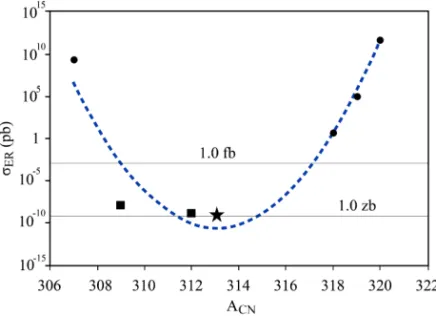
Figure 6 plots the ER cross-sections as a function of the mass numbers in the productions of the307−320126 nuclei. This figure indicates that the observation of the 309−317126 isotopes is more difficult than others. The ER cross-sections are nearly symmetrically distributed around the minimum value located at the313126 isotope. These values become larger when the mass number decreases (increases) in the range ofA <313 (A >314). This phenomenon can be understood by the shell correction energy (δ) of the CN since the survival probability strongly depends on the ratio of Γn/Γf and, subsequently, on theδ-values as described by the relations
Fig. 6. The predicted ER cross-sectionsσER.versus mass number of the CNACNfor the synthesis of the307−320126 nuclei. The black circles and star are the values obtained in Refs. 19 and 22, respectively. The dashed curve is the function Eq. (32) obtained by using theχ2-fitting.
Int. J. Mod. Phys. E Downloaded from www.worldscientific.com
Table 1. Estimated parameters necessary for pre-synthesis of the309,312126 nuclei.
Combinations α (Z2/A)cr. zas χCN χeff χm αcr.
58
28Ni +25198 Cf 0.625 47.796 269.6 1.074 0.924 0.961 0.963 64
30Zn +24896 Cm 0.590 47.528 280.1 1.070 0.938 0.971 0.962
(8)–(10). By using theχ2-fitting, the mass dependence of the cross-sections can be described by the following relation
Log(σER(pb)) = 0.468A2−292.861A+ 45850.001. (32) In the model proposed in Refs. 52 and 53, a DNS system evolves into the CN in the mass asymmetry after capturing the projectile. The parameters associated with the mass symmetry are also necessary for the consideration of the CN formation and quasi-fission processes as well as the cross-sections of the SHN synthesis. Table 1 shows the pre-synthesis parameters and the fissility and mass asymmetric factors of the309,312126 nuclei in the fusion reactions of the58Ni +251Cf and64Zn +248Cm combinations. The quasi-fission may dominate over the CN formation in all the combinations because of their high fissilities (χm >0.765). This behavior is also confirmed once again by the mass asymmetric factorsαsince these factors are much smaller than their critical values αcr.. The synthesis yield for the309126 nucleus, which is higher than that for the 312126 isotope, might be explained by the high mass asymmetry of the58Ni +251Cf combination. It is worth noting here that the cross-section for the SHN synthesis in more asymmetric fusion-reaction systems is much larger than that for the less asymmetric ones.54,55 In addition, the relatively small cross-sections of the 58Ni + 251Cf fusion reaction can be predicted based on the zas parameters, whose values exceed 235, due to which the observation of the SHN is very faint.49 The charge asymmetry of the 64Zn + 248Cm combination is higher than that of the58Ni +251Cf system. Hence, obviously, the synthesis cross-sections for the312126 nucleus should be smaller than that obtained for the309126 isotope.
4. Conclusion
The estimation of the cross-sections and pre-synthesis parameters necessary for the production of the unknown superheavy309,312126 nuclei has been theoretically investigated within this study. It has been found that the fusion and ER cross-sections proceeding via the 58Ni +251Cf and64Zn + 248Cm combinations to form the superheavy 309,312126 nuclei are much smaller than those obtained from the fusions of other Z = 126 isotopes. The production yields of the309−317126 nuclei are about 3.0 zb and 2.1 zb, indicating that the production of these isotopes is still a challenge for the presently available facilities. The results obtained in this work also confirm that the short α-decay half-life and the charge asymmetry can be consis-tently used to predict the small cross-section of the SHN synthesis. The estimated
Int. J. Mod. Phys. E Downloaded from www.worldscientific.com
fissility also suggests that the quasi-fission process dominates over the formation of the CN for both fusions. Hence, the two interested combinations are appropriate to study the mass symmetrical distribution in the fission of heavy-nuclide collisions rather than for the production of the309,312126 nuclei. The results of the present and previous works, therefore, suggest that other projectile–target systems appropriate for the production of the mentioned isotopes are highly demanded. In addition, the synthesis cross-section depends not only on the atomic and mass numbers of the superheavy isotopes but also on the pre-synthesis parameters of interacting sys-tems. Last but not the least, the results of this study are expected to be a guide for future experiments of the synthesis of the unknown superheavy element with
Z= 126.
Acknowledgments
This work was supported by the National Research Foundation of Korea (NRF) grant funded by the Korea government (MEST) (Nos. NRF-2017R1D1A1B03030019, NRF-2013M7A1A1075764, NRF-2016R1A5A1013277 and NRF-2019R1F1A1058370. This work was also supported in part by the Vietnam Government under the Program of Development in Physics toward 2020 (Grant No. DTDLCN.02/19). T. V. Nhan Hao acknowledges the financial support from Hue University Grant 43/HD-DHH for the Nuclear Physics Research Group at Hue University (NP@HU) and Nguyen Tat Thanh University for the excellent comput-ing facilities provided to him.
References
1. Y. T. Oganessianet al.,Nature400(1999) 242.
2. Y. T. Oganessianet al.,Phys. Rev. C 62(2000) 041604(R).
3. Y. T. Oganessianet al.,Phys. Rev. C63(2001) 011301(R). 4. Y. T. Oganessianet al.,Phys. Rev. C69(2004) 021601(R).
5. Y. T. Oganessian,Phys. Rev. C74(2006) 04460.
6. K. Morimotoet al.,J. Phys. Soc. Jpn.73(2004) 2593.
7. G. Munzenberg,Philos. Trans. R. Soc. Lond. A356(1998) 2083.
8. A. Sobiczewski, F. A. Gareev and B. N. Kalinkin,Phys. Lett.22(1966) 500.
9. H. Meldner,Ark. Fys.36(1967) 593.
10. W. D. Myers and W. J. Swiatecki,Nucl. Phys. A81(1996) 1.
11. G. G. Adamian, N. V. Antonenko and W. Scheid,Nucl. Phys. A633(1998) 406.
12. Y. Aritomo, T. Wada and M. Ohta,Phys. Rev. C 59(1999) 796.
13. V. I. Zagrebaev,Phys. Rev. C64(2001) 034606.
14. Z. H. Liu and J. D. Bao,Chin. Phys. Lett.21(2004) 1491. 15. W. F. Liet al.,Eur. Phys. Lett.64(2003) 750.
16. W. M. Seif,Nucl. Phys. A 767(2006) 92.
17. M. G. Itkiset al.,Nucl. Phys. A994(2015) 204.
18. H. C. Manjunathaet al.,Eur. Phys. J. A53(2017) 97.
19. H. C. Manjunathaet al.,Nucl. Phys. A962(2017) 7.
20. K. P. Santhosh and V. Safoora,Phys. Rev. C 94(2016) 024623.
21. M. A. Prelasa, H. Hora and G. H. Miley,Phys. Lett. A 378(2014) 2467.
Int. J. Mod. Phys. E Downloaded from www.worldscientific.com
22. G. Mandaglioet al.,EPJ Web Conf.38(2012) 01001.
23. H. C. Manjunatha,Nucl. Phys. A945(2016) 42.
24. S. G. Nilssonet al.,Nucl. Phys. A115(1968) 545.
25. U. Mosel and W. Greiner,Z. Phys. A222(1969) 261.
26. E. O. Fiset and J. R. Nix, Nucl. Phys. A193(1972) 647.
27. J. Randrupet al.,Phys. Rev. C13(1976) 229.
28. E. Anders and N. Grevesse,Geochim. Cosmochim. Acta53(1989) 197.
29. W. Lovelandet al.,Phys. Rev. C83(2011) 044610.
30. K. Nishioet al.,Phys. Procedia 64(2015) 140. 31. K. Nishioet al.,Phys. Rev. C86(2012) 034608. 32. K. Nishioet al.,Phys. Rev. C82(2010) 024611.
33. J. Wilczykski,Nucl. Phys. A 216(1973) 386.
34. W. Loveland,Phys. Rev. C76(2007) 014612.
35. J. D. Jackson,Can. J. Phys.34(1956) 767.
36. R. Vandenbosch and J. R. Huizenga,Nuclear Fission(Academic, New York, 1973).
37. K. P. Santhosh and V. Safoora,Phys. Rev. C 95(2017) 064611.
38. G. G. Adamian, N. V. Antonenko and W. Schied,Eur. Phys. J. A41(2009) 235.
39. A. S. Zubov, G. G. Adamian, N. V. Antonenko, S. P. Ivanova and W. Scheid,Phys.
Rev. C 65(2002) 024308.
40. P. Moller, A. J. Sierk, T. Ichikawa and H. Sagawa, At. Data Nucl. Data Tables109
(2016) 1.
41. C. E. Rolfs and W. S. Rodney,Cauldrons in the Cosmos: Nuclear Astrophysics(The
University of Chicago Press, Chicago, 1988).
42. D. L. Hill and J. A. Wheeler,Phys. Rev.89(1953) 1102.
43. C. Y. Wong,Phys. Rev. Lett.31(1973) 766.
44. J. Blocki, J. Randrup, W. J. Swiatecki and C. F. Tsang,Ann. Phys.(NY)105(1977) 427.
45. W. D. Myers and W. J. Swiatecki,Phys. Rev. C62(2000) 044610.
46. R. Bass, Nucl. Phys. A 231(1974) 45.
47. R. du Rietzet al.,Phys. Rev. C88(2013) 054618.
48. J. P. Blocki, H. Feldmeier and W. J. Swiatecki,Nucl. Phys. A459(1986) 145.
49. H. Abe, Position of the conditional Businaro-Gallone peak and the lack of large mass drift in quasi fission, KEK Preprint 86-26 (1986), https://lib-extopc.kek.jp/preprints/ PDF/1986/8627/8627026.pdf.
50. A. M. Zebeman,Phys. Rev. Lett.30(1973) 1.
51. J. Hong, G. G. Adamian and N. V. Antonenko,Phys. Rev. C92(2015) 014617.
52. J. Hong, G. G. Adamian and N. V. Antonenko,Phys. Rev. C94(2016) 044606.
53. J. Hong, G. G. Adamian and N. V. Antonenko,Eur. Phys. J. A52(2016) 305.
54. Y. Oganessian,J. Phys. G 34(2007) R165.
55. V. Zagrebaev and W. Greiner,Phys. Rev. C78(2008) 034610.
Int. J. Mod. Phys. E Downloaded from www.worldscientific.com