Resistance and Resilience: Grassroots Peace
Activism in Colombia
Manuela Nivia
Global Studies Honors Thesis
March 2017
Approved by:
Advisor: Dr. Gabriela Valdivia
Table of Contents
Dedication……….2
Acknowledgements………....3
Abbreviations………4
Chapter 1: Introduction………5
Chapter 2: Literature Review………24
Chapter 3: Research Design………37
Chapter 4: Results………45
To the Colombian men and women whose
unwavering fight for peace in the midst of
conflict is nothing short of heroic.
To the Carrillo family—for your strength, your
resilience, and your authentic desire for a
Acknowledgements
I would like to extend my deepest appreciation to Dr. Jonathan Weiler, who guided me through every step of this research process—I would not have been able to complete this thesis without your guidance, support, and inspiration. Thank you for your continued mentorship.
I would also like to thank Dr. Gabriela Valdivia and Dr. Elizabeth Olson for serving as my advisors throughout this process. Your knowledge and expertise has been invaluable.
To Chris Courtheyn: thank you for challenging me to understand the Colombian conflict in more complex ways. Your passion for Colombia inspired me to take the plunge into this journey.
My most heartfelt gratitude to the courageous and awe-inspiring members of Colombia’s civil population who give their lives for peace and the defense of human rights every day. Thank you for sharing your stories with me. I hope I did them justice.
Lastly, this thesis could not have been possible without my parents’ unending patience and support. Gracias por enseñarme que una bomba hace más ruido que una caricia, pero por cada bomba que destruye, existen millones de caricias que construyen la vida.
Abbreviations FARC ELN EPL M-19 AUC ONIC CRIC IMP ANMUCIC CONPA
Fuerzas Armadas Revolucionarias de Colombia; The Revolutionary Armed Forces of Colombia. Leading leftist guerilla forces in Colombia.
Ejercito de Liberación Nacional; National Liberation Army. Created in 1964 with the support of Castro’s regime, mainly by university students who desired to impose a revolutionary Marxist liberation movement.
Ejército Popular de Liberación; People’s Liberation Army. Established with the desire to recruit power from rural areas and peasant communities under the principles of the Chinese leader Mao Zedong.
Movimiento 19 de Abril; 19th of April Movement. Insurgent group was
created in response to alleged fraud in the presidential elections of April 19, 1970.
Autodefensas Unidas de Colombia; United Self-Defense Forces of Colombia. Paramilitary confederation united in the 1990s.
Organización Nacional Indígena de Colombia; National Authority for Indigenous Government.
Consejo Regional Indígena del Cauca; Regional Indigenous Council of Cauca.
Iniciativa de Mujeres Colombianas por la Paz; Initiative of Colombian Women for Peace.
Asociación Nacional de Mujeres Campesinas, Indígenas y Negras; National Association of Rural, Indigenous, and Afro-Colombian Women.
Chapter 1: Introduction Background
“The Colombian people want and deserve to have peace. Violence should already be a finished moment in their development as a democratic nation, because so far, violence has been the impediment to building a society with equity and equality,
with freedom stopping being a word, and starting to be a way of living.” -Stella Sacipa-Rodriguez
(Psychosocial Approaches to Peace-Building in Colombia)
For over fifty years, the Colombian nation has endured the longest-running
internal conflict in the Western Hemisphere, which has resulted in an
insurmountable loss of life with almost a quarter of a million killed and more than
5.7 million forcibly displaced (Human Rights Watch, 2014).The vast dimensions
and intricacies of the Colombian war have helped to further intensify the human
rights abuses perpetrated against civilians, which are fed by drug production and
trafficking, illicit trading, arms proliferation, and contending political ideologies
(Bouvier, 2009).
After over four decades of internal conflict, human rights atrocities, and
violence, the Colombian government has sought to develop comprehensive laws and
policies in order to address the protection of at-risk populations; however, the rights
of Colombia’s civil society population and its minority members are far from being
adequately defended. Although many marginalized Colombians, largely as victims
of their circumstances, joined the fighting forces of rebel alliances, many others
chose to establish alternative peace movements free of state cooperation. Because
the Colombian state has failed to adequately protect women, rural communities,
groups have been forced to design and develop autonomous ways to safeguard their
communities, particularly through models of self-protection based on practices of
disarmament, autonomous self-governance, neutrality in conflict, and the
denunciation of human rights abuses by armed forces.
This research analyzes peace building in Colombia in contrast to the culture
of violence typically associated with Colombia’s history. Through oral history
interviews and specific case studies of civil society peace activists, I discuss the
Colombian population’s struggle for peace in the midst of war and how the concept
of peace is constructed and interpreted in different sites and scales. Through the
implementation of a wide range of alternative techniques of non-violent
resistance—grassroots cultural identity assertions, promotion of human rights,
protective accompaniment, peace culture pedagogy, and defense of territory, among
others—I analyze communities’ complex search for peace. Under these practices, I
argue that victims of Colombia’s conflict and members of social movements have
found empowerment, support, and the promotion of personal identity as members of
minority communities. Primarily, however, my analysis focuses on how Colombia’s
broader culture of peace is developed by these social leaders.
The Colombian Armed Conflict
Colombia’s infamous armed conflict began with communist-inspired uprisings
that quickly gave way to a prolonged civil war between the Colombian government,
paramilitary groups, crime syndicates, and the leftist guerilla group, Fuerzas
increase their influence on Colombian territory. The country’s upheaval was born
out of the social and economic inequity that plagued the voiceless populace,
particularly the one-third of inhabitants that subsist in strained housing conditions
in poor rural areas. Campesinos in these regions found themselves in fierce
competition against agricultural enterprises over land and limited available
resources. Because land possession in Colombia was not formerly or properly
documented, territory from campesinos was easily seized and lacked protection from
the national government (Hwang & Cerna, 2013). Disputes arose from deep-seated
rivalries for land control, particularly between large landowners and campesinos,
many of whom were farmers deprived of their land.
These confrontations over land control provided a breeding ground for
guerilla movements in the mid-1960s. Meanwhile the underpopulated agricultural
zones and dense jungle allowed them to find shelter from adversaries (Hwang &
Cerna 2013). Guerilla groups composed of local campesinos who desired agrarian
and land reform provided essential political and armed support to the small
Communist Party groups that existed in Colombia during the mid 1940s. Beyond
the fight for land reform, however, the central objective of these united radical
organizations centered on the desire to overthrow the existing democratic
government so as to establish Marxist ideals centered on anti-imperialism.
Throughout the 1960s, three other guerilla groups were formed under
ideologies of communism and the example of Fidel Castro in Cuba. These included
Castro’s regime and led by university students who desired to impose a
revolutionary Marxist liberation movement (Hwang & Cerna 2013). Additionally,
the Ejército Popular de Liberación or EPL was established to recruit power from
rural areas and peasant communities under the principles of the Chinese leader
Mao Zedong. Lastly, the Movimiento 19 de Abril or M-19 insurgent group was
created in response to alleged fraud in the presidential elections of April 19, 1970.
This group was known by the Colombian population for their grand-scale terrorist
attacks, such as the 1980 storming of the Dominican Republic embassy and the
siege of the Palace of Justice in Bogota in 1985 (Hwang & Cerna 2013).
During this time, many citizens including elite landowners and drug
traffickers, believed the Colombian state and its security forces were not able to
appropriately protect inhabitants from communist uprisings and began civilian
initiatives to defend right-wing interests from the intimidation and violence exerted
by the guerillas. Paramilitary groups arose out of a desire by civilian militants to
take justice into their own hands, which led to a chaotic struggle between factions
through the use of mutual intimidation, extortion, and violence (Hwang & Cerna
2013). This movement was further proliferated by the passing of Decree 48 by
Colombian state forces, which gave “legal foundation for the flourishing of
paramilitary groups in Colombia” (Hwang & Cerna 2013). Although the state did
not support communist movements, it supported the formation of paramilitary
Ministry to “provide them with weapons restricted to the exclusive use of the armed
forces” (Human Rights Watch, 1996).
Rather than ending injustices, however, paramilitary forces simply
augmented the internal conflict and increased human rights atrocities through the
adoption of guerilla warfare tactics. Paramilitaries did not solely focus on guerilla
groups as their enemy targets. They besieged civilians who they considered
sympathizers particularly in guerilla-infiltrated agricultural areas (Hwang & Cerna
2013). These right-wing militias united in the 1990s to form the paramilitary
confederation named the Autodefensas Unidas de Colombia or the AUC. Under this
name, the militia was divided into blocs that sought to protect various economic,
social, and political interests through attacks against guerillas or targeted
sympathizers. Despite finding its main enemies in the FARC and ELN, the AUC
was also responsible for copious attacks against civilians. The Office of the United
Nations High Commissioner for Human Rights released a 2005 report that stated:
The AUC was responsible for 342 cases of violations of the cessation of hostilities. These include the presumed reincorporation of demobilized persons into its ranks, massacres, forced displacements, selective and systematic homicides, kidnappings, rape, disappearances, threats, intimidation and lootings. These actions took place in 11 departments and targeted the civilian population, in many cases indigenous communities (UNHCR, 2005).
After three years of governmental peace talks, the AUC was officially demobilized
in 2006. However, in 2008, reports by human rights agencies claimed that the AUC
these accusations. Regardless of the state claims and official demobilization, many
members have still declared themselves as active in the AUC (Cassman, n.d.).
The Colombian conflict was further intensified by drug cartels that became
responsible for over eighty percent of the cocaine and half of the heroine consumed
in the United States, making this market almost a third of Colombia’s foreign
income (Hwang & Cerna 2013). In 1981, a secret national convention of the illicit
drug industry was held in Colombia during which death squads and paid assassins
were recruited. These have since killed a significant percentage of innocent
civilians, state officials, contending drug dealers, and guerilla troops. This alliance
was formed so as to protect drug lords’ individual security and economic interests,
particularly with respect to the FARC’s newfound entrepreneurship in coca
cultivation, which aided in providing guerilla organizations the crucial source of
income they previously lacked.
Beyond drug production and trafficking, Colombia’s history is afflicted by
stories of violence, meriting it the title of the “kidnap capital of the world,” with
more than seventeen thousand people kidnapped in the past seven years (Bouvier,
2009). On average, from 1996 to 2005, someone was kidnapped every eight hours in
Colombia, while each day at least one person was killed as a result of anti-personnel
mines, which are explosive devices meant to kill or disable their victims (The
Guardian, 2013). Over the past 25 years, anti-personnel mines have killed or
injured over 11,000 Colombians, 40 percent of whom are civilians in rural areas,
thus endured as one of the principal obstacles in reducing extreme poverty and
inequality, fostering socioeconomic development, and strengthening democratic
systems and civil society.
While the FARC lost many of its principal military leaders and experienced a
weakening of its central governance in recent years, it is the only guerilla group
remaining with significant military capacity to “seriously threaten public order in
Colombia,” ensuring that human rights violations and endemic violence remain
(Hwang & Cerna 2013). However, it is important to note that human rights
violations have been perpetrated by all of the actors involved in the Colombian
armed conflict and include unlawful killings, the use of illegal weapons such as land
mines, recruitment of child soldiers, forced displacements of the civilian population,
kidnappings, rape, and harassment. Further impediments to this conflict have been
created as well as a result of social inequality, crime, and governmental impunity,
which are pervasive throughout the nation (See Figure 1).
State-Led Negotiations
Although several of Colombia’s past six presidents attempted to end Latin
America’s longest running insurgency, a significant breakthrough was made under
President Juan Manuel Santos whose administration announced in September 2012
that his government had been undergoing secret negotiations with the FARC and
had agreed on the configuration of future resolutions. After 54 months of
negotiations, the FARC and the Colombian government reached an agreement in
Mothers should not bury their children. Our children, our campesinos, our soldiers, should not keep suffering the mutilations of antipersonnel mines. We don’t want more young people as cannon fodder in an absurd and painful war. We Colombians have the right to recover hope in a better future. With this accord we will stop being viewed as a dangerous country, and more investment, more tourism, and more employment will come. With this accord I leave in your hands the opportunity to end the war with the FARC (WOLA, 2016).
The agreement was comprised of commitments on five primary agenda points, Figure 1. The Human Costs of the Colombian Conflict.
including: governmental commitment to making substantive investments in the
rural economy; reforms that will ease the participation of previously excluded
political movements; a new approach to illicit coca cultivation based on governance
and assistance; a truth commission and transitional justice arrangement as an
alternative punishment to those who confess to war crimes; the surrender of all
weapons to a United Nations mission; and mandatory reintegration programs
(WOLA, 2016).
Regardless of the governmental accord, however, the Colombian people
disapproved the accords in a plebiscite on October 2016 with 50.2 percent of votes
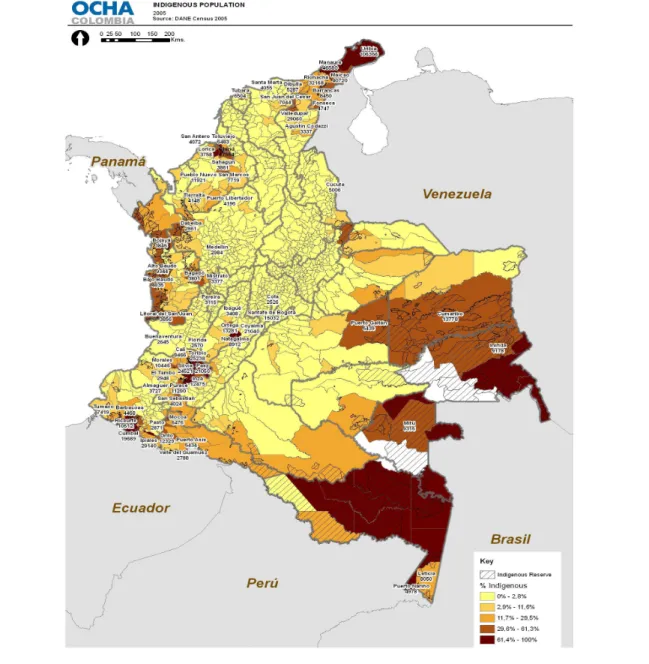
rejecting the agreement. Colombia was divided regionally with most of indigenous,
afro-Colombian, and campesino (rural workers) areas voting in favor of the peace
process and those within major cities inland voting against it (See Figure 2). For
instance, Choco, one of the regions most highly affected by conflict, voted 80 percent
in favor of the peace deal. Individuals in areas such as Antioquia who voted “no” to
the agreement believed that accepting the peace agreement was letting FARC
rebels “get away with murder” (BBC News, 2016). While some believed that they
did not trust guerrillas to keep their promises of disarmament, others did not
support the agreement because the FARC was guaranteed 10 seats in the
Colombian Congress as part of the 2018 and 2022 elections (BBC News, 2016).
Although many Colombians welcome the idea of peace for our nation, many
are also weary of rebels’ motives and are critical of the government’s willingness to
as it sets free thousands of combatants with little to no repercussions or jail time.
Additionally, this also means re-integrating thousands of revolutionaries into
society with the help of governmental services like psychological assistance and
vocational training under tax dollars, which are programs that many of the victims
themselves were not offered or provided (Buschschluter, 2014). Although the
supporters of the “no” vote insist on corrections to the agreement, such as barring
those found guilty of crimes from running for public office, forcing the FARC to pay
their victims compensation, and prison time for FARC leaders, leaders of the
opposition have not made any efforts to renegotiate the deal or formalize talks with
the FARC (BBC News, 2016).
With the past six presidential administrations that failed to properly bring
peace to the country and an increase in skepticism towards government
competence, many civil society leaders have sought peace and empowerment for
their communities on the bases of their own capacities by way of non-violent means,
such as demands for the preservation of human rights, the recovery of collective
memory, solidarity, the development of autonomy, and the revealing of truth and
denouncement of perpetrators, among many others (Sacipa-Rodriguez & Montero,
2014).
Given Colombia’s history of violence, it is not surprising that within the
relative lack of attention that Colombia receives by Western media, the limited
headlines published are dominated by stories relating to themes of internal conflict,
violence, and drug trafficking. Colombia’s drive for peace, particularly by civil
society groups and social grassroots movements has been largely ignored, while
analyses regarding state-level peace initiatives have focused on the ineffective and
futile attempts by a succession of government leaders to negotiate a peace
agreement. Limited research and attention has been devoted to studying and
supporting nonviolent actors in Colombia pursuing peace initiatives, many of whom
are marginalized minorities that hold high stakes within the resolution of the war.
The invisibility of Colombian peace leaders is due in part to “the general
invisibility of the sectors of the population that have been most victimized by
violence, economic policies, and discrimination” (Bouvier, 2009).Among the groups
populations, women, and children. The World Bank estimates that approximately
80 percent of Colombians in rural areas live in poverty, while 42 percent live in
extreme poverty and 15 percent of inhabitants are forced to survive with less than
two dollars per day (Hwang & Cerna 2013). For the duration of the war and beyond,
these populations have endured displacement, illiteracy, food insecurity, and lack of
state policies and infrastructures to uphold and defend their basic human rights.
Response by Minority Social Movements
“To think about the country we want so dearly: a Colombia at peace, with solidarity and kindness for our children; a Colombia that we sadly do not have, due to our own
inability to resolve our differences.” -Permanent Assembly of Civil Society for Peace
On July 30and 31, 1998, over 4000 Colombians met at the Luis Angel Arango
Library in Colombia’s capital to participate in the Permanent Assembly of Civil
Society for Peace. This congregation marked the beginning of “a new level of
organizations of Colombia’s civil society for peace,” as led by an assortment of
representatives from all corners of society: business leaders, prominent politicians,
church hierarchs, academics, union organizers, international accompaniers,
indigenous leaders, and campesino delegates (Bouvier, 2009). Although this
meeting ultimately did not create a detailed roadmap for peace in Colombia, it
nevertheless marked the beginning of similar gatherings throughout the country.
Four years later, another milestone congregation occurred in which actors
met for Bogota’s National Congress for Peace and Country. Unlike the Permanent
Assembly, however, this meeting did not host any elite actors, such as politicians
Permanent Assembly of Civil Society for Peace. The central purpose of this
gathering focused on a desire to restart dialogues for negotiations after the collapse
of government-led peace talks. During times when citizen efforts were small in
magnitude and even smaller in public visibility, such meetings provided spaces for
actors to engage in discourse previously absent in Colombia’s political sphere
(Bouvier, 2009). This movement also aided in linking activists across the country
that might have otherwise been isolated in their efforts. Until this wave of activism,
civil society engagement had been largely nonexistent. In fact, peace talks by former
presidents including Belisario Betancur (1982-1986), Virgilio Barco (1986-1990),
and Cesar Gaviria (1990-1994), spanning over a decade, lacked citizen
representation.
During the beginning of the 1990s, however, Gaviria’s government formally
declared total war against FARC and ELN guerilla groups, and Colombia’s state of
violence became virtually impossible to ignore. Aided by the external context of
public opinion, civil society organizations began guiding pacifist negotiations. Peace
activists helped push for a national agenda of renewed dialogues and witnessed an
overwhelming response by secular citizen groups desiring to join the movement.
Although these organizations struggled to demonstrate how peace would be
tangibly carried out, they nevertheless demonstrated to the Colombian government
that public and civil support would lie first and foremost on open negotiations.
As a response, former President Ernesto Samper’s administration
bridging the gap between governmental institutions and peace groups. This council
was designed to meet one a month to assist the government’s peace policy, as well
as channel civil society’s demands and recommendations (Bouvier, 2009). With
public opinion and government support on their side, large peace gatherings became
a frequent tool for activists. In fact, the country saw an increase of peaceful
demonstrations and hosted some of the largest peace protests that Bogota had seen
in decades, as evidenced when two prominent human right activists were
assassinated in 1998 and activists rushed to the streets to protest injustices.
Alongside Andres Pastrana’s presidency (1998-2002), peace activism continued to
surge, as his administration sought to ensure the success of state-led peace talks
with the FARC.
During this time, the Permanent Assembly of Civil Society for Peace began to
hold recurring “convergences,” which included multi-day, multi-sector meetings
where peace promoters would gather to discuss negotiations and seek consensus on
a common strategy (Bouvier, 2009). Although these significant meetings brought
together activist representatives from all sectors of society, helped to ease
networking, and encouraged free discourse, directors quickly found that the
conferences lacked coherence and were plagued by chaos. Consequently, they failed
to produce detailed recommendations regarding how to achieve goals of human
rights protection and more equitable development (Bouvier, 2009).
Civil society’s ephemeral rise began to deteriorate through structural
Colombian senator, with peace talks coming to a screeching halt. Peace activists
quickly lost Colombian public opinion, as politician Alvaro Uribe, one of Pastrana’s
most vocal critics, moved into first place in the election polls in the 2002
presidential election. The space for activism shrank dramatically as a result of
public skepticism and hostility. In fact, when peace activists assembled in February
2003 to demonstrate near the site of Bogota’s El Nogal social club, where a guerilla
car bomb had killed dozens, they were harassed and shouted down by public
gatherers (Bouvier, 2009). No longer was peace seen as a noble cause, but was
rather seen as “soft” on the guerillas—or even in support of them. What can be
arguably categorized as a Colombian anti-peace movement was further sustained by
the election of President Uribe whose “strong hand” politics made it clear he would
not negotiate with armed groups. Prospects of peace negotiations appeared weak.
Although certainly less than in the peak years of the 1990s, civil society
activism nevertheless remains “vibrant and creative with hope of a renewed
citizens’ movement of peace” (Bouvier, 2009). Peace movement efforts exist most
visibly at the local and regional levels, but continue to gain national recognition by
saving lives through dialogue with armed groups. Across the country, communities
have witnessed women’s organizations demanding gender equality and greater
leadership participation, indigenous communities seeking the defense of ethnic
groups’ autonomy and territory, and children and youth groups leading
communities toward positive change particularly through fighting for an end to
Although peace activism has been less vocal at a national level, I would
nevertheless argue that Colombians are in dire need of civil society peace
movements that are ready to help lead the charge toward a more peaceful and just
country, regardless of the outcome of state-led accords. These renewed peace
movements have learned from past challenges in order to lead a movement that is
“more pragmatic, more proposal oriented, more mature, more politically astute, and
ultimately, more successful in its endeavors” (Bouvier, 2009).
Methodology
The main victims of the country’s pervasive violence are Colombians who
suffer on account of armed groups and who must profoundly endure the scars and
damage of a war they have not created. I am among the millions of Colombians both
directly and indirectly affected by the war. Growing up in Colombia amidst fierce
violence and an adverse environment, I became aware of plaguing conflicts and an
asymmetric war between governmental and rebel alliances at a young age.
Although the vast majority of my childhood memories are inundated with
nostalgia and unconditional love, the deaths of friends and the violation of basic
human rights of relatives were also a significant part of my normal life as a
Colombian youth. In spite of the realities of war I endured, I am marked far more
by the words of Carl Gustav Jung: “I am not what happened to me, I am what I
choose to become.” It is this resilience and the deep hope that the country I love will
This thesis seeks to rectify the neglect of active proponents of peace
initiatives with the aim of considering how amidst Colombia’s culture of violence,
the Colombian population’s non-violent resistance and resilience has allowed them
to both transform and maintain their identity. Through discussing vulnerable
populations’ and civil society peace movements in Colombia, I elaborate on how
forms of nonviolent resistance have shaped both collective and individual identities
in the midst of conflict.
Such initiatives are described in the interviews I conducted for this thesis
with peace activists and leaders of various civil society movements, including
women’s alliances and indigenous and ethnic groups, who have sought their own
forms of peace demonstrations through grassroots level activism. These groups yield
particularly important insights on the conflict given that they have been
disproportionately affected by violence, but both in spite of and as a result of this
injustice, they serve as prime illustrations of sustained promotion of social justice
and the advancement of a culture of peace within their communities. This activism
has played a major role in challenging Colombia’s broken sociopolitical system,
protecting the environment, promoting equality for women, opposing injustice, and
defending the rights of minorities. Through these movements, groups affected by
violence are given the opportunity to protect their own communities in the midst of
state failure and neglect. After suffering the brunt of a cruel war, these
communities have found that peace is the essential system to develop a more just,
Women’s organizations, such as the Initiative of Colombian Women for Peace
(Iniciativa de Mujeres Colombianas por la Paz) or IMP, Women’s House (La Casa de
la Mujer), and National Network of Women (Red Nacional de Mujeres) are the
central focus of my study on women’s grassroots movements. These groups focus on
achieving gender equality, ensuring the support of victims of violence, and fostering
women’s political representation and fair inclusion. The examination of women’s
movements dedicated to ensuring the social, political, and cultural positioning of
women of ethnic and racial minority centers on the study of the National
Association of Peasant, Indigenous, and Black Women of Colombia (Asociación
Nacional de Mujeres Campesinas, Indígenas y Negras de Colombia) or ANMUCIC.
In spite of the peripheral status these groups must withstand within Colombia’s
machista culture, these movements persist in the development and implementation
of prevention, protection, and reconciliation initiatives. Throughout the civil war,
women have been victimized and silenced through exclusion, violence, and
prejudice. These organizations are working to address the pain caused by war in
order to move forward.
As a secondary case study, I analyze ethnic and racial groups, centering on
the National Indigenous Organization of Colombia (Organización Nacional
Indígena de Colombia) or ONIC, as well as the Regional Indigenous Council of
Cauca (Consejo Regional Indígena del Cauca) or CRIC. These organizations
represent indigenous communities across Colombia and call for the defense of
indigenous rights. Additionally, I examine ethnic minorities that have organized
under the support of the Afro-Colombian Peace Council, or CONPA, which is a
distinguished coalition of ethno-territorial and civil rights leaders. Because
Afro-Colombian persons also include a disproportionate number of victims and displaced
communities, under this organization, Afro-Colombian leaders have launched a
non-governmental, ethnic commission of the basis of their own autonomy to progress
peace processes and territorial rights (Sanchez-Garzoli, 2016). Lastly, I study
Puente Nayero Humanitarian Space in Buenaventura, an Afro-Colombian
community that enables local people to continue to live on their land. Through case
studies and oral history interviews with victims of Colombia’s armed conflict, I
analyze the concept of resilience through studying the experiences of Colombians
deeply affected by the results of war and violence, while further elaborating on
approaches to peace-building and identity formation.
The theoretical framework for this thesis includes the formation of a culture
of peace as a contrast to the history of violence conventionally portrayed as a part of
Colombia’s roots, particularly through how the concept of peace may be variously
constructed and interpreted according to different sites and scales. I use a
bottom-up approach to discuss the participation and innovation of civil society grobottom-ups and
how these groups have helped to foster the country’s complex search for peace in the
midst of conflict. Through literary research as well as oral history interviews, I
analyze a wide range of techniques of peacemaking that will be significant to
as diplomatic state-led initiatives, grassroots cultural identity assertions, boycotts,
protective accompaniment, and imperial boundary making practices, among others
(Megoran et al, 2014).
Primarily through literature reviews and studies of organizational projects, I
examine peace building in a time of war and how different actors in Colombia’s
struggle for peace and security engage in preventing state failure. Additionally,
through the use of individual interviews, I discuss the distinctive contributions of
social movements, and how various entities define peace, both as an ideology and in
practice, and how they desire to see these movements actively realized within their
communities and throughout Colombia. Lastly, through conversations with peace
activists, I examine how Colombians’ genuine search for peace has impacted
Chapter 2: Literature Review
“It is from numberless diverse acts of courage and belief that human history is shaped. Each time a man stands up for an ideal, or acts to improve the lot of others,
or strikes out against injustice, he sends forth a tiny ripple of hope, and crossing each other from a million different centers of energy and daring, those ripples build
a current that can sweep down the mightiest walls of oppression and resistance.” -Robert F. Kennedy
Understanding Peace
A largely contested and elusive concept, peace is fundamentally understood
and defined through the reflection of a population through social construction. A
community’s social environment legitimizes norms about what peace is as well as
provides for the opportunities and tools to mobilize support for nonviolence
(Lupovici, 2013). Therefore, rather than viewing peace as a condition, the practice of
peace is a dynamic social construct that is shaped by the space, place, and time
through which it is made. The concept of building a culture of peace is understood
as a class of human behavior, which relates to processes of community coexistence
(Sacipa-Rodriguez & Montero, 2014). Because peace requires ongoing work and
constant progressive change within communities, it is important to view this
concept beyond the idea of a signed declaration, as peace can never be truly
finalized—this ethereal concept is thus the personification of harmonious
relationships and coexistence between communities and individuals, rather than
the idea of an end goal or formalized outcome. Although a ceasefire agreement is a
starting point for reconciliation, peace emerges out of relationships, rather than
documents and policies, as these only allow peace leaders the space to further their
A peace building approach beyond policy and law is particularly significant in
Colombia’s case study. Although Colombia’s government has laws against violent
behavior and homicide, the state’s inability to enact and implement these laws
requires a deeper analysis on how to target the underlying causes violence. Because
rules and expectation of behavior within a culture are highly influential in molding
behavior, including exacerbating and encouraging violence, community
interventions are often fundamental to challenge societal norms to alter and correct
the misconceptions that individuals might have regarding the behavior of others.
Not only can cultural acceptance of violence normalize violent patterns, but it can
also support the use of it. Under these conditions, using violence to resolve conflict
can help to explain why certain countries that experience “high levels of one type of
violence also experience increased levels of other types” (World Health
Organization, 2009). In response, community approaches that seek to teach healthy
relationships and a more realistic sense of positive behavioral norms from the
bottom up have found a reduction in violence (World Health Organization, 2009).
The ultimate purpose of nonviolent resistance exists as a way to confront
violence in order to strengthen social justice without the use of direct violence
(Woon, 2014). As such, nonviolence exists beyond a belief system, but is rather an
effective technique of political behavior that can help enact anti-geopolitics, which
exists as a challenge to the geopolitical power of states and the political systems
2014). Nonviolent action can serve as an effective means for challenging oppressive
and violent relationships.
Despite the ever-changing nature of peace, the creation of a peace culture
crucially relies on establishing common behaviors and attitudes that reflect
principles of freedom, justice, democracy, civil rights, and tolerance
(Sacipa-Rodriguez & Montero, 2014). Commitments to non-violence inspire social
interaction while preventing conflicts through dialogue and negotiation. These
approaches help to ensure the preservation of full human rights of all parties
involved. Although peace is built through social interactions, lasting peace is not
merely the absence of direct, physical violence established through ceasefires,
accords, and mutual agreements, but it is rather sustained through “ethical,
harmonious interactions in situations as small as personal relationships and as
large as the global system of nations” (Barash, 2010). Consequently, as human
interactions occur over time and space, it is necessary to focus on how relationships
are continuously reconfiguring themselves so as to redefine peace and its goals.
Under this understanding, many of the community leaders I study seek to establish
peace by rebuilding the social fabric in their communities through principles of
empathy, solidarity, dialogue, and reconciliation—fundamental to bettering
communal relationships.
To construct a culture of peace, communities have developed resources to
empower victims of conflict. Through methods such as international
memory, survivors and activists find dignifying ways for reclaiming their
self-esteem and re-signifying feelings from trauma. By creating communities around
traumatic experiences with other individuals that have suffered in the same way,
individuals are able to develop a sense of being useful as well as develop hope in the
future. Rather than working on violent solutions, communities use discourse to
declare violence as the underlying problem. Through these techniques, peace
practices are seen as a class of human behavior. For instance Campesino University
in Colombia, established in 2004 by the first peace community, San Jose de
Apartado, began a project in which community members shared experiences of
suffered trauma as a result of permanent threats by armed groups and their
responses through non-violent resistance to war (Sacipa-Rodriguez & Montero,
2014).
Peace education has also become an established practice to build sustainable
peace. The proposals under peace education view schools as vitally interconnected
with the community, as the community itself is a context for learning through daily
activities. Under psychosocial approaches to building peace, these education
systems “evoke active, creative, and transformative paths to knowledge”
(Sacipa-Rodriguez & Montero, 2014). Education is thus essential to form Colombia’s peace
culture to ensure teaching peaceful conflict resolution, responsible citizenship, and
the promotion of tolerance and respect (Underwood, 2015). Through the active
formation of a peace culture, more inclusive identities are constructed that abandon
The ethics of positive peace incorporates eight extensive areas identified in
the United Nations’ Universal Declaration of Human Rights, which center on the
conditions for a just and sustainable peace, extending beyond simply non-violence.
This includes the use of education to socialize individuals into forming pacific
communities formed under an emphasis of negotiation, resolution, non-violence, and
dialogue; gender rights and equality, which are assessed through the degree to
which women’s voices, opinions, and public power are honored; respect for human
rights of all population groups; the advancement of international peace and security
over the procuring of arms and power; the promotion of tolerance and solidarity as
reflected by a country’s expanse of internal displacement; measures of democratic
participation; and the presence of equitable, sustainable development allowing for
the implementation of personal welfare (Sacipa-Rodriguez & Montero, 2014).
To ensure the development of more inclusive societies and peaceful cultures
under conceptions of positive peace, public leaders must forgo contentions of
division and social confrontation that are reflected in public discourse. Instead, they
must work to establish extensive and inclusive identities and eliminate notions of
“good” and “bad” Colombians. This allows for the establishment of social categories
that welcome all citizens—even those who are armed actors in Colombia’s conflict
(Sacipa-Rodriguez & Montero, 2014). Under these ideals, alternative movements
towards peace have sought to create a culture that advocates for a set of objectives
and systems that directly incite conscious behavioral change. This style of peace
non-violent actions on cultural, political, economic, and social dimensions. Such a
construction of a culture of peace values discourse and humanizing practices as a
supreme good, while committing to reconciliation and the protection of all citizens
through non-violent means, particularly those most vulnerable in society.
Theoretical Framework: Geographies of Peace
The theoretical approach of geographies of peace serves as a basis for
understanding grassroots peace activism in Colombia, as this framework exposes
the ways in which peace is constructed, interpreted, and experienced in distinctive
spatial, cultural, and temporal contexts (Megoran et al, 2014). This geographical
approach aims at understanding concepts of peace under “a broad umbrella rather
than a narrow dogma” and contends that peace is not simply a matter of territory,
but rather is shaped by the space through which it is made (Megoran et al, 2014).
This framework argues that geography can be used to build peace, not as an
endpoint or static achievement, but as an ever-changing form of socio-spatial
relations (Koopman, 2011).
Because “much can be learned from the different discussions about what
peace means in different places and spaces, and the ways people there are trying to
build it,” geographies of peace examines sites of peace-building to understand how
peace is essentially constructed and interpreted by various alternative peacemaking
efforts (Megoran et al, 2014). This understanding allows for the re-creation of
political geography and how it can contribute to peace. Activists and community
through the practice of acknowledging the physical, structural and cultural violence
that is pervasive in Colombian communities; nonetheless, they continue to
dynamically focus on actively constructing peaceful geographies as a contrast to the
aforementioned structures of violence.
An understanding of human rights is a crucial tool for building such peaceful
geographies, as this composition allows for the implementation of technical
practices that promote peaceful, more fruitful social relations. Human rights offer a
normative, pro-positive vision of peace as they can be used as a measure for
realizing less violent and oppressive community and cultural relations. Under this
understanding, the promotion and successful implementation of human rights is an
essential means to achieving sustainable peace. The social movements I study use
discourse and the promotion of human rights to develop understandings and
frameworks of continual peace building (Megoran et al, 2014).
Geography’s contribution aims at understanding peace in expansive and
multidimensional terms as well as “offers the possibility of capturing the complex
reality of peace both through the discipline’s integrated approach and the
foregrounding of concepts of space, place, and scales” (Megoran et al, 2014). This
theoretical understanding focuses on grassroots peacemaking practices and how
geography can be used to build peace, as peace is “inherently special.” Rather than a
matter of territory, peace is made and shaped through the space where it is
practiced. For instance, in the case of protective accompaniment, a grassroots
wearing a uniform, carrying a white flag, or the performance of presenting their
notification letter—but also by the practices by other actors, such as the Colombians
they are accompanying and the armed actors that are threatening them (Megoran
et al, 2014). Under this example, alternative peacemaking efforts are used as a way
of re-imagining political geography and how it can contribute to peace (Megoran et
al, 2014).
Because it seems that peace is not evenly distributed nor does it occur the
same everywhere, rather than being understood as an endpoint, peace is also
shaped through the scale and place through which it is made (Koopman, 2011).
Scale analysis in this sense is a fundamental geographical concept not only to
understanding how conflict is initiated and sustained, but how conflict is resolved
through peace building. For instance, a study of intrastate local variations in wealth
distribution found that the risk of violence exponentially increases in areas with low
income, particularly in developing countries with significant income inequality
(Kobayashi, 2012). While at local scales, conflict is often waged against individuals,
households and communities, at a global level, terror and violence are most
significant within countries ranked as least developed by the United Nations
Human Development Index (Kobayashi, 2012).
Movements and ideas for peace involve a wide range of thinkers and activists
that must lead the shift into a culture of peace (Megoran et al, 2014). This process
stems from the recognition and valuing of identities, territories, and alternative
Colombia are exceptionally in need of reconstruction of identities led by
mobilizations that favor peace and value life. In order to challenge structural
violence, Johan Galtung, founder of the discipline of peace and conflict studies,
argues that four steps are ultimately necessary to ensure grassroots development.
These include confrontation, struggle, decoupling, and recoupling. Step one,
confrontation, involves clearly selecting issues that encapsulate the broader conflict,
and then stating the desired outcome. Step two, embarking on a struggle, focuses on
overcoming repression and exploitation by means of nonviolence. Nonviolent
struggle is a technique to address conflict and devising an alternative to violence.
Decoupling, which is step three, centers on noncooperation, which is a common form
of nonviolent resistance that involves breaking relationships with the oppressor at a
social structure level in order to build autonomy and the capacity for self-reliance.
The final step, recoupling, is the final goal of this framework, which focuses on
“achieving a horizontal structure, one with human rights instead of repression,
equity instead of exploitation, autonomy instead of penetration, and solidarity
instead of fragmentation” (Achankeng, et al., 2015). Galtung’s framework regarding
the transformation of structural violence for peace allows for the conceptualization
of “practical avenues of peace” (Loyd, 2012).
Scale and place can also be examined through a gendered perspective, which
will be fundamental to this thesis’ analysis of women’s peace movements in
Colombia. Because men and women experience the effects of war in vastly different
while women are more often victims of crimes of rape, mutilation, and forced
displacement—warfare is “profoundly changeable in response to changing
conditions” (Kobayashi, 2012). Likewise, nonviolent resistance to war and the
creation of peace-building conditions is contingent on the conditions of the space in
which it is made. Feminist geographers have developed the term antiviolence,
which is synonymous to the contemporary movement to end violence against
women, including domestic violence and rape, among others, as a way to study
violence outside of nation-state frameworks. Women’s movements for antiviolence
allow for a broader understanding of how various groups of people experience
violence uniquely and seek to transform it (Loyd, 2012).
Under Galtung’s aforementioned framework of conflict transformation,
women’s movements’ selection and identification of the issue, in this case, domestic
violence, allows for the encapsulation of broader themes of gender and sexual
oppression. As I will discuss in my research, these movements have been able to
form their own institutions and communities to create horizontal structures for
more community and local accountability outside of state reliance.
The groups featured in this thesis search to reduce violence while creating
spaces for peace building. In the case of Colombia, sub-alternative movements have
provided a space for public debate, discourse, and social and political awareness,
which has contributed to the formulation of peace agendas for these communities
(Rojas & Meltzer, 2005). Although all the communities I examine are looking for
and justice means within their own context and culture, depending on varying goals
and priorities. The contributions that each civil society group has furthered deepens
the understanding of what peace means to different communities, what
methodologies should be employed to achieve peace, and how we might theorize
peace. Consequently, this research aims at understanding peace in more expansive
and multidimensional terms.
Understanding Resilience
Because intense suffering and constant abuse can create the psychosocial
belief that peace is unattainable and inaccessible for victims of war, individuals that
strive to overcome or mitigate the effects of violence through resilience tactics
demonstrate a notable step towards constructing a culture of peace. These
approaches for resilience, as exemplified in the case studies I will discuss, include
the idea of building consciousness in favor of a peace agenda; proactively objecting
to violence; promoting pro-peace conditions such as coalitions, marches, and strikes;
and seeking social action regarding peace and conflict resolutions within local
communities and other organizations.
Viewed by the United Nations International Strategy for Disaster Reduction
as “more of a process than an outcome,” resilience exists as a transformative process
of strengthening the capacity of individuals or communities to manager and recover
from shocks (Kindra, 2013). Although every individual experiences stressful events
in his or her life, resilience is “the capacity and dynamic process of adaptively
fundamental protective system for human adaptation and development and takes
multiple forms, including stress resistance, recovery, and positive transformation.
The concept covers three specific kinds of phenomena: overcoming the odds in
high-risk groups of people, maintaining effective functioning under highly adverse
conditions, and regaining normal functioning following the exposure to traumatic
experiences or conditions. Resilience in this sense involves positive transformation
patterns in which an individual improves in the course of a crisis (Masten &
Obradovic, 2008).
Researchers of resilience argue that just as “all disasters are local,” at least
in the short term, human resilience appears to be local, as it emerges from
individual and small community action. Resilience is found in relationships within
microsystems, which include family members, peer groups, and school systems.
Larger “exosystems”, though they may facilitate resilience, are not as likely to be
available during a major conflict or disaster. In turn, the functional presence of
values, memories, and cultural knowledge that individuals and families carry with
them all the time acts as a secure-base for positive development (Masten &
Obradovic, 2008). This research furthers the understanding of how victims of
conflict develop and enhance resilience through positive coping mechanisms and the
mitigation of stress responses. This ability is used in a variety of different ways by
the case studies in this research through various strategies, including
problem-solving approaches to difficulty, ability to adapt to change, drawing on a range of
Chapter 3: Research Design
“There is a huge social movement and it is growing. They are women, youth, children, communities, the non-traditional sectors—this is where the hope for a
change in Colombia resides these days.” –Ana Teresa Bernal, civil society leader
Method
To establish a comprehensive analysis of peace building in Colombia, I
examined peace initiatives by non-faith based civil society and minority peace
movements. Primarily, I focused on marginalized and vulnerable communities that
have been significantly affected by Colombia’s armed conflict and widespread
violence. My study defines peace initiatives through peace studies theories
established by Angelika Rettberg, Director of the Peace Building Research Program
in Colombia, which defines these movements as “collective initiatives structured
around the purpose of identifying and laying the foundations for a lasting peace in
Colombia by way of non-violent techniques” (Rettberg, 2006). To distinguish and
select pertinent case studies, initiatives had to fit one or more of the following
criteria: (1) carry the label of “peace” within their name, (2) emphasize peace within
their organizational mission, (3) implement tasks related to peace building among
their mission, such as human rights promotion, local development, or democracy
advancement.
Such an intentionally broad criteria allows for the inclusion of a variety of
experiences, objectives, cultures, geographical spaces, social classes, and gender
affiliation (Rettberg, 2006). The broad social, economic, and cultural affiliations of
social and/or ethnic affiliation, which resulted in two main case studies—women’s
contributions to peace building and local and regional peace initiatives by racial and
ethnic groups. The main theoretical principles put in practice by peace initiatives
that I study include initiatives for indigenous autonomy, non-violent resistance to
conflict, peace development and support, peace education, and resilience as a means
of empowerment. As such, these organizations are recognized as initiatives that
engage in an intentional search for peace.
Because regional and local populations in Colombia often find themselves at
the mercy of guerrillas and paramilitary forces while enduring the burden of
excessive force and violence outside of government assistance, individual
communities have established their own systems of support for survival through
measures that ensure security, justice, and governance. Women in Colombia are
often seen as passive victims and little regard is given to their roles in fostering
peace and justice in Colombian society; however, women, along with ethnic and
racial groups are at the forefront of non-violent resistance efforts (Rojas, 2004).
Women’s groups are creating a unique peace constituency in Colombia
because they have sought to unite common agendas for peace building that unite
marginalized Colombians across racial, geographical, and class boundaries (Rojas,
2009). They are active in all levels of society, ranging from local community
organizations to national coalitions representing the needs of women countrywide.
Alliances such as Casa de la Mujer (Women’s Home), Iniciativa Mujeres por La Paz
Women), Mesa de Incidencia Política de Mujeres Rurales Colombianas (Advocacy
Table for Rural Women of Colombia), and Asociación Nacional de Mujeres
Campesinas, Indígenas, y Negras de Colombia (National Association of Peasant,
Indigenous, and Black Women of Colombia) illustrate a wide diversity of
perspectives within women’s groups that are fighting for the ultimate goal of
durable peace and justice.
The methodologies presented by these networks vary widely and include
advocacy efforts to raise awareness and protect the rights of victims, promotion of
women’s participation in the national arena, arrangement of public debates and
discussions, and participation in decision-making in regards to issues of peace,
reconciliation, and security (Rojas, 2009). Despite the various approaches seen
across gender activists, all of these groups actively work with community-based
organizations to provide support and solidarity for individuals in the country’s most
war-affected regions. Examining women’s activism is crucial to understanding peace
building in Colombia, as it “adds to the understanding of how gender has shaped
women’s relationship to conflict and peace—both as victims and protagonists for
change” (Rojas, 2009).
My second case study analyzes resistance by ethnic and racial groups as a
tool for peace building in Colombia, as witnessed through organizations like Consejo
Nacional de Paz Afrocolombiano (the Afro-Colombian Peace Council), Organización
Nacional Indígena de Colombia (the National Indigenous Organization of
of Cauca). The primary goal of these groups center on the resistance of “widespread
physical, economic, and political aggression” that continue to threaten the lives and
livelihood of Colombia’s racial and ethnic minorities (Wirpsa et al, 2009).
Indigenous people in particular have been disproportionally affected by war
with over 30 percent of Colombia’s indigenous battling the effects of violence and
war, with 67 percent displaced in the Cauca Department of Colombia. Because
indigenous culture, society, and ultimate survival are deeply rooted in land and
territory, indigenous peoples are particularly vulnerable to the wide scale
displacement that has occurred as a result of Colombia’s armed conflict. As such,
indigenous health, education, and subsistence are severely threatened.
Comparably, 70 percent of Afro-Colombians live in urban and peri-urban
areas across the country and often serve as the “natural custodians of the country’s
biodiversity on which they depend for their subsistence and the maintenance of
their cultural identity” (Minority Rights Group, n.d.). Black communities also
practice a wide variety of agricultural tasks, including crop diversity and animal
husbandry. Consequently, they have often found themselves in a struggle for
control of territory over the armed forces’ exploitation of collective lands.
Afro-Colombian political consciousness has also developed to serve as black resistance
against oppression, ethnic discrimination, and cultural hegemony.
However, in spite of such complex systems of oppression hindering progress
of ethnic and racial minorities, indigenous communities and Afro-Colombians
environmental and economic sustainability, and peaceful coexistence. Such
movements play a fundamental role in influencing and structuring institutionalized
peace strategies across the nation that continue to denounce political, economic, and
violence by armed actors. Because indigenous peoples and blacks have been
“innovators of grassroots organization, resistance, and peace initiatives,”
understanding the dynamics within these communities allows for holistic
appreciation of the complex systems of minority resistance and community activism
for peace (Wirpsa et al, 2009). The education for the promotion of a culture of peace
that these groups provide directly promotes the development of knowledge,
attitudes, and abilities related to a peaceful coexistence. Additionally, the promotion
of the participation of democracy empowers the most excluded sectors of society to
transform their environments nonviolently (Chaux & Velasquez, 2009).
Through civil society participation, the formulation of peace agreements and
processes will have greater legitimacy and a greater likelihood of implementation.
Because of historical state inability to conduct successful negotiations with the
FARC, local and regional movements continue to “fill the gap at the grassroots
level” (Bouvier, 2006). With over 30,000 peace initiatives across the country, local
groups find a home principally in regions of violence and conflict that have been
largely ignored by state institutions. Through the formation of networks and
coalitions of a diverse variety of actors, peace activists have succeeded in bringing
together leaders across the country to create an agenda for peace. In the words of
organized a community, the less vulnerable it is to violent conflict and the more
capacity it has to present nonviolent alternatives to reconfigured social relations”
(Bouvier, 2006).
The approaches undertaken by these organizations are particularly
significant because to move forward towards meaningful solutions, national
frameworks must take into consideration the root causes of the conflict so as to
better address systemic elements of violence (Lederach, 2005). Peace initiatives in
Colombia promote the inclusive participation of communities, democracy, the
protection of human rights, nonviolent resistance, and the transformation of social
conflicts. Through these coalitions, social leaders work to protect their community
from corruption and violence, satisfy the basic needs of their population, and
empower citizens through inclusion (Bouvier, 2006). All of these organizations
ultimately serve as networks of solidarity that incorporate the inclusion of all actors
in society to participate in sustainable and lasting peace (Abozaglo, 2009).
Data Collection
The data sources used for this research include books and commentaries on
the topics of peace building and the development of geographies of peace, as well as
interviews with various peace activists and civil society peace leaders across
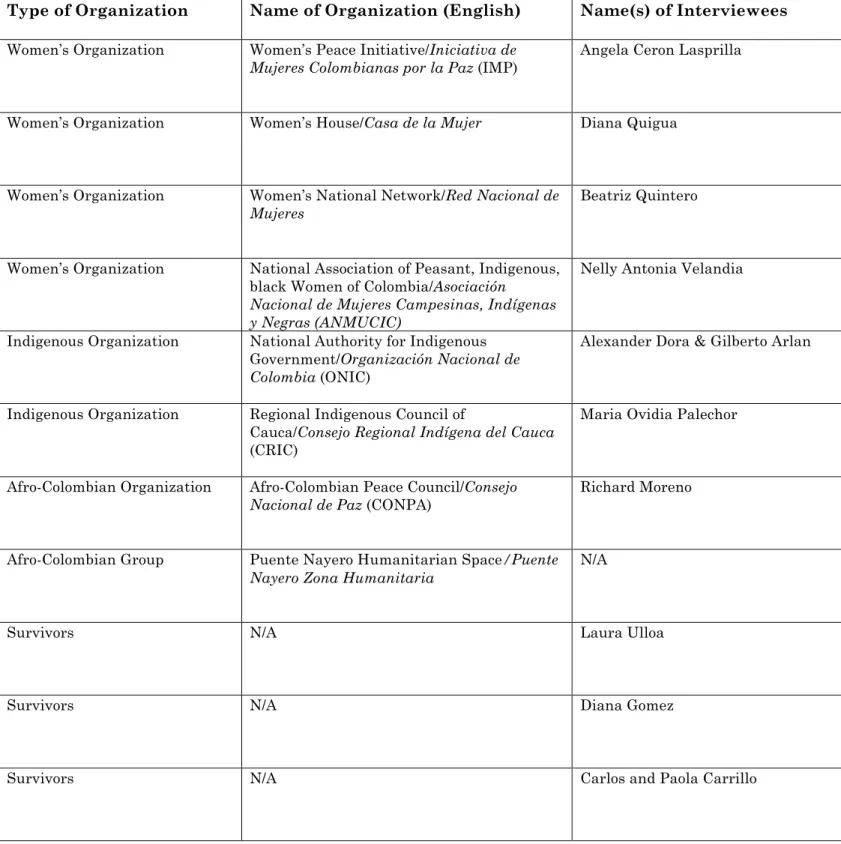
Colombia. The extensive interview processes I conducted of individual case histories
were particularly essential to developing this thesis (See Figure 3). I originally
conducted interviews with 31 groups, including indigenous organizations, women’s