AN INVESTIGATION OF EUROAMERICAN CERAMIC USE IN THE CATAWBA NATION, 1760-1820
By Chris LaMack
Honors Thesis Curriculum in Archaeology
University of North Carolina at Chapel Hill
2019
TABLE OF CONTENTS
List of Figures ... 3
List of Tables ... 5
Abstract ... 6
Acknowledgments ... 7
Chapter 1: Introduction ... 8
Project Outline ... 8
Site Selection ...12
Organization of the Thesis ... 15
Chapter 2: Historical Background ... 16
The Catawba Nation: A Brief Historical Overview... 16
Early Contact Period (c. 1675-1715) ... 17
Coalescent Period (1716-1759) ... 18
Late Colonial (1760-1775) and Revolutionary (1775-1781) Periods ...21
Federal Period (1781-1820) ... 22
Late Reservation Period (1820-1840) ... 23
Description of Sites ... 24
Old Town (c. 1760-1800) ... 25
Ayers Town (c. 1781-1800) ... 30
New Town (c. 1790-1820) ... 35
Chapter 3: Methodology ... 46
Hollow Forms ... 48
Flat Forms ... 49
Teawares ... 50
Discussion of Ware Types ... 51
Earthenwares ... 52
Stonewares ... 58
Porcelains... 60
Chapter 4: Euroamerican Ceramics at Old Town and Ayers Town ... 62
Euroamerican Ceramics at Old Town ... 62
Euroamerican Ceramics at Ayers Town ... 69
Catawba-Made Ceramics at Old Town and Ayers Town ... 76
Chapter 5: Euroamerican Ceramics at New Town ... 79
Locus 2 ... 79
Locus 3 ... 83
Locus 4 ... 87
Locus 5 ... 90
Locus 6 ... 94
Catawba-Made Ceramics at New Town... 100
Chapter 6: Conclusion ... 104
Discussion ... 104
Opportunities for Further Research ... 110
List of Figures
Figure 1. Map depicting historic Catawba sites that have been investigated
archaeologically by the Catawba Project ... 25
Figure 2. Site map of Old Town showing areas excavated between 2003 and 2017 grouped by Loci ... 27
Figure 3. Plan of Old Town Locus 1 with features and hypothesized cabin outlines ... 29
Figure 4. Plan of Old Town Locus 2 with Features and hypothesized cabin outlines .... 29
Figure 5. Plan of Ayers Town with interpretation ... 32
Figure 6. Site map of Ayers Town indicating locations of features ... 34
Figure 7. Site map of New Town showing Loci and areas excavated between 2003 and 2005 ... 37
Figure 8. Excavation plan of Cabin Locus 2 at New Town ... 40
Figure 9. Excavation plan of Cabin Locus 3 at New Town ... 40
Figure 10. Excavation plan of Cabin Locus 4 at New Town ...41
Figure 11. Excavation plan of Cabin Locus 5 at New Town ... 42
Figure 12. Excavation plan of Cabin Locus 6 at New Town ... 43
Figure 13. Sample of Euroamerican sherds from Old Town showing range of ware types ... 63
Figure 14. Sample of Euroamerican sherds from Ayers Town showing range of ware types ... 70
List of Tables
Table 1. Data Used to Calculate the Mean Ceramic Date for Old Town ... 68
Table 2. Data Used to Calculate the Mean Ceramic Date for Ayers Town ... 75
Table 3. Comparison of Euroamerican and Catawba-made Vessel Forms at Old Town and Ayers Town ... 78
Table 4. Data Used to Calculate the Mean Ceramic Date for New Town Locus 2 ... 83
Table 5. Data Used to Calculate the Mean Ceramic Date for New Town Locus 3 ... 86
Table 6. Data Used to Calculate the Mean Ceramic Date for New Town Locus 4 ... 90
Table 7. Data Used to Calculate the Mean Ceramic Date for New Town Locus 5 ... 94
Table 8. Data Used to Calculate the Mean Ceramic Date for New Town Locus 6 ... 98
Table 9. Comparison of Vessel Forms Between New Town Loci... 99
ABSTRACT
This thesis addresses an undeveloped aspect of Catawba lifeways and material culture during the late eighteenth and early nineteenth centuries: the presence of increasingly large quantities of Euroamerican ceramics on archaeological contexts associated with Catawba occupation. Although the Catawba, a coalescent nation driven into existence by the direct and indirect pressures of European contact, have long been players in colonial markets, evidence for Euroamerican ceramics in particular seems to explode from Late Colonial and Federal period contexts. Why, at the same time that Catawba ceramic production reached its peak, did the Catawba consumption of
Euroamerican materials also increase so dramatically? What were the mechanisms by which Euroamerican vessels were acquired and integrated into Catawba life? And how did such objects feature in rapidly changing relationships and modes of interaction between the Catawba and their Euro-American neighbors? This thesis will attempt to address these compelling questions through the detailed analysis of the non-Catawba-made ceramic assemblages of three late eighteenth and early nineteenth century sites —
ACKNOWLEDGMENTS
It is safe to say that this project would have been nowhere without the guidance and straight shooting of my advisor and mentor, Dr. Steve Davis. A more patient man there is not. I would also like to thank my committee members, Dr. Anna Agbe-Davies and Mr. Eric Deetz. All of you gave me everything I needed to get here. Thank you to everyone at the Research Laboratories of Archaeology for all the incredible
opportunities I’ve had during my time here, for the friends I’ve made, and for letting me
CHAPTER I
INTRODUCTION
Project Outline
The Catawba are members of a Native American group centered on a reservation along the banks of the Catawba River which touches modern York and Lancaster
counties in the South Carolina Piedmont. The only federally recognized Native nation in South Carolina, the current territorial composition of the Catawba Nation has its roots in a land claim recognized by treaty with the British in 1760, by which time the Catawba had been a long-standing ally to the South Carolina colonial government (Cranford 2018). In the decades leading up to this watershed consolidation of Catawba territory, a diverse community of Native groups had been engaged in building a coalescent polity to combat the pressures of political, economic, and population change unleashed by
European contact and colonization (Davis et al. 2015). The ability of these groups to adapt to new challenges forged the Catawba Nation — a Native society that engaged with Euro-American colonialism on its own terms — and ensured its continued existence to the present day.
the Late Colonial and Federal periods of Catawba history. Although the Catawba, a coalescent nation driven into existence by the direct and indirect pressures of European contact, seem to have long been players in colonial markets — and in fact made use of such networks to parlay strategic partnerships with British colonial regimes — evidence for Euroamerican ceramics in particular seems to explode from Late Colonial and
Federal period contexts (Davis et al. 2015). This inundation is made all the more curious when one accounts for the fact that, at the same time as they seem to be acquiring large numbers of non-Catawba-made wares, the Catawba themselves were in the process of developing and expanding their own commercial ceramic enterprise. Sales of Catawba wares, which emulated Euroamerican forms and motifs with distinctively Catawba flavor, filled a market for robust, inexpensive pottery in the Carolina backcountry (Riggs 2010). They also served to sustain the Nation economically as the Catawba worked to redefine and reinvent their relationships with their neighbors in the wake of upheaval after upheaval.
Why, then, at the same time that Catawba ceramic production reached its peak, did the Catawba consumption of Euroamerican materials also increase so dramatically? What were the mechanisms by which Euroamerican vessels were acquired and
and adaptation, by which Catawba society evolved rapidly in response to new pressures and quickly changing times. Second, it will present a formal analysis of identifiable ceramic artifacts, noting the types and styles of Euroamerican wares from Catawba contexts. Such information may provide insight into any apparent preferences on the part of the Catawba for non-Catawba-made objects to fill certain functions, whether those functions be related to the preparation or consumption of certain foods or beverages, or to the production of Catawba-made wares, either as models or physical templates. Finally, the project will consider the potential role of Euroamerican ceramics as objects of payment in kind for Catawba land rented by non-Catawba settlers through a formal land-leasing system instituted in the mid-1780s and developed through the end of the Federal period, and as evidence of Catawba integration into Euro-American
markets (Pettus 2005).
This project is intended to build on the great body of archaeological and historical research conducted by the University of North Carolina Research Laboratories of
the space of only a few years, seem to have developed a brand new — and, crucially for a coalescent nation, highly uniform — style. The new Catawba pottery innovated on forms introduced by European colonizers, and found a niche in non-Catawba societies as both a utilitarian ware and, eventually, a desirable ceramic art form. Despite the attention afforded to the development of this novel Catawba pottery, however, relatively little has been said of the Euroamerican pottery that also found its way into Catawba homes in increasing amounts. Understanding the role and conceptualization of these wares has significant implications not only for the reconstruction of the commodity and exchange networks of which the Catawba were a part, but also for the exploration of how the Catawba themselves conceived of their place within such networks during the Late Colonial and Federal periods.
The term Euroamerican, used throughout this thesis to refer broadly to non-Catawba-made ceramic wares recovered from Catawba sites, indicates the pottery
tradition carried to the South Carolina Piedmont by settlers from Europe. Specific wares in the eighteenth and nineteenth century Euroamerican tradition found on Catawba sites will be discussed in detail in Chapter 3. For the most part, the term reflects the geographical origins of the pottery under discussion, which was made largely in various production centers in what is today the United Kingdom, but also in the Netherlands, in France, in Germany, and by European transplants to North America, whose own
East Asia, they are included under the term Euroamerican because they were
introduced to the South Carolina Piedmont by European cultural interface, and thus are part of the same material vocabulary as European wares or North American wares produced in the European tradition. Late eighteenth and early nineteenth century Catawba-made wares themselves had a place within this vocabulary, and in many ways were products of contact between local and immigrant ceramic traditions, but are differentiated from contemporary Euroamerican ceramics in Catawba contexts because they were internally produced, rather than imported. The related but slightly different term Euro-American refers to the settlers that brought and perpetuated the
Euroamerican pottery tradition from Europe, and reflects the socio-political transition during the period discussed in this thesis engendered by the American Revolution.
Site Selection
This study concerns itself primarily with the ceramic assemblages of three Catawba Project sites: Old Town (RLA-SoC 634), occupied in two phases roughly
between 1760 and 1800; Ayer’s Town (38YK534), occupied roughly between 1780 and
1800; and New Town (RLA-SoC 632/635), occupied roughly between 1790 and 1820. All three sites are situated within the original Catawba Nation reservation formalized in 1760 under the Treaty of Pine Tree Hill, and confirmed by the Treaty of Augusta in 1763 (Brown 1966). Collectively, they provide a material record of roughly six decades of Catawba lifeways, years which comprise some of the most socially and politically
population never truly recovered and which heralded a complete reinvention of Catawba economic structures — and the ratification of the 1840 Treaty of Nation Ford, which left the Catawba itinerant, dispossessed of their lands, and set adrift among white Euro-Americans in an ever-increasingly race conscious South (Davis et al. 2015). One site, Old
Town, was witness to the collapse of the Catawbas’ historic alignment with the British colonial government and their fateful decision to support American revolutionaries in their war for independence — a decision which left the Catawba refugees for the second time in nearly as many decades. All three towns coincide with the growth of a land-leasing system, by which Catawba let Nation land out to non-Catawba lessees; New Town remained a Catawba village even amidst the breakdown of this system, when old
tenants began to disregard their lands’ former status and encroachment reached a fever
pitch (Pettus 2005). They provided homes for Catawba traders to return to after many a sojourn in Charleston to sell their wares and restock their own supplies, and anchors for the kinship networks that first transcended and eventually obliterated the heterogeneity of the Catawba past. After the last of the living Catawba had gone, they provided refuge for the dead.
Before the return of the Catawba from Pine Tree Hill (now Camden), South
Carolina, following members’ participation in the Quebec Campaign and the subsequent devastation of the 1759 epidemic, Catawba use of Euroamerican ceramics seems to have been quite minimal (ceramic use among the Early Contact and Coalescent period
have preserved solid, usable data in which to ground my interpretation. Evidence from sites with solid Catawba provenience from after the abandonment of New Town in c. 1820 does not exist as of the time of writing. Only one other known site — the Bowers Site (38LA483), known traditionally as Turkey Head, occupied from around 1800 to the 1820s — is roughly contemporaneous with New Town, and as such has the potential to provide an additional lens through which to view the Catawba Federal period.
Unfortunately, the material record at this site is quite limited, and as such can contribute little in the way of interpretive value. An additional site, the Nisbet Site (RLA-SoC 638), was occupied around the same time as the first Catawba occupation of Old Town (c. 1760-1780), but material recovered from this context represents too small a sample to be of use to this analysis. Consequently, this thesis will not consider material from the Bowers or Nisbet sites.
Archaeological investigations at Old Town, Ayers Town, and New Town were conducted by the RLA between 2002 and 2017, under the direction of Drs. R. P. Stephen Davis, Jr. and Brett H. Riggs. This coherence of direction ensures methodological
consistency in data recovery and documentation from site to site, and provides a stable basis for making comparative claims. Recovered materials, which have been nearly completely sorted, cleaned, and catalogued, are housed in the North Carolina
of insight to draw on in contextualizing this project within the social landscape of the Late Colonial and Federal period Catawba. I found utilizing extant assemblages in my analysis, rather than generating additional data through fieldwork, quite happily in keeping with my notions of academic responsibility vis-à-vis the present crisis of
curation. And, although I do not pretend extensive involvement in the Catawba Project, I was fortunate enough to have been employed as a field assistant on the RLA’s 2017 excavation at Old Town, and was a part, albeit a small part, of the recovery of some of the data interpreted here.
Organization of the Thesis
This thesis is divided into an introductory section, four body chapters, and a conclusion. Chapter 2 contextualizes this research, providing an overview of Catawba history and descriptions of each of the three sites the thesis will draw on. Chapter 3 discusses the methods of the investigation. Chapter 4 explores the place of
CHAPTER II
HISTORICAL BACKGROUND
The Catawba Nation: A Brief Historical Overview
Accounts of the history of the Catawba frequently begin with the travels of Englishman John Lawson, who arrived in the New World in 1700 and embarked on his first foray into the Carolina interior from Charles Town (Charleston) in late December of that year. Lawson, in his New Voyage to Carolina, provides the earliest known English
language reference to the “Catawba” identifier, describing his stay for one night at the
home of the “Kadapau King” (Moore 2002). However, the society inhabited by the people that this early observer encountered — the Esaw, Sugaree, and Kadapau —
differed fundamentally from that of both the earlier Late Woodland piedmont and the later Catawba Nation; the region was in the midst of negotiating a wide-reaching restructuring in response to the seismic political, economic, demographic, and cultural changes of the previous century.
Nor was Lawson the first European to meet the people who would become
Catawba. It is possible that the German John Lederer made contact with one or more of these politically distinct but culturally related groups, who spoke languages that, though heavily regionally inflected, shared Siouan roots; however, a number of inaccuracies in
Lederer’s claims —among them his assertion that these “Ushery” lived near brackish
water — make his account suspect (Davis et al. 2015; Randolph 1973). Tantalizing
whom Pardo may have met in the region of modern-day Charlotte, North Carolina, raise at least the possibility of a sixteenth-century Spanish contact date (Moore 2002).
Sustained economic relations between Europeans and the Esaw-Sugaree-Kadapau was established around 1676, around the same time that colonial polities in Virginia and Charles Town became preoccupied with forging military alliances with certain Native American groups in attempts to mitigate the perceived threat they posed (Davis et al. 2015; Moore 2002). In any case, such uncertainties make it clear that “contact” between
the disparate groups that would become the Catawba Nation and the European colonizers was less an event than a process.
Early Contact Period (c.1675-1715)
colonial regime, it attracted émigrés, such as the Wateree and Saura, who further bolstered the Catawba population (Davis et al. 2015).
James Merrell has argued that the Europeans’ enthusiastic pursuit of trade
relations with these proto-Catawba during the Early Contact period (c.1675-1715) should not be seen as an imposition of a new, European-dominated economic model on an unwitting and passive Native market — the creation of Native polities as colonial
dependencies. Rather, “upcountry peoples were active participants in the development of exchange across cultural boundaries;” this exchange almost certainly followed precontact piedmont forms, so that the effect of European trade on Native societies
proved “more evolutionary than revolutionary” (Merrell 2006). Lawson, whose accounts
of his travels betray a comfortable familiarity with the structure of European-Native economic interaction, finds occasion to extoll the benefits to the European trader of marriage into indigenous communities (Randolph 1973). Such arrangements worked colonists into Native kinship systems, reflecting an emphasis on the establishment of personal connections between potential business partners, and on maintaining
relationships with Europeans within intelligible structures of interpersonal association (Merrell 2006).
Coalescent Period (1716-1759)
declare war on the South Carolina colony in 1715 (Moore 2002). The Yamassee War, though a decisive victory for the English — forcing the Catawba to sue for peace under Virginia arbitration — ironically made the South Carolina regime all the more reliant on Catawba policing of the piedmont, and Charles Town supported the Catawba as the preeminent authority of the region. The fragmentation of other participant Native groups as a result of their defeat also contributed to the continuing processes of
coalescence by which the Catawba Nation achieved its modern aspect (Davis et al. 2015; Moore 2002). In fact, the resumption of the alliance with South Carolina inaugurated a Coalescent period (1716-1759) of Catawba history, during which an apparently
inexhaustible string of disparate groups were brought into the Catawba fold, whether through direct integration or simply through alignment. Such communities included the
“Wateries, Wasmisas, Casuies, Nusties, Charras, Youchines, Wiapes, Suttires, Succas, and Saxippaha...Pedees, Enos, Shakoris, Keyauwees, Cape Fears, Congarees, and
sporadically, the Saponis” (Davis et al. 2015; Williams 1930).
The heterogeneity that characterized this early Catawba Nation was manifest throughout the Coalescent period, and in many ways even into subsequent periods. By
1743, as many as 20 dialects of the “Katahba” language were spoken within Catawba
territory, and the names of settlements, such as Nassaw, Weyapee, and Charraw,
reflected some of the Nation’s constituent groups (Cranford 2018; Williams 1930).
“examine[s] each of these entities as coalescent polities that have undergone a process of
ethnogenesis.” Such a reimagining complicates the hard dichotomy between colonizer
and colonized and offers an avenue to understanding the engagement of the Catawba and the similarly emergent Euro-American nexus on decidedly different terms. Within Catawba territory proper, an influx of Scots-Irish settlers toward the end of the
Coalescent period defined a new set of relationships, a somewhat tumultuous one between the Catawba Nation and the community that would come to be known as the Waxhaw settlement (Davis et al. 2015).
In addition to surveys conducted along the trading path that once linked the Catawba to Virginia — the same path represented on a 1721 deerskin map presented to a South Carolina governor by a Catawba headman — three sites form the core of the body
of archaeological evidence for this period. These sites are Spratt’s Bottom (38YK3), a
site of frequent occupation from the Archaic period which nonetheless seems to have been abandoned by 1756; Charraw Town (38YK17), associated with the Charraw, or Sara, a Catawba constituent following the Yamassee War; and Nassaw and Weyapee (38YK434), paired towns that artifact patterning suggests may have been fortified, reflecting the continuity of violence in the region stemming from the Catawba’s military
Nassaw-Carolina) in the wake of this nearly inconceivable tragedy mark the end of the Coalescent period, and is a watershed moment in Catawba history by any measure (Davis et al. 2015; Cranford 2018).
Late Colonial (1760-1775) and Revolutionary (1775-1781) Periods
In 1760 the Catawba, reeling from population collapse and faced with the continued problem of Euro-American encroachment on their territory, concluded the Treaty of Pine Tree Hill with the South Carolina colonial regime. By this document, the Catawba accepted a guaranteed title to a 225 square mile reservation, to which they returned shortly thereafter (Cranford 2018). An apparent effect of the devastation, removal, and resettlement of the Nation was the accelerated homogenization of Catawba identity, evident in the further contraction of settlements, the loss of distinct ethnic townships, and, most clearly, the adoption of an unprecedented, highly uniform new ceramic style. At the same time, the diminished Catawba saw their relevance as British military allies depleted, and the economic advantages associated with their former service — the diplomatic gifts and shipments of war material — fell off as a consequence. Compounded with these struggling diplomatic fortunes was the continued development
of the plantation economy in the Carolina backcountry, “herald[ing] the beginning of a
shift from a world where trade was king to one where cotton would be” (Merrell
material correlates of the growing Catawba emphasis on commercial ceramic
production, are evident archaeologically at Old Town (RLA-SoC 634), further discussed later in the chapter.
This Late Colonial period (1760-1775) terminated with the Catawbas’ fateful
decision to align themselves with the cause of American revolutionaries against the British regime. During a brief Revolutionary period (1775-1781), the Catawba rehashed their political and economic relationship with Euro-American South Carolina, providing warriors and sanctuary to revolutionaries and in the process revitalizing their rights under the newly post-colonial state as well as its obligations to them (Davis et al. 2015). However, Catawba participation in the war against the British was not without its consequences; in mid-1780 the Nation was again forced to flee Catawba territory, this time to Virginia to escape retribution at the hands of an advancing British army under Lord Charles Cornwallis. Old Town and other Catawba settlements were duly burned by
Cornwallis’ troops in the absence of their residents (Cranford 2018).
Federal Period (1781-1820)
revolutionaries with whom they had served opened Catawba territory to some for legitimate settlement. In 1785, a system for the leasing of Catawba land in exchange for rent payments was formalized (Pettus 2005). Although non-Catawba settlers had occupied Catawba territory prior to the Revolution —some under “contracts” and
individual agreements with the Nation, and others as squatters with illegitimate title —
the Catawba Indian Land leaseholder system was designed to regulate settlement through the cooperation of Catawba headmen and state-appointed Indian
commissioners. Unfortunately, cracks appeared in the institution early on. Enforcement of lease payments was difficult. Euro-American settlers, as lessees rather than
landowners, were angered by their lack of political representation, and odious restrictions on Catawba landlords were imposed by the legislature, curtailing the payment of rent in advance for fear that Catawba landholders would impoverish themselves by squandering their proceeds. Payments were generally made not in cash, but in kind, and the Catawba seem to have rarely received fair market value for their leases (Pettus 2005).
Late Reservation Period (1820-1840)
Such problems eventually culminated in the breakdown of the leasing system, and in the total subversion of Catawba autonomy, during the Late Reservation period (1820-1840). Leaseholders took greater and greater liberties with Nation land,
shrinking nation, settling amongst their onetime Cherokee rivals on the Qualla
Boundary. In 1840, a few of the Catawba who did remain within the reservation signed the Treaty of Nation Ford with South Carolina politicians, and formally ceded Nation land to the state in exchange for payments and the promise of a new reservation. The latter condition was never met, and the Catawba slipped into dispossession; however,
the reacquisition on the Nation’s behalf of a portion of their former land in 1842 formed
the core of a continued Catawba occupation, which was eventually expanded to present-day reservation dimensions. The Catawba continued to manage their relationships with the Euro-American state, and maintained the work of coalescence that began in the eighteenth century through the continued definition and redefinition of Catawba identity (Davis et al. 2015).
Description of Sites
Figure 1. Map depicting historic Catawba sites that have been investigated archaeologically by the Catawba Project. Adapted from Davis et al. 2015: Figure 2.2.
Old Town (c. 1760-1800)
Named for its proximity to Old Town Branch, a Catawba River tributary also
variously recorded as “King’s Creek” and “Haglier’s [sic] Creek,” the site of Old Town
cluster of cabins depicted near the mouth of the branch on Samuel Wyly’s 1763 map of
the Catawba Nation. Systematic archaeological investigation of the site began upon its rediscovery in 2003 and was conducted by the RLA; those efforts located four widely dispersed cabin loci. Both the spatial arrangement of Old Town — the diffusion of the cabin sites and the absence of a perimeter palisade — and the apparent cribbed-log, rather than post-in-ground, construction of the cabins evince a significant discontinuity
in Catawba practice from sites occupied before the Seven Years’ War. This shift also
coincides with the drastic change in Catawba pottery tradition mentioned earlier in the chapter. Both are associated with the Catawbas’ removal to Pine Tree Hill (Camden) in the aftermath of the devastating 1759 smallpox event, and in fact Old Town represents the earliest known Catawba settlement postdating the crisis. Both archaeological and documentary evidence suggest that the site was occupied in two phases: Old Town I, representing the period, roughly 1760-1780, between the return of the Catawba after the 1759 epidemic and their flight to Virginia ahead of the British advance; and Old Town II, representing the two decades following the Catawba return in 1781 and culminating in
the site’s final abandonment around 1800. Both of the cabin loci excavated included evidence of two sequential households, with occupation of each punctuated by a brief abandonment event, which corresponds well with historical accounts of Old Town’s
1780 desertion and burning by British forces (Figure 2) (Davis et al. 2015).
Figure 2. Site map of Old Town showing area excavated between 2003 and 2017 grouped by Loci. Courtesy of the Research Laboratories of Archaeology, University of North Carolina, Chapel Hill.
Locus 2 (Figure 4) was also investigated in 2009, 2014, and 2017. It is comprised of three probable cabin seats — two dating to Old Town I and one dating to Old Town II. Three of five total rectangular cellar pits (Features 12, 15, and 18) and an additional circular pit (Feature 17) are securely attributed to an Old Town I occupation, while the other two cellar pits (Features 11 and 14) and a small, shallow circular pit (Feature 13) thought to represent a clay-curing facility associated with ceramic production
operations are datable to the locus’ Old Town II component. The attribution of two additional features — a small, corncob-filled pit (Feature 21) also associated with pottery manufacture and an additional possible clay curing pit (Feature 10) — is uncertain (Davis et al. 2012). A third additional feature (Feature 16) is likely a clay borrow pit associated with Old Town I (Cranford 2018:160). Although Locus 3 yielded a respectable assemblage, much of it was recovered by metal detecting or plow zone excavation, and not associated with identifiable features (R. P. S. Davis, Jr., personal communication 2018).
Figure 3. Plan of Old Town Locus 1 with features and hypothesized cabin outlines. Courtesy of the Research Laboratories of Archaeology, University of North Carolina, Chapel Hill.
Town signal an apparent material prosperity. The presence of coins, highly uncommon from earlier Catawba sites, attests to growing Catawba integration into regular colonial and post-colonial markets; the appearance of expensive commodities, notably much better-made firearms than the derided trade-made examples encountered on earlier sites, suggests the advantages for the Nation of such integration. Old Town was also witness to an innovation in Catawba personal adornment, one inextricably linked to a self-consciously Catawba identity during the Late Colonial and Federal periods: the triangular silver nose bangle. Crafted from cut sheet silver and worn suspended from the columella of the nose by a chain, the nose bangle immediately identified its wearer as Catawba. Many of the trends and material correlates first encountered at Old Town would come to define Catawba life through the American Revolution and well into the nineteenth century (Davis et al. 2015).
Ayers Town (c.1781-1800)
Ayers Town (38YK534), discovered in 2008, represents a Catawba village located at the western edge of the Catawba River valley in southeast York County, South
Carolina. Between April 2010 and January 2011, the site was excavated in its entirety by the RLA as part of a mitigation effort necessitated by the planned impacts of the
proposed SC Bridges over the Catawba River and Twelve Mile Creek project. Owing to
the site’s unique connection to Catawba heritage and the presence of numerous
The site is named for Colonel John Ayres (variously rendered as “Ears,” “Eayres,” “Ayers,” “Aires,” “Hixa-uraw,” and “Hixayoura”), who probably lived there by at least
1797, when Henrietta Liston described paying her compliments to “the Colonel” on a visit to Ayers Town. Ayres was a veteran of the Seven Years’ War, in which he apparently
distinguished himself: a 1757 letter from then British colonial officer George
Washington remarks on the enthusiastic support provided by the Catawba captain to the British cause. He served as a trusted lieutenant of King Haigler and was elected to the
Catawba chieftaincy himself upon the King’s death in 1763, an office he held only briefly.
If (as is likely) he did indeed spend his final years in Ayers Town, then his death around 1801 may have been partly to blame for the abandonment of the site; such a prominent figure may very well have been the social lynchpin of the community (Cranford 2018).
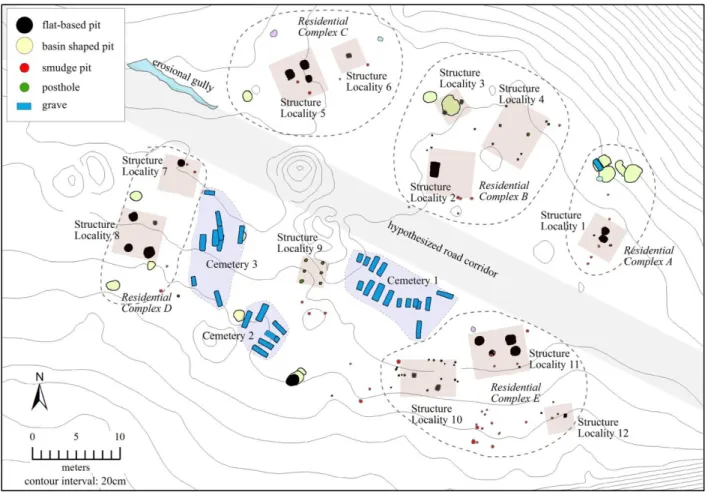
The spatial arrangement of the archaeological features at Ayers Town — 165, or roughly 86%, of which are thought to be associated with a single historic Catawba occupation event — suggests a modest village comprised of five complexes of 12 total structural localities (Figure 5). In terms of distance between localities, structures at Ayers Town were much more tightly concentrated than those at Old Town. Three cemeteries (Cemeteries 1, 2, and 3) are located between two of the complexes
Figure 5. Plan of Ayers Town with interpretation. Adapted from Davis et al. 2015: Figure 5.11.
but that at least part of it has been obliterated by intensive activity over subsequent centuries (Davis et al. 2015).
Residential Complex A includes only a single probable cabin seat, Locality 1 (Figure 5). It consists of two spatially associated flat-based storage pits (Features 3 and 4), six probable borrow pits (Features 89-92; 124), a number of postholes and cob-filled pits, and a probable grave (Figure 6) (Davis et al. 2015).
Locality 2 was originally raised; however, given the slightly later mean ceramic date from this context, Cranford (2018) has hypothesized that this shallow pit may simply be
a symptom of the cabin’s relative novelty, and may simply have undergone fewer rejuvenation events (in which stale soil may have been “dug out,” deepening the pit).
Localities 3 and 4 may be ancillary to the Locality 2 structure: Locality 3 is denoted by two small flat-based pits and two basin-shaped probable borrow pits (Features 72 and 73), one of which (Feature 72) intrudes the flat-based features and apparently postdates them; Locality 4 consists solely of postholes and cob-filled pits (Figure 6). Locality 4 may represent a post-in-ground shed (Davis et al. 2015) or an open air shelter (Cranford 2018).
Residential Complex C includes Localities 5 and 6 (Figure 5). Locality 5 is defined by three flat-based pits (Features 106-108), a probable borrow pit, and a probable clay processing pit. Locality 6 includes a flat-based pit, a cob-filled pit, and a probable hearth (Figure 6) (Davis et al. 2015).
Residential Complex D encompasses Localities 7 and 8, and possibly Locality 9 as well (Figure 5). Locality 7 is centered on a circular, flat-based pit (Feature 5), and
includes cob-filled pits and one likely grave. Locality 8 is associated with four flat-based pits (Features 33, 69, 116, and 123), two probable borrow pits, and a few cob-filled pits. A cemetery (Cemetery 3), comprised of nine graves, is likely also associated with
Locality 8 (Figure 6) (Davis et al. 2015). Locality 9 is comprised of postholes and cob-filled pits. Cranford (2018), citing ethnohistorical evidence, suggests that this structure may represent an elevated corncrib.
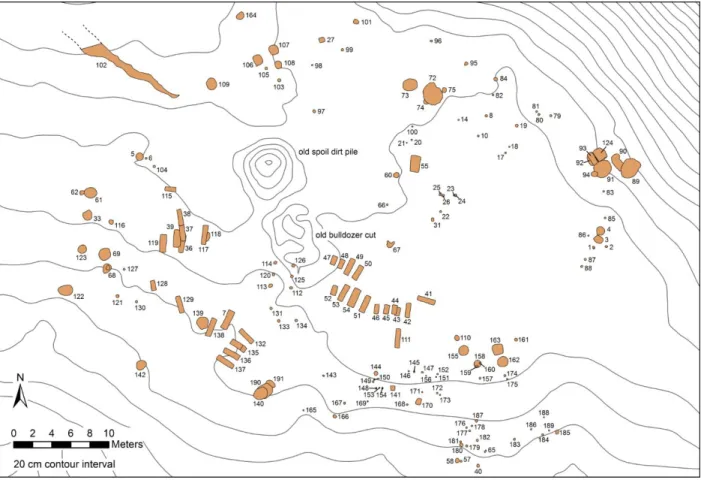
Figure 6. Site map of Ayers Town indicating locations of features. Adapted from Davis et al. 2015: Figure 5.1.
The presumed subfloor flat-based pit features of Localities 3, 6, 10, and 12 are small, and consequently may indicate that the structures they represent were
functionally distinct from posited structures with larger, and grouped, cellars (presumed to be domiciles); the spatial relationships between the two types of flat-bottomed pits suggest that they were paired. Three probable borrow pits (Features 139, 190, and 191) are located between Complexes D and E and cannot be demonstrated to be affiliated with either. A large flat-based pit (Feature 140) which intrudes one of these borrow pits (Feature 190) has an interesting morphology, with flared vertical walls, and does not appear to be associated with a residential structure (Davis et al. 2015). This feature seems to have been filled in two events, apparently quite rapidly, and may be evidence of communal activities (Cranford 2018).
As with the other sites treated here, it is difficult to say with any certainty when Ayers Town was abandoned. The formal arrangement of graves in cemeteries raises the possibility that Catawbas returned to the site to bury their dead even after formal abandonment (Davis et al. 2015).
New Town (c.1790-1820)
Sited on a ridge overlooking the Catawba valley, New Town (RLA-SoC 632/635) represents a somewhat loose collection of eight discrete cabin loci linked by wagon roads and footpaths. Like Old Town, the site does not have a formal Smithsonian
location of New Town was not verified by on-site reconnaissance until 2002 (Davis and Riggs 2005, 2006). Between that year and 2005, seven cabin loci were identified and archaeologically investigated by the RLA, with an additional (eighth) locus identified in 2012 (Figure 7). Each of these loci is comprised of the remains of one or more cribbed log structures, associated outparcels, and discard patterns represented by both discrete middens and peripheral scatters. The number, arrangement, and apparent form of the cabins correspond well to historical accounts of the town. Because not all of the New Town site has been subject to plowing, features and surface deposits in some parts of the site — notably Loci 3 and 4 — are remarkably well preserved (Davis et al. 2015).
Locus 1 was not extensively investigated, but was sampled by metal detection and surface collection (Davis and Riggs, 2005; 2006). Loci 2 and 3, however, were partially excavated during the 2003 field season. Locus 2 seems to have been spared intensive plowing on account of its rocky soil; it was found to contain a square cellar pit (Feature 1), a floor-level chimney base (Feature 2), and a small pit (Feature 3) (Figure 8). Feature 1 preserved a fairly rich assemblage, including “numerous Catawba-made sherds,
several polishing pebbles, pearlware and lead-glazed earthenware sherds, Catawba pipe fragments, several large iron objects, a wine bottle base, a 1793 French two-sol coin, glass beads, and a sheet-iron container lid” (RLA 2019a). The tops of features at Locus 3 were extremely close to the ground surface, but were remarkably intact. An irregular-shaped basin feature, likely a soil borrow pit (Feature 5), two rectangular possible cellar pits (Features 4 and 6), and a third pit feature, also rectangular (Feature 7), were noted (Figure 9). Feature 5 was found to contain large quantities of Catawba pottery, while
6 also yielded a small, unbroken Catawba-made bottle and a simple Catawba cup” (RLA
2019b). Nearby, two additional features (Features 8 and 9) were uncovered; Feature 8 was the base of a stick-and-clay chimney, while Feature 9 was an infilled tree
disturbance. Another adjacent area yielded a thin deposit of highly fired sherds from apparently unfinished vessels; this assemblage may represent a dump for wasters, or fragments of failed ceramics. An offsite dump, 35-40 m southwest of Locus 3, is also noted; it contained numerous iron artifacts including “a lockplate from a flintlock
pistol...snaffle bit[s], a harness buckle, a pistol barrel and frizzen, a worn-out shovel blade, and...unidentified iron object[s]” (RLA 2019b).
Locus 4 was extensively excavated during the 2004 field season, and Locus 5 was excavated in 2004 and 2005. Locus 4 consisted of two cabin seats, thought to be two occupation events by the same household, each with a preserved stick-and-clay chimney base (Features 1 and 2) (Figure 10). These bases elevated the hearth surface to a specific level above the ground surface, suggesting that the two cabins had raised wooden floors. Broken pottery was found to have accumulated in elliptical rings around the cabin site (likely as the result of sweeping refuse away from the yards and walkways) and around chimney bases and corner blocks. Broken glass occurred largely away from the cabins in peripheral dumps, and a number of large iron objects were even further removed,
downslope. Both Catawba and Euroamerican ceramics, as well as “glass bottle
fragments, Catawba pipes, metal buttons, glass beads and other jewelry, table cutlery, harness hardware, agricultural equipment, gunparts and ammunition, and numerous
two shallow midden deposits (Features 7 and 8), a deposit of ash and hearth cleanings (Feature 9), a tree tip-up filled with large Catawba vessel portions (Feature 11), and a probable exterior hearth of prepared clay (Feature 12) (Figure 11). Pearlware sherds recovered beneath the chimney basal deposit suggest that the cabin site was occupied prior to the completion of the wooden floor. Locus 5 yielded similar artifact types to Locus 4 (Davis and Riggs 2006).
Loci 6 and 7 were partially excavated during the 2005 season. Locus 6 was somewhat more disturbed than the other loci, having been subject to surface grading associated with logging operations in 1969 over approximately half of its surface area, but fortunately this disturbance was not deep. It consisted of a chimney base and hearth surface (Feature 12) which was considerably less elevated than those of Loci 4 and 5, and indicating that the presumed cabin associated with this hearth had an earthen floor (Figure 12). An interesting artifact distribution pattern, with a high-density periphery surrounding a low-density core, may represent an as yet undefined structure.
Additionally, a proximal quartz outcrop was covered by an approximately 20 m² deposit of hearth debris, from which refuse associated with food production, such as eggshell and fish bone, was recovered. Locus 7, also slightly disturbed by 1969 logging activities, represents a small cluster of domestic debris. Though soils at this locus proved relatively deep, no features are noted. Artifacts recovered include both Catawba and
Euroamerican ceramics and metal objects (Davis and Riggs 2006). Locus 8 is a probable cabin seat consisting only of a handful of artifacts (Davis, personal communication, 2018).
Figure 8. Plan of New Town Locus 2 showing excavations and features. Courtesy of the Research Laboratories of Archaeology, University of North Carolina, Chapel Hill.
Figure 12. Plan of New Town Locus 6 showing excavations and features. Courtesy of the Research Laboratories of Archaeology, University of North Carolina, Chapel Hill.
each cabin locus associated with horse and wagon utilization underscores the significance of mobility to the Catawba, while a clear decrease in firearms-related materials reflects a decline in the centrality of both warfare and hunting (Davis et al. 2015). Catawba dress utilized mass-produced commodities, such as buttons, beads, and sheet brass and silver, in distinctive ways. Davis et al. (2015) argue that this adornment appears to have been a conscious assertion of difference on the part of the Catawba from Euro-Americans, from enslaved blacks, and from other regional Native Americans, whose perceived assimilation into Euro-American lifeways the Catawba may have feared because of its potential to diminish their authority in the eyes of whites. For the
“Indians” from whites (and blacks), may have seemed the safe bet, as the breakdown of difference might have called the relevance and autonomy of the Nation into question.
Cabin Loci 4 and 5 — the most extensively investigated of the New Town loci —
appear to fit physician and statesman Calvin Jones’ 1815 description of the homes of
prominent Catawba Sally New River and Jacob Ayers in terms of their spatial relationship to the rest of the village and in the archaeological evidence that the structures associated with these loci once had wood floors (Davis and Riggs 2004).
Jacob Ayers (variously spelled “Ayres” or “Ears”) was a veteran of the American
Revolution, having served under General Thomas Sumter with a Catawba contingent; after the war, he championed Catawba land rights, joining other notable Catawba in
petitioning “state and sometimes federal officials to keep out trespassers, reinstate the Indians’ right to appoint their own agents, and reform the system of leasing land to
whites that Catawbas had devised in an effort to make a living while controlling
settlement of their lands” (Merrell 2000). His efforts, though valiant, failed to stem the
tide of Euro-American encroachment on Catawba territory — or to prevent the formal surrender of the entire reservation by the Treaty of Nations Ford in 1840, four years
after his death (Merrell 2000). Uniquely, Sally New River’s matrilineal kinship through
her mother and grandmother, and her status as a descendent of King Haigler, gave her a charismatic genealogy by both Catawba and Euro-American reckoning, respectively. Her later marriage to General New River further consolidated her authority through the binding of two disparate Catawba lineages. Documentary evidence suggests that she relocated her household from Old Town to New Town in either 1790 or 1791. In 1796,
inheritance of the land by Catawba descendents within Euro-American legal framework (Bauer 2016:57).
Both the archaeological and historic evidence point to New Town’s abandonment
CHAPTER III
METHODOLOGY
This chapter addresses the methods used to gather and analyze the data utilized in the thesis. The project was concerned primarily with two dimensions of
Euroamerican ceramics from late eighteenth and early nineteenth century Catawba sites: (1) vessel form, from which trends in probable use of non-Catawba-made ceramics by Catawba can be extrapolated; and (2) ware type, which can provide a means to assess the relative uniformity or heterogeneity of an assemblage in addition to helping to date the assemblage. Euroamerican ceramic assemblages from Old Town, Ayers Town, and New Town, with only a handful of exceptions, consisted of small fragments or
“potsherds” rather than complete or largely complete vessels. As such, determinations of
vessel form (the category of shape a vessel belongs to) and ware type (groups of vessels with similar paste compositions, firing temperatures, glazes, and decorations) had to be made based on incomplete evidence. The following two sections are intended to provide descriptions of each vessel form and ware type, and of the sherd characteristics used to assign both.
Attribution of Vessel Forms
decoration, condition, and crossmends. In some cases, information about vessel form was also recorded. The balance of identifiable forms were established for this project. The most common identifiable Euroamerican vessel forms identified at the three Catawba sites were bowls, plates, and teawares. The latter category includes vessels
identified as “cups,” “teacups,” “teabowls,” and “saucers,” but excludes the small number of sherds from vessels identified as “teapots.” The latter are treated as hollow forms because their forms and functions, generally speaking, are more akin to other hollow serving vessels than to other teawares, which are vessels for the individual consumption of beverages and sauces. The nonspecific category of “teawares” was settled on because these vessels are often difficult to distinguish from one another at the sherd level. Other vessel forms represented in the sherd assemblages include pitchers, mugs and tankards, bottles, jugs, punchbowls, creamers, drug jars, and teapots.
Assignment of a vessel form to a sherd — particularly when considering material produced and decorated largely by hand — is necessarily an inexact science, and, as such, estimates were conservative. When forms could be identified, determination was made based on several factors in conjunction, rather than any single factor. Often, formal determination was restricted to simple differentiation between hollow forms (i.e., containers) and flat forms (i.e., platters). However, as the relative proportions of hollow and flat wares may allow us to identify broad trends in Catawba Euroamerican ceramic acquisition and use in the late eighteenth and early nineteenth centuries, such distinctions, though relatively coarse-grained on an analytical level, were warranted.
the forms of those vessels. In one case from New Town (discussed in Chapter 4), sherds from at least two distinct but virtually identical vessels were all assigned the same form. Vessel forms are roughly divided into hollow (consisting of bowls, pitchers, teapots, creamers, other non-platter serving forms, bottles, tankards and mugs, drug jars, punchbowls, chamber pots, and jugs), flat (consisting of plates, and unidentified flat forms), and teawares (consisting of cups, teacups, teabowls, and saucers).
Hollow Forms
Fragments for which no specific form could be identified, but which were
determined to represent hollow forms, were recorded as “hollowware.” “Large hollowwares” include substantial serving forms, chamber pots, and similar vessels; these were differentiated largely by sherd thickness and by the robusticity of their features — as, for example, in a few cases of exceptionally large footrings and rolled
rims. “Vertical hollowwares” were identified primarily from their bases, which tended to have substantial footrings, often square in profile, and vertically or near-vertically ascending, rather than outward-flaring, walls. These likely represent either mugs or tankards — treated by this study as a single category owing to the problems associated with differentiating them at the sherd level — or pitchers. A small number of spouts diagnostic of the latter form were noted.
When curved sherds were decorated only on one side, they were attributed to hollowwares if the decoration was observed on the exterior. Refined earthenware
produced in exclusively hollow forms; consequently, all annular ware sherds were
recorded as “hollowware” unless a more specific form could be identified. Curved
fragments displaying both interior and exterior decoration were classified as “bowls” if
they were too robust to be teawares. Fragments with rims that curved perceptibly both vertically and horizontally, and annular ware sherds with slip-decorated interiors, could safely be said to represent bowls.
Flat Forms
The vast majority of flatware identified from the Catawba Euroamerican assemblages were attributed to “plates,” by which is meant personal flat tableware
including semi-hollow soup plates but excluding saucers (which were categorized with
teawares). Exceptions likely represent sturdier flat serving dishes or (in the case of coarse or tin-glazed earthenwares) possibly flat-bottomed cookwares such as pans. In many cases, flat sections described as plates exhibited signs of use wear (cut marks) on one side. Basal portions with recessed bases but lacking defined footrings (so that the vessel rested on the body itself) or with a footring too shallow to support the curvature of a bowl or other hollow form based on the estimated diameter, were recorded as plates. Rim sherds with thickened lips, bell-shaped in cross-section (of a type frequently associated with creamware plates) and flat scalloped edges were considered diagnostic of plates, as were sharply everted shoulders (marlys) at the juncture between the bowl and the rim. In the case of decorated wares, curved sections were called “plates” when
was too robust to be a saucer, and in conjunction with at least one additional factor, such as a recessed base.
Teawares
As noted above, for the purposes of this thesis the category of “teawares” includes
cups, teacups, teabowls, and saucers. These forms are difficult to distinguish at the sherd level, particularly the first three, since teabowls are only slightly larger than
teacups, and use of the terms “cup” and “teacup” in the artifact catalogue was found to reflect variation in the preferences of different observers more than concrete typological variation. Sherds described as belonging to cups, teacups, and teabowls displayed many of the same characteristics as bowls, but were finer-bodied and more deeply curved (indicative of their smaller size). Saucers, although they ostensibly have more affinity to flat rather than hollow forms, are included in this category due to their delicate
proportions, which flag them as objects of individual rather than communal use, and because late eighteenth and early nineteenth century saucer rims tend to resemble bowl rims more closely than they do plate rims. Historically, saucers served a number of uses, including as personal containers for condiments, and the shallow bowl form may be related to one or more of these (Beaudry et al. 1983:34). As a rule, curved sherds of teaware proportions that featured decoration on the interior but not the exterior were
characterized as “saucers.”
seem to be borne out in the documentary evidence. For the purposes of this thesis,
“teaware” should be understood simply as a formal class of delicate, personal ceramics.
It should be noted that teapots are considered hollowwares rather than teawares throughout this thesis because teapots are likely to have had quite a different range of uses from that of cups, teacups, teabowls, and saucers, one more comparable to that of other serving forms such as pitchers.
Discussion of Ware Types
This section offers brief discussions of the identified Euroamerican ware types from the Catawba sites of Old Town, Ayers Town, and New Town. For the most part, types had been established where possible prior to my work with the material by Steve Davis, Brett Riggs, Mark Plane, and David Cranford. Here, I include descriptions of the various types along with date ranges, common vessel forms, and historical context.
The date ranges given in this section are the basis for the mean ceramic dates established for the Euroamerican assemblages at Old Town, Ayers Town, and New Town. The dates for each ware type represent the most recent published information available, and sources are cited appropriately. Mean ceramic dating, a technique credited to Stanley South (1977:201-236), assigns date ranges to specific ware types based on documentary or archaeological evidence of their development or introduction into a certain context and their falling out of use. Using these ranges, the method
sherds, a mean ceramic date for the assemblage can be found (Davis et al. 2015:199-200).
The types are grouped into three broad categories: earthenwares (coarse and refined), nonvitreous pottery fired at relatively low (<1200℃) temperatures;
stonewares, a category of wares fired at temperatures high enough (>1200℃) to vitrify and become nonporous; and porcelain, a type of translucent vitreous ceramic also fired at high temperatures (1200-1400℃) that commonly utilizes kaolin clay in the paste.
Earthenwares
Both coarse and refined earthenwares comprised part of the Euroamerican
ceramic assemblage from the three Catawba sites, with refined earthenwares accounting for by far the most significant share. The following are brief descriptions of the ware types encountered at Old Town, Ayers Town, and New Town, along with date ranges and, whenever possible, economic scaling information, presented in roughly
chronological order.
Staffordshire-type slipwares, often called “North Midlands-type” to better reflect
Tin-glazed earthenwares, descended from fourteenth century Spanish and Italian
maiolica, became the cornerstone of crucial and long-lived British, Dutch, and French ceramics industries from the sixteenth century onward. Their distinctive thick glazes —
which tend to separate from their pastes in archaeological contexts, resulting in a well-weathered body and chunky surface patches which make identification fairly
straightforward — were achieved by applying a mixture of sand, potash, and lead and tin oxides to biscuit wares and painting over the glaze before firing the vessel to completion (Poole 1995:10). At least three varieties of tin-glazed earthenwares were encountered on these late eighteenth and early nineteenth century Catawba sites. The first, Rouen faïence, is a French-made red-bodied ware, which commonly features brown exterior and white interior glazes. Forms are, for the most part, utilitarian; cookwares, storage jars, pans, and robust dishes and bowls are typical. Rouen faïence seems to have a
particularly brief currency on American sites, generally occurring only in contexts dating between 1775 and 1780 (Noël Hume 1969:141-142). English and Dutch delftwares were significantly longer lived: the blue and polychrome hand-painted sherds from Ayers Town, which likely represent small hollow forms such as bowls, cups, or small jars, could date anywhere from around 1600 to 1802 (Davis et al. 2015:195-196).
Undecorated delftware ointment or drug pots, which seem to account for most if not all of the remaining tin-glazed sherds, date from c. 1650 to 1830, depending on vessel form. Such wares held compounds from salves to cosmetics and are common on eighteenth century sites (Noël Hume 1969:203-205).
“true” Jackfield — and most imitators are purple- to grey-bodied, although Staffordshire examples made by Whieldon are notably red-bodied (Noël Hume 1969:123).
“Philadelphia redware” refers to a number of American coarse earthenwares
made in and distributed from various centers such as Philadelphia and Alexandria, Virginia. Though these tend to be cookwares and other utilitarian forms, attempts were
made to challenge Staffordshire’s hegemony in tablewares in the second half of the
eighteenth century, albeit without much success. Philadelphia-type wares tended to be dark-bodied, occasionally with slipped decoration, and with clear lead glaze.
Philadelphia appears to have been established as the premier American earthenware industry by about 1750, and coarse redware vessels of the type recovered from Old Town seem to have largely given way to black-glazed refined wares for table use and new products such as portable furnaces by c.1830 (Myers 1977).
“Clouded” and “tortoiseshell” wares belong to a group of colorful, cream-bodied
refined earthenwares more generally known as “Whieldon wares” after master potter
Thomas Whieldon, though they were manufactured by a number of makers. They are readily distinguished by their patches of sponged, often hazy purple, blue, brown,
yellow, green, and grey underglaze decoration. “Clouded” and “tortoiseshell” wares were
made in both hollow and flat forms, and date from around 1750 to 1775 (Noël Hume 1969:123-124). Green-glazed earthenware, another variation of this refined cream-bodied ware, was perfected by Wedgwood in 1759, although similar wares predate this development slightly; it appears to have largely fallen out of fashion by 1775 (Noël Hume 1969:124; Barker and Halfpenny 1990:63). To this porous category can also be added
c.1780. It is commonly brown or green glazed, and more or less faithfully replicates (largely mold-made) English flat and hollow forms (South 2004).
Creamware, initially called “Queen’s Ware,” is ubiquitous on mid- to late-eighteenth and early nineteenth century sites. Though it represents more-or-less a development of techniques from the first half of the eighteenth century, creamware was officially invented by Josiah Wedgwood in 1762; by the late 1790s its vogue had ceased, and thereafter it became the cheapest British ware type available in the United States (Noël Hume 1969:124-125; Miller 1991). Nonetheless, it seems to have enjoyed
considerable popularity until about 1820 (J. Eric Deetz, personal communication 2016). Both flat and hollow forms, including teawares, bowls, and creamers and other serving forms, in addition to indeterminate hollowwares, are represented at Old Town, Ayers Town, and New Town. Creamware plates from all three Catawba sites were largely
undecorated and featured plain rims with slightly thickened edges, though a few isolated examples have pearlware-style scalloped edges or overglaze bat transfer printing
(achieved by applying linseed oil to an engraved copper plate, then transferring the design to the glaze via a thin sheet of flexible animal glue and firing it together with metallic oxide for color) (Poole 1995:9).
Pearlwares account for both the largest share of Euroamerican ceramics recovered from late eighteenth and early nineteenth century Catawba sites and the
widest variety in terms of ware type. The modern category of “pearlware” denotes a
group of similar products, such as “china glaze” and “pearl white,” produced by a variety
and the rise of later “whitewares” (which have less of a blue tinge than pearlwares) but intersects with both in intricate ways (South 1977:212). Partly owing to these
complexities, it is useful to consider prominent modes of decoration — all loosely
classified as “pearlware” — independently.
Shell-edged sherds from the three Catawba assemblages overwhelmingly represent plates or unidentified flat forms, though isolated examples of shell-edged hollow forms were noted. These wares are readily distinguishable by their blue or green edges, which are impressed with straight or curved lines and formed into undulating, scalloped designs. They were common from about 1780 to 1835. Additionally, a very small number of scalloped rims were embossed with more intricate designs; this latter type dates only from the end of the scalloped rim period, c.1820 to 1835 (Miller et al. 2000:12). Price fixing agreements made by Staffordshire potters demonstrate that, by the 1790s, shell-edged pearlwares were among the cheapest decorated wares available (Miller 1980:3-4). An array of hand-painted pearlwares dominate the New Town assemblage in particular. These include monochrome blue (popular c.1775-1830) and floral polychrome (c.1795-1815), almost exclusively hollow forms and teawares, along with transfer-printed examples (1783-c.1830) in both hollow and flat forms (Miller et al. 2000:13). The latter type was produced by rubbing ceramic color designs on damp tissue paper onto unglazed biscuit wares before removing the tissue, firing, then glazing and firing to completion. It underwent significant development in content and
composition throughout the period of its use, and some trends are worth noting for their usefulness in assigning date ranges (Poole 1995:11). Chinese print patterns were
sometimes called “clews” type, were printed from 1819 onwards, as were pastoral
scenes. British views were printed from 1813 to the end of the period (Samford 1997: 6, 20). Transfer-printed pearlwares of all patterns exceeded all but the most luxuriant hand-painted wares in price; according to Miller, in the 1790s printed wares were three to five times the price of undecorated creamware. For their part, hand-painted wares featuring simple, easily replicated motifs — of the type commonly found on late
eighteenth and early nineteenth century sites and well-represented among the Catawba Euroamerican assemblage — seem to have been more expensive than simple shell-edged wares (Miller 1980:4).
Engine-turned or “annular” wares are a variation of both pearlware and
creamware (but most usefully described independently of either for dating purposes) encountered with some frequency among Euroamerican ceramics from these sites (particularly New Town). These are exclusively hollow forms — bowls, jugs, pitchers, mugs and tankards — and exhibit a variety of decorative schemes, including slip
marbling, dendritic or “mocha” designs, slip banding, or checked, swaged, or dashed cut slips, all often in conjunction with blue or green rilled rims or rouletted bands in
geometric patterns. Variegated or slip marbled surfaces were achieved through the application of different colored slips onto the leatherhard body while turning the vessel. Gravity, the motion of the lathe, the moisture content of the body, and the action of the
potter’s quill or combs all affected the appearance of the surface, and designs varied
from “frog’s eggs” splotches of slip to elaborately swirled and naturalistic patterns intended to emulate stones such as marble and porphyry. Variegated wares were in fashion from about 1775 to 1810. “Mocha” designs were produced by brushing a solution
slip as the vessel turned on the lathe; the resulting pattern was compared to fractured moss agate. These dendritic wares were fairly long-lived, with production commencing around 1790 and continuing well into the twentieth century (Rickard 2006). In general,
however, “annular” wares tend to occur in Euroamerican assemblages from between 1790 and 1820 (South 1977). Like shell-edged pearlware, these annular wares were among the least expensive decorated vessels available in the late eighteenth and nineteenth centuries (Miller 1980:3-4).
Stonewares
Stonewares, though far rarer than earthenwares at all three Catawba sites, were nonetheless noted. Apart from two Rhenish fragments at Ayers Town, this group appears to consist entirely of British-made wares; they are presented here, again in roughly chronological order.
Westerwald is a grey-bodied stoneware that was produced in quantity all along the Rhine river valley beginning in the eighteenth century. A development on an older Rhenish industry of relief-molded cobalt and manganese accented stonewares,
Westerwald is most closely associated with the “krug” form, a globular bodied, brown manganese-painted, reeded-necked jug with stamped and incised blue-outlined
decoration arranged around a central relief-molded medallion, commonly (in examples made for the British market) the cipher of the reigning English monarch. These date from roughly 1700 to 1775 (Noël Hume 1969:284-285).
Dwight (though infringements on Dwight’s intellectual property seem to have been
endemic) (Noël Hume 1969:112-113). Fulham-type stoneware is most closely associated with bottles, pitchers, tankards, and mugs. Body color ranges from grey to white; the salt-glazed surfaces appear distinctively “pockmarked,” and some later examples feature
sprigged designs (Noël Hume 1969:111-114). The tops of vessels (and occasionally the whole vessel) were coated with a brown slip before glazing, sometimes in conjunction with a white slip on the lower portion (MAC Lab 2015a). British brown stonewares on American sites probably date between 1671 and 1775 (Oswald et al. 1982:24).
Nottingham-type stonewares, dated examples of which suggest a range of 1700 to 1799, are typically encountered as personal hollow forms such as tankards and mugs, bowls, and cups, as well as pitchers. They are gray bodied, with a smooth, glossy brown surface which gives the appearance of burnished metal. Nottingham stoneware sherds can be readily distinguished from the similar Burslem stoneware by a diagnostic white slip between the paste and glaze (Noël Hume 1969:114).
A refined dry-bodied redware, called “rosso antico” by Josiah Wedgwood, entered production in about 1750 in Staffordshire. A polished version of the similar “red
porcelain” current in the late seventeenth and early eighteenth century, it is frequently unglazed, though lead-glazed examples are not unheard of, and many feature sprigged
rococo motifs. According to Noël Hume, “rosso antico” and its variants are most
commonly encountered in the form of “teapots...usually copying silver shapes” (Noël
Hume 1969:120-121). Occurrence on American sites generally falls off after about 1780 (Barker and Halfpenny 1990:44-46).